On this page
- Check School Eligibility Before Comparing Loans
- Ask About the Exact Program
- Compare Every Funding Source Side by Side
- How to Read Each Row
- Add Up the Full Cost Before You Borrow
- Build the Full List
- Turn the Total Into Monthly Cash
- Match Your Loan to the Hours You Need
- What That Means for Borrowing
- Deferred vs Immediate Repayment Compared
- Why Income Timing Decides It
- Questions to Put to Every Lender
- How to Stage Borrowing Around Milestones
- The Seven Step Sequence
- Confirm Your Funding Plan Before You Enroll
You're probably staring at two numbers that don't match. One school quotes a tidy package price, another quotes an hourly rate, and neither tells you what you'll need in the bank each month from your first lesson until you're earning airline-level pay.
That's the wrong way to think about how to pay for flight school. Tuition is only the first line. Housing, exams, interest during training, retests, and the long stretch of hour building after your commercial certificate all pull cash out before strong pilot pay arrives. Treat financing as a timeline problem, not a loan shopping problem, and the traps get easier to spot.
Don't start by comparing monthly payments. Start by checking whether a program qualifies for the money you're counting on, add up the full cost, match the loan to the hours the FAA requires, and borrow in stages. If a plan can't survive a delay, it's not a plan yet.
Check School Eligibility Before Comparing Loans
The most expensive misunderstanding is assuming that an FAA approved school automatically qualifies for federal student aid. It doesn't. FAA certification and federal aid eligibility are separate systems, and confusing them can leave you enrolled with no funding behind you.
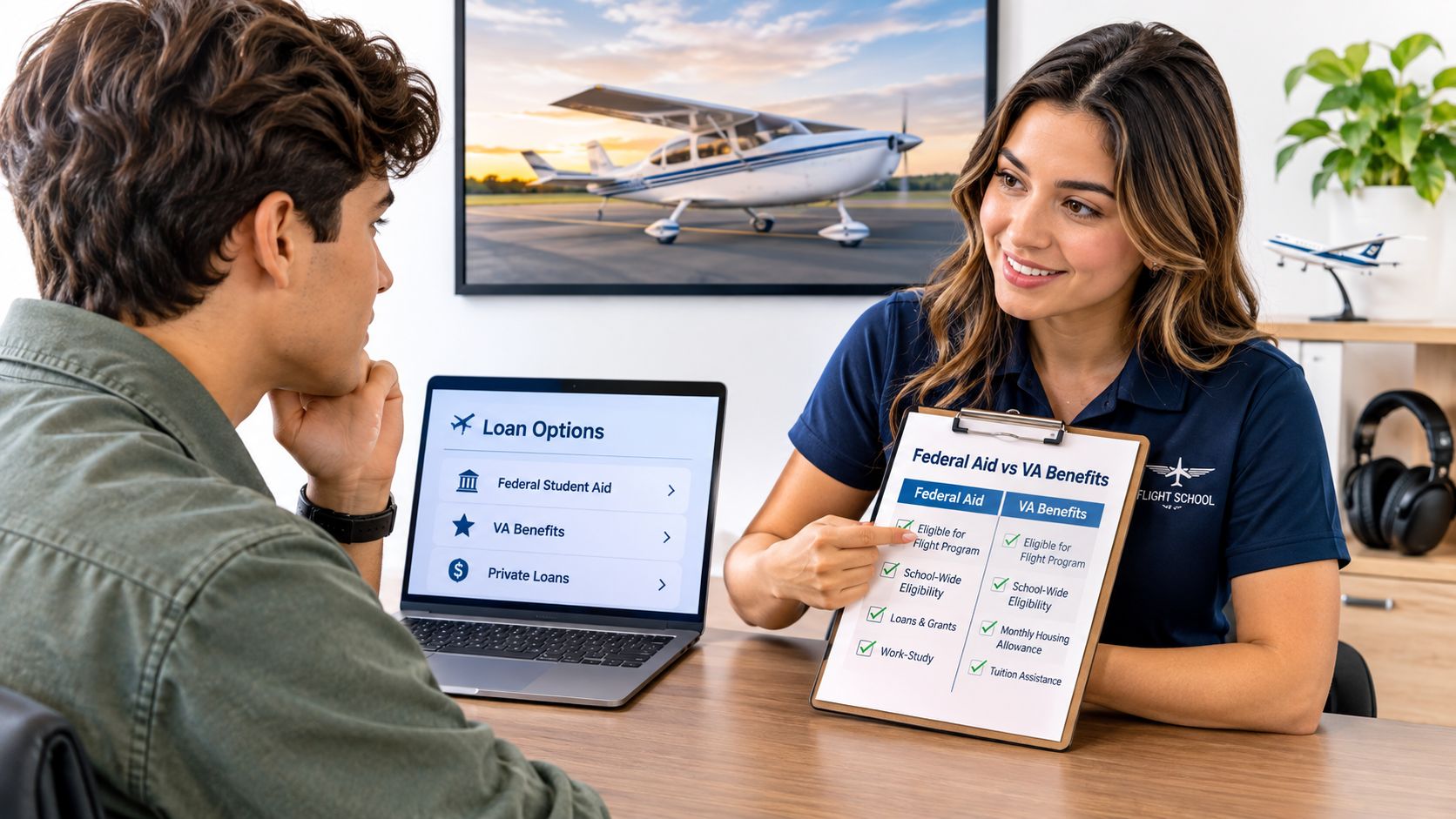
Federal aid generally requires enrollment at an accredited institution that participates in Title IV programs and offers an eligible degree or certificate program, and standalone schools operating as FAA Part 61 or Part 141 providers without Title IV status may not let students use Pell Grants or federal Direct Loans for ordinary private, instrument, commercial, CFI, or CFII training, according to Credible's guide to flight school loans. A college based aviation program is different because flight training sits inside an approved academic program.
Ask About the Exact Program
Use this one line test on any school. Is this specific program eligible, or only the institution? Get the answer in writing before you build a budget around FAFSA money.
Veterans have a second route worth checking early. VA benefits, including the Post-9/11 GI Bill and Montgomery GI Bill, can apply at VA approved flight schools and collegiate aviation programs. If that might be you, review the rules for flight schools that accept the GI Bill before you assume a benefit covers a particular certificate.
- Accreditation: Confirm who accredits the institution and whether that status is current.
- Title IV participation: Confirm the school participates, in writing, not from a sales call.
- Program status: Confirm the exact flight program, not just the college, is eligible.
- VA approval: Confirm VA approval for the program you will enter.
Don't treat federal aid as part of your funding plan until the school confirms program eligibility in writing.
If the answer is no, don't panic and don't sign anyway. Your plan then rests on private loans, savings, family help, scholarships, or employer benefits. That can work, but only if you price those options realistically.
Compare Every Funding Source Side by Side
Most career students don't pick one funding source. They stack two or three, such as savings for the private certificate, a scholarship for part of the instrument rating, and a staged loan for the rest. Read this table as a menu, not a ranking.
| Funding source | Best for | How repayment works | Main limit |
|---|---|---|---|
| Federal aid (Title IV) | Students in an eligible college based program | Federal loan terms set by the program | Only if this exact program is Title IV eligible |
| Private aviation loan | Students at standalone flight schools | Set by the lender; compare APR and capitalization | Interest may build during training; confirm the current rate, term, and fees in a written offer |
| School affiliated lender | Students enrolling in that school's program | Set by the lender; confirm deferral length in writing | Tied to one program; confirm the current rate, term, and prepayment rules in writing |
| Savings and family help | Students with cash or family support | No interest and no lender approval | Limits how fast training can move |
| Scholarships | Competitive applicants | Usually no repayment | Often partial; rarely covers the full gap |
| VA education benefits | Eligible veterans | Benefit does not need repayment | Program must be VA approved |
| Employer or sponsored training | Students with an employer commitment | Set by the signed sponsorship agreement, including any service obligation | Often requires a work commitment; confirm duration, repayment triggers, and exit terms in writing |
How to Read Each Row
Check federal aid first only if you're in a college-based route that qualifies. For standalone schools, a private aviation loan is the usual route. Compare APR, capitalization rules, cosigner liability, and prepayment penalties. The monthly payment alone tells you almost nothing.
School affiliated lenders are convenient, and convenience isn't a discount. Price Stratus alongside other private lenders, and compare its rate, term, deferral length, and prepayment rules only from written offers you receive. Don't fill those cells from a brochure or a verbal estimate.
Scholarships are worth chasing, but treat them as partial money. They're competitive and they rarely close the full gap, so use resources on commercial pilot training scholarships to build a list while keeping another source ready. An award that arrives late shouldn't be the reason training stops.
Stacking rule: Use grants, benefits, and savings first, then borrow only the documented remainder.
Say a student brings savings for early training and a veteran benefit for an approved stage. A scholarship then covers part of a later rating. The loan doesn't need to cover the whole pathway on day one, just the gap that remains after committed money is subtracted. That smaller, staged balance is easier to carry through the low income months ahead.
Add Up the Full Cost Before You Borrow
A student who borrows only for a private pilot certificate can run short before reaching the ratings needed for a flying career. AVweb reported that the median cost of a private pilot certificate was approximately $14,000, based on its report on the private certificate cost survey. Use that figure as an early-stage reference, not as the cost of an entire training path.
Your full cash need runs from the first lesson through the months when you are building experience and earning less. Add later training, living expenses, equipment, and borrowing costs before settling on a loan amount. The flight training cost breakdown can help you organize the estimate.
Build the Full List
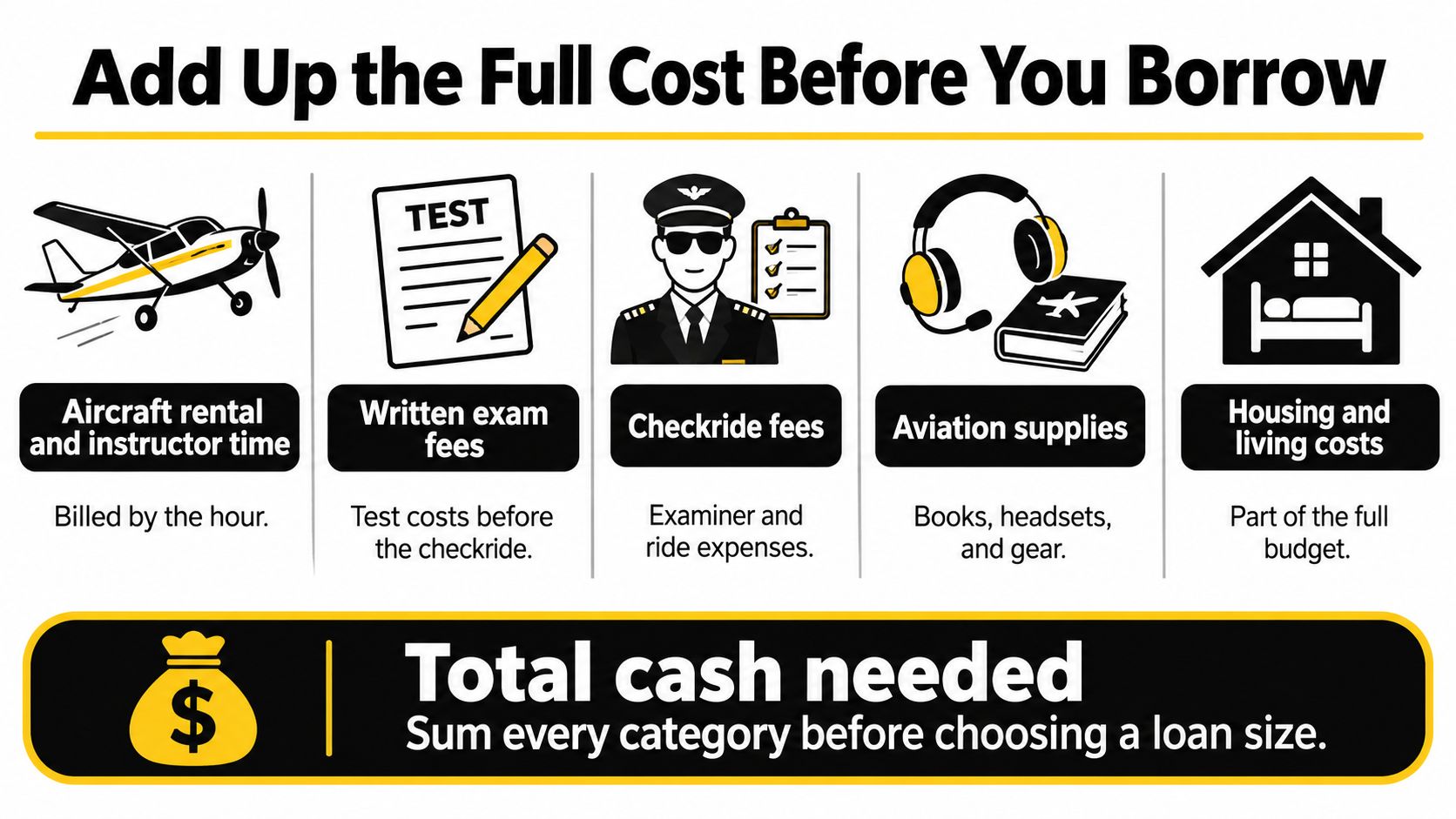
Get written estimates for every category before choosing how much to borrow. Include:
- Aircraft and instructor time: Hourly charges add up across training.
- Written exams and checkrides: Include test and examiner fees, plus aircraft time for the checkride.
- Medical certification: Budget for the exam and any renewals during training.
- Gear and supplies: Account for a headset, flight bag, books, charts, and electronic tools.
- Housing and living costs: Add rent, food, transport, insurance, and regular monthly bills.
- Interest and contingency: Include interest during deferment and a reserve for retests or weather delays.
The timing of your medical matters. A third-class FAA medical certificate from an aviation medical examiner is required before flying solo, but you can take a discovery flight and first lessons before obtaining one. Confirm you can hold the medical certificate required for your goal before borrowing for career training.
Turn the Total Into Monthly Cash
Divide the total cash need by the months you expect to train, then add monthly living costs. Compare that amount with income and savings you can count on. A plan that works only if every flight, exam, and checkride goes perfectly leaves no room for delays or extra training.
Weather can cancel flights, examiner availability can delay checkrides, and a failed checkride can require another training block. Keep enough room in your budget to handle those costs without taking out an emergency loan.
Match Your Loan to the Hours You Need
A loan that sounds large can still be too small if it ends at the wrong certificate. Match the money to the hours the FAA requires, not to a headline price or a per lesson rate.
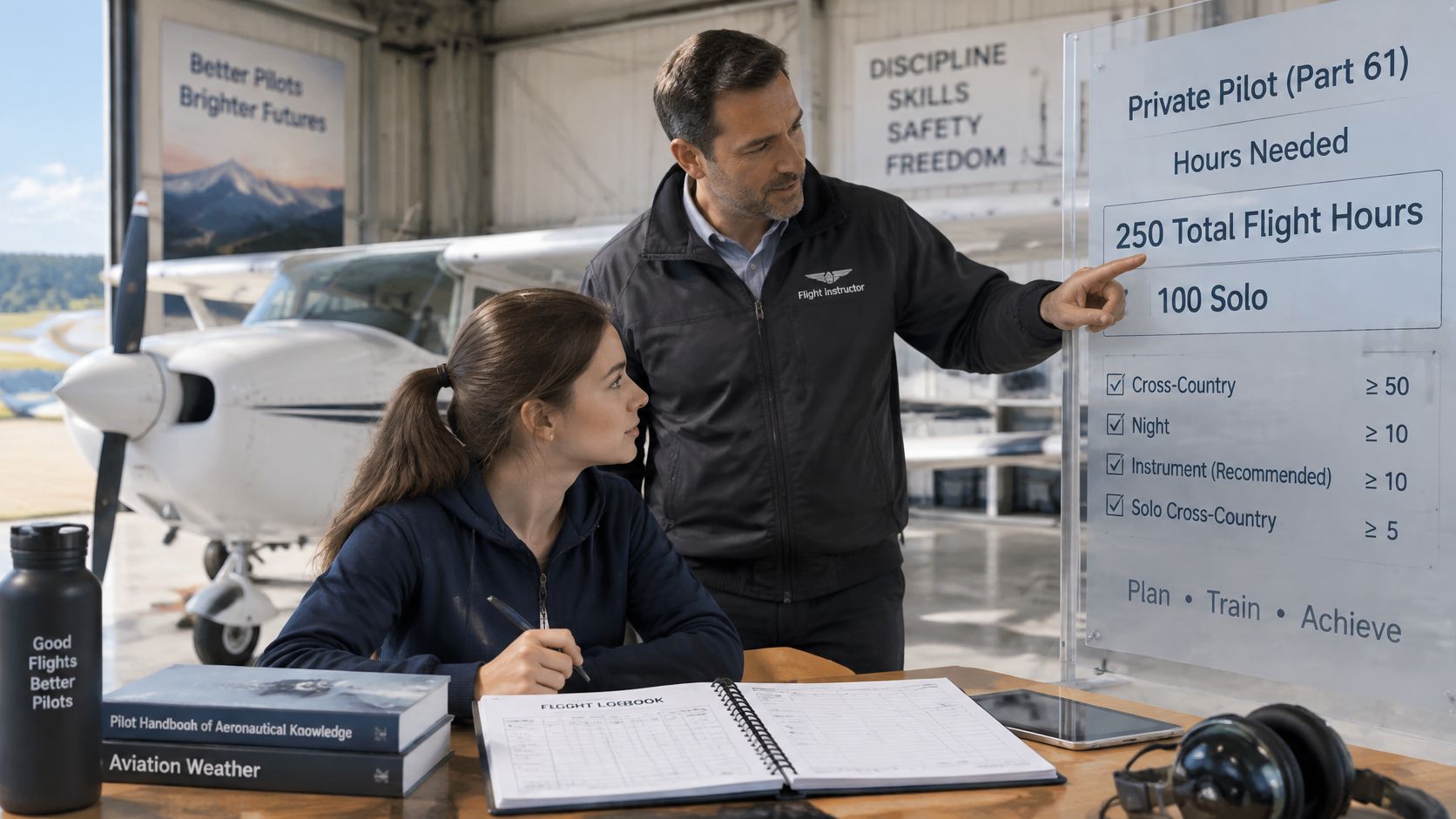
Under 14 CFR § 61.129, the standard single-engine commercial route requires at least 250 hours of flight time as a pilot, including at least 100 hours in powered aircraft, including 50 hours in airplanes, and at least 100 hours of pilot-in-command time. That regulation also requires 20 hours of commercial training, including instrument and complex or technically advanced airplane time.
| Certificate or route | Total hours | Key sub-minimums |
|---|---|---|
| Commercial pilot, single-engine (14 CFR 61.129) | 250 | 100 pilot-in-command; 50 PIC in airplanes; 50 PIC cross-country with 10 in airplanes; 20 hours commercial training including 10 instrument and 10 in a complex, turbine-powered or technically advanced airplane |
| Airline transport pilot (14 CFR 61.159) | 1,500 | 500 cross-country hours |
| Gap between the two routes | About 1,250 | Hours beyond the commercial minimum that a private-only budget leaves unfunded |
The airline gap is where many plans break. Under 14 CFR § 61.159, the ordinary airplane ATP pathway requires 1,500 total pilot hours and 500 cross-country hours. That leaves about 1,250 hours beyond the commercial minimum, usually built while instructing or in other entry level flying.
What That Means for Borrowing
- A private only plan stops short: It doesn't cover the experience needed for commercial eligibility.
- Payments may start before income does: Loan due dates don't wait for your first instructing paycheck.
- Hour building has a cost: Model housing, interest, and living expenses across that whole period.
Before you accept any quote, review the flight training requirements and ask three direct questions. Does this price end at private, commercial, or CFI? How many hours does it cover, and in what aircraft or simulator mix? What will you owe, in total and per month, if training takes 12 to 18 months instead of nine?
If a school can't answer those questions on paper, don't fill in the blanks with optimism. Borrow for the certificates and hours you need, or knowingly choose a shorter stage and reassess later.
Deferred vs Immediate Repayment Compared
One student has an instructing job lined up within months and enough savings to cover payments when deferral ends. Another has no job offer or cash reserve. Their repayment choices should differ.
| Factor | Immediate repayment | Deferred repayment |
|---|---|---|
| When payments begin | Soon after funds are released or in the first billing cycle | After the deferral period; check its length in writing |
| Interest during training | Accrues, but payments reduce the balance from the start | Accrues and may capitalize when deferral ends |
| Monthly cash need during training | Higher; needs income or savings now | Lower during training; higher once repayment starts |
| Risk if training stalls | Payments continue while progress pauses | Balance can grow if interest capitalizes |
| Best fit | Students with income or savings to cover payments | Students with a confirmed instructing or airline start date |
Why Income Timing Decides It
The U.S. Bureau of Labor Statistics reported a May 2024 median annual wage of $226,600 for airline pilots, copilots, and flight engineers, while commercial pilots had a median wage of $122,670, according to the BLS occupational outlook for airline and commercial pilots. The same outlook projected 4% employment growth from 2024 through 2034 and approximately 18,200 openings per year on average. These are long-run benchmarks, not starting salaries.
After a commercial checkride, you still need to build flight time and secure instructing or other entry-level work. Plan repayment around that lower-income period, not the airline wage you hope to earn later. Deferral suits a borrower with a credible near-term job and enough savings to handle payments once they begin. Without either, a growing balance can outlast the deferral period and add pressure before income catches up.
Questions to Put to Every Lender
- APR and capitalization: What's the rate, and when does unpaid interest get added to principal?
- Cosigner liability: Who owes the money if you can't pay, and can that person be released later?
- Prepayment rules: Can you pay early or extra without penalty?
- Deferral end date: Exactly when does the first full payment hit?
If credit concerns affect your options, review flight school financing with bad credit before applying broadly. A cosigner may help an application, but also makes someone else responsible for the debt if you cannot pay.
The lowest monthly payment is not the cheapest loan if its balance grows during the years you're building hours.
How to Stage Borrowing Around Milestones
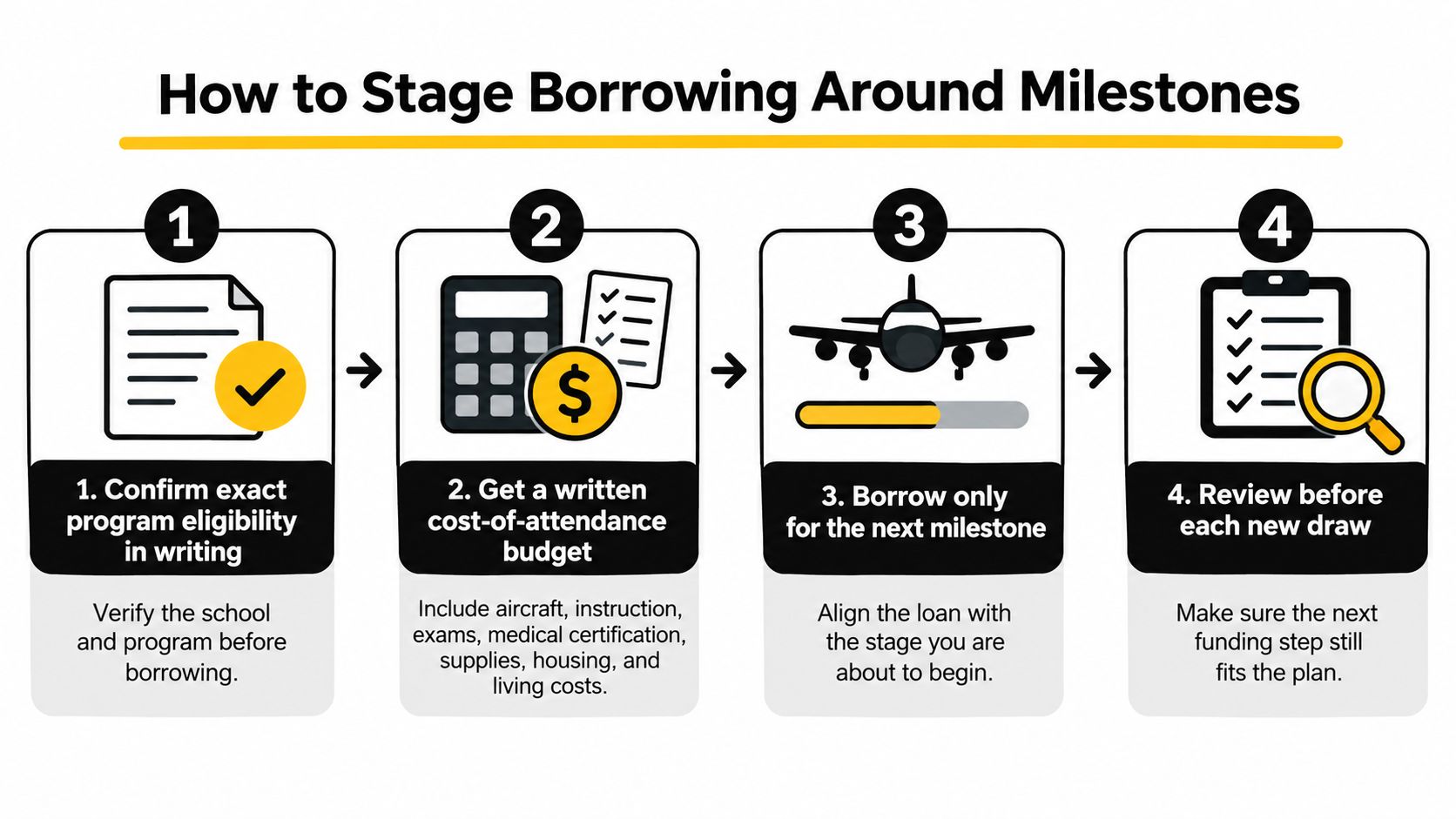
A checkride slips two weeks, and the examiner's next opening is in October. You may need more refresher flying, plus enough cash to cover the delay. Borrow in stages so a setback does not leave you paying interest on money you have not used.
The Seven Step Sequence
Use the eligibility answer from the previous section.
Build a written budget for the full training period. Include aircraft rental, instruction, exams, medical certification, supplies, housing, and living expenses. Separate costs already paid from upcoming costs so you borrow only for what remains.
Subtract committed funds. Count savings you plan to use, scholarships already awarded, confirmed family help, and benefits approved for the program. Leave hoped-for awards out of the calculation.
Borrow only the documented gap. If that gap is below the lender's maximum, request the smaller amount. A large approval does not mean you need to borrow it all.
Tie each draw to a milestone. Set funding stages around medical approval, private certificate completion, instrument progress, commercial completion, and a real instructor offer. If training stalls, you can pause before taking on the next portion of the debt.
Keep a reserve outside the loan. Set cash aside for retests, weather delays, scheduling interruptions, or medical follow-up. A reserve borrowed from the lender still accrues interest.
Reassess after each certificate. Compare spending, time to completion, and your progress with the plan. Decide whether the next stage still fits before borrowing more.
Before any deposit: Get refund terms, aircraft availability, instructor continuity, and examiner access in writing. Avoid a large nonrefundable payment until those terms work for you.
Before you continue past the commercial certificate, check whether current earnings or savings can cover the next payment without another loan. If not, reduce the next stage, save more, or slow down. The goal is to fund the entire route to airline-level pay, including the lower-paid time-building period, not just reach the next checkride.
Confirm Your Funding Plan Before You Enroll
A flight school's quoted price is only one point on the timeline. Your funding table should show how you will cover training, living costs, and the period before you can rely on pilot income. Use it as the final test: if the full timeline does not add up, do not enroll yet.
Ask every school, including CFII, the same questions: How old are the airplanes? How many students share each airplane? How often do instructors leave? Will the school provide the total price and exclusions in writing? Is training under Part 61 or Part 141? Can you fly before committing? Ask how many students finish within the quoted time, and how the school tracks that.
If you have never flown, a discovery flight lets you try a lesson before taking on a loan. If you are considering a full-time career pathway, review the Career Track and compare its fixed tuition with your funding table.
Before signing, visit the school, meet instructors, and check that the written price and training schedule fit your cash plan. CFII offers discovery flights and private pilot lessons from John Wayne Airport, as well as career training in Southern California. Choose a start date only when the table covers the entire path, not just the first payment.
Planning to fly for a living?
See what the path from zero to a pilot career looks like, what it costs and how long it takes.
Learn to fly in Riverside
We train at Riverside Municipal Airport in modern airplanes with a parachute built in. Start with a one hour discovery flight, no experience needed.