

On this page
- Financing Routes That Work With a Weak Credit File
- Why Lenders Decline Flight Students and What They Check
- What the lender is measuring
- A weaker application and a stronger one
- Cosigners Offer Real Help With Real Liability
- Get the answers in writing
- Budgeting the Full Cost Before You Borrow
- Loan Payments, Total Repayment and Deferral Traps
- Deferral and variable-rate exposure
- How to Apply in the Right Order
- Choose Your Financing Path and First Step
- If a Lender Says No
The most popular advice for flight school financing with bad credit is to add a cosigner. That can help, but it isn't a complete plan: the cosigner takes on real legal responsibility, and the loan may still leave you short on cash while you train. The better finish line isn't approval. It's a funding plan you can repay, manage month to month, and adapt if training takes longer than expected.
Financing Routes That Work With a Weak Credit File
| Route | How credit is judged | Realistic with bad credit? | Main risk |
|---|---|---|---|
| Private flight-school loan, applicant alone | Full underwriting, including minimum score and debt-to-income | Possible, but may be denied or priced high | A variable rate can rise; interest may accrue during deferral |
| Private flight-school loan with cosigner | Cosigner's credit and income are reviewed too | Often the main route for thin or damaged credit | Cosigner stays legally liable for the full balance |
| School payment plan or pay-as-you-go hourly billing | Usually light or no credit review | Often accepted because you pay as you fly | Slower training can add time and living costs |
| Personal loan | Full underwriting | Limited; rates may be high for poor credit | A short term means high monthly payments |
| Credit card | Limit set by score and utilization | Small amounts only | High rates make carried balances costly |
| Home-equity loan or HELOC | Credit plus home value and equity | Possible only if you own equity | Your home secures the debt |
| Retirement account loan or withdrawal | Plan rules, usually no credit check | Available if you have a vested balance | Lost growth; withdrawals can face taxes and penalties |
| Scholarships and grants | Application and eligibility, not credit | Strong fit for bad credit | Competitive; many awards are small |
| VA education benefits | Eligibility and school approval | Strong fit for eligible veterans | Only at approved programs; confirm approval first |
| Federal Title IV aid | FAFSA and eligibility at the institution | Usually unavailable at standalone flight schools | Only at eligible institutions |
The most realistic starting points are a cosigned loan, pay-as-you-go training, scholarships, and VA benefits if you qualify and the program is approved. A personal loan, credit card, or retirement-account option may be possible, but each can carry substantial costs or consequences. A HELOC is conditional on owning a home with available equity, while federal Title IV aid is generally limited to eligible college programs, not standalone flight schools.
You don't have to fund the entire path with one source. A smaller loan combined with pay-as-you-go hours and a scholarship can limit the amount you borrow. The trade-off is that hourly billing may slow training, and extra time can mean more living costs. VA benefits aren't a general aviation grant: verify that the specific program is approved before relying on them.
Use this guide to paying for flight school to organize the options, then write down which routes you can realistically qualify for before applying.
Why Lenders Decline Flight Students and What They Check
Private loan pricing is tied closely to credit history. With a weak file, a lender may deny the application, offer a higher rate, or ask for a creditworthy cosigner. The Consumer Financial Protection Bureau's analysis of private student loans found that more than 90% of private student loans were cosigned in 2011, compared with just over 50% in 2005. Its analysis also describes lenders tightening underwriting standards and reducing lending to nonprime applicants.
What the lender is measuring
Underwriters commonly assess minimum FICO scores, debt-to-income and payment-to-income ratios, the length of your credit history, derogatory marks, delinquencies, and bankruptcies. They're looking for evidence that you can make payments, not just a convincing career plan. A cosigner with stronger credit may improve the application, but also becomes legally responsible for repayment if you don't pay.
Flight training adds a complication: it isn't necessarily a degree program with an obvious, predictable starting salary after graduation. Lenders can't treat future aviation earnings as guaranteed repayment capacity, so they may give more weight to documented income, existing debts, housing costs, and payment history.

A weaker application and a stronger one
Consider a warehouse supervisor in his early thirties with a 590 credit score, two medical collections, and $1,900 a month in housing and car payments who wants to finance a full program. The lender sees substantial existing obligations, negative credit marks, and a large request, while the applicant's post-training income remains uncertain.
The same applicant can present a different risk profile by applying with a creditworthy cosigner, documenting stable income, and requesting a smaller amount that matches a staged training budget. None of those changes guarantees approval, but they give the lender more support for the request and reduce the amount being financed.
Before applying, focus on three practical fixes: dispute inaccurate credit-report entries, clear or settle collections where possible, and build a clean 6 to 12 month payment record on existing accounts. Bring proof of income and monthly obligations so the lender can assess your actual repayment capacity rather than an incomplete application.
Cosigners Offer Real Help With Real Liability
A cosigner signs for the full loan balance, and the lender can pursue them for every unpaid dollar if the student stops paying. That shared liability is exactly why applications with weak credit files get approved: the lender underwrites the cosigner's stronger credit instead of the student's. The obligation sits with the cosigner for years, usually well past the training timeline that justified signing.
Release is harder to get than most families expect. When the release request is filed, the lender re-examines the student's income and payment record, and a thin file means refusal and a cosigner still bound to the balance. Surveys of parents who cosigned student loans, summarized in this overview of the parent student loan trap, describe regret, damaged credit scores, and lost eligibility for mortgages and other financing years after the loan was taken out. The pattern holds often enough that the contract terms matter more than the approval itself.
Approval is the starting line, not the finish. A cosigner changes who the lender trusts; it does nothing to the interest accruing during training or the payments that come due if the program runs longer than planned.
Get the answers in writing
Before anyone signs, confirm:
- Release rules: What criteria apply, and how many on-time payments are required before the borrower can request release?
- Deferred interest: Does interest accrue during training, and can it be added to the balance?
- Credit reporting: Are late payments reported on both the student's and cosigner's credit files?
- Refinancing: Can the student refinance the loan alone later, and what would the lender require?
- Leaving training: What happens to disbursements and repayment if the student stops before completing the program?
A cosigner should get statements and online account access from day one rather than relying on the student to relay payment information. Before agreeing to a shared application, review what a co-borrower arrangement makes each party responsible for.
Budgeting the Full Cost Before You Borrow
| Cost bucket | Typical range | What it covers | What to confirm |
|---|---|---|---|
| Full professional training tuition | $80,000 to $120,000 | Instruction, aircraft time, and ground training for a career path | Written total price and exclusions |
| Living expenses during training | $18,000 to $36,000 over 12 to 18 months | Rent, food, transport, and insurance | Your local rent and expected training duration |
| Examiner and checkride fees | Get a written quote | FAA practical test and examiner fees | Whether the school includes them or bills separately |
| Aviation medical examination | Get a written quote | Medical examination for the certificate you need | Examiner fee and appointment timing |
| Headset, charts, and flight bag | Price the required equipment | Personal flying gear | School's required equipment list |
| Emergency reserve | Set a personal target before training | Overruns, delays, and missed work | Amount set aside before the first lesson |
A full professional pilot training path commonly costs $80,000 to $120,000, while living expenses can add $18,000 to $36,000 over 12 to 18 months, according to the flight-school cost information in this flight-training cost guide. Together, those two ranges produce a planning total of $98,000 to $156,000, before you add any costs that aren't included in the school's quoted tuition.
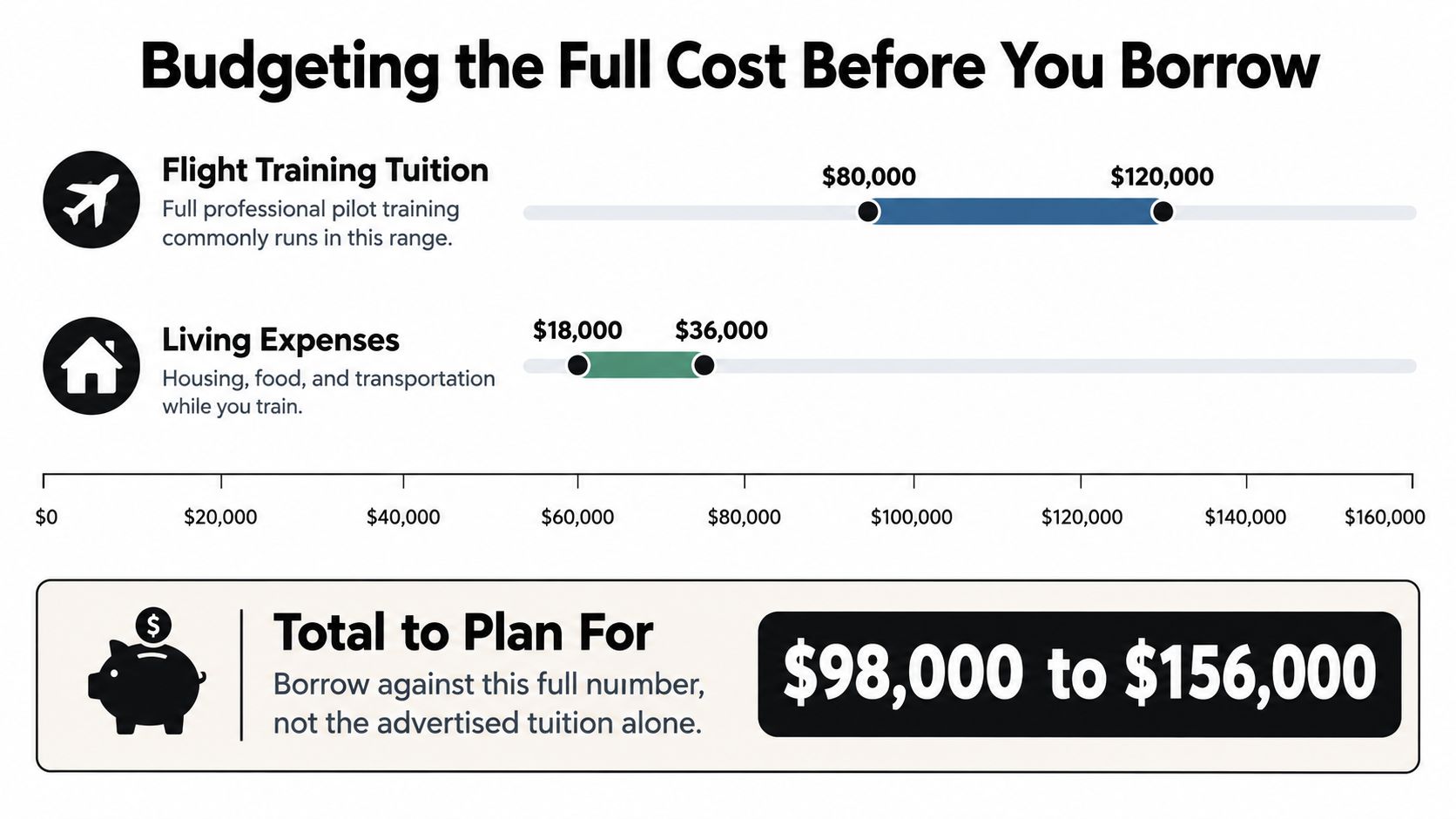
Suppose you plan to finish in nine months but training takes fourteen. Your approved amount doesn't automatically increase, yet rent, food, transport, and possibly missed work continue for five additional months. Weather, aircraft availability, or a rescheduled checkride can also affect the calendar or add training costs, so request written answers about what your price includes.
The examiner, medical, equipment, and emergency-reserve rows need your own quotes or budget figures. Don't assume an unanswered line is included in tuition. For a deeper breakdown of flight-training expenses, see this guide to flight-school costs.
Borrowing rule: Plan against the certified total cost plus a reserve, not just the tuition line.
Loan Payments, Total Repayment and Deferral Traps
An approval letter tells you a lender will fund the training. The repayment schedule tells you what that decision costs. For a $50,000 balance repaid over 10 years, the principal-and-interest payment changes sharply with the rate:
| Interest rate | Approx. monthly payment | Approx. total repaid |
|---|---|---|
| 8% | $607 | $72,800 |
| 15% | $807 | $96,800 |
| 20% | $966 | $115,950 |
These figures come from a standard amortization formula, meaning 120 fixed monthly payments at the annual rate divided by 12. The spread between the cheapest and most expensive row is roughly $360 a month and more than $43,000 over the life of the loan, so price every offer at the rate you're really quoted rather than the lowest rate in the marketing.
Deferral and variable-rate exposure
The published flight-school rate range is 2.19% to 17.64% fixed and 3.75% to 17.14% variable in this flight-school loan program overview. The lowest rates go to the most creditworthy borrowers who make interest payments while in school. With a weak credit file, budget from the upper half of the range and treat anything lower as a bonus.
Deferring payments eases cash flow during training, but interest usually keeps running. At 15%, a $50,000 balance accrues roughly $7,500 in its first year. If the contract capitalizes that interest, you begin repayment owing $57,500, and the same 15% over 10 years costs about $928 a month instead of $807. Read the contract for exactly when capitalization happens, and check whether the deferral window outlasts your training plan. If training runs long, payments can start while you're still living on student income.
A longer term shrinks the monthly bill and inflates the total repaid. Test any payment against two incomes: what you'll earn during training and what your first flying job realistically pays. Judge a loan by affordability, not approval. Use the rate you are offered, not the advertised minimum.
How to Apply in the Right Order
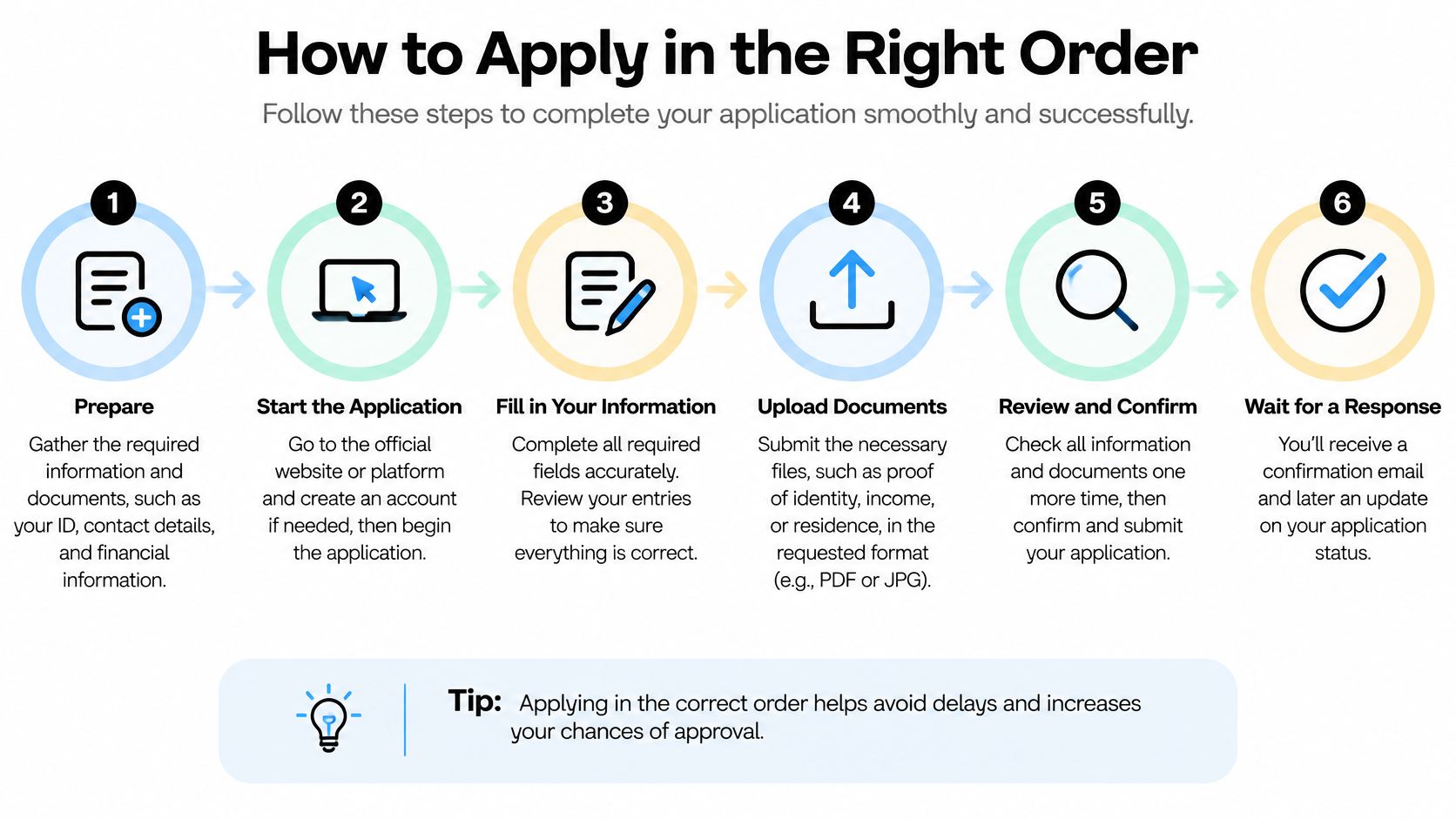
Apply in stages. Each step either lowers your rate, prevents a surprise, or keeps you from signing for money you cannot repay. Start with soft-pull prequalification and a complete picture of your finances: documented income, housing costs, existing debt, payment history, and a training budget that covers more than tuition.
- Check your credit reports. Pull your reports from all three bureaus, then work through the dispute steps in the lender section above. You want no surprises between what you expect and what the underwriter sees.
- Build the full budget. Use the cost buckets from the budgeting section, including written school quotes and a reserve for extra aircraft hours if training runs longer than planned. A loan sized to tuition alone leaves you scrambling mid-program.
- Gather your documents. Collect photo ID, proof of income, housing costs, a list of existing debts, and a short summary of your payment history. A single missing pay stub or bank statement can stall an otherwise approvable file, so compile everything before you apply.
- Ask each school specific questions. Get written answers about airplane age, students per airplane, instructor turnover, total price, Part 61 versus Part 141, and whether you can fly before committing. Ask every school on your shortlist, not just the one offering financing.
- Request soft-pull prequalification. Approach two or three lenders to learn your likely rate range without authorizing a hard inquiry. Multiple full applications before you know the terms cost you score points you may not have to spare.
- Compare the offers. Put total repayment, deferral terms, fixed or variable rates, and disbursement timing side by side. An offer with a manageable monthly payment can still carry the highest total cost.
- Submit one full application. Apply only after you choose the best-fitting offer and confirm when funds are disbursed relative to school billing. Get the refund policy in writing first: CFII's First Milestone Guarantee, for instance, lets a student stop training before about 20 hours of flight time, pay only for logged time at $200 per flight hour, and receive additional payments back, with pro-rated refunds issued within 15 days after later termination.
- Secure cosigner terms. If a cosigner is involved, run the release checklist from the cosigner section above before anyone signs.
FAA checkpoint: Under 14 CFR 61.23, a student pilot must hold at least a third-class medical certificate before flying solo. Solo also requires the endorsements specified by 14 CFR 61.87. Confirm you can pass the medical before committing to a large loan. You can take a discovery flight and initial lessons before obtaining the certificate, but don't borrow for a full program before you've flown at least once.
Choose Your Financing Path and First Step
- Thin credit with stable income: Consider a cosigner loan plus scholarships, with release terms settled in writing before signing.
- Damaged credit and no cosigner: Start with pay-as-you-go hours, a smaller loan if affordable, and credit repair before a full application.
- Eligible veteran: Confirm the program's VA approval before taking out a loan.
- Homeowner with equity: Compare a HELOC's total cost and home risk against the private-loan payments in the table.
Scholarships can reduce how much you need to borrow, so check flight-training scholarship opportunities. If you've never flown, book a discovery flight first to test the commitment with an instructor before borrowing.
If you want a structured zero-to-CFII path, CFII's Career Track has a fixed $89,000 tuition, takes about nine months from zero time to CFII and multi-engine, includes 282 total hours and six certificates and ratings, and is based in Riverside, Long Beach, and Corona in Southern California.
Run your own figures using the payment table, check whether interest accrues during any deferral, and remember that every loan remains subject to the lender's credit decision.
If a Lender Says No
Start with the adverse action notice and match each stated reason to the lender's checks: credit history, income, debt, or the requested amount. Under the Equal Credit Opportunity Act, a lender that denies credit must provide specific reasons for the decision.
If the decision relied on a credit report, request a free copy from the bureau named in the notice. The Fair Credit Reporting Act allows a free report within 60 days of an adverse decision based on that report. Check for errors, dispute any inaccurate entry, and wait for the correction to appear before applying again.
Change the structure rather than repeating the same request. You might add a creditworthy cosigner, reduce the requested amount to what you can afford, or pay for part of training through hourly billing. Keep new inquiries at the prequalification stage until something material changes in your application. For alternatives when federal aid isn't available, review this guide to paying for career training without federal aid.
CFII offers an accelerated, fixed-price Career Track from zero experience to CFII and multi-engine, with financing available through its lending partner subject to the lender's decision. If you're comparing flight school financing with bad credit, visit CFII to review the training path and decide whether its structure fits your budget.
Planning to fly for a living?
See what the path from zero to a pilot career looks like, what it costs and how long it takes.
Learn to fly in Riverside
We train at Riverside Municipal Airport in factory-new airplanes with a parachute built in. Start with a one hour discovery flight, no experience needed.