

On this page
- Is a Career Change to Pilot Right for You
- The FAA Pathway from Zero Time to Airline Eligibility
- Airline eligibility comes later
- Accelerated Programs vs Pay-As-You-Go Training
- How to Evaluate a Flight School Before You Enroll
- The Real Cost of Becoming a Pilot and How to Finance It
- Stress-test the plan before borrowing
- Balancing Training with Work and Family Life
- Entry-Level Career Outcomes After Training
- Demand is not a personal job guarantee
- Turn the decision into next steps
You've built a career, a household budget, and a routine that mostly works. But the thought of spending years behind a desk has started to feel heavier than the risk of starting over. A career change to pilot can be a real path, but the decision turns on two things people often underestimate: the 1,500-hour rule and the income valley between training and stable airline work.

Before you put money down or resign, get clear on your medical eligibility, your household's tolerance for a period of reduced income, and whether you can relocate for training or work. This isn't a decision to make on a pilot-shortage headline. It's a sequence of training, experience-building, and financial choices, each with its own risks.
Is a Career Change to Pilot Right for You
A mid-career professional may be ready to leave a desk job and still have good reasons not to leap straight into full-time training. Maybe a mortgage depends on a steady paycheck. Maybe a partner's work, children's schedules, or health coverage makes relocating complicated. Those constraints don't automatically rule out flying, but they need to shape the plan before you commit.
Start with the medical question. The FAA's required medical class depends on the privileges you'll exercise: commercial privileges generally require a second-class medical, while exercising airline transport pilot privileges as pilot in command requires a first-class medical. An FAA medical evaluation early in the process can surface issues before you've invested heavily. Review the FAA medical certification guidance for aspiring pilots, and take individual eligibility questions to an aviation medical examiner.
Practical rule: Don't treat your current salary as money you can simply replace after flight school. Plan for the period when training is finished but airline eligibility is not.
That period is the income valley. A new commercial pilot may need to instruct or take another flying job while accumulating experience, often earning less than they did in their previous profession. At the same time, the 1,500-hour rule means earning early certificates doesn't by itself make someone eligible for the standard unrestricted airline transport pilot certificate. These two realities affect the cost, duration, and household impact of the entire move.
Ask yourself plainly: Can you meet the medical standards? Can your household manage training costs and a possible drop in earnings? Are you willing to move for training or a first job? Are you prepared to build experience before pursuing an airline cockpit? If those answers are uncertain, don't ignore them. Use them to design a staged plan, with a discovery flight and medical research before a major financial commitment.
The FAA Pathway from Zero Time to Airline Eligibility
The professional path has a clear order, but the certificates aren't the whole journey. You'll need a medical certificate, then private pilot, instrument, commercial, and instructor qualifications, followed by the experience and testing needed for an Airline Transport Pilot certificate.
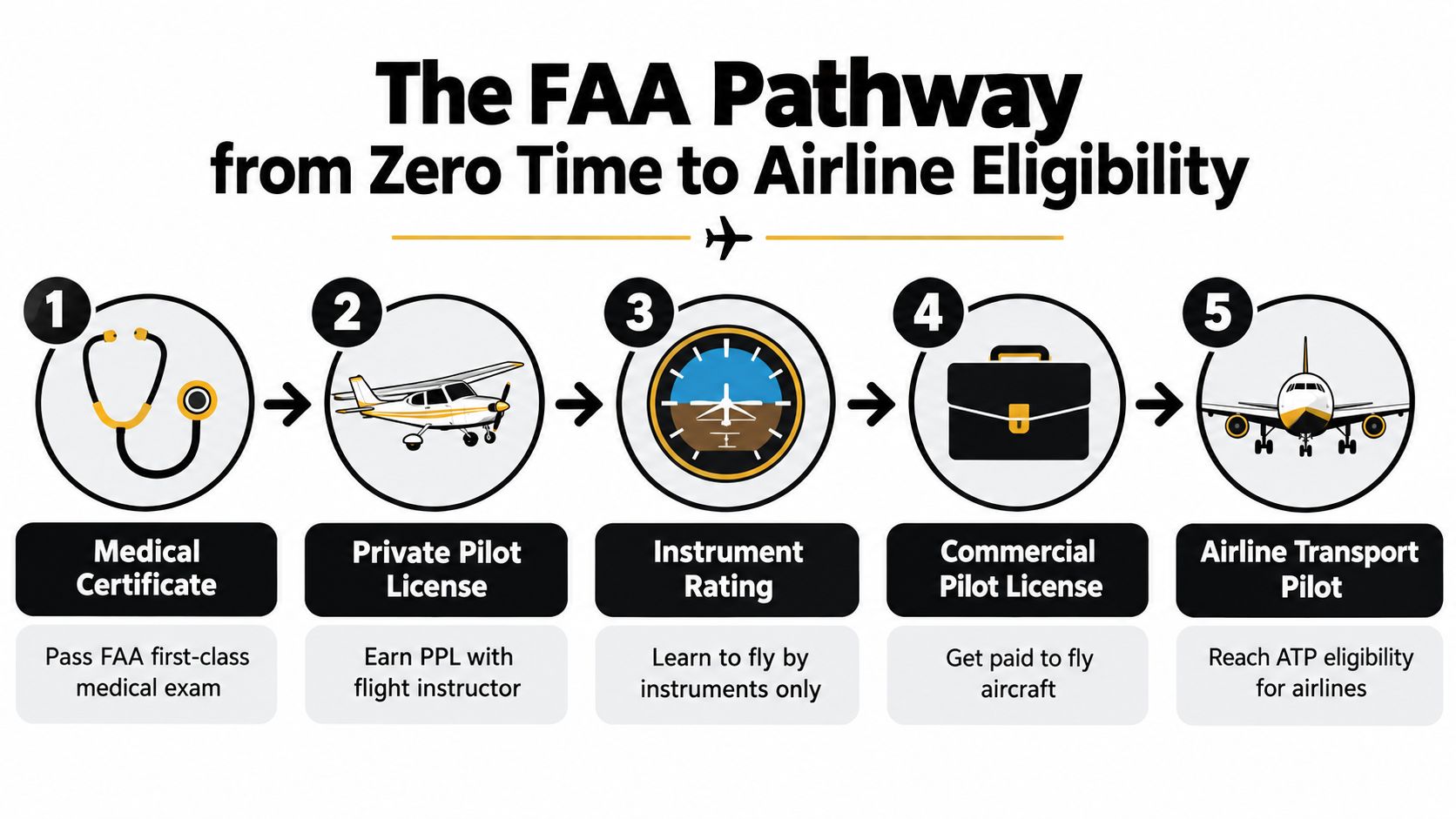
Get the medical question answered early. For the airline goal, a first-class medical is the relevant standard for exercising ATP pilot-in-command privileges. The specific requirements depend on what privileges you're exercising, and the FAA regulation on medical certificates sets out the applicable classes and testing requirements.
A private certificate teaches foundational aircraft operation. The instrument rating develops the ability to fly by reference to instruments under the applicable conditions. The commercial certificate qualifies you to exercise certain paid-pilot privileges, but it doesn't qualify you for every paid job or make you airline-ready.
For an airplane single-engine commercial certificate, the FAA generally requires at least 250 hours of pilot flight time, plus specified experience in categories such as pilot-in-command, cross-country, and night flying. The detailed requirements are set out in 14 CFR § 61.129. After commercial training, many new pilots pursue flight-instructor certificates so they can teach and build experience while earning income.
Airline eligibility comes later
The standard U.S. ATP route generally requires 1,500 total pilot hours, a commercial pilot certificate with an instrument rating, and successful completion of the required ATP tests. Some aviation-degree graduates may qualify for restricted ATP privileges at 1,000 or 1,250 hours, depending on FAA conditions. Review the FAA's ATP certificate requirements and make sure your specific training plan fits the route you intend to follow.
Don't treat every logged hour as interchangeable. Ask how the syllabus covers total, cross-country, instrument, night, and multiengine experience, and what simulator time may count toward the intended ATP pathway. Your benchmark isn't just the date you finish a rating. It's whether your training and subsequent work build the documented experience your target certificate requires.
Accelerated Programs vs Pay-As-You-Go Training
Accelerated training and pay-as-you-go training solve different problems. An accelerated program can offer a defined syllabus and concentrated schedule, but it demands time, travel, and the ability to manage a heavy training period. Pay-as-you-go training can fit around work and family, yet a longer or inconsistent schedule may make it harder to maintain momentum.
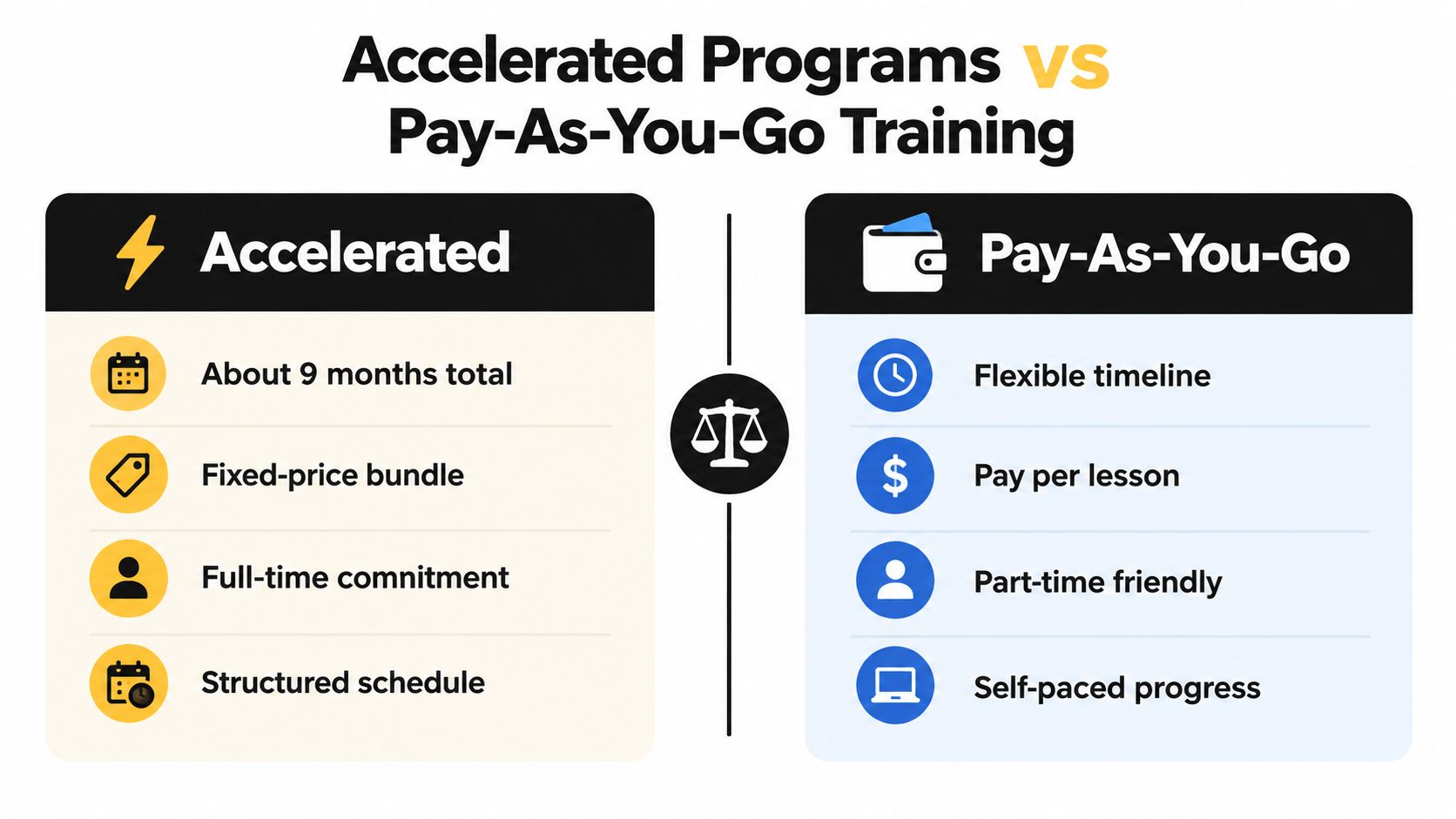
| Training model | What it can offer | What you need to manage |
|---|---|---|
| Accelerated | A structured schedule and a concentrated route through certificates and ratings | Reduced time for outside work, relocation, and household coordination |
| Pay as you go | More flexibility to train around existing responsibilities | A less predictable completion timeline and the need to keep training consistent |
As a concrete fixed-price example, CFII's Career Track has $89,000 tuition, takes about nine months from zero time to CFII and multi-engine, includes 282 total hours and six certificates and ratings, and is based in Southern California, in Riverside, Long Beach, and Corona (Career Track program details). Those figures describe the program, not a guarantee of airline eligibility or employment.
Before comparing a program with a pay-as-you-go plan, ask what the stated price covers and what remains outside it. Get the syllabus, hour breakdown, and written terms. Check whether the total includes ground instruction, study resources, simulator time, practical tests, and any additional expenses, rather than assuming a bundle covers every cost. The available training structure and scheduling rules can also affect how a program fits your life, so review this guide to Part 61 and Part 141 training.
The key question is not “Which model is faster?” It's “Which model can I complete without undermining my finances or training consistency?”
How to Evaluate a Flight School Before You Enroll
A polished completion promise isn't enough. Ask for evidence about the actual training process: what the syllabus requires, how the school tracks flight time, how it prepares students for practical tests, and how it handles delays.
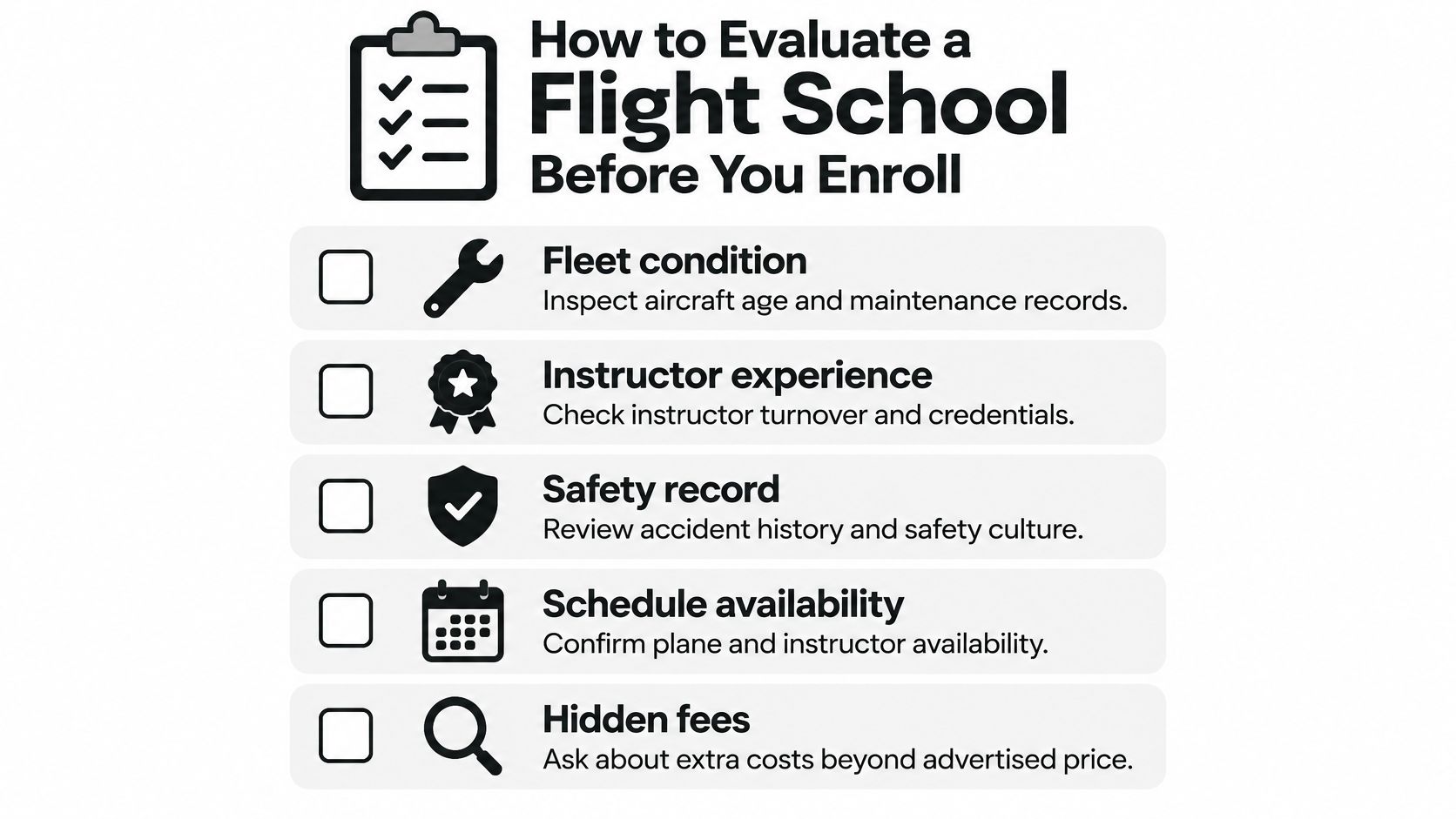
Use these questions when you meet a school:
- Hour breakdown: How are total, cross-country, instrument, night, and multiengine hours recorded? Which hours are simulator time, and how does the school explain their relevance to your planned ATP route?
- Instructor continuity: Who teaches ground and flight lessons, how are instructors qualified, and what happens if your assigned instructor leaves?
- Aircraft and maintenance: How does the school maintain its fleet, and what happens to your schedule when an aircraft is unavailable?
- Checkride preparation: What are the stage-check standards, how does the school support knowledge-test preparation, and how are practical-test appointments coordinated?
- Pricing and delays: Which costs are excluded from the advertised price? What happens if weather, maintenance, or testing availability slows your progress?
Training quality deserves particular attention because completing a syllabus and succeeding in airline training are different milestones. A peer-reviewed analysis of 6,734 pilot records from 19 U.S. Part 121 airlines found that 89% completed regional-airline new-hire training overall; completion probability was about 92–96% for pilots with fewer than 1,502 total hours. The study also reported fewer non-completions and additional training events among pilots holding restricted-ATP credentials (peer-reviewed analysis of airline training outcomes). Those findings are a benchmark, not a promise about any individual candidate or school.
Ask for transparent standards and verifiable outcome information rather than relying on vague claims. And don't assume that a commercial certificate automatically leads to a paid instructor job. Instructing requires its own qualification and practical competence, and employment depends on the school's needs and the availability of students. Use this guide to evaluating FAA-approved flight schools to build your comparison questions.
The Real Cost of Becoming a Pilot and How to Finance It
Your actual budget is bigger than tuition. Include medical exams, knowledge and practical tests, travel or relocation, rent, ordinary household expenses, and a reserve for training delays. If a school quotes a fixed tuition, ask what's excluded in writing. A clear price is useful, but it doesn't settle whether your household can afford the entire transition.
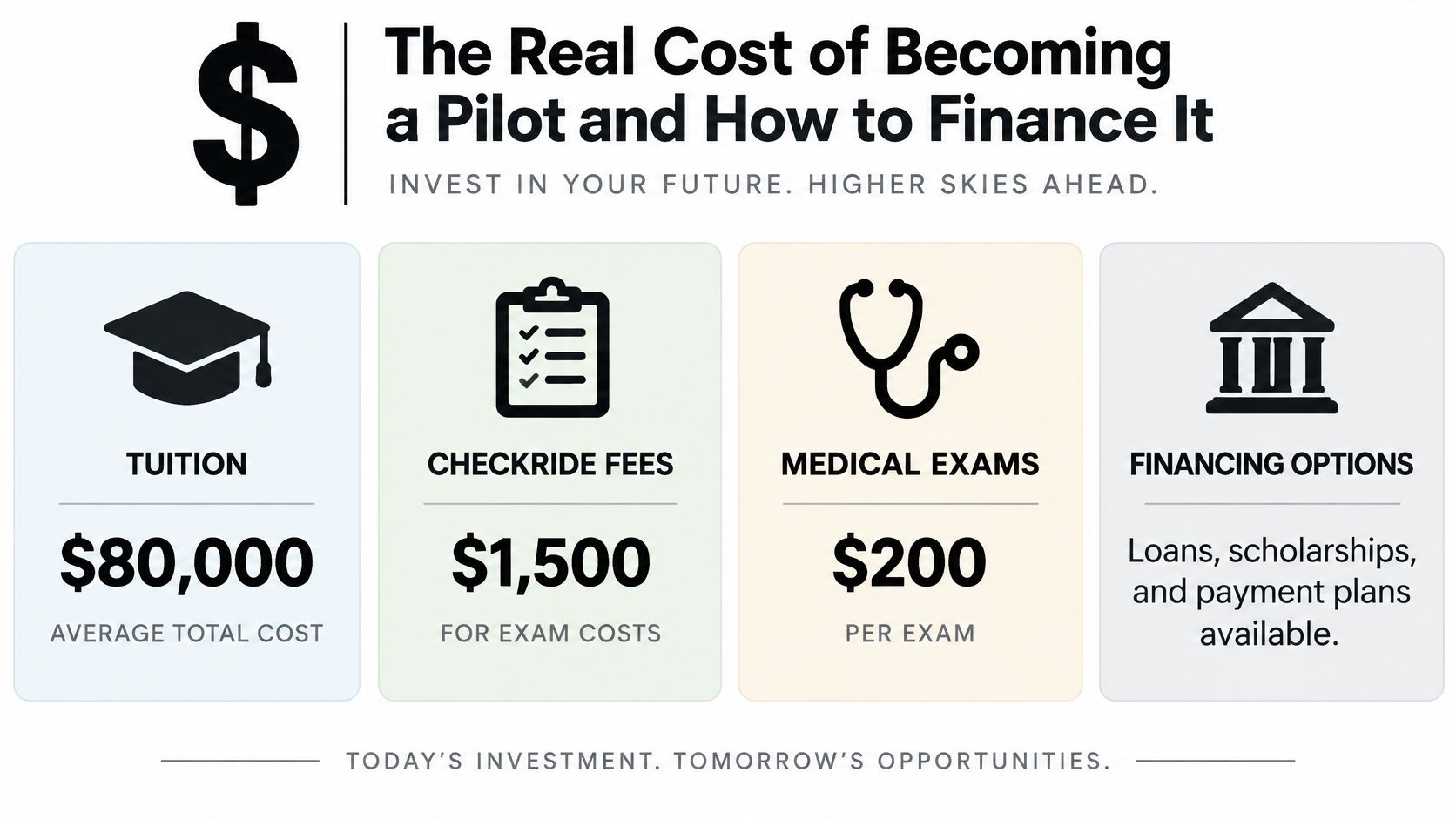
Build a household cash-flow plan around three periods: training, hour-building, and the move into a more stable professional job. During training, you may have significant expenses and reduced capacity to earn from your current career. After training, you may still need to work as an instructor or in another flying role while accruing experience. That's the income valley. Don't base your borrowing decision on a future airline salary that depends on certificates, experience, hiring, and successful training.
Stress-test the plan before borrowing
Write down current monthly household obligations, expected training expenses, loan payments, and likely income sources during hour-building. Then make a slower-progress version of the plan: training takes longer than expected, weather or maintenance interrupts flying, or paid work doesn't provide hours as quickly as you hoped. If that version puts housing, essential bills, or family responsibilities at risk, reconsider the pace or scale of the commitment.
Financing can spread payments, but it doesn't remove the debt or the uncertainty. Read the terms, check when payments start, and understand what happens if training runs late or your medical eligibility changes. Protect your options: keep an emergency reserve, avoid treating every available credit dollar as training money, and decide what would cause you to pause or reassess.
For a fixed-price pathway, confirm the listed tuition directly and verify its inclusions rather than assuming that every related expense is covered. Compare that figure with a separate estimate of living costs and household needs. The flight-school financing guide can help you organize the questions to ask before you sign.
Balancing Training with Work and Family Life
Most mid-career students can't abandon work and family responsibilities. The right training schedule is the one you can sustain, including study time, commuting, sleep, and the people who depend on you. A full-time program may concentrate lessons, while part-time training can preserve income and make caregiving easier. Neither option is effortless.
Start by putting your real week on paper. Identify the hours you can reliably devote to lessons and study, then discuss that schedule with your household before enrolling. If your plan depends on training every available evening or weekend, it probably doesn't leave enough room for work pressure, family needs, illness, or recovery.
Relocation requires its own decision. CFII's Career Track operates in Riverside, Long Beach, and Corona, so a student considering that program should examine commute or housing arrangements, family support, and the effect of being away from home before committing. Don't evaluate a training base only by flight access. Consider whether the household can handle the move and what it will mean for your partner's work and your ongoing expenses.
Before reducing your work hours or resigning, make a plan for income, health coverage, and essential bills during training. Agree on checkpoints with your family: if the schedule, medical process, finances, or hiring environment changes, you'll review the plan rather than pressing ahead automatically. Keep an exit option available. A careful transition isn't a lack of commitment. It's how you avoid turning an ambitious career change into a household emergency.
Entry-Level Career Outcomes After Training
For many aspiring airline pilots, flight instruction is the first paid flying job after training. It's a practical bridge: you teach while accumulating experience, and you keep developing the habits that matter in a professional cockpit. But it isn't automatic employment, and reaching an hour threshold doesn't guarantee an airline offer.
A new instructor's progress depends on student demand, aircraft availability, weather, scheduling, and the instructor's ability to maintain a workable pace. Don't build your household budget on a precise monthly hour target unless you have reliable information about the specific job you're considering. Ask prospective employers how work is assigned, how instructors are paid, and what support they provide for keeping records accurate and preparing students.
The first stage after flight school can feel financially tight. You may be earning less than you did in your previous career while paying living expenses and, if you borrowed, loan obligations. That's why the income valley belongs in the decision before training begins, not after graduation. Plan for it as a real phase of the career, not as a short inconvenience that must resolve on schedule.
Demand is not a personal job guarantee
Long-term hiring outlooks are useful context, but they don't predict your personal start date. Boeing's 2025 Pilot and Technician Outlook forecasts that commercial aviation will need approximately 660,000 new pilots worldwide between 2025 and 2044. The forecast also attributes roughly two-thirds of the broader aviation workforce requirement to replacing people who leave the industry, rather than solely to fleet growth (Boeing's 2025 Pilot and Technician Outlook). That is a global projection, not a promise about near-term U.S. airline hiring.
The FAA forecast cited in coverage projects the active U.S. pilot population, excluding students, to grow from 523,824 in 2026 to 576,035 in 2046. That population projection is not a published national shortage count or a guarantee that a particular new graduate will be hired (coverage of the FAA pilot-population projection). Hiring can change with airline finances, regional conditions, geography, and the broader cycle. Be prepared to relocate for an early job if your preferred location has limited openings.
A sound plan has alternatives. Consider whether you'd pursue flight instruction, another commercial flying role, or a different professional path if airline hiring slows. Think through the time and expense of moving, and whether you'd still want to fly professionally if your first-choice job is delayed. A favorable outlook matters, but it doesn't replace a realistic financial runway.
Turn the decision into next steps
Start with a discovery flight if you haven't been in a training aircraft. Then address medical eligibility, get written training details, and build a budget that includes the income valley. After that, compare full-time and part-time approaches against your actual calendar and household commitments. For a clearer picture of the milestones after training, read this guide to what happens after flight school.
If you're ready to explore a structured route, review the Career Track facts and ask the program directly about current terms, included costs, and scheduling. If you're still testing the idea, book a discovery flight before making a large commitment. The path is demanding, but the next step doesn't have to be a resignation letter. It can be a medical conversation, a first lesson, or a candid budget review with the people who share the decision.
CFII offers a structured flight-training path for students working toward CFII and multi-engine qualifications, with Career Track based in Southern California. Review the program details at CFII and decide whether its training format fits your financial plan, schedule, and career goals.
Planning to fly for a living?
See what the path from zero to a pilot career looks like, what it costs and how long it takes.
Learn to fly in Riverside
We train at Riverside Municipal Airport in factory-new airplanes with a parachute built in. Start with a one hour discovery flight, no experience needed.