
On this page
- Find and Shortlist Nearby Flight Schools
- Work the shortlist in order
- Treat the first flight as a lesson
- Southern California Bases and What Distance Changes
- Compare the commute you'll actually make
- Relocate for a defined plan
- Which Local Training Path Fits Your Situation
- Match your starting point to your next decision
- Choose a framework you can follow
- Hour Requirements From Private Pilot to Airline Eligibility
- Minimum experience isn't a completion promise
- Build a timeline around qualifying experience
- What Nearby Programs Really Cost in Money and Time
- Ask what each payment actually covers
- Stress-test the period without flying income
- Instruction, Simulator and Instructor Checks to Run
- Verify credit before counting simulator hours
- Require operational answers
What if the closest flight school gets you through your ratings quickly, but leaves you without a workable way to build hours or pay your bills afterward? Searching for pilot training near me should answer more than where you can rent an airplane. For a career pilot, the better question is which school offers a training schedule, financial plan, and next step you can sustain.
Judge nearby programs by time to airline eligibility and cash-flow risk, not driving distance alone. A convenient airport helps, but it won't compensate for unavailable instructors, unclear exclusions, or a career plan that stops at the commercial checkride.
Find and Shortlist Nearby Flight Schools
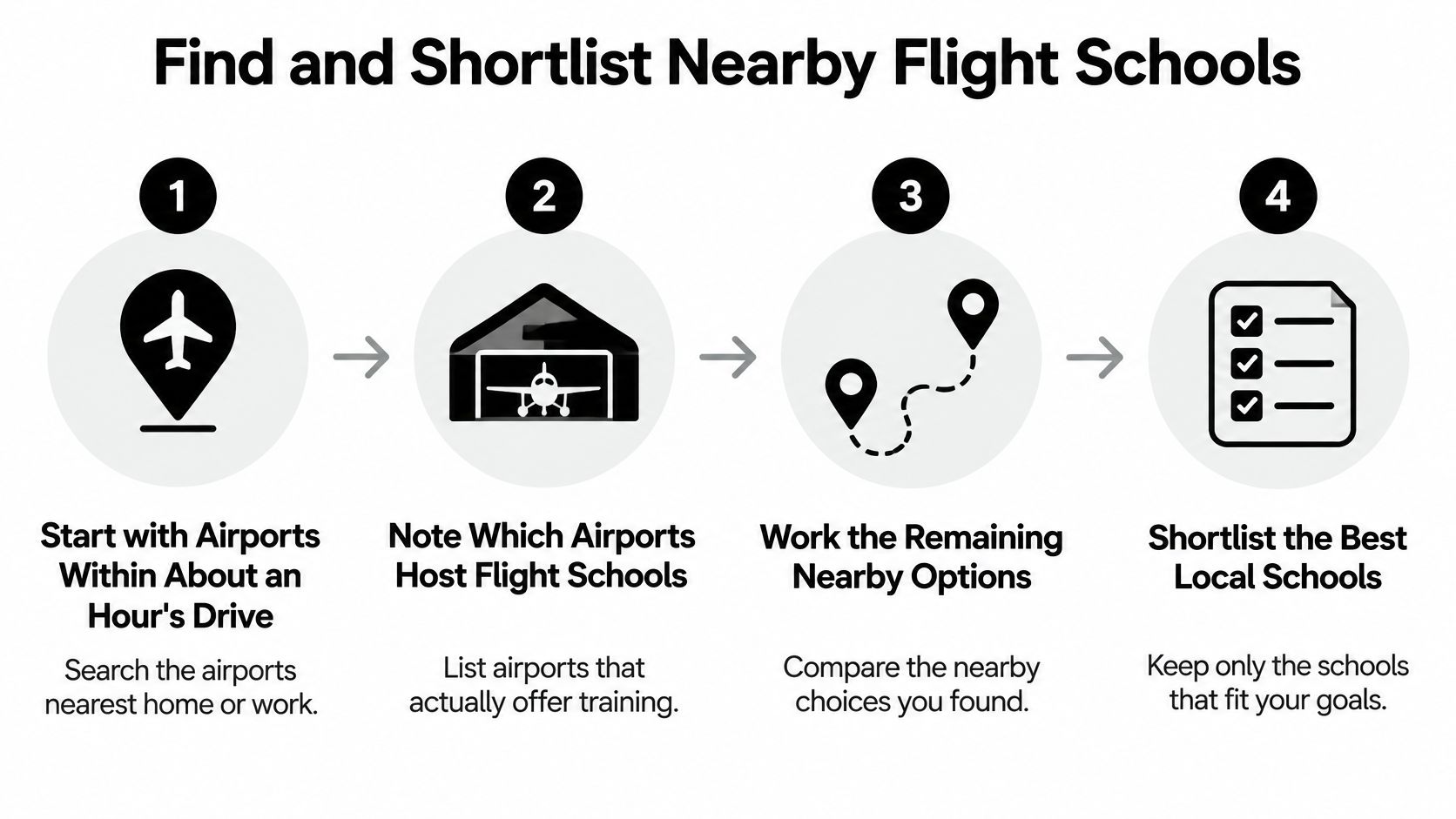
Start with airports within about an hour's drive of home or work. Treat that as a search boundary, not a commitment to commute that far. Map the airports that host flight schools, then compare the training operations rather than the airport names.
An early comparison should look like this:
| Decision factor | Weak basis for choosing | Better evidence |
|---|---|---|
| Location | Shortest drive on a map | Drive tested at your actual lesson time |
| Price | Advertised aircraft rate | Written completion estimate with exclusions |
| Availability | A large fleet photograph | Instructor and aircraft openings that match your schedule |
| Career preparation | A list of certificates | A defined transition into qualifying flight experience |
| Financial risk | Loan approval | Affordable payments if training or employment is delayed |
Work the shortlist in order
List every school at your selected airports. Confirm which certificates and ratings each offers and whether its training sequence reaches your intended endpoint. A school suited to occasional private lessons isn't automatically equipped for a full-time career student.
Request a written price with exclusions. Ask what happens when you need extra instruction, an additional practical test, or more aircraft time. Keep tuition separate from housing, equipment, examiner charges, and financing costs so unlike estimates don't appear equivalent.
Identify the operating framework. Ask whether training is conducted under Part 61 or an FAA-approved Part 141 course. Part 61 generally permits more scheduling flexibility; Part 141 uses an approved curriculum with course-specific requirements. Compare the planned training, not just the regulatory label.
Check capacity rather than appearances. Ask about airplane age, students per airplane, instructor turnover, and maintenance backup. An available instructor without an available airplane doesn't give you a usable lesson slot.
Visit the operation. Request a hangar tour, sit in a cockpit, and meet instructors. Notice whether someone can explain the next lesson's objective and show how students reserve aircraft.
Fly before making a substantial commitment. Use a discovery flight to evaluate how the instructor explains, demonstrates, and corrects. Excitement matters, but clear communication matters more once training becomes demanding.
Treat the first flight as a lesson
Our discovery flight is lesson one: you meet the instructor, preflight the airplane together, and take the controls in the air. No previous experience is needed, and we offer a one-hour discovery flight.
If you haven't flown, book a discovery flight before deciding that an accelerated career program is right for you. Ask the instructor to explain what you'll practice, what you'll handle, and what they'll assess afterward.
Carry forward three schools, one written price from each, and one visit to each. Before committing, require clear answers to the final decision questions about training credit, instructional continuity, and financial exposure.
Southern California Bases and What Distance Changes
A Southern California address doesn't tell you where your daily training will begin. Our Career Track lists Riverside, Long Beach, and Corona within its Southern California footprint, but every Career Track lesson starts and ends at Riverside Municipal Airport. Don't assume that a listed location lets you complete the full program from whichever base is closest.
Use the Southern California flight school locations to orient your search, then match your intended training to its actual departure airport.
Southern California training bases and their roles
| Base | What happens there | Best fit |
|---|---|---|
| Riverside Municipal Airport | Career Track home base; every Career Track lesson starts and ends here | Full zero-to-CFII program with nearby shared housing |
| John Wayne Airport (SNA), Santa Ana | Discovery flights and private pilot lessons | Orange County students who want to fly before committing |
| Long Beach | Listed training base; not a substitute for the stated Career Track departure location | Students evaluating local training access and confirming their lesson location |
| Corona | Listed training base; confirm the location assigned to your training | Students comparing Inland Empire access before choosing a path |
Compare the commute you'll actually make
Test the route at the time you'd leave for a lesson, not during a quiet weekend. Include parking, the walk to the briefing area, and enough time to arrive prepared. A commute that looks manageable occasionally may become exhausting alongside study and early departures.
Southern California weather and airspace also affect the practical value of proximity. Coastal conditions can change a departure plan, while busy airspace can add workload and ground time. Neither automatically makes an airport unsuitable, but you should understand how instructors adapt the syllabus when the original flight can't proceed.
Ask whether moving between listed bases is permitted for your particular training. Get the assigned lesson location in writing rather than treating the regional map as a promise of interchangeable aircraft and instructors.
Practical rule: Choose a base you can reach consistently, not one you can reach quickly only when traffic and weather cooperate.
At Riverside, our hangar is open for prospective students to visit. We train there in factory-new airplanes with a built-in parachute, but aircraft equipment shouldn't replace questions about maintenance availability, instructor scheduling, and lesson objectives.
Relocate for a defined plan
Relocation makes sense when you've chosen the complete career sequence and settled housing and financing before arrival. It can remove a difficult commute, but it also creates expenses that continue when weather, maintenance, or a checkride postpones flying.
Stay local when you're still testing whether you enjoy flight training or when you need only a particular certificate. Orange County students can take our discovery flights and private pilot lessons from John Wayne Airport rather than assuming every training goal requires a move to Riverside.
The closest school still isn't the right choice if it can't provide continuity. Conversely, a full-time program isn't automatically worth relocating for unless its schedule and financial demands fit your circumstances.
Which Local Training Path Fits Your Situation
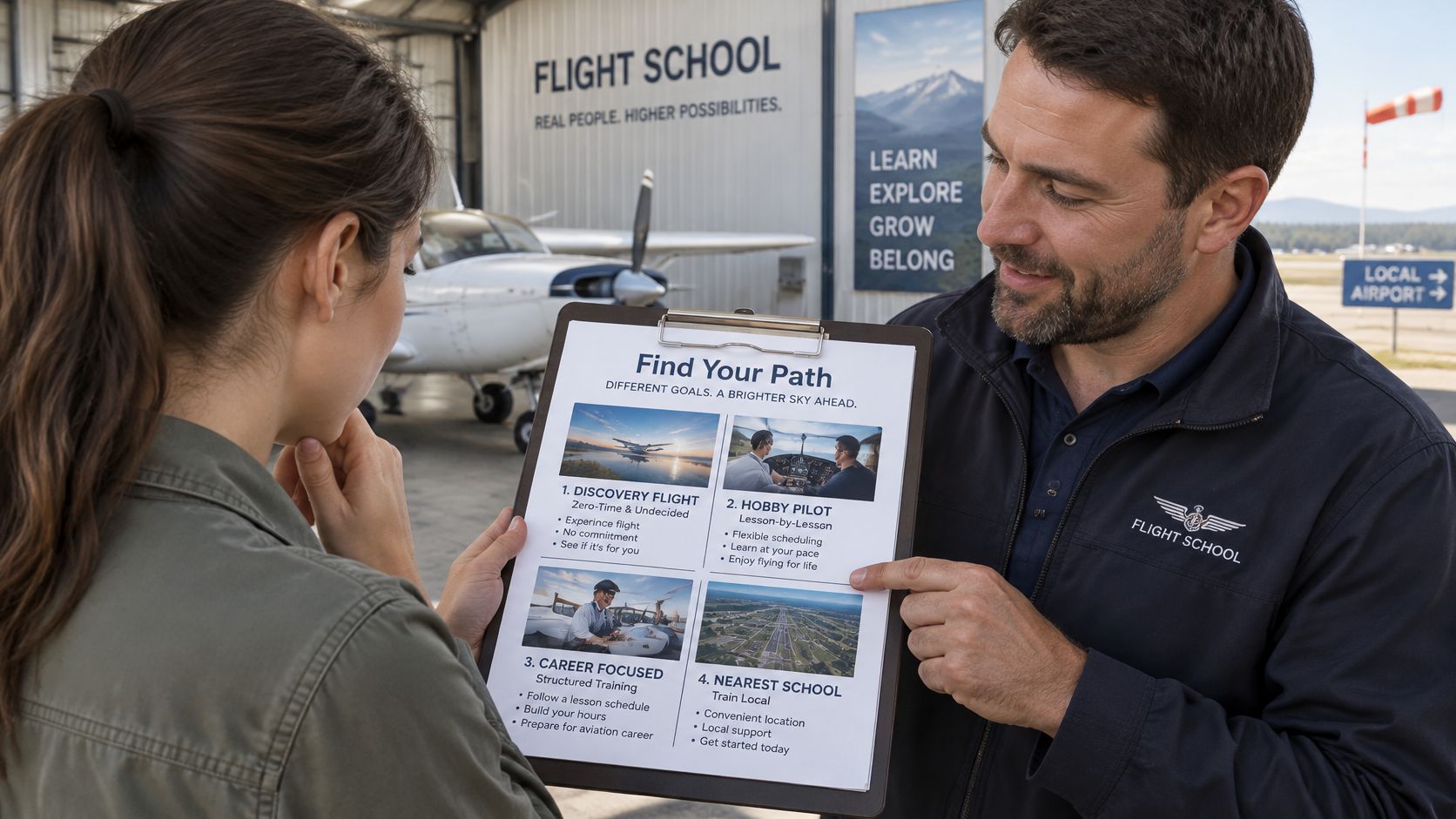
Zero-time and undecided: Start with an introductory lesson, not a loan application. Your question is whether you enjoy the learning process, including preparation, repetition, and correction, rather than enjoying the view. The common mistake is buying a complete career plan before experiencing an ordinary training session.
Learning for personal flying: Begin with a lesson schedule you can maintain around work or school. Our hobby students taking two or three lessons per week typically reach the private pilot checkride in four to six months, paying lesson by lesson. That's a planning expectation, not a promised completion date.
Match your starting point to your next decision
For younger students, there's no minimum age for lessons. Airplane students can solo at 16 and obtain a private pilot certificate at 17; the solo eligibility provision is in 14 CFR 61.83, while private pilot eligibility is addressed in 14 CFR 61.103. Don't confuse eligibility to begin lessons with eligibility to fly alone.
A third-class FAA medical certificate from an aviation medical examiner is the conventional medical route before solo. Discovery flights and initial dual lessons can happen first, but a career-minded student should investigate medical eligibility early rather than making a large financial commitment without understanding it.
Already holding flight experience: Bring your logbook and identify the exact privilege you want next, whether commercial, instructor, or multi-engine. We can tailor a discovery lesson so you learn something new while becoming familiar with our aircraft. Your key question is how existing experience maps to the proposed syllabus; the mistake is paying to repeat training without a clear proficiency reason.
Changing careers and willing to relocate: Resolve housing, living expenses, and financing before your start date. Your question is whether you can protect the time required for flying and study without depending on immediate aviation income. The common mistake is treating full-time training as something that can absorb an unpredictable work schedule.
Choose a framework you can follow
Use the Part 61 versus Part 141 comparison to frame questions about scheduling, approved coursework, and how prior experience will be evaluated. Neither label tells you whether a particular instructor is available when you are.
Planning to become an instructor: Ask about mentorship and the actual route into paid teaching. An instructor certificate establishes qualifications; it doesn't establish a student roster or employment agreement. Distinguish guaranteed paid work in writing from permission to apply or a suggestion that opportunities may become available.
Before enrolling, write down:
- Your next qualification: Name the certificate or rating you need.
- Your scheduling constraint: Identify the work, family, or relocation issue that could interrupt training.
- Your decision point: Decide what evidence you need before committing to the next stage.
That keeps a nearby school's available product from becoming your goal by default.
Hour Requirements From Private Pilot to Airline Eligibility
FAA hour thresholds on the path to airline eligibility
| Milestone | Minimum hours | Notes |
|---|---|---|
| Private pilot, airplane | 40 total | Includes 20 instruction, 10 solo, and 3 each of cross-country, night, and instrument-reference training under 14 CFR 61.109(a) |
| Commercial pilot, airplane | 250 total | Applicable Part 61 airplane pathway; commercial privileges aren't airline hiring eligibility, as the FAA explains |
| Restricted ATP, qualifying aviation bachelor's degree | 1,000 | Qualifying graduates and authorized institutions must satisfy the remaining requirements identified in the FAA's ATP guidance |
| Restricted ATP, qualifying aviation associate's degree | 1,250 | Also applies to certain bachelor's-degree pathways; restricted privileges permit co-pilot service |
| Unrestricted ATP | 1,500 | Standard total-time baseline; unrestricted experience requirements are in 14 CFR 61.159, while 61.160 provides restricted-pathway alternatives |
| Career Track program total | 282 training hours | 204 single-engine, 25 multi-engine, and 53 simulator hours, plus all one-on-one instruction |
The restricted ATP figures above describe qualifying educational pathways, not a discount available to every student who earns a degree. The institution must be authorized to certify eligible graduates, and hours alone don't establish eligibility.
The FAA's civil airmen statistics describe the certificated pilot population, not a school's employment prospects. When comparing programs, require a personalized experience audit rather than assuming a certificate count proves airline readiness.
Minimum experience isn't a completion promise
Private pilot minimums specify required experience, not the point at which every student demonstrates practical-test proficiency. Cross-country, night, and instrument-reference requirements sit within the required training total; they are not separate blocks to add together.
Commercial privileges also have operating limitations. A commercial certificate doesn't independently authorize every kind of paid flight or satisfy an airline's hiring requirements. Aircraft qualifications, medical eligibility, training, and the proposed operation still matter.
Our program's published total includes both aircraft and simulator training. Don't treat that combined figure as interchangeable with aircraft flight time or automatically creditable ATP experience. The school should identify what each entry represents and how it applies to each certificate.
Finishing the ratings and becoming eligible for an airline position are different milestones. A useful plan accounts for both.
Build a timeline around qualifying experience
The complete Career Track runs from zero time to CFII and multi-engine in about nine months and includes six certificates and ratings. That sequence prepares students for further experience-building; it isn't an airline-employment deadline.
Use the flight training requirements guide to prepare a logbook review with your instructor. Separate aircraft time, simulator credit, pilot-in-command experience, cross-country experience, and other applicable categories instead of tracking only a headline total.
For time-building, make a monthly worksheet with opening qualifying hours, expected aircraft hours, cancellations, and closing qualifying hours. Enter expected instructing activity only when there's a credible source of students and aircraft. Recalculate from actual logged experience each month rather than carrying forward an optimistic completion date.
What Nearby Programs Really Cost in Money and Time
Cost lines to request from every nearby school
| Cost line | What to request in writing |
|---|---|
| Tuition | Fixed or total price with exclusions itemized |
| Housing | Monthly cost and whether it is included in the program price |
| Time-building add-on | Whether paid instructing hours are guaranteed, the conditions, and the hourly pay rate |
| Early exit | Refund rules before the stated flight-hour threshold |
| Financing | Term, payment deferral, interest, and prepayment terms |
| Examiner and retest fees | Who pays examiner, testing, and retest costs |
Our Career Track has fixed tuition of $89,000, with financing available for the full amount. A fixed price makes comparison easier only when you also understand the written scope and exclusions.
The Government Accountability Office's aviation workforce report found that flight-training fees alone often exceeded $50,000 in collegiate programs and identified limited financial assistance as a barrier. That finding isn't a quote for your training; it illustrates why access to funding and total affordability are separate questions.
Ask what each payment actually covers
Housing: Our student accommodation is a furnished apartment shared with other pilot students, minutes from Riverside, at $1,300 per month, paid separately from tuition. Include utilities, deposits, transportation, and any costs not expressly included in your housing agreement.
Time-building: Ask whether an advertised arrangement creates employment, reserves an opportunity, or merely provides career guidance. Request the conditions, start timing, expected scheduling, and what happens when student demand or aircraft availability falls short. Don't count unconfirmed instructor income as money available for loan payments.
Early exit: Our First Milestone Guarantee allows students to discontinue for any reason before about 20 hours of flight time, paying only for logged flight time at the discounted rate of $200 per flight hour, with additional payments refunded. Read the agreement before paying so you understand how the threshold and refund process apply.
Financing: Get the repayment schedule, interest terms, fees, and any deferral in writing. Loan approval doesn't establish that the resulting monthly payment will fit your early-career income.
Testing: Identify examiner and retest charges separately. Scheduling a checkride and paying for it are different services, so don't infer one from the other.
Stress-test the period without flying income
Say you finance tuition, pay housing monthly, and expect paid instruction to begin only after earning the necessary qualifications. A delay near the end of training extends living costs while postponing the income you planned to use for repayment. Your budget needs to survive that overlap without relying on airline salary figures.
Cash-flow test: If paid instructing starts later than expected, identify which savings or non-flying income will cover the gap before you sign.
Copy these lines into a worksheet:
- Training: Tuition, additional aircraft or simulator time, and instruction outside the written scope.
- Living: Housing, transportation, food, insurance, and relocation.
- Testing and equipment: Medical, examinations, examiner and retest charges, and required supplies.
- Borrowing: Interest, fees, and payments due before reliable earnings.
- Contingency: A cash reserve and the cost of one extra training month.
Use the flight training cost guide to organize questions, then compare your completed budget with realistic monthly income.
Instruction, Simulator and Instructor Checks to Run
A nearby school should be able to show how its teaching works, not describe it as personalized. In AOPA's flight-training experience study, nearly 70% of respondents rated their overall experience very good, and instructor performance and personal interaction were especially influential. Evaluate those relationships as carefully as the aircraft.
Verification checklist for simulators, instructors and checkrides
| Check | Question to ask | Answer that signals a good program |
|---|---|---|
| Simulator approval | Which approval category does each device hold, including BATD or AATD under 14 CFR 61.4(c)? | Named device, approval documentation, and authorized credit |
| Simulator use | Which Part 60 or Part 61 devices are used, and for which lessons? | Each device tied to specific syllabus objectives |
| Instructor load | How many students does each instructor carry? | A stated number and usable calendar openings |
| Instructor continuity | Does the same instructor stay through stage checks? | A named instructor and an absence or reassignment plan |
| Measurable results | What are stage-check pass rates and average days between lessons? | Documented figures with clear definitions |
| Checkride logistics | Who schedules the examiner and handles written-test preparation? | Written responsibilities, timing, and fee information |
Verify credit before counting simulator hours
The FAA's simulator and training-device guidance distinguishes approved aviation training devices from flight simulation training devices qualified under Part 60. BATD and AATD use under 14 CFR 61.4(c) is subject to device approvals and applicable logging limits. An advertised simulator hour isn't automatically equivalent to aircraft flight time or usable toward every experience requirement.
Ask to see the approval documentation and identify the intended regulatory credit for each lesson. Use the FAA-approved flight simulator guide to prepare those questions, but require answers for the actual device you'll use.
Require operational answers
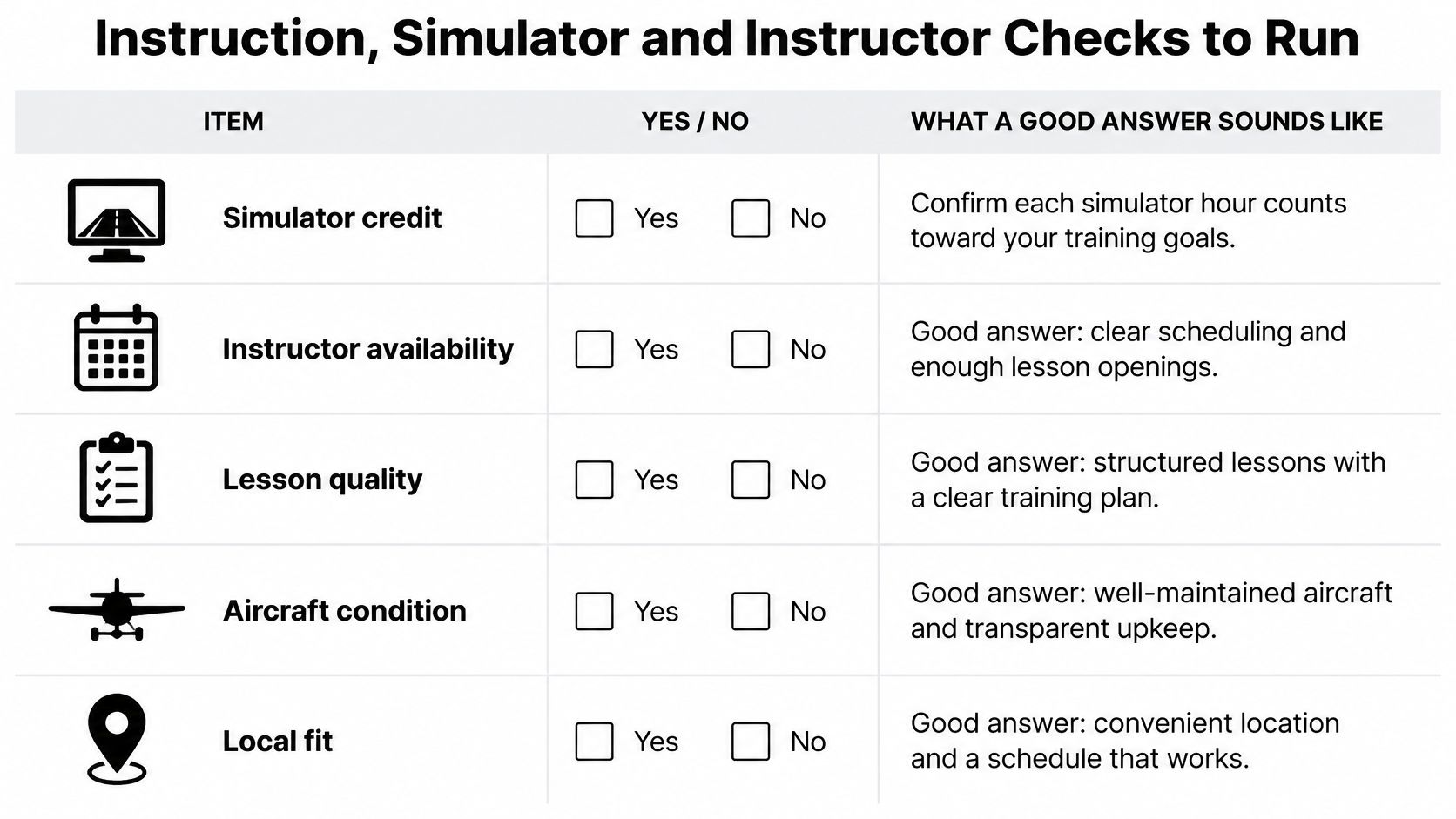
Mark each check yes or no, supported by a document or a specific explanation. For instructor availability, ask to see openings that match your schedule. For continuity, ask who takes over after an instructor departure and how your progress transfers.
Request written-exam completion information and documented student surveys alongside stage-check results. Ask how the school defines each measure, including whether the figures exclude students who withdrew. Inspect aircraft condition and ask how maintenance cancellations are communicated and rescheduled.
Our Career Track includes examiner scheduling, written-test preparation for every rating, and study materials. Students also receive textbooks, study guides, exam preparation, and a training portal with lessons, quizzes, stage checks, and a logbook.
Before committing, answer three decision questions:
- Will the training count? You understand the aircraft experience and authorized simulator credit.
- Can you progress consistently? Instructor access, maintenance backup, and checkride responsibilities are clear.
- Can you afford the transition? Your budget survives delayed completion and delayed paid instructing.
CFII offers discovery flights, private pilot lessons, and a Southern California Career Track for students pursuing the complete zero-to-CFII path. Visit CFII to arrange a first flight or discuss your training location, written program scope, and financial plan before committing.
Planning to fly for a living?
See what the path from zero to a pilot career looks like, what it costs and how long it takes.
Learn to fly in Riverside
We train at Riverside Municipal Airport in modern airplanes with a parachute built in. Start with a one hour discovery flight, no experience needed.