

On this page
- 1. Women in Aviation International Scholarships
- Make the application specific
- 2. The Ninety-Nines Amelia Earhart Memorial Scholarship
- Treat the award as one stage of the plan
- 3. Civil Air Patrol Cadet Programs and Scholarships
- Separate exposure from logged training
- 4. AOPA Foundation Scholarships
- Apply for a defined training milestone
- 5. EAA Aviation Foundation Scholarships
- Connect the award to what comes next
- 6. VA Education Benefits for Flight Training
- Confirm how benefits fit your sequence
- 7. Aviation-Specific Financing for Flight Training
- Borrow against a written plan
- How the seven commercial pilot training funding sources compare
- Building a Funding Stack That Fits Your Training Timeline
Aiming for a commercial certificate can feel straightforward until you price the whole route and realize one award may cover only a slice of it. You're starting with little or no flight time, but the funding plan has to reach well beyond the first lessons: through private-pilot training, instrument and commercial ratings, instructor qualifications, and the hours needed to progress.
Under 14 CFR § 61.129, an airplane single-engine commercial-pilot applicant generally needs at least 250 hours of flight time. A pilot exercising commercial privileges also needs at least a second-class medical certificate under 14 CFR § 61.23. That means your funding schedule must line up with your training schedule, not just get you into the cockpit.
The seven options below include scholarships, VA education benefits, and aviation-specific financing. For each, consider four practical questions: Who qualifies? When does the application open? What expenses can it pay? Can it be combined with other funding? Most individual awards won't cover a full commercial program, so plan to combine sources and confirm every award's terms before counting on it.
1. Women in Aviation International Scholarships
Decide which training stage you need funded before you open the Women in Aviation International (WAI) listings. WAI awards span many categories, and the one that fits a private-pilot candidate is rarely the one that fits someone working toward commercial or instructor ratings. An award for an early certificate does not automatically stretch to the later stages, so match each listing to the specific rating on your plan.
Check whether the award pays tuition or only fees before you plan around it. Each category sets its own window, eligibility rules, and covered expenses, and those details change between cycles. Read the listing for your category, note the deadline, and confirm what the money can be applied to before counting it in your budget. Ask whether it can be combined with other awards, since some restrict stacking and you need that answer before committing to a training start date.

Make the application specific
A strong application connects the money to a defined next step. Rather than saying you want to become a pilot, state the certificate or rating you are pursuing, show your logged progress, and explain how you will fund the remaining stages after the award is spent. Career changers should treat a WAI award as one stage of the plan, with savings or a carefully evaluated loan covering what it does not.
WAI events and member connections can put you in touch with mentors and working pilots, but treat that as a bonus rather than part of the funding math. For another award aimed at women in flight training, review this Women Soar scholarship information.
2. The Ninety-Nines Amelia Earhart Memorial Scholarship
Eligibility is the first thing to check, and the Ninety-Nines' rules set it. The Amelia Earhart Memorial Scholarship supports women pursuing aviation training, including flight training toward certificates and ratings, but which stage of training qualifies depends on the criteria in the current cycle. Read those rules before you count the award in your funding plan.
A local chapter can be useful well before you submit an application. Ask your chapter officer for a written list of what the award has paid for in past cycles, then compare it against the instruction, aircraft time, and fees in your budget. A student who joins a chapter, documents her progress, and gets feedback on her training plan submits a more concrete application than someone who waits until the deadline to explain a broad career ambition.

Treat the award as one stage of the plan
A single award rarely covers a full professional sequence. Write down the training goal, the expected next milestone, and what you will do if the award covers only part of that stage. If a certificate or rating costs more than the scholarship pays, the gap has to come from savings or another source you have already confirmed, not from optimism about a second application.
The scholarship's connection to Amelia Earhart gives it a distinctive place in aviation history, but that history does not tell you whether you qualify now. Check current requirements and deadlines through the organization's official resources, and review this Amelia Earhart Memorial Flight Training Scholarship overview for details on the opportunity.
3. Civil Air Patrol Cadet Programs and Scholarships
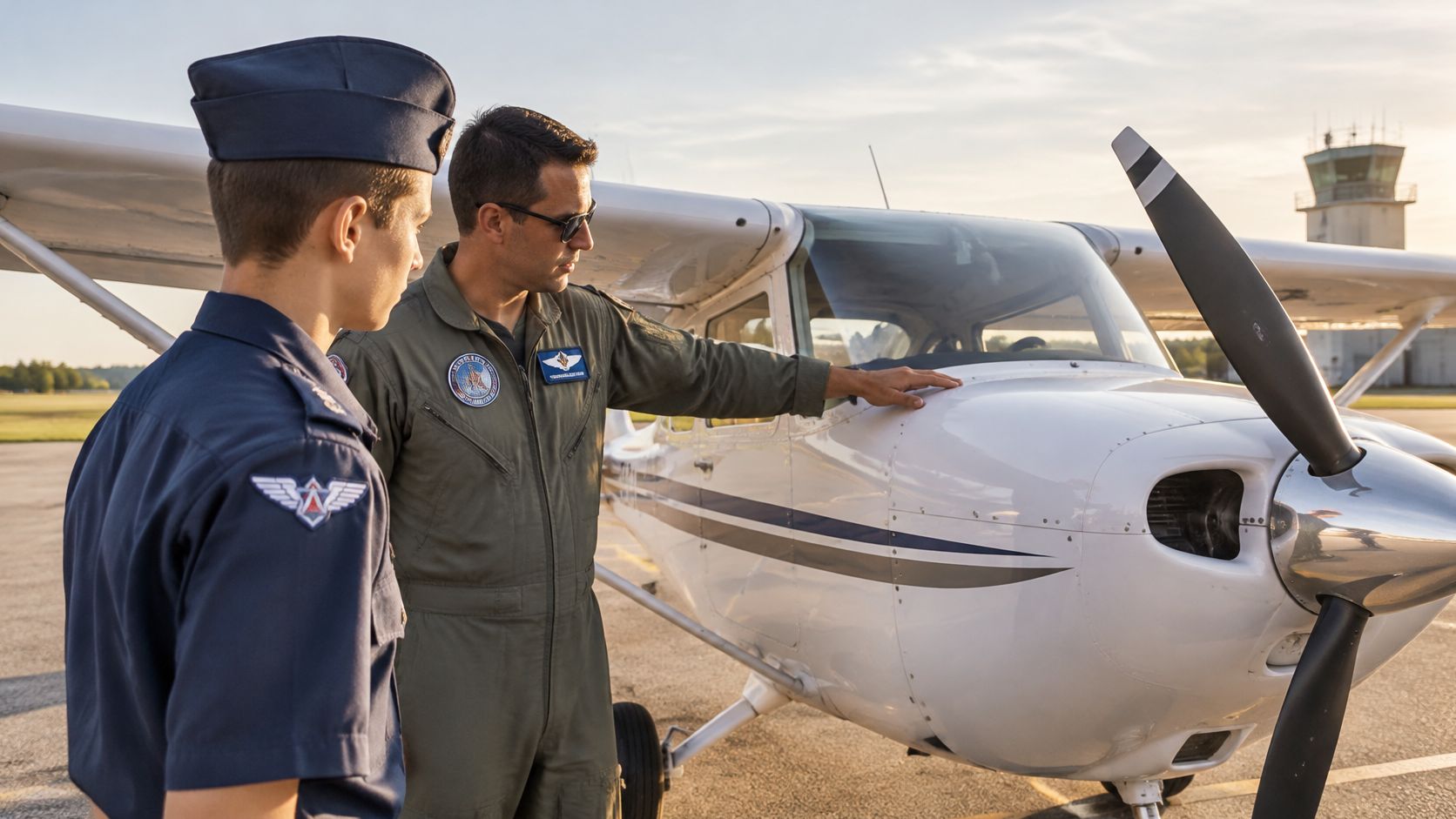
A CAP orientation flight belongs in your funding plan only after you know whether it can be logged as FAA flight time. Ask the instructor before the flight how it is classified, whether it qualifies as instruction, and what entry goes in your logbook. If the answer is experience only, treat it as exposure and give it no dollar value in your training budget.
Civil Air Patrol, the U.S. Air Force Auxiliary, gives cadets leadership structure and access to flight-related opportunities through local squadrons. Use it as an early layer in the stack: confirm who is eligible, which cycle is open, what the support pays toward, and whether it can sit alongside later scholarships or financing. Get those answers from the squadron in writing before you build a multi-year plan around them.
Separate exposure from logged training
A cadet can move from orientation flying and mentorship into private-pilot training with clearer goals and a stronger application story. The practical test is simple: does the next dollar pay for flight time, ground instruction, or checkride-related costs, and does it cover the milestone you are scheduling now. CAP can add discipline, contacts, and early confidence, but it does not by itself function as the full route to commercial employability, so pair any cadet support with funding aimed at the later ratings.
4. AOPA Foundation Scholarships
Almost 7,000 applicants competed for fewer than 400 awards in the AOPA Foundation's 2025 cycle. The AOPA Foundation's scholarship announcement reported $2.1 million awarded to nearly 400 recipients, with funding covering advanced training such as instrument, commercial, flight-instructor, and multiengine-instrument ratings.
That range of covered ratings matters if you are planning a career, because the program is not limited to first certificates. The applicant-to-recipient ratio matters just as much. Treat an AOPA application as a competitive bid, not guaranteed funding, and build your budget so the plan still works if you hear "no."
One AOPA-specific check belongs near the top of your list: membership timing. AOPA's scholarship materials require applicants to be members and to submit required documents by the deadline, so confirm whether membership must be active when you apply or only by the closing date, and join early enough that a processing delay cannot disqualify you. Prepare transcripts and references well before the window opens.
Apply for a defined training milestone
A clear application requests support for one stage: an instrument rating, commercial training, or an instructor qualification. Tie the requested funding to that stage, then show how you will finance the steps afterward. A scholarship that advances one rating is valuable, but it will not cover the remaining course sequence or the time-building a professional role requires.
Plan on any single AOPA award covering only part of a commercial program. Submit required materials early rather than gambling on a last-minute application, and keep the rest of your funding stack moving in parallel so a rejection costs you an option rather than a training start date.
5. EAA Aviation Foundation Scholarships
A private-pilot award can carry you to solo and still leave instrument, commercial, and instructor training unfunded. Run every EAA Aviation Foundation scholarship through the same four checks before you build it into a plan: who qualifies, when the application window opens, what it pays toward, and whether it stacks with other funding. Check one concrete gate early: confirm whether the award is restricted to applicants still working toward a first private pilot certificate.
EAA chapters can still be useful. Members can point you to local instructors, aircraft, events, and application feedback, and that access can shorten the time you spend researching options. Chapter access counts as research until the administrator confirms covered expenses and payment timing. Ask whether the award applies to a specific certificate or rating, which costs qualify, and how it treats other scholarships you may receive.
Connect the award to what comes next
If an award covers part of private-pilot training, write down the next unfunded milestones in order: instrument, commercial, instructor ratings, and the experience needed after them. If you are applying later in the sequence, make the rating the clear next step and show how the rest is financed. A strong application reads like a funding stack with dates, deadlines, and a defined use for each dollar.
Get requirements early and prepare a concise training plan with a defined milestone. Attend accessible EAA events for leads, then confirm terms directly with the scholarship administrator. For one specific opportunity to investigate, review the EAA Ray Aviation Scholarship information and verify its current requirements before you count it in the budget.
6. VA Education Benefits for Flight Training
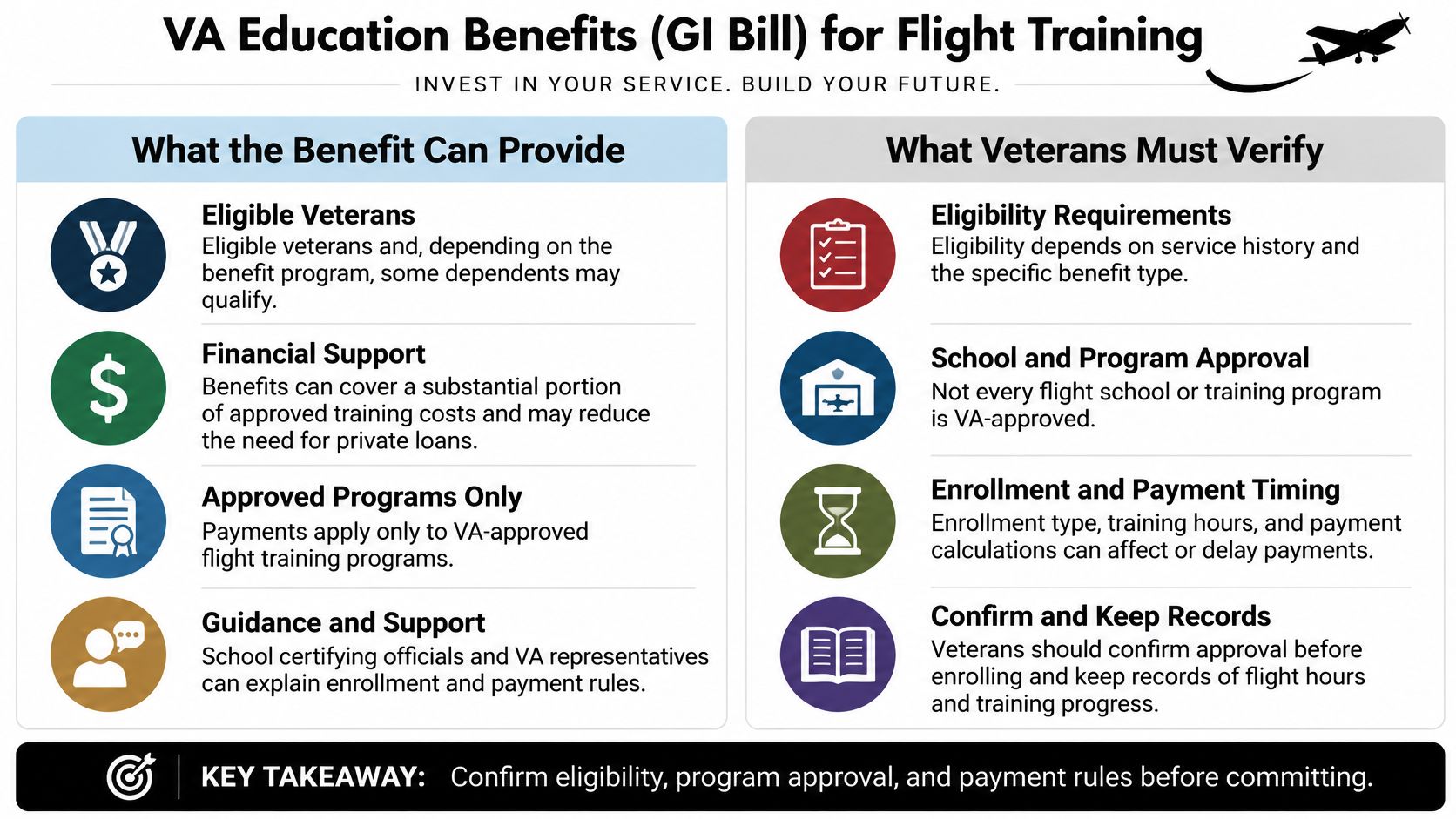
For eligible veterans, VA education benefits, including the Post-9/11 GI Bill and other programs, may help fund flight training. The main practical test is whether the training program and your enrollment meet VA requirements. Benefits don't automatically apply to any flight school or course, and payment depends on program approval and certification rules.
Before enrolling, speak with the VA and the school's certifying official. Ask whether the exact training you plan to take is VA-approved, how enrollment is reported, and how the applicable benefit will be paid. Get the answers in writing where possible, then compare them with your schedule and budget. A mistaken assumption about approval can leave you responsible for expenses you expected benefits to cover.
Confirm how benefits fit your sequence
A veteran might use benefits for a private and instrument training sequence, then need another funding source for commercial or instructor training. Whether that plan works depends on eligibility, approval, enrollment, and the program's rules. Don't budget on an assumed monthly amount or treat a general statement that a school accepts VA benefits as confirmation that your specific course qualifies.
Practical rule: Verify the exact program, benefit, and enrollment arrangement before signing a training contract or taking on other costs.
Keep records of training progress and flight hours, and ask the certifying official how each stage must be documented. If a scholarship is also available, ask both administrators whether the award can be stacked with VA benefits and whether it changes the amount or use of either funding source. Use this VA flight-training benefits video as a starting point for questions, not as a substitute for an eligibility determination.
7. Aviation-Specific Financing for Flight Training
A loan isn't a scholarship, but it can fill a gap when awards and savings don't cover the training plan. Stratus Financial offers aviation-focused financing for flight training, including a 12-month payment deferral, consideration beyond typical FICO metrics, and no prepayment penalties. Deferral can help with cash flow while you train, but it doesn't mean the borrowed amount is free or that interest stops accruing. Read the repayment terms before deciding.
Ask for the complete schedule: the amount financed, interest accrual during deferral, when payments begin, and what each payment covers. Then compare that offer with any scholarships, VA benefits, savings, and expected living expenses. A loan may cover training tuition but leave housing, transportation, equipment, or everyday costs outside the financed amount.
Borrow against a written plan
For example, you could combine a partial scholarship with financing to cover the remaining training expenses, but only after confirming the award's conditions and loan costs. Put tuition, housing, living costs, and any expenses not covered by the award into the same budget. If your plan depends on a perfect training schedule or immediate income after graduation, revisit the assumptions before borrowing.
CFII's Career Track is a fixed $89,000 tuition, takes about nine months from zero time to CFII and multiengine, and includes 282 total hours and six certificates and ratings. Training is based in Southern California, including Riverside, Long Beach, and Corona. If you're considering a fixed-price course, compare its stated inclusions with the costs your funding sources will cover, and confirm loan terms before committing.
How the seven commercial pilot training funding sources compare
Judge every funding source on the same four tests: who qualifies, when the application window opens, what the money pays toward, and whether it stacks with other funding. Applied across the seven options, those tests show one pattern quickly. Most of them pay for part of a commercial program, which matters when the program carries a fixed price like $89,000.
| Funding source | What it pays toward | Can it stack? | Confirm before counting it |
|---|---|---|---|
| Women in Aviation International scholarships | Tuition, flight training, or related costs, depending on the individual award | Generally yes; each award sets its own rules | Which costs the specific award covers and when its window opens |
| Amelia Earhart Memorial Scholarship (The Ninety-Nines) | Flight training and pilot certificates | Usually; confirm the current cycle's terms | Whether it pays tuition or only fees |
| Civil Air Patrol cadet programs | Flight scholarships or training assistance, subject to availability | Unknown; your wing sets the answer | What your wing offers this year and which expenses it covers |
| AOPA Foundation scholarships | Aviation education or training | Usually; confirm the award's conditions | Whether it funds your current stage of training |
| EAA Aviation Foundation scholarships | Aviation education, careers, or flight training | Usually; confirm the award's conditions | Whether it restricts holding other funding at the same time |
| VA education benefits | VA-approved flight training | Possible under program rules | That the program and your enrollment qualify under your specific benefit |
| Aviation-specific financing (Stratus) | Approved training costs, with a 12-month payment deferral option | Yes; a loan fills whatever scholarships leave | The repayment schedule and which costs sit outside the financed amount |
VA benefits and financing behave differently from the five scholarship programs. For eligible veterans, benefits can cover more of the bill than a single award typically does. Financing covers whatever remains, at the cost of repayment with interest. I would treat every scholarship as a reduction in the price, then size the rest of the plan around what is left.
Building a Funding Stack That Fits Your Training Timeline
Work backward from your total cash need. Start with program tuition, then add living costs, gear, and exam fees, and treat every scholarship as a partial contribution against that figure rather than a solution on its own. A worked example: at $89,000 tuition plus nine months of shared housing at $1,300 per month, the cash requirement is roughly $100,700 before an iPad, headset, and flight bag. Even a strong award year leaves most of that to financing, so the loan terms matter as much as the application deadlines.
For each award you pursue, write down four things: who qualifies, when the window opens, what the money can pay for, and whether the organization's rules let it sit alongside your other funding. Then map those awards onto training stages. Under 14 CFR § 61.129, a commercial applicant generally needs at least 250 flight hours, and an award earmarked for private pilot training does nothing for the instrument or commercial stages that follow. Assign each dollar a stage so a partial award lands where it helps instead of bunching up early.
Recurring applications deserve a deadline calendar, with documents prepared before the window opens. Membership, age, or certificate conditions can disqualify an otherwise strong submission, so check them against your own profile first. Veterans should confirm the exact program approval and enrollment details before training begins. Borrowers should read the full repayment schedule, interest accrual during deferral, and any prepayment terms.
Once the budget is set, hold training programs to the same list of questions: what is included, what is not, how many hours and ratings the price covers, and which costs land on you separately. CFII's Career Track is one benchmark to test your math against, a fixed $89,000 tuition for six certificates and ratings over about nine months, laid out on the Career Track program page. Ask each school for its total price in writing, then check whether your stack covers it with room for the expenses tuition excludes.
Set your next steps now: confirm eligibility for each award, build the deadline calendar, request a written training budget, and size the loan to the gap your scholarships leave open.
Planning to fly for a living?
See what the path from zero to a pilot career looks like, what it costs and how long it takes.
Learn to fly in Riverside
We train at Riverside Municipal Airport in modern airplanes with a parachute built in. Start with a one hour discovery flight, no experience needed.