

On this page
- 1. Liberty University School of Aeronautics
- What the approval really buys you
- 2. Embry-Riddle Aeronautical University
- Where it works, and where it doesn't
- 3. University of North Dakota, John D. Odegard School of Aerospace Sciences
- Why UND feels different in practice
- 4. Southern Utah University Aviation
- The real value is in the rotor-wing fit
- 5. Utah Valley University, School of Aviation Sciences
- The catch is location lock-in
- 6. Western Michigan University, College of Aviation
- A school that tells you the numbers early
- 7. Middle Tennessee State University, Department of Aerospace
- Why process matters here
- 8. US Aviation Academy
- Best for students who want speed and a defined career track
- 9. Coast Flight Training
- The limits are the same ones veterans keep running into
- 10. Mauna Loa Helicopters
- Why the training environment matters here
- Top 10 Flight Schools Accepting the GI Bill, Comparison
- Verify Approval Before You Enroll
You're staring at a flight school site that says GI Bill accepted, and that looks like the finish line. It isn't. The approval might cover a degree program, a specific campus, only advanced ratings, or a vocational track that still leaves you paying for the first step, and the school's own language usually tells the true story faster than the homepage does.
This list sorts flight schools that accept the GI Bill by what their approval pays for, what it excludes, and where the school's published limits appear. For flight training, the rules that matter most are the Post-9/11 vocational cap, the fact that Chapter 33 doesn't generally cover Private Pilot training in vocational setups, and whether the school participates in Yellow Ribbon for eligible students. Every entry below links to the school's own program page so you can verify the approval before you sign anything.
1. Liberty University School of Aeronautics
Liberty works best when you want a degree path first and flight training attached to it. The school's model pairs online academics with in-person Part 141 flight labs through approved Flight Training Affiliates, so the GI Bill question isn't just “Is Liberty approved?” It's “Which affiliate, which course, and which rating are approved at that site?” Liberty's School of Aeronautics page makes that affiliate structure part of the pitch, and that matters because approval can vary by location and by rating.

What the approval really buys you
The advantage here is flexibility. You can often stay closer to home while working toward a four-year aviation degree, and eligible students may be able to pair GI Bill benefits with Yellow Ribbon support. Liberty also publishes VA-related documentation, affiliate lists, and hour matrices, which helps you check whether a course is certifiable before you show up with bags packed.
Practical rule: treat the affiliate as the real school for VA purposes. If the affiliate and the rating aren't approved together, the marketing page doesn't help you.
The downside is just as practical. Not every affiliate accepts VA benefits for every course, and Private Pilot training usually isn't the piece Chapter 33 funds in a vocational setup. Liberty makes more sense for veterans who want a structured university environment and are willing to verify each moving part, rather than those who want one blanket yes for every flight hour. If you're trying to compare GI Bill payment structure against other ways to pay for flight training, the internal overview at how to pay for flight school is useful background.
2. Embry-Riddle Aeronautical University
Embry-Riddle's strength is simple. It has the aviation name many employers recognize, plus residential campuses in Daytona Beach and Prescott and a Worldwide campus for students who need a different setup. The school accepts GI Bill benefits and participates in Yellow Ribbon, but its own veteran guidance also warns that the benefit may not cover every flight activity fee. That warning matters more than the brand name.
Embry-Riddle's veteran benefits page is the first thing to read if you're trying to match the campus to the benefit. The structure is degree-based, with flight labs built into the program, so it suits students who want a university environment, veteran services offices, and a cleaner academic path around the flying.
Where it works, and where it doesn't
Embry-Riddle is a good fit if you want a well-known school and you're okay with a more formal, more expensive environment. The trade-off is that GI Bill support may not absorb every flight-related charge, so you need to look beyond the headline approval and read the fee language carefully.
You're not buying a logo, you're buying a payment structure. At Embry-Riddle, the structure is strong, but the uncovered pieces still matter.
The school also tends to reward students who are comfortable in a university setting. That's a plus for some veterans and a drag for others. If you want a campus with strong veteran support and a broad aviation network, it's a serious contender. If you want the leanest route to certificates and ratings, the administrative overhead may feel heavier than you want.
3. University of North Dakota, John D. Odegard School of Aerospace Sciences
UND is one of the clearest examples of why the phrase GI Bill accepted needs a second look. Its aviation program sits inside a major public university, and Chapter 33 Tuition and Fees can include degree-required flight training at UND. That makes the funding conversation more straightforward than at many standalone flight schools, because you're looking at a degree program with published cost structures rather than a loose training promise. UND Aerospace is the page to start with.
The public-school angle matters for non-resident students too, because eligible students may have Yellow Ribbon support. The school also lays out veteran and military guidance around how Chapter 33 is applied, which helps you understand what is and isn't part of the certification process before you arrive in Grand Forks.
Why UND feels different in practice
UND's operation has a mature, airline-style feel. That's a plus if you want structure, defined flight-lab sequencing, and a path that can support later airline goals. It also means you need to plan ahead. Flight blocks can be in demand, and North Dakota weather can slow the pace enough that you need realistic timing assumptions from day one.
Use the comparison of training models at Part 61 versus Part 141 if you're still deciding whether a university aviation department is the right frame for your GI Bill plan. UND is strongest for students who want the degree, the scale, and the campus resources. It's weaker for students who want maximum scheduling freedom or who need a warm-weather pace year-round.
4. Southern Utah University Aviation
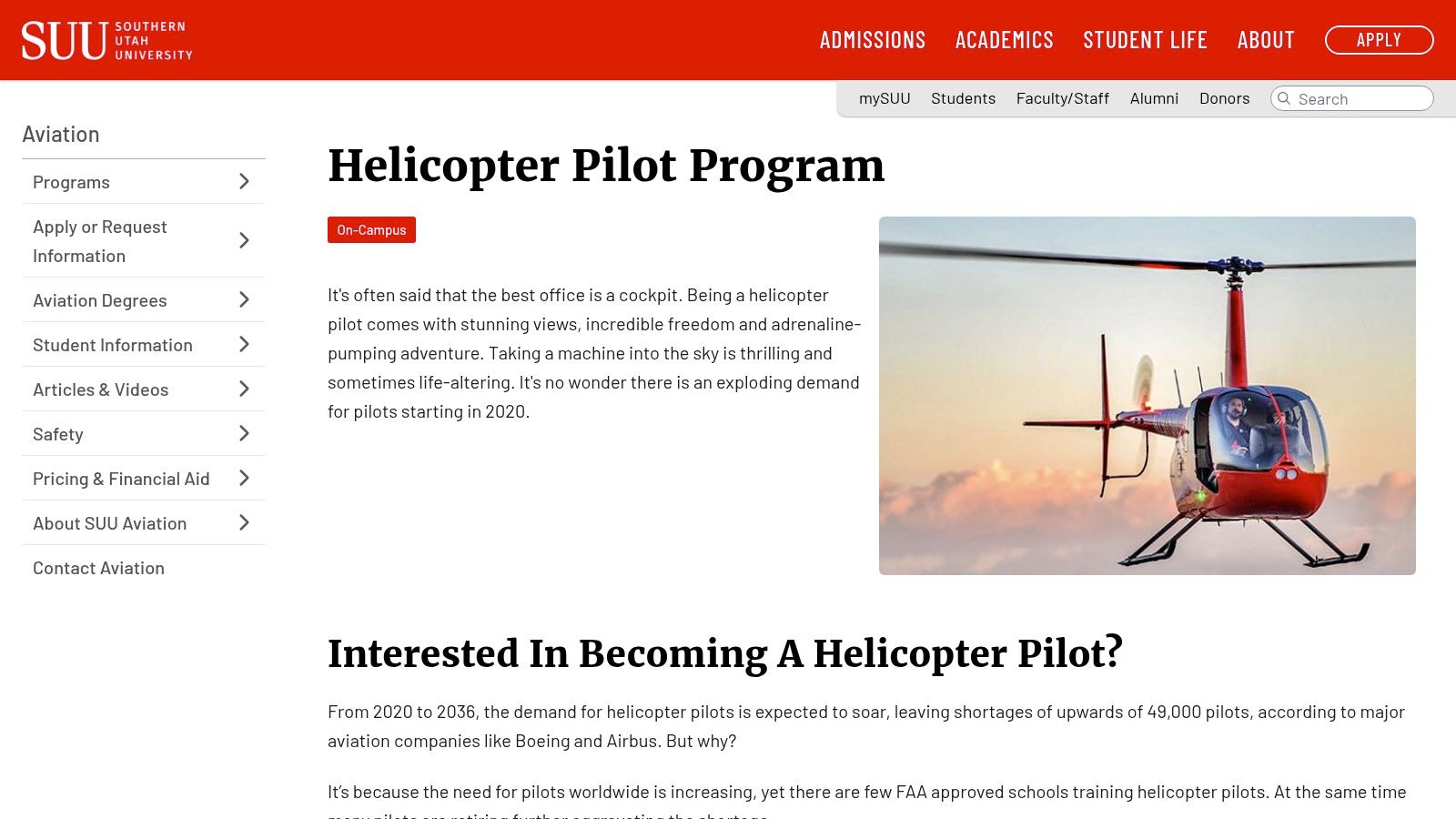
Southern Utah University is one of the few university programs where the helicopter side gets real attention instead of a token page. SUU offers a VA-approved AAS in Aviation Technology with fixed-wing and rotor options, a large collegiate helicopter fleet, and clear veteran guidance through its support services. Start with the school's helicopter aviation page at SUU Aviation if rotor-wing training is part of your plan.
The real value is in the rotor-wing fit
That helicopter emphasis is a genuine differentiator. Many schools say they do “aviation,” but a lot of them are really fixed-wing programs with a helicopter add-on. SUU's setup is more serious than that, and the VA approval is tied to the approved aviation programs rather than a vague blanket promise.
The trade-off is timing. Flight-lab availability can affect when you start, and not every GI Bill chapter covers every flight cost the same way. SUU's own guidance notes restrictions, which is exactly the kind of detail veterans need before committing.
Practical rule: if helicopter training is your goal, check the fleet and the lab calendar before you check the brochure.
SUU is a good fit for veterans who want a documented university path, a strong rotor-wing culture, and a campus that treats aviation as a real academic and training discipline. It's less attractive if you want to start immediately, skip the degree component, and move as fast as possible through ratings.
5. Utah Valley University, School of Aviation Sciences
UVU gives you a hybrid structure that some veterans like a lot. You can work through online pro-pilot academics while completing on-campus Part 141 flight labs in Provo, and the school publishes veteran guidance about which flight courses can be certified under Post-9/11. That matters because the GI Bill question isn't just whether UVU is approved, it's whether your flying has to happen at the Provo flight school for the benefit to apply. UVU's flight school page lays out that requirement.
UVU also offers an R-ATP authorization at 1,000 hours for qualified graduates, which makes the degree pathway more useful for students who already know they want the airline track. The combination of online academics and a local flight school is practical if you're balancing family, work, or military obligations.
The catch is location lock-in
For Post-9/11 GI Bill purposes, UVU requires flying at its Provo flight school, not at any affiliate. That narrows flexibility, but it also simplifies the approval question. You know where the training is supposed to happen, and you know which site the benefit is tied to.
The other practical constraint is capacity. Advanced flight stages can be tight, so don't assume that a published pathway means open slots whenever you're ready. UVU is a strong fit for students who want a public-school path with online flexibility, clear veteran guidance, and a direct route toward commercial flying. It's not the best choice if you need a lot of campus or airport flexibility.
6. Western Michigan University, College of Aviation
Western Michigan University stands out because it publishes the kind of documents veterans should ask for everywhere else. Its flight fee sheets and catalog addenda explain how Post-9/11 covers minimum required flight hours and mandatory flight course fees, which makes budgeting much less speculative. That's why WMU belongs on a shortlist of flight schools that accept the GI Bill. Start at WMU Aviation and read the fee language before you do anything else.

A school that tells you the numbers early
That published fee structure is the point. If you're trying to use GI Bill benefits without getting surprised halfway through a lab sequence, WMU's paperwork makes the process easier to model. The school also has dedicated military and veterans resources, which helps when you're trying to line up certifications, enrollment timing, and benefit paperwork.
The best VA schools don't just accept the benefit. They show you how the benefit gets applied.
The trade-off is access. Initial flight start dates can be competitive, and Michigan weather can slow flying in some seasons. That's not a small issue if your schedule is tight. WMU fits students who value documentation, a mature Part 141 environment, and a degree-plus-flight structure that's easier to budget than many marketing pages would suggest. If you're comparing school versus academy culture, the overview at flight school versus college is worth reading alongside WMU's own materials.
7. Middle Tennessee State University, Department of Aerospace
MTSU is a public university program with a university-owned fleet, integrated flight labs, and a veteran support network through the Daniels Veterans & Military Family Center. It also maintains flight-training guides for GI Bill certification and documents the process for certifying flight labs. If you want a school that has clearly thought through the VA paperwork side, MTSU Aerospace is a strong place to look.
The appeal here is procedural clarity. Some schools want to talk about brand and career outcomes first. MTSU gives you the process first, which is useful if you've already learned that VA certification doesn't happen by accident.
Why process matters here
University-owned aircraft and structured flight labs can make a program feel more predictable, but that doesn't mean every seat is instantly available. Flight lab demand can create wait times, and you'll still need to apply within the posted windows. Some fees beyond the minimum required hours may also fall outside GI Bill coverage, so the published guidance matters more than the headline approval.
MTSU is a good fit for veterans who want a large student footprint, clear veteran-oriented systems, and a public-school environment with regional airline connections. It's less ideal if you need fast scheduling or if you're trying to avoid university timelines altogether. The school's practical advantage is that the paperwork culture appears to be built into the program, not stapled on afterward.
8. US Aviation Academy
US Aviation Academy is one of the clearest examples of a vocational school that tells you what the GI Bill can and can't do. That honesty matters because the school doesn't hide the difference between collegiate and vocational funding. Its own materials explain the Post-9/11 vocational cap and how benefits apply at designated campuses, which is exactly the sort of detail veterans need before they choose a location. US Aviation Academy is the place to verify the campus you're using.
Best for students who want speed and a defined career track
This is a focused career-pilot school, not a broad campus experience. The upside is clarity and acceleration. If you already know you want a vocational path, US Aviation Academy can be a direct route into advanced ratings and airline-ready training.
The downside is equally direct. Private Pilot usually isn't covered under Chapter 33 in the vocational track, and approval varies by campus. That means the benefit can be useful, but only if you match the right chapter, the right campus, and the right starting point. If you expect one approval to cover every lesson, this is the kind of school that will force a reality check quickly.
Practical rule: vocational approval is a campus-level question, not a brand-level question. Ask for the campus name in writing before you enroll.
US Aviation Academy makes sense for veterans who want a structured vocational path and are willing to do the benefit verification work themselves. It's not the best fit for someone who wants a degree-first model or who needs the Private Pilot phase covered by the same benefit package.
9. Coast Flight Training
Coast Flight Training is another vocational option that deserves attention because it has multiple U.S. locations and publishes VA-benefit guidance for advanced ratings and career-path training. The key detail is that approval varies by site, so the school's own language makes clear you need to confirm the exact campus. Start with Coast Flight Training's VA page and check the location you're considering.
The appeal is geographic flexibility. If you may relocate or if you need to compare California and Texas options, that flexibility can matter a lot. Coast also positions itself around career readiness, which is useful if you're already past the “what is a flight school” stage and thinking about a professional pilot path.
The limits are the same ones veterans keep running into
Like other vocational programs, Coast sits under the Chapter 33 vocational cap, so you need to model how far the benefit goes before you commit. Private Pilot isn't the covered starting point for that track either, so this isn't the cleanest answer for someone starting from zero and expecting one GI Bill rule to cover all training.
The upside is that the school has experience guiding students through Chapter 33 vocational processes. That can save time if you're already past the private certificate hurdle and want a school that understands advanced-rating sequencing. Coast is a good fit for veterans who may move, want a career-focused environment, and are comfortable verifying approval at the exact location they plan to use.
10. Mauna Loa Helicopters
Mauna Loa Helicopters is a strong choice if you want helicopter training in Hawaii and you care about how the school explains its VA setup. It's ACCSC-accredited, FAA Part 141, and VA-approved, and its own benefits language spells out which VA chapters it accepts and how the Post-9/11 vocational cap applies. Mauna Loa Helicopters' flight training page is the page to read before you think about moving.
Why the training environment matters here
The year-round flying weather is a practical advantage, not a marketing slogan. Consistent weather helps training move steadily, especially in a helicopter environment where regular practice matters. The school also offers instrument and instructor-level helicopter courses, which makes it relevant for students who are past entry-level flying and need a serious progression path.
The downside is obvious. Hawaii brings relocation pressure and a higher cost of living, so GI Bill users still need to think about out-of-pocket expenses beyond tuition. The school is transparent about the vocational cap, which is helpful, but it doesn't erase the budget reality.
If the approval is clear but the relocation bill is not, you still need a second plan.
Mauna Loa is a good fit for students who want a clearly documented helicopter program and consistent flying conditions. It's not the easiest option, but it is one of the clearest on benefit language and training environment.
Top 10 Flight Schools Accepting the GI Bill, Comparison
| Program | Delivery & Core Offering | VA / Cost & Financing 💰 | Career Path & Quality ★ / Outcomes 🏆 | Unique Selling Points ✨ | Target Audience 👥 |
|---|---|---|---|---|---|
| Liberty University School of Aeronautics | Online B.S. + local Part 141 flight labs via approved affiliates | 💰 Yellow Ribbon participation; publishes VA-approved affiliate list & hour matrices | ★★★ Degree-embedded flight training; train near home 🏆 | ✨ Clear VA docs & affiliate approvals | 👥 Veterans seeking a degree + local flight training |
| Embry‑Riddle Aeronautical University | Residential & Worldwide campuses with integrated Part 141 flight labs | 💰 Accepts GI Bill + Yellow Ribbon; GI may not cover all activity fees | ★★★★★ Strong industry reputation & recruiting pipelines 🏆 | ✨ Extensive veteran services & campus resources | 👥 Students seeking top-tier aviation degree & network |
| University of North Dakota (UND) | Large Part 141 degree programs with integrated flight labs | 💰 Chapter 33 can cover degree-required flight training; published costs | ★★★★★ Airline-style training; R‑ATP pathways available 🏆 | ✨ Mature, airline-oriented operation | 👥 Aspiring airline pilots seeking robust training |
| Southern Utah University (SUU) | VA-approved AAS (fixed-wing & rotor) with university fleet | 💰 VA-approved but coverage varies by chapter; some costs restricted | ★★★★ Strong rotor/heli emphasis; career-focused pathways 🏆 | ✨ Large collegiate helicopter fleet | 👥 Students targeting helicopter careers or rotor training |
| Utah Valley University (UVU) | Online academics + on‑campus Part 141 flight labs (Provo) | 💰 Publishes veteran guidance; Post‑9/11 requires Provo for certification | ★★★★ R‑ATP authorization at 1,000 hrs for qualified grads 🏆 | ✨ R‑ATP pathway & strong airline partnerships | 👥 Online learners wanting degree + airline track |
| Western Michigan University (WMU) | Large Part 141 collegiate program with structured curricula | 💰 Transparent "GI Bill Flight Fees" sheets & veteran resources | ★★★★ Safety-focused university environment; predictable planning 🏆 | ✨ Published fee schedules for budgeting | 👥 Students who value transparency & safety-first training |
| Middle Tennessee State University (MTSU) | University-owned fleet + integrated Part 141 flight labs | 💰 Flight-training guides for GI Bill certification; veteran center support | ★★★★ Regional airline connections & practical pathway 🏆 | ✨ Clear VA certifying processes & veteran services | 👥 Veterans and students targeting regional airlines |
| US Aviation Academy | Part 141 vocational multi-campus career tracks | 💰 VA-approved Chapter 33 at select campuses; vocational cap applies | ★★★ Accelerated vocational route to advanced ratings 🏆 | ✨ Clear guidance on Post‑9/11 vocational cap | 👥 Career-focused students seeking fast pipelines |
| Coast Flight Training | Part 141 vocational programs across multiple U.S. locations | 💰 VA approval varies by campus; subject to vocational cap limits | ★★★ Career-path curricula aimed at airline readiness 🏆 | ✨ Geographic flexibility (CA & TX) and Chapter 33 experience | 👥 Relocating veterans / vocational career-track students |
| Mauna Loa Helicopters | ACCSC-accredited Part 141 helicopter school (Hawaii campuses) | 💰 VA-approved with published rules; vocational cap applies | ★★★★ Year-round helicopter training; instrument & instructor courses 🏆 | ✨ Consistent weather + clear VA chapter guidance | 👥 Aspiring helicopter pilots wanting steady weather training |
Verify Approval Before You Enroll
Before you sign an enrollment agreement, ask the school's VA certifying official for written confirmation of three things, which courses and ratings are approved at your specific campus or affiliate, how the Post-9/11 vocational cap applies to your chapter, and which flight fees fall outside the benefit. That last piece is where a lot of veterans get burned, because a school can be “GI Bill accepted” and still leave you paying for fees, hours, or a prerequisite certificate the benefit doesn't cover.
Use this list to narrow your search to two or three programs, then compare the full out-of-pocket cost for each one, including housing and relocation. If you're looking at a degree path, a public university with published fee rules may be easier to budget than a vocational school with location-specific approvals. If you're comparing accelerated training options, CFII's Career Track is one fixed-price benchmark at $89,000 tuition for about nine months, though whether it accepts GI Bill benefits should be confirmed directly with the school. The point isn't to pick the cheapest headline, it's to pick the approval structure that fits your starting point.
A good school will answer the hard questions in writing. A weak one will keep everything vague until after you've paid. That's the difference between a useful approval and a marketing line.
CFII is built for pilots who want a structured, accelerated path from zero experience to CFII with predictable pricing and coordinated training. If you're comparing flight schools that accept the GI Bill, visit CFII to review the Career Track and decide whether a fixed-price program fits your training plan.
Planning to fly for a living?
See what the path from zero to a pilot career looks like, what it costs and how long it takes.
Learn to fly in Riverside
We train at Riverside Municipal Airport in modern airplanes with a parachute built in. Start with a one hour discovery flight, no experience needed.