
On this page
- How Hard Flight School Really Is
- What a Checkride Grades
- One flight, three jobs at once
- The Ground School Work Between Flights
- Why memorizing answers backfires
- The Stages That Feel Hardest
- Instrument flying removes your favorite reference
- Commercial and instructor standards tighten the screws
- When Delays Make Training Harder
- Questions that expose friction before you pay
- Medical, Age Gates and Weekly Habits
- Choose a Discovery Flight or a Full-Time Path
CFII's zero-to-instructor Career Track totals 282 hours of flight and simulator time. That number is the first clue to how hard flight school is: the work is a sequence of lessons built on consistency. At zero hours, the question comes down to three parts. Can you learn aircraft control, pass the written and oral tests, and keep showing up on a schedule steady enough for those skills to stick?
Many students find the third part hardest, and the reasons are practical. An instructor leaves, an airplane goes into maintenance, weather cancels a lesson, or an examiner's calendar fills. A structured syllabus protects your continuity without lowering the FAA standard, the way a route map keeps you moving toward the same destination even when traffic forces a detour.
How Hard Flight School Really Is
The first choice that shapes difficulty is the rulebook you train under. Part 61 gives schools and independent instructors flexibility in lesson order, as long as you meet each FAA requirement. Part 141 means the school follows an FAA-approved course with its own syllabus and its own minimum hours. Both paths end at the same certificate and the same practical standards. The difference is how tightly your lessons are sequenced.
That sequencing matters because continuity decides progress more than talent does. Instructors change jobs, airplanes go down for maintenance, weather cancels a week, and examiners book out. A standard syllabus keeps your next lesson ready when life interrupts, so you return to a plan instead of starting over.
For the U.S. private pilot certificate, the FAA guide to hourly requirements for becoming a pilot sets the legal minimum at 40 flight hours, including at least 20 hours with an authorized instructor and 10 hours of solo flight. That same minimum curriculum includes 3 hours of cross-country flight, 3 hours of night flight, and 3 hours of instrument training. One student may learn landings fast and need extra flights for radio calls. Another may fly well and lose sharpness after two rained-out weeks. Extra practice is normal.
Hobby students taking two or three lessons per week typically reach the private pilot checkride in four to six months, paying lesson by lesson. A career path continues past that first certificate. The table below maps that longer ladder.
| Stage | Regulatory floor | Real-world marker | Why it feels hard |
|---|---|---|---|
| Private pilot | 40 flight hours, including 20 with an instructor and 10 solo | Many students finish above the minimum | Control, radio work, and judgment on one checkride |
| Instrument rating | Ground and flight training plus knowledge and practical tests under 14 CFR 61.65 | Repeated practice on approaches and clearances | Flying by instruments while managing workload |
| Commercial pilot | 250 total hours under Part 61 | Hiring minimums sit higher than this floor | Tighter performance standards after the private certificate |
| Flight instructor | Separate instructor knowledge and practical tests | Another full certificate, not a logbook endorsement | You must teach the maneuver, not only fly it |
| Airline hiring | 1,500 hours for the Airline Transport Pilot certificate | Typical hiring experience is well above entry minimums | A long period of time-building after the certificates |
Earning the right to be paid to fly is not the same as being hired by an airline. Airlines commonly expect substantially more experience than the FAA commercial minimum, so a certificate alone does not equal a job offer.
Technical skill and endurance are separate challenges. Each stage adds new maneuvers and tighter tolerances while total experience keeps growing. The useful question is practical. Can you fly often enough, in a clear order, to reach a published standard and hold it on checkride day.
What a Checkride Grades
A short cross-country leg shows what a checkride grades. You plan the route, brief the weather, and launch. Ten miles out, the examiner asks why you chose that altitude, then assigns a diversion and a simulated engine roughness. You turn, trim, run the checklist, talk on the radio, and hold your altitude within standards while explaining each choice. A clean maneuver alone does not carry the day if you cannot explain the decision behind it or say what you would do when conditions change.
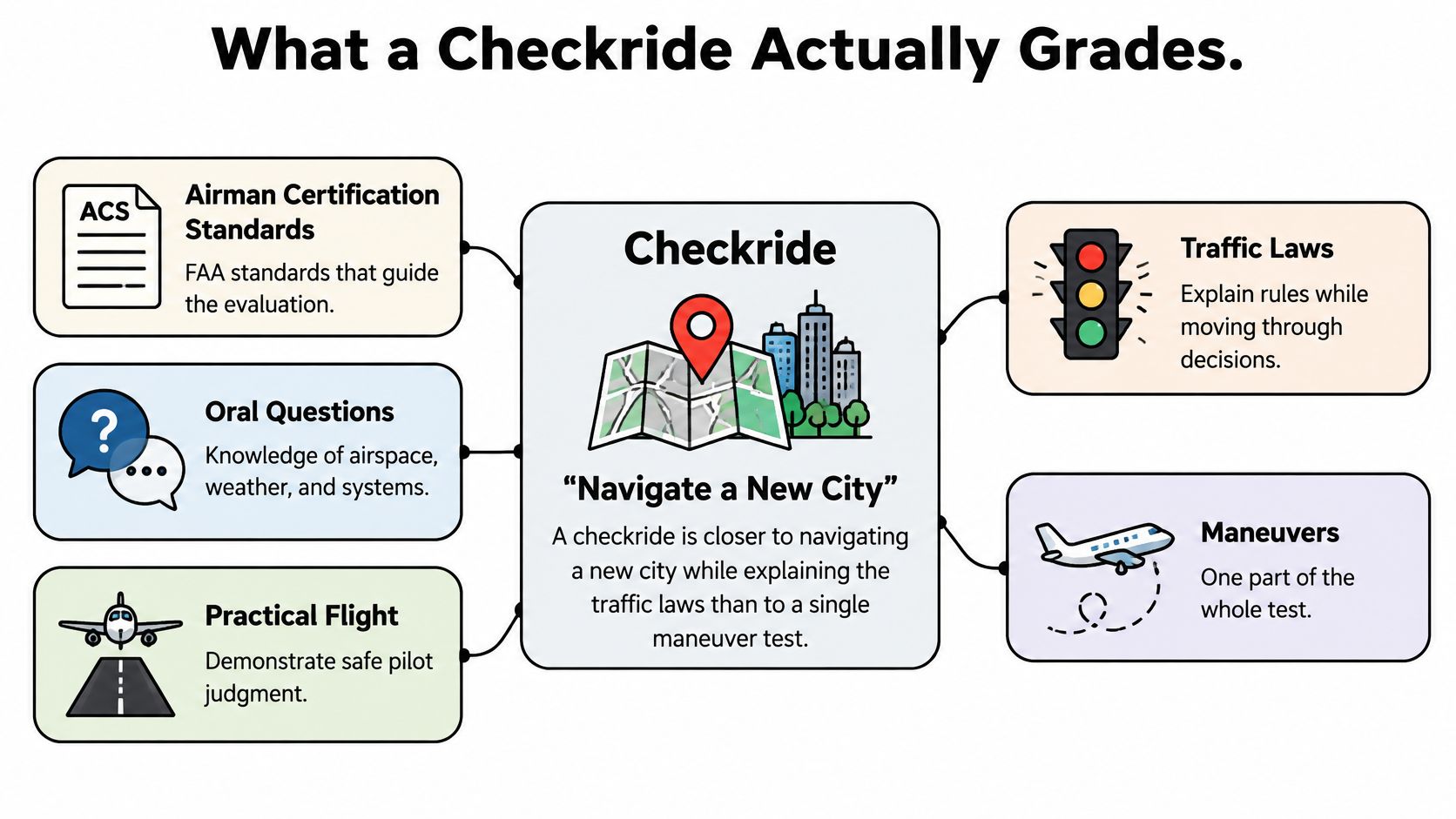
The FAA Airman Certification Standards, usually shortened to ACS, grade three competencies at once: aeronautical knowledge, practical skill, and risk management. The FAA publishes separate ACS documents for private, instrument, commercial, and flight-instructor examinations. Each certificate adds tasks and tighter tolerances, so progress means a wider set of standards to meet, not merely more hours in a logbook.
One flight, three jobs at once
Your knowledge job covers regulations, meteorology, aircraft systems, navigation, performance, and human factors. The examiner can probe any of it. Your skill job is flying the airplane while you manage radio communication, traffic, checklists, navigation, weather, fuel, and airspace. Your risk job runs underneath both, because you must notice a building headwind or a dropping fuel margin early and act before it becomes a problem.
Then the examiner introduces an abnormal situation. If you fixate on it and let altitude or heading wander, you have shown the weakness the ACS is built to catch. Flying the aircraft is one task in a stack, and that stack is what feels heavy on checkride day. A structured syllabus makes the stack predictable, but it does not lower the standard.
The knowledge portion also leaves a paper trail. Under 14 CFR §61.105 on private pilot aeronautical knowledge, a private-pilot applicant must complete ground training or an approved home-study course covering specified aeronautical-knowledge areas. The subjects include regulations, airspace, weather, navigation, aircraft operations, and aeronautical decision-making.
For every lesson, write three columns before you fly: the ACS task, the main risk you will manage, and the knowledge you should be able to say out loud without notes.
Build your preparation around those columns. Study the lesson before the flight, rehearse flows and radio calls on the ground, then debrief against the same three columns afterward. Our guide to private pilot checkride preparation walks through that structure in detail. Short, consistent preparation beats an occasional marathon session, because overloaded working memory makes a poorly prepared flight an expensive way to learn what a chair and a checklist could have taught you.
The Ground School Work Between Flights
Ground school is a scored subject, not a pamphlet to skim in the parking lot. The FAA 2023 knowledge-test statistics reported a 90.53% national pass rate for the Fundamentals of Instructing examination, with 12,929 tests recorded. Read that as a reported pass rate, and notice what it implies. Roughly one in ten recorded tests didn't pass, on an exam taken by people who had already come far in training.
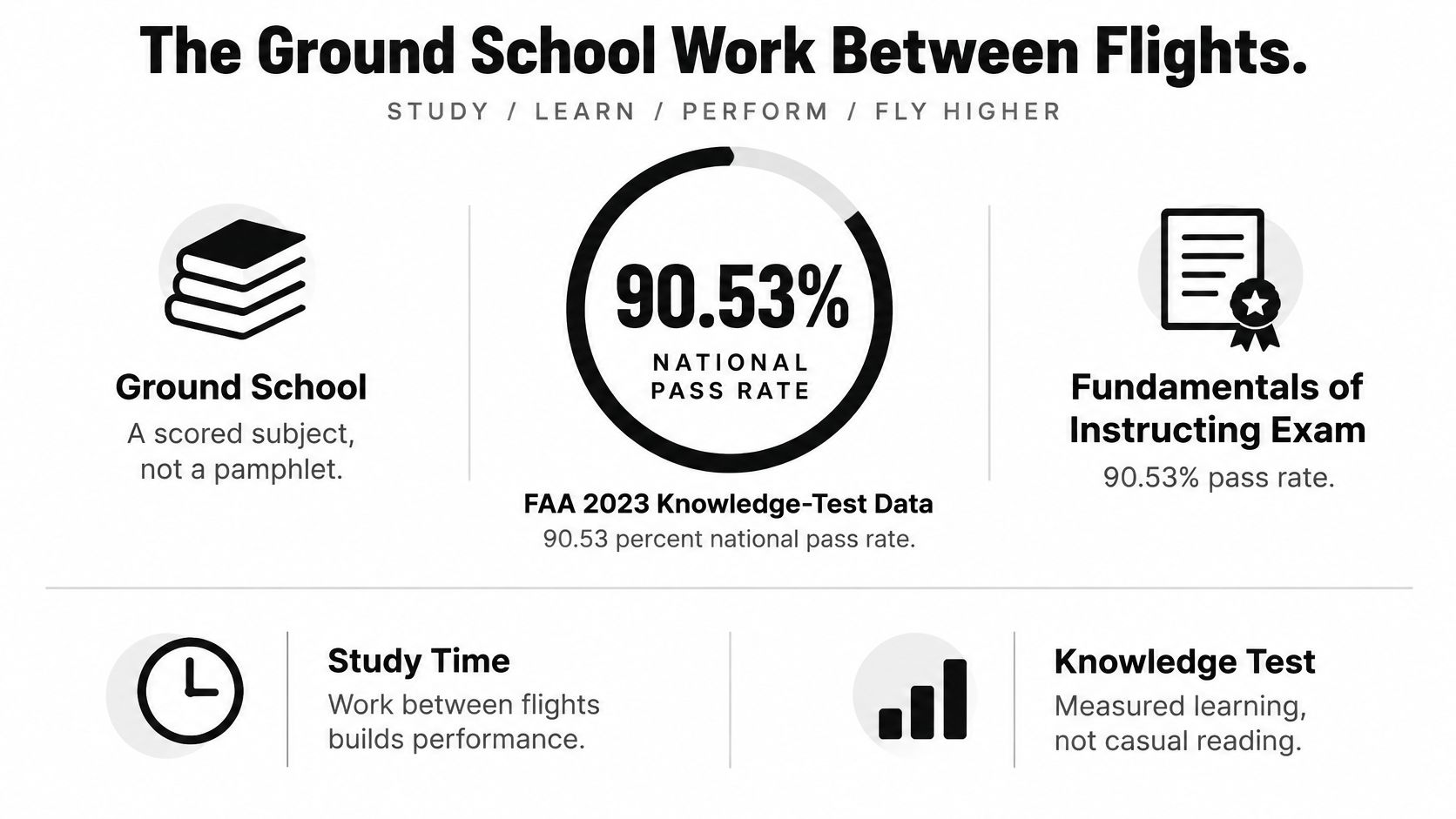
That instructor exam matters less to you today than it will later, but it shows what the FAA measures as you advance. It requires mastery of aviation subjects plus the ability to teach them, including lesson organization, learner-centered communication, assessment, and correction of unsafe or ineffective performance. Knowing a fact and teaching it safely are different skills, and the test treats them that way.
Why memorizing answers backfires
Question banks tempt students to recognize answers instead of understanding systems. That works until the oral portion, where an examiner asks why an engine behaves a certain way or what you'd do if a gauge disagreed with your expectation. The ACS framework links knowledge-test content to practical-test expectations, so a memorized answer with no mental model behind it collapses under a follow-up question.
Study so the follow-up question doesn't scare you.
- Use spaced retrieval: Quiz yourself in short sessions across several days instead of rereading a chapter passively.
- Explain systems aloud: If you can't describe the fuel or electrical system in plain sentences, you don't own it yet.
- Finish written prep early: Complete test preparation near the start of a rating, not during its busiest flying stretch.
Our private pilot written test preparation guide lays out that early-and-often approach for your first exam.
Fatigue taxes all of this. FAA human-factors work examines fatigue, workload, sleep, memory capacity, and job proficiency because reduced cognitive capacity degrades decision-making and procedural accuracy. You don't need a medical lecture to use that finding. Don't schedule your most demanding lesson after a short night, and treat rest as part of the syllabus rather than a reward for finishing it.
Pace changes how the same material feels. The regulation applies whether you train full-time or part-time, but an intensive schedule concentrates the academic workload into heavier days. In an accelerated course, the fair test isn't hours flown. It's whether you can prepare, perform, find your error, and still retain the knowledge under time pressure, week after week. Students who build a stable study-and-rest routine make that test much easier on themselves.
The Stages That Feel Hardest
Each stage has a predictable pressure point. The difficulty is rarely raw talent. It is keeping a steady training rhythm while the next skill set arrives, and knowing which stage will ask for more preparation than the last.
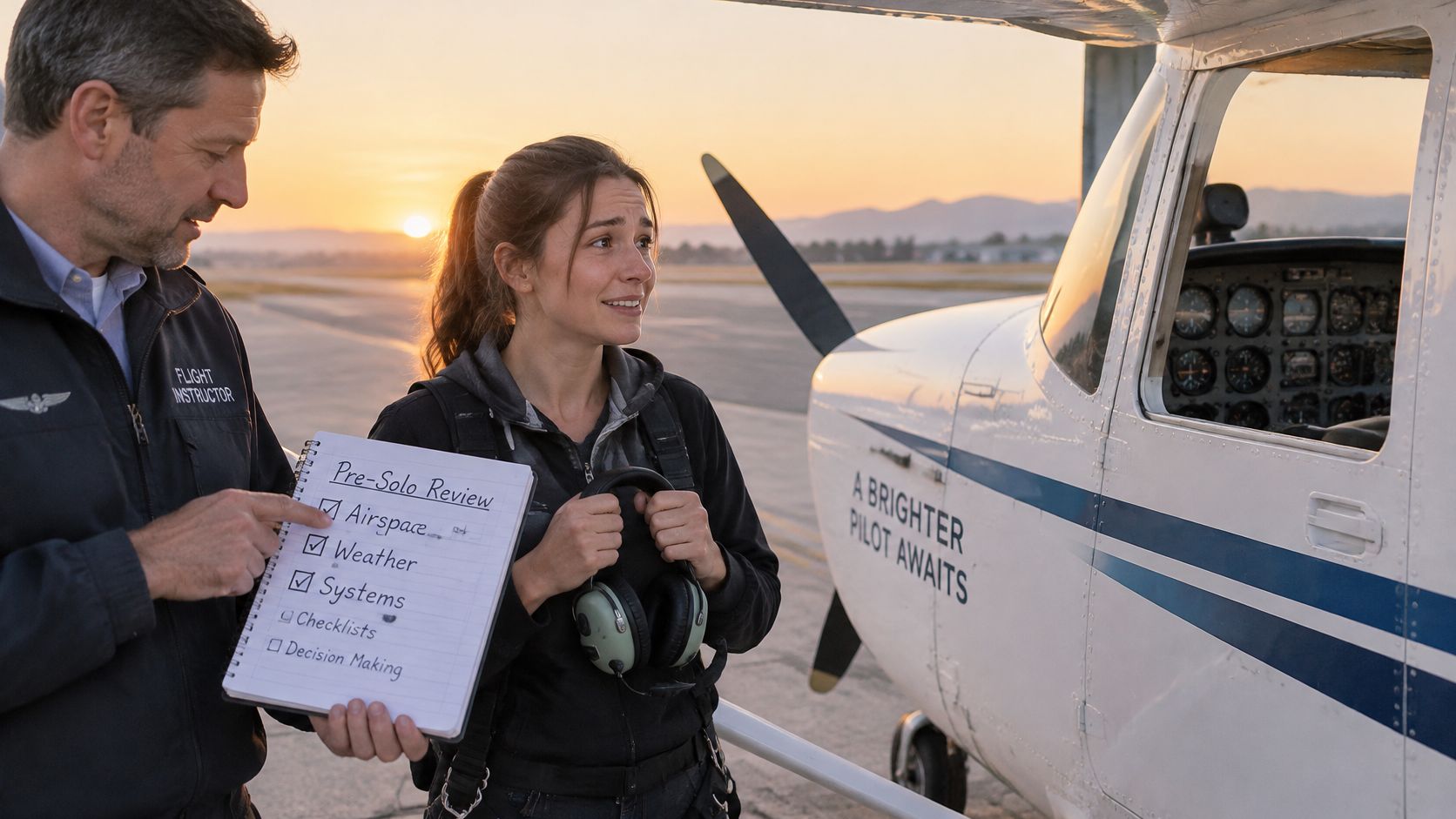
At the private stage, the first solo feels like the breakthrough, and it is a real one. You take off, fly the pattern, and land with nobody beside you. Then the oral exam can catch the student who loves stick time and postpones book work. Airspace rules, weather products, and aircraft systems come at you in conversation, not in the cockpit. If your study habit is thin, private pilot training is where it shows first.
Instrument flying removes your favorite reference
Under 14 CFR §61.65 on instrument rating requirements, an applicant must receive and log ground and flight training in required areas of operation, including instrument flight procedures, navigation systems, instrument approaches, and emergency operations. The applicant also passes an instrument knowledge test and a practical test.
Instrument work arrives in a sequence. A controller issues a clearance. You copy it, set the avionics, brief the approach, fly the procedure, and prepare for a missed approach if the runway does not appear. Outside visual cues are restricted, so your scan has to carry the attitude and navigation job. Miss one clearance item and the next tasks get harder, because instrument flying stacks work rather than swapping it. Our instrument rating course syllabus overview shows how those pieces sequence across a course.
Budget for this stage with open eyes. Instrument-rating training cost a median $12,750 in 2025, a 6% increase from the previous survey, according to Redbird Flight's 2025 State of Flight Training survey as reported by AVweb. That is one rating, paid before commercial work begins.
Commercial and instructor standards tighten the screws
Commercial training narrows the margin for error. Precision tolerances become more demanding, so drift that passed earlier now fails. A knowledge test asks what you know. A practical test asks whether you can do it while an examiner watches your hands and judgment together. Memorization alone does not carry you through that second test.
Instructor training adds a second person to every maneuver. You explain, demonstrate, and evaluate as though teaching another pilot, while still flying to standard from the other seat. Federal rules also require an instructor conducting instrument training to hold an instrument rating on the flight-instructor certificate, with additional requirements for multiengine instrument instruction. If explaining while doing feels unnatural, start narrating your flying early. It is trainable, but it will not appear on its own during instructor training.
When Delays Make Training Harder
Operational friction breaks training rhythm even when skill standards are met. A canceled lesson does more than move one date on the calendar. It interrupts the repetition that turns a maneuver from something you can do into something you can do reliably.
A GAO report on collegiate aviation programs found that nearly all interviewed collegiate aviation schools considered recruiting and retaining flight instructors a moderate or great challenge, that 15 of 18 schools said instructors frequently leave after reaching airline-hiring eligibility, and that long waits for designated pilot examiner checkrides increase both the cost and duration of training.
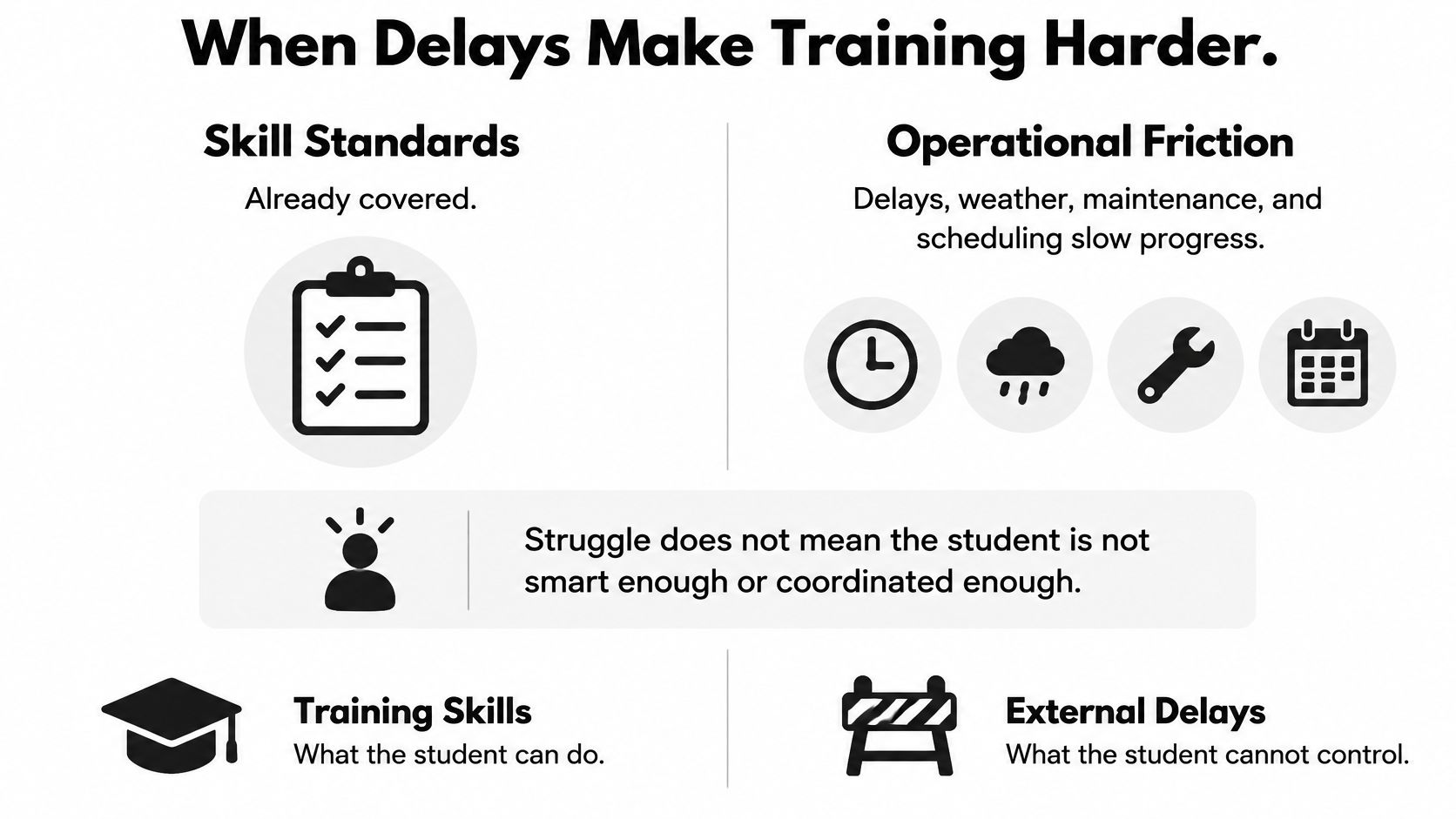
Follow one cancellation through its full cost. A missed lesson dulls a maneuver you had nearly mastered. The next flight becomes a review flight, which costs money and returns you to where you were rather than moving you forward. If a checkride then slips by weeks, you pay for more dual instruction to stay sharp, and a student who relocated for training keeps paying housing and financing costs in the meantime. Each link in that chain is a scheduling cost, and it repeats any time continuity breaks.
Contrarian point: An accelerated syllabus can be academically manageable and still fail if nobody protects your lesson continuity.
Questions that expose friction before you pay
We recommend asking every flight school, including ours, about airplane age, students per airplane, instructor turnover, total price in writing, Part 61 versus Part 141, and whether you can fly before committing. Vague answers to concrete questions are information. Treat them that way.
| Friction | What the student feels | Question to ask |
|---|---|---|
| Instructor turnover | A new teacher in the middle of a maneuver | How long do instructors stay, and how many students share each airplane? |
| Aircraft downtime | Cancelled lessons and extra review flights | How old are the airplanes, and how are maintenance cancels made up? |
| Checkride backlog | More dual while waiting for an examiner | What are recent designated pilot examiner wait times? |
| Unclear scope | Training stops when the budget or the syllabus runs out | What is the total price in writing, and what is not included? |
| Loose structure | Uncertainty about Part 61 versus Part 141 | Which rule governs the course, and can I fly before I commit? |
Ask for measurable indicators, not reassurance. Average aircraft utilization, instructor-to-student ratio, recent checkride wait times, and cancellation recovery procedures all have real answers. So does the percentage of students who maintain their planned pace.
A structured syllabus helps when lesson order, instructor support, and examiner scheduling are handled for you rather than left to weekly improvisation. It reduces friction; it does not change the FAA practical test standards. For a fixed-price program, ask for transparent contingency planning for weather, maintenance, instructor changes, and examiner availability before your money is committed.
Medical, Age Gates and Weekly Habits
Good habits start before your first solo, and the first one isn't a flying skill at all. It's paperwork that decides whether solo flight can happen on schedule.
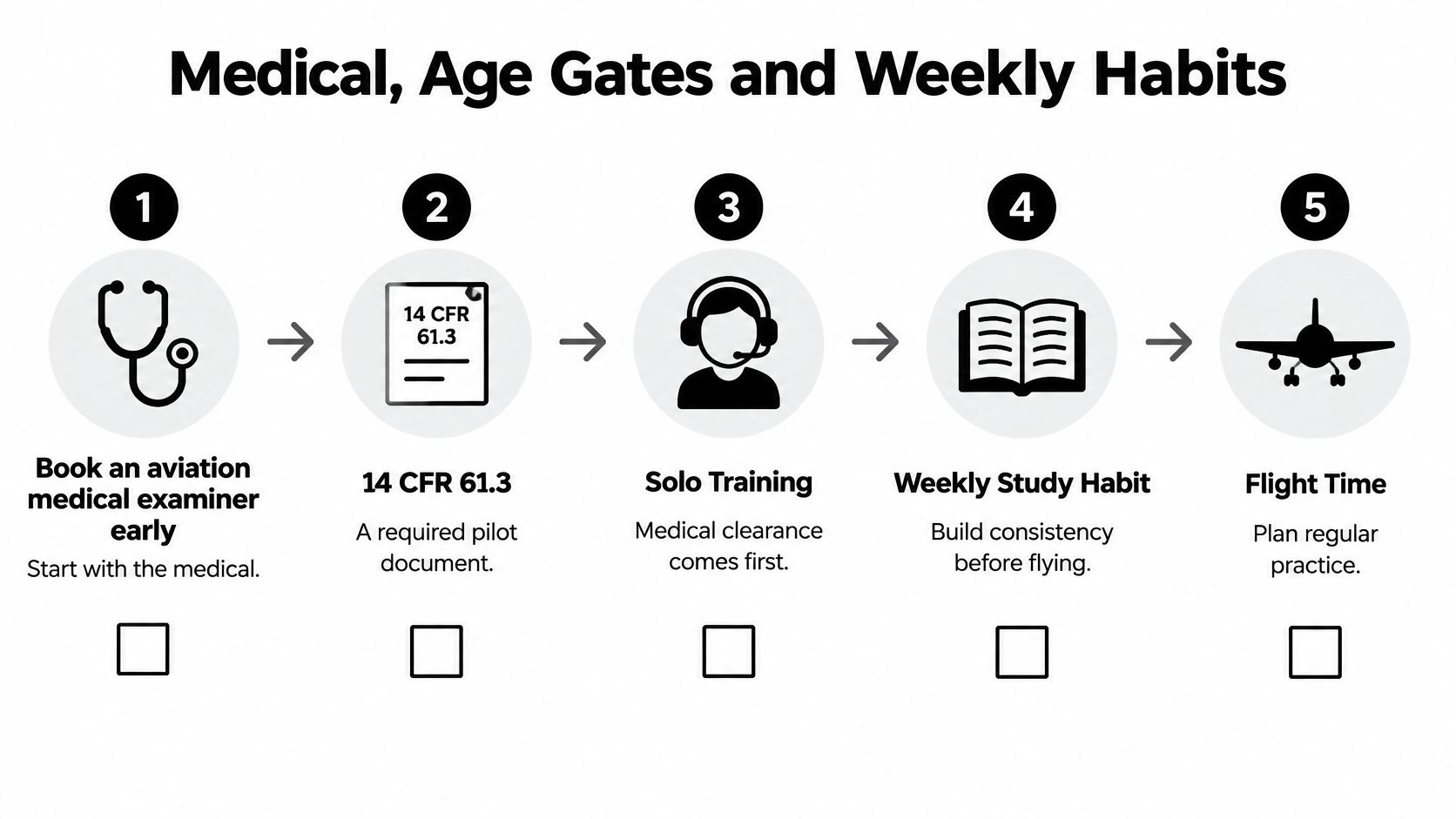
1. Book an aviation medical examiner early. Under 14 CFR §61.3 on required pilot certificates, a person serving as a required pilot flight crewmember must possess the appropriate FAA medical certificate or an accepted alternative, subject to stated exceptions. Section 61.23 specifies that a third-class medical is generally required when exercising private-pilot privileges and when taking practical tests for private, commercial, airline-transport, or flight-instructor certificates. It also sets duration rules, including a 60-month period for many under-40 privileges.
A third-class FAA medical certificate from an aviation medical examiner is required before flying solo, but a discovery flight and first lessons can happen before you hold one. That timing matters. A medical issue can affect training progression or later professional privileges even when early dual instruction is still possible, so career-focused students shouldn't spend months training before confirming eligibility. Our guide to FAA medical certificate classes explains which class fits which goal.
2. Know the age gates. There's no minimum age for lessons. You can fly solo at 16 and hold a private pilot license at 17. A younger student can build real skill with an instructor, but the calendar, not the instructor, decides when solo and certification become possible.
3. Fly often enough to stay current with yourself. A lesson every few weeks turns into a relearn, because the first half of each flight rebuilds what faded. Frequency is a proficiency tool, not a scheduling preference.
4. Pre-brief and debrief every maneuver. Walk through the steps, standards, and common errors on the ground before you fly. Then write down what happened the same day, while you still remember which correction worked.
5. Keep a short list of repeated errors by ACS task. Two or three recurring items, updated weekly, tell any instructor exactly where you are. If your instructor changes, that list keeps a new teacher from restarting your syllabus at lesson one.
A good training week ends with you able to name your next lesson, your current recurring error, and no written exam waiting to be crammed the night before an oral.
Choose a Discovery Flight or a Full-Time Path
The first honest test is one flight. A one-hour discovery flight works like a single trial lesson: you meet the instructor, preflight the airplane together, and take the controls in the air. No prior experience is needed. Our discovery flight pricing guide explains what that first lesson includes, and you can book a discovery flight when you want to test the left seat for yourself.
If you already want a professional certificate and can train full time, judge a structured program by how it handles continuity. Instructor turnover, aircraft downtime, and examiner waits are the usual reasons a nine-month plan stretches. A structured program fixes lesson order, instructor support, and a known end point, so your effort goes into flying and studying rather than rescheduling. FAA standards stay the same. The schedule is what changes.
Our Career Track program is built that way: fixed $89,000 tuition, about nine months from zero time to CFII and multi-engine, 282 total hours, and six certificates and ratings. Training runs in Southern California at Riverside, Long Beach, and Corona.
The certificate opens the door to more training. Airline hiring comes after a much longer hour build, well past the commercial minimum, so treat each checkride as a gate to the next stage rather than a job offer.
Before you pay a deposit, get the schedule answers in writing. Then choose by what you can keep. Fly once if the feel of the work is still unknown. Commit to full-time training when you can name a start date and a weekly flight count you can hold for nine months. Visit CFII to compare the discovery flight and the Career Track, then take the step that matches the schedule you can really keep.
Planning to fly for a living?
See what the path from zero to a pilot career looks like, what it costs and how long it takes.
Learn to fly in Riverside
We train at Riverside Municipal Airport in modern airplanes with a parachute built in. Start with a one hour discovery flight, no experience needed.