
On this page
- Airplane Certificate Requirements and the Order to Earn Them
- The only order that works
- Medical Class Before You Commit Tuition
- Which class matches which certificate
- Check before you finance the course
- Private Pilot Hours That Count Under 61.109
- Dual lines, then solo lines
- What has to exist before any solo
- Instrument Rating Rules in 61.65
- Who can apply
- The 40-hour split
- What a simulator session can credit
- Commercial Pilot and Multi-Engine Experience
- The training block
- Adding multi-engine is not a second license
- CFI and CFII Checkride Prerequisites
- Airplane CFI gates
- CFII is a teaching add-on
- Checkride Gates Before Each Practical Test
- Match a Training Plan to These FAA Gates
- Audit the plan against the gates
- One zero-to-CFII scope
The FAA reports that most U.S. private-pilot applicants need 60 to 75 hours of training, even though the regulatory minimum is 40 hours, and that figure is current as of 2026 on the FAA pilot schools page. If you're starting from zero time and aiming at an airline seat, that gap is the whole story of flight training requirements. Every hour number in the rules is a floor. The logbook has to contain named tasks, not just a total. Finishing the instructor certificates still leaves the airline gate open.
Treat the numbers below as eligibility floors. Proficiency, weather, airplane availability, and examiner calendars usually add time on top.
Airplane Certificate Requirements and the Order to Earn Them
Read this as 14 CFR Part 61 airplane minimums, not as the time most people finish. A knowledge test is passed at 70 percent. You must read, speak, and understand English at every certificate.
| Certificate or rating | Minimum age | Medical to exercise it | Part 61 time minimum | Tests before the checkride |
|---|---|---|---|---|
| Student pilot certificate | 16 for airplane solo | Third class before solo | No total-time minimum | None; instructor endorsement before solo |
| Private pilot airplane | 17 | Third class | 40 hours total | Private knowledge test and instructor endorsement |
| Instrument rating airplane | 17, and hold or concurrently apply for a private certificate | Third class | 50 hours cross-country PIC and 40 hours instrument | Instrument knowledge test and instructor endorsement |
| Commercial pilot airplane | 18 | Second class | 250 hours total | Commercial knowledge test and instructor endorsement |
| Multi-engine class rating | Same age as the certificate it is added to | Same class as that certificate | No separate total-time minimum for an add-on | Practical test; knowledge test only if this is the original commercial certificate |
| Certificated flight instructor airplane | 18 | Third class when acting as pilot in command | Commercial or ATP certificate and instrument rating already held | Fundamentals of instructing and flight instructor knowledge tests, plus a spin endorsement |
| Instrument instructor | 18 | Same as the flight instructor certificate | CFI certificate and instrument rating already held | Instrument flight instructor knowledge test |
| Airline transport pilot airplane | 23, or 21 for a restricted ATP | First class | 1,500 hours total | ATP knowledge test after the ATP Certification Training Program |
The only order that works
You can't rearrange that column and still be eligible.
- Student solo comes first. You need the student pilot certificate, a medical, and an instructor's solo endorsement. Airplane solo starts at 16. The private certificate itself waits until 17.
- Private, then instrument. The instrument rules won't take an applicant who doesn't hold a private certificate or apply for one at the same time.
- Commercial, then multi-engine added to that commercial certificate. An add-on is a new class on a certificate you already hold, not a second commercial license.
- CFI, then CFII. The instructor certificate requires a commercial or ATP certificate plus an instrument rating. The instrument instructor privilege requires a CFI certificate you already hold.
Part 61 is what blocks the shortcut. Each rule lists the certificate you must already hold. An approved Part 141 syllabus can lower the private training minimum to 35 hours and the commercial minimum to 190 hours. It never removes the knowledge test or the practical test.
Practical rule: Match the medical class in the table to the certificate you intend to use, not to the lesson you're flying this week.
A pilot who finishes CFII has the teaching certificates. That pilot is still short of the 1,500-hour airline transport pilot floor in the last row.
Medical Class Before You Commit Tuition
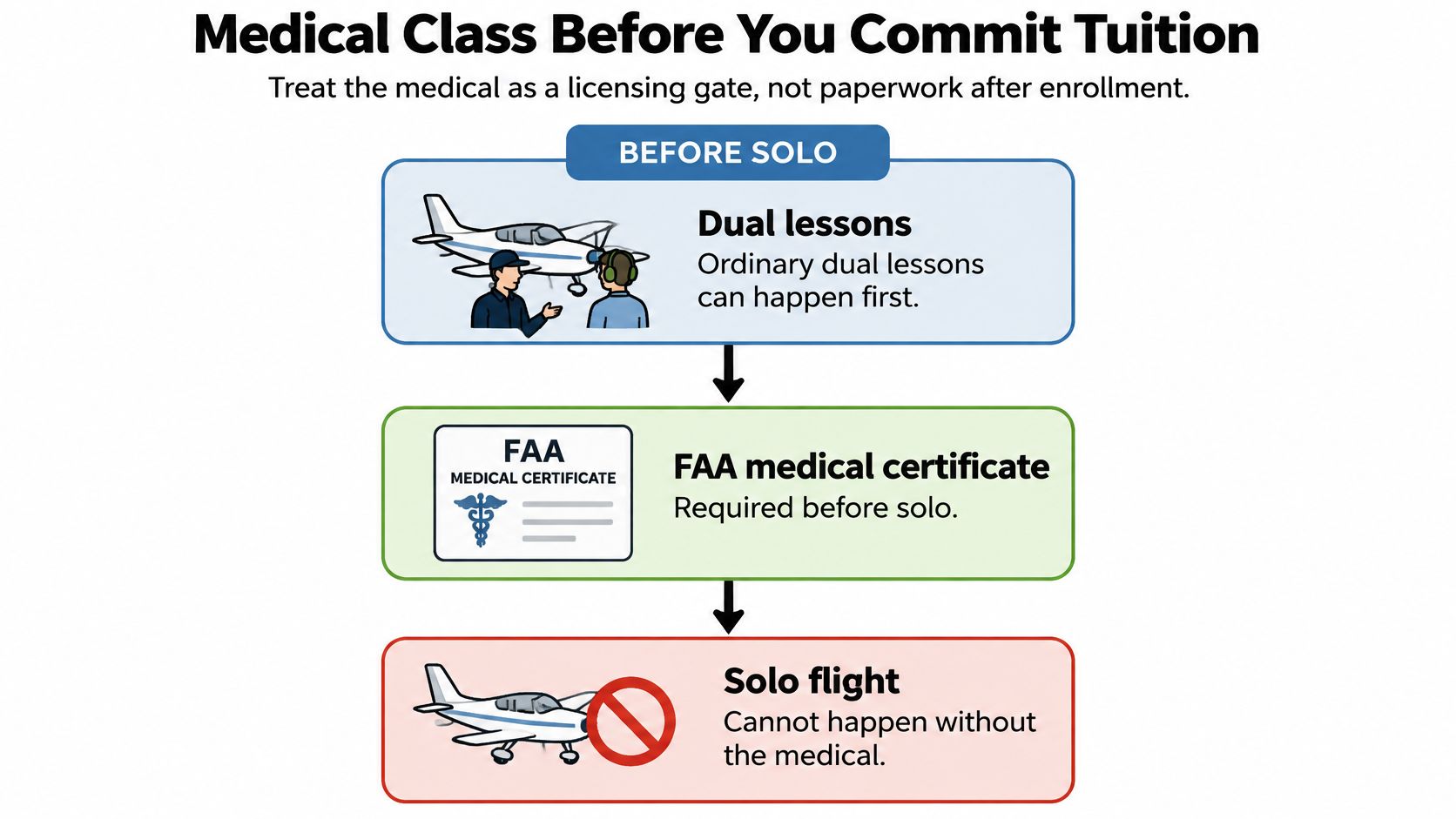
The medical certificate is a licensing gate, not a form you file after you've paid for a full course. FAA medical guidance recommends that a prospective professional pilot get the highest class they may eventually need as early as possible, so they don't spend training money and then discover a certification obstacle.
Ordinary dual lessons can happen before you hold a medical. Solo cannot. A student pilot needs an FAA medical certificate before the first solo flight. Our discovery flight and first lessons can be taken before the medical is in hand. Solo stays blocked until it is.
Which class matches which certificate
Use the opening table as the match.
- Third class supports student solo and private privileges.
- Second class is what you need to exercise commercial pilot privileges, including getting paid as pilot in command.
- First class is what you need to exercise ATP privileges.
| Medical class | Privileges it supports | Under 40 | 40 and over |
|---|---|---|---|
| Third class | Student solo and private privileges | 60 months | 24 months |
| First class | ATP privileges as airline pilot in command | 12 months | 6 months |
Second-class commercial privileges are set in 14 CFR 61.23. Confirm that period in the current rule text before you book, especially if you're 40 or older, because first-class airline pilot-in-command privileges step down on a shorter clock than the third-class certificate.
A short walkthrough of how the classes line up with training is on our FAA medical page.
Check before you finance the course
Book an Aviation Medical Examiner for the highest class your goal needs, gather records that might matter, and only then finance an accelerated path. The useful question isn't "Can I start lessons?" It's whether your history will support the certificate the career uses.
Special issuance or an exemption can still produce a certificate. Those paths often mean extra records and extra testing, which means delay. BasicMed isn't available to student pilots, and it isn't the medical path for an ATP career.
The FAA's own overview of medical standards is worth watching before you schedule the exam.
Private Pilot Hours That Count Under 61.109
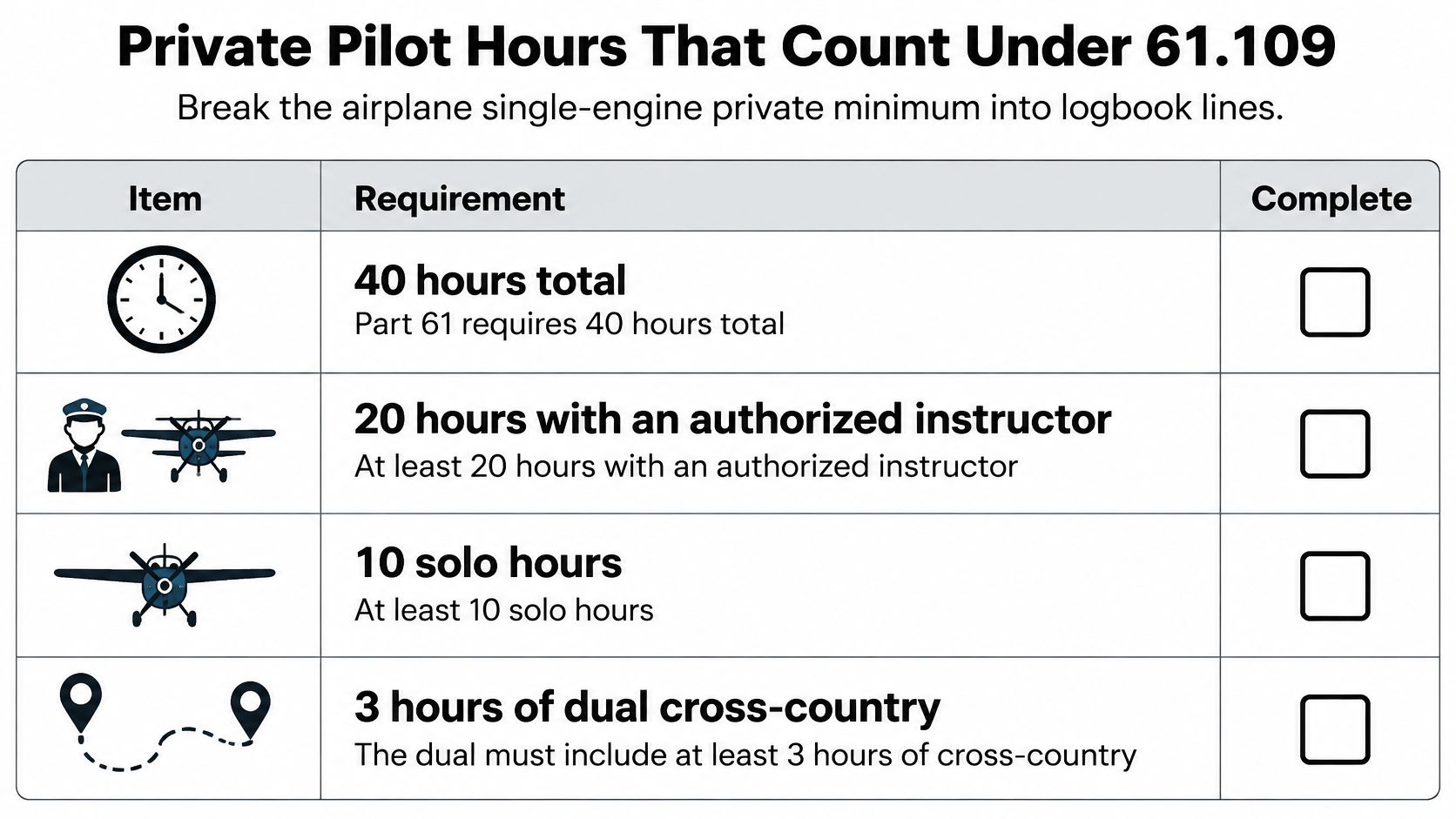
For an airplane single-engine private certificate, 14 CFR § 61.109(a) requires at least 40 hours of logged flight time. That total must include at least 20 hours with an authorized instructor and 10 hours of solo. Those are minimums. They aren't a promise that you'll be ready for the practical test at hour 40.
Dual lines, then solo lines
Log the dual tasks before you chase the solo total.
- Cross-country dual: at least 3 hours.
- Night dual: at least 3 hours, including a night cross-country of more than 100 nautical miles and 10 takeoffs and landings to a full stop.
- Instrument dual: at least 3 hours.
- Practical-test prep: 3 hours in the two calendar months before the checkride.
Solo isn't "ten hours in the pattern." It includes 5 hours of solo cross-country, one solo flight of 150 nautical miles with full-stop landings at three points and one segment longer than 50 nautical miles, and three solo full-stop takeoffs and landings at a towered airport.
Say your logbook shows 40 hours and every one of them is traffic-pattern work at the home field. The total meets the headline. The rule still fails, because the long cross-country, the tower work, the night work, and the instrument time are missing.
What has to exist before any solo
Before the first solo you need a student pilot certificate, a medical, a pre-solo knowledge and flight endorsement, and a solo endorsement. That solo endorsement is renewed every 90 days. Airplane solo can start at 16. The private certificate waits until 17.
Compare the logbook with this task list, not with the number 40.
Pilot-in-command entries start to matter as soon as you're solo, which is why the difference between dual received and pilot-in-command time is worth getting straight in the logbook now.
Instrument Rating Rules in 61.65
Who can apply
Under 14 CFR § 61.65, you must hold a private pilot certificate with the airplane rating, or apply for that certificate at the same time. You must meet the English requirement, complete aeronautical knowledge training or an approved home-study course, and hold an instructor endorsement for the knowledge test.
The training has to cover a set list, not a pile of hood time:
- Preflight preparation and postflight procedures.
- ATC clearances and procedures.
- Flight by reference to instruments and navigation systems.
- Instrument approaches and emergencies.
The 40-hour split
The experience behind the instrument row is 50 hours of cross-country time as pilot in command and 40 hours of actual or simulated instrument time. Of those 40, 15 hours must come from an authorized instructor in an airplane.
One flight has to be a long instrument cross-country: at least 250 nautical miles along airways or ATC routing, an instrument approach at each airport, and three different kinds of approaches. The practical test then samples those same tasks. A syllabus that never leaves the local area can log instrument time and still miss the cross-country that makes the rating legal.
A clean way to see whether a course contains those tasks is to read an instrument rating course syllabus against your own logbook lines.
What a simulator session can credit
Training can happen in an aircraft, a full-flight simulator, or a flight-training device. Credit isn't automatic. The regulation generally limits credited instrument time in approved simulators, flight-training devices, and aviation training devices to 20 hours toward the instrument-time requirement.
Say you've logged 25 hours in a simulator. Only 20 of those hours can be credited toward the 40. The rest has to be flown in an aircraft, or in another session that the rule allows. For every session, confirm four things: the device is approved, the instructor is authorized, the tasks are documented, and the logbook entry matches the session. A sim block with no task list doesn't move the rating.
Commercial Pilot and Multi-Engine Experience
14 CFR 61.129 is a task rule wearing a 250-hour label. For airplane single-engine commercial, the total has to include 100 hours as pilot in command and 50 hours of cross-country, with the airplane portion specified in the rule. Hitting 250 with short local flights doesn't satisfy it.
The training block
On top of the totals, the training itself is specific.
- 20 hours in the commercial areas of operation.
- At least 10 hours of instrument training under a view-limiting device, five of those hours in a single-engine airplane. That instrument time is the commercial rule's own block. It isn't a substitute for the rating discussed above.
- 10 hours in a complex airplane or a technically advanced airplane.
- A dual day cross-country of at least two hours and more than 100 nautical miles.
- A dual night cross-country on the same scale.
- Three hours of test preparation within two calendar months of the practical test.
A pilot who reaches 250 hours and never logs that night cross-country isn't eligible. The missing line is the disqualifier, not the total.
You need a second-class medical to be paid as pilot in command. A third-class medical can be enough merely to sit a test. If the point of the certificate is paid flying, hold the second class before the commercial checkride so the new certificate is usable the week you earn it.
Adding multi-engine is not a second license
If the original commercial certificate is in a multi-engine airplane, 61.129(b) places 10 hours of the commercial training in a multi-engine airplane instead of the single-engine complex block.
Adding multi-engine after you already hold a single-engine commercial certificate is different. It's training and a practical test in a multi-engine airplane. It isn't a second 250-hour requirement, and it isn't a new knowledge test. The age and medical class stay the ones attached to the certificate you're adding the class to.
What that add-on ride contains is easier to picture after you look at how multi-engine flight training is structured, then match those lessons to the class rating rather than to a new hour total.
CFI and CFII Checkride Prerequisites
Airplane flight instructor eligibility sits in 14 CFR 61.183. There isn't a new total-time minimum past the certificate you already hold. The gates are age, language, certificates, knowledge tests, and one flight endorsement.
Airplane CFI gates
You must be 18, and you must read, speak, and understand English. You must hold a commercial or ATP certificate. For an airplane CFI, that pilot certificate also needs an instrument rating.
The knowledge side is two tests. Fundamentals of instructing can be waived for certain accredited teachers. The flight instructor airplane knowledge test is the second. The flight side adds a spin endorsement covering stall awareness, spin entry, spins, and recovery, in an airplane that's suitable for spins.
The CFI practical test is an oral teaching test as much as a flying test. The examiner asks you to teach tasks from the Airman Certification Standards. A smooth commercial pilot who can't explain a maneuver out loud isn't ready, even with the hours already logged.
A commercial single-engine pilot with no instrument rating can't take the usual airplane CFI ride. The instrument rating has to be on the pilot certificate first. That isn't an extra courtesy. It's an eligibility line in 61.183.
CFII is a teaching add-on
CFII isn't another hour-building program. You must already be a CFI, you must already hold an instrument rating, you pass the instrument flight instructor knowledge test, and you pass a practical test aimed at teaching instrument flight, approaches, and emergencies.
A brand-new CFI, even with CFII, is still a long way from an airline seat. The instructor certificates let you teach and log time. They don't replace the airline transport pilot experience rule.
Checkride Gates Before Each Practical Test
14 CFR 61.39 is the same door for every practical test. Walk it in this order before you book the ride.
- Knowledge test timing. You need a passed knowledge test for that certificate, taken within the 24 calendar months before the practical test. A private knowledge test passed 26 months ago has to be retaken, even if the logbook already shows 40 hours.
- Training endorsement. An instructor endorses that the required ground and flight training for that test is complete.
- Identification. Bring the identification the examiner requires.
- Logbook, line by line. The hours have to match the private, instrument, commercial, or instructor rule for the test you're taking. A total that looks large enough isn't the check.
- The extra item that test adds. Private adds three hours of practical-test preparation in the two calendar months before the ride. Instrument needs the cross-country and instrument hours, with the instructor's endorsement. Commercial needs its knowledge test and the medical class that certificate uses. CFI needs the fundamentals of instructing test, the flight instructor test, and the spin endorsement. CFII needs a passed instrument flight instructor test and a CFI certificate already held.
Multi-engine and CFII practical tests add their own endorsements. They don't add a new total-time floor.
The examiner grades the ride against the Airman Certification Standards. The logbook is the entry ticket, not the grade. If you've never sat one, it helps to know what a checkride asks you to do before the oral starts.
Match a Training Plan to These FAA Gates
Commercial, multi-engine, CFI, and CFII certificates do not grant an unrestricted airline seat. The FAA's ATP pathway requires 1,500 hours of total pilot time for the standard airline transport pilot certificate. A restricted-privileges ATP allows a pilot to serve as co-pilot until those 1,500 hours are logged. Eligibility follows a specific education and experience route. It is not based on holding a commercial certificate.
One of those routes is 1,250 hours after at least 30 semester credit hours of qualifying aviation or aviation-related coursework. Airlines can also set experience bars of their own, above the FAA floor. Earning the instructor certificates and reaching ATP eligibility are different milestones.
Audit the plan against the gates
Check any school plan line by line.
- Airplane time versus simulator time. Only approved, properly logged device time credits, and only up to the cap in the rule you're using.
- Which tasks the hours satisfy. Private cross-country, the instrument long cross-country, and the commercial night cross-country are separate lines.
- What remains after CFII. Teaching certificates end one pathway. The 1,500-hour total is still ahead unless a restricted route applies and you've met that route's own conditions.
A nine-month training calendar isn't an airline hire date. It's the time to the instructor certificates, if the plan is full time and the checkrides happen on schedule.
One zero-to-CFII scope
CFII's Career Track, based in Southern California at Riverside, Long Beach, and Corona, is a fixed $89,000 tuition. It runs about nine months from zero time to CFII and multi-engine. The scope is 282 total hours: 204 single-engine, 25 multi-engine, and 53 simulator, covering six certificates and ratings: private, instrument, commercial single-engine, commercial multi-engine, CFI, and CFII. Those are program claims, not FAA guarantees, and they don't include a job promise. Financing is available for the full amount.
That 282-hour scope can cover the six certificates inside the gap. It doesn't close the gap. After CFII you're still building toward 1,500, or toward a restricted route if you qualify for one.
Readers who want that full path can review the Career Track. If you haven't flown yet, start with a discovery flight before you choose any program. You'll walk around the airplane with an instructor and a checklist card, and you'll know whether the cockpit is where you want the next year of your life.
CFII trains career pilots from zero time through the private, instrument, commercial, multi-engine, CFI, and CFII certificates these rules require, with the legal minimums treated as floors rather than finish lines. If you're ready to map your logbook against that path, or you want to see the airplane before you commit, visit CFII and start with the step that matches your hours.
Planning to fly for a living?
See what the path from zero to a pilot career looks like, what it costs and how long it takes.
Learn to fly in Riverside
We train at Riverside Municipal Airport in modern airplanes with a parachute built in. Start with a one hour discovery flight, no experience needed.