On this page
- What a Multi-Engine Rating Costs at a Glance
- Plan around your completion scenario
- FAA Minimums That Set the Training Hours
- An initial certificate isn't an additional class rating
- Audit the logbook before buying hours
- Why Twin-Engine Hours Cost More
- The syllabus affects what you buy
- Compare included training, not matching price tags
- Examiner Fees and Costs Outside the Lesson Rate
- A retest isn't just another appointment fee
- Separate training expenses from living expenses
- How to Build Your Own Multi-Engine Budget
- Work through a completion estimate
- Use a worksheet you can reconcile
- Ways to Lower Your Bill Without Cutting Training
- Buy continuity and arrive prepared
- Spend twin time on twin-specific learning
- Choosing Your Route and Your Next Step
- Compare a complete pathway with a complete pathway
Two pilots can pay very different totals for the same multi-engine rating, and the checkride fee is rarely the biggest reason. The FAA sets no fixed number of twin-engine hours for the add-on, so the bill depends on how much training you need to reach proficiency and on what the quote leaves out: examiner fees, higher twin hourly rates, travel to an available examiner.
The larger question is what the price buys and what you must finish first. An add-on quote assumes you already hold a commercial certificate. It does not cover the ratings that come before it, and confusing the two purchases can leave a substantial hole in a career pilot's budget.
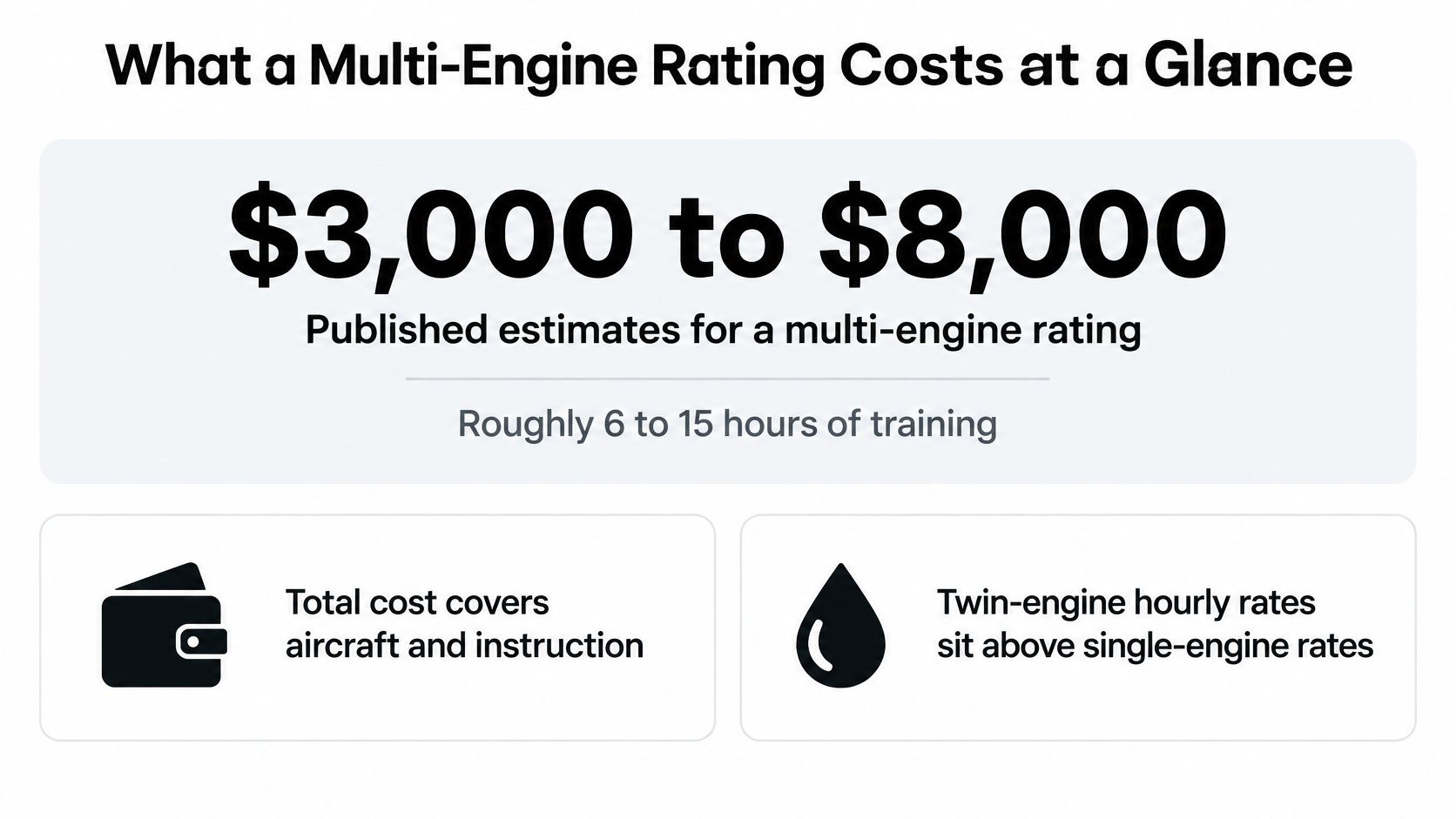
What a Multi-Engine Rating Costs at a Glance
Cost guides publish multi-engine pricing in tiers, and the gap between the tiers carries more information than either figure alone. The Rotate Pilot multi-engine rating cost guide separates the bare add-on quote from the fuller bill that builds in travel, extra instruction and examiner fees. The table below keeps those published ranges and adds the two completion scenarios that decide where your own cost lands.
Published multi-engine rating cost ranges
| Estimate basis | Training hours | Total cost | What it covers |
|---|---|---|---|
| Low published estimate | 6–15 hours | $3,000–$8,000 | Aircraft and instructor time, typically without examiner fees or travel |
| Broader published estimate | Additional training as needed | $8,000–$18,000 | Higher-cost aircraft, extra training, travel and examiner fees |
| Efficient completion | Fewest hours needed to demonstrate proficiency | Included hours × quoted rates, plus fixed fees | Fewest hours; priced using the school's twin rate |
| Remediation after a weak checkride | Planned hours plus corrective training | Original budget plus retraining and retest costs | Extra aircraft, instructor and examiner time before the retest |
Each row describes a different quote basis. The lower range covers aircraft and instructor time and leaves examiner fees, travel and ground instruction charges outside it. The wider figure folds in higher-cost aircraft and the extra training a slower completion requires. A prepared student in a lower-cost market can finish under the first tier; a drawn-out completion can run past the second.
Plan around your completion scenario
Efficient completion means you arrive prepared, adapt promptly to the twin and finish within the quoted allowance. A low advertised price may be achievable for that student without being a sensible budget for someone returning after a long break.
Typical completion should come from the school's individualized estimate after it reviews your certificates, currency and readiness. That figure prices the hours you will fly, which makes it more useful than any industry average. Remediation after a weak checkride prices separately because corrective instruction and a second practical-test attempt bill differently from initial training.
Quote test: Can you identify the included aircraft hours, aircraft rate, instructor billing and examiner fee without asking someone to interpret the advertisement?
The FAA doesn't set a training price. The checkride fee draws the attention, yet twin hours and quote exclusions decide the total.
A student with zero time should place the add-on figure inside a complete flight-training cost budget. Budget around a written, itemized completion estimate with room for extra instruction, and treat the lowest advertised number as a prompt to ask for the itemized version.
FAA Minimums That Set the Training Hours
14 CFR 61.129 minimums for a commercial multi-engine path
The current commercial aeronautical-experience regulation establishes the following requirements for the initial commercial airplane multi-engine pathway, including 250 total flight hours, unless an applicable exception applies.
| Requirement | Minimum | Notes |
|---|---|---|
| Total flight time | 250 hours | Required for the commercial certificate under 61.129(b), subject to applicable exceptions |
| Powered aircraft time | 100 hours | At least 50 hours in airplanes |
| Pilot-in-command time | 100 hours | At least 50 hours in airplanes |
| Cross-country flight | 50 hours | At least 10 hours in airplanes; within the required pilot-in-command experience |
| Commercial multi-engine training | 20 hours | Training on the required commercial operating areas, with specified multi-engine elements |
| Instrument training with a view-limiting device | 10 hours | At least 5 hours in a multi-engine airplane |
| Multi-engine complex or turbine training | 10 hours | A separate specified training element from the instrument requirement |
Don't add every row together. These categories describe overlapping qualifications within the overall experience requirement, not entirely separate blocks of flight time.
Also, don't read the commercial-training row as saying every training hour must occur in a twin. The regulation specifies which portions require a multi-engine airplane and which experience can come from other qualifying flying.
An initial certificate isn't an additional class rating
The initial commercial pathway and a commercial multi-engine add-on are different regulatory situations. An applicant earning an initial commercial certificate in a multi-engine airplane must satisfy the applicable commercial experience requirements. A pilot who already holds a commercial airplane certificate and adds another airplane class generally follows the additional-class-rating provisions instead.
That's why a proficiency-based add-on can coexist with a detailed commercial aeronautical-experience rule. The published short-course training range estimates preparation for an add-on practical test. It doesn't replace the initial commercial requirements, and it isn't a zero-time training syllabus.
For a beginner, the practical consequence is important: you don't need to purchase your entire commercial experience in a twin. Qualifying single-engine experience can satisfy parts of the overall requirement, while the specified multi-engine work still needs the appropriate aircraft and instruction.
Audit the logbook before buying hours
Have your instructor classify existing experience before preparing a training agreement:
- Certificate pathway: Establish whether you're pursuing an initial commercial certificate or adding a class to an existing certificate.
- Experience categories: Separate total, powered-aircraft, airplane, pilot-in-command and cross-country entries.
- Training records: Identify qualifying instrument and complex or turbine training, including aircraft class and instructor endorsements.
- Remaining tasks: Match each missing requirement to a planned lesson rather than buying a generic block of twin time.
Use the multi-engine rating requirements guide to organize that discussion. A regulatory minimum tells you what must be satisfied. It doesn't predict how quickly you'll demonstrate consistent practical-test performance.
Why Twin-Engine Hours Cost More
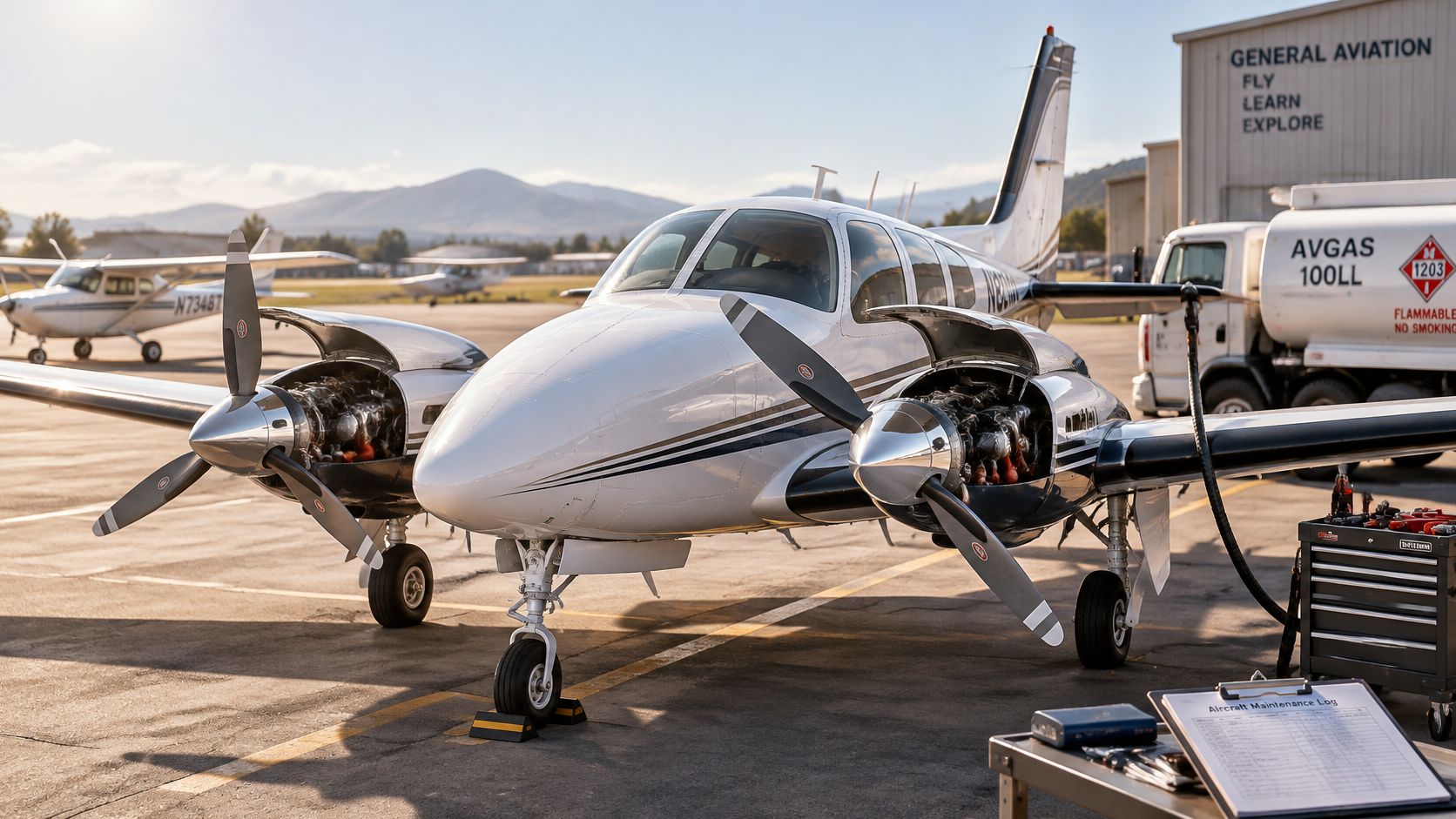
A twin's hourly rate buys more than a second engine's fuel. The operator prices in maintenance on two engines and two propellers, more complex systems, higher insurance and the dispatch reliability of a scarcer airplane. A cheaper airplane that sits in the hangar for unscheduled work can cost more per usable lesson than a pricier one that flies every day, because gaps between lessons erode proficiency you already paid to build.
The syllabus affects what you buy
For the initial commercial multi-engine pathway, the commercial training regulation published by GovInfo specifies daytime and nighttime cross-country training flights of more than 100 nautical miles each, 3 hours of practical-test preparation within the preceding two calendar months, and 10 hours of solo flight or performing pilot-in-command duties with an authorized instructor, subject to the rule's conditions.
Those requirements belong to the initial commercial route. They shouldn't be billed indiscriminately to an already-certificated commercial pilot adding a class. For the beginner, though, they explain why a quote must cover cross-country flying, night work and solo time rather than local maneuver practice alone.
The regulation sets tasks, not a proficiency timeline. Asymmetric-thrust handling, twin systems knowledge, instrument work and performance decisions each take however many repetitions they take, and that count varies by student. A useful lesson plan separates tasks you're learning, tasks you're consolidating and tasks being evaluated for test readiness, so you can see where the remaining budget goes.
Compare included training, not matching price tags
Consider a hypothetical comparison: Quote A and Quote B carry the same headline price, but Quote A includes 10 twin hours while Quote B includes 14 twin hours with instruction bundled. A higher sticker price can still leave you with less unpaid training to purchase, so rank quotes only after running the same test on each:
- Normalize the aircraft charge. Ask for the wet rate, meaning an aircraft rental rate that includes fuel, and confirm the billing method plus any operating charges billed separately.
- Match instruction scope. Separate airborne instruction from briefings, ground lessons and simulator sessions.
- Calculate included-hour value. Divide the package price by included twin hours only after accounting for material differences in scope.
- Price the overrun. Record what another lesson costs once you exhaust the allowance, since the regulatory minimum rarely matches the hours a student needs.
Simulator time needs the same scrutiny. Get the device, its permitted credit and its training purpose identified before treating simulator hours as interchangeable with airplane time.
Examiner Fees and Costs Outside the Lesson Rate
The checkride can create a bill even after you've paid for every lesson. The FAA's practical-test guidance explains that designated pilot examiners generally charge applicants for practical tests, so examiner charges belong outside the aircraft-and-instructor calculation unless explicitly included.
Budget examiner fees as extra everywhere, including at CFII. Separately confirm aircraft rental for the test, positioning arrangements and any instructor time associated with the appointment.
A retest isn't just another appointment fee
If you don't meet the practical-test standard, the next expense may include corrective ground instruction, flight training and aircraft rental for another attempt. Confirm the examiner's retest policy rather than assuming the original payment covers a return visit.
Read what a checkride involves before committing to an accelerated schedule. Readiness should determine the test date, not the desire to avoid another lesson.
A knowledge-test fee needs the same pathway-specific treatment. Don't automatically add a new written test to a class add-on budget; establish which tests your actual certificate and rating sequence requires. Medical-certificate expenses also belong in the broader career budget where applicable, rather than being assigned to the twin course.
Separate training expenses from living expenses
Your personal equipment is another distinct purchase. Our Career Track price doesn't include student-selected gear such as an iPad, headset and flight bag.
Travel and lodging need their own budget when you train away from home. Include accommodation during plausible scheduling interruptions, not just the advertised course dates, and check cancellation terms before purchasing nonrefundable travel.
Before paying a deposit, obtain written answers covering:
- Examiner payment: The expected charge, who collects it and what a retest costs.
- Aircraft access: Checkout requirements, checkride rental and any positioning charges.
- Package boundaries: Ground instruction, insurance surcharges, supplies and equipment.
- Disruptions: How aircraft downtime, weather cancellations and rescheduling affect prepaid training.
- Unused balances: Refund conditions and how completed training is valued.
Budget safeguard: Keep tuition, testing, equipment and living costs on separate lines. A fixed tuition amount isn't the same as a fixed total cost of attendance.
An estimate becomes useful when you can tell not only what it includes, but also which expenses remain your responsibility.
How to Build Your Own Multi-Engine Budget
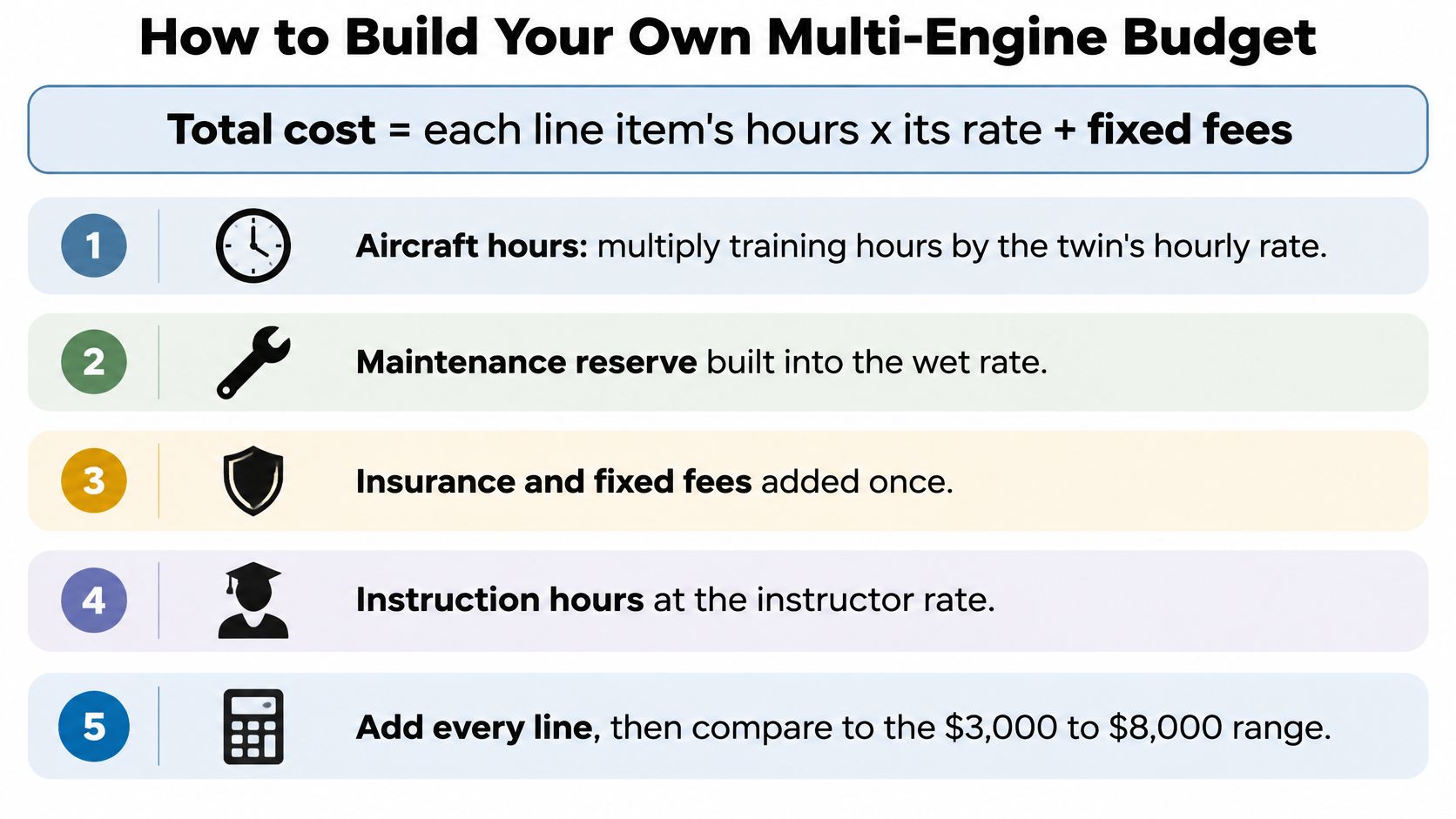
Total cost = each line item's hours × its rate + fixed fees. Use separate entries for aircraft, flight instruction, ground instruction and simulator use. Combining them too early makes it difficult to identify what caused an overrun.
Start with an efficient-completion case. Enter the smallest training allowance your instructor considers credible for your starting qualifications, multiply aircraft time by the wet rate, add the instructor's billable time and include the examiner charge. This is your planning floor, not a promise that you can safely stop training at that allowance.
Work through a completion estimate
For a typical-completion worksheet, use these placeholders:
- Aircraft subtotal: Planned twin hours × quoted wet rate.
- Instruction subtotal: Billable instructor hours × instruction rate, with ground instruction separately identified if billed differently.
- Simulator subtotal: Planned device hours × device rate, plus any separately billed instruction.
- Fixed-fee subtotal: Examiner, checkout and other confirmed fixed charges.
- Travel subtotal: Your own transport and accommodation estimate, kept outside the training subtotal.
Suppose the school bundles flight instruction with aircraft rental. Enter the bundled rate instead of charging instruction again. Likewise, if maintenance reserves are included in the aircraft rate, don't invent a second maintenance line.
For a hypothetical remediation case, add three to five extra twin hours at the quoted aircraft and instructor rates. That's a stress test for your budget, not a forecast of what a failed checkride necessarily requires.
The added training calculation is straightforward: extra twin hours × (aircraft rate + airborne instructor rate). Then add any corrective ground instruction and applicable retest charges. Don't spread a fixed fee across every extra hour unless the provider bills it that way.
Use a worksheet you can reconcile
Budget line items and how to calculate them
| Line item | How to calculate it | Question to ask the school |
|---|---|---|
| Twin aircraft time | Training hours × wet rate per hour | Is fuel included in the wet rate? |
| Instructor time | Instructor hours × instruction rate | Is instruction billed by the hour or in blocks? |
| Simulator time | Simulator hours × simulator rate | Does simulator time count toward the rating requirements? |
| Insurance or checkout surcharge | Flat fee or per-hour surcharge | Is there a surcharge for twin aircraft? |
| Extra hours after a weak lesson | Extra hours × (aircraft rate + instructor rate) | How many extra hours does the school typically schedule? |
Keep planned, committed and actual spending in separate worksheet columns. A booked checkride is a committed expense even if you haven't paid the examiner yet; a completed flight belongs in actual spending.
Add a reserve of extra training hours rather than relying on an arbitrary percentage. Compare actual hours with the plan each month during a longer career program, and after each lesson during a concentrated add-on.
If you're borrowing, review aviation financing considerations separately from the training estimate. Compare the training purchase and the repayment obligation as distinct decisions.
Ways to Lower Your Bill Without Cutting Training
Start by examining whether the school can deliver the schedule it sells. A low hourly rate won't help if you can't reserve the airplane or must repeatedly change instructors without a useful handover.
We recommend asking every flight school, including ours, about airplane age, students per airplane, instructor turnover, total price in writing, Part 61 versus Part 141, and whether you can fly before committing. The flight-school selection guide can help you turn those questions into a consistent comparison.
Buy continuity and arrive prepared
Aircraft age alone isn't a verdict on training quality. Ask how maintenance interruptions are handled and whether another suitable airplane is available. For instructor changes, ask whether lesson records identify completed tasks, persistent weaknesses and the next lesson's objectives.
Plan a steady pace that fits your work, study and financial capacity. Long gaps can force you to spend paid lesson time rebuilding procedures rather than progressing.
Preparation should be specific to the next flight:
- Systems knowledge: Explain the fuel, electrical, landing-gear and propeller systems using the actual aircraft's approved materials.
- Cockpit rehearsal: Chair-fly flows and checklist transitions with the instructor's approved sequence.
- Performance planning: Practice finding and interpreting the relevant takeoff, climb and single-engine performance information.
- Test preparation: Use the applicable practical-test standards to identify tasks you can't yet explain or perform consistently.
Don't rehearse an emergency sequence from a different airplane because it appears familiar. Memorized errors are expensive to correct and can undermine safe decision-making.
Spend twin time on twin-specific learning
Use your single-engine foundation deliberately. Have the instructor confirm which existing experience satisfies your pathway, then reserve twin training for the remaining requirements and the proficiency you still need.
A lower-cost twin is worth considering when it provides suitable training, dependable access and instruction appropriate to the test standard. Saving money shouldn't mean omitting engine-out decision-making, systems understanding or instrument workload management.
Judge the saving by the cost of reaching the standard, not by the cheapest hour you can purchase.
The useful comparison is total completion cost at acceptable proficiency. If a cheaper rate leads to substantially more paid repetition, the apparent saving can disappear.
Choosing Your Route and Your Next Step
A commercial pilot adding a multi-engine class rating and a beginner buying a full certificate sequence are purchasing different products, so price them differently. Paying per lesson charges you for the hours and services you use. Fixed tuition sets the training price in advance, and the comparison becomes included hours and excluded expenses.
Compare a complete pathway with a complete pathway
| Question | Pay per lesson | Fixed-tuition career program |
|---|---|---|
| Best fit | Existing certificate holder adding a rating | Student starting from zero experience |
| Scope | One rating or class add-on | Full sequence through instructor certificates |
| How you pay | Per flight hour and service | One price set before training starts |
| Timeline | Set by your weekly pace | Published schedule, typically full time |
| What to verify | Twin hourly rate, aircraft access, instructor availability | Included hours, excluded items, examiner fees |
CFII's Career Track shows what the second model looks like in numbers: $89,000 covers six certificates and ratings, 282 training hours (204 single-engine, 25 multi-engine, 53 simulator) and all one-on-one instruction over about nine months at Riverside, Long Beach and Corona. That figure is the lowest published career price in Southern California once multi-engine is counted. Examiner fees stay extra, as they do at every school.
Those training totals are a different milestone from airline eligibility. Under the standard airplane ATP experience rule, the unrestricted pathway requires 1,500 total pilot hours, including 500 cross-country hours, 100 night hours and 50 hours in the airplane class sought, subject to the regulation's applicable provisions.
Track qualifying aircraft experience and simulator credit separately. A multi-engine rating by itself leaves most of those categories unfilled.
- If you haven't flown: Start with a discovery flight, priced at $200, before committing to career training.
- If you want a fixed price with an exit option: CFII's First Milestone Guarantee lets you stop for any reason before about 20 hours of flight time, paying only for logged time at $200 per flight hour with additional payments refunded.
- If you're ready for a full pathway: Review the Career Track program and compare its included hours and exclusions against your complete training budget.
Whichever route you take, ask every school about airplane age, students per airplane, instructor turnover, total price in writing, Part 61 versus Part 141 structure, and whether you can fly before committing. Run the same list at CFII, which publishes its included training, exclusions and scheduling approach for that scrutiny. Compare total included hours and excluded costs across routes, then choose the option whose complete price fits your finances and pace.
Planning to fly for a living?
See what the path from zero to a pilot career looks like, what it costs and how long it takes.
Learn to fly in Riverside
We train at Riverside Municipal Airport in modern airplanes with a parachute built in. Start with a one hour discovery flight, no experience needed.