
On this page
- Who Lends for Flight Training and What Loans Require
- Where your training money can come from
- Why lenders focus on your finances
- Prepare before you apply
- FAA Hour Requirements That Set How Much You Borrow
- Why the kind of time matters
- Turn the rules into a training budget
- What Each Means for Your Loan
- How an overrun changes borrowing
- Questions that reveal the real cost
- What Deferred Payments Really Cost During Training
- What the advertised terms leave out
- A hypothetical deferred-payment example
- Financing Flight Instructor Training and Paid Instructing Hours
- Work backward from spendable income
- Test a slow month before relying on a full one
- Confirm Your Financing Plan Before You Enroll
- Make the checks in a useful order
- Choose a path you can fund through completion
You've been looking at flight-training programs, comparing tuition with your savings, and wondering whether you can afford to leave your current job. You may not have logged a single flight yet, but you're already facing a financial decision that could follow you well beyond graduation.
The useful question isn't just whether someone will lend you the tuition. It's whether you can manage the debt through training, delays, early instructing work, and the wait for your next career opportunity. Good aviation financing starts with that full timeline, not the advertised monthly payment.
Who Lends for Flight Training and What Loans Require
A student with no flight time can still approach a lender. You don't need to arrive with a pilot certificate, but you do need to explain what you're buying, how much you need, and how you expect to make payments before aviation becomes your main income.
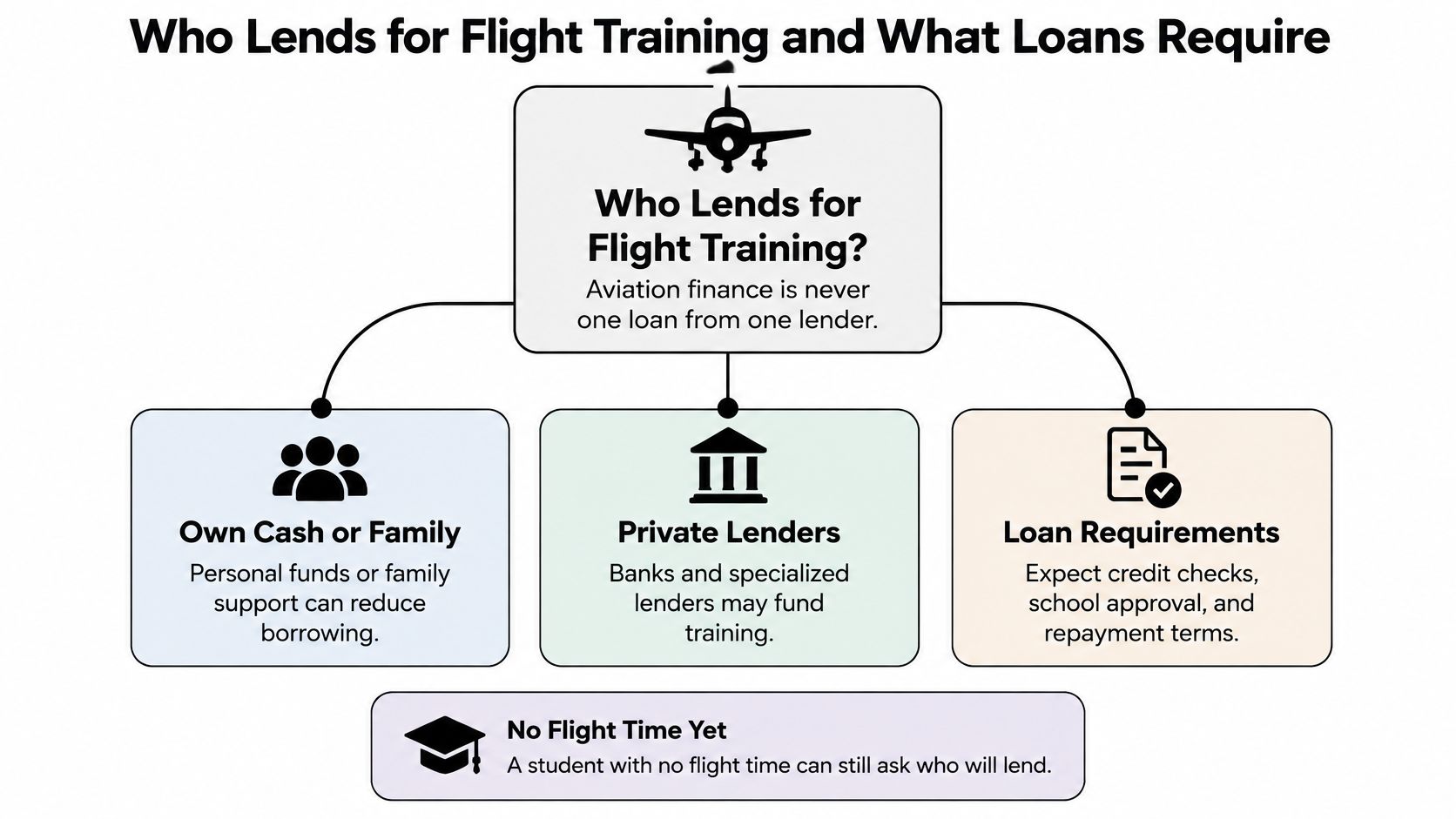
Aviation financing is never one loan from one lender. For an aspiring pilot, the choices fall into several practical funding categories.
Where your training money can come from
- Your own cash or family support. Savings can reduce the amount you borrow. If family members contribute, establish whether the money is a gift or a loan, and put any repayment expectations in writing.
- Lender credit. Bank personal loans, private-training loans, and aviation credit lines may fund eligible expenses. Approval may involve a cosigner, and some products restrict which schools or programs qualify.
- School-arranged or lease-style plans. A school may introduce you to a lender or offer a payment arrangement. Identify who provides the credit, who receives your payments, and what happens if training stops. A lease-style label doesn't automatically mean you're financing an aircraft or building ownership.
This map separates the funding sources from the requirements you'll encounter.
Before applying, investigate commercial pilot training scholarships. Treat an application as a possibility, not money available to pay an invoice, until you receive an award and understand its restrictions.
Why lenders focus on your finances
A training loan usually doesn't give the lender an airplane it can repossess and sell. That leaves the lender relying heavily on your credit history, current income, debt-to-income ratio, and any cosigner's finances.
Debt-to-income ratio compares your recurring debt obligations with your income. A lender may approve a loan based on your current employment, but you should also test affordability against the income you'll have after starting full-time training.
Aircraft lending works differently. PwC's aviation-finance analysis explains that aircraft lenders assess both borrower cash flow and collateral value, including maintenance condition, aircraft marketability, and repossession rights. A student without pledged aircraft collateral is seeking a much smaller advance than an aircraft buyer, but the lender has fewer tangible assets supporting repayment.
The broader funding picture helps clarify the distinction. Boeing's delivery-funding shares describe airline aircraft purchases, not flight-training loans, as shown in its commercial-aircraft financing outlook.
Aviation financing sources and their share of delivery funding
| Funding source | What it typically provides | Share of delivery funding |
|---|---|---|
| Commercial banks | Secured aircraft debt | 18% in 2024, compared with 35% in 2018 |
| Lessors | Operating and finance leases | 27% in 2024, compared with 11% in 2018 |
| Capital markets | Bonds and notes | 17% in 2024, compared with 25% in 2018 |
| Cash | Owner or airline equity | 31% in 2024, compared with 35% in 2022 |
| Export-credit agencies | Government-backed support | 2024 share not stated in the cited summary; 9% in 2021 |
| Manufacturer programs | Vendor-supported financing | Separate share not stated in the cited summary |
These aircraft-purchase channels aren't a menu of student loans. For you, the immediate task is finding credit whose repayment terms fit a training budget.
Prepare before you apply
Resolve medical questions early. For the ordinary student-airplane pathway, a third-class FAA medical certificate from an aviation medical examiner is required before solo flight under 14 CFR 61.23; a discovery flight and initial lessons can happen before you obtain it. Medical eligibility deserves attention before you commit substantial money.
Bring a lender a useful application package:
- Identification and credit report. Check your identifying information and address any reporting errors.
- Proof of income. Include the documents requested for you and any cosigner.
- Medical status. Know whether you've completed the examination or still need an appointment.
- Itemized budget. Separate tuition, equipment, testing, housing, transportation, and a cash reserve.
Practical rule: Borrow against a documented training plan, not an estimate built around everything going perfectly.
FAA Hour Requirements That Set How Much You Borrow
The FAA sets experience requirements by certificate and by type of time, not through a single universal hour total. An advertised program total therefore needs explanation before you use it to size a loan.
FAA hour minimums by certificate and pathway
| Certificate or pathway | FAA minimum | Regulation |
|---|---|---|
| Private pilot, airplane | 40 hours for the standard Part 61 airplane pathway, with specified training and solo experience | 14 CFR 61.109, within Part 61 |
| Commercial pilot, single-engine airplane | 250 hours pilot time, with category and cross-country minimums | 14 CFR 61.129(a) |
| Commercial pilot via 190-hour pathway | 190 hours, only after satisfactory completion of an appropriate approved Part 142 commercial course | 14 CFR 61.129 |
| Airline transport pilot, airplane | 1,500 hours total pilot time for the standard unrestricted pathway | 14 CFR 61.159 |
These are regulatory baselines, not promises that every student will finish at the minimum. Approved training pathways can have different provisions, so verify the actual course rather than assuming every program follows the same rule.
Why the kind of time matters
The commercial single-engine rule distinguishes powered-aircraft time, airplane time, pilot-in-command time, and cross-country time. It also specifies training and flight experiences beyond the overall total.
A student could have substantial logged time but still lack a required experience category. If that student needs another qualifying flight, the aircraft rental and instruction must fit the budget.
The reduced-hour commercial provision is particularly easy to misunderstand. It applies to satisfactory completion of the relevant approved Part 142 course, not just to any accelerated program advertising a low completion total.
A logbook total tells you how much experience you've recorded. It doesn't, by itself, tell you which certificate requirements you've satisfied.
Turn the rules into a training budget
Ask the school to map its syllabus against the applicable requirements and your existing logbook, if you have one. The FAA's commercial-pilot experience provisions make clear why an itemized review matters.
Your budget should distinguish:
- Aircraft time. Identify the aircraft category, class, and purpose of the planned flights.
- Simulator credit. Ask exactly which device time receives credit toward each requirement.
- Instruction and testing. Include ground instruction, practical tests, and preparation for them.
- Experience shortfalls. Identify flights needed to correct missing categories rather than merely increase the total.
Use this flight-training requirements guide to prepare your questions. Completing commercial and instructor qualifications doesn't itself establish airline eligibility, and reduced-experience ATP pathways require their own eligibility review.
What Each Means for Your Loan
Fixed-price and hourly tuition place different risks on the borrower. A fixed price establishes the tuition amount for a defined scope; hourly tuition establishes rates, leaving the eventual total tied to billed training.
Neither label is enough on its own. A fixed-price contract needs an inclusion and exclusion list, while an hourly proposal needs a realistic estimate of aircraft time, instruction, and additional charges.
Fixed-price vs hourly tuition for a financed student
| Criterion | Fixed-price tuition | Hourly tuition |
|---|---|---|
| Total cost known before enrolling | Yes, for the contracted scope, with a written exclusion list | No, total depends on hours flown and added fees |
| Loan amount | One fixed tuition sum, plus any financed outside costs | Funding needs grow with each billed hour |
| Cost if training runs long | Tuition stays the same within the contract's scope; check exclusions | Each extra billed hour increases training cost |
| Items outside tuition | Listed in writing and bought by the student | Often billed separately |
| Repayment planning | Can use one defined tuition amount | Needs regular recalculation as spending changes |
How an overrun changes borrowing
Consider a hypothetical hourly student who budgets for 250 hours but ultimately needs 300. That student must fund 50 additional hours at the applicable aircraft and instructor rates, along with any related charges.
The lender doesn't necessarily increase an existing loan automatically. The student might need savings, another approved disbursement, or new credit, potentially interrupting training while arranging the money.
Under a fixed-price agreement, additional training within the covered scope doesn't increase tuition. But an exclusion for repeated tests, certain extra training, or an expired completion window could change that result, so read the actual language rather than relying on a salesperson's description.
Living expenses remain separate from tuition certainty. A fixed training price won't prevent another rent payment if completion takes longer than expected.
Questions that reveal the real cost
Use an itemized flight-training cost breakdown to compare proposals on equivalent terms. Don't compare a tuition-only quote with another estimate that includes equipment, testing, and living costs.
We recommend asking every school, including ours:
- Airplane age and availability. How old are the aircraft, and how does the school handle maintenance downtime?
- Students per airplane. How does enrollment affect your ability to book the flights your schedule requires?
- Instructor turnover. What happens to your progress if an instructor leaves?
- Total price in writing. Which expenses are included, excluded, or subject to additional approval?
- Training framework. Is the course Part 61 or Part 141? If the school cites a Part 142 pathway, which approved course supports that claim?
- A flight before committing. Can you experience instruction before signing the larger enrollment agreement?
Finish by matching the school's payment schedule to the lender's disbursement schedule. Ask what happens to unused funds if you withdraw and whether refunds go to you or directly to the lender.
That detail matters because a school refund and cancellation of your debt aren't necessarily the same transaction. Keep the enrollment agreement and loan agreement together, and reconcile both before signing.
What Deferred Payments Really Cost During Training
A lower advertised APR doesn't necessarily produce the safer financing plan. The amount borrowed, when funds are disbursed, and how long interest accrues before repayment can change the result substantially.
A deferment postpones required payments under specified conditions. A grace period typically describes a payment-free interval after a defined event, such as completing training. Neither term automatically means interest-free borrowing.
What the advertised terms leave out
PilotBound's financing summary lists private-training rates around 8%–14% APR, with some products offering up to 12 months of post-training grace, and certain aviation credit lines around 12%–14% APR without deferment.
Typical training loan rates and deferment terms
| Loan type | Typical APR | Deferment |
|---|---|---|
| Private-training loan with grace period | 8%–14% APR | Up to 12 months after training on some products |
| Aviation credit line without deferment | About 12%–14% APR | None for the products described |
These are market-summary ranges, not a personal offer. Your contract controls your rate, fees, payment timing, and treatment of unpaid interest.
Capitalization means adding unpaid interest to principal. If the contract permits it, later interest may be charged on that larger principal balance.
A hypothetical deferred-payment example
Suppose you borrow $50,000 at an assumed 11% annual interest rate, with the entire amount outstanding throughout deferment. Using simple interest and dividing annual interest by the months in a year, the loan accrues about $460 monthly, or roughly $5,500 over a hypothetical 12-month pause.
That's an illustration, not a lender quote. It treats the assumed annual rate as the interest rate, excludes fees, and assumes no payments, no interim capitalization, and no staged disbursements; actual APR and contractual accrual calculations may differ.
Now suppose completion slips by six months. If the contract also extends the payment-free period, interest continues accumulating for longer. If it doesn't extend the period, required payments could begin while you're still paying training expenses.
Payment warning: A delayed graduation date doesn't automatically move your loan's first payment date.
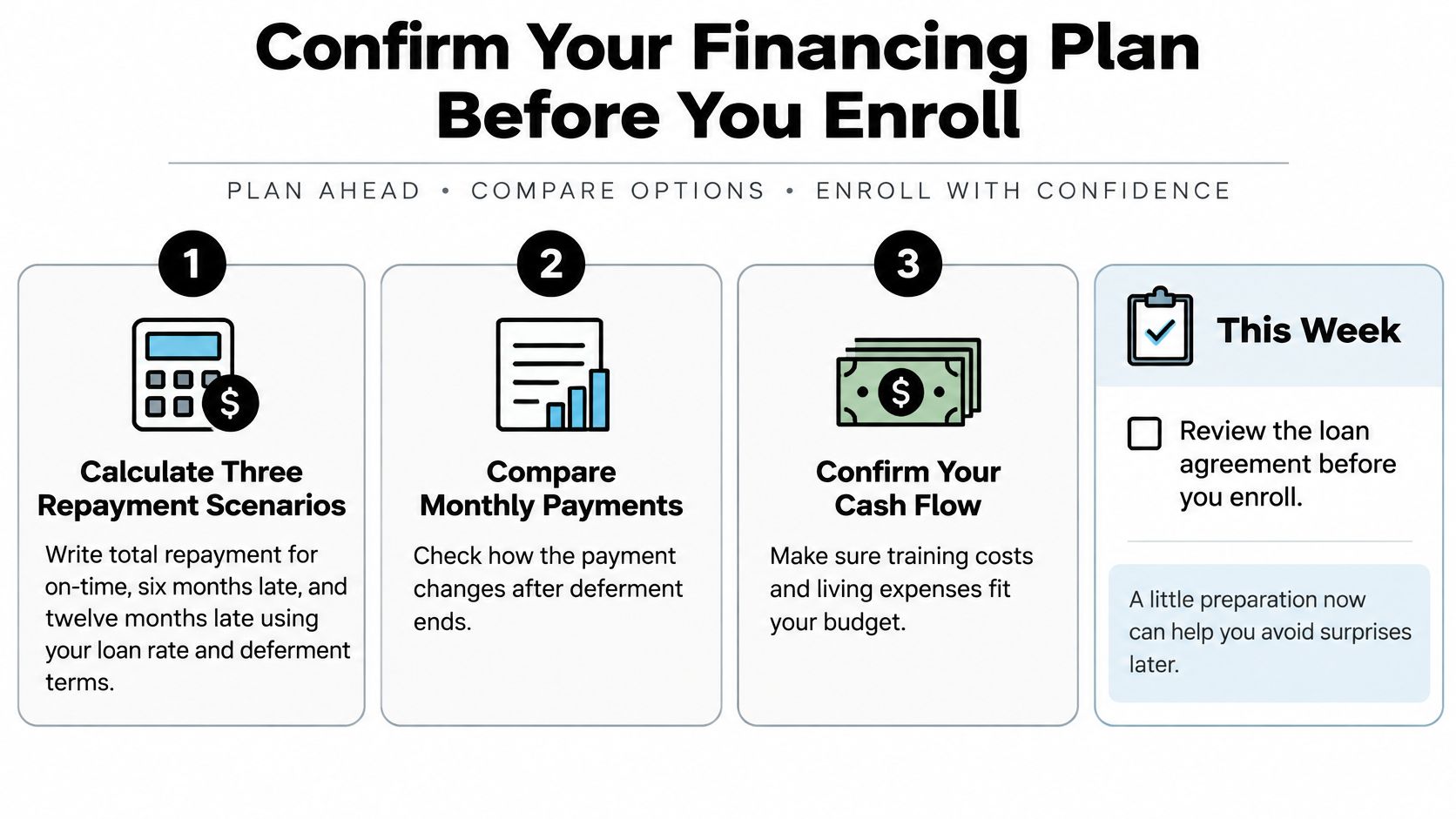
Build hypothetical schedules for on-time completion, completion six months late, and completion twelve months late. In each, record total disbursements, accrued interest, capitalization, the first payment date, required payments, and total repayment through payoff.
Keep the repayment term consistent when comparing offers, and include fees. Review cosigner liability and any release conditions, then test the plan without assuming you'll qualify for refinancing. A future refinance is an option you might pursue, not a dependable source of relief.
Financing Flight Instructor Training and Paid Instructing Hours
A common career sequence is commercial pilot, certificated flight instructor, then instrument instructor. Paid instruction can let a qualified pilot earn income while building relevant experience, but earning the qualification and finding reliable paid work are separate steps.
Use the career roadmap as a planning aid, not an income promise.

Work backward from spendable income
Consider a hypothetical assumption of $30 per paid instructing hour. At an assumed 20 paid hours weekly, that produces $600 weekly, or about $2,600 monthly before taxes, using 4.33 weeks per month.
Those inputs aren't a wage forecast. Replace them with a written compensation arrangement, and distinguish paid ground instruction, paid flight instruction, cancellations, and unpaid preparation or waiting time.
Use a CFI training cost review to identify the remaining expenses before you can begin earning. Don't start the income line in your spreadsheet on the date commercial training ends if you still need instructor training, testing, and an employment arrangement.
For another way to think through the training-to-work transition, consider the accompanying video.
Test a slow month before relying on a full one
Weather, student availability, aircraft maintenance, and scheduling affect paid hours. Time spent at an airport isn't necessarily billable time.
For the hypothetical assumptions above, test these cash-flow cases:
- Expected month. About $2,600 gross, before taxes and work-related expenses.
- Half-hours month. About $1,300 gross when paid instruction falls to half the assumed schedule.
- Zero-income month. No instructing revenue, while essential expenses and any required loan payment continue.
The lowest case tells you how much reserve or outside income you need. Estimate taxes and essential living costs before treating any gross income as available for debt repayment.
Some programs may contractually guarantee paid instructing hours, while others leave the job search to the graduate. Get any commitment in writing, including eligibility conditions, timing, compensation, and remedies if hours aren't delivered. We facilitate introductions and scheduling between instructors and student leads, but a lead isn't a guarantee of booked training or income.
Confirm Your Financing Plan Before You Enroll
A financing plan is ready when the school agreement, loan contract, medical status, and personal budget fit together. An approval notice alone doesn't establish that fit.
Make the checks in a useful order
- Write the repayment scenarios. Calculate the on-time and delayed-completion cases using the actual loan offer. Include living expenses through the point when you expect dependable income, not merely through the last lesson.
- Confirm interest treatment. Ask the lender when interest begins, how it accrues during deferment, and whether unpaid interest is added to principal. Request the first payment date and a repayment illustration in writing.
- Audit the promised training. Match each certificate and rating to the applicable FAA requirements. Clarify how aircraft, simulator, and other experience fit the course.
- Resolve medical and first-flight timing. Confirm your medical status and schedule an introductory flight if you haven't flown. For a career goal, discuss appropriate medical planning with an aviation medical examiner before committing.
- Reconcile tuition and borrowing. Obtain the tuition model, exclusion list, refund terms, and disbursement schedule. Compare the amount available with the amount due, including expenses outside tuition.
Use this checklist while reviewing the agreements.
Choose a path you can fund through completion
A careful flight-school selection process should leave you with written answers, not just confidence after a tour. Keep unresolved financial questions open until the school or lender answers them clearly.
Our Career Track has fixed tuition of $89,000, with about nine months from zero time to CFII and multi-engine, 282 total hours, and six certificates and ratings. It's based in Riverside, Long Beach, and Corona in Southern California. Our lending partner, Stratus Financial, finances the full Career Track, with payments deferred 12 months; confirm the deferral's start date and interest treatment in your individual agreement.
If you haven't flown yet, start with a discovery flight, a first flight with an instructor before committing. Experiencing the cockpit is a useful decision to make before accepting a long-term repayment obligation.
CFII offers a fixed-price path from zero experience to CFII and multi-engine, along with access to financing for the full Career Track. Visit CFII to review the training path, discuss financing, or arrange your first flight before making an enrollment decision.
Planning to fly for a living?
See what the path from zero to a pilot career looks like, what it costs and how long it takes.
Learn to fly in Riverside
We train at Riverside Municipal Airport in modern airplanes with a parachute built in. Start with a one hour discovery flight, no experience needed.