On this page
- Hour Requirements for Each Multi Engine Pathway
- Prerequisites and Steps Before Your First Twin Lesson
- What the Multi Engine Syllabus Covers Lesson by Lesson
- What to log from the first lesson
- Common Maneuvers and What Examiners Check
- How to Judge Whether Engine-Out Training Is Real
- Costs, Timeline and What Changes Them
- What actually drives the calendar
- Choose Between a Discovery Flight and Career Track
The school's website says you can have a multi engine rating in four days. You have never flown a twin, and you have barely flown anything. So you're reading flight school pages late at night, weighing a fixed price for a full career program against an hourly quote for an add-on rating, and trying to work out which one you're even eligible to buy.
The rating itself is simple to describe. It's a class rating added to a pilot certificate, and it's what lets you act as pilot in command of an airplane with more than one engine. What isn't simple is the distance between the FAA minimums that make you legal and the engine-out competence that keeps you alive when a cylinder quits at 400 feet. That distance is where most of the money goes and where nearly every judgment call about your training gets made.
Hour Requirements for Each Multi Engine Pathway
Start with the row that matches the certificate you'll hold on test day, not the row that matches your ambition.
| Pathway | Total flight hours | Multiengine requirements | Source |
|---|---|---|---|
| Part 61 commercial airplane with multiengine rating | 250 | 10 hours multiengine solo or PIC with an instructor aboard; 10 hours instrument, 5 in a multiengine airplane; 10 hours complex or turbine; day and night cross-countries over 100 nm | 14 CFR 61.129(b) |
| Part 141 graduate, commercial practical test | 190 | Conditions in 14 CFR 61.129(i) must be met | 14 CFR 61.129(i) |
| Restricted ATP pathway, qualifying graduates | 1,250 or 1,000 | Up to 25 hours of full-flight simulator time representing a multiengine airplane, where approved | FAA guidance on reduced-hour pathways |
| Airline hiring, typical | 1,000 to 2,000 or more | Set by each airline, not the FAA | FAA guidance on commercial certificates |
| Airline transport pilot certificate | 1,500 | Multiengine ATP experience requirements apply | FAA guidance on the 1,500-hour aeronautical-experience requirement |
Part 61 commercial airplane with a multiengine class rating is the pathway a self-directed student usually follows, and 250 hours is the number bolted to it. The rule also calls for 10 hours of multiengine time, flown either solo or as pilot in command with an authorized instructor aboard, subject to the regulation's stated exceptions (FAA guidance on the multiengine commercial requirements). Whether you're stacking a class rating onto an existing commercial certificate or earning the commercial multiengine certificate outright changes which experience pathway applies, so settle that with your school before the first invoice arrives.
Approved Part 141 graduates can sit the commercial practical test at 190 hours rather than 250 when the conditions in 14 CFR 61.129(i) are satisfied. Restricted ATP routes run to 1,250 or 1,000 total hours for qualifying graduates, and approved training may credit up to 25 hours in a full-flight simulator representing a multiengine airplane toward a specified experience requirement, with a separate provision permitting up to 100 simulator or device hours toward the 1,500-hour aeronautical-experience requirement (FAA guidance on reduced-hour pathways).
Airline hiring is a different number entirely. The FAA is clear that 250 hours is a certification minimum rather than an airline standard, and many airlines set thresholds at 1,000, 2,000 or more hours (FAA guidance on commercial pilot certificates). A plan that ignores this sends you shopping for a certificate when what you need is logged time.
Find your row, total your logbook against every line in it, and write down the shortfall. Enrolling before you can name that shortfall is how students pay for hours nobody required. If pilot in command time is the gap, this explanation of how pilot in command time is logged and counted covers which hours qualify.
Prerequisites and Steps Before Your First Twin Lesson
The sequence below matters more than the calendar. Done out of order, it costs you weeks and sometimes a second checkride.
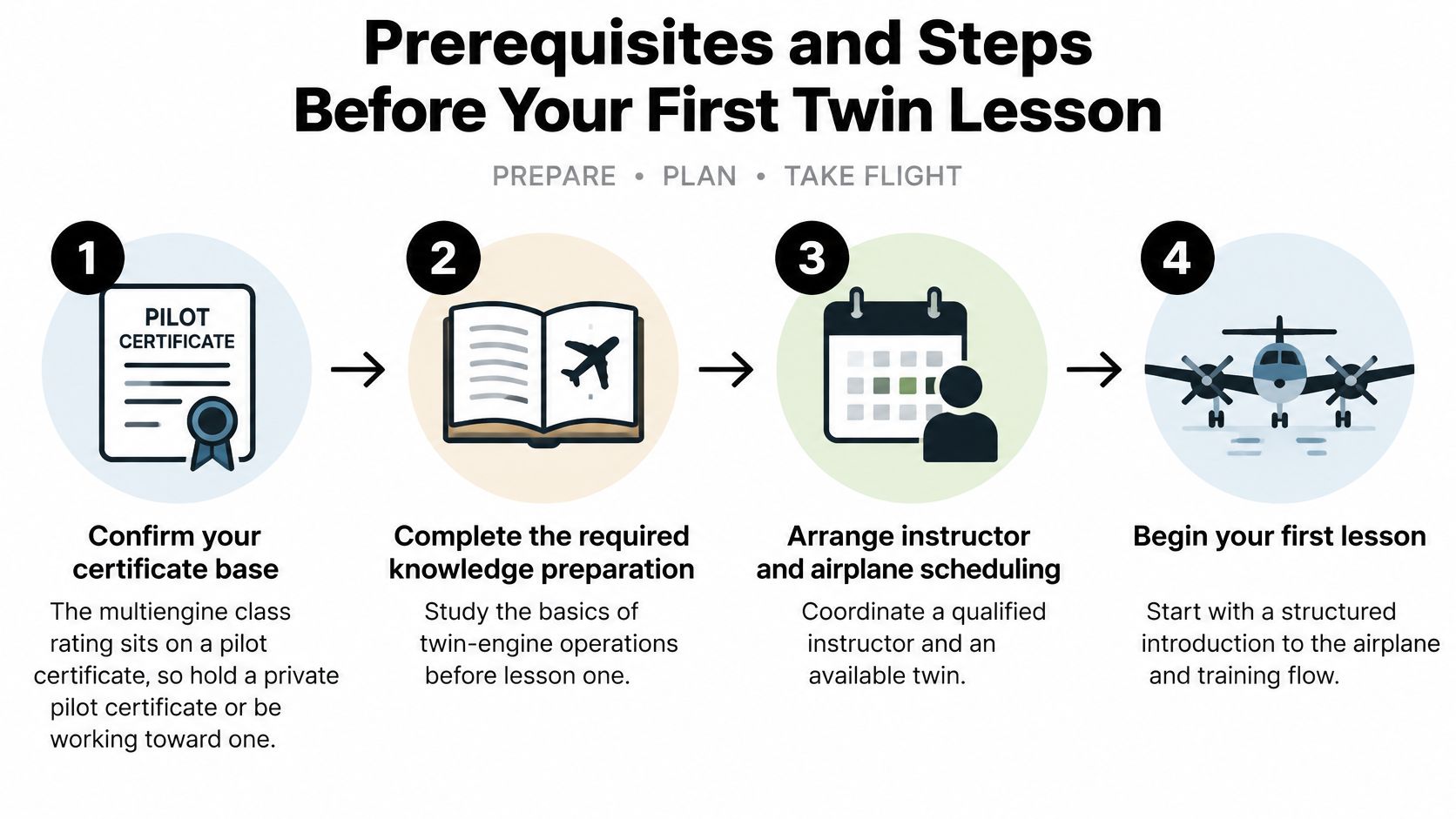
- Confirm your certificate base. The multiengine class rating rides on a pilot certificate, so you need a private pilot certificate in hand or an active training path toward one. Skipping this check is how people end up pricing a twin course they can't legally start.
- Fly something first, or fly something new. If you have no time at all, a discovery flight answers the only question that matters before money moves, which is whether you enjoy being in a small airplane. If you already hold a certificate, ask for the first lesson to be built around what you haven't done yet, which is exactly how CFII tailors an introductory flight for students arriving with existing experience.
- Get the medical early. A third-class FAA medical certificate from an aviation medical examiner is required before you fly solo, but the discovery flight and your first lessons can happen before it's issued. Book the exam in week one anyway. A deferred medical discovered in month four is the most expensive kind of surprise.
- Build logbook categories as you go. Don't reconstruct your cross-country and instrument hours at the end from memory and receipts. Total flying time, pilot in command time, cross-country time and instrument time each get counted separately under the rule, and the regulation sets 3 hours of instructor-led preparation in a multiengine airplane during the two calendar months before the practical test apart from everything else (14 CFR §61.129). That two-month window is a deadline, not a suggestion.
- Earn the training endorsement. You cannot act as pilot in command of a twin until an authorized instructor has given you the training and endorsement required under 14 CFR §61.31 for the class rating. This is the step students forget when they assume the checkride alone grants the privilege.
- Schedule the knowledge and practical tests last. Only after the endorsement is signed and the experience counts reconcile. Examiners book out, and a slot you can't use is a slot you lose.
Self-check before you enroll. Can you name your remaining hours in each category the regulation lists, and can you point to the instructor endorsement in your logbook? If either answer is no, you're not ready to schedule.
What the Multi Engine Syllabus Covers Lesson by Lesson
Ground and flight blocks interleave. You'll brief a maneuver, fly it within the week, then revisit the theory once the flight has shown you what you didn't understand the first time.
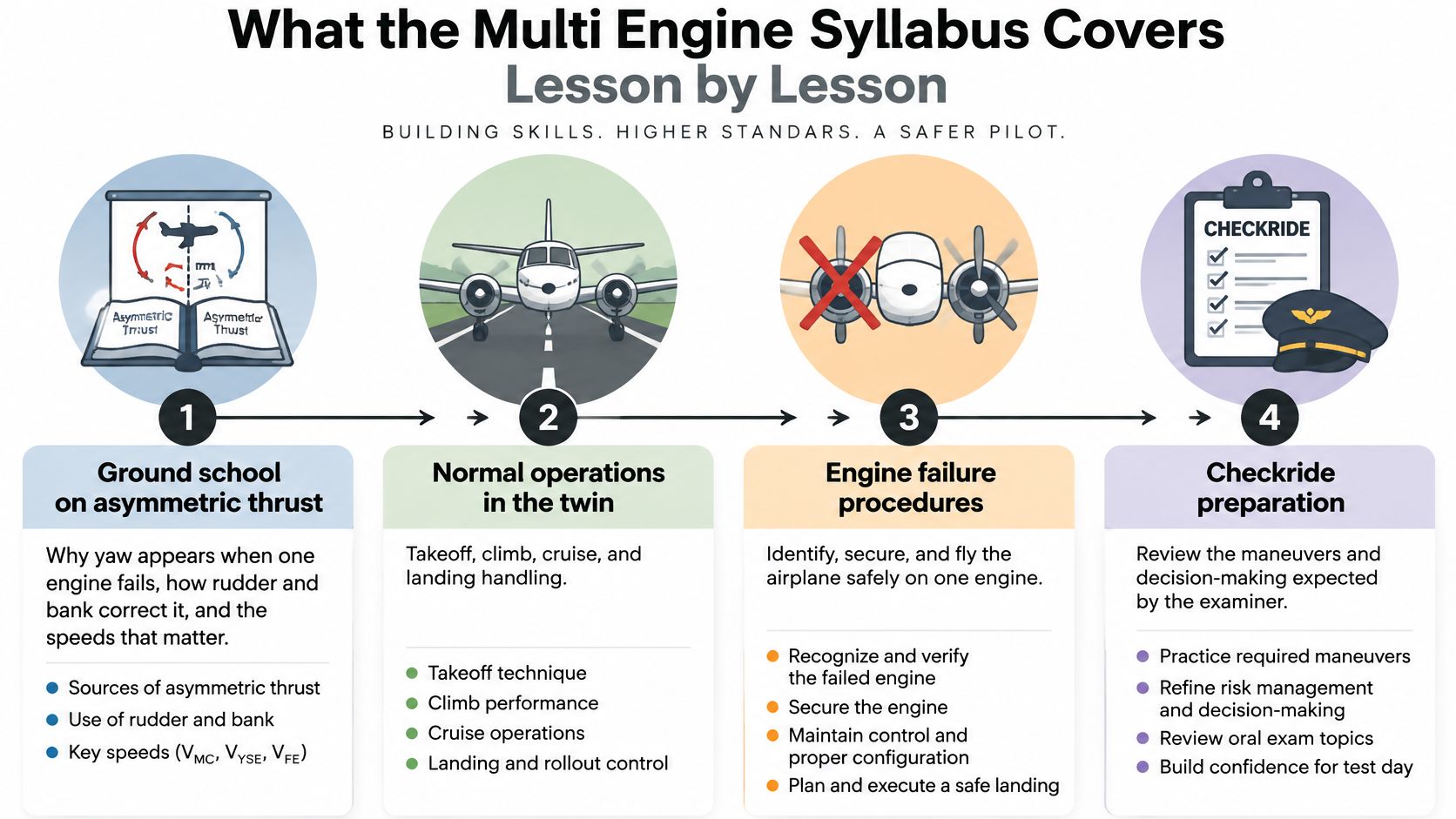
Asymmetric thrust, on the ground first. Every twin lesson starts here. When one engine stops producing thrust, the running engine pushes the nose toward the dead side, and the airplane yaws. You learn why rudder, not aileron, is the primary control, how a few degrees of bank toward the live engine helps, and which speeds frame the whole problem: minimum control speed, best single-engine rate of climb, and best single-engine angle of climb. Learn these on a whiteboard before you learn them at altitude.
Systems, because the twin has more of them. Fuel selectors and crossfeed, electrical load with one alternator offline, cowl flaps, constant-speed props and feathering. The sequence you'll drill until it's boring is identify, verify, secure, and the "verify" step is the one that saves engines and careers.
Normal flying in the airplane. Takeoffs, patterns, landings and slow flight in a heavier, faster machine with retractable gear. Early lessons are about feel and sight picture, not emergencies.
Engine-out flying, the core of the course. Failures after takeoff, in cruise and on approach, flown against the published single-engine performance charts at the density altitudes you'll encounter. The rating earns its keep here.
Instrument work in the twin. Approaches and missed approaches with an engine simulated out, which is the closest thing to real workload you'll practice before a bad day.
Cross-country and night flying. Navigation, fuel planning and the night environment in an airplane that climbs more slowly on one engine.
Checkride preparation. Maneuvers polished, oral questions rehearsed, and the instructor-led preparation hours logged inside the regulatory window.
What to log from the first lesson
- Aircraft type and registration, so the hours trace to a specific airframe later.
- Every engine failure you practice, with the phase of flight and the configuration.
- The endorsement, signed and dated, with your instructor's certificate number.
Common Maneuvers and What Examiners Check
The mistake that fails more multiengine applicants than any other isn't weak hands. It's rushing the sequence: identifying, verifying and securing in a blur because the airplane is descending and the applicant wants the problem gone.
The FAA's commercial pilot standards treat multiengine proficiency as its own discipline, built on aircraft control, engine-out risk management and minimum-control-speed awareness (FAA Commercial Pilot Airplane Airman Certification Standards). The current ACS covers single-engine and multiengine land and sea classes, so the multiengine tasks you'll be graded on are published, not guessed at.
| Maneuver | What the examiner checks | Common student mistake | Habit that prevents it |
|---|---|---|---|
| Engine failure after takeoff | Identify the failed engine, control heading, hold a speed above VMC and configure for climb | Banking into the dead engine or letting airspeed decay | Fly to a set speed first and keep bank small toward the good engine |
| Engine failure in cruise | Identify, verify and secure the failed engine, then set best single-engine speed | Securing the good engine after a misidentification | Use dead foot, dead engine, and verify by reducing power on the suspect engine |
| VMC demonstration | Recognize directional control loss and recover promptly with minimal altitude loss and bank within limits | Holding the loss too long or recovering with excessive bank | Rehearse the recovery sequence until it is automatic and called aloud |
| Single-engine approach and landing | Stabilized approach with a planned configuration sequence and a go-around on one engine | Configuring late and carrying excess speed on final | Set configuration steps by altitude and call each one |
| Instrument approach with one engine out | Workload management, checklist use and the missed approach procedure | Fixating on the gauges and missing altitude callouts | Brief the missed approach before the approach and use a fixed callout script |
Two limitations sit behind that flight test and they decide which airplane you can use. To remove the Airplane Multiengine VFR Only limitation, you must demonstrate the required tasks in an airplane with a manufacturer's published minimum control speed, VMC. If the test aircraft publishes no VMC, the FAA may issue a Center Thrust limitation unless you've already shown competence in a multiengine airplane with a published VMC. Those limitations restrict what you may fly, which is why renting whatever twin is cheapest on the day isn't always the cheaper decision. The airman certification standards explained walks through how tasks are graded rather than just listed.
Practice routine that works. Brief the failure and the exact speed you'll hold before you launch. Fly it at a safe altitude with the instructor's hands hovering. Debrief control inputs and airspeed within two minutes of the maneuver, while your feet still remember what they did.
Engine-failure practice is about control and sequence, not speed. Fast hands that skip verification are worse than slow hands that follow the order.
How to Judge Whether Engine-Out Training Is Real
Logged multiengine hours are not the same thing as readiness, and a syllabus that satisfies the regulation proves only that the regulation was satisfied.
The FAA's rules and testing standards establish minimum exposure to multiengine instrument work, night operations, cross-country flying and checkride preparation, while the standards separately emphasize automation management and instrument-system competence (FAA Instrument Rating Airplane Airman Certification Standards). Minimums are a floor. The question worth asking is what evidence shows a course builds transferable engine-out judgment rather than ticking the syllabus.
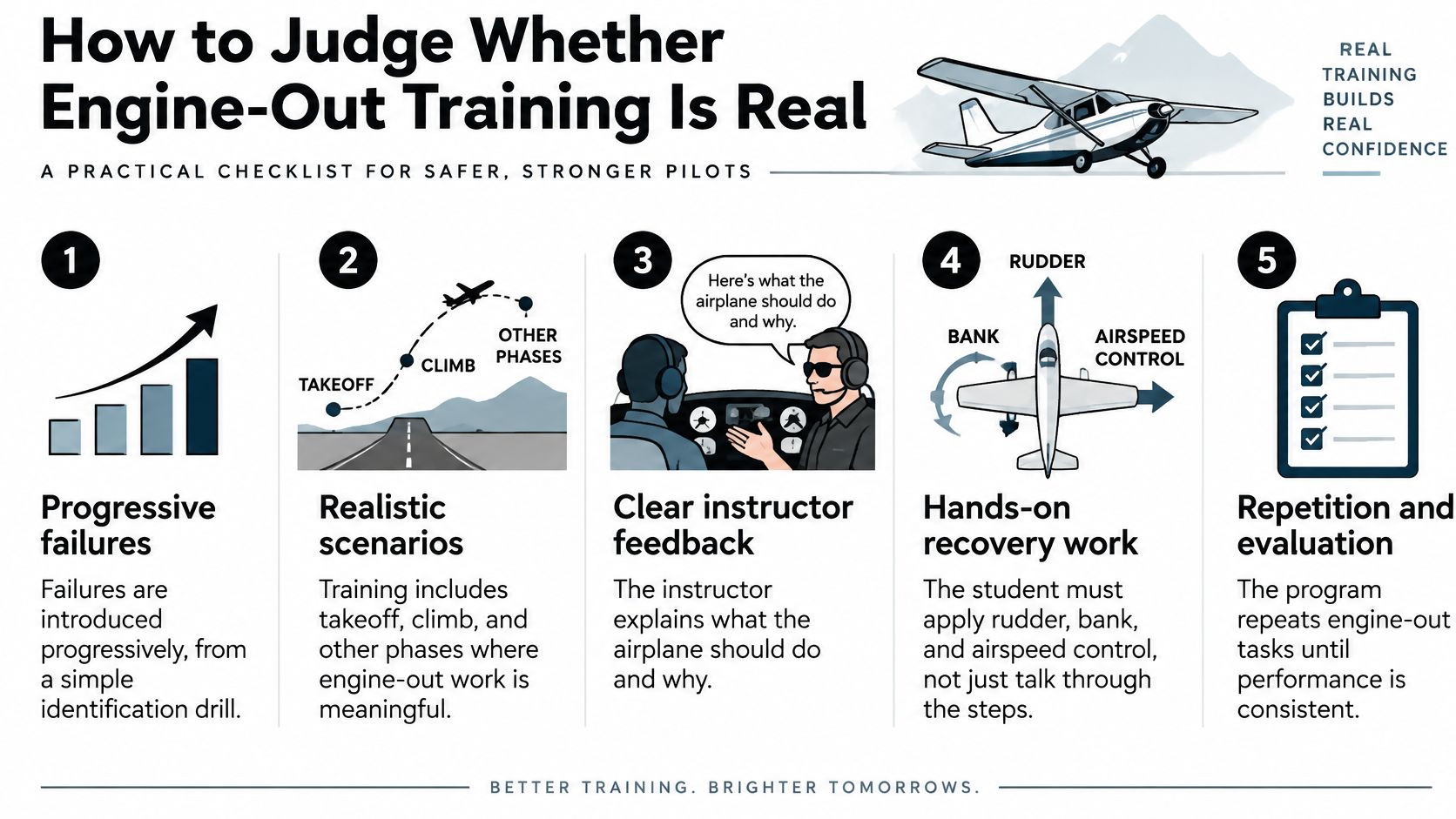
- Failures arrive progressively. A simple identification drill at altitude comes before a full approach with the failure planted at a realistic point. Programs that start with worst-case scenarios produce panic, not skill.
- Verification is drilled before the engine is secured. Every step said aloud, in order, with the instructor listening for a skipped call. Silent checklist running is how the good engine gets feathered.
- Performance is assessed at realistic density altitudes. A single-engine climb chart checked only at sea level on a cool morning tells you nothing about a summer departure from a high desert field.
- Workload is practiced, not described. Real radio calls, altitude callouts and a missed approach flown with one engine out, not a discussion about what you'd do.
- Every failure ends in a debrief that names the first error and the fix. Not a general "good job." The correction usually lives in the first three seconds.
- Recurrent practice is planned before you finish. The rating expires in your skills long before it expires on paper.
More logged multiengine hours don't automatically make a better-prepared pilot. Scenario design, briefing discipline and the quality of the debrief usually matter more than raw time.
That's why the checklist method matters as much as the maneuver. CFII teaches two methods: read-and-do for rare or high-stress tasks, and do-then-confirm for routine flying, drawn from the FAA's Airplane Flying Handbook, which calls checklists the foundation of pilot standardization and flight deck safety. The same split applies on the engine-out drill, where feathering belongs on the read-and-do list and configuration changes belong on the confirm list. For the takeoff case specifically, this breakdown of what to do after an engine failure on takeoff follows the same identify-then-act order.
Request three things before you pay a deposit: a sample lesson plan, the briefing script for an engine failure, and the debrief checklist. A school that can't produce them is teaching by improvisation.
Costs, Timeline and What Changes Them
Total price and hourly rate are different animals. A cheap hourly rate on an airplane that gets billed for extra hours, extra proficiency flights and a repeated checkride costs more than a higher rate on a program that finishes on schedule.
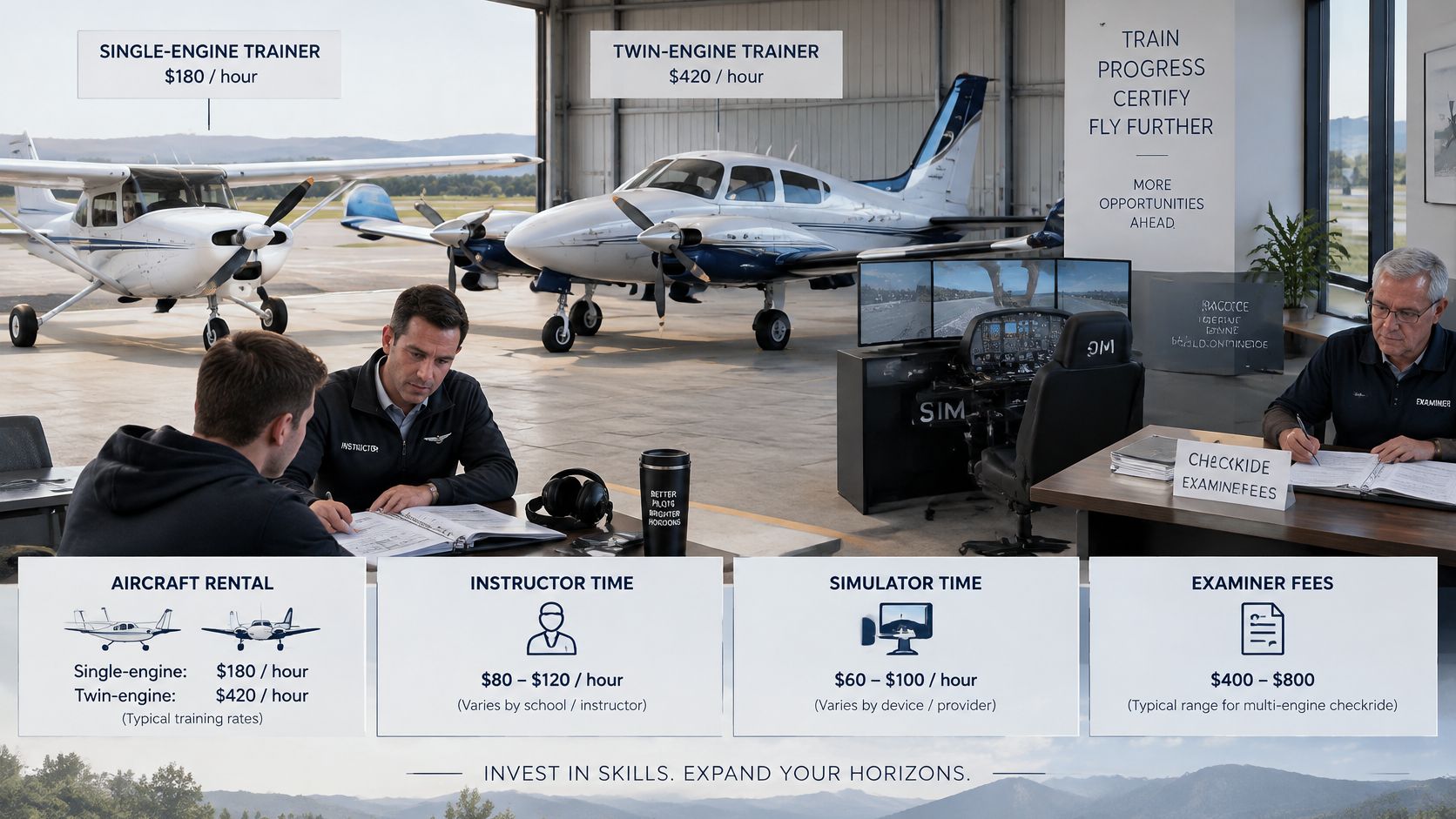
Run the estimate yourself rather than accepting a brochure number.
| Cost driver | What to get in writing | How to estimate |
|---|---|---|
| Multiengine aircraft rental | Hourly rate, wet or dry, and minimum billing | Hours from your table row x rate |
| Instructor time, flight and ground | Hourly rate and whether ground is billed separately | Hours x rate |
| Simulator or training device | Rate and whether time counts toward required hours | Hours x rate |
| Examiner fee | Written quote and retest fee | Fixed |
| Aviation medical, written test and study materials | Exam and test fees from the provider | Fixed |
| Retest buffer | Cost of one repeated checkride | Add one buffer |
Nothing in that worksheet is a price. Each line is a question, and the answers come back in writing or not at all. If you're spreading payments across a longer program, this guide to paying for pilot training covers how pilots sequence the cost.
What actually drives the calendar
How often you fly decides more than anything else. Twice a week keeps engine-out procedures sharp; once a fortnight means each lesson starts with a refresher you paid for. Weather and aircraft availability come next, and a single twin down for maintenance can stall a schedule for days. Examiner scheduling is the fourth driver, and in busy airspace it's often the longest wait of the four.
I would ask every school the same six questions in writing, including CFII: airplane age, students per airplane, instructor turnover, total price, Part 61 or Part 141, and whether you can fly before committing. The answers separate a training program from a rental counter.
Full-time training compresses the calendar. Part-time training spreads the same hours across months, and the cost shows up as slower recall rather than a bigger invoice.
Choose Between a Discovery Flight and Career Track
Route by where you are, not by which page has the bigger number.
You've never flown. Book a discovery flight at CFII's discovery flight page. You'll feel a light aircraft in the air and get a sense of whether the daily grind of training appeals to you. If you're weighing what that first hour costs against the rest of the budget, this look at the price of a discovery flight and what it includes puts the number in context.
You hold a private certificate and want only the rating. Take the row from the first table that fits you, compare it to your logbook, and ask for total price in writing before you schedule anything.
You want the full path from zero to instructor. CFII's Career Track program is a fixed $89,000 tuition that includes multi-engine, running about nine months from zero time to CFII and multi-engine with 282 total hours and six certificates and ratings, delivered across Riverside, Long Beach and Corona in Southern California. The multi-engine module sits inside the same sequence as the instrument, commercial and instructor training, so twin time accumulates alongside the rest of the syllabus rather than as a separate checkout bolted on at the end.
Nothing about that structure promises you a job. What it does is remove the scheduling mismatch that appears when multi-engine training is bought as a standalone add-on months after the rest of your certificates, when your scan, radio work and instrument discipline have all gone soft.
Pick your first step this week and keep your logbook where you can reach it. The comparison against the table only works if the numbers in it are current.
If you're mapping the multi-engine rating into a larger plan, CFII builds it into a single sequence from first flight to instructor, with multi-engine time logged alongside your instrument and commercial training rather than purchased separately. The program runs on a fixed published tuition from its Southern California bases, and the school schedules checkrides directly rather than leaving you on an examiner waitlist. Start at CFII and compare your own hour count against the pathway you intend to fly.
Planning to fly for a living?
See what the path from zero to a pilot career looks like, what it costs and how long it takes.
Learn to fly in Riverside
We train at Riverside Municipal Airport in modern airplanes with a parachute built in. Start with a one hour discovery flight, no experience needed.