
On this page
- Know Your Goal and the Real Hour Requirements
- Separate first flights from solo requirements
- Comparing Training Structure and Curriculum
- Use the commercial certificate as a syllabus test
- Judging Fleet, Safety and Instructor Quality
- Judge operations, not just appearances
- Reading Pass Rates and Checkride Outcomes
- Ask for the denominator
- Auditing the Full Cost and Financing Picture
- Build the written estimate line by line
- Scheduling, Housing and Realistic Timelines
- Match the training pace to your life
- Your Next Step Toward Choosing a Flight School
You've opened three flight-school websites, and each promises a different route from zero experience to the cockpit. One advertises a quick timeline, another leads with a low hourly rate, and a third lists a long course without explaining what the price covers. It's hard to compare them when they don't show the same numbers.
The practical way to choose a flight school is to set your goal, then compare realistic completion hours, audited test outcomes, and the full written cost. Fleet photos and headline tuition don't tell you whether you'll get enough consistent training to finish.
Know Your Goal and the Real Hour Requirements
Before comparing schools, decide what you're aiming for. A private pilot certificate for personal flying has different training and cost needs from a commercial certificate or a career track that includes instructor ratings. If you're considering airline flying, map the certificates and experience you'll need along the way. This guide to how to become an airline pilot can help you understand the larger path.
A zero-time student might see one school advertise training close to the legal minimum and another plan around a much larger number of hours. For a U.S. private pilot certificate, the FAA minimum is 40 logged flight hours, including at least 20 hours with an authorized instructor and 10 hours of solo flight. The requirements also include specified cross-country, night, and instrument training. But the minimum isn't a reliable budget or timeline by itself: the FAA reports that applicants without hearing impairment who complete the requirements average approximately 75 hours, nearly 88% above the regulatory minimum (FAA private-pilot hour requirements).
Separate first flights from solo requirements
You don't need to have your medical certificate in hand before you take a discovery flight or begin early lessons. A third-class FAA medical certificate from an aviation medical examiner is required before flying solo, but the first lesson can happen before you obtain one. That gives you a chance to experience the training environment while you work through the appropriate next steps.
For a useful comparison, ask each school for its recent median completion hours and calendar time for your specific certificate or rating. Then ask how it tracks progress and what happens if you need more training than the planned amount. A school quoting a fixed price should explain whether that price assumes minimum hours or includes a defined amount of training above the minimum.
Practical rule: Compare schools on the training students typically complete, not just the hours required to qualify.
You're not trying to predict your exact training time before your first lesson. You're checking whether a school gives you a clear, honest planning range and can explain what could move it.
Comparing Training Structure and Curriculum
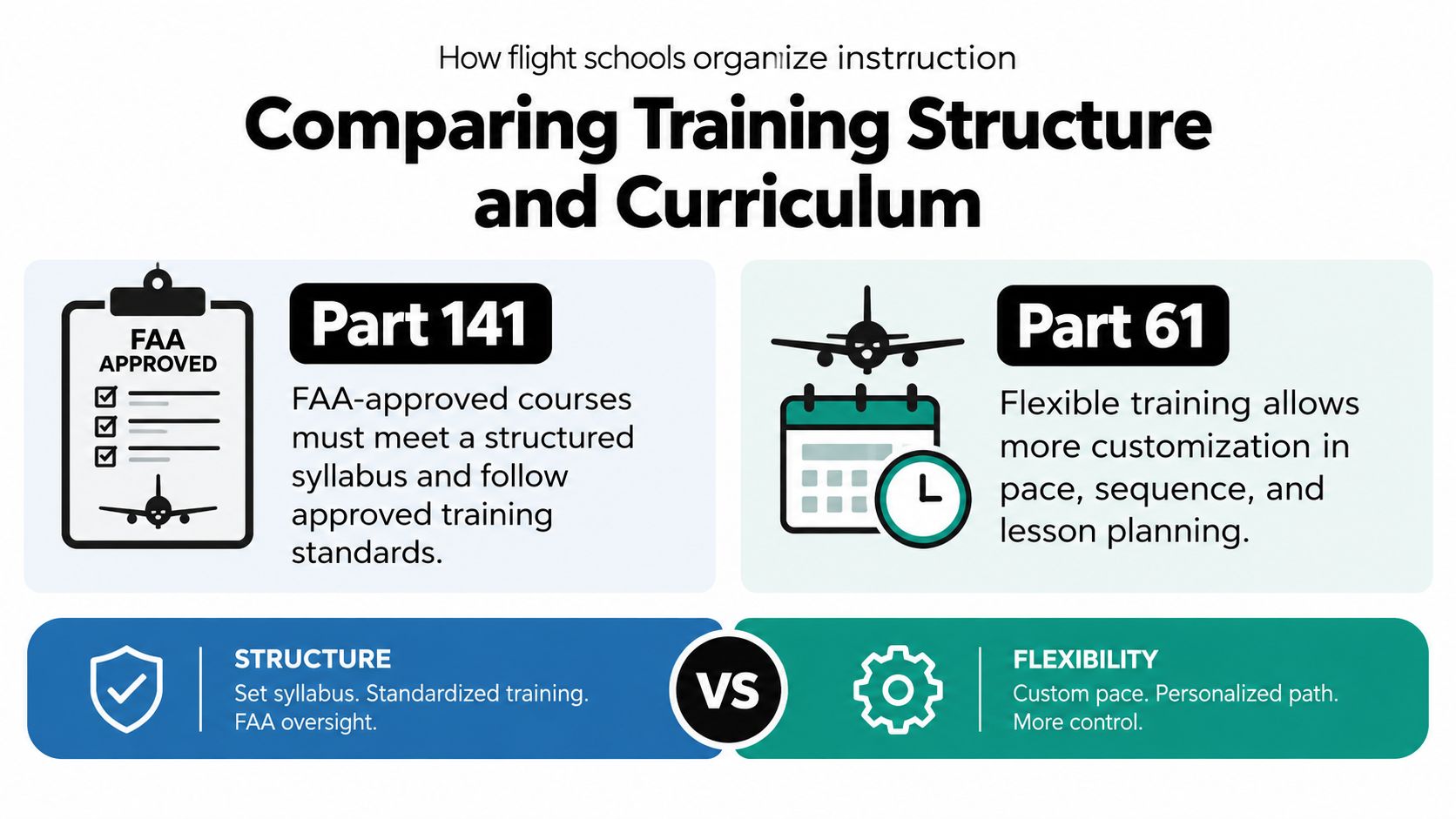
A school's training label tells you how it's approved to organize instruction. It doesn't tell you whether its syllabus is a good fit for your goal or whether its cost estimate reflects the hours you're likely to need.
FAA-approved Part 141 courses must meet prescribed curriculum and minimum ground- and flight-training requirements. Schools operating under Part 61 may structure training differently. Neither label alone shows how clearly a school maps lessons to requirements, monitors your progress, or handles extra training. Compare the actual syllabus and policies, not just the category. For more context on Part 141 flight schools, focus on what the program documents and how it measures progress.
Use the commercial certificate as a syllabus test
A career program's hour totals are easier to assess when you compare them with specific regulatory requirements. For an airplane single-engine commercial pilot certificate, 14 CFR § 61.129 generally requires at least 250 hours of flight time as a pilot. The rule includes experience requirements for powered aircraft, airplanes, pilot-in-command time, and cross-country flights, plus 20 hours of commercial-pilot training. That training includes instrument work and experience in a complex, turbine-powered, or technically advanced airplane, or a qualifying combination (14 CFR § 61.129).
Ask the school to show, in writing, how its aircraft, simulator, cross-country flights, and pilot-in-command opportunities fit each required category. Simulator time can support instrument proficiency and approved credit, but it doesn't replace every airplane hour or every specific experience requirement. A vague promise of “enough hours” isn't a substitute for an hour-mapped syllabus.
| A documented syllabus | A vague syllabus |
|---|---|
| Shows which lessons and experiences meet each requirement | Lists a total without explaining what the hours include |
| Defines how instructors record and review progress | Offers no clear process for spotting delays or gaps |
| States what happens if you need additional training | Leaves extra lessons and their costs undefined |
| Separates airplane time from simulator time | Implies that all logged or simulated time is interchangeable |
If your intended route includes airline work, calculate the experience still needed after training. The standard Part 61 commercial path and airline transport pilot requirements create different milestones, so ask the school to show how its course fits your own plan rather than treating a certificate list as a complete career timeline. The Bureau of Labor Statistics' pilot overview provides broader occupational context, while the school should explain its own syllabus and hour-building assumptions.
Judging Fleet, Safety and Instructor Quality
A polished fleet page can't tell you whether an airplane will be available when you're scheduled to fly. Ask about aircraft age, how many students share each airplane, instructor turnover, whether the total price is provided in writing, and whether you can fly before committing. We encourage prospective students to ask those questions at every school, including ours.
Judge operations, not just appearances
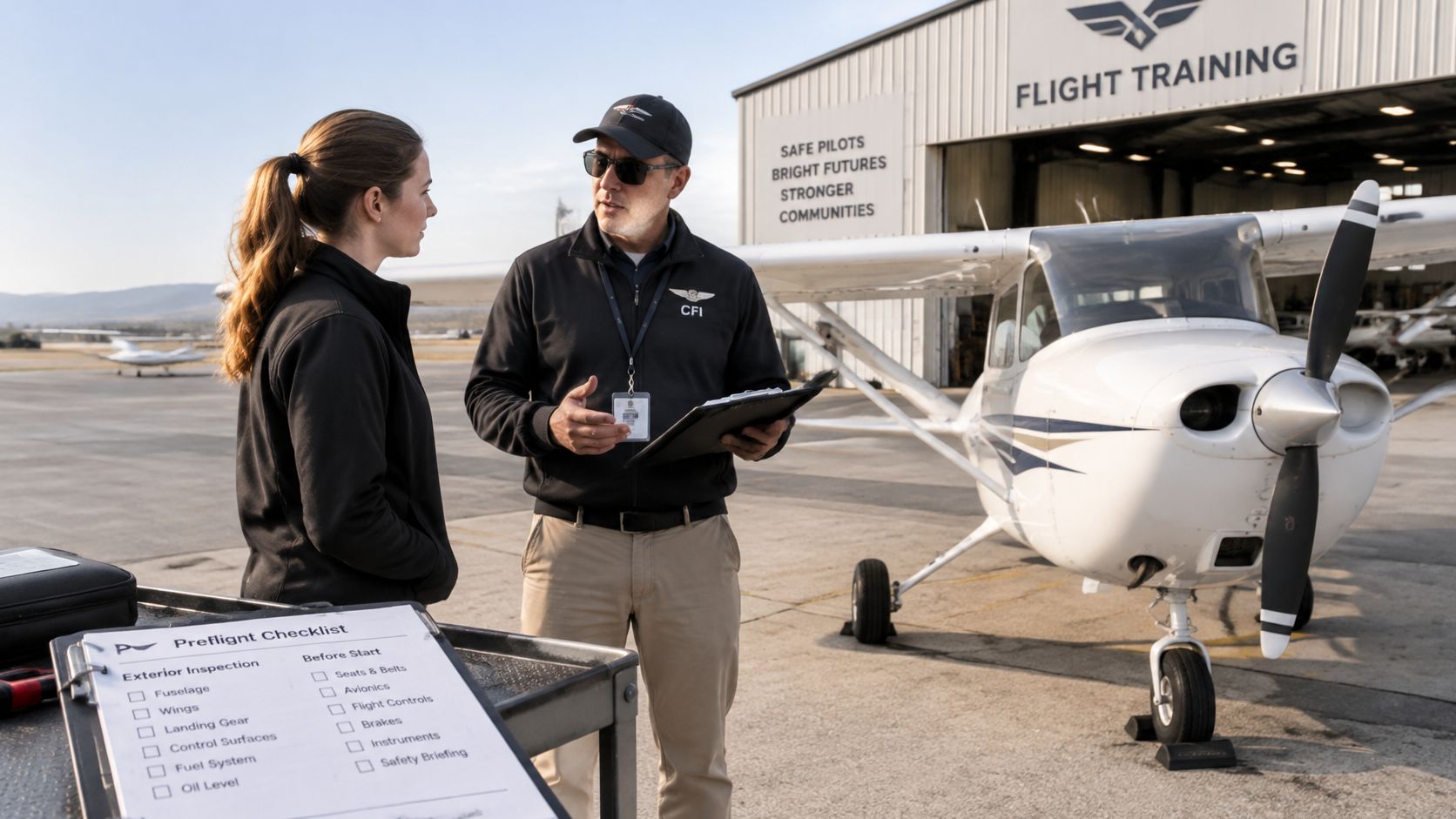
A newer-looking airplane isn't automatically the better training choice if it spends too much time unavailable. Ask how maintenance is handled under applicable FAA requirements, whether the school has backup aircraft, and what its weather cancellation rules are. A strong answer is specific and easy to understand: the school should be able to explain how it decides whether a flight can go, who makes that decision, and how it reschedules a cancelled lesson.
Instructor continuity matters for the same reason. Frequent changes can interrupt the training plan, so ask how instructors follow a standardized syllabus and how the school tracks your progress when you change instructors. You should also hear clear answers about emergency procedures, simulator use, runway and airspace risk management, and whether staff track incidents and near misses.
Examining authority offers one historical indicator of testing standards, but it isn't a requirement for every student. FAA data listed 74 of 509 certificated pilot schools, about 15%, as approved to hold examining authority for at least one course. To qualify, a school had to train at least 10 students in the relevant course and achieve a 90% first-attempt pass rate on the required test, administered by an FAA inspector or an examiner who wasn't a school employee (FAA examining-authority data).
That historical benchmark doesn't certify a school's safety or guarantee your outcome. Use it as one prompt for a broader conversation about documented results and operating practices. You can also review the kinds of aircraft a school uses on its fleet page.
Before you leave a school visit, ask for a plain-language explanation of its maintenance process and weather cancellation rule. If staff can't explain who makes the call and what happens next, keep asking before you pay.
Reading Pass Rates and Checkride Outcomes
A headline pass rate can look impressive and still tell you very little. The important questions are who is counted, which test is measured, and when the results were collected. Ask for outcomes by certificate or rating rather than accepting a single schoolwide figure.
For a school seeking Part 141 examining authority, the standard includes graduating at least 10 different students and showing at least an 80% first-attempt pass rate on the relevant knowledge and practical tests (14 CFR § 141.5). That threshold provides context, but it isn't a complete report card.
Ask for the denominator
Private, instrument, commercial, CFI, and CFII tests differ in difficulty and in who reaches the testing stage. Historical initial CFI practical-test pass rates have been just below 70%, according to AOPA's review of test data. Treat that as a reason to ask sharper questions, not as a prediction of your own results.
Request the number of students the school recommended for each test, the number who passed on the first attempt, the number who passed eventually, repeat attempts, and the measurement period. Make sure the denominator includes everyone the school recommended, not only graduates or successful students. Then ask whether figures are schoolwide, instructor-specific, or limited to a selected group.
| Outcome Data to Request | Why It Matters | Complete Answer Includes |
|---|---|---|
| First-attempt practical-test results | Shows how often students arrive prepared for the checkride | Number recommended, number passing, rating, and date range |
| First-attempt knowledge-test results | Measures another required part of preparation | Cohort size, test type, and results for the same period |
| Eventual pass rate and repeat attempts | Reveals outcomes after initial failures | Separate counts for first attempts and later passes |
| Results by certificate or rating | Avoids blending different tests and student groups | Private, instrument, commercial, CFI, and CFII reported separately |
| Stage checks and remedial training | Shows what happens before and after a weak result | Written policies, added-hour process, and relevant outcome data |
A school that reports a very high rate without cohort size, dates, or failed attempts may be showing selection bias. Ask whether students can be delayed by stage checks or examiner availability, too. A reported outcome can look clean on paper while extra training and long waits remain invisible. For a plain-language explanation of what a checkride involves, start with the practical test, then use the school's records to judge its preparation process.
Auditing the Full Cost and Financing Picture
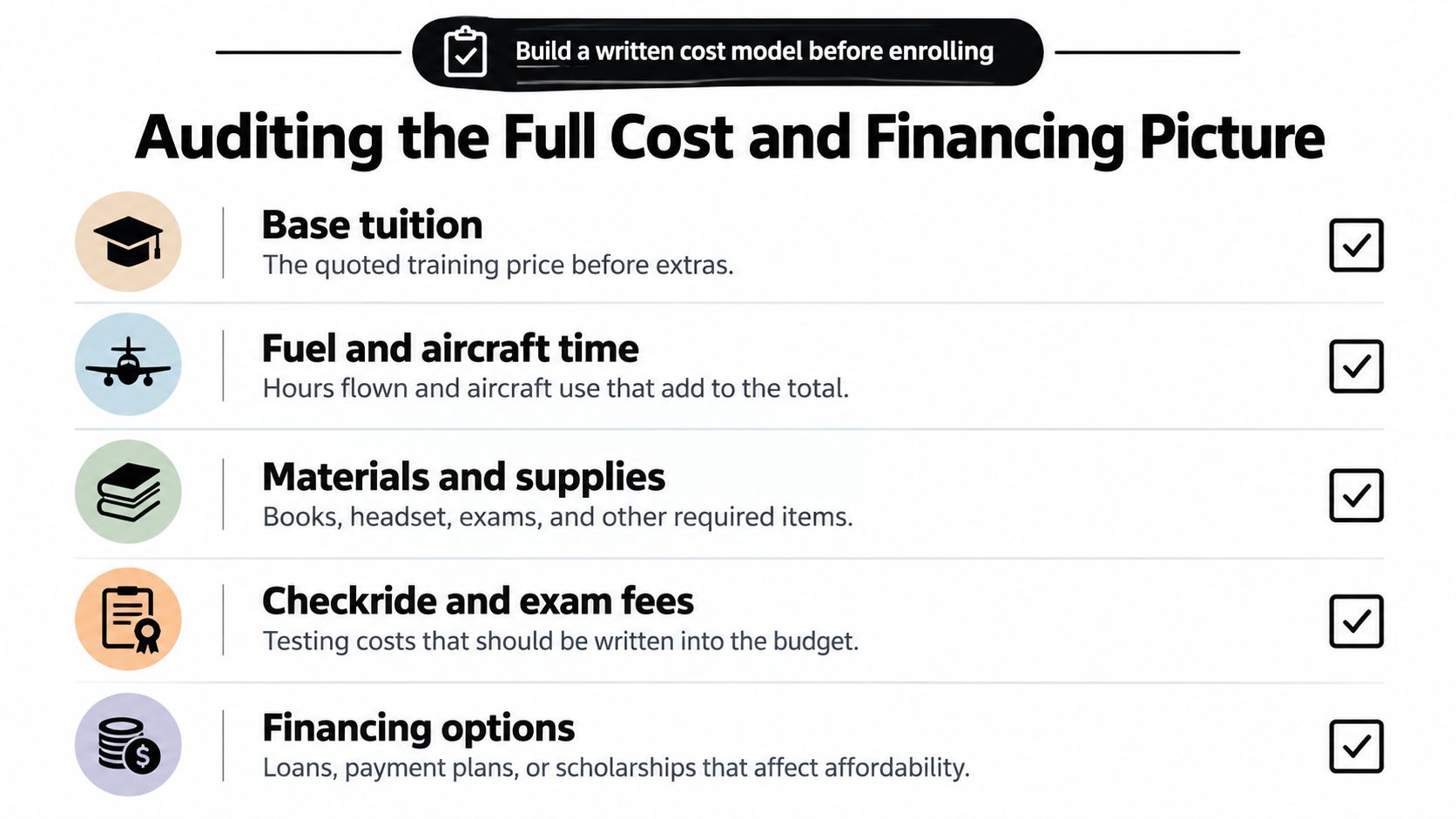
Compare the amount you'll pay, not just the hourly aircraft rate or tuition headline. A useful estimate puts every likely expense in one written model. It also makes exclusions visible before you enroll.
Build the written estimate line by line
Start with the school's quoted training price and ask which training hours it includes. Add aircraft and instructor costs, checkride and examiner fees, written tests, fuel or aircraft surcharges, medical certification, headset and other equipment, study materials, housing, financing interest, retakes, and weather downtime. Get the refund rules in writing, including what happens to prepaid funds if you withdraw or training can't be delivered as planned.
Then test the estimate against a 15–25% contingency for aircraft unavailability, maintenance, instructor changes, and proficiency remediation. That's a planning allowance, not a prediction of what you personally will spend. Ask the school to show which assumptions would cause you to draw on it.
| Cost item | What to verify before enrolling |
|---|---|
| Training hours | Included airplane hours, simulator credit, and the rate for extra lessons |
| Exams and surcharges | Checkride, examiner, written-test, fuel, and aircraft-related charges |
| Equipment and living costs | Required gear, housing, and other expenses outside tuition |
| Financing | Interest terms, payment timing, and whether payments are deferred |
| Refunds and overages | Written cancellation terms and the cost of training beyond the plan |
The Government Accountability Office found that flight-training fees at collegiate programs often exceeded $50,000 in addition to tuition, with approximate total flight-training costs reaching about $81,000. Costs varied by school type, program length, residency, student aptitude, and school requirements (GAO flight-training costs). Those figures aren't a quote for your school. They're a reminder to ask for the assumptions behind any estimate.
A low hourly rate can still produce a high total if aircraft availability, instructor turnover, or repeated stage checks stretch the program. Ask for recent median completion hours and the share of students who finish within the school's published budget. The flight-training cost guide can help you organize the questions, but make the school's own written quote the basis of your decision.
Scheduling, Housing and Realistic Timelines
A fast advertised timeline is credible only if the school can explain how its operation supports that pace. Ask about aircraft use, backup aircraft, instructor coverage, stage-check capacity, and how it coordinates checkrides. A syllabus may set the sequence, but the calendar also depends on weather, maintenance, and access to an examiner.
Designated pilot examiner availability can be a bottleneck. In some regions, students may wait weeks or months for a checkride or need to travel to find an examiner. Paperwork errors in applications or endorsements can waste a scarce appointment. Ask for the school's recent median wait between training completion and checkride, how it handles cancellations and retests, and what share of students waited more than 30 days. A clear process for checking endorsements and application paperwork matters as much as a promised finish date.
A timeline is only useful when the school can explain what happens after a flight is cancelled, an aircraft goes down, or an examiner isn't available.
Match the training pace to your life
Your own lesson frequency also affects consistency. Hobby students taking two or three lessons per week typically reach the private pilot checkride in four to six months, paying lesson by lesson. That example isn't a guarantee; your schedule, readiness, and local operating conditions may differ.
If you plan to relocate, compare housing with the airport and the hours you'll need to be available for lessons. A long commute or a housing arrangement that doesn't fit the training schedule can make it harder to maintain a steady pace. Ask how students book lessons, how the school handles weather disruptions, and whether it can keep the schedule moving when an instructor or airplane becomes unavailable.
Your Next Step Toward Choosing a Flight School
If you haven't flown yet, start with a discovery flight rather than trying to settle every training decision from a website. CFII offers a one-hour first flight with an instructor that requires no experience. You'll meet the instructor, walk around and preflight the airplane together, then take the controls in the air. If you'd rather see the operation before booking, we invite prospective students to walk the hangar, sit in a cockpit, and meet the instructors.
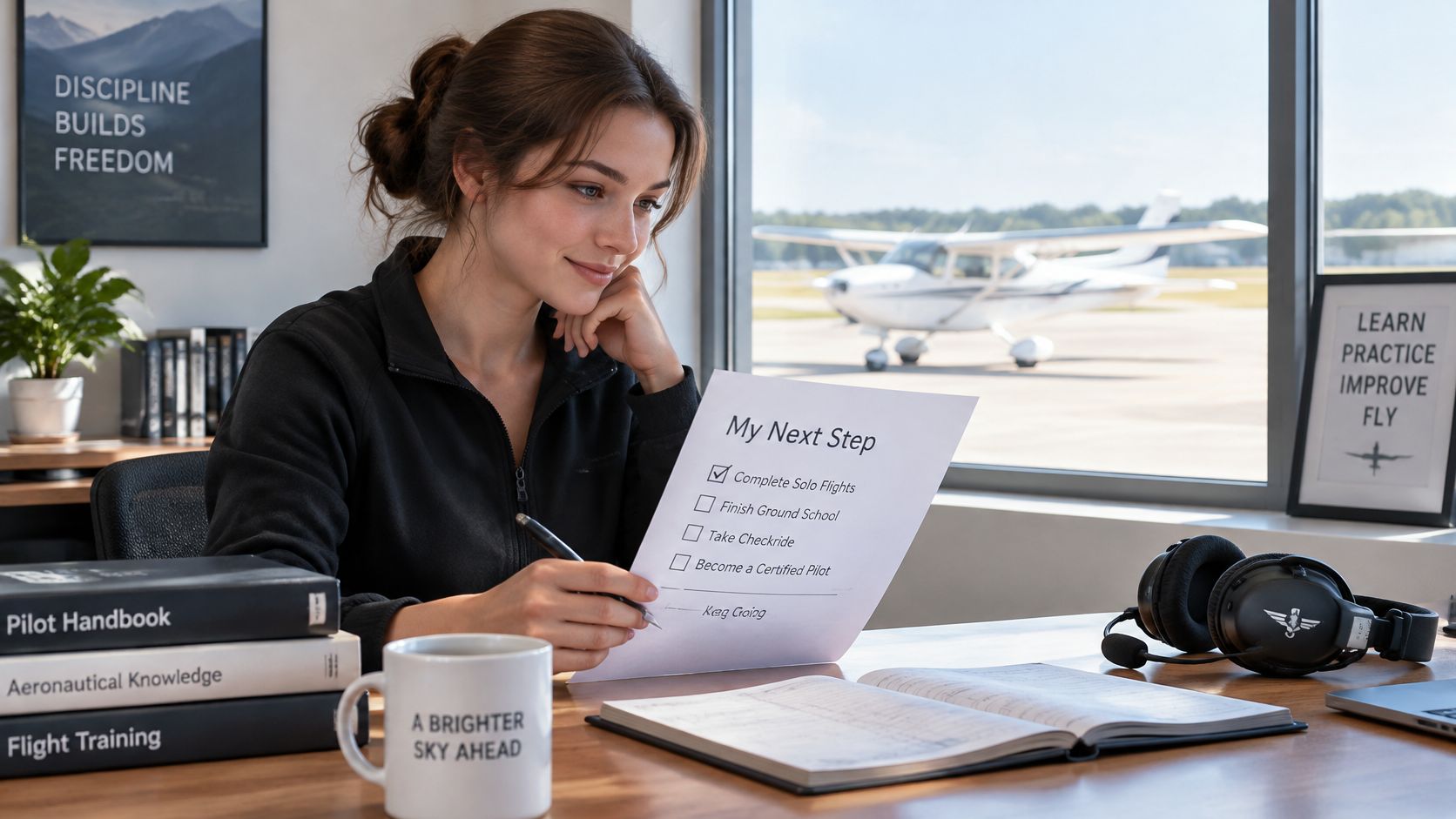
For students seeking a complete path from zero time, CFII's Career Track has fixed $89,000 tuition, about nine months from zero time to CFII and multi-engine, 282 total hours, and six certificates and ratings. Training is based in Southern California, including Riverside, Long Beach, and Corona. The tuition doesn't include pilot gear such as an iPad, headset, or flight bag; students choose and purchase those items themselves. You can review the Career Track program and decide whether its stated scope matches your goals.
Bring these questions to any school, including CFII:
- What are the recent median completion hours and calendar time for my goal?
- How many students share each airplane, and how often do instructors change?
- Can I review first-attempt pass rates by certificate, with cohort sizes and dates?
- What does the written price include, and what costs are excluded?
- What happens if training takes longer, an aircraft is down, or my checkride is delayed?
Book a discovery flight if you haven't flown, or visit a school and ask to see its airplanes and training records before committing.
CFII offers a discovery flight for first-time flyers and a fixed-price Career Track from zero time to CFII and multi-engine. Compare its stated hours, schedule, and exclusions with the checklist above, then visit CFII to explore whether the program fits your plans.
Planning to fly for a living?
See what the path from zero to a pilot career looks like, what it costs and how long it takes.
Learn to fly in Riverside
We train at Riverside Municipal Airport in factory-new airplanes with a parachute built in. Start with a one hour discovery flight, no experience needed.