
On this page
- Multi Engine Rating Requirements by Certificate
- A class rating isn't a second pilot license
- Privileges come from more than the class name
- Private Multiengine Training Blocks Under 61.109
- What the training must accomplish
- The instructor's endorsement matters
- Commercial Hours and What the Checkride Tests
- Cross-country planning must meet the actual rule
- What happens on test day
- Why One Failed Engine Changes the Whole Airplane
- Control comes before diagnosis
- Practice different conditions, not just a familiar demonstration
- Hours That Make You Legal Versus Hireable
- When simulator time counts
- Plan airplane time separately from proficiency practice
- Pick a Zero to Multi Engine Path
- Choose according to your starting point
- Match the course to the privilege you need
40 total hours for a private multiengine class rating under 14 CFR 61.109, 250 total hours for commercial under 14 CFR 61.129, and 1,500 total hours with 50 hours in class for an ATP under 14 CFR 61.159 are the main experience floors to distinguish. They're total-experience requirements for different certificate paths, not interchangeable requirements for hours spent flying a twin.
The important question isn't how many hours you need. It's which certificate you're earning, what you already hold, and whether you're planning for a checkride or a career. A zero-time student and a commercial single-engine pilot adding multiengine privileges don't start from the same place.
Multi Engine Rating Requirements by Certificate
A multiengine class rating sits within a pilot certificate. The certificate sets the broader privileges, while the class identifies the aircraft type within a category. That distinction helps explain why the applicable requirements depend on what you hold and what you are pursuing.
| Goal | Total time floor | Multiengine or class piece | Regulation |
|---|---|---|---|
| Private pilot, airplane multiengine | 40 hours | 20 hours dual and 10 hours solo in the multiengine areas | 14 CFR 61.109 |
| Commercial pilot, airplane multiengine | 250 hours | 100 hours in powered aircraft, 50 in airplanes, 100 as PIC, and 20 hours of specified training | 14 CFR 61.129 |
| Airline transport pilot, airplane class | 1,500 hours | 500 cross-country, 100 night, and 50 in the class of airplane sought | 14 CFR 61.159 |
The table compares eligibility floors for different certificate goals. Its rows are not a sequence of multiengine courses. For example, a commercial single-engine pilot adding multiengine privileges uses the existing commercial certificate as the base. The commercial row describes the experience requirements for earning that certificate, not a new block every existing commercial pilot must accumulate.
The private-rating training components are broken down in the next section's table. Dual means flight training with an authorized instructor. PIC, or pilot in command, refers to time logged under the applicable pilot-in-command rules. These terms describe different kinds of experience, not interchangeable totals.
A class rating isn't a second pilot license
The FAA organizes pilot qualifications by certificate, category, and class. Airplane is a category; airplane multiengine land is a class within it.
A commercial single-engine pilot adding multiengine privileges demonstrates the additional capability while keeping the existing certificate. Under the additional-class-rating provisions of 14 CFR 61.63, the pilot adds the class to that certificate. The applicable training, instructor endorsement, and practical test are still required under FAA Part 61.
The requirements differ by starting point:
- Starting without a certificate: Meet the complete eligibility, experience, training, and testing requirements for the certificate you seek.
- Adding multiengine to an existing certificate: Existing logged experience remains part of your record, while the additional-class provisions determine what you must demonstrate.
- Moving from private to commercial: Meet the commercial certificate requirements, as well as any requirements involved in adding a class.
For many applicants adding a class, the rule does not prescribe a fresh fixed minimum block of training hours. An instructor must still assess your proficiency, and you must demonstrate the required skills on the practical test. The absence of a set hour minimum does not make training optional.
Privileges come from more than the class name
A multiengine class rating identifies the class of airplane you may operate within your certificate privileges. It does not by itself authorize carrying passengers or cargo for compensation.
Instrument privileges are separate. An instrument rating addresses operating under instrument flight rules with the appropriate qualifications and limitations. A class rating and an instrument rating answer different questions about what you may do as a pilot.
Planning rule: Identify the certificate first, the aircraft class second, and the operating privileges third. An hour total alone does not show which requirements apply.
A flight training requirements guide can help organize those prerequisites before you compare courses.
Certificate requirements also differ from operating rules. Part 135 governs particular commercial operations and sets qualifications based on the pilot's role and operation. Its requirements are not a separate multiengine rating, and SIC or PIC hour totals should not be treated as universal across Part 135 operations.
Meeting an experience floor is only one part of readiness. You must also complete the applicable training, secure endorsements, prepare the required documents, and demonstrate proficiency.
Private Multiengine Training Blocks Under 61.109
Private multiengine blocks inside the total-time requirement
| Block | Minimum | What it must include |
|---|---|---|
| Dual with an authorized instructor | 20 hours | Flight training in the required areas of operation |
| Solo training | 10 hours | Solo in the applicable multiengine areas |
| Cross-country flight training | 3 hours | Multiengine cross-country dual |
| Night training | 3 hours | In a multiengine airplane, one cross-country over 100 nautical miles, and 10 full-stop takeoffs and landings |
| Instrument reference | 3 hours | Flight by reference to instruments |
| Practical-test preparation | 3 hours | With an instructor, within the preceding two calendar months |
These minimums come from 14 CFR 61.109(b). They're training components within the overall private-certificate requirements, not independent totals you should add together.
For example, an appropriately planned instructional flight might contribute to both night training and cross-country training. Your instructor must ensure the flight satisfies each applicable requirement and that the logbook records it correctly.
What the training must accomplish
A night cross-country and full-stop landing practice teach different skills. Flying laps around the airport can develop approach and landing proficiency, but it doesn't provide the route planning, navigation, fuel management, and arrival decisions of a cross-country flight.
A full-stop landing also means bringing the airplane to a stop, not immediately taking off again in a touch-and-go. Your instructor plans the lesson around the required events rather than treating all landings as equivalent.
The required private-pilot proficiency areas include normal airport operations, navigation, slow flight and stalls, instrument-reference flight, emergencies, and multiengine operations under 14 CFR 61.107. You're learning to manage the whole airplane, not just its engine controls.
The instructor's endorsement matters
The rating isn't self-endorsed. Your instructor records the training received and recommends you for the practical test only after determining that you're prepared in the applicable areas of operation.
The recent test-preparation requirement also prevents you from relying entirely on lessons completed long before the checkride. If scheduling slips, your instructor should review both your proficiency and the calendar-based eligibility requirements before the new test date.
Logged time documents experience. The instructor's recommendation documents readiness.
You don't need an instrument rating before earning a private multiengine rating. The required instrument-reference training is still mandatory, but it isn't equivalent to earning instrument privileges.
Treat these figures as minimums, not a completion promise. You may need additional dual instruction before you can consistently meet practical-test standards, especially while learning coordinated engine-out control.
For an aspiring career pilot, a private multiengine rating usually isn't the final destination. The training plan must eventually address commercial privileges and the qualifications needed for the work you intend to pursue.
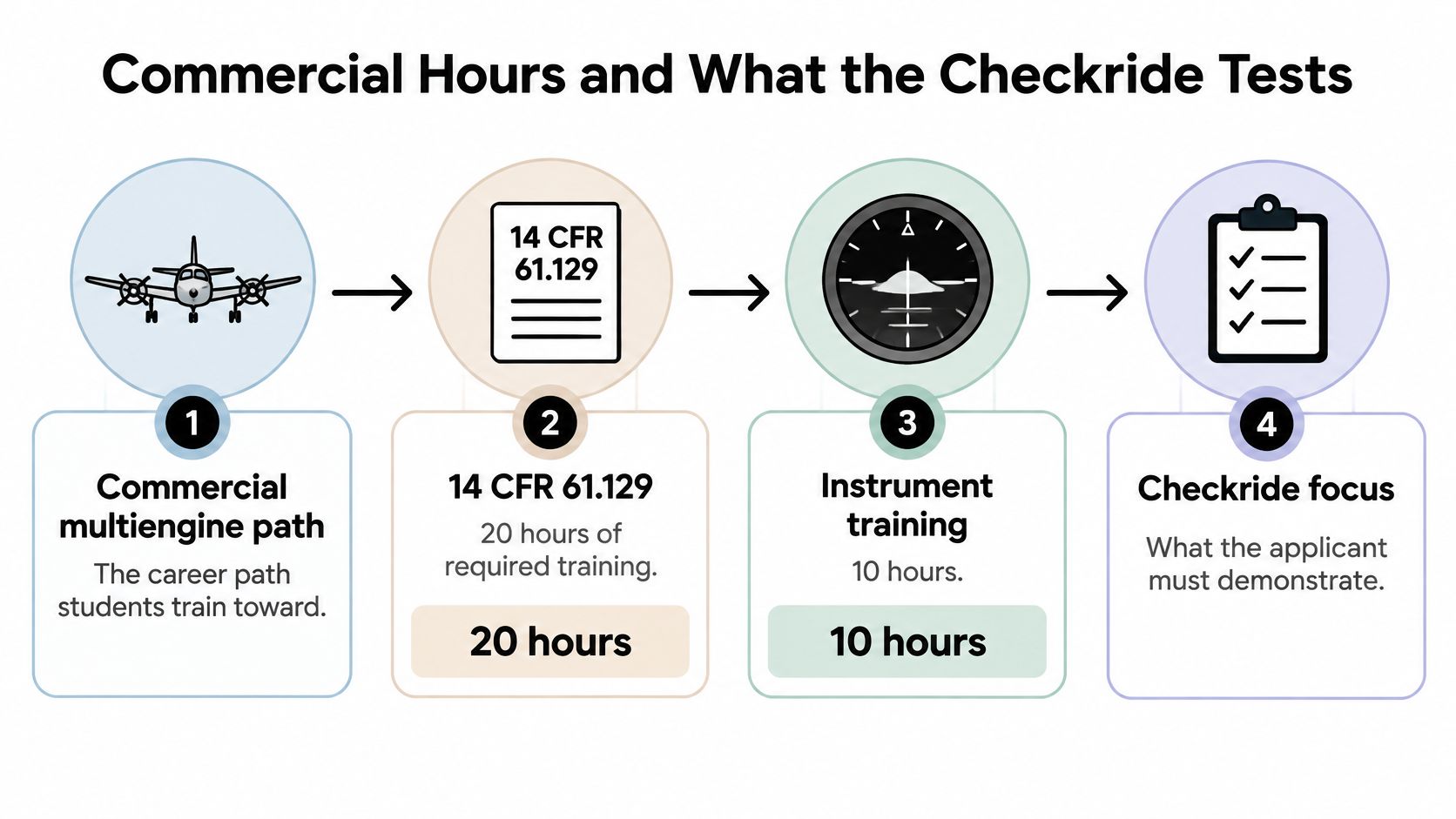
Commercial Hours and What the Checkride Tests
20 hours of specified training, including 10 hours of instrument training, belong to the full commercial multiengine training requirements in 14 CFR 61.129. At least 5 instrument hours must be in a multiengine airplane, and the training includes 10 hours in a multiengine complex or turbine-powered airplane.
Those requirements aren't merely a way to accumulate time. They connect aircraft systems, instrument flying, performance planning, and emergency management.
The progression is easier to understand when you separate training inputs from what you must demonstrate.
Cross-country planning must meet the actual rule
The commercial training includes a daytime multiengine cross-country and a separate nighttime multiengine cross-country, each extending more than 100 nautical miles straight-line from the departure point. It also requires 3 hours of multiengine practical-test preparation within the preceding 2 calendar months under the regulation cited above.
“Straight-line” matters. Flying a long, winding route near the departure airport doesn't substitute for reaching the required distance from it.
Say your instructor assigns a daytime destination beyond the required distance. You prepare fuel calculations, compare departure and arrival performance, select alternates, and discuss what an engine failure would mean along the route.
During the lesson, the instructor introduces a diversion decision. The nighttime flight is scheduled separately, with its own weather, lighting, terrain, and airport considerations.
What happens on test day
The examiner normally begins with eligibility and logbook review, then evaluates your knowledge before the flight. Expect questions about fuel and electrical systems, propellers, landing gear, aircraft limitations, and performance after an engine failure.
The Commercial Pilot Airplane Airman Certification Standards, FAA-S-ACS-7B, effective May 31, 2024, establish the evaluation framework in the FAA commercial airplane ACS. The standards include normal in-flight engine shutdowns and restarts, including feathering and unfeathering when the aircraft flight manual permits them.
Feathering turns the propeller blades toward an orientation that reduces drag from the stopped engine. You must understand why the procedure matters, when it's appropriate, and how the aircraft-specific controls and limitations govern it.
For removal of an Airplane Multiengine VFR Only limitation, the applicable tasks must be completed in a multiengine airplane with a manufacturer-published minimum control speed. That's a specific practical-test requirement, not merely a discussion topic.
- During the oral: Explain the system and the consequence of a failure.
- During the flight: Maintain control, manage workload, and use the correct procedures.
- Throughout the test: Make decisions consistent with the airplane's actual performance.
Our explanation of what a checkride involves can help you prepare for the format without confusing preparation with memorizing answers.
A zero-time student still has the full commercial certificate to earn. An existing commercial single-engine pilot follows the additional-class pathway while demonstrating the applicable multiengine tasks.
Why One Failed Engine Changes the Whole Airplane
Push a shopping cart from both sides, then stop pushing on one side. The remaining force turns the cart toward the side that stopped moving forward. That gives you a starting picture of yaw, the airplane's nose turning left or right. In a conventional twin, the operating engine produces asymmetric thrust that tends to yaw the nose toward the failed engine.

The airplane also loses thrust, while a windmilling propeller can add substantial drag. These forces affect both directional control and performance, so maintaining control and deciding whether the airplane can climb are separate tasks.
Control comes before diagnosis
VMC is the minimum control speed associated with the critical engine inoperative under specified conditions. It marks a demonstrated control limit under defined conditions, not a guarantee of climb performance. Below the applicable control margin, rudder may no longer oppose the yaw; above it, the airplane may still be unable to maintain altitude or clear terrain.
The FAA flight-testing guidance addresses minimum-control-speed behavior and asymmetric-flight handling. Training connects those concepts to the airplane's actual rudder pressure, bank, pitch, and airspeed cues.
A safe response follows a clear priority:
- Maintain control: Apply appropriate rudder, establish the aircraft-specific bank and pitch, and protect airspeed.
- Identify and verify: Determine which engine failed before touching controls that could disable the operating engine.
- Apply the procedure: Follow the airplane's published emergency actions and checklist.
- Choose the outcome: Assess whether to continue, divert, or land.
For example, if the flight manual calls for a specific bank and pitch during the engine-out demonstration, use those cues while checking airspeed and rudder response. Stabilize the airplane before diagnosing further. Correctly identifying the failed engine matters only if directional control is maintained.
Practice different conditions, not just a familiar demonstration
An aggressive nose-up attitude can bleed airspeed when control authority matters most. Excessive or poorly coordinated inputs can also increase drag.
Training should include different configurations and discussion of density altitude. A demonstration in cool conditions is only one picture of the airplane's behavior. The right response depends on the aircraft's limitations, available performance, altitude, and phase of flight.
An operating engine doesn't guarantee a climb. Control the airplane, then make a performance-based decision.
Simulators can help rehearse recognition, checklist use, and decision-making. Aircraft training is still needed to learn real control pressures, outside visual cues, and handling behavior.
An engine failure on takeoff leaves little altitude and decision time, making the priorities especially important. Multiengine proficiency comes from applying them to the conditions at hand: identify the failed engine, use the appropriate controls, assess performance, and choose a safe course of action.
Hours That Make You Legal Versus Hireable
A multiengine rating, ATP eligibility, and an airline's hiring screen measure different things. A focused add-on course can prepare you for the rating's practical test, while leaving you with less actual multiengine airplane experience than an employer seeks.
Separate certificate eligibility, required training and endorsements, ATP qualifications, and employer screening. Each rule or policy covers its own requirement; meeting one does not establish that you meet another.
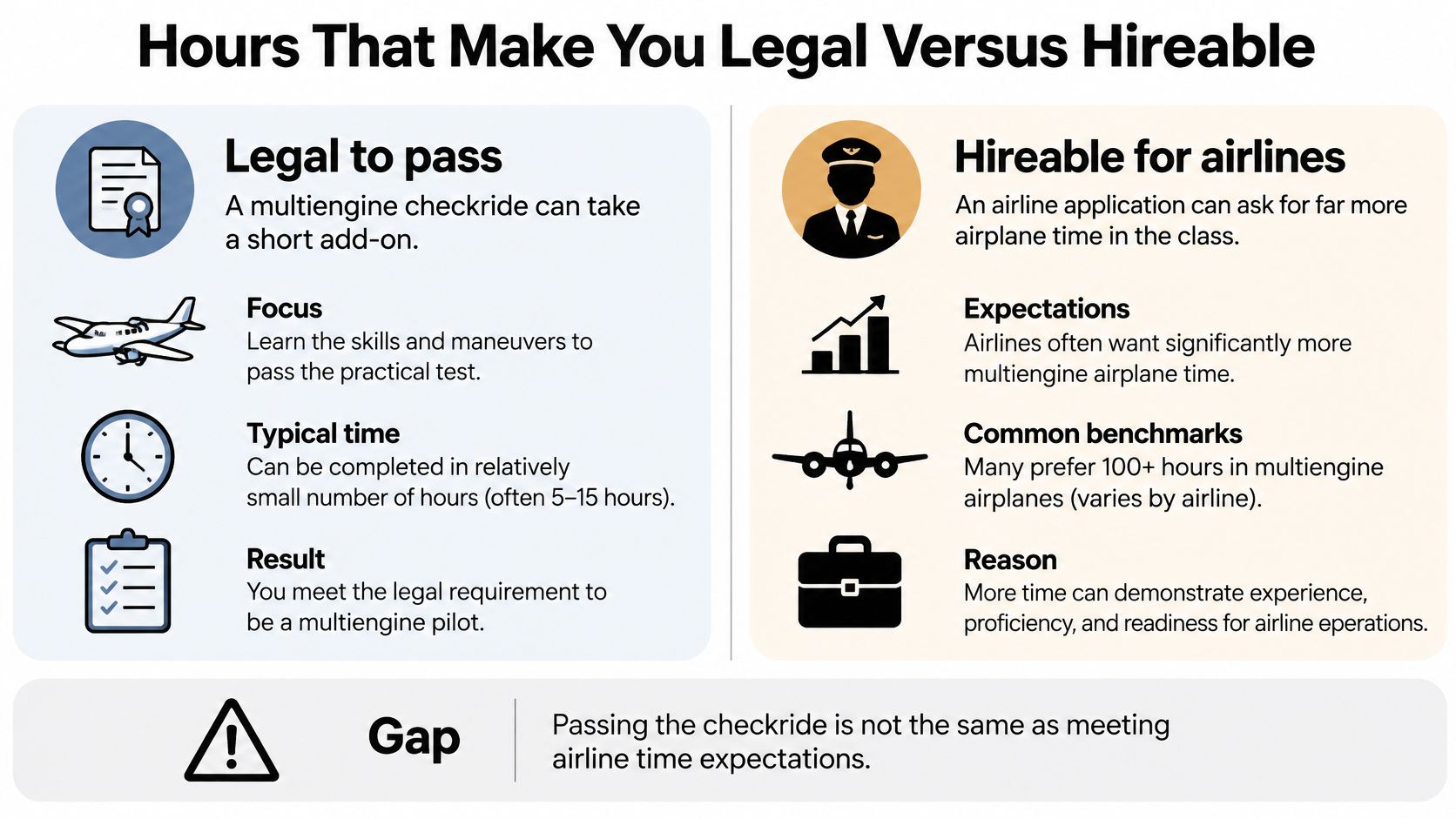
Certificate minimums versus time employers notice
| Purpose | What the rule accepts | What can still fall short |
|---|---|---|
| Private or commercial multiengine checkride | Applicable certificate or additional-class requirements, endorsements, and a proficient practical test | A short add-on can leave limited total multiengine experience |
| ATP certificate | Required total experience, class experience, and other specified experience categories | A class rating by itself does not establish ATP eligibility |
| Airline hiring screen | Employer policy, not a rating rule | An employer may ask for actual multiengine airplane time beyond the add-on |
| ATP knowledge-test device training | Required training in a qualified multiengine turbine device | Device training does not automatically count as airplane multiengine time |
| Full-flight simulator toward ATP | Limited credit under an approved course and the applicable rule | An employer may separately ask for actual airplane experience |
When simulator time counts
10 hours of training in a Part 60 device representing a multiengine turbine airplane are part of the ATP certification training program required before the multiengine ATP knowledge test, as stated in the ATP qualification provisions. This requirement covers specified device training for the knowledge test, not every use of a simulator as a substitute for airplane time.
For ATP class-experience credit, the applicable rule permits a maximum of 25 hours in a qualifying full-flight simulator through an approved course under Parts 121, 135, 141, or 142, subject to the regulation's conditions. The simulator, course, instructor authorization, training purpose, and logbook entry all matter.
A simulator can help you practice an engine failure without qualifying for a particular airplane-time requirement. Before counting a session toward a requirement, identify the rule that allows that credit.
Plan airplane time separately from proficiency practice
Without a direct source for a particular airline's current screen, use employer requirements as the guide rather than relying on an example attributed to an airline. Hiring criteria can differ from certificate rules, so check the current requirements for the specific position.
The practical distinction is airplane time versus device time. A simulator entry that earns legal credit under one rule may not meet an employer's request for experience in an actual multiengine airplane.
Plan multiengine time building around legitimate flying responsibilities and accurate logging. Occupying a seat, sharing expenses, or manipulating the controls does not by itself establish that the whole flight can be logged in the category an employer requests.
Ask two separate questions: “Does this experience satisfy my certificate requirement?” and “Will this employer accept it?” You need a clear answer to each.
Pick a Zero to Multi Engine Path
If you've never flown, start with a discovery flight before making a tuition decision. You can experience the cockpit, follow basic control inputs with an instructor, and decide whether you want to commit to regular training.
A third-class FAA medical certificate is required before solo on the conventional student-pilot path, but the discovery flight and initial lessons can happen before that appointment. If you have medical concerns, address them early rather than after committing substantial money.
Choose according to your starting point
- No flight experience: Begin with an introductory flight, then map the certificate sequence and medical requirements.
- An existing pilot certificate: Have your logbook and privileges reviewed so you pursue the correct additional-class pathway.
- A professional flying goal: Plan commercial multiengine training as part of the broader pilot career path, including instructor qualifications and later experience building.
For a structured route, our Career Track pathway takes students from zero time to CFII and multi-engine in about nine months, with six certificates and ratings, 282 total training hours, and fixed $89,000 tuition that includes multi-engine. Training is based in Southern California at Riverside, Long Beach, and Corona.
Examiner fees are extra. Keep those separate from tuition when planning your budget, and don't treat the program timeline as a promise of airline eligibility or employment.
Match the course to the privilege you need
For personal multiengine flying, a private class rating may meet your objective. If you want to be paid to fly, commercial multiengine privileges belong inside a longer qualification plan.
The rating is a milestone, not the airline job itself. Choose a path that explains both how you'll pass the checkride and how you'll build the experience needed afterward.
CFII offers a structured path from your first flight through instructor qualifications and multi-engine training. Visit CFII to discuss your starting experience and build a training plan around the certificate privileges you need.
Planning to fly for a living?
See what the path from zero to a pilot career looks like, what it costs and how long it takes.
Learn to fly in Riverside
We train at Riverside Municipal Airport in modern airplanes with a parachute built in. Start with a one hour discovery flight, no experience needed.