On this page
- Multi Engine Training Requirements at a Glance
- How to read the hours
- Why a Second Engine Makes Failure Harder
- Redundancy requires a trained response
- Aircraft Differences and Systems You Must Learn
- Learn the path, not just the switch
- Connect systems to decisions
- Engine-Out First Seconds and Stall Traps
- The immediate response and its reasons
- Know which speed solves which problem
- The Multi Engine Syllabus and Checkride Standards
- Understand the safety boundaries
- What an unsafe response reveals
- Costs, Hours and Whether the Rating Pays Off
- Test the purchase against the career timeline
- Check the school as carefully as the price
- Choose Your Multi Engine Path Before You Book
- Choose a complete route, not an isolated rating
You're comparing pilot training programs, trying to work out which qualifications you need and what the final bill might look like. Then you see “multi-engine” listed beside commercial training, and a reasonable question follows: does flying an airplane with another engine mean learning more controls, or learning a different way to fly?
Multi engine flight training is primarily about managing an airplane when its engines aren't producing equal thrust. The rating matters for a professional flying career, but earning it and becoming dependable during an engine failure aren't the same achievement. Understanding that distinction will help you judge training hours, costs, and career promises before you commit.
Multi Engine Training Requirements at a Glance
| Requirement | Minimum | What it covers |
|---|---|---|
| Total flight time | 250 hours | Total time generally required for a commercial certificate with an airplane multiengine class rating |
| Powered aircraft time | 100 hours | Includes at least 50 hours in airplanes |
| Pilot in command time | 100 hours | Includes at least 50 hours in airplanes and 50 hours of cross-country |
| Multiengine training | 10 hours | In a complex or turbine-powered multiengine airplane, or the applicable seaplane equivalent |
| Multiengine cross-country | Flights extending over 100 nautical miles from departure | Daytime and nighttime cross-country, measured as straight-line distance from departure |
| Multiengine solo or PIC with instructor | 10 hours | Solo multiengine flight, or performing pilot-in-command duties with an authorized instructor |
| Long multiengine cross-country | 300 nautical miles | Landings at three points, with one point at least 250 nautical miles from the original departure point |
These commercial airplane multiengine experience requirements come from 14 CFR §61.129. The table summarizes the relevant experience blocks, not every training, eligibility, and practical-test requirement.
The most important distinction is initial commercial certification versus adding a class rating to an existing certificate. This isn't a universal checklist requiring every already-certificated commercial pilot to repeat the entire experience framework. An additional class rating follows the applicable additional-rating rules, including §61.63, so your instructor should identify your certification route before quoting a course.
How to read the hours
The rows overlap. Powered-aircraft time, airplane time, and pilot-in-command time are categories within your overall experience, not separate totals you add together.
Pilot in command, usually shortened to PIC, means more than occupying a seat or handling the controls. For the instructor-supervised option, your training records must reflect the duties and conditions the regulation requires. Don't assume any flight with an instructor automatically satisfies that experience block.
A complex landplane generally has retractable landing gear, flaps, and a controllable-pitch propeller, as described in §61.31(e), including the applicable electronic engine-control arrangements. That equipment gives you configuration and propeller-management decisions to learn alongside basic handling.
Planning rule: Budget for demonstrated proficiency, not just completion of the minimum experience blocks.
Day and night cross-country flights also require scheduling, suitable weather, aircraft availability, and preparation. They aren't interchangeable with repeating emergency drills near the airport.
If you're starting from zero, build the foundation through aircraft flying training before treating the multiengine portion as a standalone purchase. A useful training plan shows where each requirement fits and leaves room to repeat lessons that haven't become reliable.
Why a Second Engine Makes Failure Harder
During a climb, one engine suddenly stops producing power. The other keeps pushing, and the airplane starts yawing toward the failed engine. Unlike a boat that turns when one oar stops pulling, an airplane must also stay coordinated and controlled in three dimensions.

The pilot has to manage asymmetric thrust, reduced performance, and added drag at the same time. The extra engine buys time and options, but a trained response is what makes that redundancy useful. A second engine does not guarantee a safe outcome.
Historical comparisons have reported that fatal outcomes in twin-engine crashes involving an engine failure can be higher than in single-engine powerplant-failure accidents. Such figures vary by aircraft and do not describe a current government accident-rate series or predict the outcome of a particular flight.
Redundancy requires a trained response
The first priority is maintaining control. The pilot then has to identify the problem, manage the airplane's configuration, and decide whether continued flight is possible. Leaving the operating engine's throttle forward does not address the yaw or the loss of performance.
The critical engine is the one whose failure most adversely affects handling or performance. The aircraft handbook explains the applicable arrangement, and some twins do not have a distinct critical engine.
A rating demonstrates that a pilot has met training and checkride standards. It does not, by itself, make every engine-out response operationally reliable. Repeated practice and sound decisions under pressure matter because recognition, control, and configuration changes have to work together.
This training video offers another view of the workload:
The professional pathway continues beyond the initial rating. The FAA's ATP Certification Training Program applies to applicants seeking an airline transport pilot certificate with an airplane multiengine class rating and prepares them for operations requiring that certificate. Earning the rating is one step; it does not, by itself, secure a job or replace the practice needed to respond competently to an engine failure.
Aircraft Differences and Systems You Must Learn
| Topic | Single-engine airplane | Multi-engine airplane |
|---|---|---|
| Engine failure | Loss of the only engine generally removes propulsive thrust without the same asymmetric-thrust problem | Unequal thrust creates yaw and can produce roll toward the failed side |
| Fuel system | May have multiple tanks and selector positions | May include separate tanks, crossfeed, balance requirements, and individual engine shutoffs |
| Propeller | Fixed-pitch or a controllable propeller | Often separate propeller controls with feathering capability |
| Landing gear and flaps | Trainers often have fixed gear; retractable examples also exist | Many trainers have retractable gear and flaps that require configuration decisions |
| Performance data | All-engine performance and engine-out glide planning | Single-engine climb and ceiling information for engine-out planning |
| Critical engine | Not applicable in the multiengine sense | Handbook identifies the critical engine, if the design has one |
| Electrical and hydraulics | Arrangement is aircraft-specific | May include engine-driven sources, separate buses, and cross-tie arrangements |
These are common training-aircraft differences, not universal equipment rules. Some twins automate controls that other airplanes require you to operate separately. Likewise, a single-engine airplane can have a complex fuel, electrical, or retractable-gear system.
Learn the path, not just the switch
Start with fuel. Trace how fuel travels from each tank to each engine, then explain what each selector position does. Crossfeed can allow an engine to draw from the opposite-side fuel supply in an approved configuration, but it isn't permission to improvise fuel transfer or balance procedures.
Next, understand the propellers. Feathering turns the blades toward a low-drag position when the design permits it. Moving the wrong propeller control after an engine failure can remove the thrust you still need, so control identification must be deliberate.
Electrical knowledge matters for the same reason. If an engine-driven generating source stops, you need to know which equipment remains powered, what indications confirm the failure, and which checklist governs load reduction or bus configuration.
Connect systems to decisions
Gear and flap position affect drag. Their operating systems may also have limitations or emergency-extension procedures that become important after a failure.
Performance charts answer a different question from the emergency checklist. The checklist tells you how to configure and secure the airplane; the charts help you evaluate what the configured airplane can do.
- Trace each system: Follow fuel, electrical power, and relevant hydraulic connections on the handbook diagrams.
- Locate every control: Identify the correct engine's throttle, propeller, mixture, fuel selector, and magnetos where fitted.
- Rehearse the checklist: Learn the emergency checklist before the flight that introduces its associated failure.
You're building a reliable connection between an indication, the affected system, and the correct control. Memorizing a cockpit flow without that understanding leaves you vulnerable when the indications aren't obvious.
Engine-Out First Seconds and Stall Traps
Control comes before performance. An airplane that remains controllable but descends still gives the pilot options. An airplane that departs controlled flight may not.
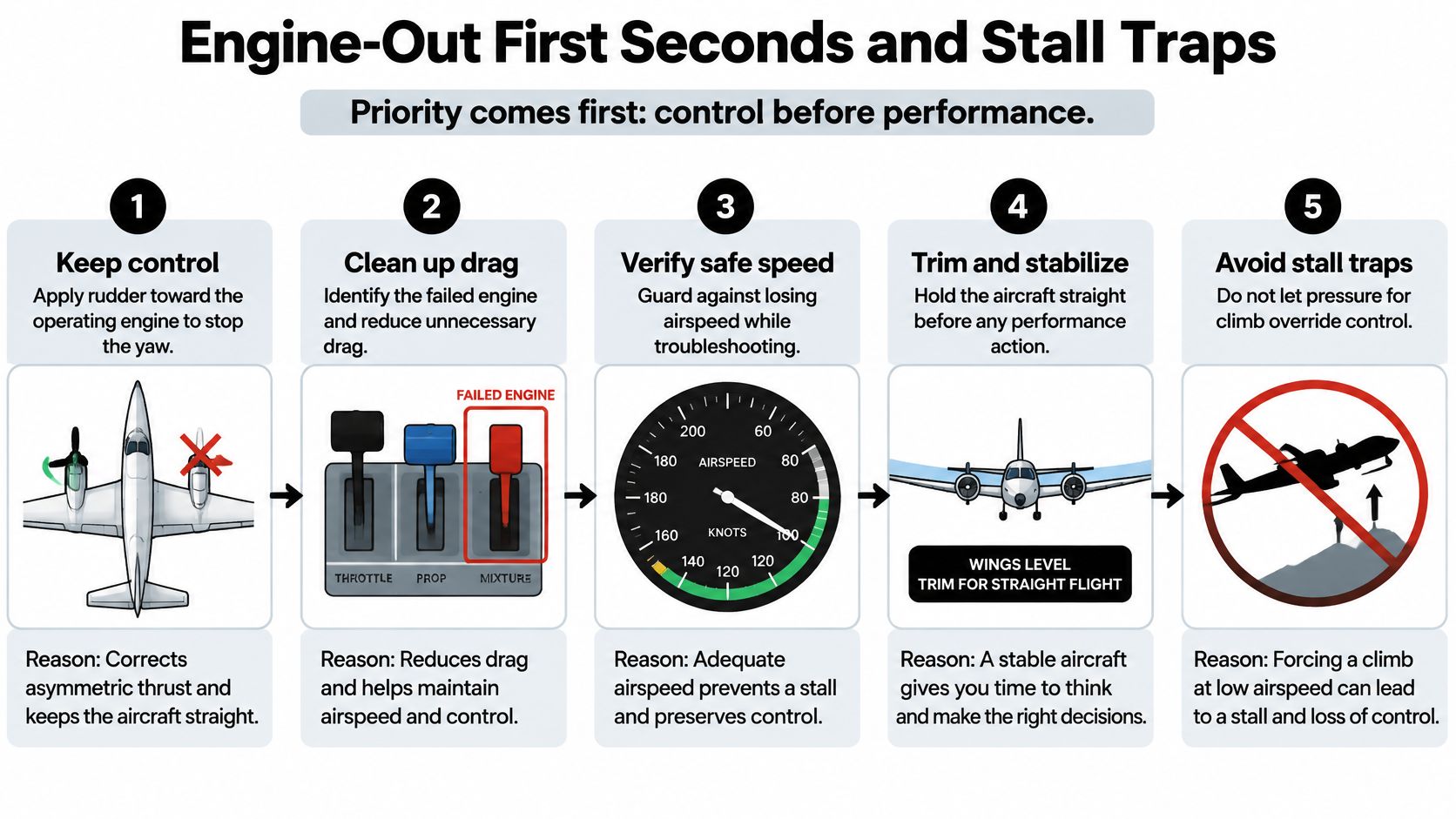
The following sequence explains the priorities, not a universal emergency checklist. Your aircraft's operating handbook and instructor determine the exact actions, memory items, configurations, and limitations.
The immediate response and its reasons
Keep control. Apply rudder toward the operating engine to counter yaw, and use the aircraft's prescribed bank attitude. The FAA Airplane Flying Handbook describes an initial bank of approximately 5° toward the operating engine, which helps oppose yaw while the rudder provides primary directional control.
Identify, then verify. The mnemonic dead foot, dead engine helps identify the failed side after you've established the appropriate rudder input. Confirm with engine indications, including manifold pressure where applicable, and verify the suspected engine using the handbook procedure before moving an irreversible control. A mnemonic alone isn't verification.
Recover control margin if it's disappearing. During an incipient minimum-control-speed loss, reduce power on the operating engine as necessary and lower pitch to regain airspeed. Don't attempt to rescue a simulated loss of control by restoring power on the simulated failed engine. This recovery priority takes precedence over trying to maintain altitude.
Establish the appropriate single-engine performance speed. Once controllability is assured, use VYSE for best rate of climb or VXSE when the approved obstacle-clearance procedure requires it. Configure gear and flaps according to the handbook, not a blanket instruction to retract everything immediately.
Secure the verified failed engine. In a conventional piston twin, the sequence may include throttle idle, propeller feathered where equipped, mixture cutoff, and the appropriate fuel and ignition controls off. Use the aircraft's actual memory items and checklist; automated or differently equipped airplanes won't necessarily use that sequence.
Choose a landing plan early. Evaluate whether the airplane can continue safely, whether a diversion is appropriate, or whether you need an immediate landing. Communicate when control and the immediate actions allow it.
This visual summarizes the priorities to rehearse with your instructor.
Know which speed solves which problem
| Speed | What it means | When it applies |
|---|---|---|
| VMC | Minimum control speed under specified certification conditions with an engine inoperative | A directional-control reference, never a climb target |
| VSSE | Intentional single-engine safety speed | A reference for safely introducing intentional engine-failure practice |
| VYSE | Best single-engine rate-of-climb speed | The usual performance target once control is established |
| VXSE | Best single-engine angle-of-climb speed | Approved obstacle-clearance situations |
| VMC + 5 knots | A minimum alternative where the applicable procedure specifies it | Only where that procedure directs its use |
Actual minimum control speed changes with configuration and operating conditions. The published marking doesn't promise control under every circumstance, and it certainly doesn't promise a climb.
Holding altitude isn't a successful response if you lose the airspeed needed to keep flying.
The stall trap begins when the pilot pulls back to resist a descent while speed decays. Increasing angle of attack can produce a stall while asymmetric thrust remains. Lowering pitch and reducing the asymmetric power demand as necessary protect control, even when the resulting descent is unwelcome.
A windmilling propeller adds substantial drag. High weight and high density altitude, often associated with hot conditions, further reduce available single-engine performance. You may therefore have directional control without enough performance to climb.
Before takeoff, brief the target speed, aircraft-specific reject and continue criteria, runway remaining, terrain, and landing options. Don't substitute an arbitrary altitude for a complete departure plan. Work through engine failure on takeoff with an instructor before practicing the scenario in an airplane.
The Multi Engine Syllabus and Checkride Standards
A useful syllabus builds the workload in stages. First, learn the aircraft's systems and procedures; then combine them with the control and decision-making needed when one engine is unavailable.
- Ground and systems preparation: Study starting procedures, fuel routing, propellers, landing gear, limitations, performance charts, and emergency checklists.
- Normal handling: Practice takeoffs, climbs, patterns, and landings with both engines operating. Build stable control and consistent checklist habits.
- Engine-out introduction: Rehearse identifying and verifying the simulated failure at a suitable altitude, with clear criteria for ending the exercise.
- Practice-area scenarios: Apply the drill while managing heading, speed, configuration, and workload.
- Departure failures: Practice a rejected takeoff on the runway and an airborne engine-failure response as separate tasks.
- Single-engine arrivals: Plan approaches and landings within realistic performance and configuration limits.
- Cross-country and night operations: Combine navigation, planning, communications, and aircraft management.
- Simulator scenarios: Rehearse time-critical decisions and situations that would be unsafe to reproduce in an airplane.
Understand the safety boundaries
The FAA commercial practical-test standards document specifies airborne simulated failures at or above VSSE/VYSE and 400 feet AGL. Its separate takeoff-roll failure task occurs before 50% of calculated VMC. Examiners assess each task according to its own procedure and criteria.
That publication is a legacy standards document. Your instructor and examiner should use the current applicable standards and the aircraft's limitations when planning the practical test.
Evaluate the quality of the response, not just whether you completed the maneuver. During preparation, note heading deviation, minimum airspeed, altitude loss, identification and securing time, and whether you establish the appropriate performance speed. These measures show whether the response is controlled and repeatable, rather than merely ending acceptably.
What an unsafe response reveals
As covered earlier, restoring power to the simulated failed engine is not the response to an incipient VMC loss. The checkride scoring question is whether you recognize the developing loss of control and follow the aircraft-specific recovery procedure. Excessive pitch-up can also lead to an accelerated stall, so examiners look for control of the airplane rather than an attempt to preserve the exercise.
Australia's civil aviation guidance on multiengine operations and training emphasizes pre-briefed responses, instrument cross-checks, workload priorities, and clear criteria for ending a maneuver. These are useful standards for assessing proficiency, wherever you train.
Before flying solo, you'll need the appropriate medical qualification. For the conventional beginner pathway, obtain a third-class FAA medical certificate from an aviation medical examiner. You can take a discovery flight and first lessons before obtaining it.
Prepare for the checkride by demonstrating judgment as well as aircraft handling. Passing earns the rating; continued operational competence, especially after an engine failure, depends on ongoing practice. The rating itself does not guarantee a job or make every engine-out response automatic.
Costs, Hours and Whether the Rating Pays Off
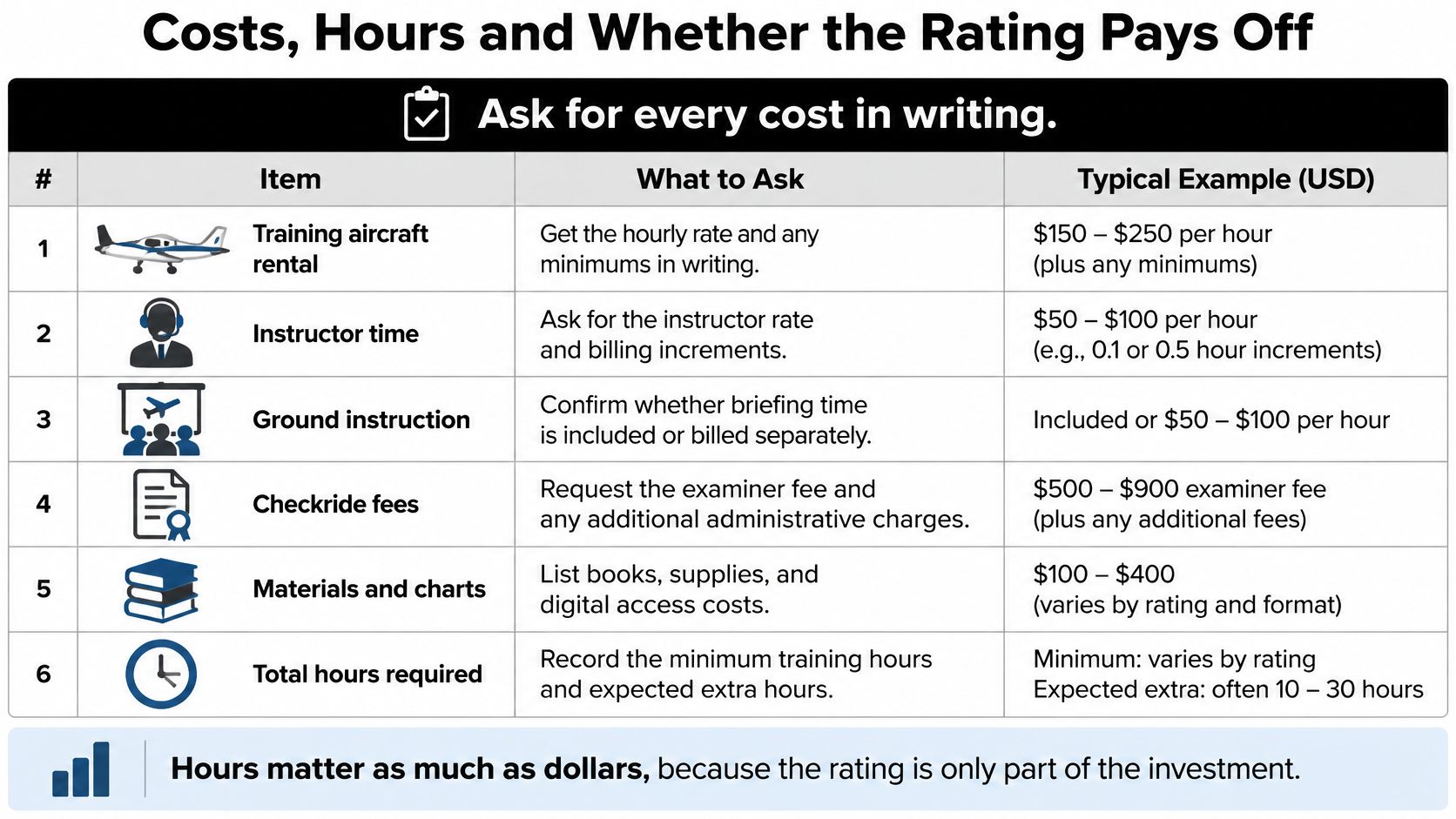
A multi-engine rating adds training expense and time, so price it alongside the experience you'll need afterward. Start with a written estimate that separates aircraft rental, instruction, testing, and living expenses. Ask how extra lessons, weather delays, and examiner availability could affect the total.
| Cost line | What to request in writing | Why it matters |
|---|---|---|
| Multi-engine aircraft rental | Hourly rate and billing meter, such as Hobbs or tach | A major recurring training expense |
| Instructor time | Hourly rate and whether ground time is billed | Briefings and instruction add to the total |
| Simulator time | Rate and minimum booking block | Helps price focused emergency practice |
| Ground school and written materials | Course price and included materials | Identifies costs beyond aircraft rental |
| Checkride and examiner fees | Who charges and whether fees are separate from tuition | Prevents testing-cost surprises |
| Medical certificate | Examination fee and policy for additional visits or testing | Helps with medical and solo planning |
| Housing and relocation | Monthly estimate for the training location | Captures expenses beyond flight training |
Use the table to compare written estimates line by line. This flight training cost breakdown can help you identify expense categories to ask about.
Test the purchase against the career timeline
Boeing's 2025–2044 outlook projects demand for 660,000 new commercial pilots globally over 20 years and estimates that roughly two-thirds of new aviation personnel will replace attrition, with the remainder supporting fleet growth. Use this long-range outlook to understand workforce demand, while planning your own finances around the time and qualifications needed to pursue work.
Training activity can shift, too. Reports of expanding entry-level and multi-crew training alongside slower type-rating activity during aircraft-delivery delays illustrate why broad workforce forecasts cannot establish when a particular pilot will find work.
Ask what you can realistically do after certification. A multiengine class rating doesn't itself authorize you to teach in twins, and a multiengine instructor qualification doesn't guarantee students or paid work.
Before paying: Identify the next experience-building opportunity, its eligibility requirements, and how you'll support yourself until it becomes available.
Compare the rating's additional cost with likely time-building access, progress toward commercial requirements, aircraft availability, financing costs, and examiner scheduling. Ask whether paid multiengine instruction is available, what qualifications it requires, and how long instructors wait for that work. The rating establishes a qualification; becoming operationally competent after an engine failure takes practice and continued proficiency.
Check the school as carefully as the price
CFII recommends asking every flight school, including itself, about airplane age, students per airplane, instructor turnover, total price in writing, Part 61 versus Part 141, and whether you can fly before committing. Part 141 schools follow FAA-approved curricula, while Part 61 training allows more flexibility within FAA requirements.
Build the rating into a budget that already covers 12 months of living costs. Include the time needed to train and build experience, not only the scheduled completion date.
Choose Your Multi Engine Path Before You Book
If you've never flown, start with a discovery flight before making a career-sized commitment. It's a first lesson with an instructor: you meet, preflight the airplane together, and take the controls in the air. You don't need prior experience.
Choose a complete route, not an isolated rating
For a full zero-to-instructor route, our Career Track has fixed tuition of $89,000, includes multi-engine training, and takes about nine months from zero time to CFII and multi-engine. It includes 282 total training hours, six certificates and ratings, and is based in Riverside, Long Beach, and Corona in Southern California.
That program description isn't a guarantee of a job, pass rate, or hiring outcome. Compare its training scope with your available time, living expenses, financing obligations, and plan for building experience after certification.
- Starting from zero: Confirm that you enjoy the learning process before committing to accelerated training.
- Already flying: Have your existing experience reviewed so you're comparing the route you need.
- Planning professional work: Connect each qualification to the aircraft and work you intend to pursue.
For an airline pilot career, multiengine qualification is a required step; corporate requirements depend on the aircraft and position. Whether it pays off depends on the complete plan, continued proficiency, accumulated experience, and access to paid time-building.
CFII offers a discovery flight before you commit and a Career Track that includes multi-engine training within the broader path to becoming an instructor. Visit CFII to discuss your starting point, review the training scope, and choose a next step that fits your career and financial plan.
Planning to fly for a living?
See what the path from zero to a pilot career looks like, what it costs and how long it takes.
Learn to fly in Riverside
We train at Riverside Municipal Airport in modern airplanes with a parachute built in. Start with a one hour discovery flight, no experience needed.