

On this page
- Understanding the FAA Practical Test
- The checkride as a certification gate
- Why standardization matters
- Breaking Down the Oral and Flight Components
- The oral evaluation is a decision conversation
- The flight portion tests applied skill
- How to study both halves together
- The Reality of First-Time Pass Rates
- Why advanced instructor checkrides feel different
- Navigating Scheduling Bottlenecks and Delays
- Schedule before you feel finished
- Protect the final stretch
- Building a Winning Preparation Strategy
- Start with the ACS
- Build scenarios, not flashcard dependence
- Conduct a true mock checkride
- Make the aircraft and your mind ready
- Managing Test Day Expectations and Pitfalls
- During the oral
- During the flight
- Choosing a Training Program That Supports Success
- Look for operational structure
A checkride is the FAA practical test that awards an airman certificate or additional rating, with an oral evaluation followed by a flight portion. In 2023, first-time pass rates were 74.5% for Private Pilot, 79.0% for Commercial, 76.1% for Flight Instructor, 91.2% for Airline Transport Pilot, and 79.3% overall.
You've finished the required training, your instructor says you're ready, and the next available examiner slot is suddenly the most important item on your calendar. The airplane is familiar, the maneuvers are practiced, and yet the word “checkride” can make an otherwise capable pilot feel as if every decision will be judged under a microscope.
That reaction is normal, but it becomes manageable once you understand what the event measures. A checkride isn't a surprise quiz or a ceremonial final flight. It's a structured evaluation of whether you can apply knowledge, manage risk, operate the aircraft safely, and meet the published standard without continuous coaching.
The most useful way to approach it is as a professional flight operation. You'll prepare the aircraft and paperwork, brief the flight, explain your decisions, complete the oral evaluation, fly the required tasks, and respond to changing circumstances. The examiner isn't looking for theatrical perfection. The examiner is looking for a pilot who can recognize problems, make sound decisions, and keep the flight safe.
Understanding the FAA Practical Test
A checkride is the FAA practical test used to issue an airman certificate or rating. It normally has two connected parts: an oral examination and a flight or simulator evaluation. The test is conducted by a Designated Pilot Examiner, commonly called a DPE, or by an FAA inspector, and the result determines whether your training has reached the certification standard.
The FAA describes the practical test as an evaluation conducted under the applicable Airman Certification Standards, or ACS, or under the relevant practical test standards. The ACS gives the examiner a published framework for evaluating knowledge, risk management, and skill. That framework matters because it prevents the checkride from becoming a personal judgment based on whatever questions happen to occur to one examiner.
Before the test can begin, you must satisfy the required eligibility, knowledge, skill, and aircraft documentation requirements. The examiner is checking whether you're legally and practically ready to be evaluated, not merely whether you've accumulated training experience. Logging lessons is part of the path, but it isn't the same as demonstrating certification-level performance.
The checkride as a certification gate
Think of the checkride as the bridge between being trained and being certificated. Your instructor's endorsement means your instructor believes you're prepared to take the test. It doesn't replace the FAA practical test, and it doesn't guarantee the outcome.
That distinction explains why preparation should focus on judgment rather than memorized answers. For example, a pilot who can recite a regulation but can't apply it to a proposed flight hasn't demonstrated the level of understanding the examiner needs to see. Practical knowledge becomes meaningful when it supports a safe decision.
Flight planning is a good example. You're not preparing a route just to draw a line on a chart. You're showing that you can consider weather, airspace, aircraft performance, fuel, alternates, and threats before committing to the flight. A review of flight planning principles for pilots can help connect those individual tasks into one operating process.
Why standardization matters
The FAA's framework is designed to produce consistent pass-or-fail decisions against published criteria. The same principle applies when the FAA evaluates examiner candidates. The FAA requires an initial examiner candidate evaluation to include oral questioning and aircraft or simulator performance under the applicable practical test standards, which illustrates how tightly controlled the assessment system is. You're not facing an informal opinion. You're participating in a regulator-controlled evaluation model.
That doesn't mean every checkride feels identical. Different examiners may use different scenarios, communication styles, or sequences. The standard remains the anchor. If you prepare to explain your decisions and demonstrate the required skills under the ACS, you'll be better equipped for reasonable variation on test day.
Breaking Down the Oral and Flight Components
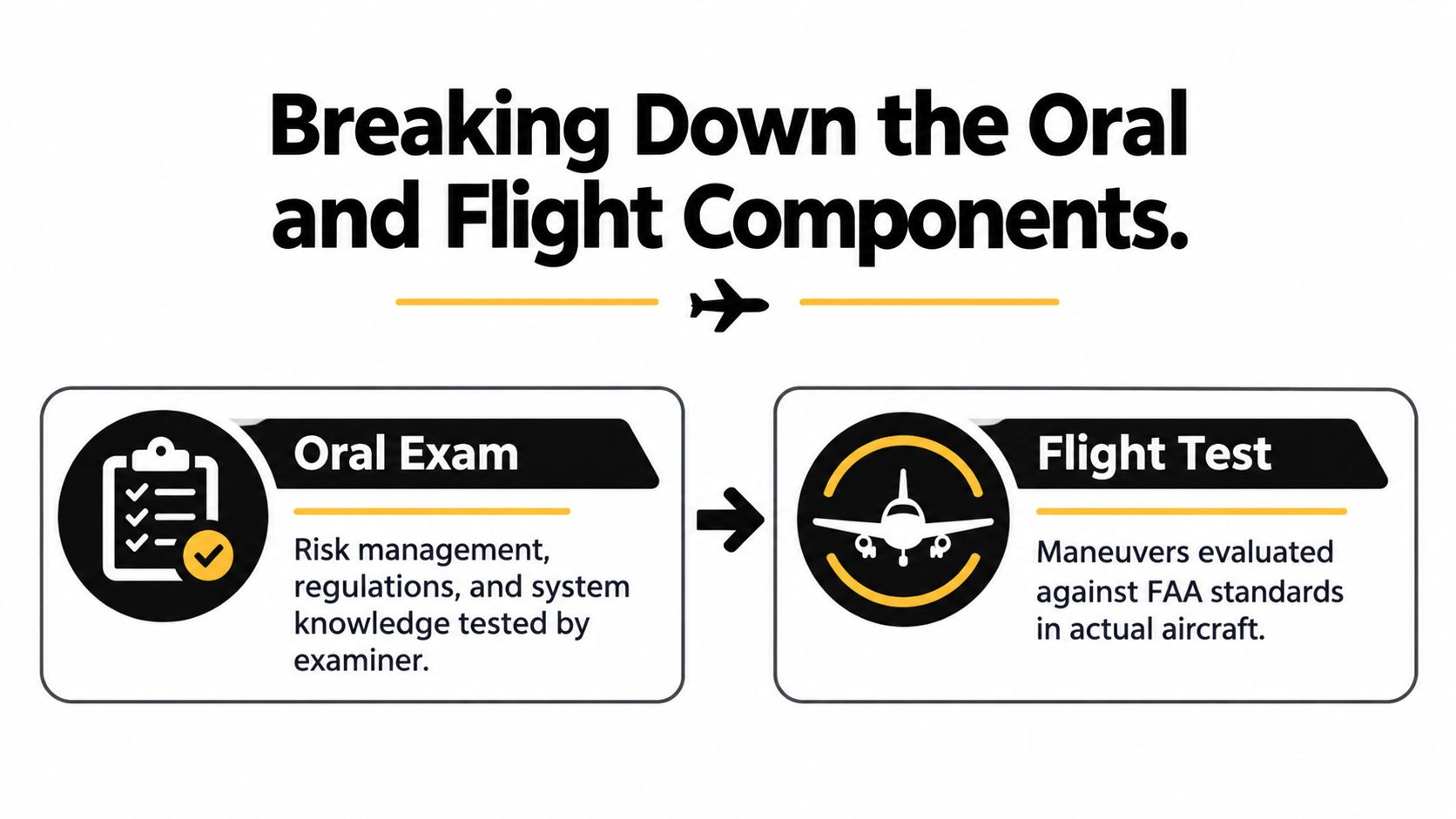
The two parts of a checkride test different expressions of the same responsibility. The oral evaluation examines whether you understand the operation and can make defensible decisions. The flight portion examines whether you can carry out those decisions while controlling the aircraft and managing risk.
The oral evaluation is a decision conversation
Many applicants study as if the oral were a list of isolated trivia questions. That approach creates fragile knowledge. An examiner may begin with a planned flight and then explore the decisions connected to it. The conversation can move from weather to aircraft performance, then to airspace, equipment, regulations, and risk management.
A strong answer does more than name a rule. It explains how the rule affects the flight. If the weather changes, what information would you obtain? What part of the route becomes less attractive? What aircraft limitation matters? What would make you delay, divert, or cancel?
The examiner is also listening for honest limits. If you don't know an answer, bluffing creates a larger problem than admitting the gap and explaining where you'd verify the information. A professional pilot uses approved references, the aircraft flight manual or pilot's operating handbook, charts, and other appropriate sources. The key is to know how to find and apply the information, not to pretend that memory is perfect.
Risk management deserves equal attention. Review how you identify hazards, assess their effect, choose controls, and re-evaluate the plan as conditions change. Threat and error management for pilots is useful here because it frames safety as an active process rather than a slogan.
The flight portion tests applied skill
The flight or simulator portion turns your explanations into observable performance. The examiner evaluates tasks against the applicable standards, while also watching how you maintain aircraft control, use checklists, communicate, plan routes, and respond to abnormal situations.
You may be asked to demonstrate maneuvers, navigation tasks, takeoffs and landings, emergency procedures, or other rating-specific skills. The exact sequence depends on the certificate or rating and the applicable ACS. What remains constant is the expectation that you'll brief the task, manage the aircraft, recognize deviations, and correct them appropriately.
A small mistake doesn't automatically define the flight. Skilled pilots notice when performance begins to drift and take timely corrective action. Continuing without acknowledging a developing problem can be more concerning than making an initial imperfect input.
How to study both halves together
Avoid separating oral preparation from flight preparation completely. For every major flight task, ask yourself:
- Purpose: What is this maneuver or procedure designed to demonstrate?
- Risk: What can go wrong, and what cues would warn me early?
- Execution: What references, configuration, airspeeds, and clearances apply?
- Recovery: How will I correct a deviation or discontinue the task safely?
That approach mirrors the way the ACS combines knowledge, risk management, and skill. It also creates a useful mental map for the test. You're not memorizing disconnected boxes. You're preparing to operate as pilot in command.
The Reality of First-Time Pass Rates
Completing training does not make a checkride a formality. The available 2023 civil airmen data shows meaningful variation by certificate and rating. First-time pass rates were 74.5% for Private Pilot, 79.0% for Commercial, 76.1% for Flight Instructor, and 91.2% for Airline Transport Pilot, with an overall first-time pass rate of 79.3% across certificates, as summarized in FAA-oriented checkride coverage.
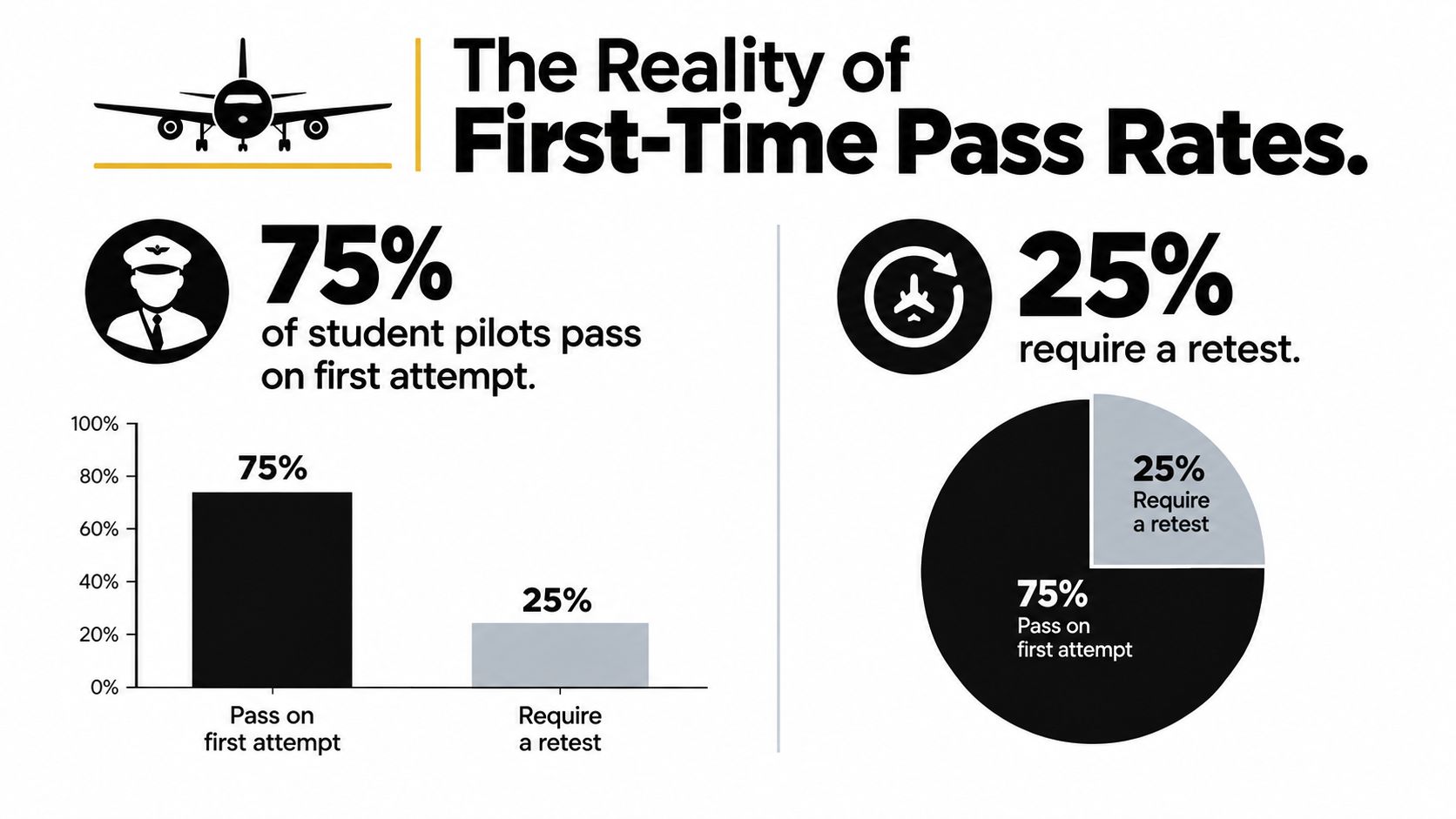
The important lesson isn't to predict your result from someone else's category. It's to calibrate your preparation. A first-time pass rate below universal success means capable applicants still arrive with gaps, and those gaps may involve judgment, teaching ability, aircraft control, or readiness for the specific standard.
Why advanced instructor checkrides feel different
An instructor checkride adds a layer that many applicants underestimate. You aren't only demonstrating that you can perform a maneuver. You're demonstrating that you understand it well enough to explain it, identify common errors, correct those errors, and teach it safely.
That changes the psychological demand. A private pilot applicant may be asked to perform a maneuver safely. An instructor applicant must also show the reasoning behind the maneuver and communicate it in a way another pilot can use. The evaluator is assessing technical competence and instructional judgment at the same time.
The same issue applies to an instrument instructor evaluation. Instrument procedures require disciplined interpretation of indications, clear decision-making, and precise communication. An applicant who relies on memorized scripts can struggle when the examiner changes the scenario or asks why a particular action is appropriate.
Recent training coverage comparing certificate categories highlights that CFI and CFII preparation can be distinctly demanding, rather than just being a longer version of earlier pilot training. The published comparison of first-time rates and the challenges of instructor evaluations appears in this checkride preparation guide.
Instructor mindset: Don't prepare only to perform the maneuver. Prepare to explain the objective, identify the risk, demonstrate the correct technique, and coach a student through the error.
Your preparation should therefore include teaching demonstrations, not just solo review. Practice explaining a task in plain language, then ask another pilot to interrupt with realistic student questions. If you can remain accurate and calm while adapting your explanation, you're addressing the core challenge of an instructor checkride.
Navigating Scheduling Bottlenecks and Delays
Knowing what a checkride is doesn't guarantee that you can take one when you're ready. Examiner availability often becomes the operational bottleneck. One industry guide reports that DPEs may be booked four to eight weeks in advance in many areas, and applicants sometimes need to travel to a less-busy location when local appointments are scarce, as described in this guide to checkride scheduling and preparation.
The delay matters because readiness can decay. A pilot who finishes training and then waits for an appointment may fly less often, lose confidence in recently practiced tasks, or need additional refresher training before the test. Weather, aircraft maintenance, examiner travel, and local demand can add further uncertainty.
Schedule before you feel finished
Your instructor and school should discuss examiner availability before the final lesson, not after it. That doesn't mean booking an applicant who isn't ready. It means identifying realistic appointment windows early enough to shape the final training plan around them.
Ask practical questions:
- Examiner access: Which DPEs regularly work with the school or training area?
- Location: Can the test be conducted at another airport if local availability is limited?
- Aircraft continuity: Will the same aircraft type and avionics be available for preparation and testing?
- Cancellation plan: What happens if weather or maintenance prevents the appointment?
- Currency plan: How will you maintain proficiency while waiting?
Regional variation makes this a school-management issue as much as a student issue. A training provider that coordinates examiners, tracks readiness, and maintains backup options can reduce uncertainty. A student training without that support may finish the syllabus yet remain unable to complete the certification process.
Protect the final stretch
Once an appointment is scheduled, treat the remaining period as a controlled preparation phase. Don't spend every lesson repeating comfortable maneuvers. Use the time to identify weak areas, practice the expected aircraft configuration, rehearse the oral, and confirm that required documentation is complete.
The operational question is simple: Can you move from training completion to examination without losing momentum? A checkride plan should answer that question with dates, responsible people, aircraft availability, and a response to likely disruptions. That's how a definition becomes an executable path.
Building a Winning Preparation Strategy
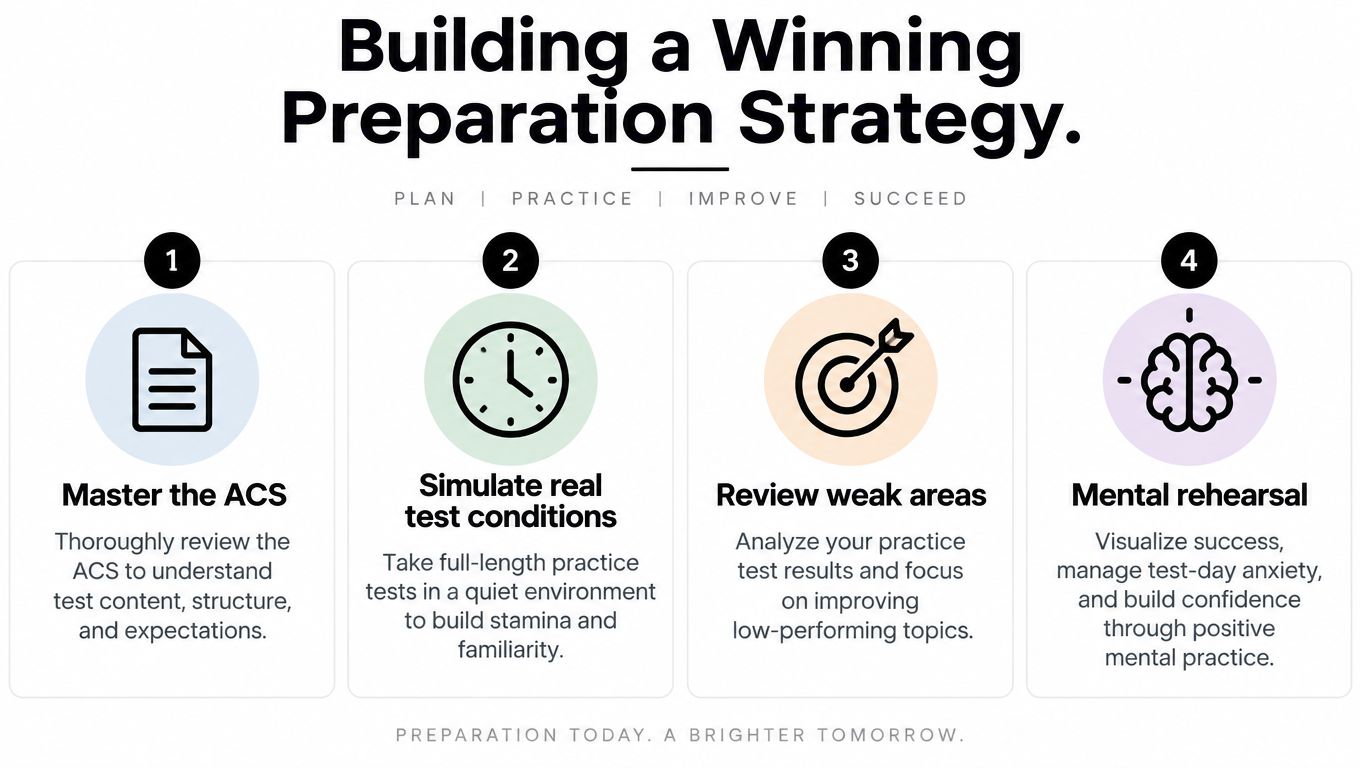
Confidence should come from evidence, not optimism. Build that evidence in layers, beginning with the standard and ending with realistic performance under pressure.
Start with the ACS
Read the applicable Airman Certification Standards as an evaluation document. Mark each knowledge, risk management, and skill element. Then compare it with your logbook, instructor feedback, written-test results, and recent flight performance.
Create a simple readiness record:
- Green: You can explain and perform the item consistently.
- Amber: You can complete it with hesitation, prompting, or inconsistent precision.
- Red: You can't yet explain the decision or demonstrate the task reliably.
This method prevents a familiar maneuver from hiding a weak knowledge area. It also gives your instructor something more useful than “I think I'm ready” to evaluate.
Build scenarios, not flashcard dependence
Use a planned flight as the spine of your oral preparation. Explain the route, weather information, airspace, aircraft performance, fuel considerations, risk controls, and diversion options. Then change one variable at a time.
Your instructor might introduce deteriorating weather, an inoperative item, a passenger concern, a navigation problem, or an unexpected performance limitation. You should be able to explain what you'd do, why you'd do it, and which approved source would confirm the requirement.
That kind of practice develops correlation. It also prepares you for an examiner who follows your answer into a related subject instead of moving through a neat list.
Conduct a true mock checkride
A useful mock checkride should include more than a friendly review with your primary instructor. Ask for an examiner-style session with unfamiliar questions, realistic time pressure, and no rescue prompts. If you're preparing for an instructor certificate, teach the tasks aloud and receive feedback on both accuracy and delivery.
Use the debrief to identify patterns. A pilot who repeatedly rushes checklists has a process issue. A pilot who knows the regulation but can't apply it has a correlation issue. A pilot who performs well until a minor deviation occurs may need more practice recovering without losing situational awareness.
The preparation video below can serve as another review resource, but it should supplement, not replace, practice against your applicable ACS.
Make the aircraft and your mind ready
Have your instructor help audit the aircraft records and required applicant documents before test day. Confirm that the aircraft is appropriate for the planned evaluation, that the equipment is familiar, and that you know how to use the installed avionics without losing attention outside the cockpit.
Mental rehearsal should be specific. Brief the first task, visualize the setup, imagine a deviation, and practice the correction. Then rehearse saying the decision out loud. The goal isn't to eliminate nerves. It's to make your procedures and priorities available when nerves are present.
Managing Test Day Expectations and Pitfalls
Test day usually starts before the engine does. You'll meet the examiner, establish the plan, review eligibility and aircraft information, and begin the oral evaluation. Keep your materials organized and answer the question that was asked. Long, unfocused answers can bury the decision the examiner needs to evaluate.

During the oral
Suppose the examiner asks whether you'd depart for a planned flight. You don't need to rush toward “yes” because the flight was prepared in advance. Work through the actual conditions. Identify the relevant weather, aircraft, airspace, and personal factors. If the risk is unacceptable, say what would make you delay or change the plan.
A pause is often better than a guess. Organize your response, state what you know, and identify the appropriate reference for anything you need to verify. The examiner is evaluating your judgment and resource use, not rewarding confident improvisation.
During the flight
Once you're airborne, fly the airplane first. Students sometimes become so focused on satisfying the next task that they neglect traffic scanning, checklist discipline, navigation, or changing conditions. Keep your normal cockpit priorities intact.
If a maneuver begins to drift, recognize it early and correct it deliberately. If the situation no longer supports a safe continuation, communicate that and use the appropriate recovery or discontinuation procedure. An applicant who manages a problem calmly demonstrates more useful airmanship than one who hides a developing problem while trying to preserve a perfect appearance.
Common pitfalls include:
- Rushing the setup: Begin each task with the required clearing, briefing, configuration, and plan.
- Treating tolerances as the whole task: Standards matter, but the examiner also observes judgment, control, and correction.
- Ignoring uncertainty: Ask for clarification when an instruction is unclear rather than acting on an assumption.
- Abandoning normal discipline: Continue using checklists, lookout procedures, radio technique, and cockpit organization.
- Letting one error spread: Identify the error, stabilize the aircraft, and return to the task methodically.
A professional demeanor doesn't mean acting emotionless. It means staying teachable, honest, and responsible for the aircraft. A practical pilot checklist can support that habit during preparation, especially when you're organizing the many small details surrounding the evaluation.
If the examiner finds an unsatisfactory area, listen carefully to the debrief and document what needs further work. One difficult moment doesn't erase every skill you demonstrated. Your responsibility is to understand the deficiency, train specifically, and return with a stronger process.
Choosing a Training Program That Supports Success
The training program you choose shapes more than your flying technique. It affects aircraft continuity, instructor access, study structure, examiner coordination, and the speed at which you can respond to a weak area.
An ad hoc approach can work for a disciplined student with flexible time and strong local support. It can also create gaps. Lessons may be scheduled around aircraft availability rather than readiness, instructors may use different standards, and the student may have to manage examiner contact without knowing which appointment windows are realistic.
Look for operational structure
A serious program should be able to explain how it handles the full path from lesson planning to certification. Ask whether it provides:
- A defined syllabus: You should know what knowledge and skills precede each stage.
- Consistent aircraft and avionics: Familiar equipment reduces unnecessary workload during evaluation.
- Integrated ground training: Oral preparation should develop alongside flight skills.
- Stage checks or mock evaluations: Internal feedback should identify gaps before the DPE does.
- Examiner coordination: The school should have a process for finding and confirming practical-test appointments.
- Progress tracking: Instructors and students should be able to see what is complete and what remains weak.
A fixed-price pathway can also make planning easier when its inclusions and exclusions are clearly stated. Price alone doesn't establish quality, but transparent scope helps you compare programs on the resources that directly affect checkride readiness.
CFII's Career Track is one example of a structured option. It combines one-on-one instruction, modern aircraft, study resources, progress tracking, and coordinated FAA examiner scheduling in a pathway from initial training through advanced instructor qualifications. Students considering any accelerated program should still verify the syllabus, aircraft access, instructor availability, scheduling process, and what happens when weather or maintenance changes the plan.
The right question isn't “Can this school get me to a checkride?” Every legitimate training program should aim for that. Ask instead, How does this program keep my preparation, aircraft access, instructor feedback, and examiner appointment aligned? That answer reveals whether the school is offering a coherent certification process or just a collection of flight lessons.
If you want a structured route from initial training through advanced instructor checkrides, review the one-on-one instruction, study resources, aircraft access, and examiner coordination available through CFII. Use the program details to compare how each training partner would keep your preparation and testing timeline moving.
Planning to fly for a living?
See what the path from zero to a pilot career looks like, what it costs and how long it takes.
Learn to fly in Riverside
We train at Riverside Municipal Airport in factory-new airplanes with a parachute built in. Start with a one hour discovery flight, no experience needed.