On this page
- Commercial Multi-Engine Requirements at a Glance
- The Three-Hour Window Before the Checkride
- Private Multi-Engine Privileges vs the Commercial Certificate
- What the Private Privileges Get You
- Why Two Engines Change the Commercial Certificate
- Engine-Out Maneuvers You Must Master in a Twin
- The Recovery Sequence
- Instrument Engine-Out Work for the Practical Test
- Why an Engine Failure in IMC Is a Different Problem
- Career Value and the Time-Building Gap
- What the Logbook Looks Like to a Hiring Department
- Pick Your Next Step Toward a Multi-Engine Commercial Rating
- Questions to Put in Writing Before You Pay a Deposit
The advice you hear most about the commercial multi engine rating is that it's an errand. Book the cheapest twin you can find, fly the minimum hours, pass the checkride over a long weekend, and get back to building time. That plan produces a certificate. It rarely produces a pilot an employer wants to hire, because it skips the part that costs the most and matters the most: the hours you spend flying a twin with one engine behaving badly.
The rating itself is real work. A second engine adds redundancy and takes it away in the same motion. When one quits, the survivor doesn't just halve your power. It pulls the nose sideways, and your first job stops being navigation and becomes directional control. Nothing in a single-engine syllabus prepares you for that.
What follows is the honest version of the pathway: the regulation with its actual numbers, the maneuvers that only exist in a twin, the instrument work the examiner expects, and the career arithmetic nobody puts in the brochure. If you haven't flown yet, most of it is still two or three certificates away, but the shape of it is worth understanding now, because it decides how you spend your money later.
Commercial Multi-Engine Requirements at a Glance
The most common planning mistake is treating every logged hour as interchangeable. For an airplane multiengine commercial certificate, 14 CFR 61.129 requires at least 250 hours of total flight time as a pilot, with specific experience and training requirements within that total.
| Requirement | Minimum | Notes |
|---|---|---|
| Total flight time as pilot | 250 hours | Required for the airplane multiengine commercial certificate under 14 CFR 61.129 |
| Powered aircraft time | 100 hours | Includes at least 50 hours in airplanes |
| Pilot in command time | 100 hours | Includes at least 50 hours in airplanes and 50 hours of cross-country |
| Commercial-level training | 20 hours | Across the applicable areas of operation |
| Instrument instruction with view-limiting device | 10 hours | At least 5 hours in a multiengine airplane |
| Complex or turbine multiengine training | 10 hours | In a multiengine complex or turbine-powered airplane |
| Solo multiengine or PIC with instructor | 10 hours | Solo multiengine, or PIC duties with an authorized instructor aboard |
| Daytime cross-country | More than 100 nautical miles | Meet the distance and flight requirements in 14 CFR 61.129 |
| Night cross-country | One flight with specified takeoffs and landings | Meet the landing requirements in 14 CFR 61.129 |
| Multiengine preparation before practical test | 3 hours | Within the two calendar months before the practical test |
The 20 hours of commercial-level training cover the applicable areas of operation. Within the required training, at least 10 hours must be instrument instruction under a view-limiting device, including 5 hours in a multiengine airplane. The rule also requires 10 hours in a multiengine complex or turbine-powered airplane. That time develops proficiency with systems such as retractable landing gear and propeller controls, alongside engine-out procedures.
The Three-Hour Window Before the Checkride
Three hours of multiengine preparation with an authorized instructor must fall within the two calendar months before the practical test. The timing keeps procedures fresh for the checkride. Schedule the training with enough flexibility to handle weather cancellations or maintenance delays.
Read the regulation's exact requirements for daytime and nighttime cross-country flights before logging them. A syllabus may summarize the distance or landing requirements, but the regulation governs whether the experience qualifies. The commercial pilot written test covers performance, systems, and regulations that support understanding the multiengine material.
Practical rule: A night cross-country completed long before the practical test may satisfy a logging requirement, but it does not demonstrate current proficiency. Be prepared to explain the flight and the applicable rule during the oral.
Private Multi-Engine Privileges vs the Commercial Certificate
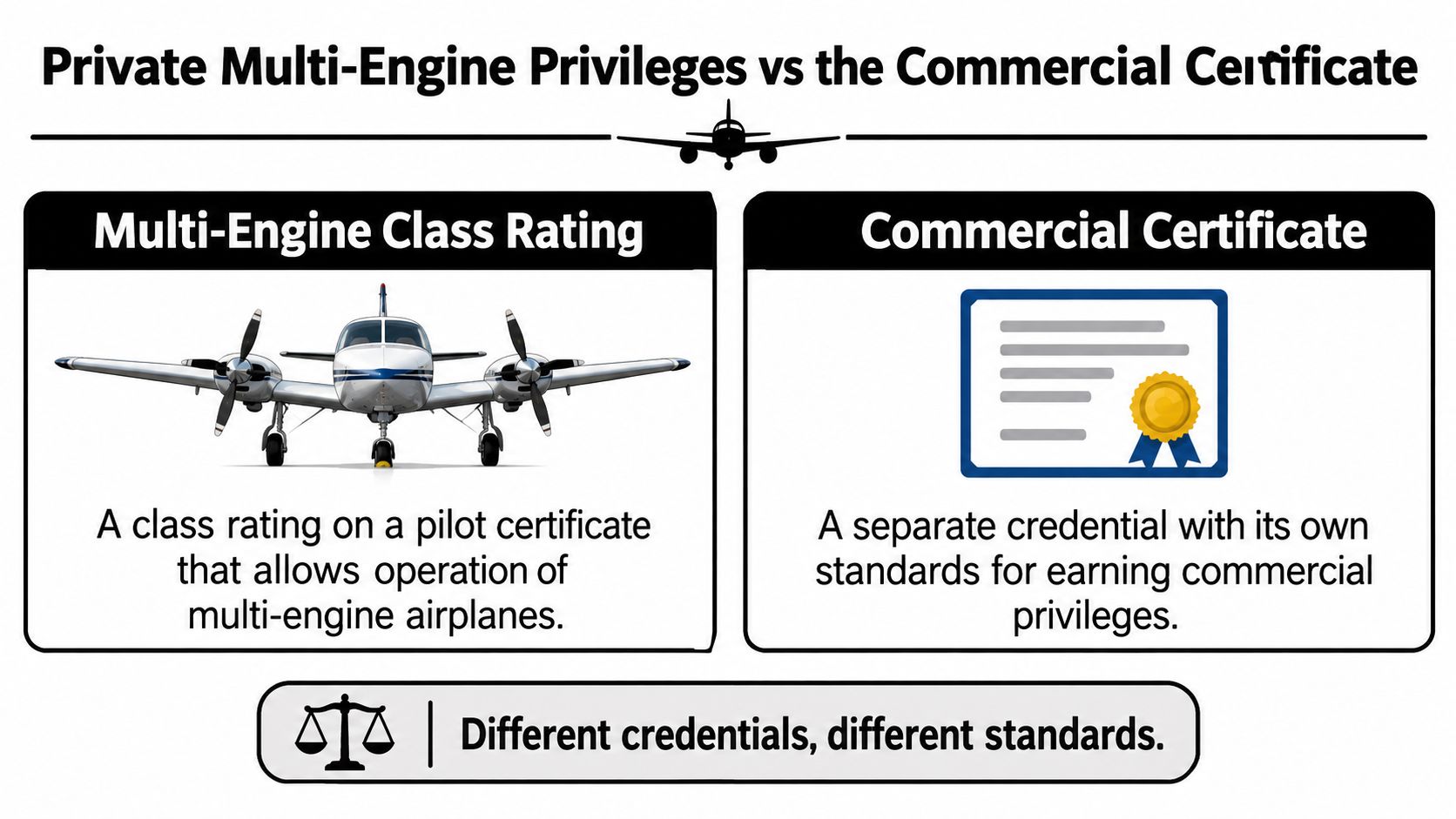
A multi-engine class rating is added to a pilot certificate. It gives the pilot privileges in the relevant class of aircraft; the commercial certificate separately determines whether the pilot may exercise commercial privileges. The two credentials serve different purposes, and a pilot can hold one without the other.
For a private pilot seeking multi-engine privileges, 14 CFR 61.109 sets a minimum of 40 hours of flight time, including 20 hours of flight training and 10 hours of solo flight training in the required areas. The required training includes 3 hours of cross-country instruction, 3 hours of night training that includes a cross-country flight exceeding 100 nautical miles, 3 hours of instrument training in a multi-engine airplane, and 3 hours of instruction preparing for the practical test within the preceding two calendar months. The rule also requires 10 hours of solo airplane time, including at least 5 hours of solo cross-country.
Those private-pilot requirements establish a foundation for flying twins for personal purposes. The commercial certificate adds the privileges needed for paid flying, subject to the applicable rules and limitations.
| Credential | Regulation | Minimum total time | Paid flying | Best fit |
|---|---|---|---|---|
| Private pilot with multi-engine privileges | 14 CFR 61.109 | 40 hours | No | Personal and recreational flying in twins |
| Commercial pilot, single-engine | 14 CFR 61.129(a) | 250 hours | Yes, single-engine only | Career flying in single-engine airplanes |
| Commercial pilot, multi-engine | 14 CFR 61.129(b) | 250 hours | Yes, including multi-engine airplanes | Career flying in twins |
For the private-pilot minimums, consult the text of 14 CFR 61.109.
What the Private Privileges Get You
Private privileges suit pilots who want to fly a twin for personal purposes, including carrying passengers without compensation. The required night, instrument, and cross-country training provides a starting point for later commercial work. It does not grant commercial privileges.
If your goal is paid flying in twins, plan for the commercial multi-engine certificate and its separate experience and practical-test requirements. If your goal is personal flying, private privileges may fit; the commercial certificate's additional requirements serve a different purpose. For a broader explanation of commercial versus private pilot certificates, focus on the privileges each certificate grants, not just the aircraft class rating.
Why Two Engines Change the Commercial Certificate
A second engine adds options, but it also creates a new failure mode. If one engine quits, the other keeps pulling on its side of the fuselage, yawing the airplane toward the failed engine. Your first task is to maintain control; diagnosis and checklist use come after.
The federal rule governing the commercial certificate requires more than familiarity with another powerplant. It covers engine-out procedures, instrument operations, cross-country judgment and advanced aircraft systems. For a student, that means learning to make sound decisions while managing asymmetric thrust and planning where to go if the airplane cannot continue as intended.
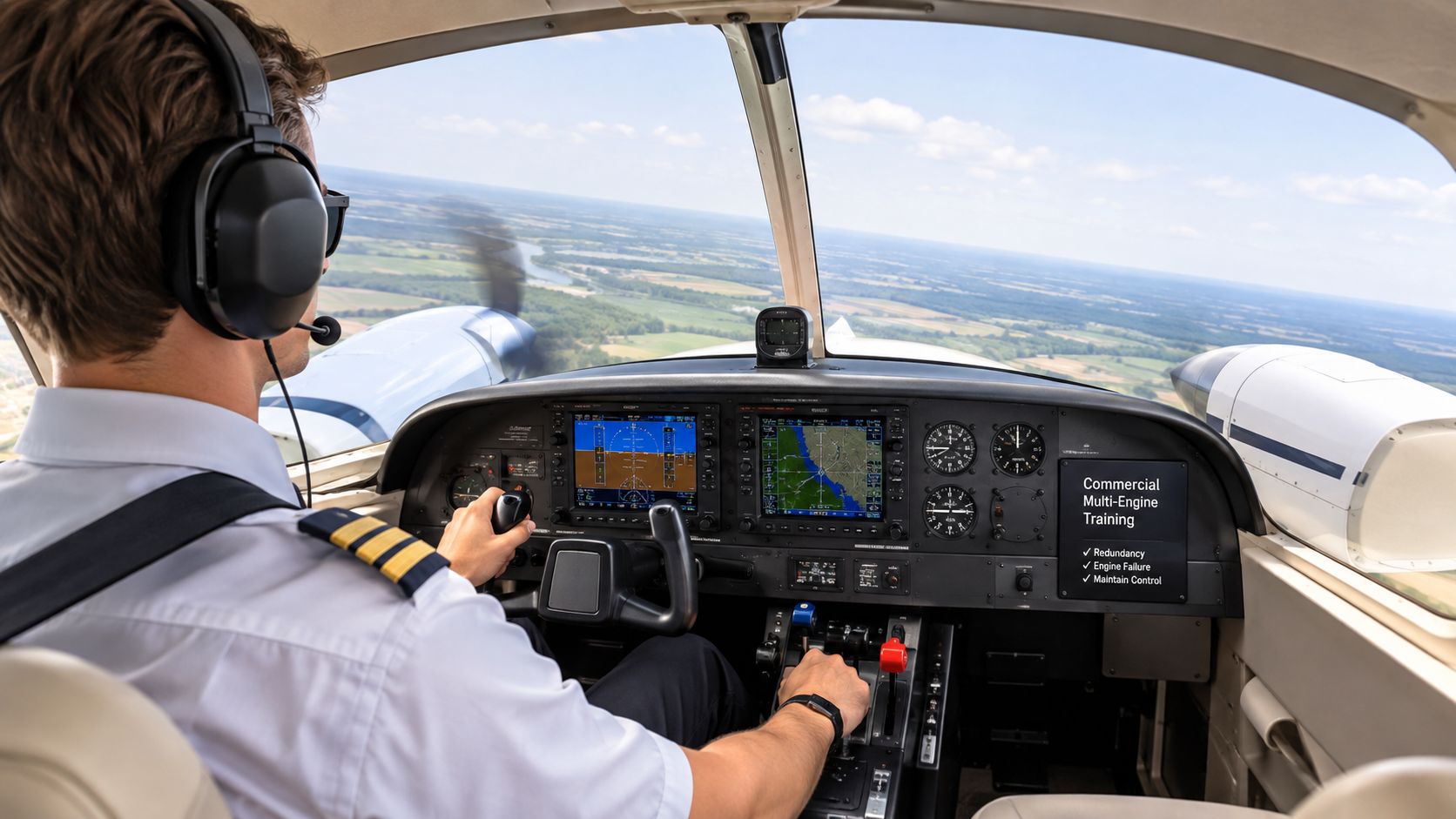
Diversion planning is practical even in a light twin. On a cross-country, choose a suitable airport before departure and keep reassessing your options as weather, fuel and aircraft performance change. ETOPS rules for airline operations reflect the same broad concern: a twin must be able to reach an appropriate alternate if an engine problem prevents it from continuing. The scale differs, but the student's decision is concrete: identify a usable diversion field rather than assuming the destination remains the best option.
Twin flying combines redundancy with the need to plan around a possible loss of power. One operating engine does not guarantee that a light twin can maintain altitude or reach the planned destination. The rating builds the judgment to account for that limitation as well as the procedures for handling the failure.
A twin gives you another engine, not a guarantee that the flight can continue as planned.
Engine-Out Maneuvers You Must Master in a Twin
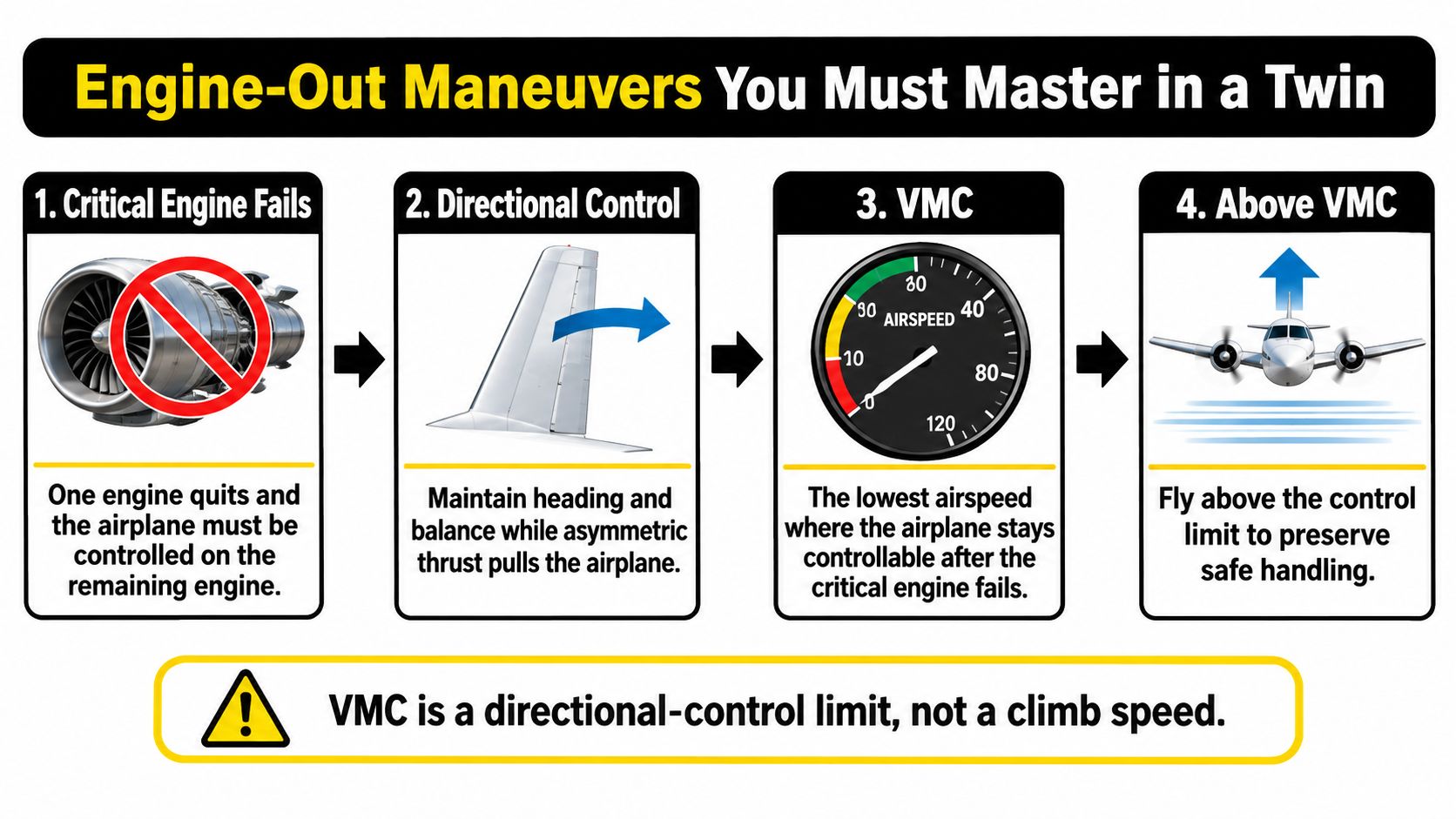
Everything in this section exists because of one number. VMC is a controllability limit, not a climb speed. The FAA's airplane flying handbook chapter on multiengine operations defines it as the calibrated airspeed at which the aircraft remains controllable after sudden loss of the critical engine. Read that definition carefully: it addresses directional control only, and it does not require the airplane to climb at that speed.
The critical engine is the one whose failure produces the greatest adverse directional effect. Four forces drive that: asymmetric thrust, propeller P-factor, slipstream and raw yawing moment. Below VMC, rudder authority can be insufficient to hold the nose against the yaw even while the good engine is producing full power.
The Recovery Sequence
Learn this as one continuous motion, not six separate checklists.
- Recognize the failure. Yaw and a roll toward the dead engine show up before the airspeed indicator does anything dramatic. Feet first, then eyes.
- Apply maximum appropriate rudder toward the failed engine. Not a nudge. Enough to arrest the yaw.
- Bank up to about 5 degrees toward the operating engine. The bank converts a little of the vertical component of lift into a sideways force that helps the rudder, and it kills the temptation to skid.
- Lower the nose to hold airspeed above VMC. Altitude is negotiable. Control is not.
- Identify and verify the dead engine before securing it. Verification is what stops a real accident chain, and it's the step students skip under stress.
- Decide whether climb performance is available. If it isn't, pick a landing site and fly to it. An engine-out approach to a field beats a hopeless attempt to hold altitude.
Where students get hurt: too much pitch. Raising the nose increases angle of attack, airspeed decays, and the airplane can drop below VMC before a stall warning ever becomes your primary threat. Directional control disappears first.
The certification demonstration is deliberately demanding. The examiner arranges the critical engine inoperative, takeoff power on the operating engine, landing gear retracted, takeoff flaps set, and unfavorable weight and center-of-gravity conditions. That's the reference case, and it's the reason your preflight performance planning matters: if the book numbers are thin in those conditions, they're thinner in yours.
Straight-and-level flight, turns and climbs on one engine follow the same logic. Hold the airspeed, accept the bank, keep the ball centered, and don't chase altitude you don't have. The engine failure on takeoff scenario is where this gets unforgiving, because the decision window is measured in seconds and the ground is close.
Before your next flight, say the sequence out loud for the specific airplane you fly, using its airspeeds and its memory items. If you can't, you don't know it yet.
Instrument Engine-Out Work for the Practical Test
The practical test requires more than handling an engine failure in visual conditions. The Commercial Pilot Airplane Airman Certification Standards include simulated one-engine-inoperative instrument approaches and landings where applicable. The multiengine instrument standards also cover straight-and-level flight and turns with an inoperative engine.
If you do not meet the instrument-task standards, your airplane certificate may be limited to multiengine VFR operations. Removing that limitation requires another practical test.
Why an Engine Failure in IMC Is a Different Problem
In cloud, asymmetric thrust arrives alongside instrument procedures, navigation constraints and changing performance margins. You must maintain control and manage the approach without an external visual reference. The airplane behaves the same; the workload does not.
Use the instrument portion of the sequence to organize the approach, not to repeat the visual engine-failure recovery steps.
| Order | Instrument task | Why it matters |
|---|---|---|
| 1 | Brief the approach and set the missed-approach altitude | Keeps the procedure and next altitude clear under workload |
| 2 | Set up navigation sources and identify the required fixes | Reduces mode and course-selection errors |
| 3 | Review single-engine performance for the approach and missed approach | Helps you judge whether the planned climb is available |
| 4 | Communicate the aircraft's situation and fly the approach | Keeps ATC informed while you maintain the procedure |
| 5 | Make a timely go-around or landing decision | Avoids continuing when performance or stability is inadequate |
Simulator practice lets you repeat instrument procedures without running the airplane's engine. Aircraft sessions then let you experience control forces and trim changes, and assess how weight, temperature and density altitude affect performance.
The key benchmark is maintaining directional control, instrument attitude, and airspeed simultaneously while following the procedure. VMC does not guarantee climb capability or obstacle clearance. The airman certification standards and their task tolerances show what the examiner evaluates.
Career Value and the Time-Building Gap
The rating is rarely the bottleneck. The 12 to 24 months after it can be. The U.S. Bureau of Labor Statistics projects 7% employment growth for airline and commercial pilots from 2025 to 2035, but projected demand is not a job offer for every newly certificated pilot.
A certificate shows that you met training and testing requirements. It does not establish that you have the experience an airline job requires. A commercial multi-engine rating is one step in a longer process, not a guarantee of employment.
What the Logbook Looks Like to a Hiring Department
Recruiters and chief pilots look beyond the total time in a logbook. They also consider what kind of flying produced it:
- Multi-engine PIC time records time as pilot in command, rather than time spent receiving dual instruction.
- Instrument approaches show practice with a skill that requires regular use to stay current.
- Night operations record experience flying at night and working with unfamiliar airports and lighting.
- Instruction given shows experience explaining procedures, monitoring another pilot, and correcting errors.
- Simulator time should be distinguished from aircraft time in the logbook.
Consider a graduate who finishes training with 250 hours and is targeting a posting that lists 1,500. That leaves 1,250 hours to build. At 40 hours a month, it takes a little over two and a half years; at 80 hours a month, it takes about 16 months. The actual pace depends on access to an airplane and instructing work, along with the costs of housing and financing and interruptions from weather, maintenance, checkride scheduling, or local demand.
Ask every school: Does the course create a practical path toward the hiring minimums you are targeting, or does it end with the next certificate?
The time-building options after a multi-engine rating deserve the same attention as the training itself. The rating qualifies you for a new set of flying tasks; building the experience required for your career target takes additional time.
Pick Your Next Step Toward a Multi-Engine Commercial Rating
The right next step depends entirely on whether you've flown yet. If you haven't, don't start by comparing multi-engine syllabi. Start by finding out whether you enjoy sitting in a small airplane on a warm afternoon with a checklist on your knee. A discovery flight answers that for the price of an afternoon, and it's the cheapest possible mistake to make or avoid.

You can take that flight and your first lessons before you hold an FAA medical certificate. A third-class medical from an aviation medical examiner is required before you fly solo, so get the exam scheduled early rather than discovering a problem three lessons in. Later, exercising commercial privileges requires a second-class medical under 14 CFR 61.23, which is worth planning for well before the commercial checkride rather than the week of it.
If you already know you want the whole path, our Career Track program runs about nine months from zero time to CFII and multi-engine, with 282 total hours, six certificates and ratings, and a fixed $89,000 tuition. Training is based in Riverside, Long Beach and Corona in Southern California.
Questions to Put in Writing Before You Pay a Deposit
Ask every school, including this one.
- Airplane age and equipment. A 1973 trainer with steam gauges teaches you to fly, but not in the environment you'll be hired into.
- Students per airplane. The ratio predicts how often your lesson gets canceled for maintenance or scheduling.
- Instructor turnover. High turnover means your instructor leaves two weeks before your checkride.
- Total price, in writing. Course fees, examiner fees, aircraft time, materials and retest costs as separate lines.
- Part 61 or Part 141. Different structure, different documentation, different minimums.
- Whether you can fly before committing. If the answer is no, that tells you something about the operation.
Then do the arithmetic that decides your timeline. Take the 250-hour requirement and divide it by the hours your plan can realistically log each month, allowing for weather, work and money. If the answer is longer than you're willing to spend, the fix isn't a faster course. It's a better-funded one.
If the multi-engine rating is the part of the pathway you've been circling, CFII builds it into a single fixed-price route rather than selling it as a standalone add-on: one enrollment, one instructor relationship, and multi-engine time logged as part of the run from private pilot through commercial, CFI and CFII. The program is based in Southern California, where the weather lets you fly year-round instead of waiting out a season. Visit CFII to see how the Career Track maps to the requirements above and to book the first conversation.
Planning to fly for a living?
See what the path from zero to a pilot career looks like, what it costs and how long it takes.
Learn to fly in Riverside
We train at Riverside Municipal Airport in modern airplanes with a parachute built in. Start with a one hour discovery flight, no experience needed.