
On this page
- What the IRA Written Test Covers and How It Is Scored
- Verify the Time Limit Before You Plan Around It
- What the Passing Arithmetic Means
- Eligibility and Endorsement Before You Book
- Topic Breakdown by ACS Area
- Check Your Edition Before You Study a Word
- Topics Don't Stay in Their Lanes
- An Eight-Week Study Plan Built on the ACS
- Practice Scores and the Weak Areas That Cost Points
- Set the Bar at the High 80s on Fresh Questions
- Keep an Error Log, Not Just a Score
- Test-Day Plan From Check-In to Final Question
- The Night Before
- During the Test
- Confirm Your Endorsement Before You Book the Test
- Your Passing Score Has an Expiration Month
- If You Fail, the Retest Has Its Own Rules
- Pick Your Next Step Based on Where You're Starting
In 2024, 25,647 applicants took the Instrument Rating Airplane knowledge test, and the FAA annual test statistics report a 94.24 percent passage rate with an average score of 85.64 percent. That sounds reassuring if you're new to flying. It shouldn't make you casual. Applicants who reach the testing center have already finished structured ground study, and the instrument rating written test is built to check whether you can read an unfamiliar chart, apply a regulation, and finish a calculation under time pressure. Treat it as a moving target from day one, because the matrix, supplement, and Airman Certification Standards edition that govern your test date may not match the guide you found online.
What the IRA Written Test Covers and How It Is Scored
The test you'll book is the Instrument Rating Airplane knowledge test, code IRA. The FAA airman knowledge-testing matrix lists it as 60 questions with a 70 percent passing score and a minimum age of 15 years old to take the examination. Every question is multiple choice with a single correct response, so your job isn't to find an answer that sounds plausible. It's to find the answer that fully solves the problem the question asks.
Verify the Time Limit Before You Plan Around It
Time is where older material first misleads students. Older guides show 2.5 hours, while the FAA current testing matrix page identifies a newer September 2026 matrix listing the IRA exam as 60 questions, 2.0 hours, with a 70% passing score. Don't build your pacing drills around a screenshot. Find the IRA row on the current matrix, confirm the limit that applies to your appointment, and write that number at the top of your study plan.
| Test | Questions | Time Limit | Passing Score |
|---|---|---|---|
| Instrument Rating Airplane (IRA) | 60 | 2.5 hours in older guides; 2.0 hours on September 2026 matrix | 70% |
What the Passing Arithmetic Means
On a simple 60-question model, 70 percent means at least 42 correct answers. Don't try to count your way to 42 during the exam, because FAA testing systems may include validation questions that are not counted toward your scored total. You won't know which ones they are, and you don't need to. Treat every question as scored.
Pacing follows from the same math. A 2.5-hour limit gives you roughly two and a half minutes per scored question, and a shorter limit tightens that margin. Some regulation questions take twenty seconds. A chart question with a wind or fuel calculation can take three minutes if you haven't practiced the setup. That's why weather theory, navigation, regulations, flight planning, and instrument procedures all need timed practice, not just reading.
Practical rule: If a question is eating your clock, mark it, move on, and come back. One hard chart problem isn't worth three easy regulation questions.
Don't confuse the IRA with the instructor test you'll hear about later if you pursue teaching. They're separate exams with separate codes, and booking the wrong one wastes your fee and your day. Confirm the code on your appointment says IRA, in writing, before you pay.
Eligibility and Endorsement Before You Book
Booking early feels productive. Booking before you're eligible and endorsed is just expensive. Work through this list in order, because each step prevents a specific, common mistake.
- Hold the right certificate first. You need at least a private pilot certificate with an airplane category and class rating, as 14 CFR 61.65 requires. Students often start instrument ground school during private training, which is fine for learning, but the rating itself builds on that certificate.
- Complete the training 61.65 specifies. That includes 40 hours of instrument training, up to 15 of them with an authorized instructor as the rule structure allows, and 50 hours of cross-country time as pilot in command. The common mistake is treating the written as step one and discovering the experience requirements later, when your test result is already aging.
- Get your instructor's endorsement. You need an authorized instructor's logbook or training record endorsement certifying you're prepared for the knowledge test. The FAA guidance tied to 14 CFR 61.65(a)(4) explains that the test-results report by itself does not satisfy this endorsement requirement, so finishing an app course doesn't replace the signature.
- Match the test to your practical test category. An airplane instrument rating needs the instrument airplane test. Students who grab the first available seat without checking the category end up with a result that doesn't support their checkride.
- Get your FAA Tracking Number. You need an FTN before you test. Leaving this to test morning turns a simple administrative step into a check-in problem.
- Check the minimum age. You must be at least 15 to sit the exam. That's rarely the barrier, but young students and their parents should confirm it before scheduling around school.
If you're sequencing all of this from zero time, the instrument rating requirements page lays out how the certificate, experience, and test pieces fit together. Read it before you commit money to any single piece.
One exception keeps this in perspective. An applicant who already holds an unrestricted instrument rating on a U.S. pilot certificate doesn't need another instrument knowledge test for that rating process. If you're reading this as a first-time instrument student, that exception isn't you yet. Bring a copy of your endorsement to the test center, and schedule only after your instructor has signed off on your ground preparation.
Topic Breakdown by ACS Area
The Airman Certification Standards, or ACS, defines this exam. A question bank doesn't. The ACS lists what you must know, consider, and do, area by area and task by task, and the written test samples from that outline. If you study the ACS, unfamiliar questions still feel familiar in structure. If you only memorize bank answers, a reworded question with a new chart can undo months of practice.
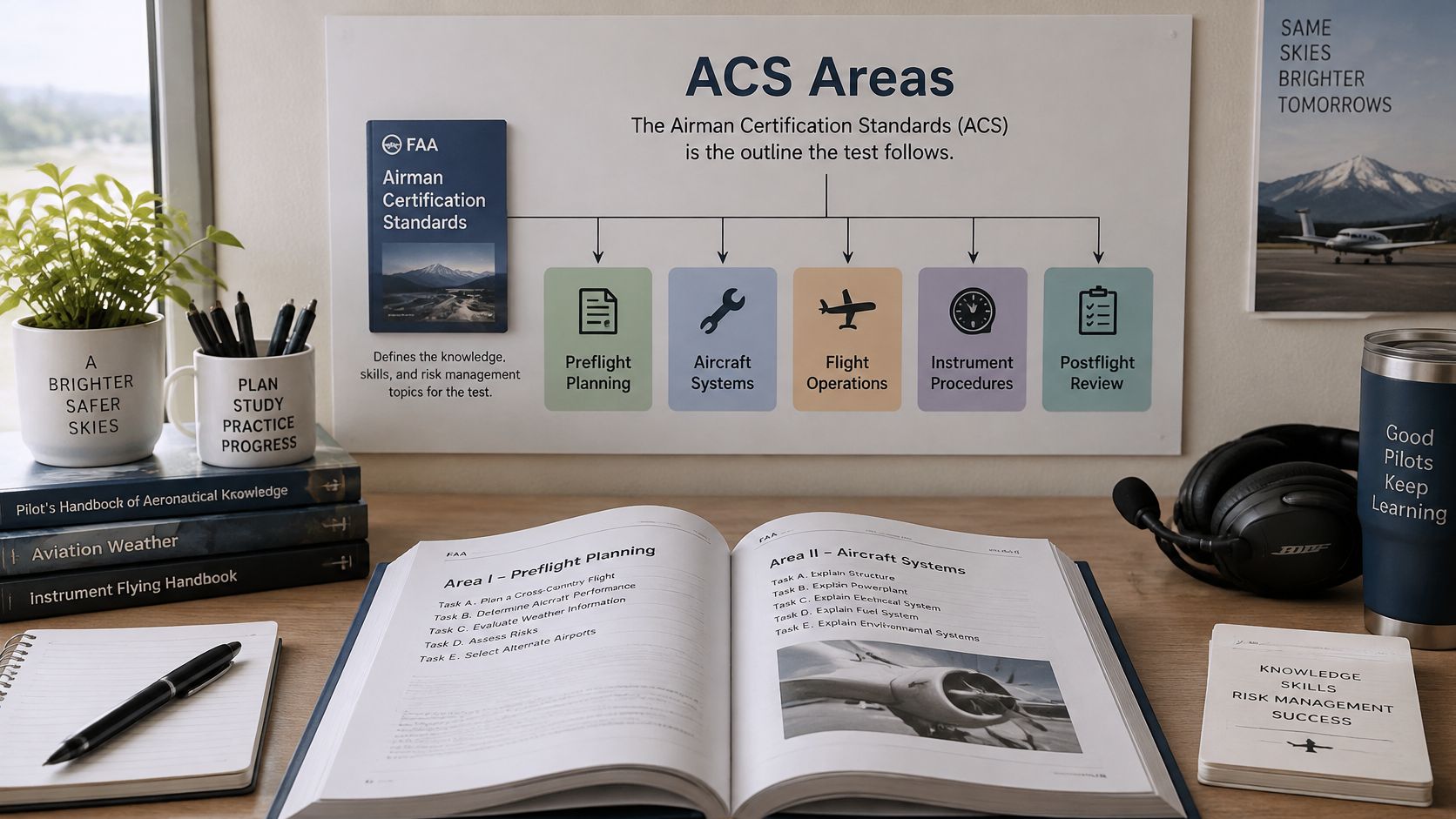
| Area | What to Master | Typical Trap |
|---|---|---|
| Preflight Preparation | Weather products, icing and turbulence forecasts, NOTAMs, IFR flight planning, alternate minimums | Using a forecast from the wrong time or ignoring alternate requirements |
| Preflight Procedures | IFR equipment and aircraft systems, instrument currency, IFR fuel reserves | Choosing an answer that is only partly correct on equipment rules |
| Air Traffic Control Clearances and Procedures | Clearance readback, holding entry, lost communications procedures | Picking a lost-comm option that does not fit the phase of flight |
| Flight Procedures | Approaches, missed approaches, holding, partial-panel control | Calculating from memory instead of reading the current chart |
| Emergency Operations | Unusual attitudes, partial panel, inadvertent IMC, icing | Skipping the risk-management or decision-point implications |
Check Your Edition Before You Study a Word
Area names and task numbers change between ACS editions. Download the current ACS before your first study session, and check which supplement and chart cycle apply to your test date. Many popular guides still cite the older FAA-CT-8080-3F instrument supplement, with figures and plates that may not match current governing materials. Confirm the supplement, ACS edition, and chart cycle named on the current matrix, then make sure every book and app you use points back to those same sources.
Topics Don't Stay in Their Lanes
Weather theory shows up in preflight planning when you brief a route, then again in emergency operations when ice or convective weather forces a decision. The regulations in 14 CFR Part 91 and the procedures in the Aeronautical Information Manual underpin answers in every area, because instrument flight rules govern how all of it connects. If the phrase itself is new to you, this plain-language explainer on instrument flight rules is the right starting point before the details pile up.
Say a question gives you a flight plan where destination weather sits near minimums and asks whether you must file an alternate, and which airport qualifies. You need the regulation that triggers the alternate requirement, the forecast that tells you it applies, and the chart data that confirms the alternate's approach and minimums. Miss any one leg and you'll pick a partly right answer.
Turn each ACS area into a checklist of task statements you can tick off only when you can explain the task out loud, without notes.
That spoken explanation is the standard. Recognizing an answer you've seen before isn't.
An Eight-Week Study Plan Built on the ACS
A calendar only helps if each session has a method. Use the same five steps in every session, then let the weekly schedule decide which topic gets the treatment.
- Map the session to one ACS task. One task, not a chapter. Students who study "weather" for an evening finish unsure what they covered.
- Study the underlying sources. Read the relevant parts of 14 CFR, the Aeronautical Information Manual, instrument procedures, weather products, charts, and aircraft systems material for that task.
- Practice scenario calculations. Work charts, altitudes, fuel, navigation, and alternate requirements until the arithmetic is automatic and boring.
- Take timed, mixed-topic practice exams. About once a week is enough early on. Daily full exams burn fresh questions you'll need later.
- Review every missed item. Explain why each wrong answer is incomplete or wrong, in words, before you look at the next question.
That sequence mirrors what the FAA Airman Certification Standards guidance is built for, since the ACS structures knowledge into Areas of Operation and Tasks with objectives describing what you must know, consider, or do, and directs you to current regulations and guidance. It also advises reading the complete question before viewing answer choices and selecting the answer that fully solves the problem.
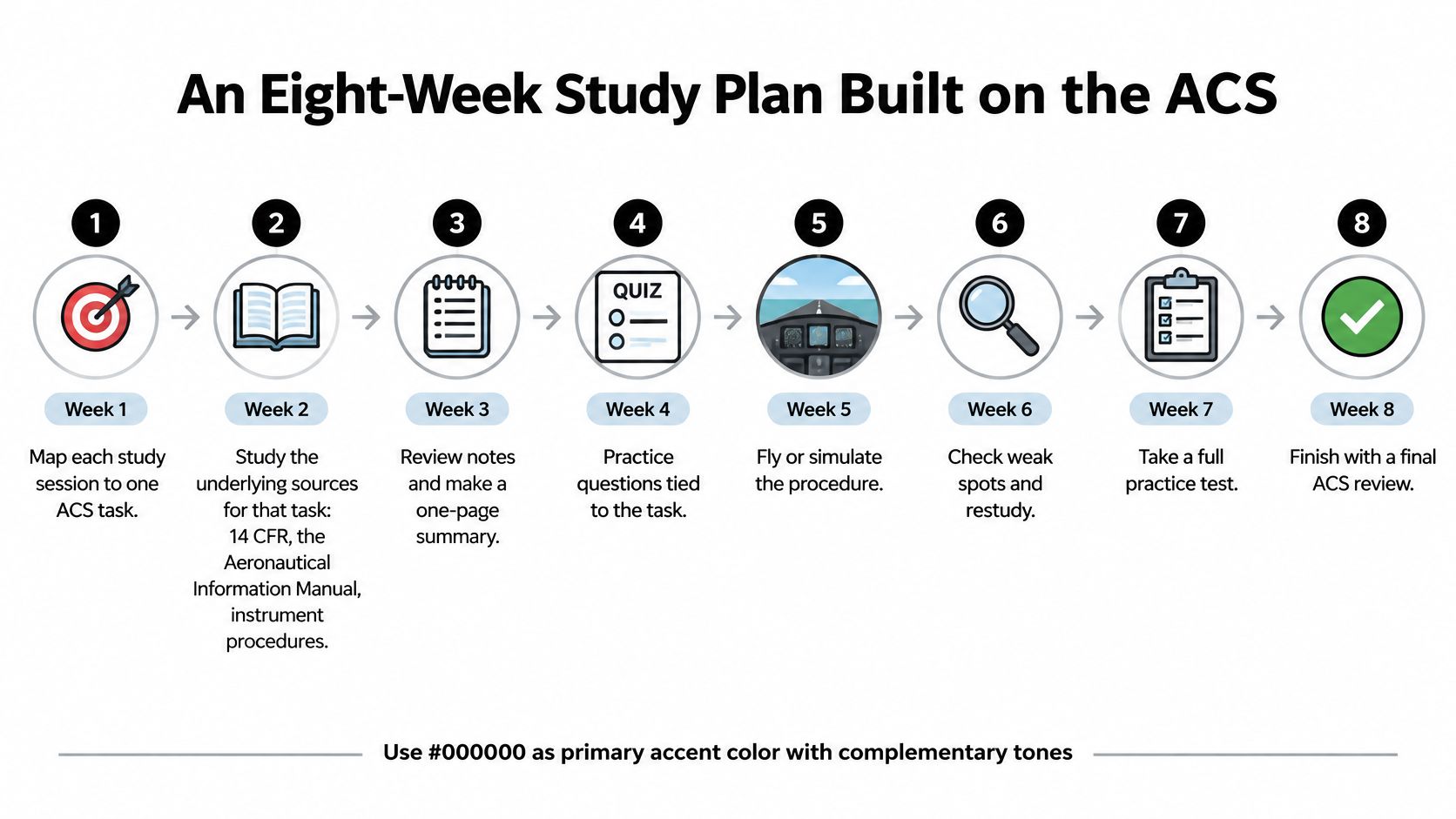
| Week | Focus | Done When |
|---|---|---|
| Week 1 | Regulations and aeronautical knowledge (14 CFR, AIM) | You can cite the IFR rule that applies to a given scenario |
| Week 2 | Preflight weather and NOTAMs | You can make a go or no-go decision from a sample briefing |
| Week 3 | IFR flight planning and alternates | You can work out alternate requirements for a planned route |
| Week 4 | Charts and approach procedures | You can read minimums and procedure notes without notes |
| Week 5 | ATC clearances and lost communications | You can state the lost-comm procedure for each phase of flight |
| Week 6 | Holding and instrument flight procedures | You can enter a hold correctly from any heading |
| Week 7 | Emergency operations and aircraft systems | You can work partial-panel scenarios with correct decision points |
| Week 8 | Timed mixed practice exams and error review | You score consistently in the high 80s or above on fresh questions |
If you're following a structured course, compare this sequence against the instrument rating course syllabus so your ground sessions and flight lessons reinforce each other instead of drifting apart.
Short on hours some weeks? Stretch the early weeks across ten days each. Don't compress week eight, because timed mixed exams are where pacing and weak areas reveal themselves under realistic pressure. And don't mistake a high score on a quiz you've already seen for readiness. Repeated questions reward recognition, and recognition evaporates when the chart is new. If you miss a week's finish line, repeat that topic before moving on. Advancing on schedule with a shaky week two makes week three, which depends on weather judgment, harder than it needs to be.
Practice Scores and the Weak Areas That Cost Points
Passing practice quizzes doesn't mean you're ready. That's the assumption to retire. The 70 percent pass mark is a floor, and the national results show how far above it prepared applicants sit. The FAA 2025 test statistics recorded 27,143 applicants with a 94.38% pass rate and an 86.15% average score on the instrument airplane test. If your practice scores hover in the low 70s, you're not near the typical passing applicant. You're near the line, with no margin for a bad chart question.

Set the Bar at the High 80s on Fresh Questions
Aim to score consistently in the high 80s or above on fresh, mixed-topic exams you've never seen. Consistency matters more than one good day. Three scores in the high 80s across two weeks, with reasoning you can explain, is a readiness signal. One 91 after retaking a familiar quiz isn't. Using a structured FAA written exam practice test routine helps here, because fresh mixed sets are what expose the gaps that topic quizzes hide.
Keep an Error Log, Not Just a Score
Record every missed question under one of five categories: weather, regulations, navigation, flight planning, or aircraft systems. Correct it using the current source document, not the answer key's one-line explanation, then retest the same topic after a few days. Spaced retesting tells you whether you fixed the gap or just remember yesterday's correction.
Four failure patterns will fill most of your log at first:
- Obsolete information: You used an outdated regulation or chart because your study material predates the current edition.
- Misreading the question: You calculated correctly for a question that wasn't asked, often because you started math before finishing the stem.
- Partly correct answers: You picked an option that's true but incomplete, while another option fully solves the problem.
- Skipped implications: You answered the procedure but ignored the risk-management or aircraft systems consequence the question was testing.
For calculation questions, use one fixed method every time. Reread the stem slowly, identify which chart or table applies, do the math on paper, and only then compare your result to the answer choices. Looking at the choices first invites you to reverse-engineer a number that looks familiar.
Weekly check: If the same error category appears in two consecutive practice exams, give it a dedicated review session before your next timed test.
That's how an error log becomes a study plan instead of a guilt list.
Test-Day Plan From Check-In to Final Question
Make every avoidable decision the night before, then run this routine twice: once at home, once mentally at check-in.
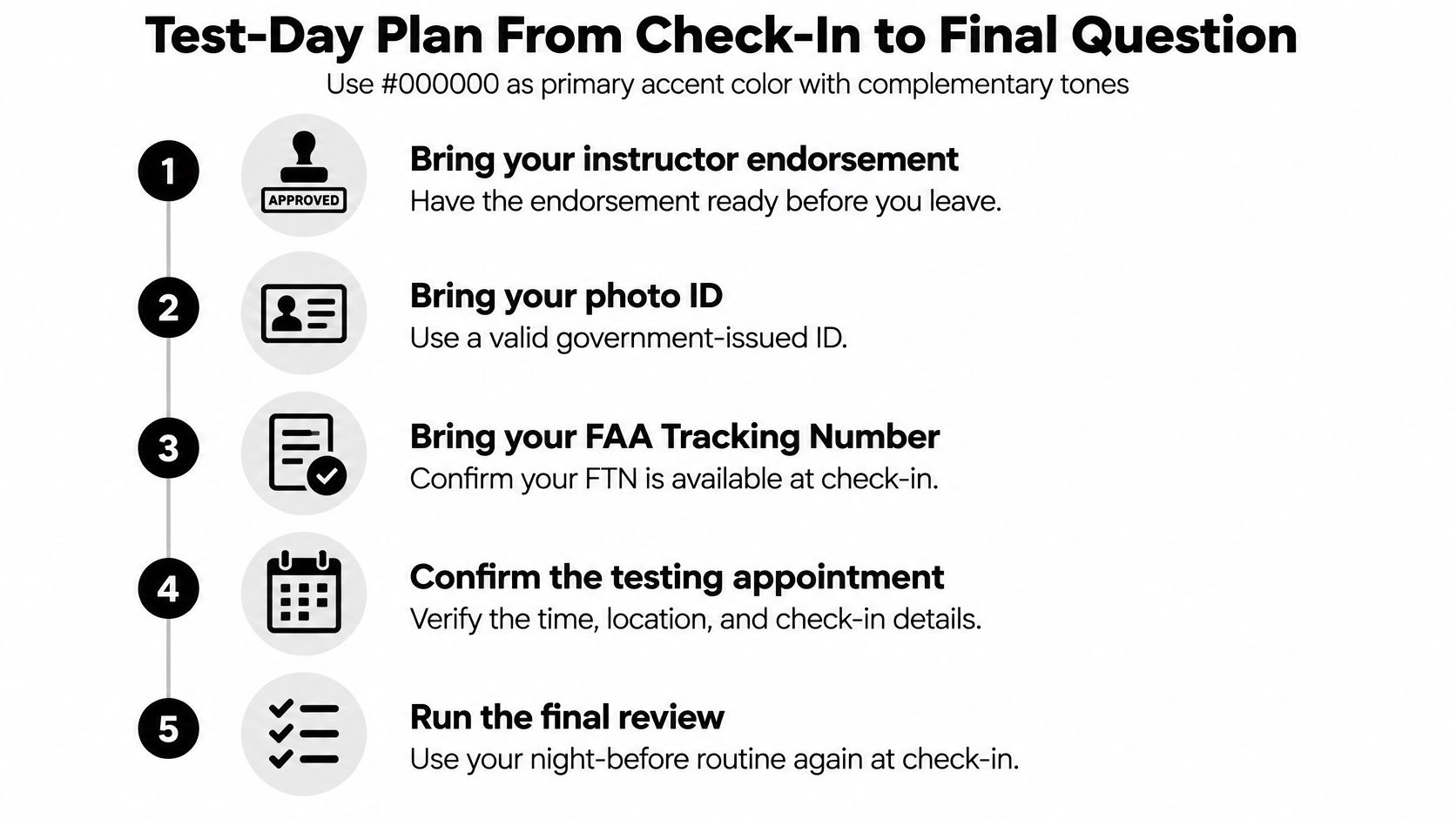
The Night Before
Pack the documents from the eligibility checklist, then handle logistics. Confirm the testing center's location and parking, pick an arrival time that leaves a buffer for a slow drive or a full lot, and set out everything you'll carry in the morning. Re-read your appointment confirmation for the current time limit, question count, and which testing supplement applies; an older study guide or a saved screenshot may describe an exam that has since changed. Stop studying early enough to sleep. A tired brain misreads questions, and misreading is already one of the top ways to lose points.
- Arrival time set: Aim to be inside the building early enough to check in without rushing.
- Parking and route checked: Know the drive and where you'll leave the car.
- Bag packed: Documents, permitted materials, and anything the testing center requires go in tonight.
If you haven't booked yet, the step-by-step for how to schedule your FAA written exam covers the appointment mechanics so test week stays about studying.
During the Test
The proctor will hand you the current supplement booklet. Page through it before the first question; the charts may be arranged differently from the copies in your practice materials, and hunting for a familiar figure mid-question burns time you budgeted for calculations.
Use the clock deliberately. At the halfway point of your time limit, check how many questions you've finished, and adjust your pace before you're behind rather than after. Mark anything you can't answer confidently, move on, and return with whatever time remains. Some questions may be validation items that don't count toward your score, so one strange question isn't evidence your test is going badly.
Don't change an answer on instinct during your final review. Change it only when you can state a clear reason the new answer is right.
Work your marked questions in order, reread each stem once, and finish with a few minutes to spare rather than a few seconds.
Confirm Your Endorsement Before You Book the Test
Book the written test only after your instructor's endorsement is in your logbook and your practice scores are consistently in the high 80s. That single rule prevents most wasted appointments. Everything else in this section explains why the timing around that booking matters.
Your Passing Score Has an Expiration Month
A satisfactory result stays valid for 24 calendar months after the month you took the test, per the FAA pilot knowledge-testing guidance. The planning problem is that instrument training rarely runs on a clean schedule: weather cancels flights, aircraft go down for maintenance, and instructors and examiners book out weeks ahead. Test too early and you burn your validity window waiting on a checkride slot. Note the expiration month printed on your Airman Knowledge Test Report, then schedule the practical test with enough slack for the extra lessons your instructor may want before signing you off.
If You Fail, the Retest Has Its Own Rules
Under 14 CFR 61.49, a failed attempt requires additional training and a fresh instructor endorsement before you retest, and you must present the failed test report with your retest authorization. One bad day becomes documented remedial work and a second trip to the testing center. Sitting the exam because a gap opened in your calendar, rather than because your scores say you are ready, is the most expensive shortcut in the rating.
Pick Your Next Step Based on Where You're Starting
If you haven't flown yet, the instrument written sits several steps down your path, and that is normal. A discovery flight is the low-commitment first step: one flight with an instructor to confirm this career appeals to you before you budget for training, and nothing about it obligates you to continue.
If you already know you want the full route from zero time to teaching instrument students yourself, a structured program handles the sequencing so the booking decision is part of the syllabus. Our Career Track pairs each written test with its rating on a fixed timeline, with written-test preparation and checkride scheduling included. No program can promise a passing score or a job at the end, and be wary of any that does.
The exam itself can shift while you train. The standards edition or figures supplement current when you booked may differ from what an older guide or a forum screenshot describes, so pull the test guide for your exam code in the final week and confirm you studied the version in effect. Then take the seat.
When you're ready to stop piecing together endorsements, written prep, and checkride scheduling on your own, CFII offers a single structured path from your first flight through the instrument rating and on to instructor, with written test preparation built into every rating. Visit us to see how the sequence fits together, ask questions about timelines and training bases, and decide whether an accelerated career path matches how you want to reach the cockpit.
Planning to fly for a living?
See what the path from zero to a pilot career looks like, what it costs and how long it takes.
Learn to fly in Riverside
We train at Riverside Municipal Airport in modern airplanes with a parachute built in. Start with a one hour discovery flight, no experience needed.