
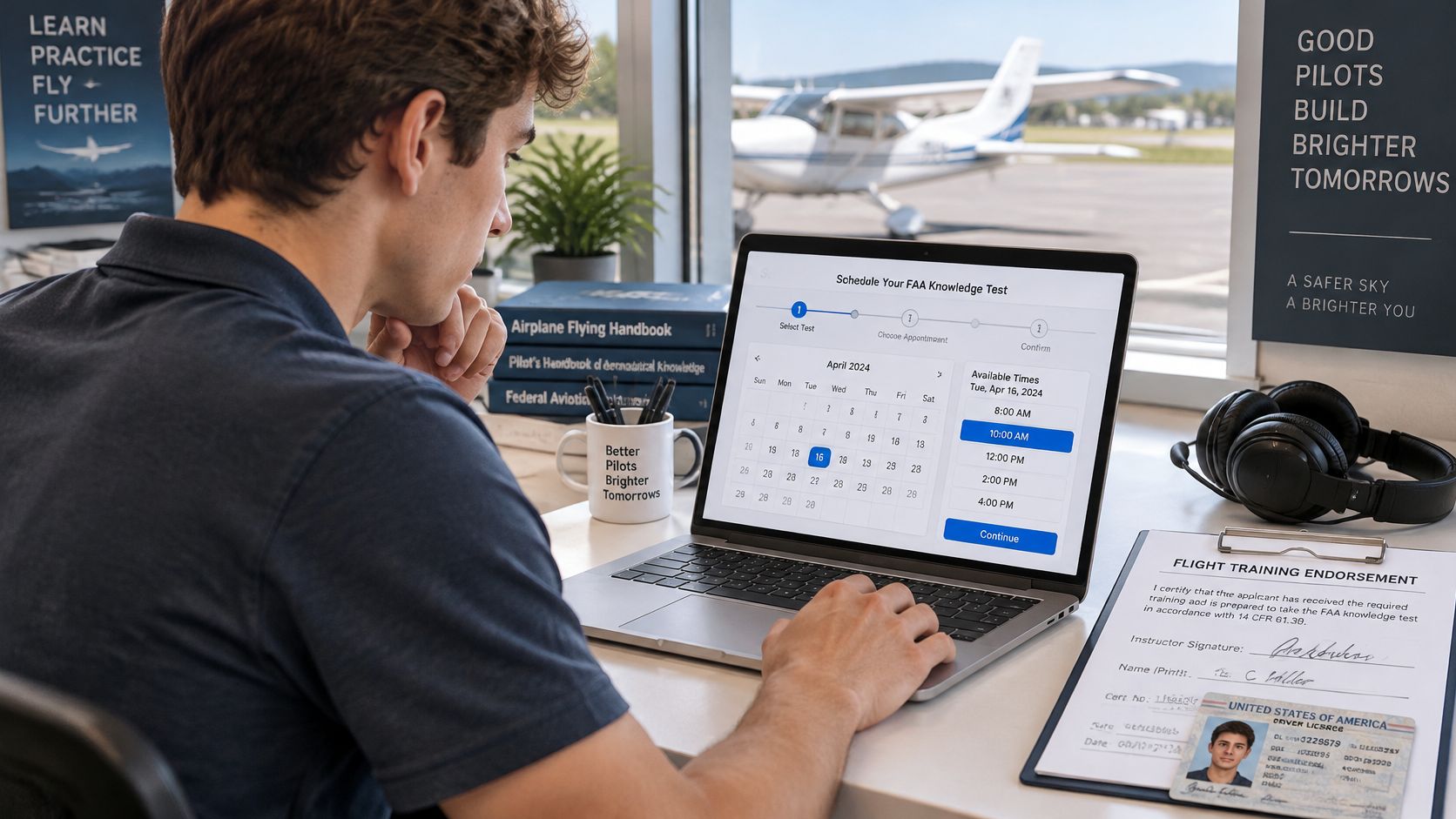
On this page
- Key Numbers Before You Book Your Written Exam
- Read the benchmarks correctly
- Confirm Your Eligibility and Test Code First
- Use the matrix as a sorting tool
- When to Book Based on Readiness, Not the Calendar
- Set a readiness gate
- Fit the appointment around flight training
- How to Schedule Your FAA Written Exam Step by Step
- Complete the booking in order
- Check the reservation before you close the browser
- Rescheduling, No-Shows and Retakes
- When plans start to break
- Book Your Written Exam and Plan Test Day
- Keep the result connected to your training
- Put the appointment inside a complete plan
You've started studying airspace and weather, and now you're looking at the testing calendar wondering whether to reserve a seat. Booking feels like progress. But if your endorsement isn't ready, your identification doesn't match your records, or your practice scores depend on recognizing answers, that appointment can cost you a fee without moving your training forward.
To schedule your FAA written exam, treat the decision as two separate jobs: prove you're ready, then protect the appointment. The written exam is a formal knowledge test, separate from your flight lessons and eventual practical test. A good booking fits your training plan, not just an opening on the calendar.
Key Numbers Before You Book Your Written Exam
A test date can fit your calendar and still leave too little time to finish flight training before your result expires. For most FAA airman knowledge tests, a passing result is valid for 24 calendar months. The FAA airman testing order explains how that period is counted: a test passed on July 12, 2016, remained valid through midnight on July 31, 2018. Count calendar months, not a fixed number of days.
Key numbers for scheduling the FAA written exam
| Rule or benchmark | Value | What it means for you |
|---|---|---|
| Passing score | At least 70%, with the exam-specific minimum confirmed in the current matrix, as explained in the FAA's knowledge-test guidance | Treat this as the minimum. Aim higher in timed practice. |
| Result validity | 24 calendar months for most tests, according to the FAA airman testing order | Complete the practical test before the validity period ends. |
| Minimum age, private pilot knowledge test | 15, according to the FAA Airman Knowledge Testing Matrix | The required endorsement or other eligibility documentation still applies. |
| Private Pilot Airplane pass rate, 2025 | 89.56%, in the FAA's calendar-year testing report | This is a group result, not a forecast for your exam. |
| Instrument Rating Airplane pass rate, 2025 | 94.38%, in the same FAA report | Applicants' training backgrounds differ, so the figures do not show that one test is easier for you. |
Read the benchmarks correctly
A passing score meets the test requirement; it does not show whether you can apply the knowledge during flight training or answer an examiner's questions. Use an FAA written exam practice test to identify weak subjects, then return to those topics in your study materials.
The pass-rate figures describe different groups of applicants. For example, a higher reported rate for instrument applicants does not establish that an individual private pilot applicant has lower odds of passing.
Planning rule: Estimate when you expect to finish flight training before deciding when to pass the written test.
The validity period starts when you pass, not when you reserve a seat. Booking early does not start the clock, but passing well before you can continue flight training uses up more of the period you have to complete the practical test.
Confirm Your Eligibility and Test Code First
A reservation for the wrong exam isn't a useful reservation. Before choosing a date, confirm that the exam matches the certificate or rating you're pursuing and that you can supply its required authorization.
Under 14 CFR § 61.35(a), applicants must have an authorized instructor's endorsement when required by the applicable regulation. That endorsement addresses completion of appropriate ground training or an acceptable home-study course and readiness for the knowledge test. Paying for a course isn't the same as receiving authorization to test.
Keep your training records beside you while checking eligibility and entering your details.
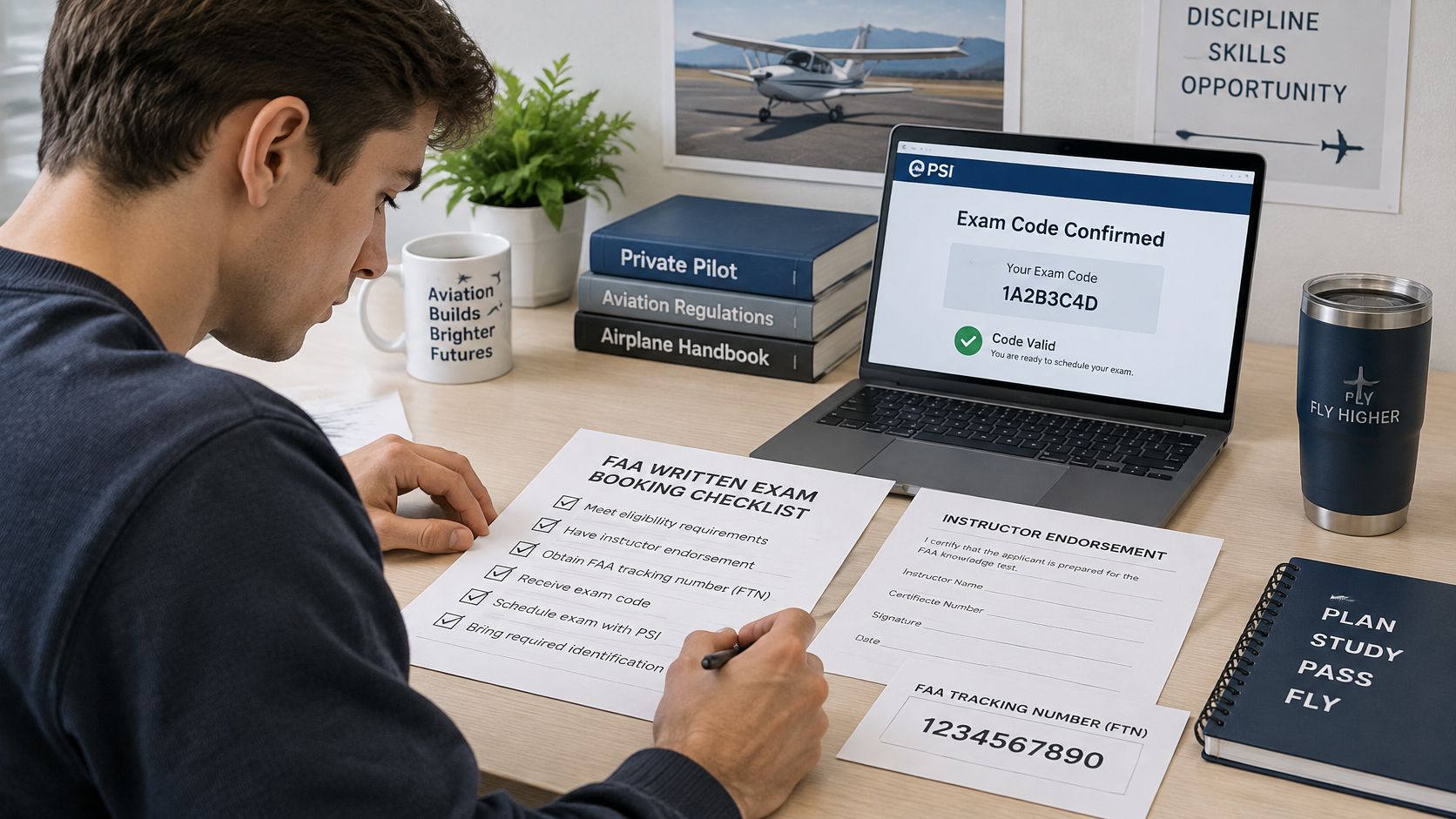
Requirements by applicant situation
| Your situation | Needed before you book | Why it matters |
|---|---|---|
| No FTN yet | FAA Tracking Number created through IACRA | Your testing record needs the correct applicant identifier |
| Enrolled in a Part 61 private pilot course | Instructor endorsement under the applicable knowledge-test requirements | Certifies ground training and readiness to test |
| Studying through an approved academic or home-study course | Qualifying completion documentation from that course | A purchase receipt alone doesn't establish eligibility |
| Any applicant | Current government photo ID meeting the required photo, signature, birth-date and residential-address requirements | Personal details must match your applicant and booking records |
| Choosing where to test | Authorized center search by postal code, country, travel distance and exam | Confirm identification and admission requirements before traveling |
Use the matrix as a sorting tool
Locate the exam's name and test code, then read across its eligibility, authorization and retesting entries. The matrix also identifies the question count, allotted time and passing requirement. Don't select an exam because its title sounds close to your goal.
A beginning private-pilot student needs the appropriate private-pilot exam. An applicant adding an instrument rating needs the instrument exam and its applicable authorization, not a repeat of the private-pilot process by assumption.
Keep the knowledge-test requirement separate from your student pilot certificate. They're different administrative tasks, even when you're handling them during the same training period.
If your identification lacks a required detail, ask the testing center which supplemental documentation it accepts before booking travel. Don't assume a document that worked for another appointment will satisfy this one.
When to Book Based on Readiness, Not the Calendar
Starting ground school isn't a reason to book immediately. A date can motivate you, but it can also push you toward memorizing answers while leaving gaps in weather interpretation, navigation or aircraft performance.
Use the readiness checklist as a decision aid, not a countdown.
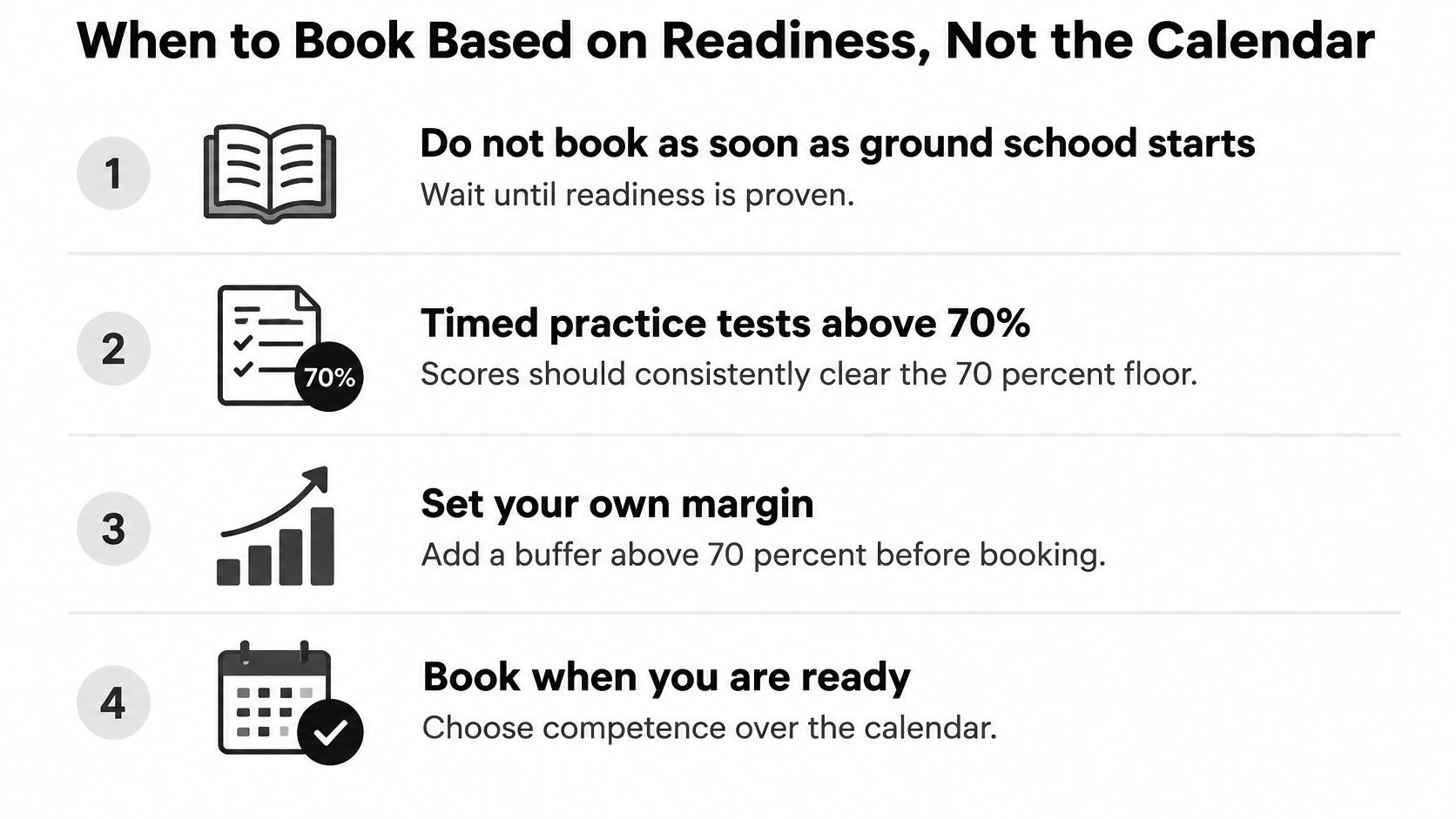
Set a readiness gate
Before reserving a seat, require all of the following:
- Consistent timed performance. Complete practice tests under realistic conditions, without looking up answers. Set a personal target comfortably above the minimum.
- Completed weak-area review. Explain why your missed answers were wrong, then solve a different question testing the same concept.
- Ready paperwork. Have your tracking number, acceptable authorization and matching identification available, rather than expecting to assemble them afterward.
For example, if you can identify the correct weather answer only because you remember its wording, keep studying. If you can interpret the underlying report and explain the operational consequence, you're building knowledge you can use beyond the test.
Organize missed questions by Airman Certification Standards (ACS) area where applicable. That produces a useful review list: weather interpretation, performance calculations or airspace requirements, rather than a collection of isolated answer choices. Our private pilot written test preparation guide can help you structure that work.
This video provides another way to review the preparation and scheduling process.
Fit the appointment around flight training
Booking too early creates pressure to test before you understand the material. Booking too late can leave you handling written-test preparation while your instructor is trying to finish practical-test preparation.
A study deadline is useful. An appointment you can't support with knowledge and documents isn't.
For accelerated training, choose a date between major training milestones when practical. Leave room in the plan for remedial study and a retest without assuming you'll need either.
Once the readiness conditions are met, take the next workable seat. The nearest opening isn't automatically the best choice if it requires exhausting travel or conflicts with an important flight lesson.
How to Schedule Your FAA Written Exam Step by Step
The FAA Airman Testing portal separates knowledge-test scheduling from general preparation resources and directs applicants to the authorized testing network. Flight-school enrollment doesn't automatically reserve your appointment.
Use this process overview before entering the booking system.
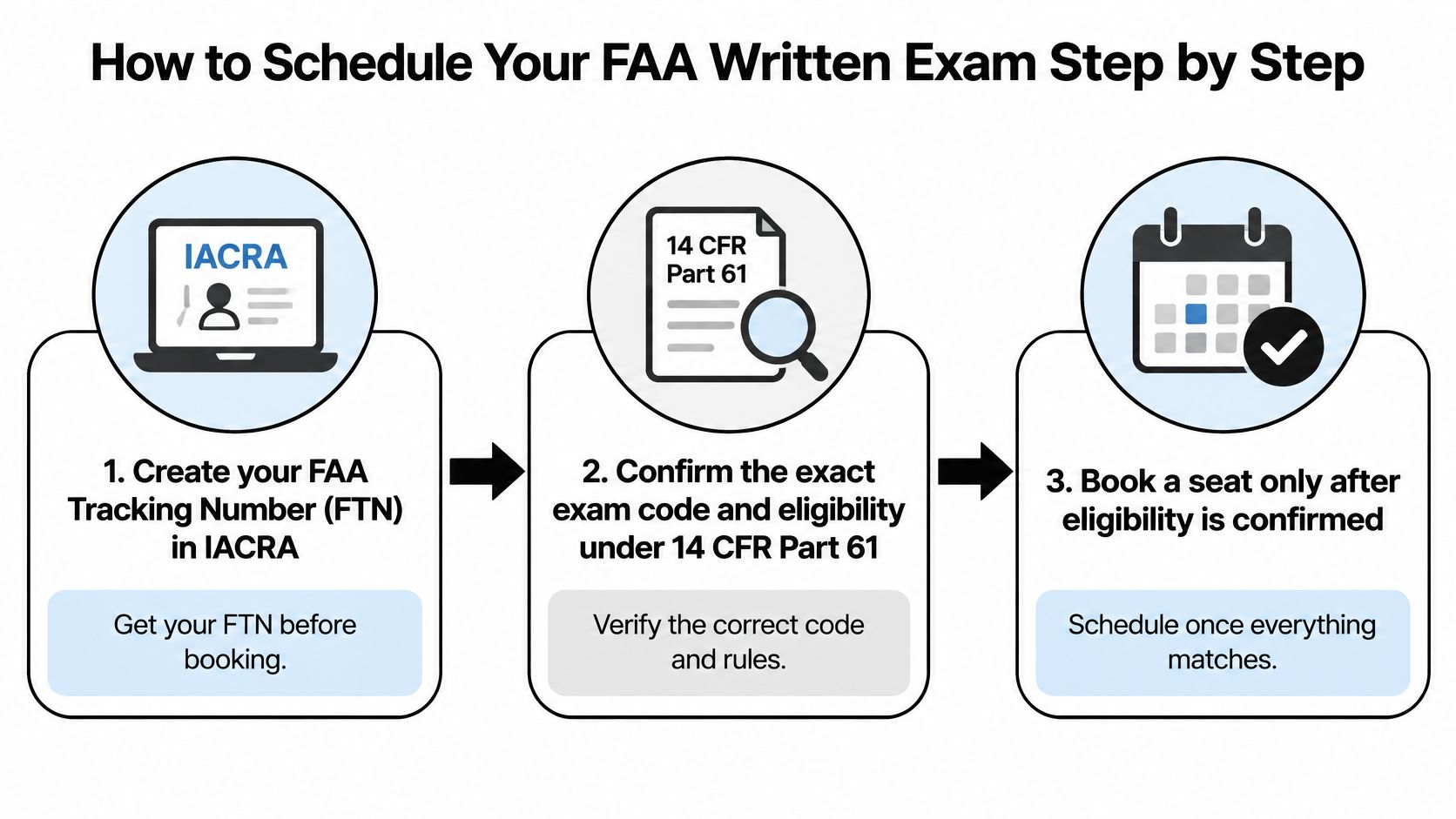
Complete the booking in order
Create or retrieve your FAA Tracking Number. Establish your FTN through IACRA if you don't already have one, and save it with your training records. Don't create another applicant identity because you can't immediately find an existing number; resolve access to your record first.
Confirm the exact exam and eligibility. Check the current testing matrix for your certificate or rating and record the exam code before searching appointments. The common slip is selecting a similar-sounding test instead of matching the actual requirement.
Obtain the required authorization. Have your instructor's endorsement or other acceptable eligibility evidence ready before committing to a date. Tell your instructor which exam you intend to take so the authorization addresses the correct requirement, rather than relying on a general course-completion conversation.
Choose an authorized knowledge-testing center. Search by location, travel distance and desired exam, then choose an appointment you can reach reliably. Don't assume a nearby flight school administers tests or that being its student gives you a reserved seat.
Reconcile your personal details. Compare your legal name, date of birth and residential-address information across IACRA, the booking record and your identification. A nickname, outdated address or missing identifying detail deserves attention before payment, not an explanation at the front desk.
Review the fee and save the confirmation. Check the amount shown for your selected exam, read the cancellation terms and complete payment through the authorized booking process. Save the confirmation somewhere accessible without depending on a last-minute email search, and check the center's address rather than navigating only by its name.
Retain your Airman Knowledge Test Report afterward. Keep the official report with your training documents, whether the result is satisfactory or unsatisfactory. For a passing result, record the practical-test validity deadline; for an unsuccessful result, bring the report to your instructor before arranging another attempt.
Check the reservation before you close the browser
A clean booking leaves you with more than a calendar event. You should have a confirmation showing the correct exam, center and appointment time, plus the documents needed for admission.
Use a short final check:
- Appointment record. Confirm the selected exam and location against your training plan.
- Admission documents. Put your identification and authorization together in a secure folder.
- Travel plan. Check parking, building access and the center's check-in instructions.
- Study plan. Reserve time for targeted review rather than cramming unfamiliar material immediately before testing.
If anything is ambiguous, contact the center while there's still time to act. A confirmation email proves you reserved a seat; it doesn't prove that every eligibility or identification issue has been resolved.
Rescheduling, No-Shows and Retakes
A missed appointment can cost you the test fee and delay your training plan. Before booking, read the cancellation terms for the testing center tied to your reservation. Policies vary, so don't assume another center's deadline or refund rules apply.
Cancellation, no-show and retake rules
| Situation | Fee and rule | What to do |
|---|---|---|
| Cancel or reschedule at least 24 hours ahead | The cited testing center's policy generally preserves the fee when you make the change at least 24 hours ahead. Your center's terms may differ. | Change the appointment before your center's cutoff. |
| Cancel or reschedule inside 24 hours | The cited testing center's policy generally treats a late change as a forfeited fee. Your center's terms may differ. | Check your reservation terms and contact the center promptly. |
| No-show | The cited testing center's policy forfeits the fee for a no-show. Your center's terms may differ. | If you cannot attend, contact the center before the appointment. |
| Failed attempt, retest | Present the unsatisfactory report when applying and meet the exam's retest authorization requirements. | Review weak areas with your instructor before booking again. |
| Passed, want a higher score | FAA procedures specify a 30-day wait and surrender of the earlier satisfactory report. | Follow the FAA procedure and retain the replacement report. |
When plans start to break
If illness, transportation trouble or another problem puts attendance at risk, contact the testing center immediately. Ask what options remain under your reservation terms, and get confirmation of any change in writing. An outgoing request alone does not confirm that your appointment has been changed.
A knowledge-test appointment is separate from a practical checkride. If a disruption affects your timeline, discuss its impact on your flight training requirements with your instructor.
For a failed attempt, review the Airman Knowledge Test Report with your instructor and obtain any required remedial-training endorsement before applying for a retest. Correct the deficient knowledge first. Repeating the same preparation can leave the same gaps, and the new appointment carries the same risk of a missed cutoff or no-show fee.
Book Your Written Exam and Plan Test Day
A booked seat only helps if you can arrive with the right documents and enough time to check in. Confirm the test center, appointment details, government identification and required authorization before you leave. Check the center's rules for permitted materials, then review your exam's allotted time and question count in the testing matrix to plan transportation and other commitments.
Keep the result connected to your training
After the exam, keep your Airman Knowledge Test Report and note its expiration. Share the result with your instructor so any deficient knowledge areas can guide your ground and flight preparation.
The written exam is one requirement within a broader practical test. Review what a checkride involves to understand how knowledge-test results fit into the practical evaluation of pilot performance.
If you have not flown yet, a discovery flight can give you a chance to experience the airplane before committing to training.
Put the appointment inside a complete plan
CFII's Career Track includes written-test preparation for every rating, study materials, and checkrides scheduled with FAA examiners. Those resources support preparation, but you remain responsible for confirming your knowledge-test appointment and bringing the required admission documents.
If your timed practice, weak-area review and paperwork are ready, book a suitable seat. If they are not, set a specific reassessment date and list the work to complete before it.
CFII offers a fixed-price pathway from zero experience to CFII and multi-engine, with 282 training hours and six certificates and ratings. Visit CFII to review the Career Track and discuss how your first knowledge test fits into your training plan.
Planning to fly for a living?
See what the path from zero to a pilot career looks like, what it costs and how long it takes.
Learn to fly in Riverside
We train at Riverside Municipal Airport in modern airplanes with a parachute built in. Start with a one hour discovery flight, no experience needed.