On this page
- The Purpose of a Structured Instrument Syllabus
- Why sequence matters
- From lesson completion to operational readiness
- Comparing Part 61 and Part 141 Training Pathways
- What Part 141 adds
- Module Progression and Core Lesson Plan
- Foundation and instrument procedures
- Control and attitude
- Navigation systems and en route work
- Approach precision and integration
- Flight and Simulator Hour Breakdown
- Why simulator time belongs in the syllabus
- Glass cockpit preparation
- Aligning Lessons with Airman Certification Standards
- Turning ACS tasks into lesson objectives
- Risk management must appear in the cockpit
- Knowledge Test Preparation and Upcoming Changes
- Why visual literacy matters
- Replace answer-bank dependence
- The Role of Stage Checks and End of Course Tests
- A gateway between modules
- The end-of-course test
- Accelerated Career Track Programs and Fixed Pricing
- What fixed pricing should clarify
- Glass aircraft and coordinated training
- Quick Reference Guide to Instrument Training Milestones
- Eligibility and preparation
- Skill development and records
- Evaluation and final readiness
Moving from VFR to IFR can feel disorienting even when you're comfortable flying the airplane. The outside horizon fades behind a view-limiting device, an unfamiliar clearance arrives from ATC, and the approach plate on your tablet suddenly matters as much as the attitude indicator. Many pilots discover that the challenge isn't one difficult maneuver. It's managing several ordinary tasks at the same time without losing priorities.
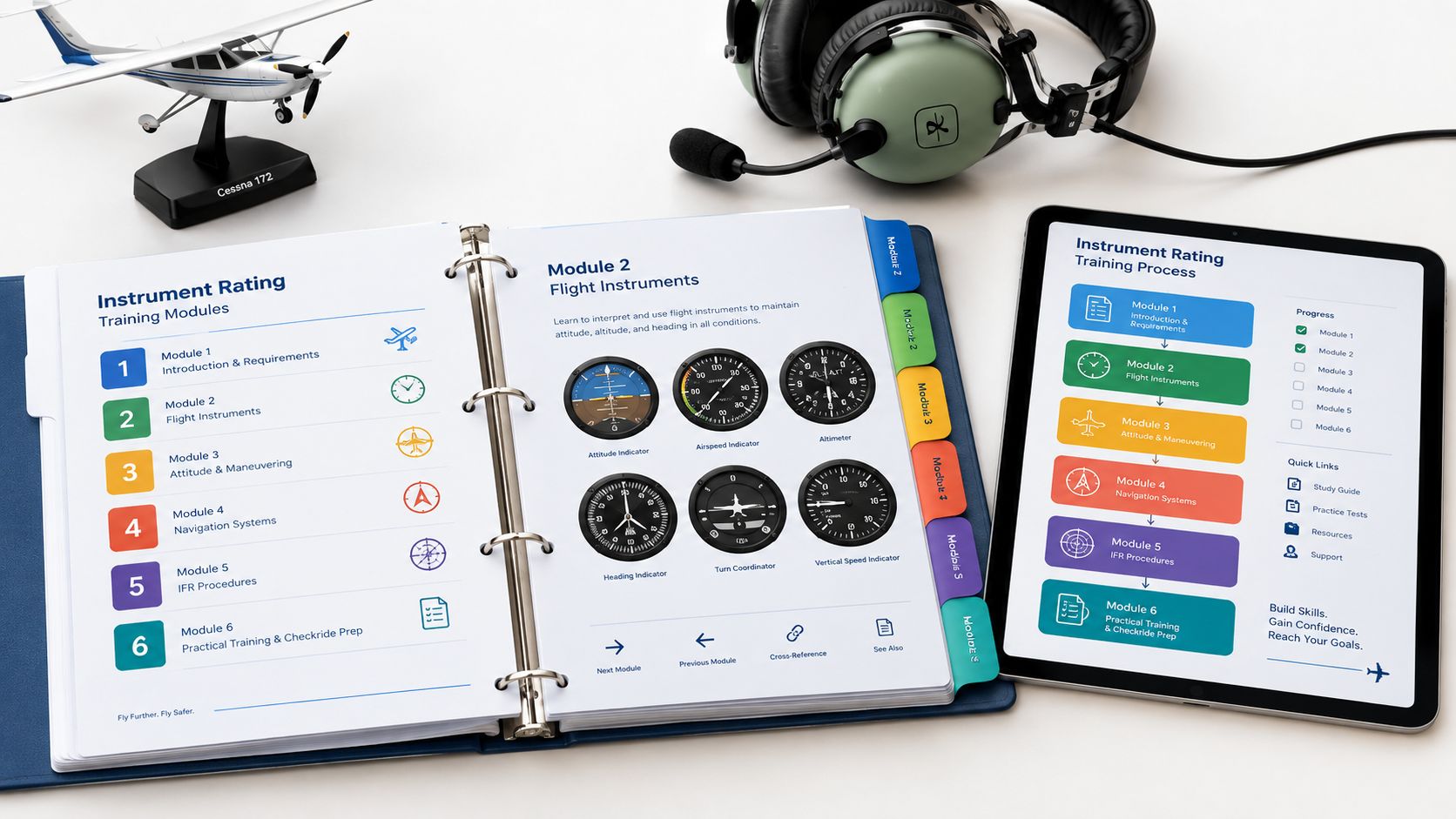
A well-designed instrument rating course syllabus turns that workload into a sequence of manageable skills. It shows you what to learn first, when to add complexity, how simulator sessions fit alongside aircraft lessons, and how each stage connects to the FAA practical test. The regulatory minimums provide the floor, but the syllabus should build the judgment and procedural discipline needed to operate safely in real instrument conditions.
The Purpose of a Structured Instrument Syllabus
A pilot beginning instrument training often wants to start with approaches. That's understandable. Approaches feel like the visible purpose of the rating, and flying an ILS or GPS procedure is more exciting than spending another lesson practicing straight-and-level flight by reference to instruments. Yet a student who starts with approach complexity before mastering basic control usually spends the lesson dividing attention between too many weak skills.
A chief instructor might instead begin with a simple scenario. The student maintains altitude and heading using the attitude indicator, interprets a clearance, identifies the next assigned altitude, and communicates the readback. No approach is involved. The exercise teaches the foundation that later makes an approach manageable: instrument scan, aircraft control, prioritization, and communication.
Why sequence matters
Visual flying allows a pilot to confirm attitude and trend through the outside view. Instrument flying removes that immediate confirmation, so the pilot must build a reliable internal process. The syllabus should introduce attitude instrument flying, trim, power management, and scan discipline before adding navigation systems, holds, or approach procedures.
That order prevents a common training plateau. A pilot may appear to improve during isolated maneuvers but struggle whenever the instructor adds a clearance, a frequency change, or a simulated failure. Structured lessons expose one new workload at a time, then combine previously learned tasks after the student can perform them consistently.
Practical rule: If a student can't control the airplane while handling a simple clearance, adding an approach plate won't solve the problem.
From lesson completion to operational readiness
An effective syllabus doesn't measure progress only by hours flown. It defines what the student must demonstrate before moving forward. For example, a stage may require the pilot to maintain assigned altitude, intercept and track a course, brief an instrument procedure, and explain the risks of continuing when weather or equipment changes.
This approach also makes instructor feedback more precise. Instead of saying that a flight “felt rough,” the instructor can identify whether the problem was an unstable scan, incomplete clearance readback, weak automation management, or poor workload prioritization. The student then returns to a specific skill rather than repeating an entire lesson without a clear purpose.
The FAA instrument rating guidance establishes the regulatory framework, but schools need to translate that framework into a practical progression. The strongest syllabi connect every aircraft, simulator, and ground lesson to a capability the pilot will need during IFR operations and the checkride.
Comparing Part 61 and Part 141 Training Pathways
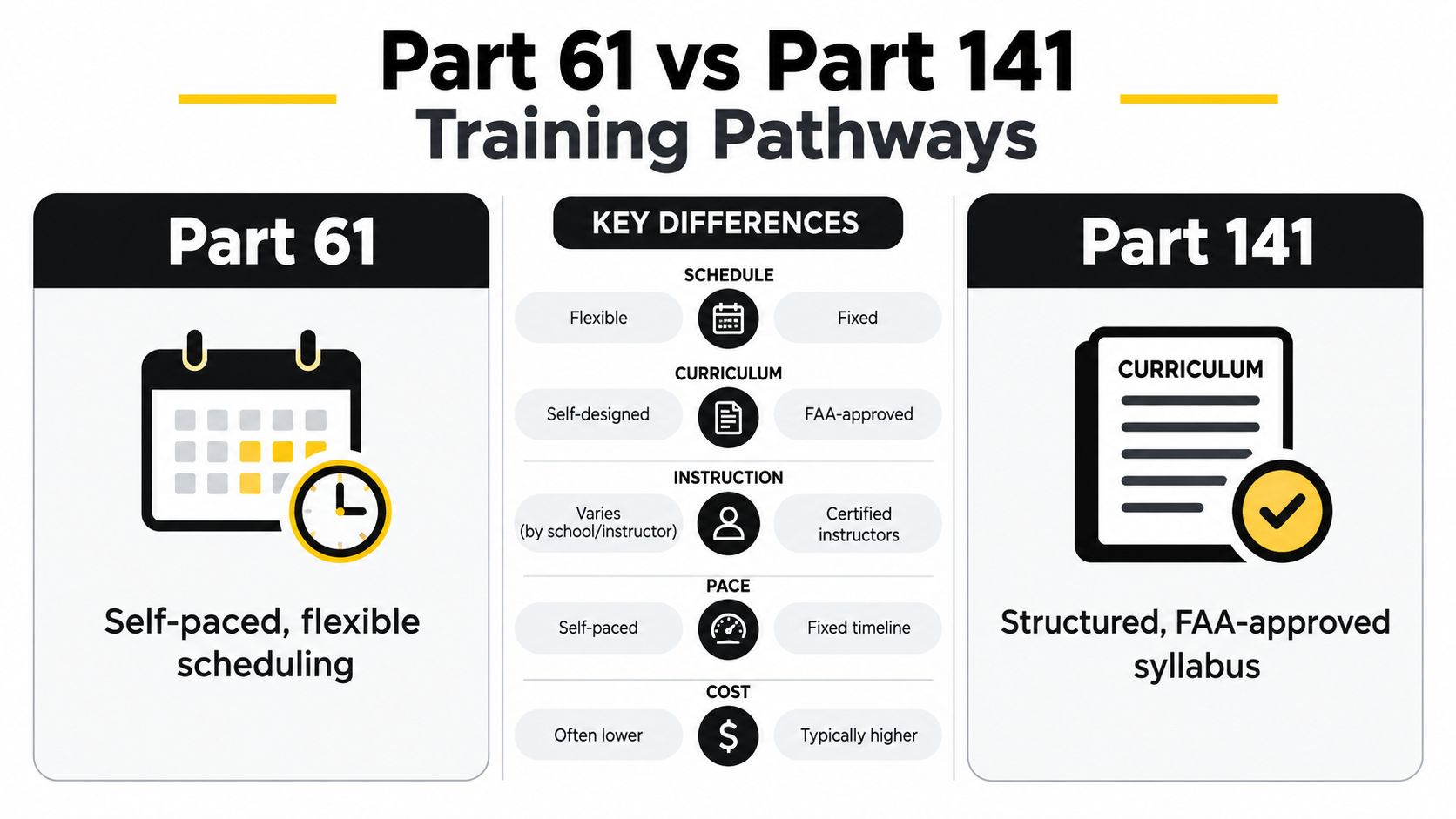
A pilot who can train every Tuesday in the same glass-cockpit aircraft may thrive in a Part 141 course. A pilot sharing an airplane, working irregular hours, or returning to training after a long gap may need Part 61 flexibility. The choice affects more than scheduling. It determines how the syllabus records progress, introduces simulator sessions, and prepares the student for consistent IFR performance.
Under Part 61, the instructor and student can shape the plan around existing experience, aircraft access, and personal goals. An instrument-airplane candidate must log at least 50 hours of cross-country flight time as pilot in command, including at least 10 hours in airplanes. The candidate also needs 40 hours of actual or simulated instrument time, at least 15 hours from an authorized instructor, and at least 3 hours of instrument training within the two calendar months before the practical test. The instrument rating requirements from AOPA summarizes these requirements.
That freedom requires active recordkeeping. If weather, work, or aircraft availability creates long gaps, the instructor must identify which skills remain reliable and which need rebuilding. A modern Part 61 syllabus can assign simulator practice between flights, use the same glass cockpit in training and aircraft sessions, and adjust lesson timing without losing the overall sequence.
What Part 141 adds
Under Part 141, the school follows an approved curriculum with defined stages, lesson objectives, evaluations, and completion requirements. The minimum initial instrument-rating curriculum includes 30 hours of ground instruction and 35 hours of instrument flight training. An additional instrument rating includes 20 hours of ground instruction and 15 hours of flight training. Stage checks and an end-of-course test form part of the structure, while ground subjects include IFR regulations, the Aeronautical Information Manual, ATC procedures, navigation, approaches, and decision-making. The regulatory details appear in Appendix C to Part 141.
Part 141 can make simulator time easier to schedule because the school assigns it within the approved course. It also gives instructors a shared standard for teaching conventional instruments, GPS, autopilot management, and glass cockpit failure procedures. A defined curriculum does not guarantee faster completion. It gives the student a sequence and evaluation points. The Part 61 versus Part 141 training comparison helps applicants compare the structures before choosing a school.
| Consideration | Part 61 | Part 141 |
|---|---|---|
| Scheduling | Flexible and instructor-directed | Built around an approved course |
| Progress tracking | Logbook, instructor records, and practical-test preparation | Sequenced lessons, stage checks, and an end-of-course test |
| Best fit | Pilots balancing training with changing commitments | Students seeking a defined academic and flight pathway |
| Syllabus design | More freely customized | Must follow the school's approved curriculum |
The right choice depends on consistency and purpose. A personal IFR goal may favor flexible scheduling. A professional pathway may favor formal stages and checks. In either case, the syllabus should connect airplane work, simulator sessions, avionics practice, and preparation for upcoming FAA knowledge test changes to the same operational standard.
Module Progression and Core Lesson Plan
An instrument syllabus works best when it builds from control to integration. The student first learns to keep the airplane where it belongs, then learns to manage the navigation and communication systems, and only afterward combines those skills in demanding procedures.
The exact lesson titles vary by school, but a sound progression usually follows four broad modules.
Foundation and instrument procedures
Early lessons establish the language of IFR flight. The student learns how to interpret clearances, organize a cockpit, use checklists, identify instruments, and understand the relationship between attitude, power, and performance. Ground instruction introduces regulations, weather considerations, charts, navigation references, and the logic behind instrument procedures.
The instructor should also establish a standard cockpit flow. Where will the clearance be written? How will the student brief an approach? Which items deserve immediate attention if ATC changes the route? These habits reduce mental friction later.
Control and attitude
The next stage concentrates on flying without dependable outside visual references. The student practices straight-and-level flight, climbs, descents, turns, timed turns, unusual attitudes, and partial-panel control. The aim isn't to memorize isolated maneuvers. It's to recognize attitude and trend, correct smoothly, and avoid chasing instruments.
This is also where trim and power management become practical tools rather than abstract concepts. A student who understands how configuration changes affect pitch and power can recover more quickly when workload rises.
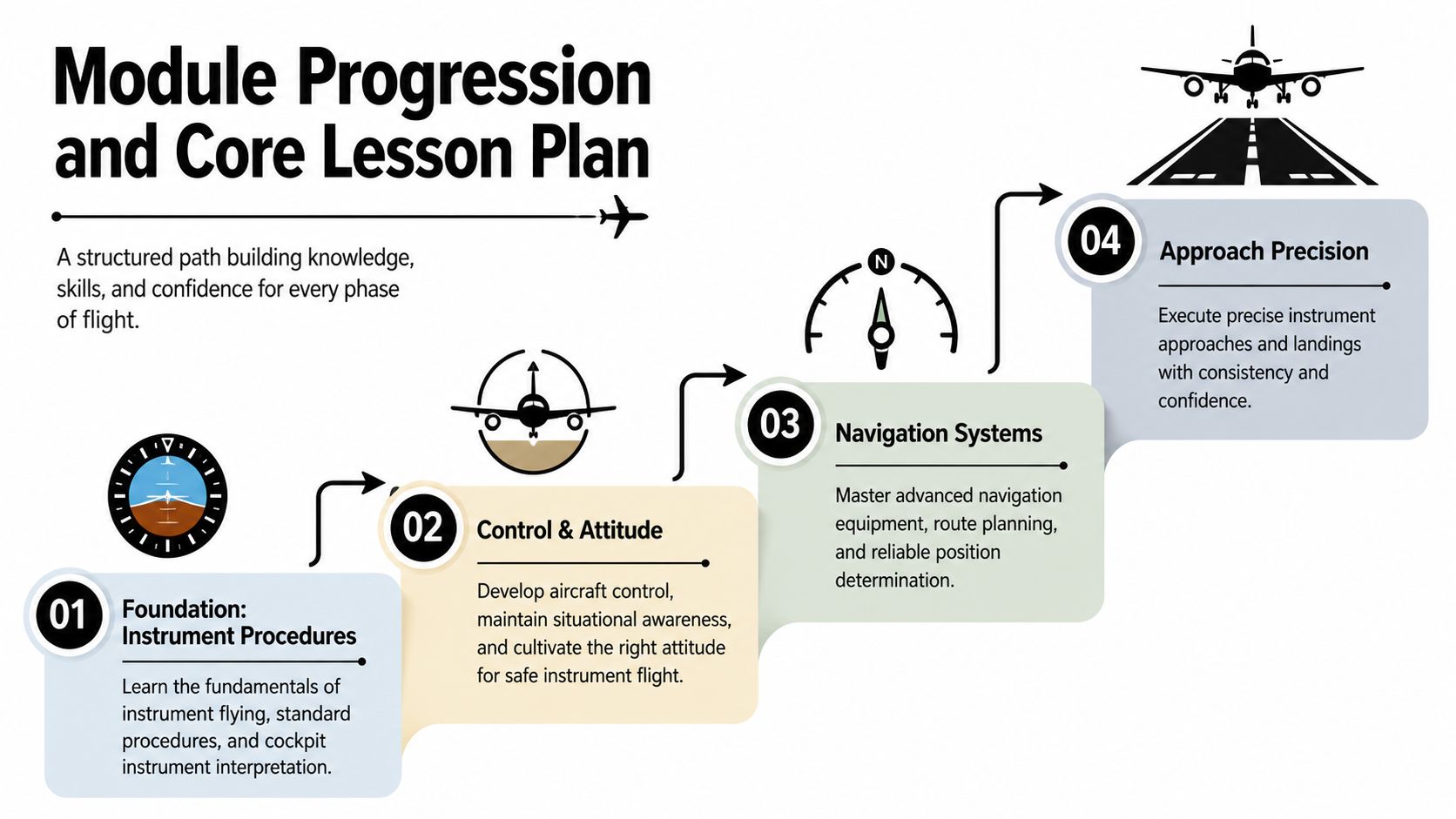
Navigation systems and en route work
Once basic control is stable, the syllabus adds VOR, GPS, DME, and HSI navigation as appropriate to the aircraft and training equipment. The student learns to select, identify, monitor, and cross-check navigation sources instead of trusting a single display without verification.
En route lessons then combine navigation with ATC interaction. The pilot accepts a clearance, loads or tunes the route, confirms the expected path, manages altitude and frequency changes, and remains prepared for a diversion. A modern glass cockpit can reduce workload, but it can also create new errors if the pilot doesn't understand what the automation is doing.
Approach precision and integration
Approach training introduces precision and non-precision procedures, holding, missed approaches, and full procedure briefings. The instructor should vary the workload gradually. First, the student may fly a procedure with a stable setup and close instructor support. Later, the instructor can add amended clearances, distractions, equipment limitations, or a missed approach.
The final stage integrates the entire course. The student prepares the flight, evaluates weather and alternates, copies the clearance, manages avionics, flies the procedure, communicates with ATC, and explains the decisions made along the way. That is much closer to the practical test and real IFR flying than a collection of disconnected maneuvers.
Flight and Simulator Hour Breakdown
A student asking, “How many hours will I need?” is really asking a planning question. The answer starts with three separate pieces, regulatory minimums, credited simulator time, and the extra practice a particular pilot may need. A minimum only clears the gate. It does not mean the pilot is ready for the practical test.
For a Part 61 instrument-airplane rating, the baseline includes the required cross-country PIC experience, instrument time, instructor-led instrument training, and the recent preparation described earlier. Simulator credit can also count, but only within the limits set by the rules. As described in 14 CFR 61.65(h) - Use of flight simulators and FTDs, up to 30 simulator hours may be allowed under Part 142, or up to 20 hours otherwise.
| Training Category | Minimum Hours | Key Conditions |
|---|---|---|
| Cross-country PIC experience | 50 hours | Includes at least 10 hours in airplanes for an instrument-airplane rating |
| Actual or simulated instrument time | 40 hours | At least 15 hours must come from an authorized instructor |
| Recent instrument preparation | 3 hours | Must occur within the two calendar months before the practical test |
| Simulator credit under Part 142 | Up to 30 hours | Must be conducted under the applicable approved training structure |
| Simulator credit outside Part 142 | Up to 20 hours | Credit depends on the applicable training rules and documentation |
| Part 141 initial instrument course | 35 flight hours | Part of a school-approved curriculum |
| Part 141 initial ground course | 30 ground hours | Includes defined IFR knowledge areas |
Why simulator time belongs in the syllabus
A simulator is most useful when it targets a specific training need. A student can repeat clearance copying, avionics setup, holds, missed approaches, and partial-panel work without waiting for suitable weather or spending aircraft time on every repetition. The instructor can pause the scenario, correct the mistake, and restart at the exact point where the error began.
That does not make the simulator a replacement for aircraft training. The student still has to handle the cockpit, the physical airplane, checklists, workload, and the consequences of imperfect execution in flight. A modern syllabus uses the simulator to prepare and reinforce, then uses aircraft lessons to confirm that the skill carries over.
Glass cockpit preparation
Glass avionics require more than button familiarity. Students need to understand the flight plan structure, navigation source, mode annunciations, autopilot behavior, database limits, and how the display relates to the clearance. A simulator configured to match the training aircraft lets the student practice those tasks before adding turbulence, radio congestion, or heavier approach workload.
A practical instrument rating training program may build simulator sessions into the larger sequence for that reason. When you compare programs, ask how simulator time is logged, which tasks it is meant to cover, and how instructors confirm that the skill transfers to the aircraft.
Aligning Lessons with Airman Certification Standards
A syllabus becomes useful to an examiner when its lesson objectives map directly to the Instrument Rating Airplane Airman Certification Standards. The FAA currently lists the instrument ACS as FAA-S-ACS-8C, effective May 31, 2024, in the official instrument rating ACS document.
The ACS organizes the practical test around knowledge, risk management, and skill. That structure changes how an instructor should teach. The student isn't preparing merely to perform a steep turn or intercept a course on command. The student is preparing to make and explain sound IFR decisions while controlling the airplane and managing procedures.
Turning ACS tasks into lesson objectives
A lesson on preflight preparation might require the student to obtain weather, evaluate the route, identify relevant NOTAMs, select an alternate where appropriate, brief the departure and arrival, and explain the risks associated with the planned flight. A lesson on approaches should include more than tracking the final course. It should include setup, configuration, descent planning, missed approach actions, and the decision to continue or discontinue.
The ACS task areas include:
- Preflight preparation, including regulations, weather, equipment, and planning.
- IFR clearances and procedures, including communication and compliance.
- Navigation, using the systems installed in the aircraft.
- Holding, with correct entry, timing, course control, and communication.
- Instrument approaches, including precision and non-precision procedures.
- Missed approaches, including aircraft control, navigation, and ATC coordination.
- Postflight risk management, including debriefing and identifying limitations.
Risk management must appear in the cockpit
Human factors and aerodynamic factors belong in the syllabus because instrument errors rarely come from one forgotten button alone. Fatigue, task saturation, fixation, unfamiliar avionics, and pressure to continue can all affect a pilot's choices.
A student should be able to answer practical questions during training. What will you do if the GPS annunciation changes? How will you respond if ATC assigns an unexpected hold? When will you abandon an approach? Which task has priority if the aircraft begins drifting while you're programming the navigator?
A checkride-ready pilot doesn't just fly the procedure correctly. The pilot knows why the procedure is appropriate, what could make it unsafe, and what action comes next if the plan changes.
Knowledge Test Preparation and Upcoming Changes
The instrument knowledge test shouldn't be treated as a vocabulary contest. A student who memorizes answer patterns without understanding charts, regulations, weather, navigation, and ATC procedures may pass practice quizzes and still struggle to apply the information in the cockpit.
Part 141 ground curricula specifically address Federal Aviation Regulations for IFR operations, the Aeronautical Information Manual, ATC procedures, IFR navigation and approaches, and decision-making. A modern syllabus should connect those subjects to flight lessons. For example, a lesson on an approach plate should include chart interpretation, briefing discipline, altitudes, navigation sources, missed approach instructions, and the operational risks of using the procedure in changing conditions.
Why visual literacy matters
Recent FAA and industry reporting indicates that the IRA knowledge test is expected to change in October 2026, with embedded images included directly in questions. The report on the planned instrument written-test change explains why students will need to interpret visual information rather than rely solely on text-based recall.
That change makes chart work a central study skill. Students should practice reading approach plates, en route charts, weather graphics, instrument indications, and scenario illustrations under time pressure. The instructor can ask the student to explain what the image shows, identify the controlling information, and state what action follows.

Replace answer-bank dependence
Question banks still have a place in preparation. They help students identify weak areas and become familiar with exam wording. They shouldn't replace understanding. A better study cycle looks like this:
- Learn the rule or concept from the regulations, AIM, aircraft manuals, and instructor explanation.
- Apply it to a chart or scenario rather than studying the answer in isolation.
- Explain the reasoning aloud, including why the other choices are unsafe or incorrect.
- Revisit the cockpit application during a simulator or aircraft lesson.
The syllabus should also schedule knowledge-test preparation early enough that the student can use the material during flight training. IFR knowledge becomes more durable when the pilot studies a clearance, then copies one, loads it into the avionics, verifies it, and flies it.
The Role of Stage Checks and End of Course Tests
Stage checks give a structured program its internal quality control. They aren't surprise examinations designed to catch students out. They are planned evaluations that confirm whether the pilot is ready to add the next layer of workload.
A useful stage check examines both technical proficiency and procedural discipline. The student may need to demonstrate control by reference to instruments, complete a clearance readback, identify navigation errors, brief an approach, manage a missed approach, and discuss the relevant risks. The evaluator should also observe how the student prioritizes tasks when something doesn't go according to plan.
A gateway between modules
Suppose a student can fly a localizer accurately but becomes disorganized when asked to copy a reroute. The stage check exposes that weakness before the student progresses to high-workload approach scenarios. The instructor can then assign targeted simulator work, ground review, or additional aircraft practice.
This process protects the student from false confidence. Completing a lesson doesn't necessarily mean the skill is reliable under pressure. A stage check asks whether the student can perform consistently enough to build on that skill.
A stage check should answer one question: Can this pilot safely absorb the next level of complexity?
The end-of-course test
Part 141 programs require an end-of-course test as part of the approved curriculum. It serves as an internal readiness review before the student schedules the FAA practical test. The school can use it to confirm that the required lessons, stage checks, knowledge areas, and completion standards have been satisfied.
The end-of-course test shouldn't become a rehearsal of one predictable route. A strong evaluation varies clearances, navigation tasks, approach types, and decision points while keeping the objectives tied to the approved syllabus and ACS. That helps the student prepare for the practical test's oral and flight components without relying on memorized choreography.
Accelerated Career Track Programs and Fixed Pricing
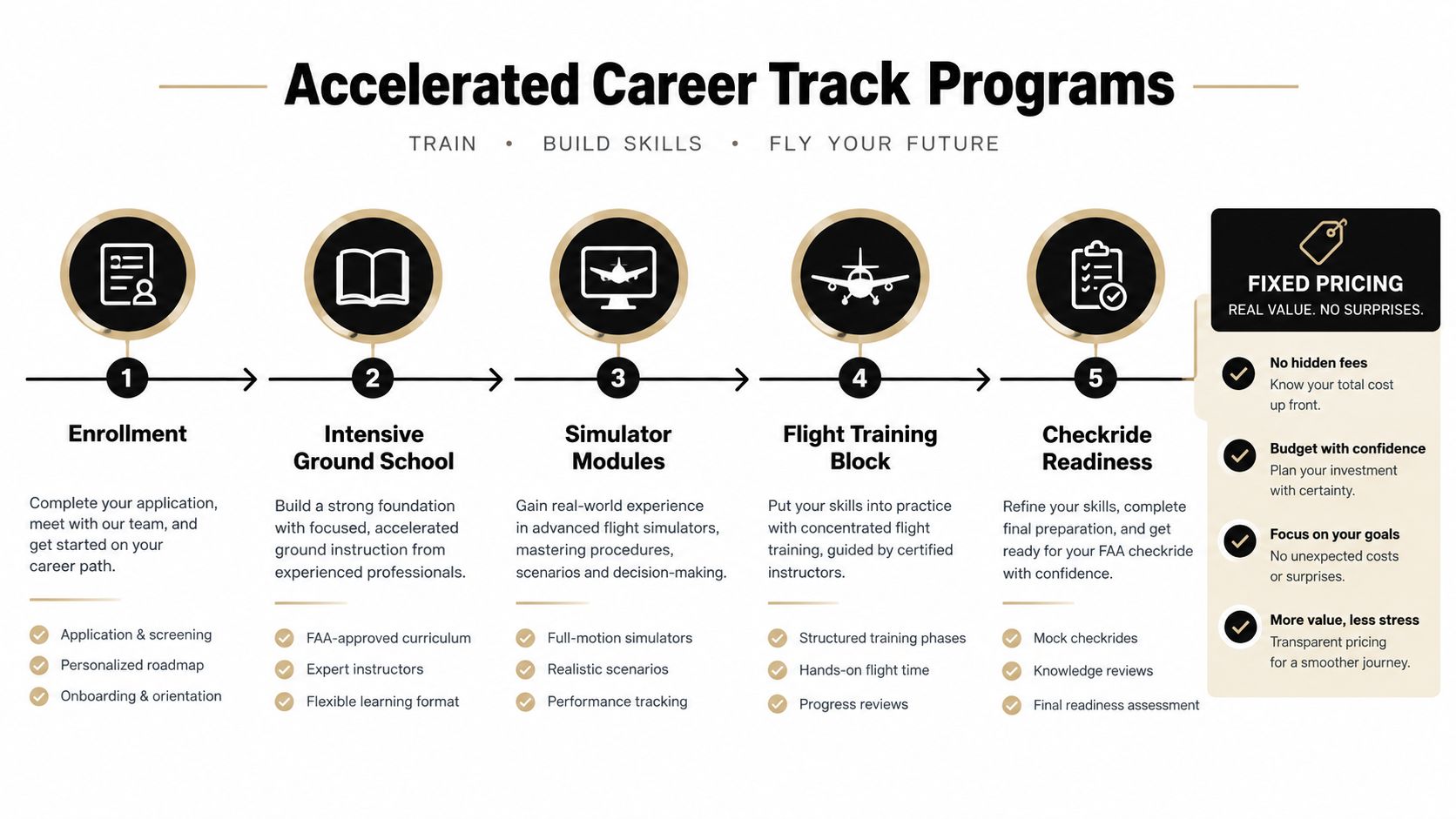
Traditional instrument training can become difficult to plan when lessons are scheduled one at a time, aircraft availability changes, instructors rotate, and checkride coordination happens late. A structured career-track program addresses those issues by defining the sequence in advance and making responsibilities clearer.
The important distinction isn't just “accelerated” versus “traditional.” The key question is whether the program has enough coordination behind the schedule. A compressed plan needs instructors, aircraft, simulators, ground study, progress tracking, and examiner availability to work together. If one element routinely falls behind, the student may face the same delays as a conventional trainee, only with more pressure.
What fixed pricing should clarify
A fixed-price offer is useful only when the school explains its scope. Prospective students should ask which aircraft and simulator sessions are included, how additional training is handled, what study materials are provided, and whether checkride coordination is part of the service.
The CFII guide to pilot training costs can help students frame those questions. A transparent program should also explain what happens if weather, maintenance, or proficiency changes the schedule. Fixed pricing doesn't remove the need for disciplined training, but it can reduce uncertainty when the inclusions and exclusions are written clearly.
Glass aircraft and coordinated training
A standardized glass-cockpit fleet lets instructors teach consistent flows and avionics logic across lessons. Simulator sessions can introduce navigation programming, automation management, and abnormal scenarios before the student uses valuable aircraft time for the same tasks.
One Southern California example is CFII, which offers a structured career track combining one-on-one instruction, modern aircraft, simulator training, digital progress tracking, written-test preparation, and coordinated checkrides. Students evaluating that type of program should compare its syllabus, equipment, scheduling policy, and completion standards with other schools rather than focusing on the label “accelerated.”
A sensible fixed-price pathway should include clear milestones:
- Enrollment and baseline review: Confirm certificates, medical eligibility, prior experience, and training objectives.
- Ground preparation: Establish the knowledge foundation before complex flight lessons.
- Simulator integration: Practice avionics, clearances, approaches, and failures in a controlled environment.
- Aircraft consolidation: Demonstrate that simulator skills transfer to real cockpit operations.
- Checkride readiness: Complete internal evaluations, records review, and focused practical-test preparation.
Quick Reference Guide to Instrument Training Milestones
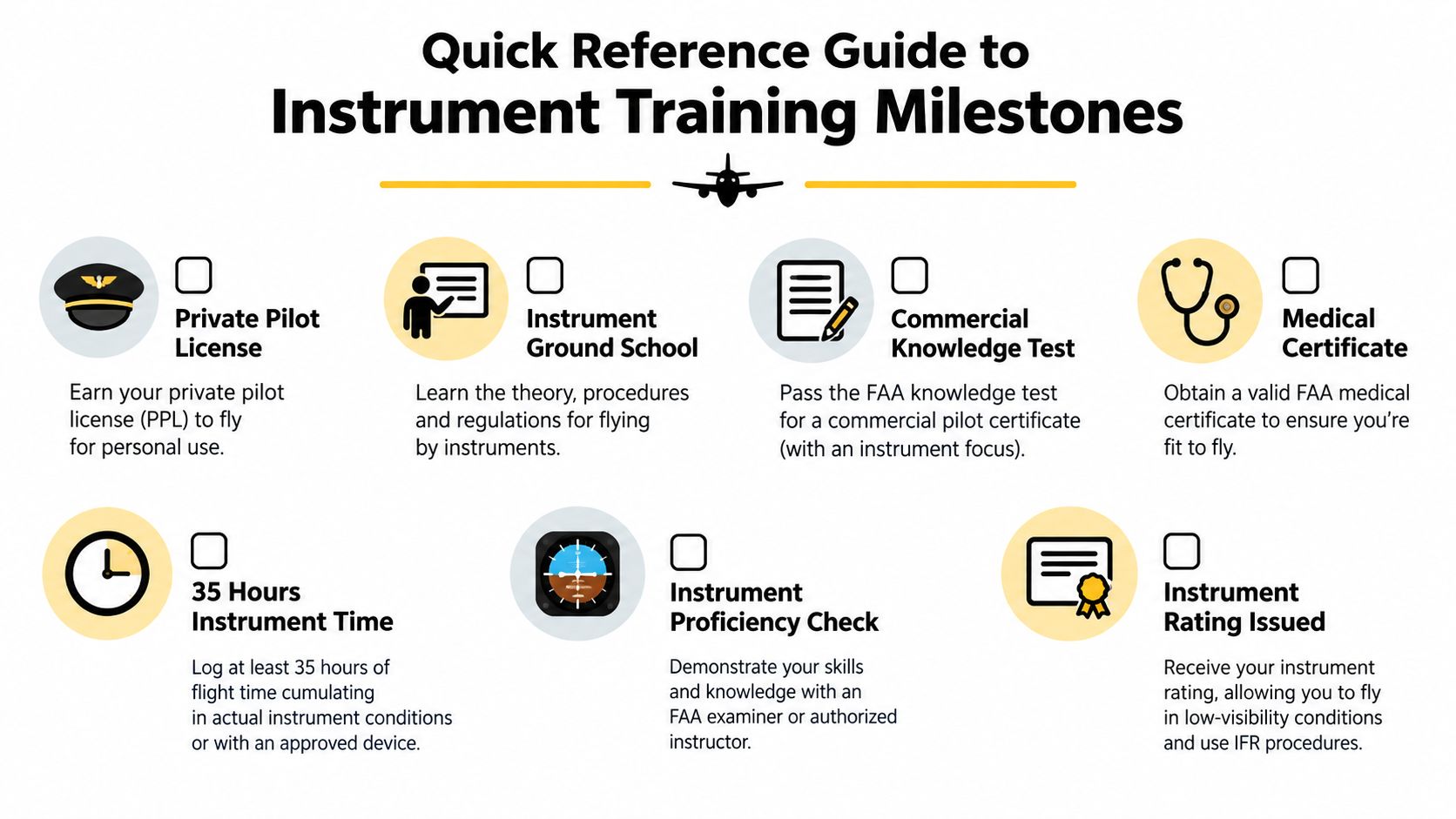
A student can use the following checklist when comparing a school's syllabus with personal progress. The labels may differ between programs, and some items depend on the student's existing certificates and training pathway, but the underlying question remains the same: can the pilot demonstrate the required knowledge, skill, and judgment?
Eligibility and preparation
Private pilot certificate: Confirm that the existing certificate and aircraft category support the planned instrument rating pathway.
Medical certificate: Verify the medical qualification required for the intended operation and practical-test plan with an aviation medical examiner or instructor.
Instrument ground school: Study IFR regulations, the AIM, weather, navigation, clearances, approaches, aircraft systems, and risk management. The student should be able to explain decisions, not only recognize correct answers.
Knowledge test: Prepare with regulations, charts, scenario questions, and visual interpretation. The planned changes to the IRA test make image-based reasoning especially important for students testing after the change takes effect.
Skill development and records
Instrument time: Track actual and simulated instrument time separately, identify instructor-led time, and confirm that simulator sessions are conducted and logged under the applicable rules.
Cross-country PIC experience: Review the logbook with the instructor to verify that the required cross-country experience is documented and that any qualifying flight requirements are satisfied.
Core modules: Confirm completion of instrument control, partial-panel work, navigation, holds, clearances, precision and non-precision approaches, missed approaches, diversions, and IFR flight planning.
The FAA FITS training resources provide useful background for structured, scenario-based instrument training. A syllabus should use that type of progression to connect technical tasks with operational decisions.
Evaluation and final readiness
Stage checks: Treat each evaluation as a progression gateway. If a stage check identifies a weakness, address it directly before advancing.
End-of-course test: For Part 141 students, confirm that the school has completed the required internal evaluation and reviewed the training record.
ACS review: Match lesson completion and mock-checkride performance to the current FAA Instrument Rating Airplane ACS, including knowledge, risk management, and skill elements.
Practical test preparation: Complete the required recent training, verify endorsements and logbook entries, rehearse the oral discussion, and practice adapting when the examiner changes the scenario.
The following video can supplement the written checklist with a visual explanation of instrument training concepts:
The most useful syllabus is the one that makes your next training decision obvious. Before enrolling, ask to see the module sequence, simulator policy, stage-check standards, aircraft avionics, recordkeeping process, and practical-test preparation plan. Then choose a program that matches the way you can train consistently, not merely the minimum printed on a comparison chart.
If you're ready to turn the instrument rating into a structured IFR training plan, visit CFII to review its Career Track, one-on-one instruction, glass-cockpit aircraft, simulator integration, study resources, and coordinated checkride process. Request the current syllabus and ask how each stage maps to your experience, schedule, and professional goals.
Planning to fly for a living?
See what the path from zero to a pilot career looks like, what it costs and how long it takes.
Learn to fly in Riverside
We train at Riverside Municipal Airport in modern airplanes with a parachute built in. Start with a one hour discovery flight, no experience needed.