
On this page
- Instrument Rating Requirements at a Glance
- What the table means for a beginner
- Why hours don't finish the application
- Who Qualifies Before Training Starts
- Follow the eligibility sequence
- Separate medical eligibility from rating eligibility
- How the Instrument Hours Are Counted
- Separate the kinds of experience
- Understand device credit before scheduling it
- Knowledge Test and Practical Test Topics
- Start with usable ground knowledge
- Turn knowledge into cockpit actions
- Understand the practical test sequence
- When the Rating Stops Being Current
- Match your status to the permitted recovery method
- Apply the rule to ordinary situations
- Common Instrument Rating Questions
- Eligibility and preparation
- Practical test and continuing privileges
- Choose the Next Step Toward IFR
- Choose a rating or a complete career sequence
Instrument rating requirements are built from several parts of 14 CFR 61.65: eligibility, logged experience, instructor endorsements, and knowledge and practical tests. Each requirement counts separately, and one flight can satisfy more than one of them. Your logbook records the experience; your instructor also confirms that you can apply it in instrument conditions.
Hours alone do not earn the rating. You must also meet the Airman Certification Standards (ACS) and receive the required endorsements before testing.
A rating can also become unusable if its currency tasks lapse. Earning it and staying current are separate responsibilities.
Instrument Rating Requirements at a Glance
The airplane instrument rating is added to your pilot certificate. It isn't a separate first license, and an aircraft's hour meter doesn't tell the whole story of your eligibility.
The following airplane minimums come from 14 CFR 61.65, which combines eligibility, aeronautical knowledge, training, experience, instructor endorsements, and testing.
FAA airplane instrument rating minimums
| Requirement | Minimum | Where it lives |
|---|---|---|
| English language | Read, speak, write, and understand English | 14 CFR 61.65(a) |
| Pilot certificate | Private pilot, airplane category and class, or apply concurrently | 14 CFR 61.65(a) |
| Cross-country PIC | 50 hours, at least 10 in airplanes | 14 CFR 61.65(d) |
| Instrument time | 40 hours actual or simulated | 14 CFR 61.65(d) |
| Dual instrument in an airplane | 15 hours with an authorized instructor | 14 CFR 61.65(d) |
| IFR cross-country | 250 NM along airways or ATC-directed routing, an approach at each airport, and three different kinds of approaches | 14 CFR 61.65(d) |
| Knowledge test | Pass the instrument knowledge test after an instructor endorsement | 14 CFR 61.65(a) |
| Practical test | Pass the practical test after a separate endorsement | 14 CFR 61.65(a) |
What the table means for a beginner
PIC means pilot in command. Dual means instruction received from an authorized instructor. NM means nautical miles, the distance unit used in flight planning.
Think of the requirements as different labels attached to your experience. A qualifying training flight can contribute to more than one requirement, but only when you meet the conditions for each kind of time you log.
The long IFR cross-country is a good example. It isn't a flight to a distant airport. Your instructor plans it around routing, navigation systems, and the required variety of instrument approaches.
Why hours don't finish the application
Your instructor's endorsements connect preparation to testing. Ground instruction or eligible home study prepares you for the knowledge examination; flight instruction develops the skills and judgment you'll demonstrate on the practical test.
Practical rule: Ask what requirement a lesson satisfies and what you must demonstrate, not just how much time you'll log.
The same broad regulatory framework covers helicopter and powered-lift instrument ratings, but the aircraft or qualifying simulator must represent the category sought. The discussion here stays with airplanes.
You'll also hear instructors refer to the Airman Certification Standards, or ACS. The FAA's Airman Certification Standards listing identifies FAA-S-ACS-8C, Instrument Rating–Airplane, as effective May 31, 2024. That document gives your training a performance standard, rather than leaving readiness to an hour total alone.
Who Qualifies Before Training Starts
A student can take a discovery flight and begin initial lessons before obtaining a medical certificate. Before solo flight in the usual airplane student-pilot pathway, however, the student must meet the applicable medical requirements under 14 CFR 61.23, generally with a third-class FAA medical certificate issued by an aviation medical examiner.
Follow the eligibility sequence
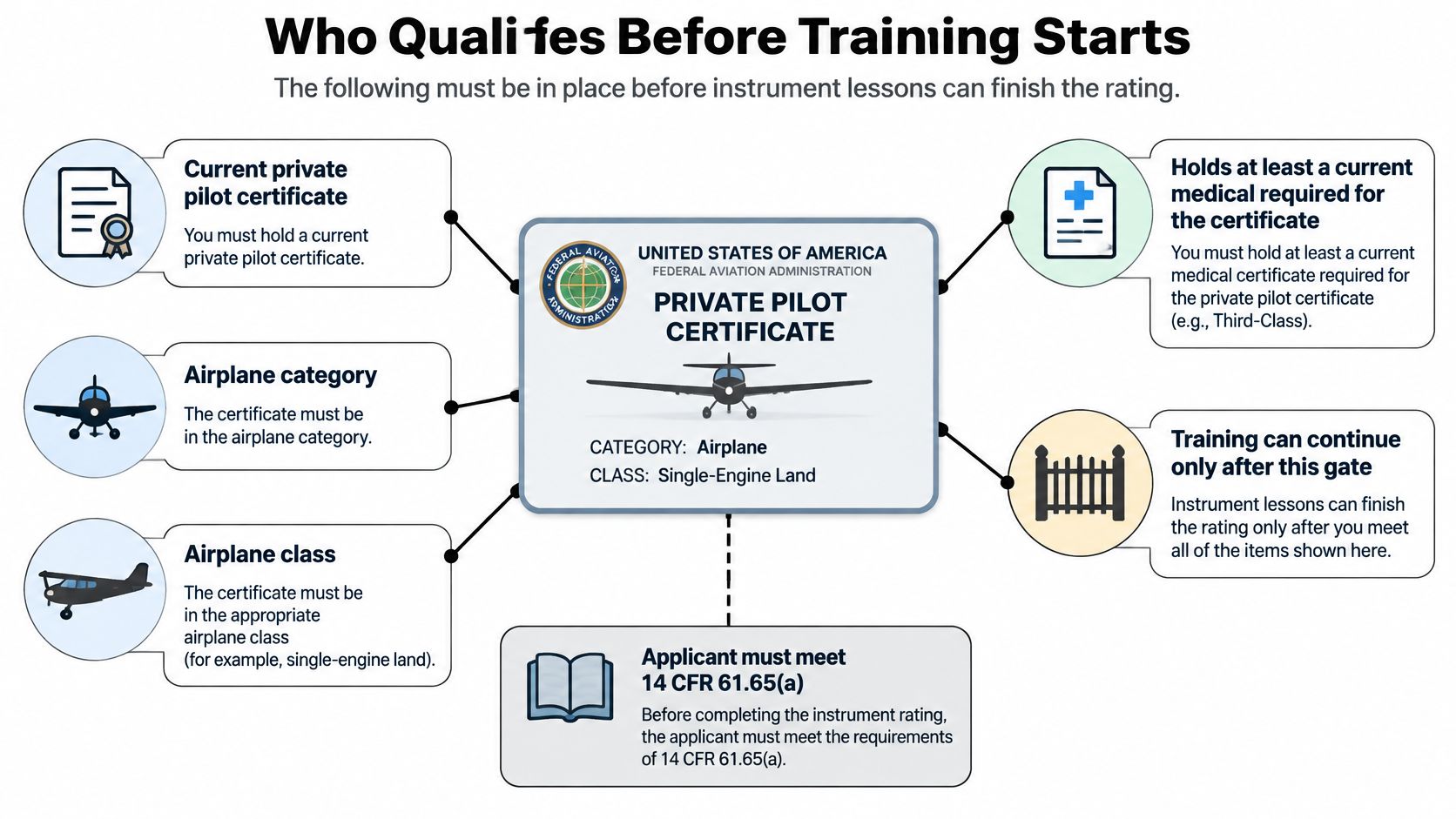
Under 14 CFR 61.65(a), an instrument applicant must hold the appropriate private pilot certificate or apply for it concurrently. The applicant must also read, speak, write, and understand English. The FAA may prescribe an operating limitation addressing the language requirement when a qualifying medical condition applies.
A concurrent application can let a student pursue the instrument rating alongside the private certificate. The student still needs to qualify for the private certificate; instrument training builds on the ability to operate the aircraft, communicate, and make sound decisions.
The qualification relationships are illustrated below.
Separate medical eligibility from rating eligibility
The instrument-rating qualifications in 61.65 do not include a medical certificate. Medical rules instead govern privileges such as solo flight and acting as pilot in command. Under 14 CFR 61.23, eligible pilots may meet applicable medical requirements through a medical certificate or BasicMed, provided the operation qualifies.
Before choosing a training path, discuss potential medical concerns with an aviation medical examiner. To understand the broader requirements before training, review this guide to flight training requirements. Then confirm the applicable private-pilot qualifications, language ability, training records, and endorsements as you progress toward the instrument rating.
How the Instrument Hours Are Counted
A flight can add one kind of experience without adding another. For example, a clear-weather cross-country flight may count toward cross-country PIC time, while the visual cruise does not count as instrument time.
Separate the kinds of experience
Actual instrument time is time operating solely by reference to instruments in actual instrument conditions. Simulated instrument time is time operating by reference to instruments with outside vision restricted, typically with a view-limiting device in an airplane.
A worked entry shows how to keep the categories straight:
Example: You fly a clear-weather cross-country as PIC, then spend a portion of the flight practicing under a view-limiting device with a qualified safety pilot. Log the qualifying cross-country PIC time separately from the simulated instrument time, and record the safety pilot and relevant conditions as required. The clear-weather portion does not become instrument time.
For the airplane rating, 14 CFR 61.65(d) sets the experience requirements. Cross-country PIC time in another aircraft category may contribute to the applicable total when it meets the logging rules.
The required instructional IFR cross-country must meet the regulation's route, approach, and navigation-system conditions. Plan it with your instructor before departure. A flight that does not meet those conditions cannot be made qualifying by changing the logbook entry afterward.
Understand device credit before scheduling it
An approved training device can provide practice with holding entries, approach briefings, missed approaches, and navigation setup. A home computer setup does not automatically qualify for training credit.
How much instrument time each device can credit
| Device | Maximum credit toward 40 hours | Limit |
|---|---|---|
| Full flight simulator | Up to 30 hours combined with FTD under the qualifying approved-course provision in 14 CFR 61.65(h) | Credit depends on the approved course and applicable combined limit; it cannot replace the required airplane dual instruction |
| Flight training device | Up to 20 hours under the qualifying approved-course provision in 14 CFR 61.65(h) | Credit depends on the approved course and applicable combined limit; it cannot replace the required airplane dual instruction |
| Advanced aviation training device | Up to 20 hours under 14 CFR 61.65(i) | Credit depends on the device authorization and applicable course requirements; it cannot replace the required airplane dual instruction |
| Basic aviation training device | Up to 10 hours under 14 CFR 61.65(i) | Credit depends on the device authorization and applicable course requirements; it cannot replace the required airplane dual instruction |
These limits are not added together freely. The approved course, device authorization, instructor supervision, and combined-credit rules determine what can count. Read more about FAA-approved flight simulators and training devices, then confirm the permitted credit with your instructor before scheduling sessions.
A Part 141 instrument course uses a different training framework, including its own instrument-training minimum and required cross-country experience. Check the rules for the course you are enrolled in rather than mixing requirements from different training paths.
Knowledge Test and Practical Test Topics
Brief a departure, copy an ATC clearance, configure the navigation system, and then respond when the destination changes. Instrument preparation connects the rules and procedures you study on the ground with the decisions you make while flying.
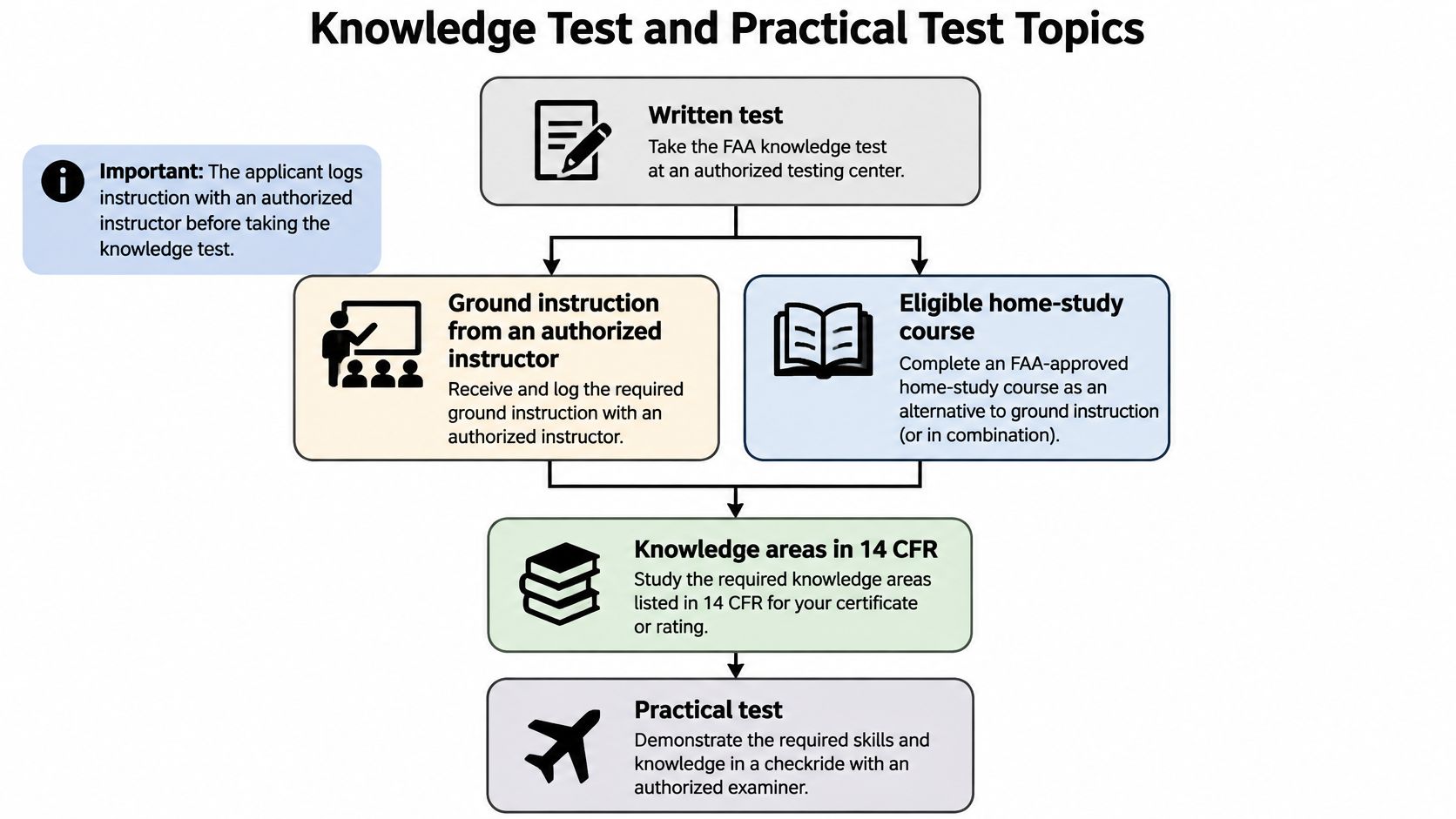
The sequence below shows how study, instructor verification, and testing fit together.
Start with usable ground knowledge
Before the knowledge test, you must log ground instruction from an authorized instructor or complete an eligible home-study course. Your instructor's endorsement confirms that you're prepared for the examination.
The knowledge areas in 14 CFR 61.65(b) translate into practical questions:
- IFR regulations and ATC procedures: What clearance do you have, and what must you do if communication fails?
- Navigation and charts: Which route, altitude, approach, and missed-approach instructions apply?
- Weather reports and forecasts: What conditions can you reasonably expect along the route and at your destination?
- Critical weather and wind shear: What hazards should cause you to delay, divert, or cancel?
- Safe operation and decision-making: Is the proposed flight sensible for the airplane, equipment, and pilot?
- Crew resource management: How will you use available people, checklists, and cockpit resources without losing aircraft control?
Study with charts and realistic scenarios, not just isolated questions. For example, explain why a forecast might make an otherwise legal destination a poor choice. The written test checks your knowledge; the practical test also evaluates how you apply it while managing the airplane.
Turn knowledge into cockpit actions
Flight or qualifying simulator training covers the areas of operation in 61.65(c): preflight preparation and procedures, ATC clearances, flight by reference to instruments, navigation systems, instrument approaches, emergency operations, and postflight procedures.
A useful lesson connects those tasks. You might brief a departure, copy a clearance, set up the navigation system, fly the assigned route, and then respond when your instructor changes the destination.
Your instructor should have you explain what you're doing before workload rises. If you can't describe the missed approach while parked, decoding it during a climb will be harder.
The video below provides another view of instrument-training preparation.
Understand the practical test sequence
After passing the knowledge examination and receiving the practical-test endorsement, you demonstrate how you combine knowledge, risk management, and flight skills. The applicable certification guidance described with 61.65's instrument-testing requirements calls for three different approach types, including one precision and two nonprecision approaches.
A typical checkride begins with an oral discussion of weather, charts, clearances, equipment, and regulations. The flight portion may connect an IFR departure, holding, approaches, a missed approach, and a reduced-instrument or partial-panel task.
For preparation, you might practice an ILS precision approach followed by a missed approach, plus suitable RNAV and localizer or VOR nonprecision procedures. RNAV approaches can differ in classification, so learn what guidance and minima each procedure provides.
The test may use an appropriate airplane or qualifying simulator or training device when applicable approvals permit it. A device suitable for lessons is not automatically authorized for the practical test.
Our guide to instrument checkride pass rates offers context for preparation. A useful readiness measure is whether you can consistently perform to the ACS while explaining your decisions, rather than just reaching the scheduled test date.
When the Rating Stops Being Current
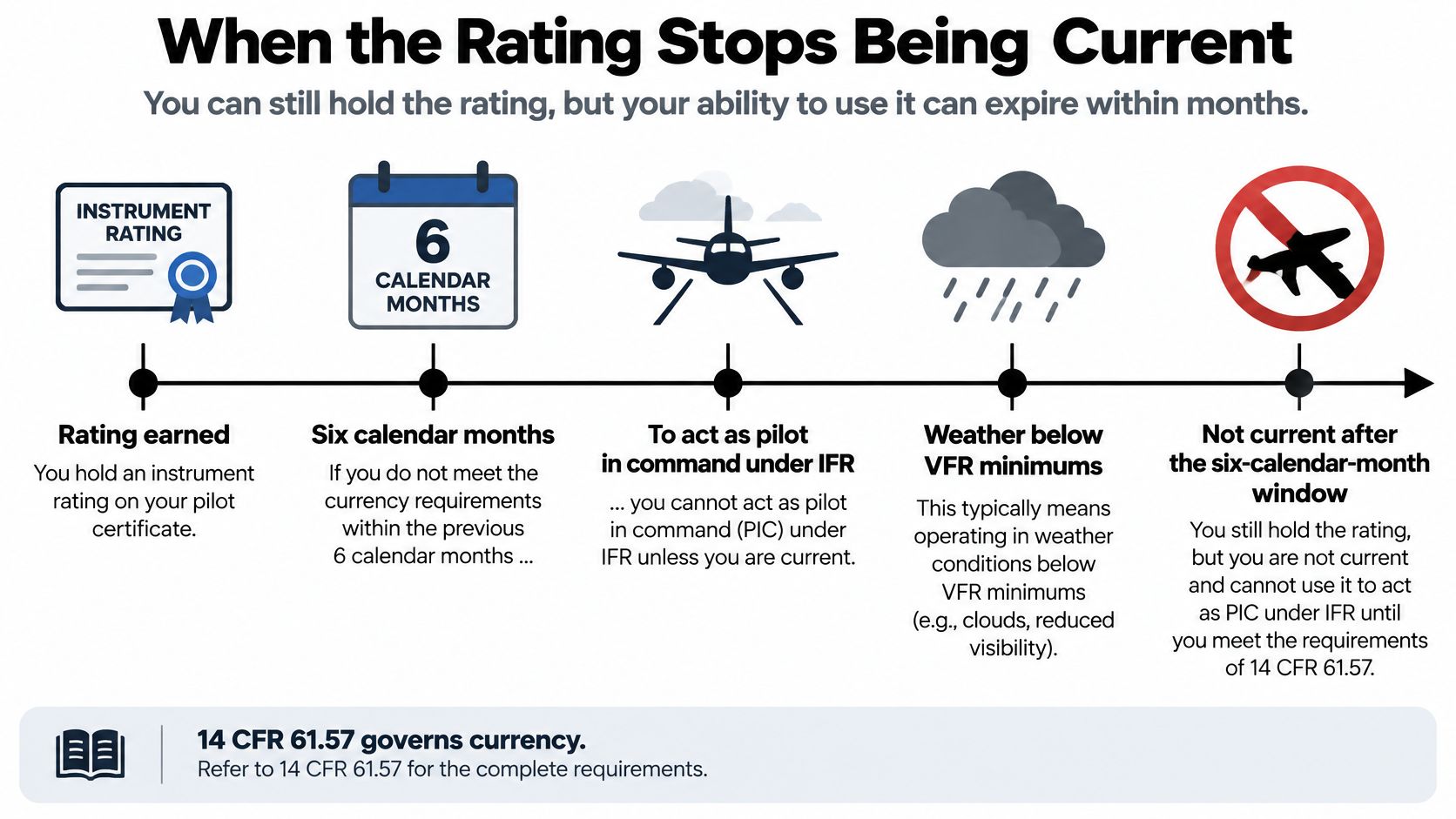
Six calendar months is the key window for instrument currency. Your rating remains on your certificate, but the recent-flight tasks required to act as PIC under IFR can lapse.
Under 14 CFR 61.57, you generally need to complete six instrument approaches, holding procedures and tasks, and intercepting and tracking courses using navigation systems within the preceding six calendar months. The tasks must be performed and logged under qualifying actual or simulated instrument conditions. An IFR clearance in clear weather doesn't automatically establish instrument currency.
The timeline shows how the six-month window works and when additional time to regain currency applies.
Match your status to the permitted recovery method
Instrument currency by situation
| Situation | Status | Action |
|---|---|---|
| Six approaches, holding procedures, and tracking tasks completed in the preceding six calendar months | Current | Act as IFR PIC when all other applicable requirements are satisfied |
| Tasks missed, but still within the additional six-calendar-month period | Not current, within the recovery period | Complete the required experience using a lawful safety-pilot arrangement, instructor, or approved device |
| Both six-month windows passed | Not current | Complete an instrument proficiency check with an authorized instructor or other authorized evaluator |
The additional six-calendar-month period gives you time to regain currency. It does not authorize you to act as IFR PIC while you are not current.
Apply the rule to ordinary situations
An incomplete approach record. If your logbook shows four approaches and a hold, you haven't completed the six approaches required for currency. Feeling comfortable in clouds doesn't replace the logged tasks.
A device session. An approved simulator or training device can count when the device and session meet the regulation. Confirm its authorization and log the required tasks. Calling a session “simulator time” alone doesn't establish that it qualifies.
A long return after inactivity. After the recovery period passes, one practice approach won't restore currency. You need an instrument proficiency check, commonly called an IPC.
Calendar habit: Track the six-calendar-month window from your completed approaches, holds, and intercepting and tracking tasks. Check that record before planning an IFR flight.
A safety pilot or instructor must have qualifications appropriate to the operation. If you're not current, you can't use a friend in the other seat to make an IFR flight legal.
Hours alone don't establish currency or proficiency. The regulation sets the recent-experience limits; your ability to perform the tasks safely still matters.
Common Instrument Rating Questions
Eligibility and preparation
Can home study prepare me for the knowledge test?
An eligible home-study course can cover the required subjects, but you still need an instructor's endorsement before taking the knowledge test.
How long is the knowledge-test endorsement valid?
Under 14 CFR § 61.39, the endorsement must be issued within the two calendar months before the practical test. If it falls outside that window, ask your instructor whether you need a new endorsement.
Practical test and continuing privileges
What should I bring to the practical test?
Bring the required pilot and training records, identification, and any aircraft or test materials specified by your instructor and the examiner. Check the current FAA practical-test standards and confirm the examiner's instructions before test day.
Does the knowledge-test endorsement also clear me for the practical test?
No. The practical test has its own eligibility requirements and readiness endorsement under 14 CFR § 61.39. Passing the written test is one part of preparation, not approval to take the checkride.
For a plain-language comparison of IFR and VFR operating rules, see the linked guide.
Choose the Next Step Toward IFR
If you haven't flown, begin with an experience you can evaluate rather than a long-term commitment. A discovery flight lets you meet an instructor and experience the airplane before deciding whether intensive career training fits your goals.
At CFII, that flight begins with a walk around the airplane alongside an instructor and a checklist card. You can take it before obtaining your medical certificate.
Choose a rating or a complete career sequence
If your goal extends through instrument instructing, our Career Track offers fixed $89,000 tuition, including multi-engine, and takes students from zero experience to CFII and multi-engine in about nine months. It includes six certificates and ratings and 282 total training hours, comprising 204 single-engine, 25 multi-engine, and 53 simulator hours, plus all one-on-one instruction, at our Southern California bases in Riverside, Long Beach, and Corona.
The instrument rating sits after private-pilot qualification and before commercial, multi-engine, and instructor qualifications in that sequence. A complete training-hour package and the hours credited toward an individual rating aren't interchangeable, so examine how each syllabus stage satisfies its own requirements.
Use our instrument rating cost guide to organize the budget conversation. Compare training scope, not just the price attached to the word instrument.
Before committing, put these questions beside the syllabus:
- Regulatory coverage: Which lessons satisfy each eligibility, experience, knowledge, and testing requirement?
- Included training: What airplane time, simulator time, and instruction are included?
- Written scope: What is the total price, and what falls outside it?
- Readiness standard: How will your instructor determine that you're prepared to test?
Get the total price and included hours in writing. A clear training plan should show both what you're buying and how you'll become qualified to use it.
CFII offers a Southern California pathway from first flight through instrument training and instrument instructing. Visit CFII to discuss your starting point, review the training sequence, and match your plan to the FAA's instrument rating requirements before you commit.
Planning to fly for a living?
See what the path from zero to a pilot career looks like, what it costs and how long it takes.
Learn to fly in Riverside
We train at Riverside Municipal Airport in modern airplanes with a parachute built in. Start with a one hour discovery flight, no experience needed.