

On this page
- 1. FAA Airman Knowledge Testing Question Banks
- Use samples to expose gaps
- 2. FAA Pilot's Handbook of Aeronautical Knowledge (FAA-H-8083-25 series)
- Turn reading into usable knowledge
- 3. FAA Airman Certification Standards (ACS)
- Map errors to operational decisions
- 4. Subject-Based Commercial Question Banks
- Demand explanations, not answer letters
- 5. Video-Based Ground School With Practice Quizzes
- Use an active viewing routine
- 6. Printed FAA Test Prep Books
- Make the margins useful
- 7. Online Ground School With Progress Tracking
- Read beyond the total score
- FAA Written Exam Practice Test Resources at a Glance
- Build a Study System, Then Start Flying
- Finish with independent performance
If you can recognize the right answer on a practice quiz but can't explain it to an instructor, are you ready for the FAA written exam? For an aspiring career pilot who hasn't flown yet, the knowledge test is an early measurable hurdle. Passing the FAA written exam starts with the right practice tests, but a high score from repeated questions can hide weak understanding.
You'll take the official exam at an FAA-approved testing center, with eligibility governed by 14 CFR 61.35, including the applicable training endorsement and identification requirements. A practice website doesn't replace those requirements.
The most useful preparation starts with free FAA materials, then adds commercial tools where they help: explanations, video instruction, printed exercises, and timed simulations. You don't need to buy every format. If you haven't been in a training airplane, a discovery flight can come first; if you're committed to a zero-to-CFII path, fit written preparation into your flight-training schedule rather than treating it as a separate project.
1. FAA Airman Knowledge Testing Question Banks
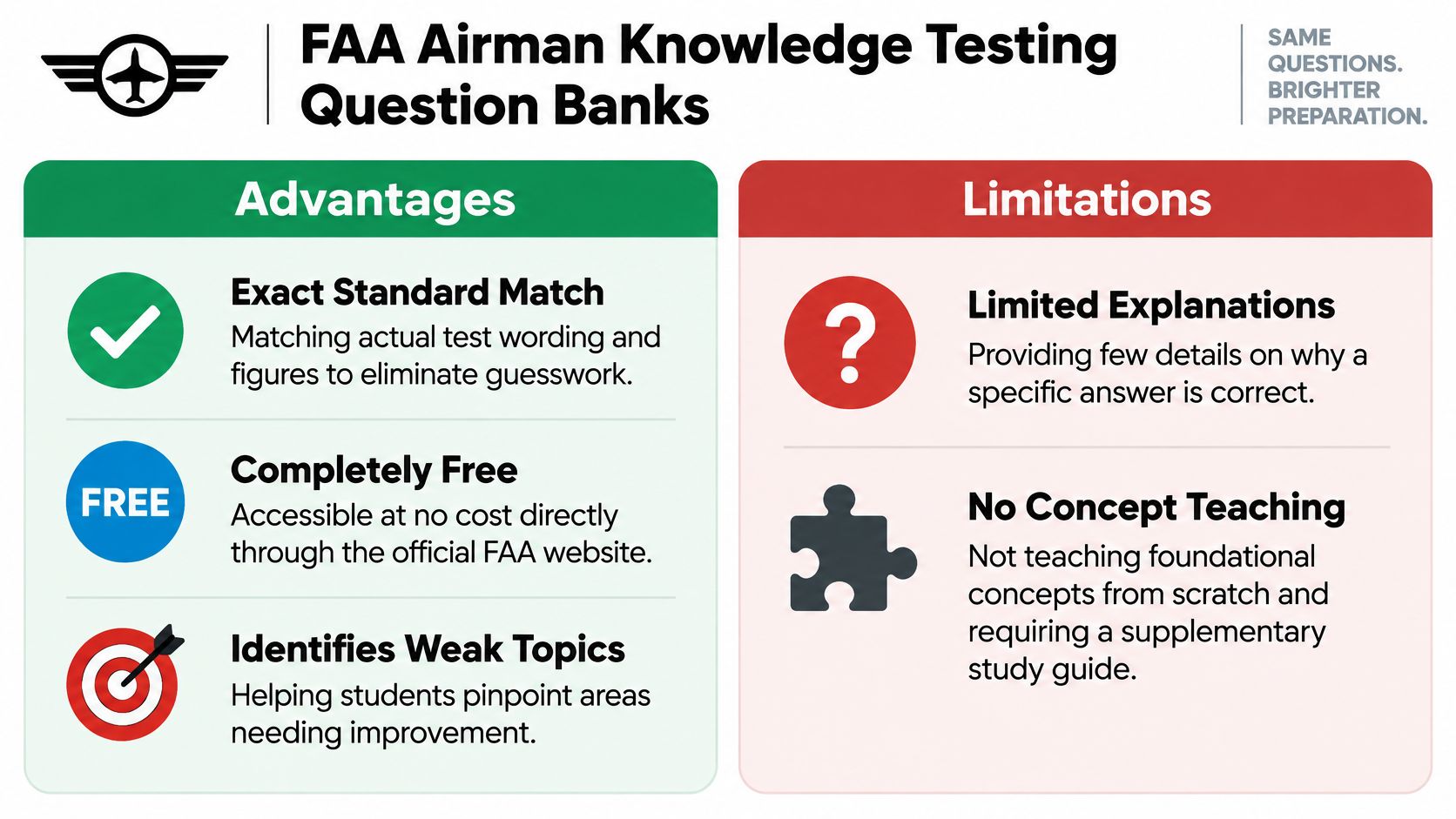
Start with official sample questions, not the promise of an exact exam bank. The FAA explains in its knowledge-testing questions and answers that it revises active test questions and applicants are increasingly unlikely to encounter exact matches between published samples and the operational exam.
That distinction matters. Official samples teach you the question style and use of reference figures, but they aren't a complete collection of live exam answers.
Use samples to expose gaps
Say you repeatedly miss questions about controlled airspace. Don't keep selecting answers until the pattern feels familiar. Open the relevant handbook chapter, draw the airspace, and explain the entry requirements aloud.
- Review the reasoning: Explain why the correct response works and why the distractors don't.
- Practice with figures: Use the applicable testing supplement instead of guessing from a cropped illustration.
- Separate learning from testing: Study with references available, then complete timed practice without explanations showing.
The trade-off is straightforward: official samples are authoritative examples, but they don't provide the lesson sequence or extensive performance tracking of a commercial platform. Use our private pilot written test preparation guide to organize the work around them.
Practical rule: If you remember the answer but can't explain the concept, count that topic as unfinished.
2. FAA Pilot's Handbook of Aeronautical Knowledge (FAA-H-8083-25 series)
A student who misses a density-altitude question usually needs more than another question. They need to connect temperature, pressure, air density, and aircraft performance. The FAA's Pilot's Handbook of Aeronautical Knowledge provides that foundation.
Keep your handbook and chart materials together so you can work through examples rather than read passively.
You can read the handbook sequentially for a broad introduction, but targeted reading works better during remediation. After missing weather questions, read the relevant weather material, decode a sample report, and explain what it would mean for a proposed flight. Then return to unfamiliar questions on the same subject.
Turn reading into usable knowledge
Make short notes on relationships and procedures, not just vocabulary. Sketch how a center-of-gravity change affects loading, or work a navigation problem on paper before checking the answer.
For regulations, distinguish the handbook's explanation from the current operating rule. Your notes on visual-flight weather requirements should identify 14 CFR 91.155 and the applicable airspace conditions, rather than a single minimum stripped of context; our visual flight rules guide provides supporting context.
Use video as a supplementary explanation, then return to the reference material and calculations.
The handbook's limitation is feedback: it won't tell you whether you misunderstood a paragraph. Questions and instructor discussion supply that missing check.
3. FAA Airman Certification Standards (ACS)
The ACS tells you what you must understand and demonstrate, not merely what answers to memorize. Use the document for your intended certificate or rating to connect knowledge, risk management, and flight skills.
The FAA's training and testing resources separate knowledge-test materials, learning statements, and certification standards. That's an important distinction: a practice test is part of preparation, not a substitute for the broader certification process.

Map errors to operational decisions
Suppose you miss a weight-and-balance question. Record the relevant ACS area, identify the calculation error, then explain how you'd decide whether a proposed passenger-and-baggage load is acceptable. Getting the arithmetic right is necessary, but you also need to recognize an unacceptable loading condition.
Build a simple study record with:
- Knowledge area: The subject and applicable ACS element.
- Cause of the miss: Concept, calculation, chart interpretation, or question-reading error.
- Remediation: The handbook passage and a fresh problem demonstrating understanding.
This approach also prevents a strong overall score from concealing a persistent weakness. You might answer systems questions comfortably while still misunderstanding weather decisions.
The ACS isn't written like a beginner's textbook, so don't expect it to teach every concept. Pair it with the handbook and instructor explanations. Our private pilot checkride preparation guide helps connect that study to the practical test.
4. Subject-Based Commercial Question Banks
A subject-based question bank can help you practise one topic at a time. Start with questions that match what you have studied, then check whether the explanations teach the reasoning or only identify the correct answer.
Demand explanations, not answer letters
For a weather question, a useful explanation shows how to interpret the information and what decision follows from it. A bare answer key won't help you recognize the same principle in a differently worded question.
- Check coverage: Confirm the questions match your intended knowledge test and current standards.
- Track recurring errors: Separate reading mistakes from gaps in your understanding.
- Retest with variation: Use new questions on the same subject to check that you understand the principle, not just the answer pattern.
The FAA testing matrix lists each knowledge test's code, question count, time allowance, and eligibility requirements. Check the requirements for your specific exam rather than assuming every pilot test follows the same format.
Question banks make repetition convenient, but hints and explanations can become a crutch. For a realistic self-check, answer without help, then use the explanation and FAA references to address any gaps. The FAA's question banks, handbooks, and ACS should remain the backbone of your preparation; commercial practice tools are supplements.
5. Video-Based Ground School With Practice Quizzes
If written descriptions of aerodynamics leave you confused, video instruction can make movement and relationships easier to understand. An animation of airflow or an instructor working through a chart can clarify what a paragraph leaves abstract.
But watching isn't the same as retrieving knowledge. After an airspace lesson, close the video and sketch the airspace yourself. Then answer unfamiliar questions without replaying the explanation.
Use an active viewing routine
A useful session follows a clear progression:
- Predict: Before the instructor solves a problem, write down your approach.
- Explain: Pause and describe the concept in your own words.
- Apply: Complete related questions and connect the lesson to a proposed flight.
For example, after a weather lesson, decode a sample forecast and explain what further information you'd want before departure. That's more useful than remembering which response appeared beneath the video.
The FAA private pilot sample-question document identifies the Private Pilot Airplane exam as 60 multiple-choice questions, with 2.5 hours allowed and a 70% passing standard. Your final preparation needs to include independent question solving under exam conditions, not just completed video lessons.
Completing a lesson tells you that you watched it. Explaining a new scenario tells you much more about what you learned.
Video is a good teaching supplement, especially for unfamiliar concepts. It's less efficient when you already understand the subject and only need to locate a specific reference or correct a calculation.
6. Printed FAA Test Prep Books
A printed prep book puts the explanation, diagrams, and practice problems on the same pages. That makes it easier to mark up a chart or calculation and see where your reasoning went wrong. Choose an edition for your certificate and check it against current FAA references; printed material does not update when those references change.
A navigation problem may place a chart beside a worked calculation. Trace the course on the chart, write the wind information beside your work, and label each conversion. If the answer is wrong, review the steps rather than memorizing the final number.
Make the margins useful
Record the misunderstanding, not just the answer letter:
- Label units: Keep distances, speeds, weights, and moments distinct.
- Write the rule: Note the principle that determines the answer.
- Flag uncertainty: A correct guess still needs review.
Books offer little performance tracking, so keep a separate error log and revisit weak subjects instead of repeating familiar pages. Use the FAA's knowledge-test guidance to check test-validity details: a satisfactorily completed recreational or private pilot knowledge test expires 24 calendar months after the month it was taken. Passing early can reduce later workload, but only if your practical-test timeline fits that period.
Do calculations at a desk when you can concentrate. In the training airplane, keep your attention on the flight and your instructor.
7. Online Ground School With Progress Tracking
A progress report can show which subjects need more work, but a completion mark is not proof of understanding. Online ground schools combine lessons, practice questions, and subject-level reports. They can help organize study, provided you use the results to guide review rather than treating them as a measure of readiness.
Read beyond the total score
If navigation is your weakest subject, inspect the missed problems. Did you misread variation, enter the wind incorrectly, or misunderstand the chart? Each calls for a different correction. Rework the specific skill, then test yourself on a new problem.
The FAA's 2024 airman knowledge-test volume report recorded 271,247 tests across certificate and rating categories, with an overall pass rate of 89.51%. That figure covers many certificates and ratings, so it is not a personal readiness target or proof that a particular course works.
Use the report to choose what to review, then check your understanding without hints. You should be able to work unfamiliar mixed questions, use the supplied reference figures, and explain the reasoning behind answers you previously missed. A course's progress tracker can organize that work; the FAA's question banks, handbooks, and ACS remain the foundation for studying what the test and practical test require.
FAA Written Exam Practice Test Resources at a Glance
Official FAA materials should anchor written-test preparation. Use commercial resources to add structure or explanations, not to replace the FAA's questions and standards.
| FAA resource | What it provides | Cost |
|---|---|---|
| FAA Airman Knowledge Testing Question Banks | Sample knowledge-test questions | Free |
| FAA Pilot's Handbook of Aeronautical Knowledge (FAA-H-8083-25 series) | Explanations of aviation concepts | Free |
| FAA Airman Certification Standards (ACS) | Knowledge and skill standards for each certificate or rating | Free |
The question banks help you get familiar with FAA-style questions. The handbook explains the concepts behind them, while the ACS shows the knowledge and skills you'll be expected to demonstrate. Commercial courses, quizzes, and printed prep books can supplement these materials when you need a different format or more guided practice.
Build a Study System, Then Start Flying
How will you turn practice questions into knowledge you can use in the airplane? Start with the ACS area you're studying, read the relevant FAA handbook material, then use practice questions to identify concepts that need more work.
Use commercial study aids to address a specific need. Explanations can help with calculations, videos can clarify visual concepts, and printed exercises offer an offline way to review. Avoid paying for overlapping tools that cover the same material.
Finish with independent performance
Use timed mixed practice to check your pacing and whether you can apply concepts across topics. Review the applicable testing supplement so you know how to use its references.
Before booking, confirm the requirements for your test with your instructor. For a private pilot knowledge test, 14 CFR 61.103 covers eligibility, while 14 CFR 61.35 addresses knowledge-test prerequisites. A practice score does not replace the required endorsements and documentation.
Set a regular study schedule alongside flight lessons, and revisit missed questions until you can explain the underlying concept. CFII's Career Track includes written-test preparation for every rating, study materials, and a training portal with lessons and quizzes.
Planning to fly for a living?
See what the path from zero to a pilot career looks like, what it costs and how long it takes.
Learn to fly in Riverside
We train at Riverside Municipal Airport in modern airplanes with a parachute built in. Start with a one hour discovery flight, no experience needed.