
On this page
- What an IFR Rating Actually Allows
- More privileges, with operating limits
- The airplane must qualify too
- FAA Minimums Before the Instrument Checkride
- Instrument-airplane minimums under 14 CFR 61.65
- The gates around the hours
- How Instrument Training Usually Unfolds
- Build control before adding workload
- Make the cross-country a complete IFR operation
- What Cloud Accidents Still Teach
- What the FAA review found
- Turn the lesson into decisions
- Staying Current After the Rating
- IFR currency under 14 CFR 61.57(c)
- Practice for the flight you expect to make
- How a CFII Teaches the Rating
- Brief, fly, and debrief the decision
- A missed approach reveals more than a smooth descent
- Pick a First Step Toward the Rating
- Match the path to the commitment
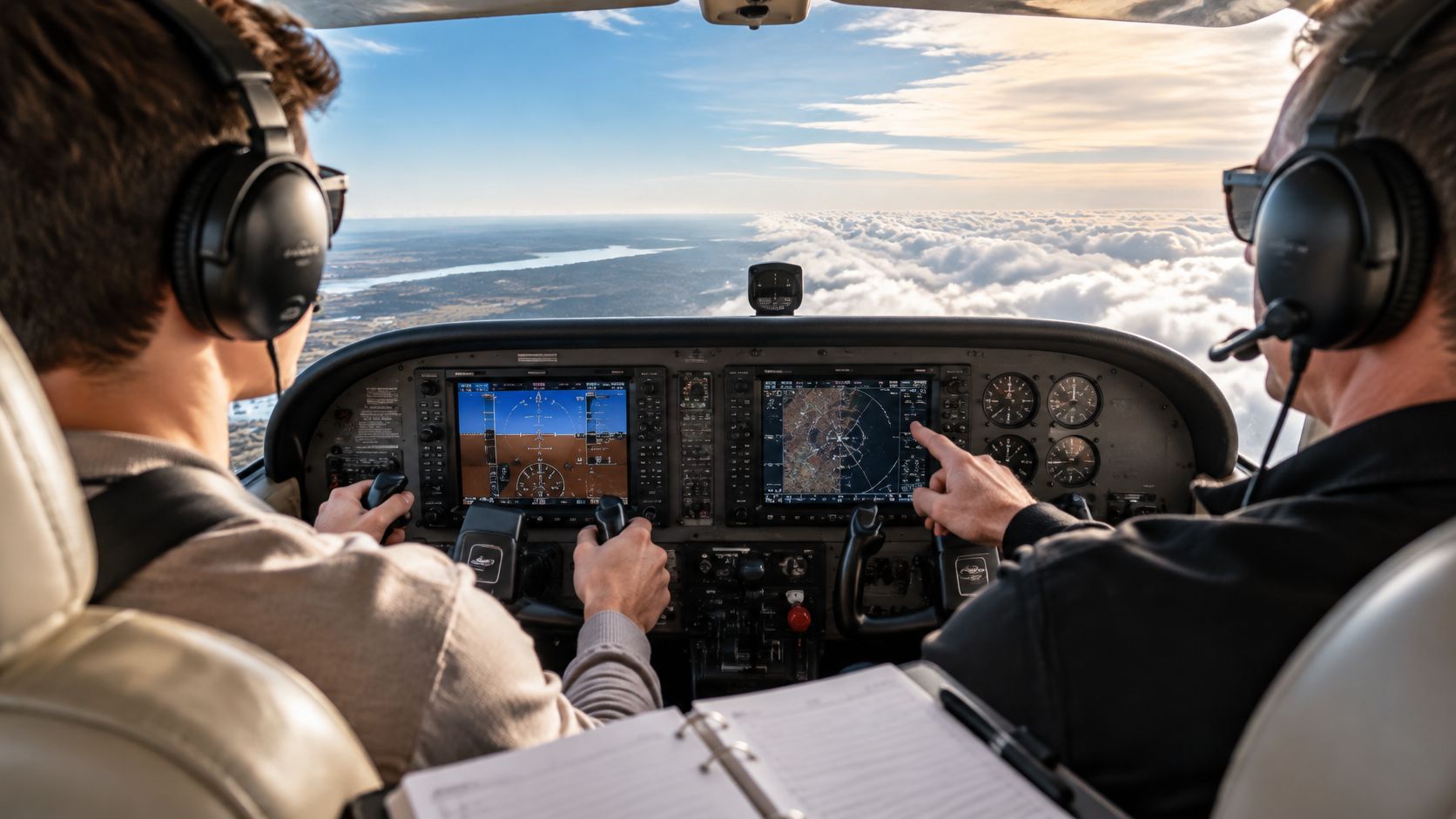
You're looking at pilot training requirements, and the same terms keep appearing: private pilot, instrument rating, commercial, instructor. You may not have flown yet, but you can already see that learning to take off and land is only the beginning. An IFR rating, formally called an instrument rating, is where you learn to control the airplane and make decisions when the view outside can't guide you.
What an IFR Rating Actually Allows
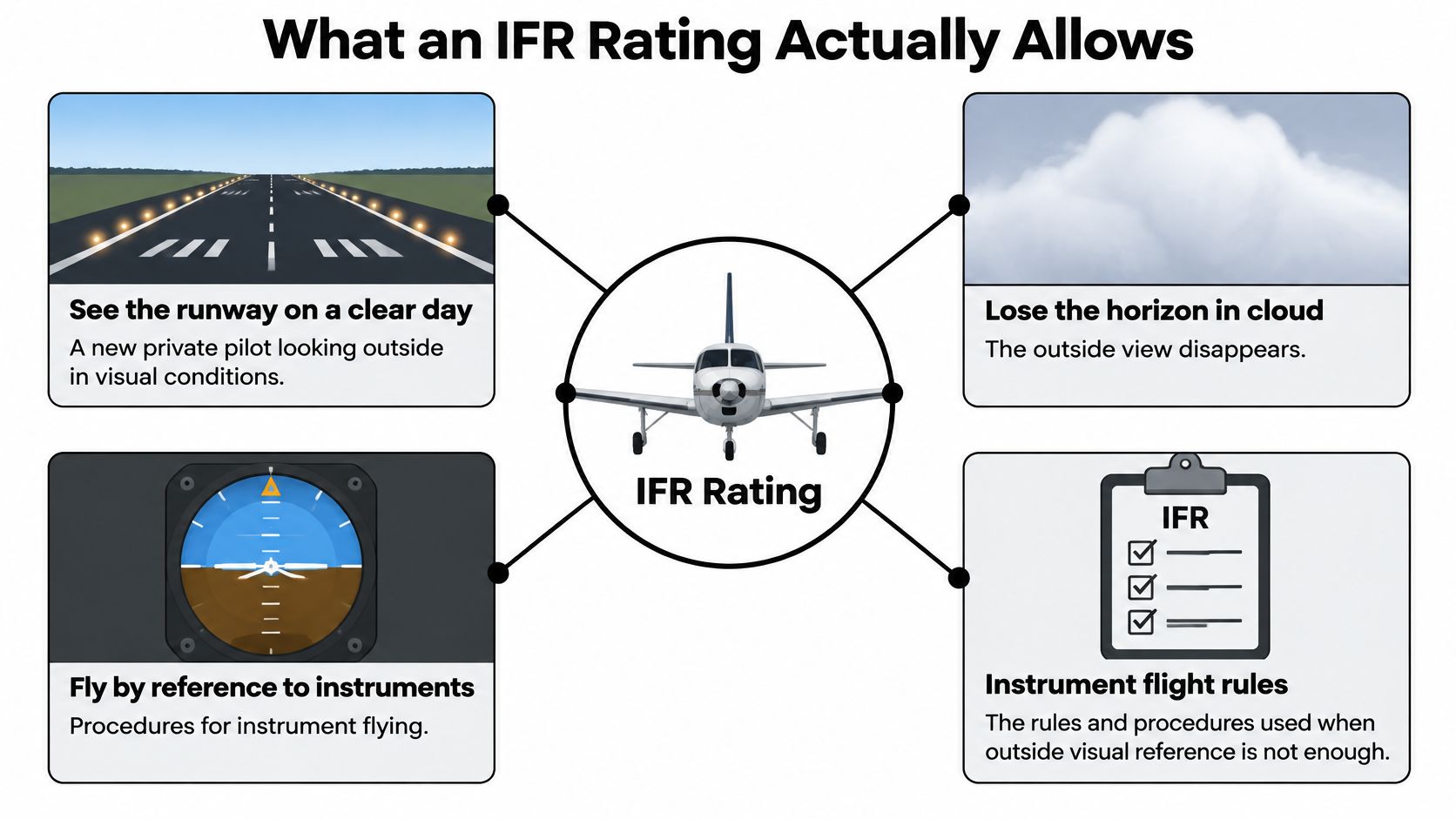
Say you've earned your private pilot certificate. On a clear day, you can see the runway, nearby terrain, and the horizon. Those outside references help you recognize whether the airplane is climbing, descending, or turning.
Then consider what happens inside a cloud. The horizon disappears, and your body may give you misleading sensations about which way you're moving. You need a reliable instrument cross-check, not a stronger feeling that the airplane is level.
Instrument flight rules, or IFR, provide the operating framework for that environment. The instrument rating is an addition to your pilot certificate, not a separate pilot license. Our explanation of instrument flight rules describes how clearances, navigation procedures, and aircraft control fit together.
More privileges, with operating limits
With the appropriate rating and current qualifications, you can act as pilot in command under IFR, including in weather below visual flight minimums. That means learning to file an IFR flight plan, obtain and follow clearances, fly in clouds, conduct instrument approaches to published minimums, and operate in Class A airspace.
You can also fly IFR in clear weather. IFR describes the operating rules; IMC describes instrument meteorological conditions. They aren't interchangeable.
The rating helps you manage weather risk. It doesn't remove that risk.
An instrument-airplane rating doesn't automatically qualify you for instrument privileges in another aircraft category. Nor does it authorize flight into thunderstorms, icing your airplane isn't equipped to handle, or descent below approach minimums without the required visual references.
The airplane must qualify too
Before filing, confirm that the airplane meets the instrument-flight equipment requirements of 14 CFR 91.205, including the applicable instruments, navigation equipment, and communication equipment. Installed equipment also needs to be operational or handled under the applicable inoperative-equipment rules.
Your rating doesn't replace an applicable medical qualification, a current flight review, or instrument recent experience. Medical requirements depend on the privileges and operation involved, rather than on possession of an instrument rating alone.
14 CFR 61.65 sets the training and certification bar. The important starting point is concrete: the FAA requires both documented experience and a demonstration that you can use it.
FAA Minimums Before the Instrument Checkride
Under 14 CFR 61.65(d), the baseline instrument-airplane requirements include 50 hours of pilot-in-command cross-country time, at least 10 in an airplane, and 40 hours of actual or simulated instrument time. The required instrument experience includes at least 15 hours from an appropriately qualified instrument-airplane instructor, plus 3 hours of instrument training within the 2 calendar months preceding the practical test, under that same rule.
These are minimums, not a promised finishing point. An instructor must determine that you're ready for the practical test, not merely that your logbook contains enough time.
Instrument-airplane minimums under 14 CFR 61.65
The table separates eligibility, experience, and testing gates. Its experience requirements come from the regulation cited above; its checkride standard is the FAA's Instrument Rating–Airplane Airman Certification Standards.
| Requirement | FAA minimum | Where it lives |
|---|---|---|
| Pilot certificate | Private pilot, airplane, held or applied for at the same time | 61.65(a) |
| English | Read, speak, write, and understand English | 61.65(a) |
| PIC cross-country | 50 hours, at least 10 in an airplane | 61.65(d) |
| Instrument time | 40 hours actual or simulated | 61.65(d) |
| Dual instrument | At least 15 hours from an instrument-airplane instructor | 61.65(d) |
| Recent training | 3 hours of instrument training in the 2 calendar months before the test | 61.65(d) |
| Long IFR cross-country | At least 250 NM, approaches at 3 different airports | 61.65(d)(2) |
| Knowledge test | Pass the instrument knowledge test with an instructor endorsement | 61.65 |
| Practical test | Pass ACS tasks, including risk management | Instrument ACS |
Don't add every row together as though each represents a separate block of flying. Dual instrument instruction can also be instrument time. Recent preparation can satisfy more than one applicable experience requirement when the flight and logging meet the rules.
PIC cross-country and instrument time, however, describe different things. One concerns your role and the qualifying cross-country flight; the other concerns flying solely by reference to instruments. Your instructor should review how each proposed flight will count before you launch.
The gates around the hours
Under 14 CFR 61.65(a), you must hold, or concurrently apply for, the appropriate private pilot certificate, meet the English-language requirement, complete the required preparation, and obtain the necessary test endorsements. Ground study covers weather, regulations, navigation, aircraft systems, and IFR procedures so that cockpit actions have a reason behind them.
Approved simulation can contribute, but a home computer session isn't automatically loggable training credit. The device must qualify for the intended use, and its approval and the applicable rules determine what credit you can claim.
Keep the records organized as you train. A digital pilot logbook can help separate instrument time, instructor time, cross-country experience, and recent preparation, but accurate entries still require attention.
Treat the table as the legal floor. Readiness means you can combine those skills during an actual trip, rather than perform each one only after an instructor tells you what comes next.
How Instrument Training Usually Unfolds
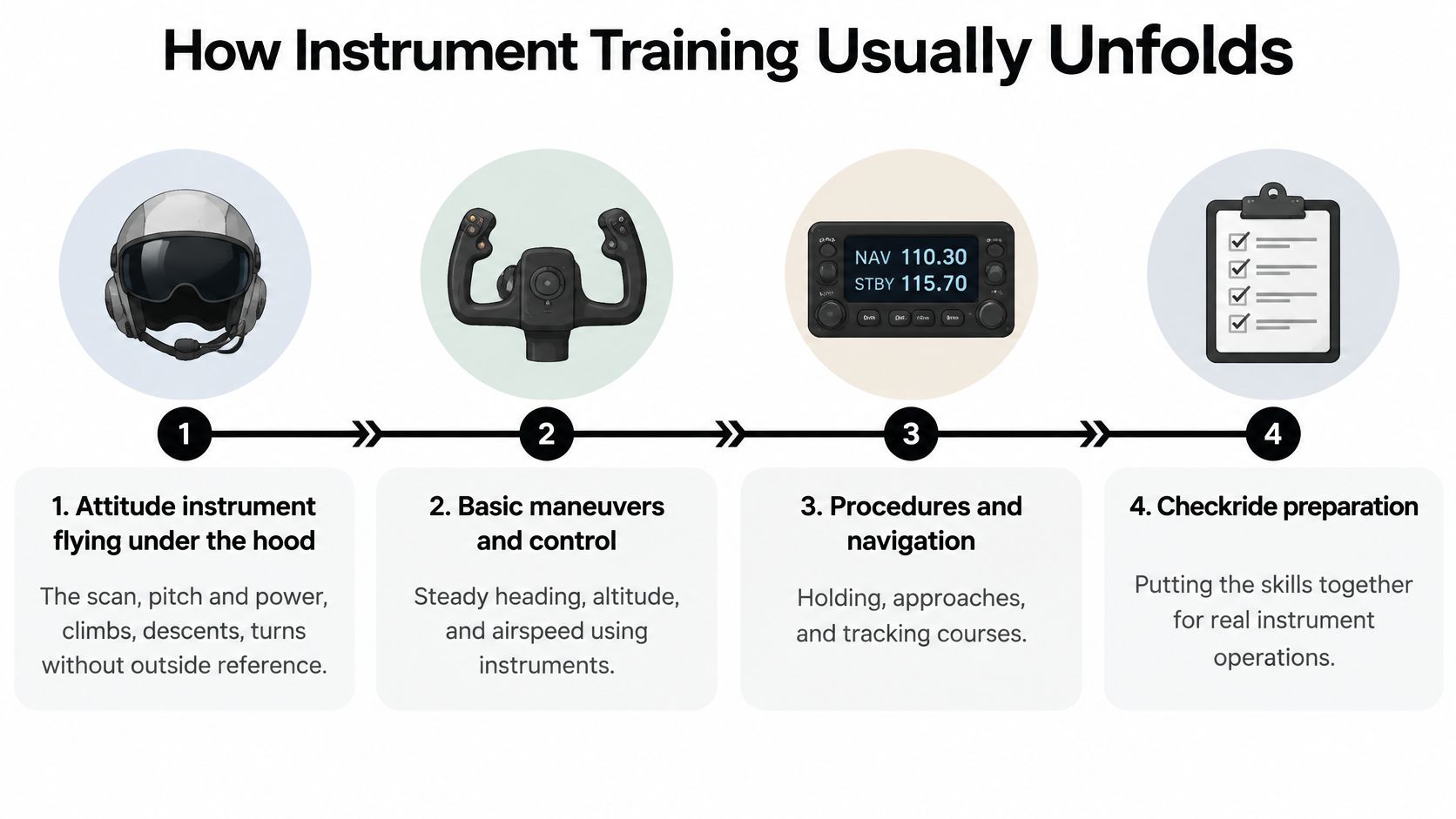
A typical IFR lesson starts with one task, then adds more until you can manage a flight from departure through arrival. Written-test study runs alongside flight training, connecting weather concepts and procedure rules to decisions in the cockpit.
Build control before adding workload
- Attitude instrument flying. Under a view-limiting device, you learn to cross-check instruments and control pitch, power, climbs, descents, and turns without outside visual references. Unusual-attitude recovery builds the habit of identifying the airplane's motion before correcting it.
- Navigation and clearances. You practice intercepting and tracking courses, flying holding patterns, and copying and reading back clearances. The challenge is to keep heading, altitude, and airspeed steady while handling each task.
- Approaches and missed approaches. You brief procedures, configure the airplane, manage navigation modes, and fly missed approaches. Equipment-failure scenarios teach you to recognize lost capability and select a safe alternative.
- Integrated cross-country flying. You combine those skills on a route that requires planning beyond the familiar home airport.
Make the cross-country a complete IFR operation
Under 14 CFR 61.65(d)(2)(ii), the required cross-country includes an IFR flight plan filed with ATC, at least 250 nautical miles along airways or ATC-directed routing, and an instrument approach at each of three different airports using approved navigation systems.
The flight also requires you to manage fuel, weather, alternates, clearances, and cockpit organization together. An amended clearance may arrive while you prepare for an arrival, or destination weather may make your alternate the better choice. Stabilize the airplane, understand the clearance, reassess the plan, and communicate.
Training benchmark: You're approaching readiness when you can brief an approach, fly it, execute the missed approach, and choose a diversion without prompts for every step.
Training pace varies with lesson frequency, weather, aircraft availability, prior experience, and how much practice each skill takes. Plan final preparation around the practical-test date so required recent instruction remains valid. Begin instrument rating written-test preparation early enough for study to reinforce your flying rather than compete with it at the finish.
What Cloud Accidents Still Teach
A visual pilot continues toward worsening weather. The cloud base drops, the horizon fades, and the destination still seems close. Once the airplane enters cloud, the pilot becomes disoriented and loses control.
That chain of events shows how quickly a weather decision can become a control problem. The pilot must recognize that conditions are changing, decide whether to continue, and maintain control without visual references.
What the FAA review found
The FAA review of NTSB accident records for 2014–2023 identified 180 IMC-related general aviation accidents, with more than 82% fatal, resulting in 268 deaths and 29 serious injuries. The FAA review also found that approximately 55% of accident pilots lacked an instrument rating, more than 40% of accidents involved some level of intentional flight into IMC, investigators cited spatial disorientation in nearly half, and instrument failure appeared in only 7 accidents.
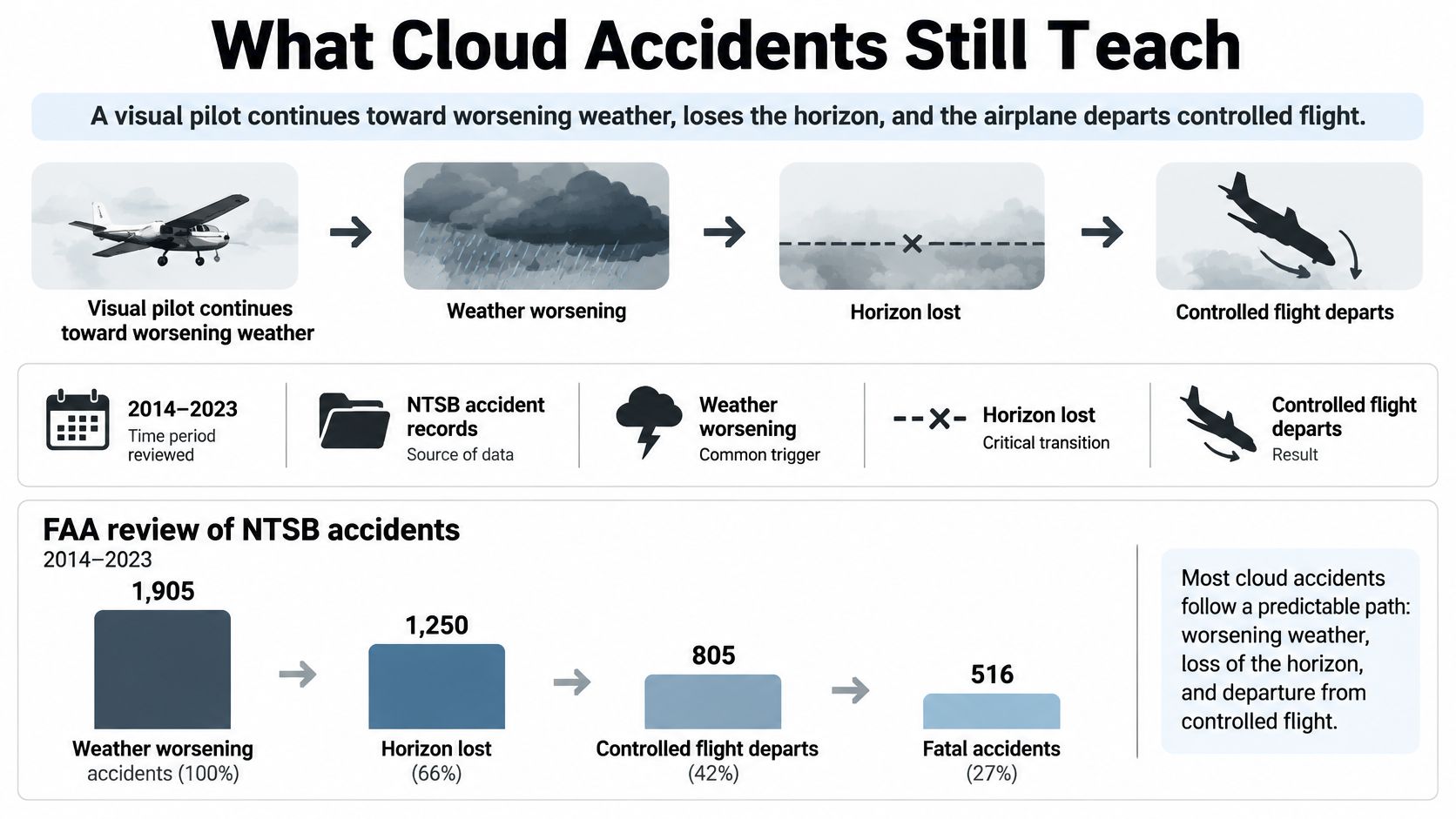
These figures describe the reviewed accidents, not an individual pilot's chance of an accident or the risk reduction from earning a rating. Instrument-rated pilots were also involved. A rating provides training for instrument flight, while sound judgment determines when and how to use that skill.
Instrument failure appeared in relatively few accidents in the review. The larger lesson is to recognize worsening conditions early, avoid committing to an unsafe flight, and maintain control when outside visual references disappear.
Turn the lesson into decisions
For a student, the practical response starts before takeoff:
- Choose an escape before departure. Identify a place to divert if the route or destination becomes unsuitable.
- Read the weather as it changes. Use a cloud ceiling forecast alongside other weather information, then reassess if conditions develop differently than expected.
- Set personal limits. Consider terrain, darkness, turbulence, equipment familiarity, and recent practice alongside published approach minimums.
- Act while options remain. An early diversion leaves more time to plan than a decision made under rising workload.
Instrument training builds the skills to control the airplane and fly procedures. The 250-nautical-mile cross-country, the practical test's decision-making standards, and later practice all matter because safe IFR flying depends on applying those skills when the situation changes.
The rating is a starting point for continued practice, not proof that a pilot's scan, procedures, and weather judgment will always be ready.
Staying Current After the Rating
Passing the checkride doesn't keep your IFR privileges usable indefinitely. Currency is the legal recent-experience requirement; proficiency is your actual ability to manage the flight. You can satisfy the first and still need practice before handling turbulence, unfamiliar avionics, and a busy arrival together.
Under 14 CFR 61.57(c), acting as pilot in command under IFR or in weather below VFR minimums generally requires performing and logging at least 6 instrument approaches, holding procedures and tasks, and intercepting and tracking courses within the 6 calendar months preceding the month of flight. The regulation permits qualifying work in actual or simulated conditions using an appropriate aircraft, full-flight simulator, or qualifying training device.
IFR currency under 14 CFR 61.57(c)
| Task or status | What the rule requires | How it can be logged |
|---|---|---|
| Instrument approaches | At least six within the six calendar months before the month of the flight | Actual IMC or simulated instrument conditions in an appropriate aircraft, full-flight simulator, or qualifying training device |
| Holding procedures and tasks | Perform holding procedures and tasks within the same six-month window | Same qualifying options as approaches |
| Intercepting and tracking courses | Intercept and track courses using navigation systems within the same window | Same qualifying options as approaches |
| Lapse of six calendar months or less | Complete the required tasks to restore currency | Properly logged approaches, holds, and course tracking under qualifying conditions |
| Lapse beyond six calendar months | Instrument proficiency check covering applicable ACS areas of operation | Completed with an authorized instructor or other authorized evaluator |
A pilot who has lost currency cannot depart as IFR pilot in command to rebuild it. Restoration must occur under conditions that are legal for the pilot's status, with the required safety pilot or qualified instructor where applicable.
Once the permitted restoration period has passed, an instrument proficiency check, or IPC, is required. It isn't merely an instructor watching you complete a currency list.
Practice for the flight you expect to make
The broader instrument recent-experience and proficiency framework in Part 61 distinguishes task completion from the applicable proficiency-check areas. Use recurrent sessions to practice missed approaches, equipment problems, and workload management as well as approach tracking.
Personal operating rule: Schedule recurrent practice before currency expires, and use weather limits more conservative than the published minimums while rebuilding confidence and consistency.
Suppose you've practiced only in smooth conditions at familiar airports. Before accepting a demanding arrival elsewhere, rehearse the approach briefing, automation setup, missed procedure, and diversion plan with an instructor.
Two procedural details deserve deliberate checking. Approach minimums normally rely on the airport's local altimeter setting unless the procedure provides otherwise, and navigation databases need to be current and appropriate for the intended flight.
Don't treat those checks as administrative chores. An incorrect pressure setting or unsuitable navigation information can undermine otherwise accurate flying. The table tells you what to log; your preparation determines whether you're ready to use it.
How a CFII Teaches the Rating
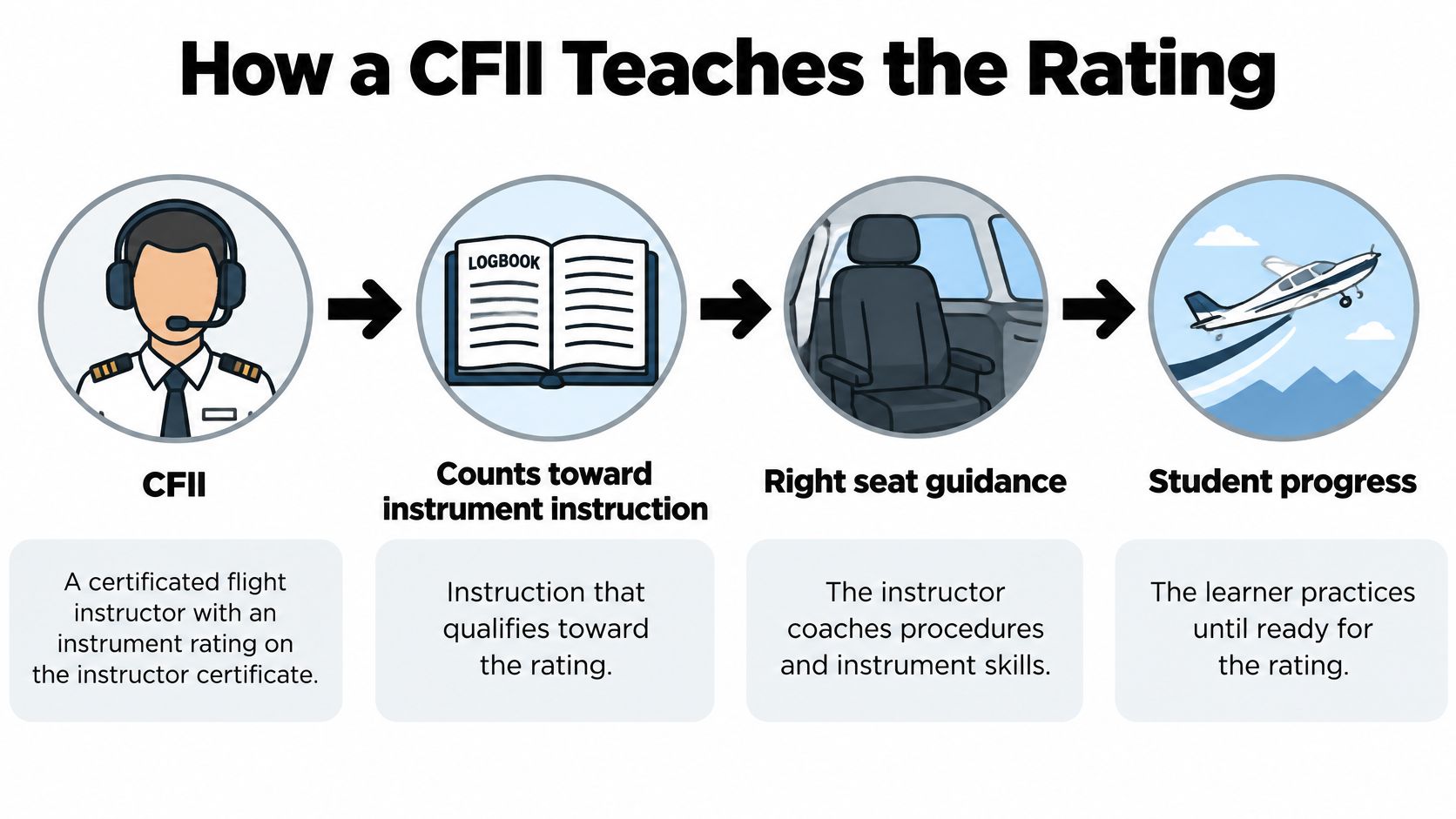
The instructor beside you needs the appropriate authority to teach instrument flying. A CFII is a certificated flight instructor with an instrument rating on the instructor certificate. For airplane instrument training, the instructor must also hold the relevant airplane qualifications.
Under 14 CFR 61.65, applicants must receive the prescribed preparation, obtain endorsements, and demonstrate instrument-flight competence. A useful lesson therefore connects what you know, how you control the airplane, and why you choose a particular action.
Brief, fly, and debrief the decision
Before flying, you and the instructor brief the maneuver or procedure. You identify the navigation source, expected configuration, altitude restrictions, minimums, and missed-approach instructions.
During the exercise, the instructor watches more than the needles. Are you cross-checking effectively? Do you recognize an unexpected indication? Can you manage a radio call without abandoning aircraft control?
Afterward, the debrief should identify the cause of an error and a repeatable correction:
- Aircraft control. Explain whether pitch, power, trim, or an incomplete cross-check caused the deviation.
- Procedure execution. Identify a missed briefing item, incorrect navigation selection, or misunderstood clearance.
- Risk management. Discuss whether continuing remained sensible and when a diversion would have been the better choice.
The Instrument Rating–Airplane ACS integrates knowledge, risk management, and skill. Lesson plans should reflect that structure rather than reducing training to isolated maneuvers.
A missed approach reveals more than a smooth descent
Consider a practice instrument landing system approach. You brief the chart, establish the correct configuration, and fly to the applicable minimums without seeing the required visual references.
You begin the missed approach. The instructor then simulates a GPS failure and asks you to select a diversion airport.
A successful response starts with aircraft control. You follow an available, valid navigation method, understand which capabilities remain, communicate as needed, and choose a workable destination. The instructor shouldn't create a scenario that depends on using navigation equipment you've just lost.
An approved simulator is useful for rehearsing this workload before doing it in the airplane, subject to the device's approval and applicable credit limits. You can pause the exercise afterward and identify exactly where the plan became unclear.
A career pilot encounters instrument training from both sides: first as the learner, later, if appropriately qualified, as the instructor responsible for teaching it. The flight instructor requirements describe that later qualification, which is distinct from the instrument rating on your pilot certificate.
Pick a First Step Toward the Rating
If you haven't flown yet, start by experiencing the cockpit. On a discovery flight, you can follow an instructor's explanations and see how you feel about flying before committing to a longer training path. A discovery flight gives you a concrete place to begin.
If your goal is to become an instructor, the instrument rating fits between private-pilot training and commercial and instructor qualifications. It is the second certificate-or-rating milestone in that sequence.
Match the path to the commitment
The CFII Career Track is a fixed-price route from zero experience to flight instructor, including instrument, commercial, and multi-engine ratings. Consider whether a structured path suits your schedule and goals, then assess the training by what you'll be able to do independently:
- Understand the records. Know which logbook entries document instrument experience, instruction, and cross-country requirements.
- Manage a complete flight. Plan the route, brief procedures, respond to changes, and make a defensible diversion decision.
- Keep practicing. Build a plan for maintaining usable instrument skills after certification, rather than waiting until your privileges lapse.
The goal is more than completing the required training. Your records should show that you met the FAA requirements, and your practice should help you make sound decisions in changing conditions.
To discuss your starting point, visit CFII and choose a next step that fits your goals.
Planning to fly for a living?
See what the path from zero to a pilot career looks like, what it costs and how long it takes.
Learn to fly in Riverside
We train at Riverside Municipal Airport in modern airplanes with a parachute built in. Start with a one hour discovery flight, no experience needed.