On this page
- Instrument Rating Timelines at a Glance
- Why the Same Syllabus Produces Different Calendars
- FAA Minimums Every Applicant Must Meet
- The Two Month Currency Rule and Why It Wrecks Schedules
- Factors That Stretch or Shrink Your Timeline
- Part 61 and Part 141 Set Different Clocks
- How Simulator Time Shortens the Schedule
- What Belongs in the Box and What Belongs in the Air
- Ways to Run Training in Parallel
- Choose Your Realistic Timeline and First Step
For a pilot who already holds a private certificate and has the cross-country time logged, an instrument rating usually takes about 3 to 5 months training part-time, or 4 to 8 weeks flying nearly every day. Those two ranges aren't competing rules. They're the same regulatory floor crossed at two different paces.
Search results for how long to get instrument rating usually hand you a division problem. Add up the 40 hours, divide by two lessons a week, and out comes "about five months." It sounds rigorous. It's the least reliable way to plan, because logged hours don't divide evenly into lessons and the calendar doesn't care about your arithmetic.
What the arithmetic misses is everything that decides whether a flight happens. A ceiling at 900 feet. The one trainer that's already booked. An instructor who leaves for the airlines mid-course. An examiner with a four-week wait. Those forces set your finish date far more than the hour minimums do, and once you see how they stack up, you can build an honest estimate instead of borrowing someone else's.
Instrument Rating Timelines at a Glance
Two students can start the same syllabus on the same Monday and finish eight weeks apart. One flies Monday, Tuesday, Thursday. The other flies Saturday, loses the next weekend to a failed attitude indicator, and loses the one after that to a low overcast. Both log legal instruction. Only one stays sharp between lessons.
Use the table below as a planning estimate, built from typical lesson pace and how often students fly. It is not FAA data, because the FAA publishes minimum experience and never publishes a calendar.
| Starting point | Schedule | Typical elapsed time | What sets the pace |
|---|---|---|---|
| Private pilot, prerequisites done, full-time intensive | 4-5 flights a week with simulator sessions | 4-8 weeks | Weather days and examiner availability |
| Private pilot, prerequisites done, part-time | 2-3 lessons a week | 3-5 months | Weather and aircraft availability |
| Private pilot, prerequisites done, weekend-only | 1-2 lessons a week | 5-8 months | Gaps between lessons and skill fade |
| Private pilot, cross-country time missing | 2-3 lessons a week | Add 2-4 months to the timeline | Cross-country trips to a 250 nautical mile flight |
| Zero time, starting from the first lesson | 2-3 lessons a week | 9-15 months including the private certificate | Private pilot first, then instrument training |
Why the Same Syllabus Produces Different Calendars
An accelerated student flying four or five days a week, with two simulator sessions folded in, moves through the instrument block in about 4 to 8 weeks. A part-time student at two or three lessons a week covers the same milestones in roughly 3 to 5 months. Neither student is smarter. The difference is the gap between flights.
Instrument flying is unforgiving of gaps because it's built on sequences, not single maneuvers. Brief the approach, set the radios, fly the hold, configure, intercept, descend, miss. Learn it Monday, skip to Saturday, and you'll spend the first half of Saturday's lesson reconstructing what you did on Monday. Long gaps don't just delay you. They consume hours you're paying for.
Self-check: if your last three flights fit inside two weeks, you're on pace. If every third lesson starts with re-learning hold entries, your calendar is already slipping, and the fix is frequency, not more total hours.
Weekend-only training is the schedule most likely to surprise people. One or two lessons a week works, but it stretches the same syllabus into five to eight months, and the reason isn't the hour count. It's that six days pass between every repetition of a perishable skill.
FAA Minimums Every Applicant Must Meet
Everything below comes from one rule. 14 CFR 61.65 sets the aeronautical experience for an airplane instrument rating, and it reads like a floor because it is one. It tells you what you must have logged and demonstrated before you may take the practical test. It says nothing about how many weeks that takes.
Here's the whole checklist on one page:
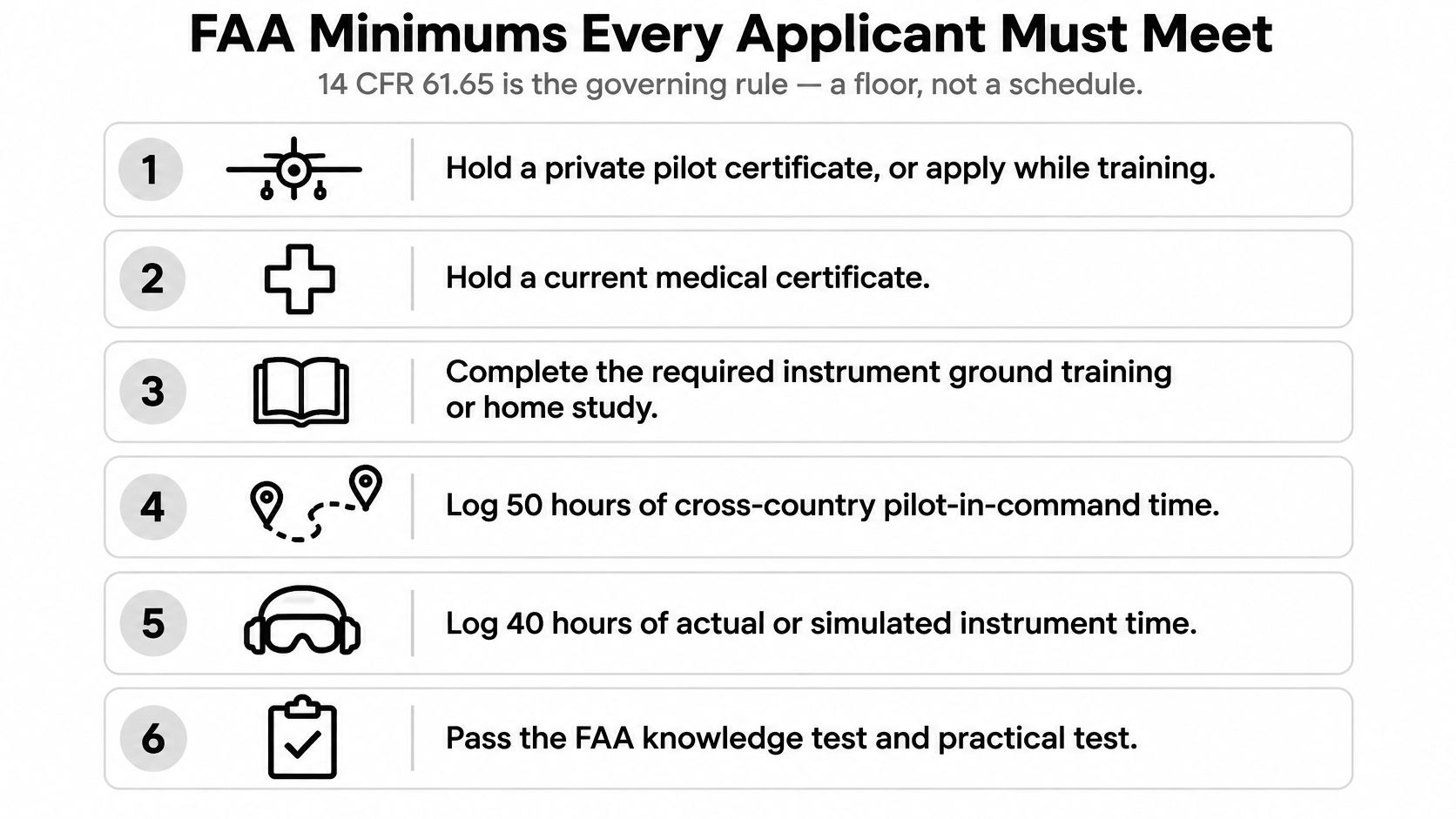
You need at least 50 hours of cross-country pilot-in-command time, including 10 hours in an airplane, plus 40 hours of actual or simulated instrument time in the required areas of operation, with at least 15 of those instrument hours given by an authorized instructor who holds an instrument-airplane rating, as the regulation specifies.
In the order a student meets them:
- Hold a private pilot certificate, or apply for it at the same time. This is why instrument training is a rating added to a certificate, not a standalone course.
- Log 50 hours of cross-country pilot in command. Time from your private training counts. Most pilots have more than they think.
- Log 40 hours of actual or simulated instrument time. Actual clouds, a view-limiting device, and approved devices all feed this total.
- Fly one qualifying cross-country of 250 nautical miles. It has to include instrument approaches, flown on an instrument flight plan.
- Pass the knowledge test. The Instrument Rating Airplane Airman Certification Standards set that exam at 60 questions with a 2.5-hour limit and a 70 percent passing score, and it requires an instructor endorsement before you sit down.
- Complete 3 hours of instrument training in an airplane within the two calendar months before the practical test. This is the recency rule, and it's the one that wrecks schedules.
The Two Month Currency Rule and Why It Wrecks Schedules
Students treat the 40 hours as the finish line. It isn't. The finish line is a checkride date with recent training attached to it.
Say you complete your instrument hours in March and the examiner's first open slot is late May. Those March flights are now outside the two-month window. You'll need another airplane session with an instructor before you test, and that session may surface a weak area that costs two more. Booking the examiner early isn't administrative fussiness. It protects the polish you already bought.
Meeting the minimums also doesn't mean you're ready. The examiner tests against the practical test standard, and an applicant who has logged exactly 40 hours but can't hold an approach stable will fly more before the endorsement gets signed. For a wider view of every paperwork and experience item, see the full instrument rating requirements.
| Requirement | Minimum | Source |
|---|---|---|
| Private pilot certificate | Held, or applied for at the same time | 14 CFR 61.65 |
| Cross-country pilot-in-command time | 50 hours, including 10 hours in an airplane | 14 CFR 61.65 |
| Instrument training | 40 hours actual or simulated, with 15 hours from an instrument-rated instructor | 14 CFR 61.65 |
| Qualifying cross-country flight | 250 nautical miles with instrument approaches | 14 CFR 61.65 |
| Recent instrument training | 3 hours within 2 calendar months before the practical test | 14 CFR 61.65 |
| Knowledge test | 60 questions in 2.5 hours, 70 percent to pass | Instrument Rating Airplane Airman Certification Standards |
Pull out your logbook and tally the cross-country and instrument columns before you plan anything else. The size of that gap is the single biggest variable in your timeline.
Factors That Stretch or Shrink Your Timeline
Think of training as a relay rather than a marathon. Each leg depends on the handoff before it, and one fumbled handoff costs days you can't get back. Miss a weather window and the next available airplane slot is Thursday. Wait three weeks for an examiner and the recency clock starts ticking against you.
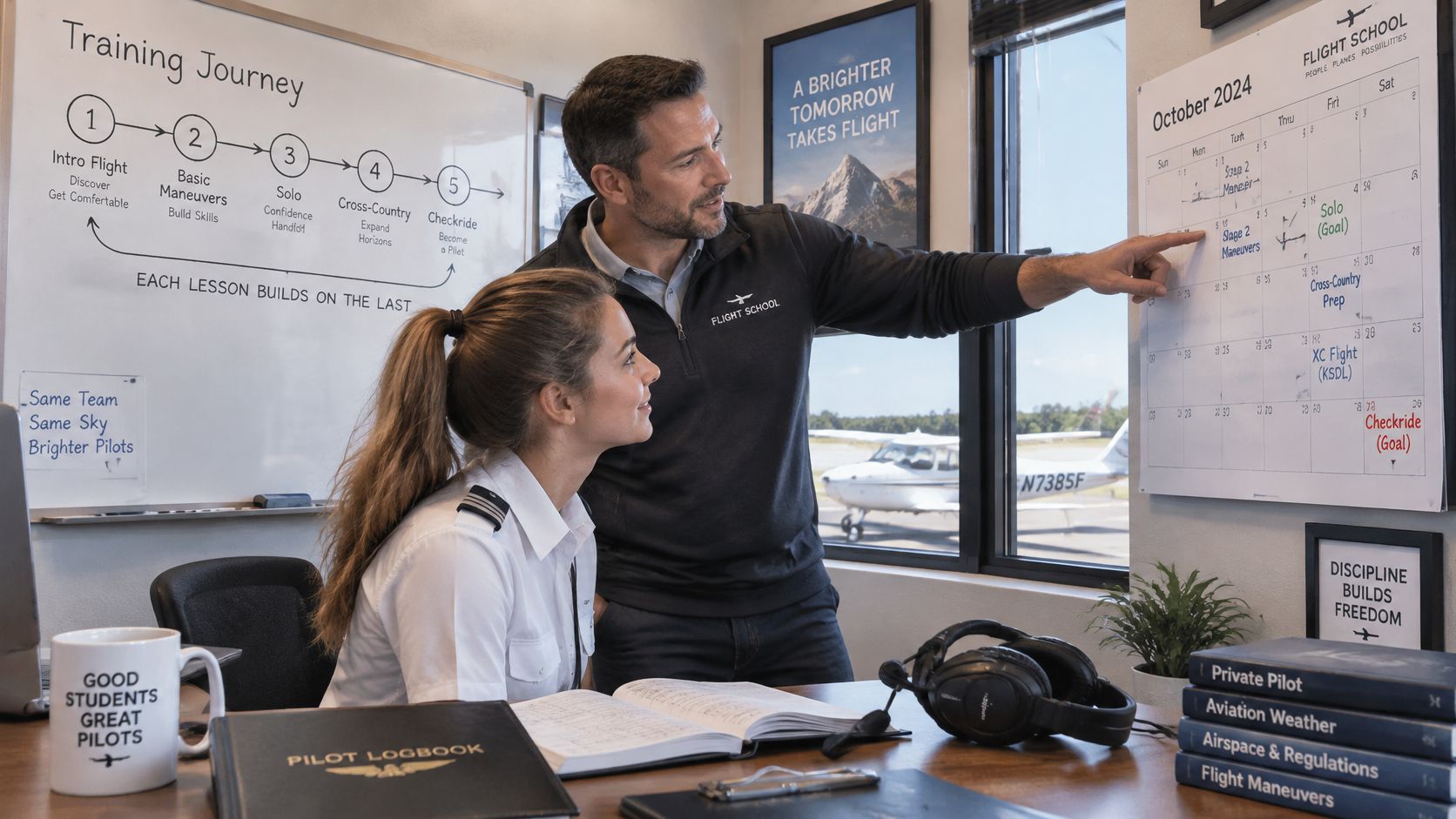
Start with what's in the logbook. A pilot who is short on cross-country time has to fly trips that teach almost nothing about instrument procedures. Those hours are required, they're legal, and they feel like a detour. A recently certificated private pilot who finished near the minimums may need two to four months of those trips before the instrument work even begins in earnest.
Flying frequency is the second lever and the one students control most directly. Three lessons a week with four-day gaps loses approach sequences between sessions. Four or five flights a week, some in a device, keeps the sequence fresh and lets each lesson build instead of restart. Consistency beats volume, but volume with consistency is what compresses a calendar.
Four more factors push from outside your control:
- Weather and season. Low ceilings and winter icing days cancel instrument lessons in a way they rarely cancel a fair-weather private lesson. In a cloudy region, budget for cancellations instead of being ambushed by them.
- Aircraft availability. A single trainer booked solid turns a planned one-week milestone into two. Book the airplane before you book anything else that week.
- Instructor continuity. A new instructor needs to re-discover your weak spots, and you'll spend a lesson demonstrating partial-panel work and radio workload you'd already fixed.
- Examiner scheduling. Checkride dates can run several weeks out in busy periods. The date is a resource you reserve, not one you request when you feel ready.
Part 61 and Part 141 Set Different Clocks
A Part 141 school teaches from an FAA-approved syllabus with defined stages and stage checks, which suits a student who wants fixed milestones and external structure. Part 61 training is built around one student and one instructor, which suits a working pilot who already has cross-country hours and tracks the requirements personally.
A 2024 analysis published by Flight Training Central reported that pilots completing instrument ratings through Part 141 programs averaged 127 total hours, while Part 61 pilots averaged 253 total hours. Read those as totals across a pilot's training, not instrument-only hours, and read them as a picture of who chooses each route. A university student flying full time and a career changer paying as they go aren't the same population.
| Training route | How the syllabus works | Scheduling | Average total hours (2024) |
|---|---|---|---|
| Part 141 school | Approved syllabus with set stages | Set by the school's course structure | 127 |
| Part 61 individual training | Built by instructor and student | Flexible and student-paced | 253 |
For a worked illustration: a pilot who already has the cross-country time, flies twice a week with one instructor and one airplane, and never switches either finishes in about three to four months. The same pilot with two-week gaps and a mid-course instructor change takes considerably longer, on identical regulatory requirements. If you want to see how a structured sequence is laid out before you commit, review an instrument rating course syllabus.
How Simulator Time Shortens the Schedule
Of everything that moves a finish date, simulator credit is the only one written into the rulebook as a lever. It doesn't lower the requirement. It changes where you satisfy part of it, and a device can be scheduled on a foggy Tuesday when the airplane cannot leave the ground.
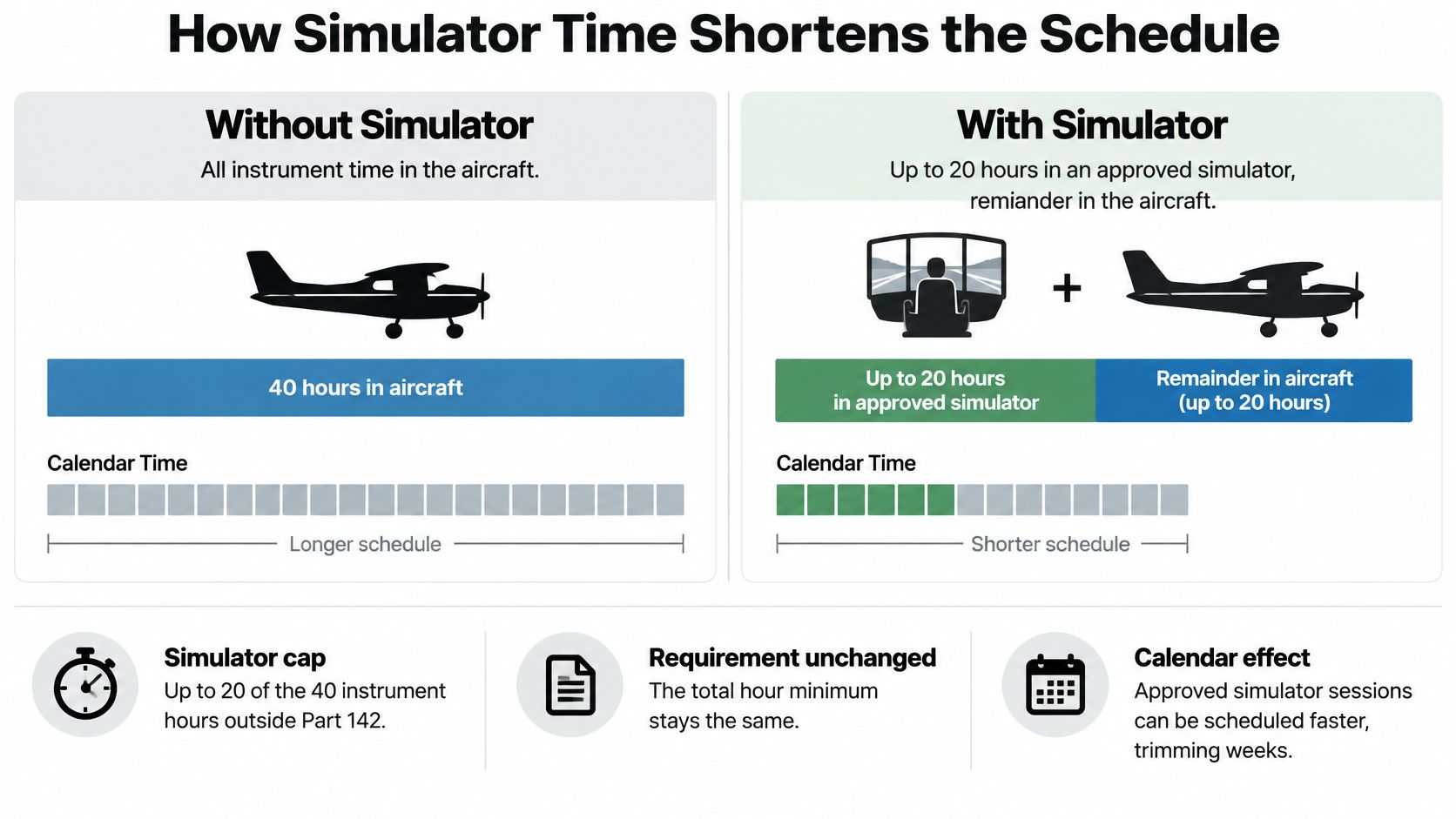
Outside a Part 142 program, up to 20 of the 40 required instrument hours may be completed in an eligible full-flight simulator or flight-training device. Inside a Part 142 course, 14 CFR 61.65 permits as much as 30 hours. The device has to be appropriate for the rating and for the specific maneuver, and the session has to be conducted and logged under the instructor and certification rules that apply.
What Belongs in the Box and What Belongs in the Air
Some tasks go faster in a device. Copying and reading back clearances, briefing and flying published approaches, recognizing and managing navigation failures, entering holds, and running an approach sequence three times in a row without paying for three takeoffs. Repetition in a device is cheap and repeatable, and a student can pause mid-procedure to fix a radio call that would have derailed the whole approach in the air.
Other tasks need an airplane. The feel of workload at 120 knots with real traffic, weather avoidance decisions with a real buildup on the nose, cockpit resource management with a second human beside you, and abnormal conditions that include actual motion. No approved device gives you the first ten minutes of real instrument meteorological conditions.
An example of how this runs in practice. A week of 300-foot ceilings grounds the airplane, so the student books four simulator sessions instead and drills holds and partial-panel approaches. The next clear morning, they fly the airplane and confirm the stabilization they practiced feels the same with real motion and real radio congestion. Three checks to run in both settings: approach stabilization by 500 feet, radio workload while task-saturated, and partial-panel flying without the attitude indicator. If a student can hold all three in the box but not the airplane, the box is lying. Our FAA approved flight simulators guide covers how device approval changes what counts.
Ways to Run Training in Parallel
The regulation lists separate milestones. It never says you must finish them one at a time, and the students who lose months are usually the ones who do.
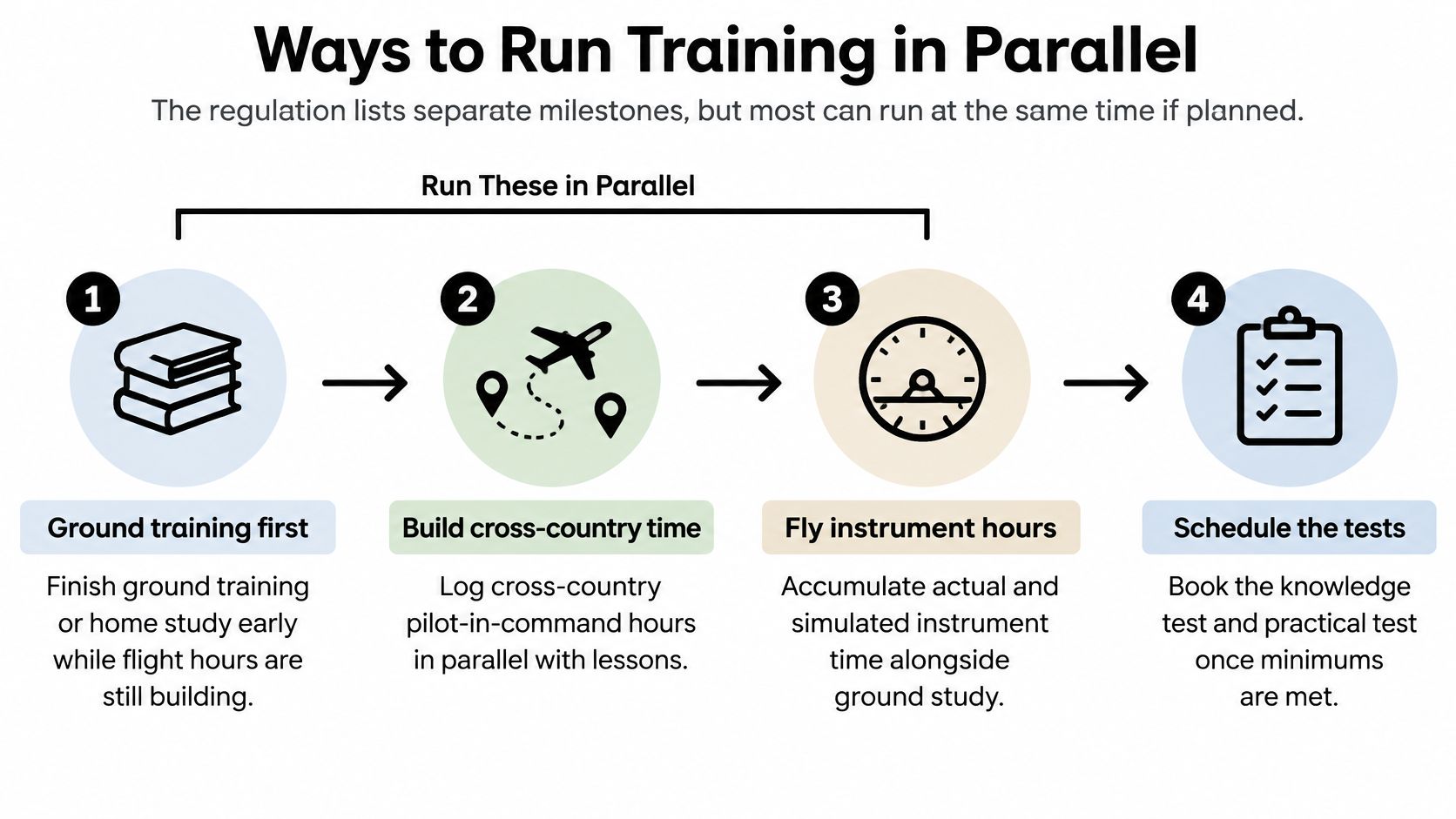
14 CFR 61.65 requires ground training or an approved home-study course covering the aeronautical knowledge areas, an endorsement before the knowledge test, the test itself, the instrument training, a separate practical-test endorsement, and the practical test. Treat that list as a schedule to overlap rather than a queue.
- Finish ground training while you're still building flight hours. Ground school has no weather dependency. Work through it in the weeks you're flying cross-country so the theory lands before the procedures arrive.
- Take the knowledge test as soon as the endorsement is ready. A passed written test that sits in a folder for two months is a milestone you finished early. An unpassed one is a blocker that surfaces at the worst possible time. Once your practice scores are consistently above the passing mark, book it. The instrument rating written test is mostly a study-discipline problem, not a flying problem.
- Back-time the final training block. Work backward from a target checkride date so the last airplane sessions fall inside the recency window instead of expiring before the examiner is free.
- Book the examiner before the last training block. This is the step students skip. Scheduling runs weeks out in busy airspace, and the delay is what pushes a March finish into May.
- Protect the slots like appointments. Book the airplane a week ahead, keep one instructor where possible, and hold a backup day each week for weather. Fly the day after a cancellation rather than waiting for the next scheduled lesson.
Practical rule: if two milestones can run in the same week, run them in the same week. Sequential planning is what turns a four-month rating into a seven-month one.
The parallel approach works because flight training is a set of recurring commitments rather than a checklist you attack from the top. Blocking fixed time for lessons, ground study, and simulator sessions, the same way you'd handle task intervals instead of to-do lists in any other busy period, keeps the work moving when one item slips.
One caution. Compressing the calendar is not the same as skipping proficiency. If you shave weeks by testing before your approaches are stable, you'll pay them back in extra training after a disapproval. Finish on skill, then let the calendar catch up.
Choose Your Realistic Timeline and First Step
Match your starting point in the first table to a schedule you can hold for the whole training, not just the first month, then add a buffer for weather. Three checks settle it.
Confirm your cross-country hours against the 50-hour and 250-nautical-mile requirements before you budget anything. That gap, not the 40 instrument hours, decides whether you start instrument work next month or next spring. Decide between Part 61 and Part 141 by asking how much outside structure you need to keep showing up. Pick a schedule you can sustain at two or more lessons a week, because anything less stretches the same syllabus into the weekend-only column.
Then take the first step that matches where you are. If you've never flown, a discovery flight needs no experience and answers the only question that matters first, which is whether you want to keep going. If you already know you want the full path from zero time to CFII, our Career Track runs about nine months from first lesson to instructor and multi-engine, with 282 total hours, six certificates and ratings, and a fixed $89,000 tuition, flying out of Riverside, Long Beach, and Corona.
Before committing anywhere, ask for four things in writing: aircraft age, students per airplane, instructor turnover, and the total price. A school that hesitates on any of them is telling you something. Our guide to how to choose a flight school walks through the rest of the questions worth asking.
CFII trains pilots in Southern California with one-on-one instruction, a factory-new glass-cockpit fleet, and simulator sessions that let you keep flying when the marine layer shuts the airport down. Whether you're adding an instrument rating to an existing certificate or starting from zero, the schedule is built around how often you can fly. Visit CFII to see the Career Track, book a discovery flight, or talk through a timeline that matches your starting point.
Planning to fly for a living?
See what the path from zero to a pilot career looks like, what it costs and how long it takes.
Learn to fly in Riverside
We train at Riverside Municipal Airport in modern airplanes with a parachute built in. Start with a one hour discovery flight, no experience needed.