On this page
- Ground School Topics at a Glance
- What these subjects look like in practice
- In-Person, Online and Blended Ground School Compared
- Choose the trade-off you can manage
- Questions before you pay
- From Memorized Facts to Cockpit Decisions
- Work the situation, not the answer bank
- Check whether you can defend your choice
- Flight Hours and Endorsements Ground School Cannot Replace
- Solo permission lives in your logbook
- Track readiness as carefully as flight time
- Study Resources and a Sequence That Works
- Build a useful reference shelf
- Follow a blended progression
- Choose Your First Step Toward Ground School
- If you haven't flown yet
- If you're planning a flying career
You've started looking at flight training, and suddenly there's another course to understand before you even know what the cockpit controls do. Private pilot ground school is where you learn why a flight is legal, whether the airplane can perform safely, and when the right decision is to stay on the ground.
If you're aiming for a flying career, treat this as the beginning of your professional judgment, not just an exam to get out of the way. The useful question after every lesson is simple: What would this knowledge make me do differently in an airplane?
Ground School Topics at a Glance
The FAA requires ground training across prescribed aeronautical knowledge areas. An approved Part 141 private-pilot airplane course must include at least 35 hours of ground training, according to Part 141, Appendix B. That's academic instruction, not flight time, and it isn't a universal classroom-hour requirement for every training pathway.
Ground school connects rules, technical knowledge, and pilot judgment. Use this syllabus map to understand what you're studying and what you should eventually be able to do with it.
Core ground school topics and what each one teaches
| Topic | What You Learn | Scenario You Must Solve |
|---|---|---|
| Regulations and airspace | Who may fly where, required documents, right-of-way | Go or no-go near restricted airspace |
| Weather | Reading METARs, TAFs and forecasts | Delay, divert or go on a marginal forecast |
| Navigation | Charts, pilotage, dead reckoning, fuel planning | Divert when winds change en route |
| Aircraft systems and performance | Engine, electrical system, weight and balance, density altitude | Hot, high-altitude takeoff with a heavy load |
| Aeromedical factors | Hypoxia, fatigue, medication limits | Flying while feeling unwell |
| Emergency operations | Engine failure, fire, lost communications | Choosing a forced landing field |
| Risk management | Combining all topics into a go or no-go decision | Scheduling a flight around an approaching front |
What these subjects look like in practice
You don't need aviation experience to begin. A METAR describes observed airport weather, while a TAF forecasts conditions at an airport. You'll learn to decode them, then compare the information with your route, the surrounding terrain, and your own limitations.
Navigation starts with knowing where you are and where you intend to go. Pilotage means navigating by recognizable landmarks; dead reckoning uses heading, speed, time, and wind to estimate your position. Fuel planning turns that route into a practical question: can you reach a suitable landing place with an appropriate reserve?
Aircraft performance makes seemingly simple decisions more demanding. An airplane that can physically accommodate passengers and baggage may still exceed a loading limit or lack adequate takeoff performance in hot conditions. You'll use the aircraft's approved information, not an impression of how much runway looks sufficient.
Practical rule: A correct definition is the start of understanding. A defensible flight decision is the goal.
Aeromedical lessons apply the same discipline to you. Feeling tired, taking medication, or becoming unwell belongs in the departure decision just as much as the weather does.
Compare any course syllabus against this list. Ask whether each topic ends with a calculation, explanation, or decision you can demonstrate, rather than a definition you can repeat.
In-Person, Online and Blended Ground School Compared
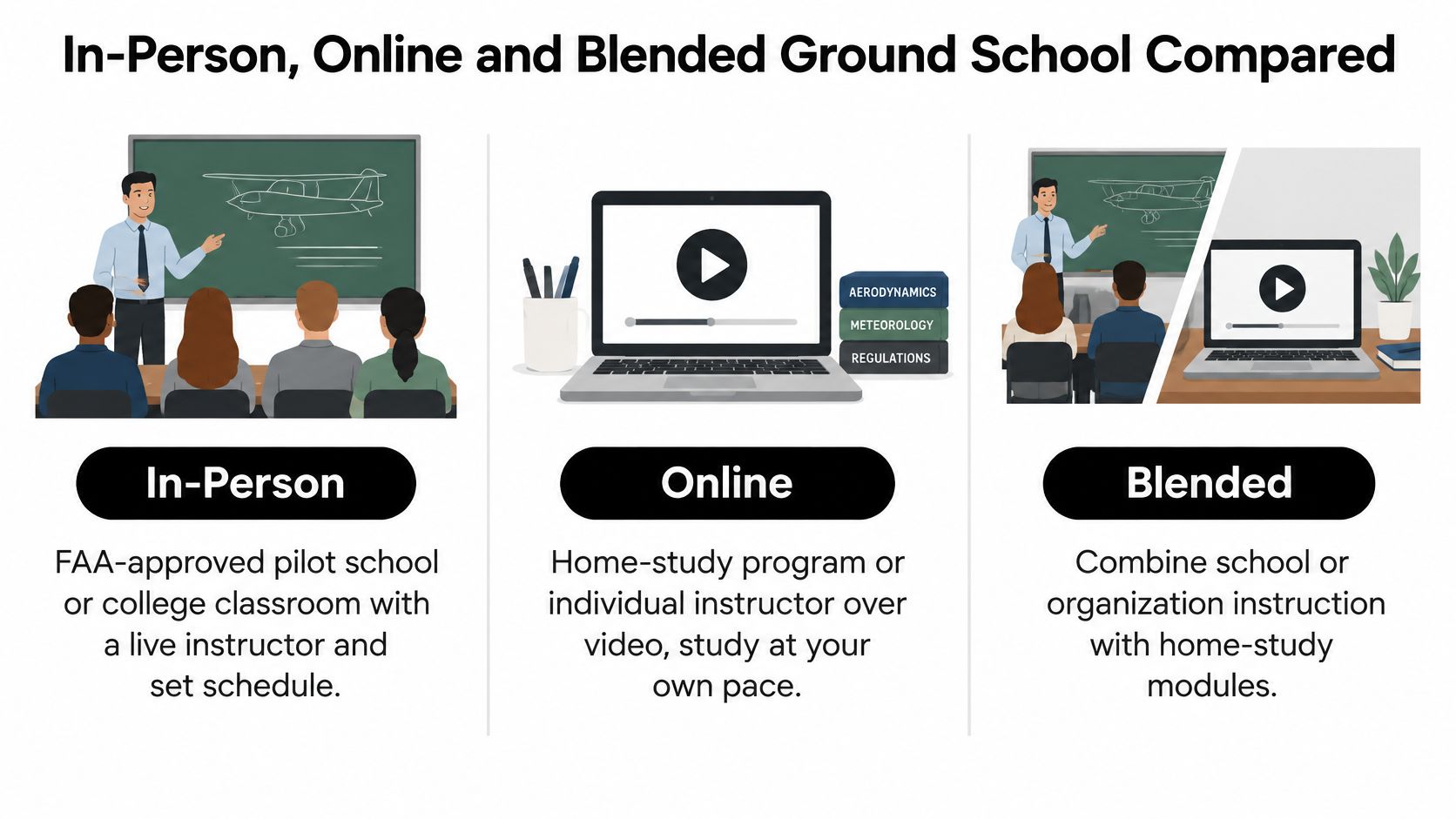
Ground instruction can come through pilot schools, colleges, aviation organizations, individual instructors, or home-study programs, provided you obtain the appropriate knowledge-test endorsement or documentation. Your best format is the one you'll use consistently and that gives you a reliable way to resolve misunderstandings.
Ground school delivery formats compared
| Format | Schedule | Instructor Access | Pace | Best For |
|---|---|---|---|---|
| In-person classroom | Fixed weekly sessions | Live questions in the room | Set by the class | Students who need deadlines and peers |
| Live online class | Fixed sessions | Live instructor by video | Set by the class | Students far from an airport |
| Self-paced online course | Anytime | Forum or email support, when included | Student-driven | Self-disciplined students with busy schedules |
| One-on-one with an instructor | Arranged around you | Full access during booked instruction | Adjusted to your gaps | Students who want a tailored pace |
| Home study | Anytime | Limited, often by request | Student-driven | Students with prior study experience |
Choose the trade-off you can manage
Scheduled classes give your study week a fixed shape. You can ask questions immediately and hear explanations prompted by classmates, but missed sessions need a catch-up plan.
Self-paced online study works around shift work and family responsibilities. Its weakness is easy to overlook: finishing a video doesn't demonstrate understanding. Close the lesson and explain the decision without looking at the answer.
One-on-one instruction concentrates attention on your gaps, but dedicated instructor time can cost more than shared instruction. A blended arrangement can pair independent reading with instructor-led problem solving, rather than spending the entire appointment encountering material for the first time.
Questions before you pay
We recommend asking every flight school, including ours, these questions:
- Aircraft age: What airplanes will you train in, and how is maintenance downtime handled?
- Students per airplane: How does aircraft availability affect the schedule you're considering?
- Instructor turnover: What happens to your training plan if your instructor leaves?
- Written total price: What's included, excluded, and payable separately?
- Training framework: Is the program Part 61 or Part 141?
- Try before committing: Can you fly with an instructor before making a longer commitment?
The distinction between Part 61 flight schools and approved school curricula deserves attention, but it doesn't determine whether you personally learn best in a classroom or independently.
Choose scheduled sessions if you need deadlines to keep studying. If you already work well alone, self-paced learning may suit you, provided you've arranged instructor help for questions that don't resolve themselves.
From Memorized Facts to Cockpit Decisions
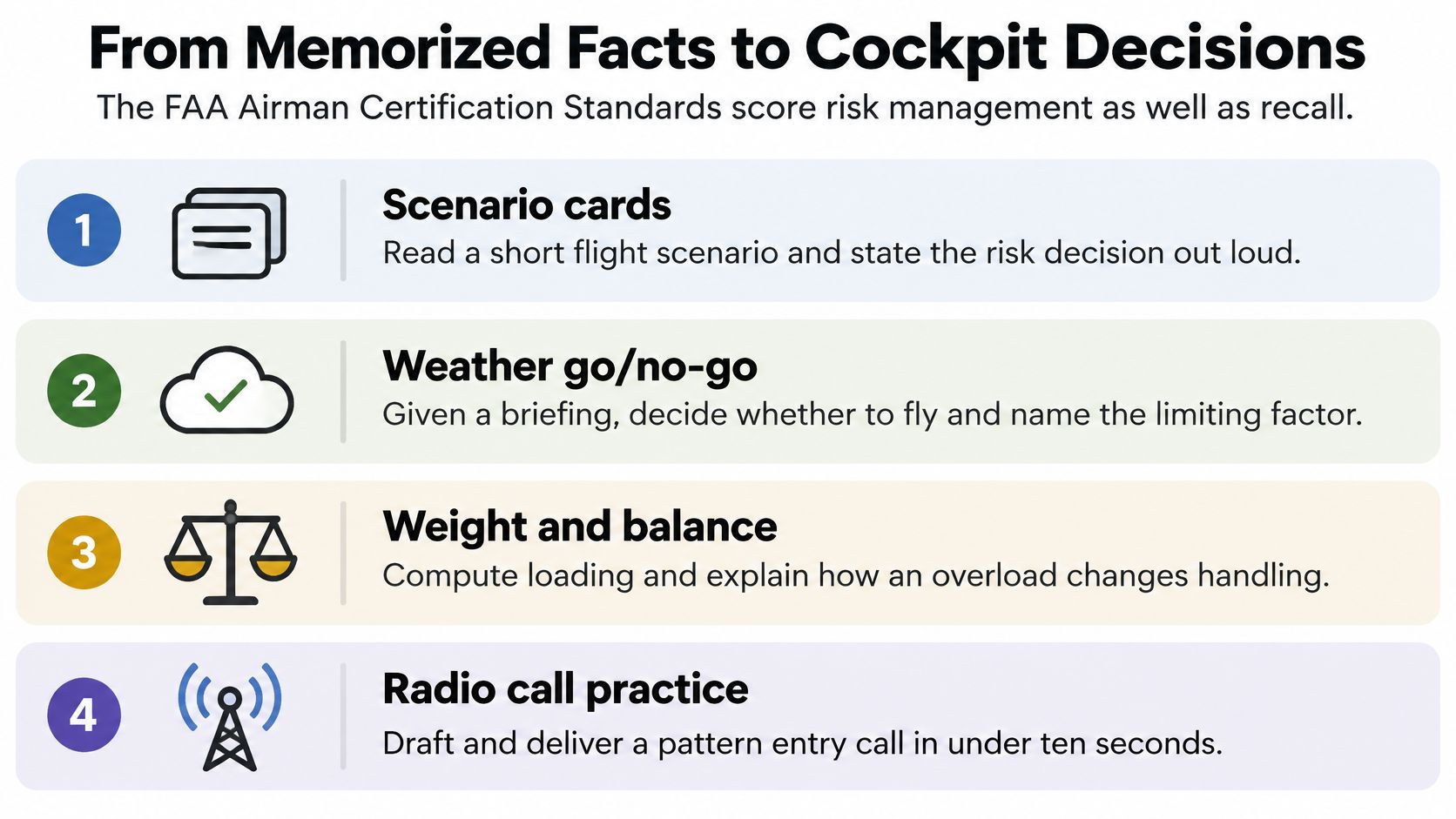
Passing the knowledge test doesn't prove you can manage a flight scenario. The FAA's Private Pilot Airplane Airman Certification Standards integrate knowledge, risk management, and flight skills. An examiner needs to hear how you apply information, not just recognize the correct multiple-choice answer.
The FAA's knowledge-test guidance also distinguishes the knowledge test from the practical test, whose ground portion must be passed before its flight portion begins. Knowledge-test readiness and checkride readiness are different milestones.
Work the situation, not the answer bank
Use these hypothetical drills with your instructor. Each connects an ACS subject to an operational consequence.
- Deteriorating weather: On a cross-country, the forecast ceiling drops from 3,000 to 1,500 feet. Check applicable visual-flight visibility and cloud-clearance requirements for the airspace, terrain clearance, and your personal minimums. Decide whether to continue, divert, or land before your options narrow. Don't treat a ceiling alone as proof that a route is safe or legal.
- An airspace deviation: You drift across a controlled-airspace boundary without the required authorization, or toward active restricted airspace. Maintain aircraft control, establish your position, and contact the appropriate air traffic control facility. Explain your situation plainly, follow instructions, and distinguish immediate radio communication from any subsequent reporting obligation. Don't make an abrupt avoidance maneuver that creates another hazard.
- A shrinking fuel reserve: Headwinds increase and your expected fuel remaining falls. Recalculate using usable fuel, actual consumption, and revised groundspeed. Work backward from your planned landing reserve to identify the latest diversion point, then choose an earlier action point that preserves options.
- Abnormal oil pressure: Halfway through a flight, the indication becomes abnormal. Fly the airplane first, then use the aircraft-specific abnormal or emergency procedure. Cross-check related indications, identify a suitable landing option, and explain why troubleshooting must not distract you from a developing engine problem.
Check whether you can defend your choice
For each drill, state the applicable rule or aircraft limitation, explain why it applies, and describe what would change your decision. In the weather example, ask what you'd do if the ceiling dropped another hypothetical 500 feet.
Don't stop at identifying the hazard. Explain what you'll do, when you'll do it, and what happens if you delay.
Use the Airman Certification Standards guide to organize your review around tasks rather than isolated trivia. Before the practical test, run these drills against your own course material and keep a gap log of anything you couldn't explain without notes.
Flight Hours and Endorsements Ground School Cannot Replace
Ground school does not replace the aeronautical experience you must log. The regulatory minimum is also not a prediction of your completion time: proficiency, training continuity, and the approved syllabus determine when you're ready.
For the standard Part 61 airplane single-engine pathway, 14 CFR § 61.109 establishes the flight-time requirements summarized below. The experience categories sit within the required totals; they aren't all extra hours to add together.
Flight training minimums for the airplane private certificate
| Requirement | Minimum | Source |
|---|---|---|
| Total flight time, airplane private certificate | 40 hours | 14 CFR 61.109 |
| Flight training with an authorized instructor | 20 hours | 14 CFR 61.109 |
| Solo flight training | 10 hours | 14 CFR 61.109 |
| Cross-country instruction | 3 hours | 14 CFR 61.109 |
| Night training | 3 hours | 14 CFR 61.109 |
| Instrument-reference training | 3 hours | 14 CFR 61.109 |
| Instructor training in the two calendar months before the practical test | 3 hours | 14 CFR 61.109 |
| Part 141 approved private-pilot airplane course flight training | 35 hours | 14 CFR Part 141, Appendix B |
The approved-course flight-training minimum of 35 hours comes from Part 141, Appendix B. Don't confuse that flight-training provision with the separate ground-training requirement.
Solo permission lives in your logbook
Under 14 CFR § 61.87, you must receive and log applicable maneuver and procedure training for the aircraft make and model, and obtain an authorized instructor's logbook endorsement before solo; night solo requires a separate aircraft-specific endorsement following the required training within the preceding 90 days.
Reaching an hour total doesn't authorize you to take the airplane alone. Your instructor must determine that you're prepared, and the endorsement's aircraft and operating limitations matter.
For the standard student-airplane pathway, arrange a third-class FAA medical certificate with an aviation medical examiner before solo. You can take a discovery flight and initial lessons before obtaining it, but a career-minded student should address medical eligibility early rather than leave uncertainty until solo preparation.
Track readiness as carefully as flight time
Keep an endorsement list alongside your logbook. Record what each endorsement permits, any limitations, and the next action needed to remain eligible for the flight you're planning.
Use a flight-training requirements checklist to separate completed instruction from authorized privileges. Before your practical test, have your instructor review both your experience totals and the recency window for final preparation.
Logbook check: An entry showing that you practiced a maneuver isn't automatically an endorsement authorizing solo flight.
Ground preparation earns its value when you arrive ready to explain the procedure, brief the risks, and use the flight lesson to practice rather than encounter every concept for the first time.
Study Resources and a Sequence That Works
Build the calendar backward from the flights that will use the knowledge. Front-loaded study establishes regulations, aeromedical factors, aircraft documents, and basic weather before flying. Blended study starts those foundations early, then pairs operational topics with the flights that make them concrete. Fully integrated study ties every block closely to the next lesson, which can work for a student already flying consistently.
For a zero-time student, the blended approach usually gives the best return. You need enough background to understand the instructor's briefing, while navigation and weather judgment become easier once you have seen the workload from the cockpit. The FAA private-pilot certification framework supports scenario-based preparation. A passed knowledge test has a 24-calendar-month validity period, so plan testing against a realistic checkride date using the FAA knowledge-test guide.
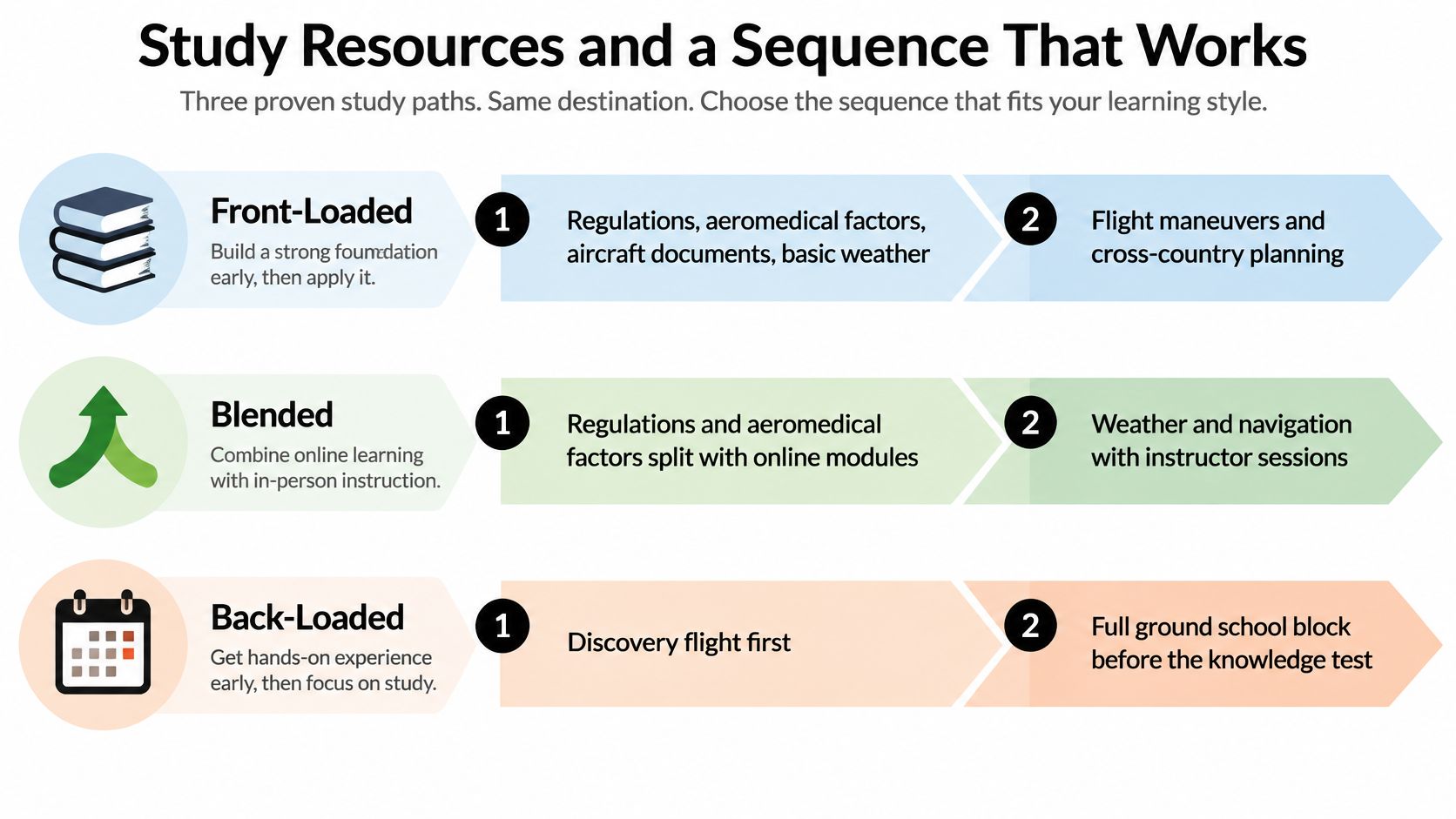
The back-loaded option shown above postpones the main study block until after initial flying. Used badly, it turns early lessons into expensive first exposure; used well, it still begins with enough rules, documents, and airspace knowledge to make each flight purposeful.
Build a useful reference shelf
Treat the Private Pilot Airplane ACS as the grading rubric: every task should eventually be explainable, applied, and defended. Read the Pilot's Handbook of Aeronautical Knowledge for concepts such as lift, density altitude, weather theory, and aeromedical factors. Use the Airplane Flying Handbook for maneuver and operating explanations.
Keep the Aeronautical Information Manual, 14 CFR Parts 61 and 91, current sectional charts, and a flight computer available for applied work. Your aircraft's operating handbook supplies the performance figures, limitations, and procedures for the airplane you fly, which is where ground knowledge becomes takeoff, fuel, and diversion decisions.
Follow a blended progression
- Begin with regulations and documents. During the opening block, learn pilot privileges, aircraft paperwork, airspace basics, and how to find the rule behind an answer.
- Add weather and aeromedical judgment. Use regular quizzes, then explain the errors aloud. Connect those subjects to local conditions, aircraft limitations, and the decision to delay, reroute, or continue.
- Develop cross-country planning alongside flying. Once the traffic pattern is reliable, work through routes, radio calls, navigation, fuel, and diversion choices with your instructor before the corresponding flights.
- Schedule the knowledge test deliberately. Use consistent practice results and a realistic completion plan. Passing the written proves knowledge-test readiness; the checkride also requires explaining the same material while managing the airplane.
- Revisit ACS gaps regularly. Mark each task as explainable, applicable with help, or independently defensible, and focus review on the weakest category.
Make milestones observable: explain the departure decision before early solo work, produce and defend a route before cross-country training, and solve unfamiliar scenarios before the checkride. Ground school is the flight plan; flying is the trip. A student who understands the plan can explain why the route was chosen, not merely arrive at the destination.
Choose Your First Step Toward Ground School
Choose according to the uncertainty you need to resolve. If you haven't flown, you need to find out what instruction feels like in an airplane. If you're committed to a career change, you also need to evaluate the scope, schedule, and financial commitment of a complete training path.
If you haven't flown yet
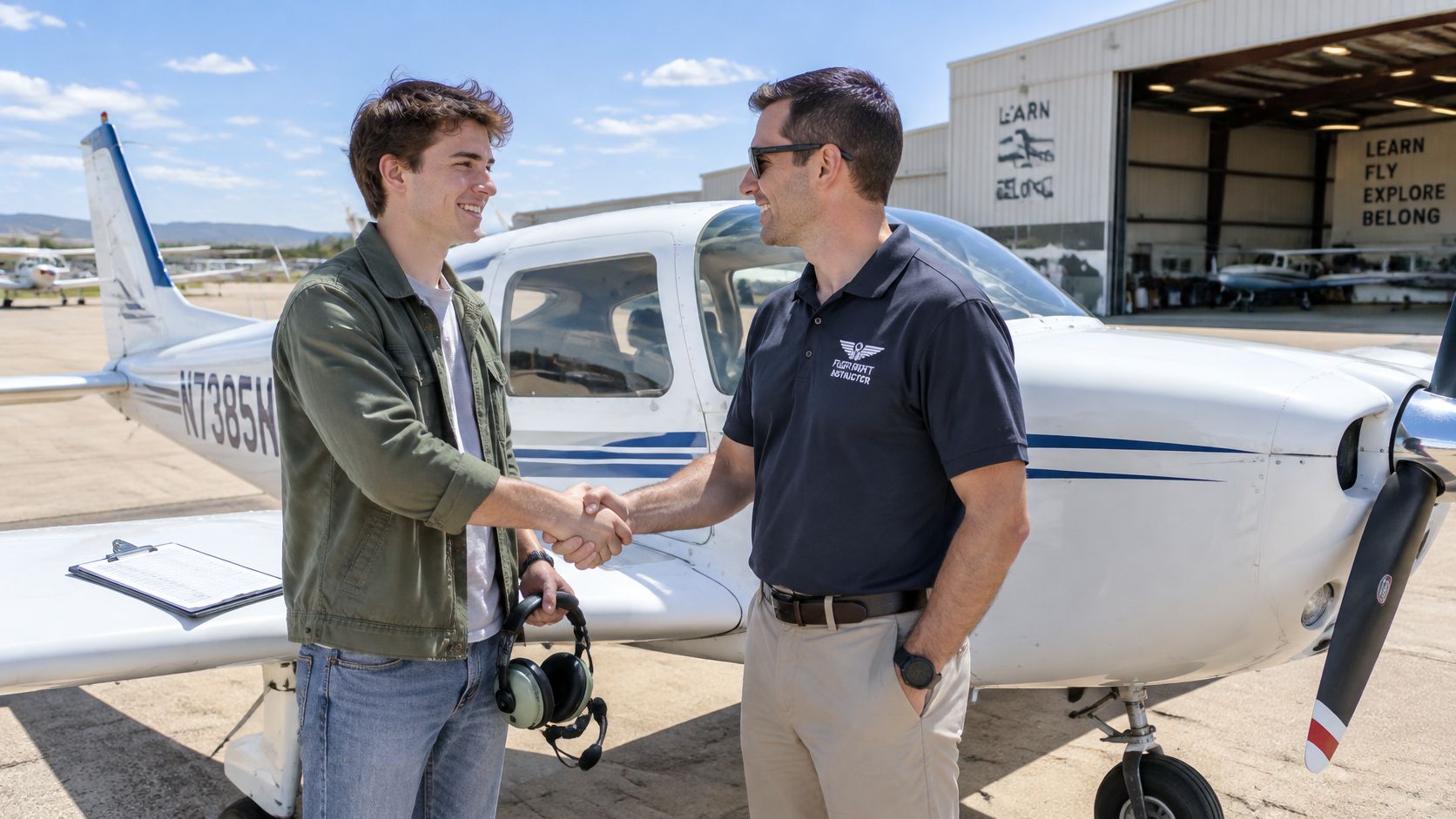
A discovery flight is lesson one, not an experience you must prepare for by already knowing aviation. You meet the instructor, preflight the airplane together, and take the controls in the air, with no prior experience needed.
Use that time to evaluate the teaching. Can you follow the explanation? Does the instructor make room for questions? When you don't understand something, does the next explanation help?
We also invite prospective students to walk the hangar, sit in a cockpit, and meet the instructors before committing. Those conversations can help you decide whether you want scheduled study, independent preparation, or a combination.
If you're planning a flying career
CFII's Career Track has fixed $89,000 tuition, takes about nine months from zero time to CFII and multi-engine, and includes 282 total hours and six certificates and ratings. It's based in Southern California, in Riverside, Long Beach, and Corona.
Evaluate that commitment against your actual availability. Consider whether you can protect study time, arrive prepared for lessons, and maintain the continuity an intensive training plan requires. A career goal gives you direction, but your daily preparation is what you control.
- Clarify the learning arrangement: Decide whether you need scheduled accountability or can sustain independent study.
- Understand the administrative steps: Review the student pilot certificate process so paperwork doesn't become a last-minute surprise.
- Test the instructional fit: Use an introductory lesson and instructor conversation to judge how explanations translate into actions.
Before booking, choose the study format you can realistically maintain and bring the delivery-format questions to the conversation. You don't need to arrive knowing how to fly. You do need a plan for learning why each cockpit decision makes sense.
CFII offers discovery flights before you commit and a Career Track for students pursuing a full training path. Visit CFII to meet the instructors, discuss how ground study fits your goals, and choose a first step that matches your experience.
Planning to fly for a living?
See what the path from zero to a pilot career looks like, what it costs and how long it takes.
Learn to fly in Riverside
We train at Riverside Municipal Airport in modern airplanes with a parachute built in. Start with a one hour discovery flight, no experience needed.