

On this page
- Which Airman Certification Standard Covers Each Certificate
- Governing ACS and Minimum Experience by Certificate
- How to Use This Lookup
- Reading an ACS Task and Why the FAA Replaced the Practical Test Standards
- Read From the Top Down
- A Short Worked Example
- Private Pilot and Instrument Checkride Requirements
- Private Certificate Minimums to Verify in Your Logbook
- Minimums Are Not Readiness
- Using ACS Codes to Plan Training and Stage Checks
- Training Stage, ACS Items and Evidence to Record
- Match the Checklist Method to the Task
- Tolerances, Risk Management and Crew Coordination on Checkride
- What Turns a Deviation Into a Failure
- The Behavioral Side of the Grade
- Sequence and Possible Outcomes
- How Test Day Usually Unfolds
- How Commercial, Instructor and Instrument Standards Connect
- The Instrument Rating as the Connecting Example
- Watch the Multiengine Limitation
- Choose Your Next Step Toward Your Certificate
Which certificate are you working toward, and what standard will the examiner use to assess you? The examiner's scoring document is public, so you can read it before your first flight.
Students who ask first about required flight hours are checking one part of the picture. The Airman Certification Standards, or ACS, also describe the knowledge, risk-management decisions, and flying skills you must demonstrate. Read the standards as a progression: each certificate builds on pilot-in-command tasks and expects you to apply them with greater responsibility.
Which Airman Certification Standard Covers Each Certificate
Start with this lookup before you open any textbook. Find your target certificate, note its governing standard, then confirm the core regulation that controls the experience you must log.
Governing ACS and Minimum Experience by Certificate
| Certificate or rating | Governing ACS | Core regulation | Key minimum |
|---|---|---|---|
| Private Pilot Airplane | Private Pilot Airplane ACS | 14 CFR 61.109 | 40 hours total, 20 dual, 10 solo |
| Instrument Rating Airplane | Instrument Rating Airplane ACS (FAA-S-ACS-8) | 14 CFR 61.65 | 40 hours instrument training, 50 hours cross-country PIC |
| Commercial Pilot Airplane | Commercial Pilot Airplane ACS | 14 CFR 61.129 | 250 hours total time |
| Multiengine Rating Airplane | Multiengine airplane ACS | 14 CFR 61.63 for an additional class rating | Meet ACS tasks; verify current hour requirements in the rule |
| Certified Flight Instructor Airplane | Flight Instructor Airplane ACS | 14 CFR 61.183 | Commercial certificate and instructor eligibility |
| Instrument Instructor (CFII) | Flight Instructor Airplane ACS with Instrument Rating Airplane ACS | 14 CFR 61.183 | Instrument rating plus instructor privileges |
That table separates two questions beginners often merge. The regulation says what you must have logged before you're eligible. Hours, types of flights, and required training live there. If your logbook doesn't meet the regulation, you can't take the practical test, no matter how smoothly you fly.
The ACS says what you must demonstrate once you're eligible. It doesn't replace the hour requirement, and logging the hours doesn't prove you meet the standard. You need both. Think of the regulation as the entry ticket and the ACS as the scoring sheet the examiner uses during the test itself.
How to Use This Lookup
- Pick one target first: Don't study commercial tasks while you still need private pilot fundamentals, because each standard builds on earlier work.
- Check the revision: Open the current version of your target standard on faa.gov before you build a study plan, because a revised ACS replaces the earlier version.
- Map your training record: Keep your logbook hours and your ACS task progress side by side, so a gap in either one is visible early.
If you want the eligibility side explained in more detail, work through the flight training requirements for each certificate and rating and compare each requirement with your own logbook or training plan. That simple habit prevents the common surprise of reaching the hour minimum while still missing a specific kind of flight or endorsement.
Reading an ACS Task and Why the FAA Replaced the Practical Test Standards
The older system was called the Practical Test Standards, or PTS. For instrument applicants, the FAA's Airman Certification Standards page records that FAA-S-8081-4E Instrument Rating Practical Test Standards was issued in January 2010 and FAA-S-ACS-8 was first published on June 1, 2016, with FAA-S-ACS-8A following on June 12, 2017. The change wasn't cosmetic. The FAA wanted one document that connected the written knowledge test, judgment, and flying skill instead of treating them as separate hurdles.
Under the ACS, you're not judged only on whether you can perform a maneuver. You're also judged on whether you understand the relevant risks and can make sound operational decisions about weather, aircraft limits, navigation reliability, workload, and fuel margins.
Read From the Top Down
Every certificate is divided into Areas of Operation, such as preflight preparation, takeoffs and landings, or navigation. Each area contains tasks, and each task opens with an objective that tells you what you must know, consider, and do.
Within a task, every individual element gets a unique code. According to the FAA ACS informational brochure, each task combines aeronautical knowledge, risk management, and flight proficiency, and each element receives a unique identifier so instructors can map lessons, stage checks, and test deficiencies to the same standard.
Take a private pilot code such as PA.I.A.K1 and read it left to right.
- PA means Private Pilot Airplane: It tells you which certificate standard you're in.
- I means Area of Operation I: Roman numerals identify the broad phase or subject area.
- A is the task letter: Tasks inside an area are labeled in sequence.
- K1 is the element: K means knowledge, R means risk management, and S means skill, followed by a number for that specific element.
A Short Worked Example
Say a task covers weather information. The knowledge element might produce a question about which weather products you need before departure. The risk element might require a decision about departing toward deteriorating visibility with limited fuel. The skill element, where one applies, might require you to obtain and use that information during planning or flight. One objective therefore produces a question, a decision, and an action, each tracked by its own code.
If you can't name the code for a weak task, you can't reliably find it again in your next lesson.
Keep a running list of codes for tasks you're weakest on. Bring that list to ground school, review it before each flight, and ask your instructor to score you against those exact elements. That's how the ACS becomes an auditable training tool instead of a study outline you read once and forget.
Private Pilot and Instrument Checkride Requirements
Work through the private requirements in the order you'll meet them, and check each one against your logbook rather than your memory.
Private Certificate Minimums to Verify in Your Logbook
| Requirement | Minimum | Regulation |
|---|---|---|
| Total flight time | 40 hours | 14 CFR 61.109(a) |
| Flight training with an authorized instructor | 20 hours | 14 CFR 61.109(a) |
| Solo flight training | 10 hours | 14 CFR 61.109(a) |
| Instrument-reference instruction | 3 hours | 14 CFR 61.109 |
| Practical test preparation | 3 hours within the two calendar months before the test | 14 CFR 61.109 |
| Solo cross-country | At least 150 nm total distance, full-stop landings at three points, one leg over 50 nm | 14 CFR 61.109(a) |
| Part 142 graduate exception | 35 hours total, not automatic for Part 61 training | 14 CFR 61.109 |
14 CFR 61.109(a) requires at least 40 hours of logged flight time, including at least 20 hours of flight training with an authorized instructor and 10 hours of solo flight training, plus at least 3 hours of instrument-reference instruction and 3 hours of preparation within the preceding two calendar months for the practical test. The solo cross-country must cover at least 150 nautical miles total distance, with full-stop landings at three points and one leg exceeding 50 nautical miles between takeoff and landing locations.
Those details trip people up because they count total hours and stop there. A student can reach 40 hours and still be short on a specific component, such as recent test preparation or the required solo cross-country shape. Circle dates as well as hours, because the two calendar month window can expire if a checkride is delayed.
Minimums Are Not Readiness
These are FAA minimums, not a promise that you'll be ready at exactly 40 hours. Weather, aircraft availability, proficiency, and performance on knowledge and practical test tasks can all require more training. The reduced 35-hour total applies only to certain graduates of an approved Part 142 training center course and doesn't apply automatically to ordinary Part 61 training.
You'll need a third-class FAA medical certificate from an aviation medical examiner before you fly solo, but you can take a discovery flight and your first lessons before obtaining one. Don't let paperwork sequencing confuse you. Start learning, but schedule the medical early enough that it doesn't block your first solo.
Before you schedule, verify total, dual, and solo time, instrument-reference instruction, recent preparation, the qualifying cross-country, your knowledge test result, medical, and endorsements. A focused private pilot checkride preparation checklist helps you turn that logbook review into a final readiness check instead of a last minute scramble.
Using ACS Codes to Plan Training and Stage Checks
A standard only helps if you convert it into a sequence of lessons and records. Use this table as your planning reference.
Training Stage, ACS Items and Evidence to Record
| Training stage | ACS items to use | Evidence to record |
|---|---|---|
| Ground school | Knowledge elements for each task | Quiz scores logged by ACS code |
| Stage check | Whole areas of operation against published tolerances | Tolerance numbers and corrective-action timing |
| Pre-solo preparation | Private Pilot Airplane ACS tasks for solo-related areas | Instructor sign-off tied to codes |
| Written test preparation | Knowledge elements for weak tasks | Missed questions mapped to codes |
| Practical test preparation | Full task list with risk management and skill | Mock checkride score sheet |
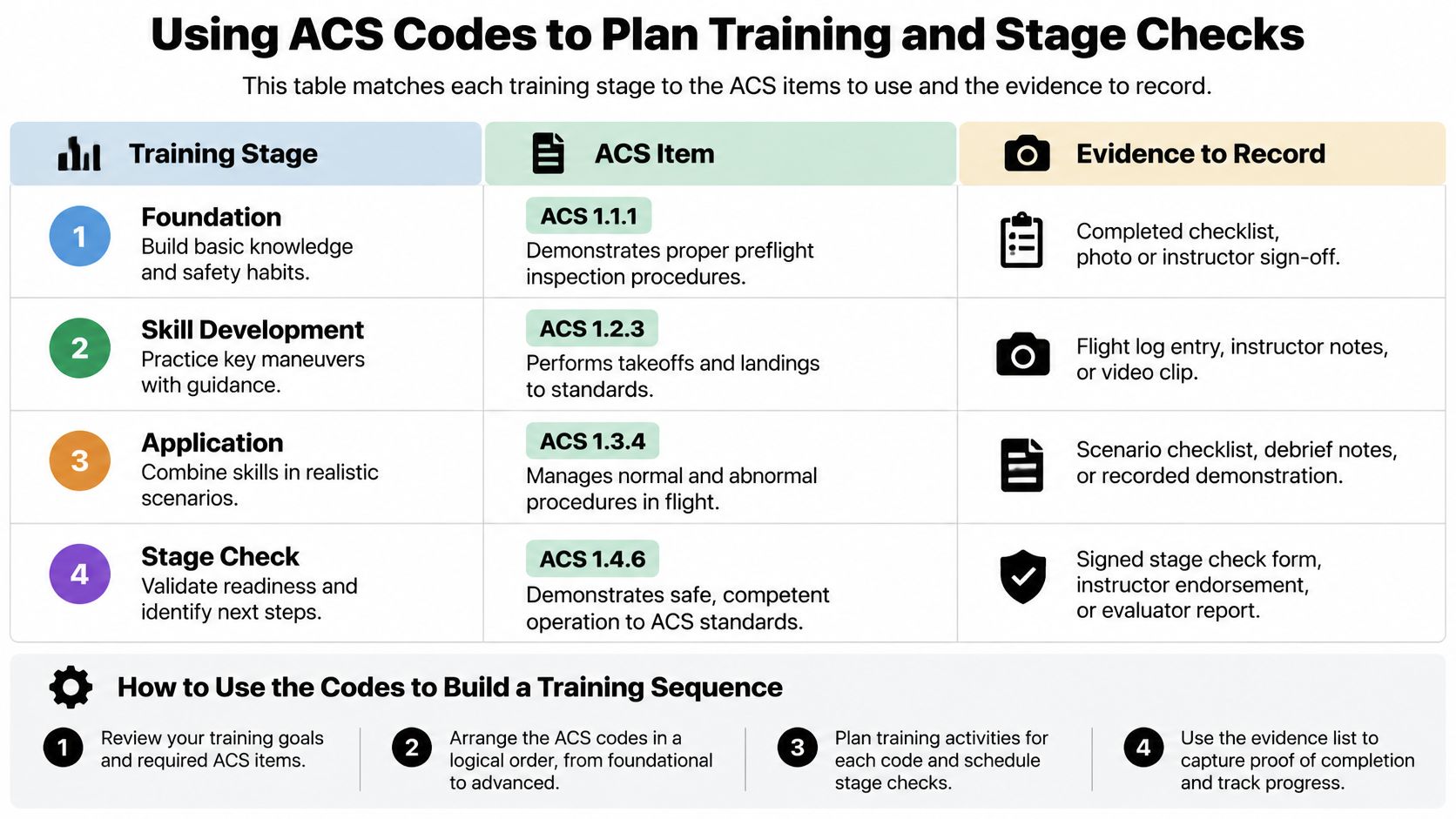
In ground school, don't record only a percentage score. Record which knowledge codes produced the missed questions, because two students with the same score can have completely different gaps. One may miss weather, the other regulations. Their next study sessions shouldn't be identical.
Stage checks work differently. Your instructor tests whole areas of operation against the published tolerances, then records both the numbers and how quickly you corrected a deviation. Pre-solo review narrows the focus to the tasks tied to solo readiness, while written test preparation returns to your weakest knowledge codes. Practical test preparation widens again to the full task list, scored like a checkride. If you're planning ahead, an instrument rating course syllabus built around ACS tasks shows how that same code-based structure carries into more advanced training.
Match the Checklist Method to the Task
Checklists deserve deliberate teaching, not casual imitation. We teach two methods. Use read-and-do for rare or high-stress tasks, where you read one item and complete it before moving on. Use do-then-confirm for routine flying, where you complete a practiced flow and then use the checklist to verify that nothing was missed.
Our checklist training references the FAA's Advisory Circular 120-71B on standard operating procedures and pilot monitoring duties. Our training also follows the FAA's Airplane Flying Handbook, which calls checklists the foundation of pilot standardization and flight deck safety. Confirm the exact checklist wording in the current Airplane Flying Handbook and FAA Standard Operating Procedures guidance before quoting it to a student or examiner.
Practical rule: A lesson without an ACS code isn't yet a measured lesson.
Write the code, tolerance, result, and correction for every lesson. Over several weeks, that record shows whether you're improving or just accumulating hours.
Tolerances, Risk Management and Crew Coordination on Checkride
An examiner evaluates each task against its own standard. A strong task does not offset a weak one, and a single deviation is judged in context: whether you noticed it, corrected it promptly, and managed the risk. Repeated deviations or a failure to correct can show that performance is not meeting the standard.
For private-pilot tasks, the ACS gives examples such as maintaining altitude within 100 feet, heading within 10 degrees, and airspeed within 10 knots. Check the Private Pilot ACS tolerance table for the exact tolerance that applies to the task. The required precision varies by task and certificate level.
What Turns a Deviation Into a Failure
The FAA commercial airplane ACS identifies consistently exceeding tolerances, or failing to take prompt corrective action after exceeding them, as grounds for an unsatisfactory result. A brief deviation that you recognize and correct promptly is different from one that goes unnoticed or continues to grow.
The examiner is looking for the pattern behind the error. Are you repeatedly outside the limits? Do you recognize the problem but fail to stabilize the aircraft? Do you continue a maneuver or approach when a go-around or missed approach is the safer choice? Those actions help show whether the cause is aircraft control, delayed recognition, or a risk-management decision.
The Behavioral Side of the Grade
Examiners also evaluate Crew Resource Management and Single-Pilot Resource Management, including situational awareness, communication, task allocation when applicable, and decision-making within standard operating procedures. In a single-pilot airplane, you manage the tasks a crew would otherwise share. The examiner observes how you prioritize flying, navigation, communication, and checklists when they compete for your attention.
Make your decisions observable. Brief passengers or students, state key risk decisions, manage workload before it spikes, and correct navigation errors promptly. If conditions call for a go-around or missed approach, make that decision clearly.
In the commercial ACS example, initiating a go-around because you cannot complete a task within its tolerances is unsatisfactory performance for that task. The go-around may still be the safe decision, but it does not turn the out-of-tolerance task into a pass.
Build the habits described in single-pilot resource management for checkride and real flying into your training. The examiner needs to see how you control the airplane, recognize and correct deviations, and respond to changing risks.
Sequence and Possible Outcomes
Test day has a fixed logic. Walk it in order so there are no surprises about when each part can stop the rest.
For the instrument practical test, you must pass the ground portion before the flight portion begins. Oral questioning may continue throughout the examination, so passing the ground portion doesn't mean the questions end when you start the engine. You may explain a weather decision at the table, then defend the same decision again while planning a diversion or flying an approach.
How Test Day Usually Unfolds
- Ground portion: The examiner covers the knowledge elements for each applicable task in the standard.
- Flight portion: You fly the areas of operation in order, with oral questions possible at any point.
- Task evaluation: The examiner judges each task against its tolerances, risk decisions, and corrective action.
- Outcome: The examiner issues one of three results and explains what happens next.
A satisfactory result produces a temporary airman certificate. An unsatisfactory performance produces a notice of disapproval. A test that can't be completed for reasons such as weather or an aircraft issue can produce a letter of discontinuance, which is different from failing.
A discontinuance pauses the test. A disapproval identifies tasks you must fix and retest.
If you receive a notice of disapproval, don't reschedule on emotion. Use the ACS codes tied to the unsuccessful areas, map each one to a specific training lesson, and practice until an instructor can score those elements as satisfactory. Then reschedule with evidence that the exact weakness has changed.
That's the practical value of the system. The same codes guide your study before the test, the examiner's evaluation during it, and your retraining plan if the result isn't a pass.
How Commercial, Instructor and Instrument Standards Connect
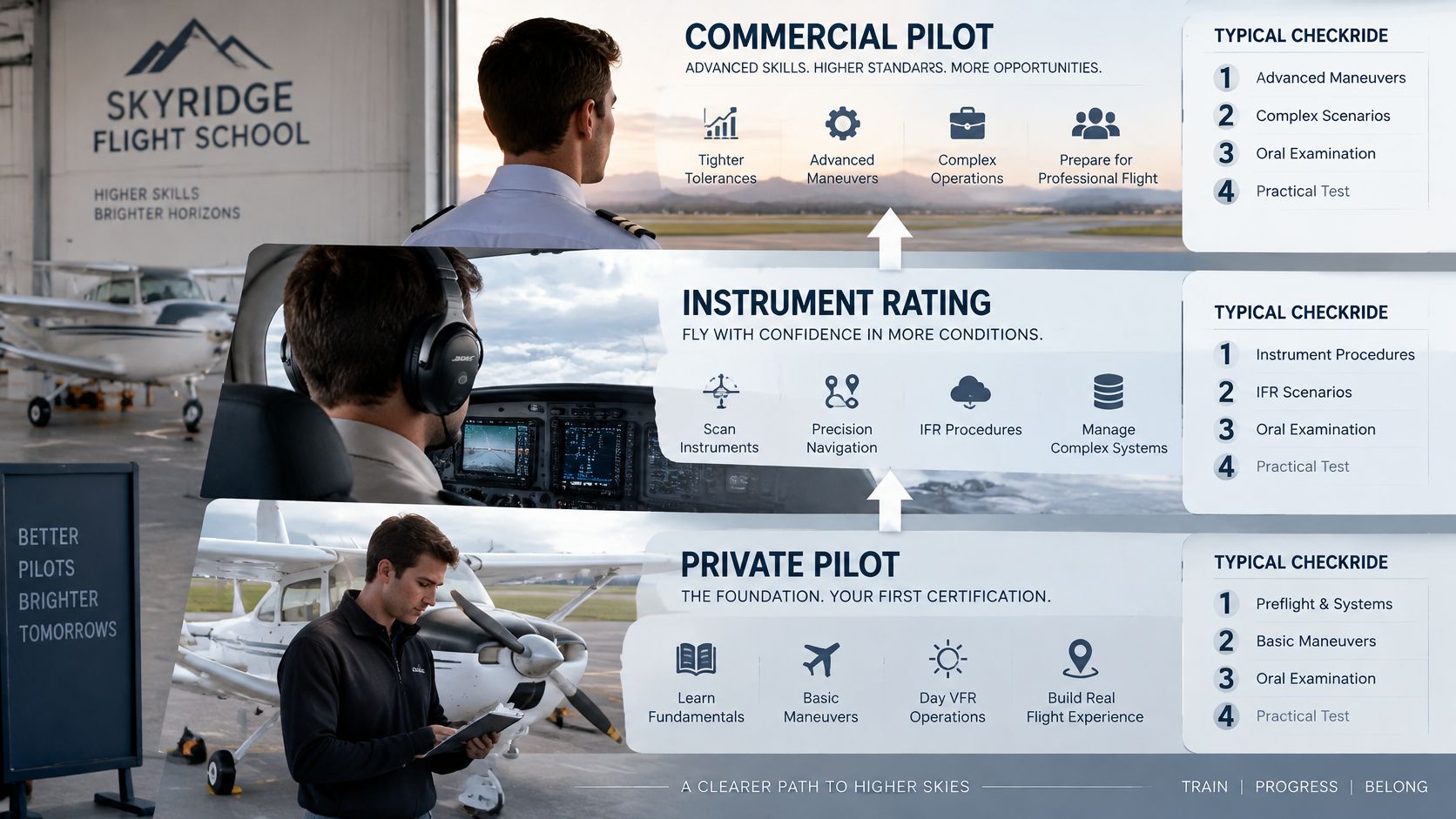
How does each new certificate build on the skills you already learned? The sequence is cumulative: private pilot standards establish basic pilot-in-command skills, instrument standards add instrument procedures, commercial standards demand greater precision and judgment, and instructor standards require you to teach and evaluate those tasks.
The Instrument Rating as the Connecting Example
The FAA Instrument Rating Airplane ACS says applicants must pass the ground portion before beginning the flight portion. For a combined private and instrument test under 14 CFR 61.65(a) and (g), applicants must pass all applicable areas in both the Private Pilot Airplane ACS and the Instrument Rating Airplane ACS. An instrument rating adds instrument knowledge, risk management, and proficiency on top of private pilot responsibilities.
The instructor step changes your role: you must hold a commercial certificate, meet instructor eligibility requirements, and show that you can explain, demonstrate, and correct tasks. Reviewing a CFI checkride guide focused on teaching tasks can help clarify how instructor standards extend the skills assessed in earlier certificates.
Watch the Multiengine Limitation
An instrument rating does not automatically remove a multiengine VFR-only limitation. A student who holds an instrument rating may still carry an Airplane Multiengine VFR Only limitation. Removing it requires satisfactory performance of the specified emergency operation tasks in a multiengine airplane with a manufacturer-published VMC speed.
Follow a task across the private, instrument, commercial, and instructor standards. Compare its objective, knowledge depth, risk expectations, and tolerances at each stage. The task remains recognizable, while the standard for performing and explaining it develops.
Choose Your Next Step Toward Your Certificate
Don't begin by memorizing an entire standard. Begin by using a small part of it correctly.
- Open the current standard: Find the current revision for your target certificate on faa.gov and read the objectives in the first three Areas of Operation.
- Trace one task forward: Write down its codes, tolerances, and required knowledge, then find the comparable task in the next certificate's standard and note what becomes stricter or broader.
- Choose your starting point: If you haven't flown yet, book a discovery flight to see flight training firsthand before you commit to a full program.
If you want the complete zero to CFII path in one structured program, review the CFII Career Track for aspiring professional pilots. It has fixed $89,000 tuition, takes about nine months from zero time to CFII and multi-engine, and includes 282 total hours and six certificates and ratings, based in Riverside, Long Beach, and Corona in Southern California. Those six are the Private Pilot License, Instrument Rating, Commercial Pilot License in single and multi engine, Flight Instructor Certificate, and Instrument Instructor.
The 282 hours comprise 204 hours single-engine, 25 hours multi-engine, and 53 hours in the simulator, plus one-on-one instruction. The program also includes checkrides scheduled with FAA examiners, written test preparation for every rating, study materials, and a training portal with lessons, quizzes, stage checks, and a logbook.
Verify every figure against the current FAA standards before you decide. Then take the first action today. Open the standard for your target certificate and read one complete task from objective through skill.
Your next certificate becomes far less mysterious when you can read the ACS task codes, tolerances, and risk elements behind it, and CFII can help you turn that understanding into a structured training plan. Visit us to explore a discovery flight or the full Career Track, meet the instructors, and choose the starting point that fits your experience.
Planning to fly for a living?
See what the path from zero to a pilot career looks like, what it costs and how long it takes.
Learn to fly in Riverside
We train at Riverside Municipal Airport in modern airplanes with a parachute built in. Start with a one hour discovery flight, no experience needed.