
On this page
- What the Student Pilot Certificate Covers
- Eligibility Requirements by Aircraft Category
- Documents to Gather Before You Apply
- The TSA Step That Moves Start Dates
- How to Apply Through IACRA Step by Step
- The Three Delays That Cost Weeks
- Pre-Solo Requirements and Solo Limits
- What the Endorsement Actually Certifies
- Processing Times and Certificate Validity
- When Your Certificate Expires, and When It Doesn't
- Choose Your Next Step Before You Start Training
You can begin flight lessons without holding a student pilot certificate, but you must have one before your first solo flight. The minimum age is 16 for airplanes and 14 for gliders and balloons, and the FAA's stated processing time runs about three weeks after the application is reviewed.
Ask a room of career changers what the student pilot certificate does and most will describe it as the permission slip that lets training start. That's the wrong job description, and the mix-up costs people weeks. The certificate is an identity and eligibility record the FAA keeps before it lets you fly alone. Training can start on Monday. The card can arrive in week five. Both are true at once, and the whole process makes sense once you stop treating them as the same event.
What the Student Pilot Certificate Covers
Picture a 17-year-old who books a discovery flight this month and wants to start lessons next week. Between that first lesson and the first solo sits an FAA application with its own documents, its own reviewer and its own clock. That application is the student pilot certificate, and its job is narrower than many assume.
It confirms two things. You meet the eligibility thresholds the regulation sets, and an authorized person has checked who you are. That's the entire administrative payload. The card isn't a license, and it isn't permission to fly alone. Your instructor's logbook endorsement, written for a specific make and model of aircraft, is what authorizes a solo flight. The FAA's student pilot guidance is explicit that the certificate does not replace those endorsements.
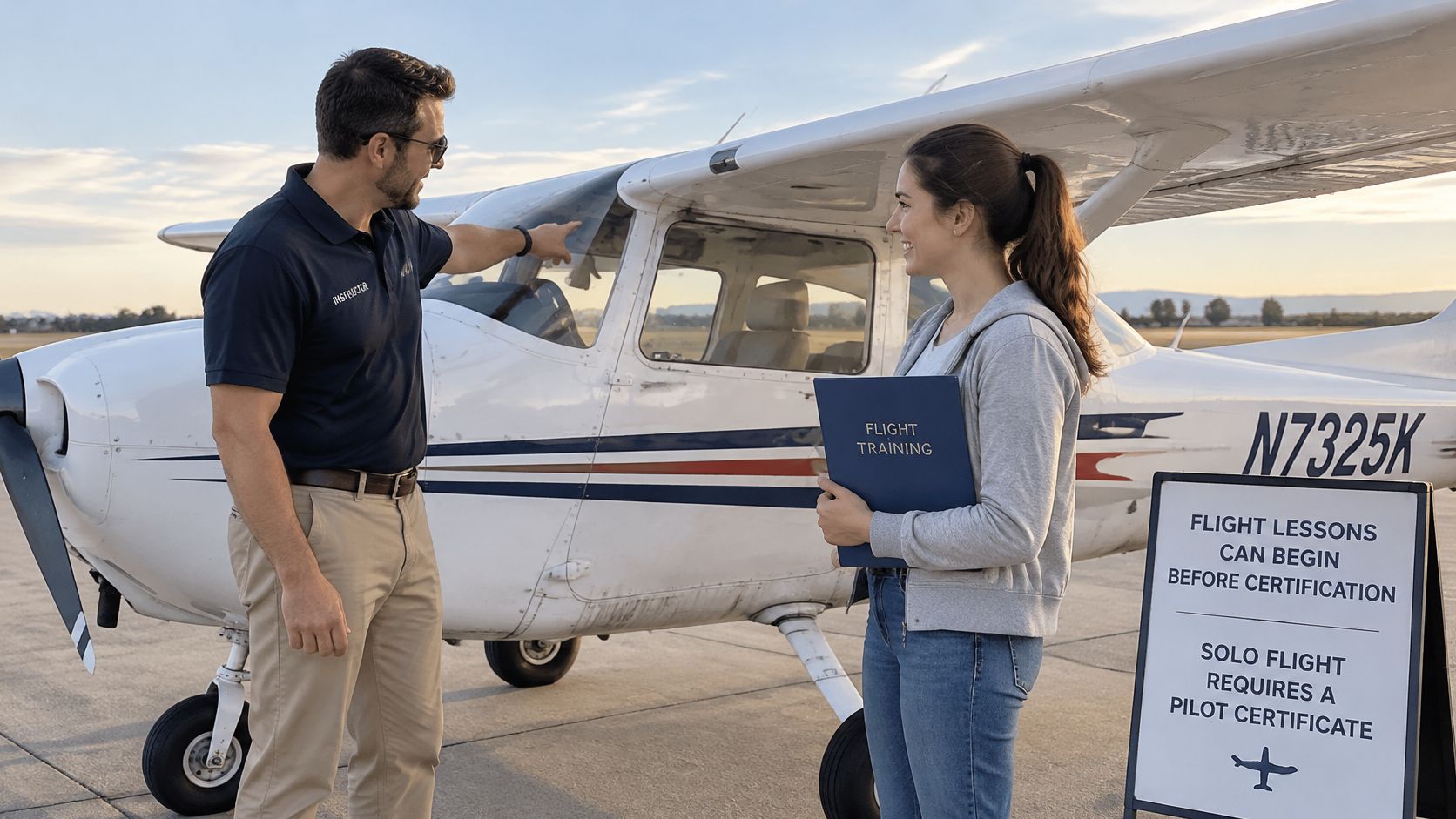
The limits on a student pilot are equally specific. No carrying passengers, no carrying property for compensation or hire, no acting as pilot for compensation or hire, and no operating in furtherance of a business. Holding the card changes none of that.
Three separate gates stand between a new student and the left seat alone, and each one fails for a different reason:
- Eligibility covers age and English proficiency, set in 14 CFR § 61.83.
- Issuance covers the IACRA application, the identity check and the mailing.
- Authorization covers the endorsements an instructor signs after seeing you fly.
A stuck applicant is almost always stuck at exactly one of those gates, and naming the right one tells you what to do next. If you're still deciding which certificate you're pursuing, our overview of the types of pilot licenses shows where the student certificate sits on the ladder. If you already clear the age and English requirements and intend to fly within a few months, file now. If you're still months from your first lesson, the application can wait without costing you anything.
Eligibility Requirements by Aircraft Category
| Requirement | Airplane or powered aircraft | Glider or balloon | Basis |
|---|---|---|---|
| Minimum age | 16 years old | 14 years old | 14 CFR § 61.83 |
| English proficiency | Read, speak, write and understand English | Same requirement | 14 CFR § 61.83 |
| Medical certificate | Third-class medical before first solo | Third-class medical before first solo | Aviation medical examiner |
| Instructor endorsement | Make and model endorsement before each solo | Make and model endorsement before each solo | 14 CFR § 61.87 |
The age row is the one people misread. Under 14 CFR § 61.83, an applicant must be at least 16 to operate an airplane or other aircraft category covered by the rule, and 14 for glider or balloon operations. That's a floor on holding the certificate, not a floor on taking lessons, so a 15-year-old can log dual instruction for a year and apply the week they turn 16.
Language is a functional test, not a fluency contest. The applicant has to read, speak, write and understand English, and a medical condition that prevents that doesn't automatically disqualify anyone. The FAA Administrator can instead impose the operating limitations needed for safe operation.
On the language rule: think of it as a safety-of-communication standard. If a condition interferes with reading a clearance or speaking on frequency, the fix is a limitation on the certificate, not a rejection letter.
The medical row deserves its own framing. A third-class medical certificate from an aviation medical examiner is what stands between a student and solo flight, and it's a separate appointment from the application, with its own examiner network and its own timeline. Applicants with a complicated history, a past deferral or a medication question should book that exam early, well before the solo date, because the review can run long.
The final row is the one no application can complete for you. Under § 61.87, the endorsement applies to a specific make and model, and no instructor can sign it on your behalf from a desk.
Check your own case in this order: age first, then language, then medical scheduling, then enrollment. If you're also weighing a lighter entry point, our guide to the sport pilot license explains how that path differs before you commit tuition.
Documents to Gather Before You Apply
| Document | What it establishes | When it is needed |
|---|---|---|
| Government-issued photo ID | Identity at the application appointment | At submission |
| U.S. citizenship or nationality documentation | Status for U.S. citizens and nationals | At submission |
| TSA Determination of Eligibility | Eligibility for non-resident foreign students | Before any training starts |
| Name consistent across passport, IACRA and ID | Matching records across the application | At submission |
Start with the photo ID, because it's the document everything else has to agree with. The official who reviews your application is verifying that the person in front of them matches the record in the system, and a driver's license, passport or other government-issued photo ID is what makes that possible.
U.S. citizens and nationals establish status with acceptable government documentation at that same appointment. Non-resident foreign students face a different gate entirely, and it isn't a longer line at the same desk.
The TSA Step That Moves Start Dates
Under the TSA's Flight Training Security Program, a flight training provider may not provide training or access to training equipment until citizenship, nationality, or a valid TSA Determination of Eligibility has been verified, as set out in the FAA's summary of the student pilot rule change. That single sentence is why an international applicant can be academically ready, medically qualified and financially committed yet unable to sit in an airplane on the planned date.
The consequences reach past paperwork. An unresolved security determination interrupts the start date, and the housing deposit, the financing schedule and the training timeline all move with it. Resolve eligibility before signing a fixed-price or accelerated commitment, not after.
Practical habit: keep one folder, physical or digital, holding your photo ID, your proof of status, your TSA determination if you need one, and your IACRA confirmation page. Every name in that folder should match character for character.
Two items do not belong at the application appointment. The medical certificate and the instructor's endorsements come later, and reviewers aren't checking them at submission. If an examiner or a physician is part of your plan, our guide to choosing an aviation medical examiner covers how to schedule that visit.
How to Apply Through IACRA Step by Step
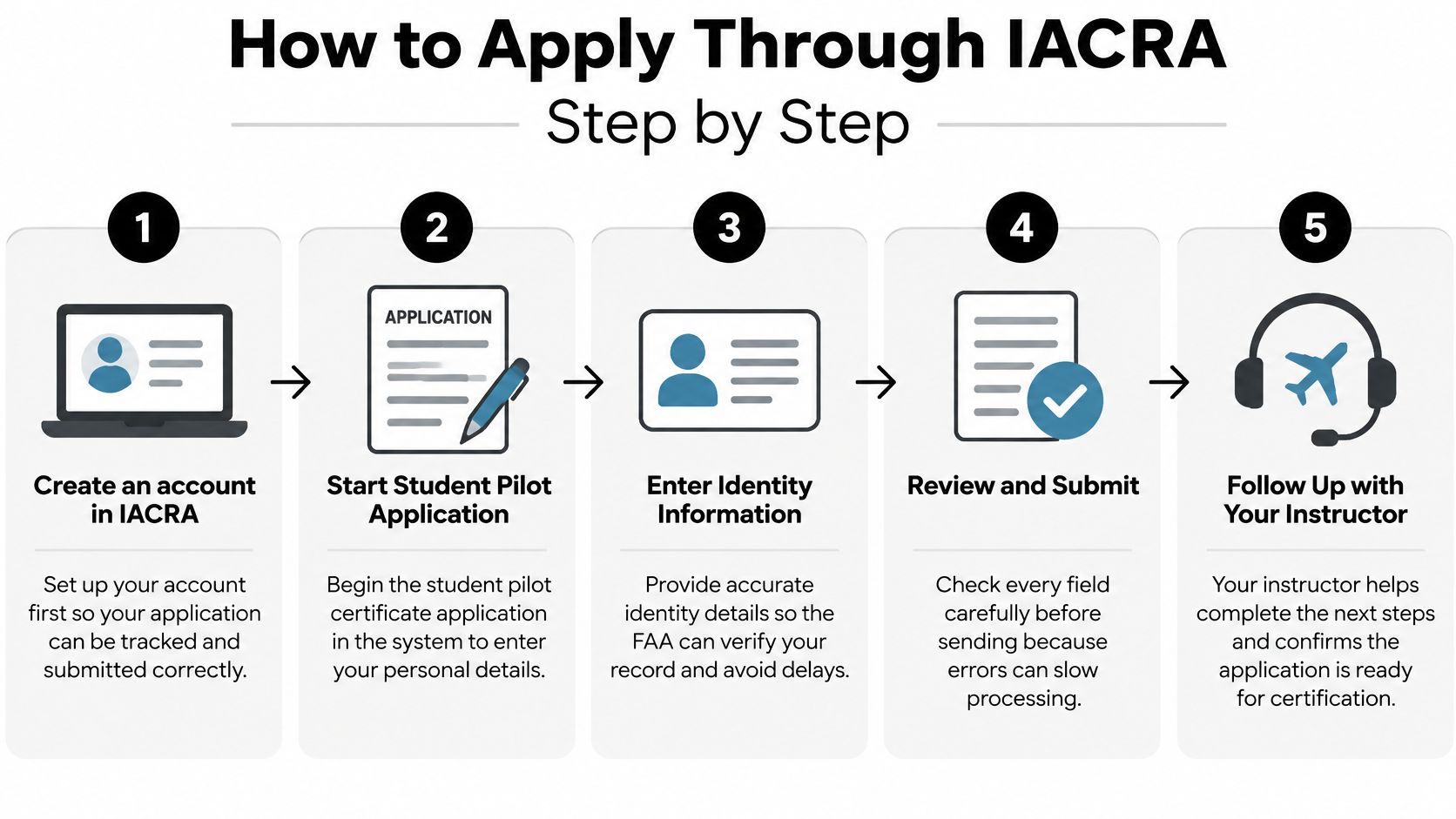
The FAA accepts the application through its Integrated Airman Certification and Rating Application system, or on paper using FAA Form 8710-1, according to the agency's student pilot certificate page. Here's the electronic route, with the reason behind each move.
Create your IACRA account. Register as an applicant and treat the login as permanent. This is the same portal you'll use for every certificate and rating later, and your record follows the account.
Open FAA Form 8710-1 and select the student pilot certificate. Answer the personal and training questions, including the ones about prior experience. Having none is a valid answer and doesn't slow anything down.
Print the form and the confirmation page, then sign where prompted. The signature is a legal attestation, so the printed legal name has to match your ID exactly. A nickname or a dropped middle name is the most common reason a submission gets reprinted.
Pick a processing channel that handles your case. The FAA lists four: a Flight Standards District Office, a designated pilot examiner, an airman certification representative at a Part 141 school, or a certificated flight instructor. A CFI is usually the fastest option because you already sit with one weekly.
Present your ID and documents in person. The representative verifies identity and completes the submission. This is the step that can't be done by email, and it's why the folder from the previous section matters.
Wait for the card. After review by the FAA Airmen Certification Branch, the certificate is mailed, and the FAA indicates an approximate processing time of three weeks, noting that IACRA can reduce it.
The paper route exists for applicants who can't use the system, and it works, but it adds handling time and a second person to the chain.
The Three Delays That Cost Weeks
A channel that can't process your situation. Some reviewers handle only students they've trained, and some offices have their own intake rules. Confirm availability before you book the appointment, not after.
A name that doesn't match your ID. Fix it in the system before submitting. Corrections after submission mean reprinting and re-signing.
Submitting before the identity check. The application isn't complete until someone verifies you in person. Filing early and assuming the rest happens automatically just moves the delay.
Practical rule: apply the week you start lessons, not the week you feel ready to solo. Then the three-week estimate finishes long before your instructor's endorsement does.
Pre-Solo Requirements and Solo Limits
| Limit | Rule | What it means in practice |
|---|---|---|
| Make and model endorsement | 14 CFR § 61.87 | Each aircraft type needs its own endorsement before solo |
| Endorsement recency | § 61.87(n), 90 days | Training older than 90 days may need instructor review |
| Passengers and paid work | Student limitations | No passengers, property for hire or business flights |
| Visibility | Student limitations | At least 3 statute miles by day and 5 statute miles at night |
| Cross-country solo | 14 CFR § 61.93 | Pre-solo maneuvers must be complete in the applicable make and model |
| International flights | Student limitations | No ordinary solo flights on international routes |
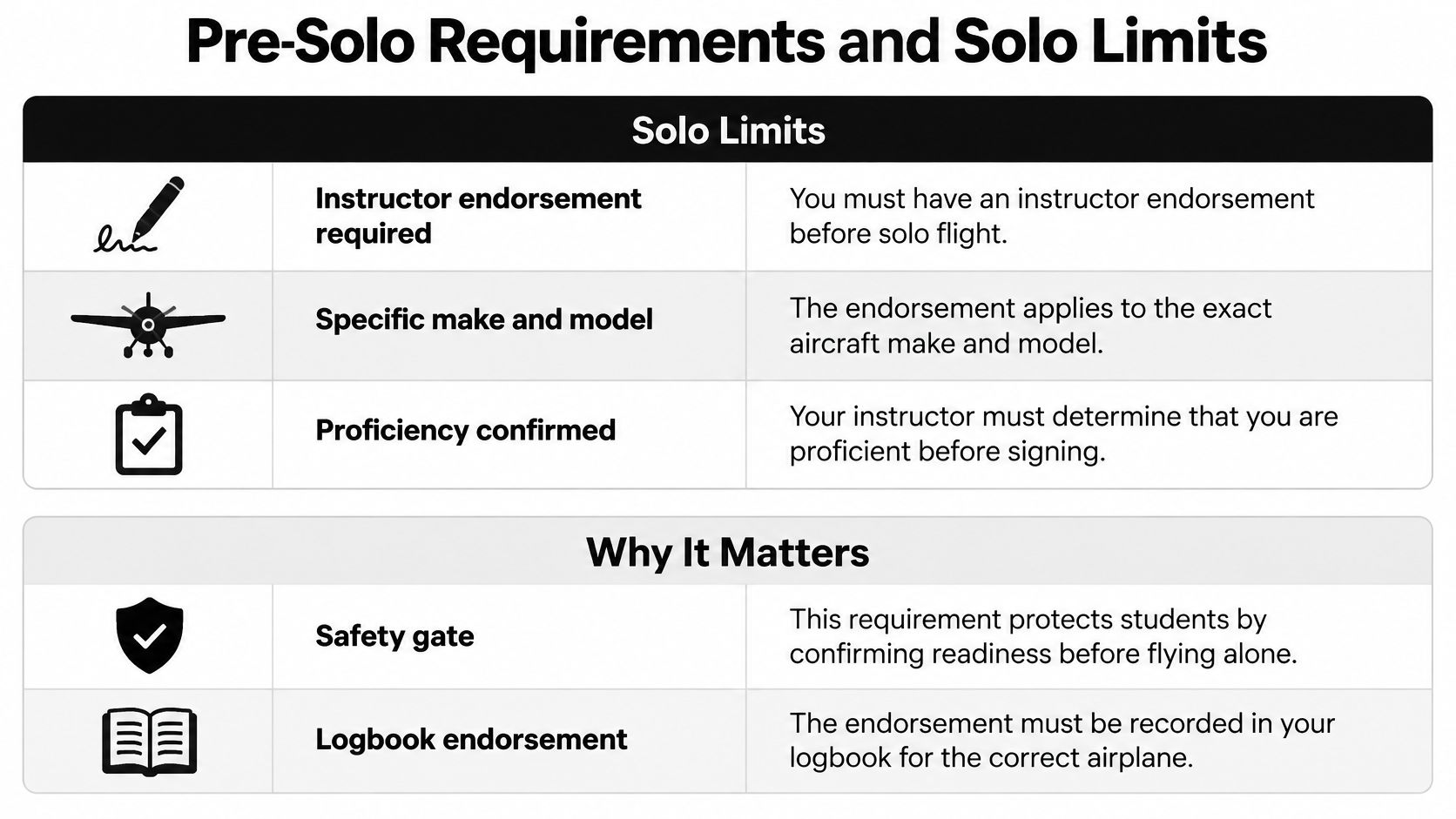
A certificate in your wallet authorizes none of this by itself. Under 14 CFR § 61.87, the student must complete and log training appropriate to the aircraft and demonstrate satisfactory proficiency and safety on the required maneuvers, as judged by an authorized instructor. The preparation list is concrete: the applicable Parts 61 and 91 rules, the airspace rules and procedures for the airport where the solo will happen, and the flight characteristics and operating limitations of the make and model.
What the Endorsement Actually Certifies
It certifies a judgment, made by a named instructor, about a named aircraft. That's why an endorsement for one trainer doesn't transfer to another. Cross-country privileges sit on top of the same foundation, since the Part 61 rules tie solo cross-country authorization under § 61.93 to completing the § 61.87 maneuvers in the applicable make and model first.
Here's how it bites in real life. A student solos a Cessna 152 in March, then the school's 152 goes down for maintenance and they move into a different model in November. The old endorsement doesn't cover the new airplane, and even a like-for-like endorsement from eight months ago is stale. New training, new signature, new solo.
The 90-day clock: § 61.87(n) requires the endorsement to come from an instructor who gave the relevant training within the preceding 90 days. Blow past that window and you're back with an instructor before you fly alone again, even if you've already soloed dozens of times.
The medical belongs here too. A third-class certificate from an aviation medical examiner is required before flying solo, while a discovery flight and your first lessons can happen before you have one. That's a solo gate, not an application gate.
Weather and visibility limits are the instructor's to tighten, never to loosen. When your logbook carries additional restrictions, the FAA's minimums are the floor and your instructor's numbers are the rule. If you're mapping the training hours that lead here, our guide to private flight lessons walks through what the dual instruction contains.
Processing Times and Certificate Validity
| Item | Timing or rule | What it means for you |
|---|---|---|
| Certificate processing | About three weeks, FAA estimate, not a guarantee | Submit through IACRA to shorten processing |
| Certificate issued on or after April 1, 2016 | Does not expire | Stays valid until replaced by a higher certificate |
| Certificate issued before April 1, 2016 | Fixed period set at issue, extended from 36 to 60 months in 2010 for pilots younger than 40 | Check the issue date and any printed expiration on the card |
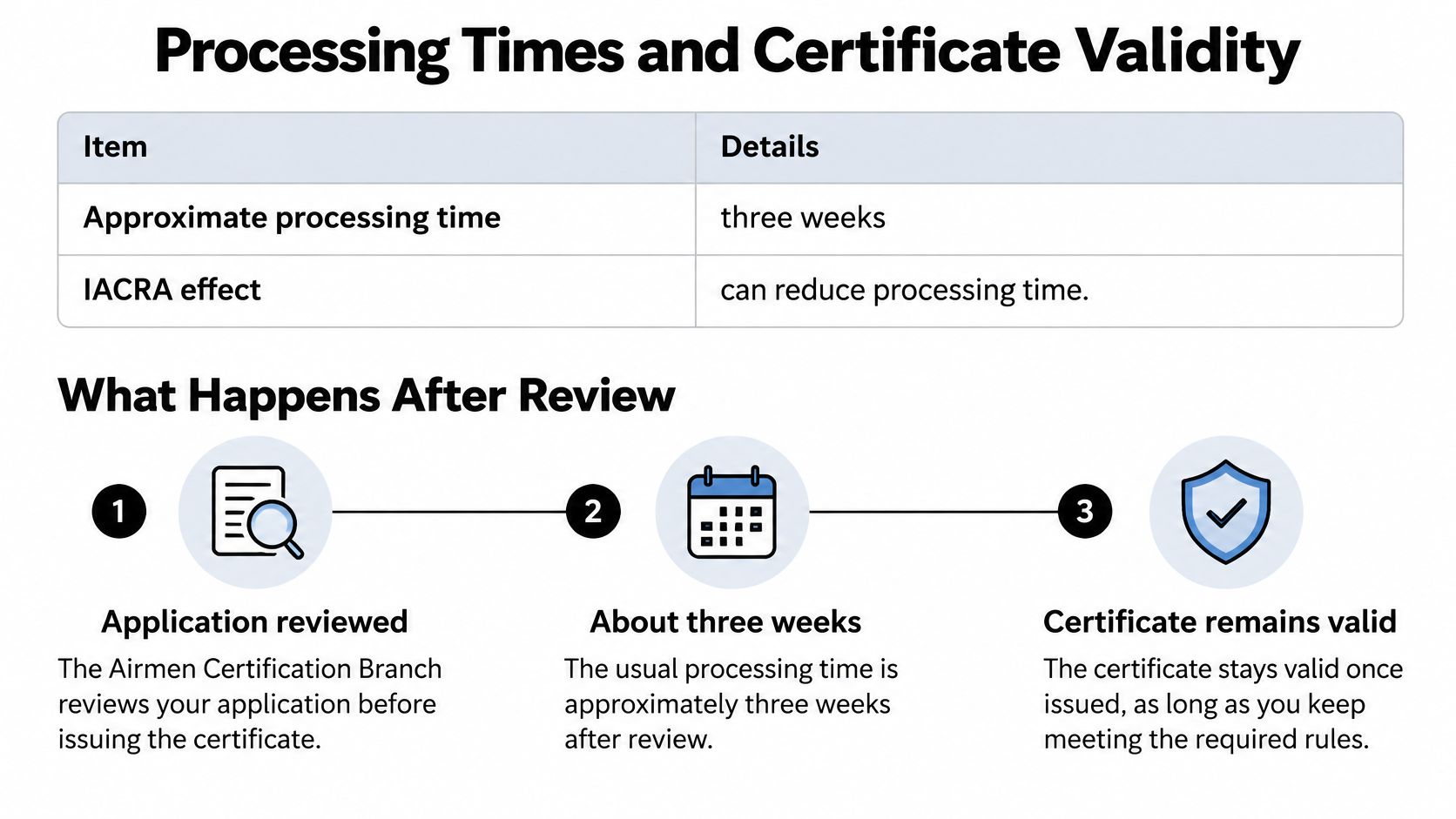
Treat the estimate as a planning number, not a contract. Volume at the Airmen Certification Branch moves it, and the electronic route is consistently faster than paper because fewer hands touch the file.
When Your Certificate Expires, and When It Doesn't
Issue date decides everything. Newly issued student pilot certificates stopped expiring on April 1, 2016, and the FAA warns that this produces a cumulative increase in reported active student pilots, because certificates stay in the statistical population until they're surrendered or superseded by a higher certificate.
The earlier rules are the ones to watch if someone hands you an old card. Before 2016, validity was a fixed period set at issue, and in July 2010 the FAA extended it for student pilots younger than 40 from 36 months to 60 months, per the FAA's active civil airmen statistics. Certificates printed before that date kept shorter periods depending on the rules then in force.
That history explains an odd-looking statistic. Active student pilots rose from 72,280 at the end of 2009 to 119,119, an increase of 46,839 certificates or roughly 64.8 percent, and the FAA attributes much of it to the validity change rather than a surge of new trainees.
So if you find a card that once belonged to a friend or a school, read the issue date before assuming anything. A pre-2016 certificate may have expired years ago, and an expired one is not a shortcut.
Choose Your Next Step Before You Start Training
The right next move depends on how much time you've logged, not how much research you've done.
If you have zero flight time, book a one-hour discovery flight that requires no experience. On that flight you meet the instructor, preflight the airplane together and take the controls in the air, which tells you more about whether you want this than any forum thread will.
If you've already soloed or hold a private pilot certificate and want the full ladder, look at the Career Track: fixed tuition of $89,000, about nine months from zero time to CFII and multi-engine, 282 total hours, six certificates and ratings, based in Southern California at Riverside, Long Beach and Corona.
If you're not ready to commit to either, do the cheap version first. Confirm your age, English and immigration or TSA status, then file the IACRA application so the card is sitting in a drawer well before your instructor reaches for a pen. For local options and how to compare them, our guide to pilot training near me covers what to ask before you pay a deposit.
Three things are worth doing this week: check yourself against the eligibility table, assemble the document folder, and choose between booking a first flight and filing an application. Everything else follows from those three.
A student pilot certificate is the first FAA document in a long chain, and at CFII we build the whole chain from that first application onward. Our Career Track takes you from zero experience to CFII and multi-engine in about nine months for a fixed $89,000, with 282 hours, six certificates and ratings, and instruction based in Riverside, Long Beach and Corona. If you haven't flown yet, start with a one-hour discovery flight at CFII and see how the cockpit feels before you file anything.
Planning to fly for a living?
See what the path from zero to a pilot career looks like, what it costs and how long it takes.
Learn to fly in Riverside
We train at Riverside Municipal Airport in modern airplanes with a parachute built in. Start with a one hour discovery flight, no experience needed.