
On this page
- Which FAA Knowledge Test You Need
- When an endorsement isn't the usual starting requirement
- How to Register and Book Your Test
- Complete the booking sequence
- Separate testing eligibility from flight eligibility
- A Study Plan That Builds Real Understanding
- Order the work by deficient codes
- Make every session produce something useful
- Practice Tests and Common Pitfalls
- Turn missed codes into a review plan
- Fix the errors that survive ordinary quizzes
- How Long Your Results and Retakes Last
- Confirm Your Test Date Before You Commit
- Run the final decision checklist
You've started looking at flight training, opened a ground-school lesson, and found a testing page full of unfamiliar exam codes. You want to become a career pilot, but right now you're trying to answer a simpler question: which FAA knowledge test should you take, and how will you know you're ready?
Start by treating the exam as a diagnostic tool, not just a hurdle. Your preparation should reveal what you understand, and your test report should tell you what still needs work before you carry that knowledge into the airplane.
Which FAA Knowledge Test You Need
If you have zero flight time and want a private pilot certificate in an airplane, your starting point is the Private Pilot Airplane knowledge test, not an instrument, commercial, or instructor exam. The knowledge test is a required certification milestone, but passing it doesn't authorize you to fly independently or replace flight training and the practical examination.
Each certificate or rating has its own knowledge requirements. Under 14 CFR Part 61, including § 61.35, applicants generally need documentation confirming completion of the applicable ground training or home-study course and readiness to test.
Knowledge test by certificate: endorsement and passing score
| Test | Endorsement needed before first attempt | Passing score | Validity after passing |
|---|---|---|---|
| Private Pilot Airplane (PAK) | Yes, authorized-instructor endorsement or acceptable home-study completion authorization | 70% | Through the end of the 24th calendar month after the month taken |
| Instrument Rating Airplane (IRA) | Yes | 70% | Practical-test timing governed by § 61.39 |
| Commercial Pilot Airplane (CAX) | Yes | 70% | Practical-test timing governed by § 61.39 |
| Flight Instructor Airplane (FIA), distinct from FOI | Generally no | 70% | Practical-test timing governed by § 61.39 and applicable exceptions |
An important code correction: Flight Instructor Airplane is FIA. FOI means Fundamentals of Instructing, a separate examination addressing teaching and learning. Don't use those codes interchangeably when you register.
When an endorsement isn't the usual starting requirement
The general first-attempt exceptions include airline transport pilot, flight instructor, certificated ground instructor, military-competency, and foreign-pilot instrument knowledge tests. Those exceptions don't eliminate other eligibility requirements, and a failed attempt changes the retest authorization process.
For a beginning private pilot applicant, the practical choice is between instructor-led ground training and an acceptable home-study route. A course completion screen isn't automatically the document your testing center needs. Confirm how your course provides the required authorization before scheduling.
Before you pay: Have your instructor verify both the exam code and the document that establishes your eligibility.
Use the private pilot written test preparation guide to organize your first exam preparation. Your eventual career goal may be advanced certificates, but your immediate booking should match the certificate you're pursuing.
How to Register and Book Your Test
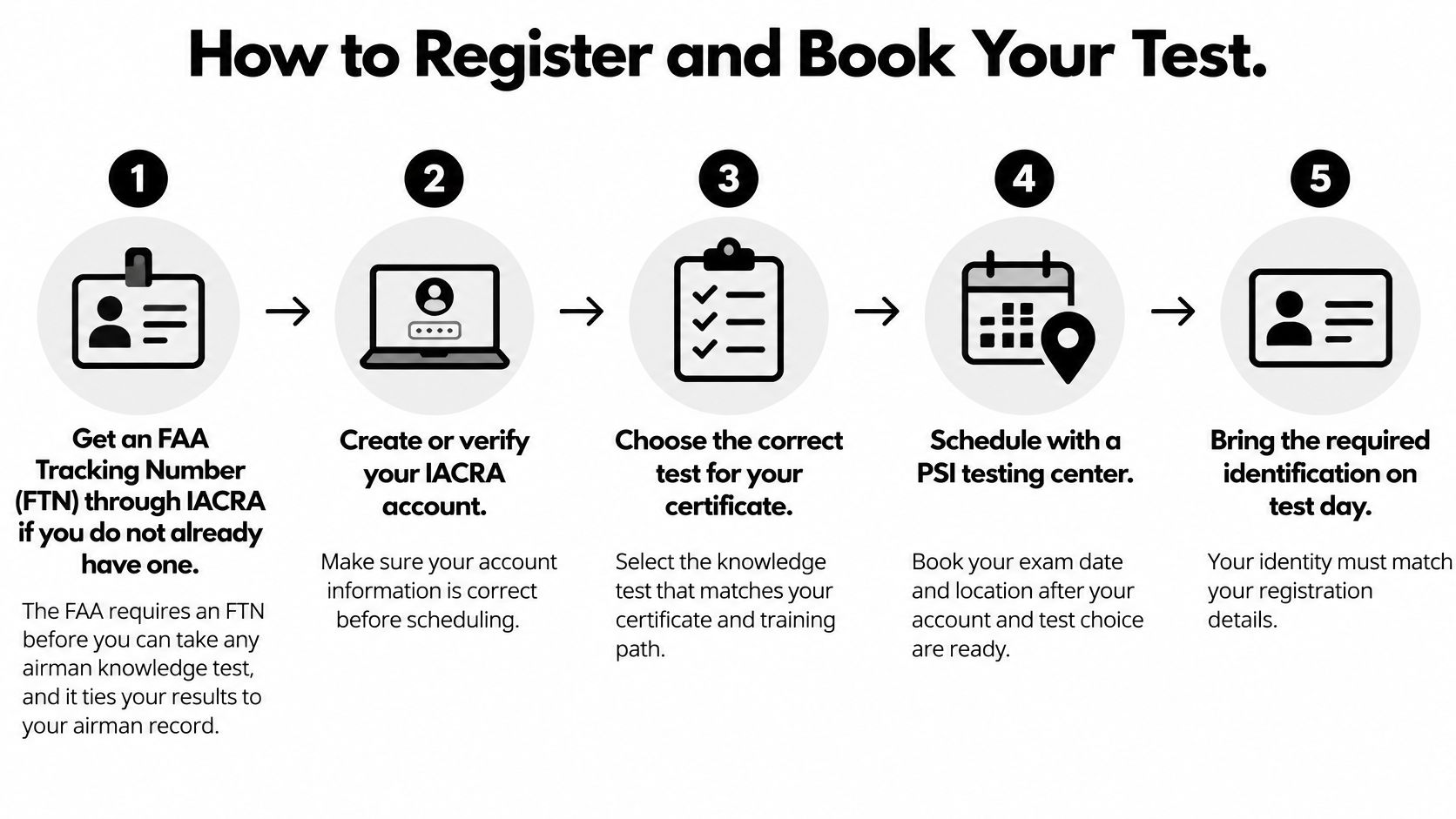
Treat registration like a preflight: establish identity, verify eligibility, and check the details before committing. The FAA's Airman Knowledge Testing Matrix specifies test-specific identification, authorization, eligibility, and retesting requirements, including the requirement to establish an FAA Tracking Number before testing.
Complete the booking sequence
Get your FAA Tracking Number through IACRA. If you don't already have an FTN, establish it through the Integrated Airman Certification and Rating Application system. Verify your account information carefully because the number connects your testing activity to your airman record.
Finish the applicable ground training and obtain authorization. For a first-time private pilot applicant, resolve the endorsement or acceptable course-completion documentation before booking. Keep an accessible copy and check that it authorizes the examination you intend to take.
Choose an approved testing center and the exact exam code. Match the registration to your training objective rather than selecting a test because its name sounds close. Review the appointment's location, arrival instructions, cancellation terms, and permitted materials before paying.
Prepare acceptable photo identification. Check that your registration and identification agree, and resolve name discrepancies before test day. Don't assume a testing-center employee can correct your application or accept substitute documents at the appointment.
Keep your Airman Knowledge Test Report afterward. It records your result and identifies deficient knowledge areas. Save it somewhere you and your instructor can retrieve it for review, practical-test preparation, or a retest.
Separate testing eligibility from flight eligibility
You don't need a medical certificate to sit the knowledge test. For the conventional private-pilot training path, a third-class FAA medical certificate from an aviation medical examiner is required before solo, but you can take a discovery flight and initial lessons before obtaining one.
That distinction helps you plan, but it shouldn't encourage postponing medical questions when you're considering a flying career. Ground-study progress and medical eligibility are separate planning issues.
The FAA written exam scheduling guide can help you organize the appointment details. Keep your registration confirmation, identification requirements, and authorization together rather than searching through separate messages on test morning.
A Study Plan That Builds Real Understanding
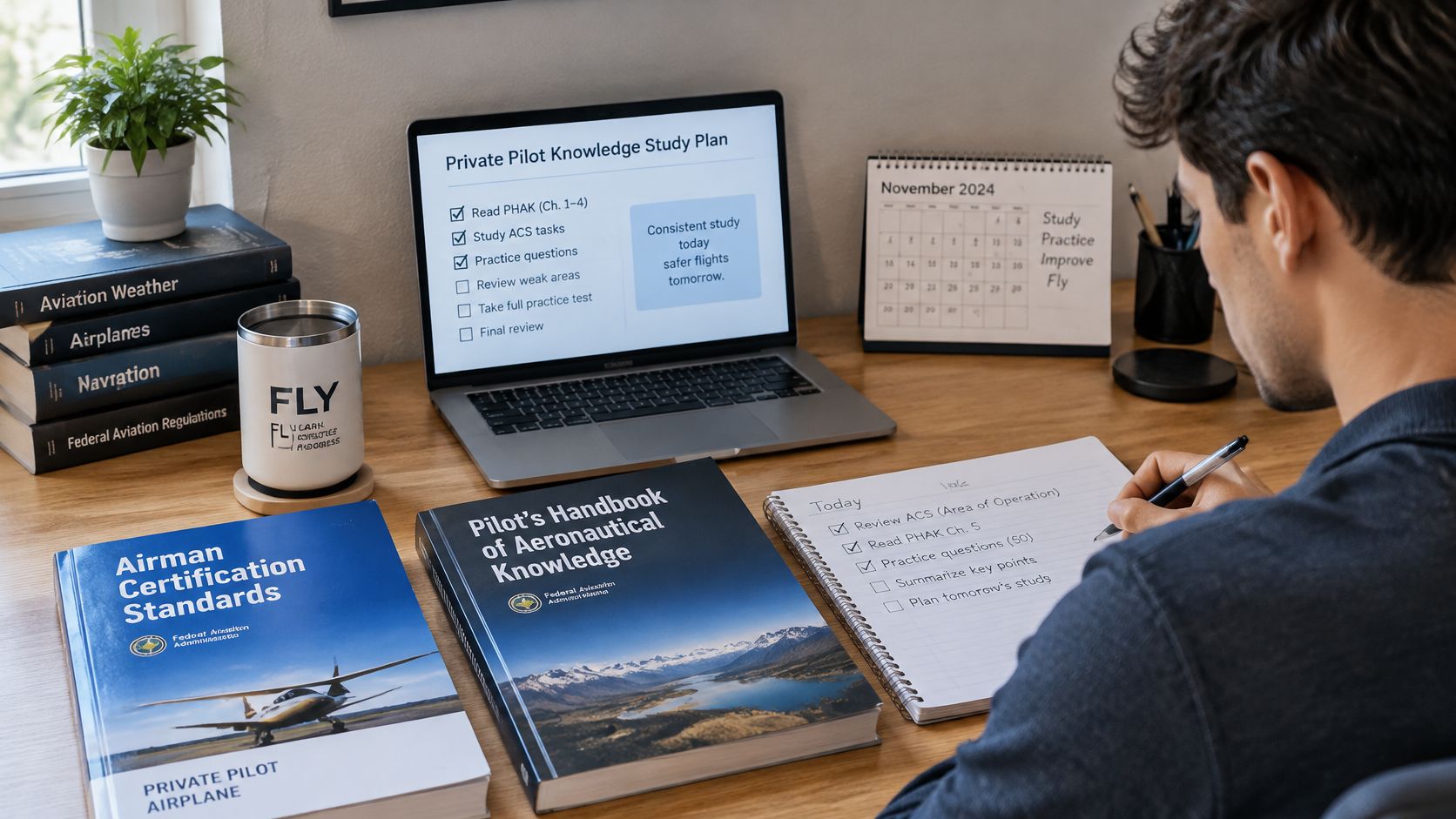
You close a practice set and the score report lists ACS subject codes, not one tidy percentage. That list is the study plan. Start with the Airman Certification Standards for your certificate and the Pilot's Handbook of Aeronautical Knowledge. The ACS names each task the test can sample. The handbook and the applicable regulations teach the material behind the code.
The FAA's knowledge-testing FAQ explains that the agency doesn't publish its live question bank and directs applicants toward regulations, guidance, certification standards, and official sample tests. Use an unofficial answer set to check your reasoning against those sources.
Order the work by deficient codes
I recommend you rank missed codes by how often you miss them before you pick the next chapter. Three weather misses outrank one clean airspace item. That personal miss rate, matched to the ACS task, sets the week. A code you already answer cleanly can wait, even when the topic sounds more advanced.
Use a timed block per code: 25 minutes on one deficient code, then five minutes noting what the item tested (the regulation, the chart, or the calculation). Two days later, spend ten minutes on that same code with a new problem. Seven days later, run it once more. Retire the code only after the later pass is clean. Recent familiarity is not the same as a fixed code.
Still learn the subjects so later math has a purpose. Begin with pilot privileges, limitations, and operating rules. Then study airspace, where those rules become decisions about where you can fly and what equipment or communication you need. Move into weather observations and forecasts, including METARs and TAFs. Follow with aerodynamics, aircraft systems, performance, and weight and balance, then navigation, chart interpretation, and human factors. A takeoff-distance answer means more once you know why temperature, pressure, loading, and runway conditions change the airplane.
Make every session produce something useful
- Keep an error notebook keyed to the code. Record the ACS code, the concept you missed, why the reasoning failed, and the handbook or regulation paragraph that resolves it.
- Show calculation steps. Write units beside values and identify the correct chart, configuration, and interpolation method before calculating.
- Find the deciding condition. Underline wording about altitude, day or night, airspace, visibility, or aircraft configuration.
- Schedule the revisit. Put each missed code back on the calendar at two days and seven days, and move on only after a clean answer on a new question.
Private-pilot codes come first. The instrument rating written test guide is the right reference once you are preparing for that rating. Weak privileges, weather, or performance still have to be repaired on their own codes.
Practice Tests and Common Pitfalls
A high score on a repeated question bank can mean you recognize the wording. It doesn't necessarily mean you can solve the problem when the chart, conditions, or answer choices change.
Use fresh or randomized questions to test transfer of knowledge. Then examine your pattern of errors, not just the overall percentage.
Practice test patterns and what to do next
| Practice pattern | Likely meaning | Next action |
|---|---|---|
| Same question bank scored high on repeat | Memorized wording, not concepts | Switch to randomized or unseen questions |
| Strong on regulations, weak on performance | Chart and calculation skills are not yet solid | Work performance problems by hand with units |
| Correct answer but cannot explain why | Concept isn't understood yet | Explain the answer aloud and cite the handbook chapter |
| Consistently high scores on fresh question sets | Understanding is developing well | Move to full timed practice and review remaining weak codes |
The FAA's annual knowledge-test statistics report an aggregate 89.51% pass rate across 271,247 tests in 2024. That's a system-wide benchmark across different examinations, not a prediction of your private-pilot result.
Turn missed codes into a review plan
After an actual exam, preserve your report and identify every deficient subject-matter code. Where ACS codes appear, look up the applicable task and knowledge element rather than guessing what the letters mean.
Create a simple review record containing the code, its plain-language topic, the governing reference, and a fresh problem you can solve. Review the regulation or handbook explanation, complete a different style of problem, and explain the answer aloud with its assumptions, units, and limitations.
A code identifies an area, not necessarily the exact question you missed. Don't spend your review trying to reconstruct protected test wording. Work until you can handle the underlying concept in a different scenario.
The FAA's knowledge-test analysis summary notes that, in the second quarter of 2025, one Private Pilot Airplane ACS item was missed by 73.33% of applicants. That finding supports reviewing item-level weaknesses, but it doesn't identify your personal weak area or justify guessing which topic the item covered.
When using quarterly ACS miss-rate analysis, match the certificate and code to the current ACS before choosing your review topic. Your own missed codes should take priority; broader miss rates are a secondary check for blind spots.
Fix the errors that survive ordinary quizzes
- Chart symbols and legends. Trace the relevant feature with your finger or pointer, identify the symbol, and consult the legend. Don't answer from a familiar-looking color alone.
- Density altitude and takeoff distance. Work a fresh problem regularly using the correct performance table. Separate pressure altitude from density altitude and check whether the chart asks for ground roll or distance over an obstacle.
- METAR and TAF timing. Decode real reports, identify observation or forecast validity, and translate the conditions into operational meaning. Recognizing an abbreviation isn't enough if you apply the wrong time period.
- Outdated regulations. Check the current regulatory text when an explanation relies on remembered privileges, equipment requirements, or limitations. Old notes can preserve a rule that no longer applies.
- Test-day logistics. Run your document and appointment checklist before travel. Preparation won't help if you arrive without acceptable authorization or identification.
Use the explanation test: If you chose correctly but can't justify the answer, keep the topic on your review list.
The FAA written exam practice test guide can help you structure mock exams. Use timed practice after your subject-level work is sound, not as a substitute for learning calculations.
Schedule when you can explain your weak areas and apply the methods to unfamiliar problems. A friend's passing result tells you nothing about whether your weather interpretation or performance calculations are ready.
How Long Your Results and Retakes Last
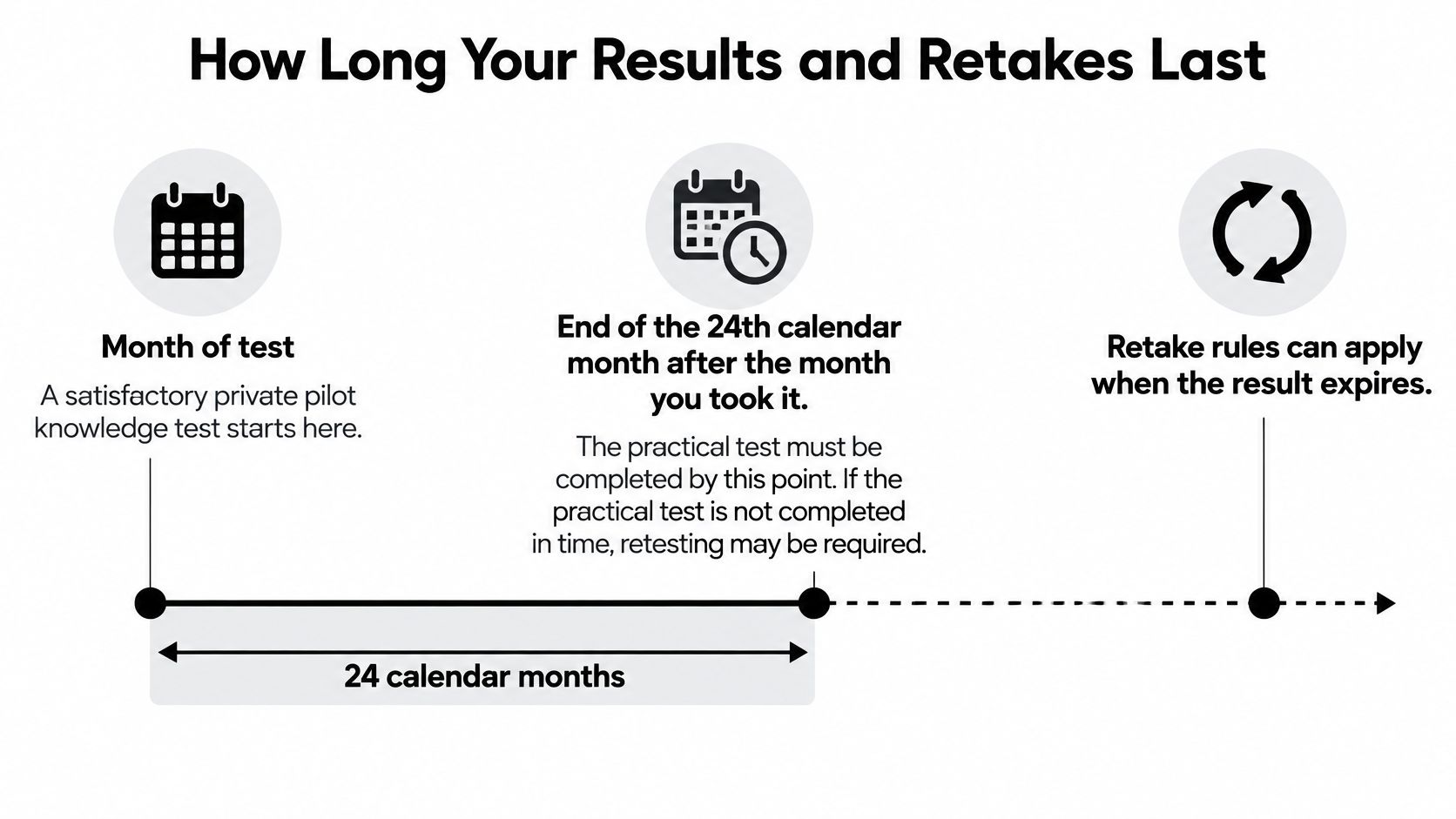
You pass the private pilot knowledge test on March 12, 2026. Do not count 730 days from that date. Per the FAA's knowledge-test guidance, the result runs through the last day of the 24th calendar month after the test month: March 31, 2028. A practical test on April 1 is already outside the window.
The eligibility table earlier sets that same calendar-month clock. What it does not do is put the date on your training plan. Write the expiration on the score report the day it arrives, then work backward: stage checks, aircraft time, and a buffer for weather, maintenance, or a discontinued ride. An appointment that looks safe in February can still slip past the last usable day.
Validity and retake rules by situation
| Situation | FAA rule | What to do next |
|---|---|---|
| Passed, validity running | Result stays usable only until that calendar-month end date | Put the end date on your practical-test plan and finish before it |
| Failed attempt | Additional training and an authorized-instructor endorsement are required | Bring the unsatisfactory report and endorsement, then retest |
| Passed, want a higher score | FAA procedures require a waiting period before retaking the same test | Use the wait on missed subject codes, and check that a new pass still leaves time for the practical test |
| Failed, reviewing the report | The report identifies deficient subject-matter areas | Make those codes the study list, then confirm you can apply them on new problems |
Read the report as a diagnostic. Subject codes name the tasks you missed. Work those first, then sample nearby tasks so one narrow miss does not hide a weak method. A higher score only helps if the replacement result still expires after the practical test you can schedule.
Under § 61.49, a failure means more training, an instructor endorsement that you are ready, and then the retest. The FAA's ACS Companion Guide tells you to bring the unsatisfactory report with that endorsement. Chart errors and mixed-up regulations take different amounts of time to fix. Keep your own copy of the report and follow the testing center's instructions for the original.
Time each later written the same way, against the training and practical test that use it. The commercial pilot written test guide lays out that exam so you can place it on the calendar before the private result, or the one after it, runs out.
Confirm Your Test Date Before You Commit
Book when your paperwork and understanding are ready together. An available appointment isn't a reason to accelerate past unresolved eligibility questions or recurring calculation errors.
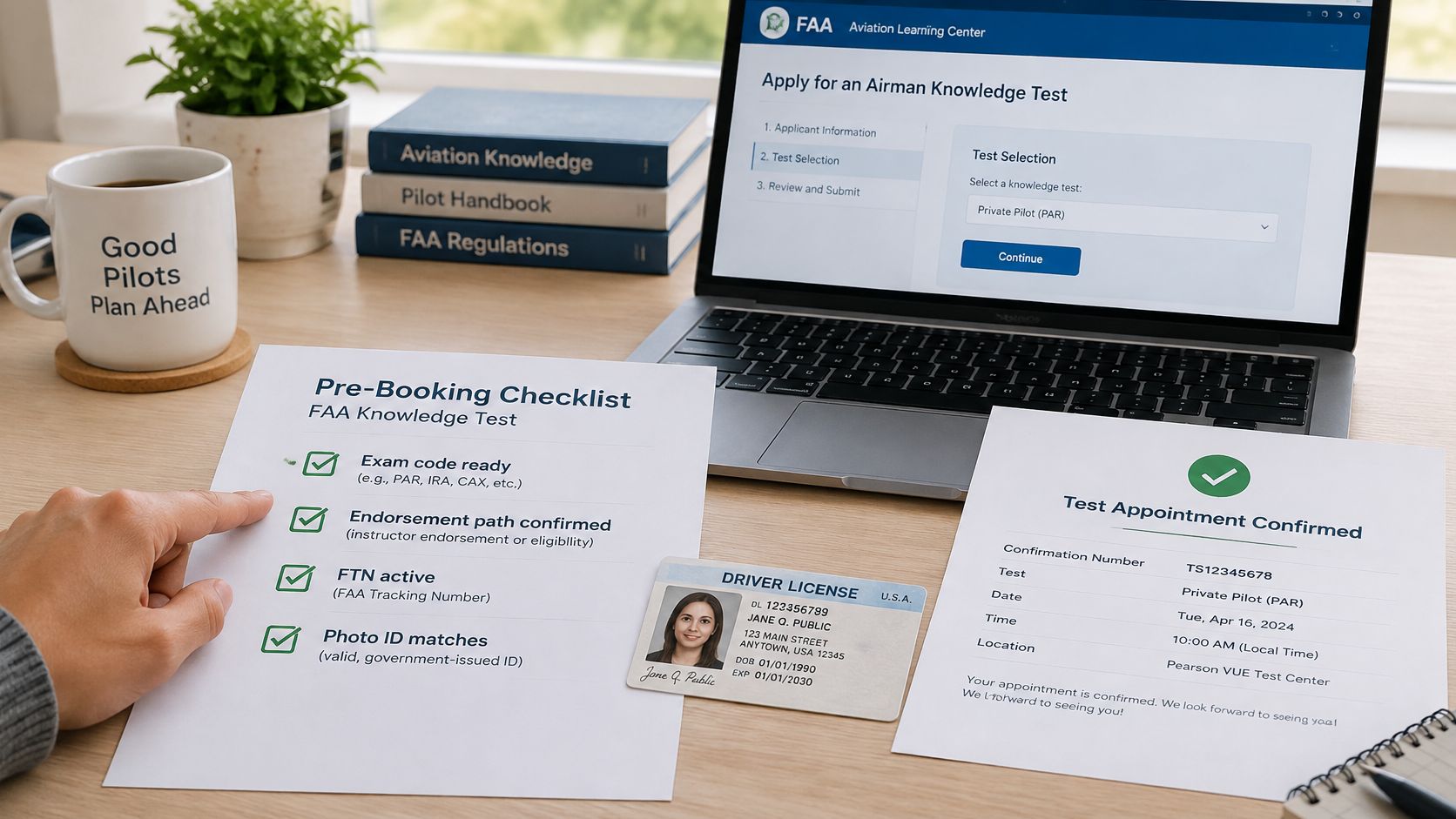
Run the final decision checklist
- Correct examination. Your exam code matches the certificate or rating you're pursuing.
- Clear authorization. You have the required endorsement or acceptable completion document, or have confirmed the applicable exception.
- Verified identity. Your FTN and account information are correct, and your acceptable photo ID matches your registration.
- Demonstrated readiness. You can explain missed topics and solve unfamiliar problems without relying on remembered wording.
- Practical training plan. Your knowledge-test timing supports the rest of your certification pathway.
If you haven't flown yet, a discovery flight is a sensible step before committing to career training. For a full pathway, our Career Track has fixed $89,000 tuition, takes about nine months from zero time to CFII and multi-engine, and includes 282 total hours and six certificates and ratings, based in Riverside, Long Beach, and Corona in Southern California.
Confirm your exam code today. Book only after the checklist is complete.
CFII offers a zero-time-to-CFII and multi-engine training pathway for aspiring career pilots. Visit CFII to explore that pathway and decide how your first FAA knowledge test fits into your training plans.
Planning to fly for a living?
See what the path from zero to a pilot career looks like, what it costs and how long it takes.
Learn to fly in Riverside
We train at Riverside Municipal Airport in modern airplanes with a parachute built in. Start with a one hour discovery flight, no experience needed.