

On this page
- Hours Behind Each Pilot Certificate
- How to read the columns
- The rungs a career student is actually buying
- A License Is a Permission Level
- What a rating adds
- The age mix-up
- How Training Reaches the Private Checkride
- What the calendar usually looks like
- What Changes After the Private Certificate
- Why a big simulator total can still fail
- Paid flying, then the instructor bridge
- Delays That Blow the Timeline
- A finished student can still wait
- Questions to Ask Before You Pay
- Fleet, people, and the written total
- Rules, and whether you can fly first
- Book a Discovery Flight or Career Track
The legal floor for an airplane private pilot certificate is 40 hours. The FAA's pilot-hour FAQ also says many people need about 60 to 75 hours, and its average for applicants without a hearing impairment is about 75 hours. If you are getting a pilot license with an airline seat in mind, that gap is the first number to plan around, not the number in the advertisement.
A certificate is the license itself. A rating is an add-on to a certificate, not a second license. Read every later rung that way.
Hours Behind Each Pilot Certificate
| Milestone | FAA minimum | Plan around | Age note |
|---|---|---|---|
| First solo | Third-class medical before solo | Lessons can start before the medical | Solo at 16 |
| Private pilot, airplane | 40 hours (35 at an approved school), with 20 dual and 10 solo | About 60-75 hours; FAA average about 75 | Private certificate at 17 |
| Instrument rating | 40 hours actual or simulated instrument time, at least 15 with an instrument instructor | Track aircraft, sim, and recent dual separately | No separate minimum |
| Commercial pilot | 250 hours Part 61, or 190 in an approved Part 141 or 142 course | Not airline-ready; airlines often want 1,000-2,000 hours | At least 18 |
| Flight instructor, including instrument | Commercial certificate plus instructor knowledge and practical tests | Paid instructing is the usual bridge toward airline time | At least 18 |
| Airline transport pilot | 1,500 hours and a commercial certificate with an instrument rating; 200 hours cross-country on the standard path | Restricted ATP only for certain college graduates | At least 23 |
How to read the columns
FAA minimum is the legal floor. Plan around is the column that should drive your calendar and your bank account. The same FAA FAQ sets the airplane private floor at 40 hours: at least 20 with an authorized instructor and 10 solo, including at least 3 hours of cross-country, 3 hours of night, and 3 hours of instrument training. An approved pilot school may qualify a student at 35 hours. Weather, airplane availability, how fast the maneuvers settle, lesson frequency, maintenance, and test prep are what push people off that floor.
The Aircraft Owners and Pilots Association puts typical private completion at about 50 to 70 hours. Use that band and the FAA's 60 to 75 range together. Both are planning anchors, not guarantees.
The rungs a career student is actually buying
A private certificate does not get you paid, and a commercial certificate does not get you an airline job. Under the FAA's commercial-certificate FAQ, the standard path is 250 total hours, or 190 hours in an approved Part 141 or 142 course, while airlines commonly set hiring minimums of 1,000 to 2,000 hours or more. The pilot certification rule sets the airline transport pilot certificate at 1,500 hours and at least age 23, with a commercial certificate and instrument rating already in hand and 200 hours of cross-country on the standard path. Restricted-privileges routes exist only for certain graduates of qualifying colleges.
Practical rule: Budget and schedule from the typical column. A syllabus sold at the legal minimum is a floor, not a plan.
The private certificate is the first permission that matters. It is not the last one.
A License Is a Permission Level
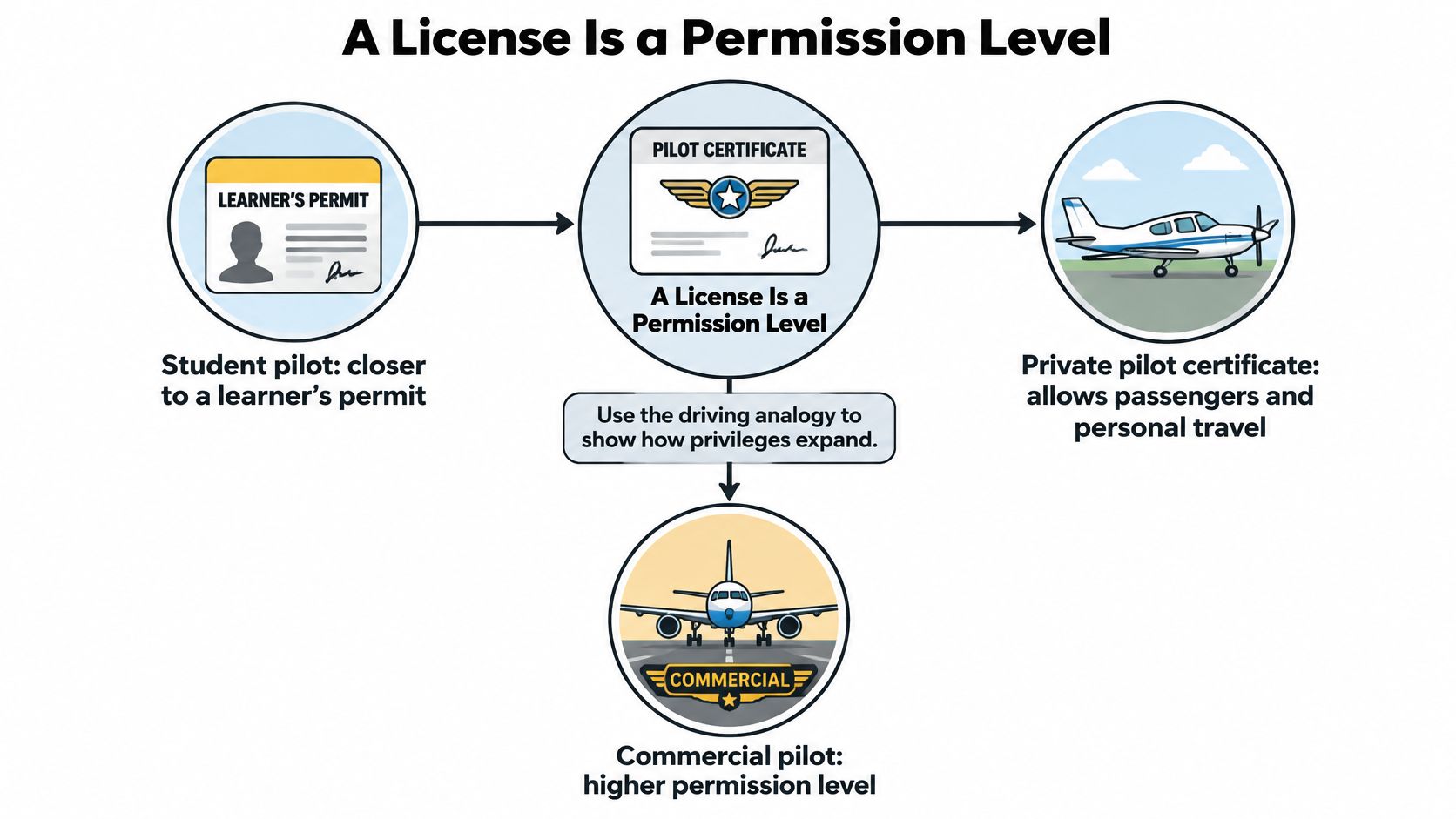
Think of the ladder the way you think of driving, then add a few extra gates.
A student pilot is closer to a learner's permit. You train with an instructor, and you fly solo only within the limits set by that instructor. A private pilot certificate is the license typically envisioned: carrying passengers and personal travel, but without receiving payment. A commercial pilot certificate is the step that permits compensation under FAA rules. It represents a higher level of authorization, though it remains well below the qualification for an airline seat.
What a rating adds
A rating does not replace the certificate underneath it.
- Instrument rating: the add-on that lets you fly under instrument rules when you cannot rely on outside visual references.
- Multi-engine rating: a class of airplane, not a new license.
- Instructor certificates: the right to teach, which is how most career pilots later log pilot-in-command time.
Passing the test and getting hired are different events.
Certificates prove you passed a test. They do not prove an airline will hire you.
The age mix-up
Under 14 CFR §61.103, an airplane private applicant must be at least 17, able to read, speak, write, and understand English, and meet the flight-experience rules. The age of 16 applies to a glider or balloon rating, not to the standard airplane private certificate. There is no minimum age to start lessons. A zero-time student can begin before 17 but cannot be issued the airplane private certificate until that birthday. Solo in an airplane comes at 16.
Part 61 is the standard regulation path. Part 141 is an approved-school curriculum. An approved course can lower some hour floors. It does not change what the certificate lets you do once you hold it.
The next thing to learn is the private-pilot sequence itself: medical, knowledge test, dual, solo, then the checkride.
How Training Reaches the Private Checkride
The path below is the usual order for a single-engine airplane. Each step has an FAA reason, and each one has a usual slip.
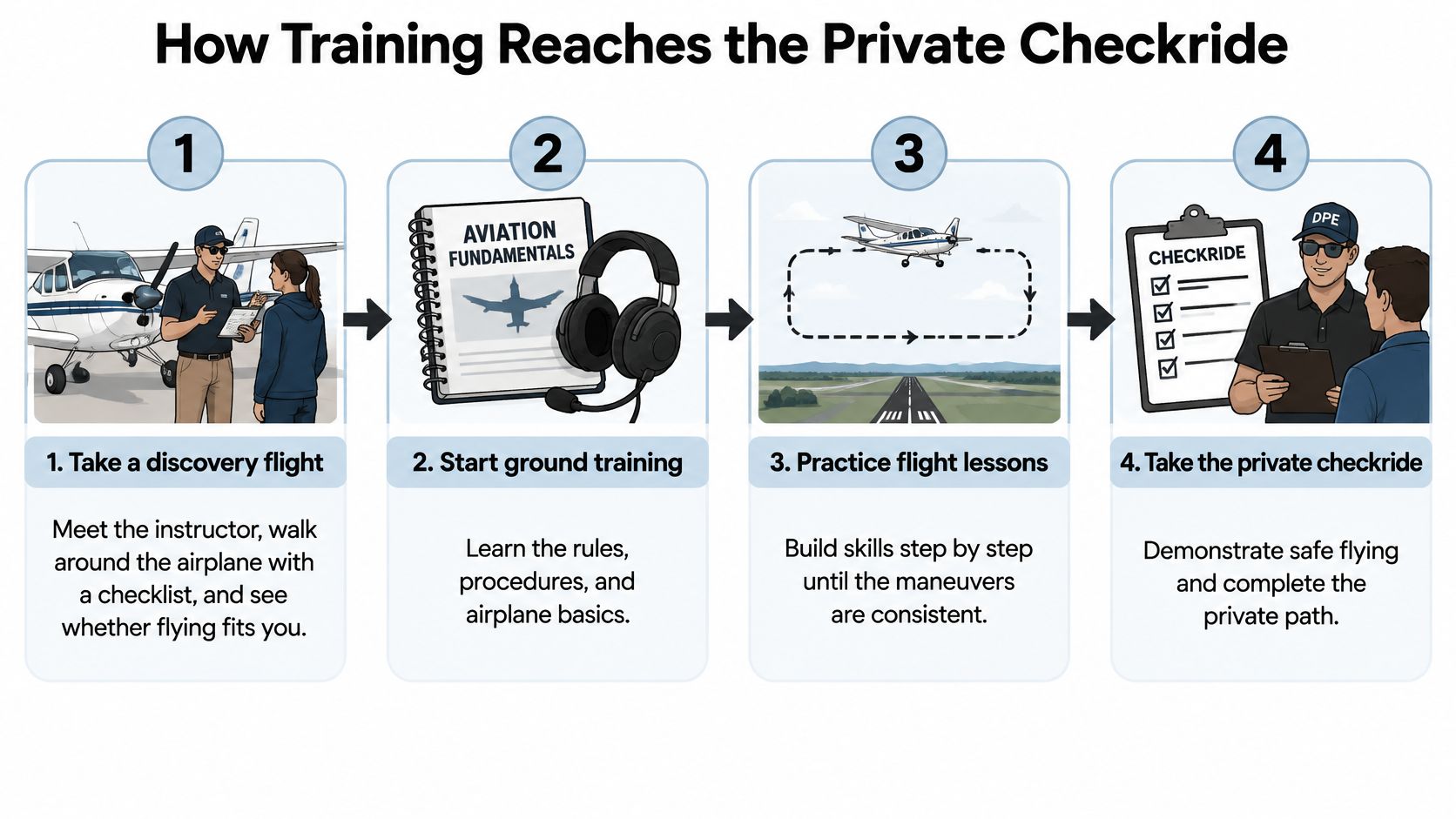
If you have not flown yet, start with a discovery flight. That flight is lesson one, not a contract. You meet the instructor, walk the airplane with a checklist card, and take the controls. No prior experience is required, and this ride can happen before a medical.
- Take a discovery flight if you have never flown. You learn whether the cockpit feels workable before you buy a headset or a stack of books. People skip this and then discover, ten hours in, that they hate the radio or the motion.
- Get at least a third-class medical before the first solo. The FAA medical FAQ says a student pilot generally needs at least a third-class medical from an Aviation Medical Examiner before the first solo, and a higher class also satisfies it. Third class generally covers student, recreational, and private pilots. Second class is generally tied to commercial flying, and first class to airline transport. Lessons may start earlier. The certificate has to be in hand before you leave the pattern alone, not merely before the checkride.
- Pass the private pilot knowledge test while you are still flying. Waiting until the flying is “done” leaves you cold on both the book and the airplane. Study on the days the weather cancels you.
- Log the dual the regulation names. For a single-engine airplane, 14 CFR §61.109 requires at least 40 hours total, 20 with an authorized instructor and 10 solo. Inside the dual: at least 3 hours of cross-country, 3 hours by instrument reference, and 3 hours of practical-test prep in the two calendar months before the checkride. A fat total with the wrong categories still fails the application.
- Solo only with the instructor's endorsements. The solo block includes 5 hours of solo cross-country and one solo cross-country of at least 150 nautical miles, with full-stop landings at three points and one leg longer than 50 nautical miles. The usual slip is treating any long flight as “the” cross-country when the route does not meet those points.
- Sit the practical test only when the records match. Endorsements, knowledge test, medical, and logbook have to tell the same story. An examiner is not there to sort a mismatched file.
What the calendar usually looks like
Hobby students flying two or three lessons a week often reach that checkride in four to six months, paying lesson by lesson. Treat that pace as a planning example, not a promise. Weekly lesson count, weather, and airplane access set the calendar. A fuller look at how private flight lessons are paced helps before you lock a weekly slot.
This short walk-through shows what that first supervised flight feels like before you commit to a syllabus.
What Changes After the Private Certificate
Private privileges let you carry people on a clear day. A career student still needs ratings the private checkride never tested.
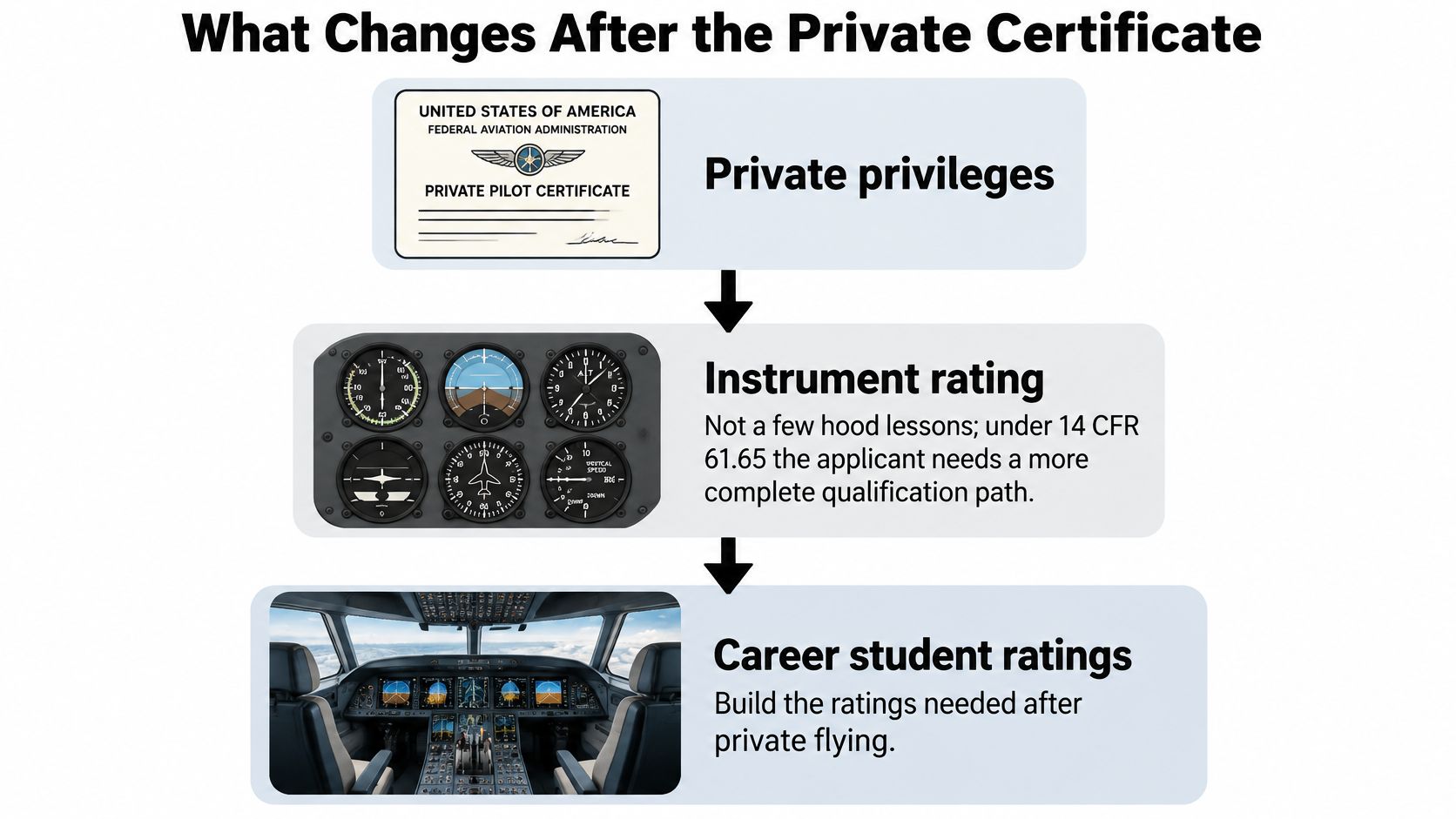
An instrument rating involves more than a few hood lessons. It trains you to control the aircraft, follow a course, and make decisions when outside visual references are gone. Under 14 CFR §61.65, the applicant needs at least 40 hours of actual or simulated instrument time, at least 15 of them from an authorized instrument instructor, an instrument cross-country, and at least 3 hours of instrument instruction in the two calendar months before the practical test.
Why a big simulator total can still fail
Simulator credit is capped. The same rule permits up to 20 hours in an approved simulator or flight-training device on the standard path, up to 30 hours under Part 142, and only up to 10 hours in a personal computer-based aviation training device. Sims are excellent for scans, approaches, and failures. They do not replace the airplane or the instructor-supervised time.
A syllabus has to label aircraft, simulator, device, instructor, cross-country, and recent-training time in separate columns. Say you show up with 45 instrument hours and 12 of them are a home computer. Only 10 of those device hours can count, and you may still be short of the 15 instructor hours or the recent dual. The logbook looked finished. The application was not.
Hours that earn a certificate, simulator time, and time an airline will count are three different piles.
Paid flying, then the instructor bridge
After the instrument rating, the commercial certificate adds the legal ability to be paid, first in a single-engine airplane and then with a multi-engine class rating. What you can already do with a private pilot license is personal travel. The instructor certificates, CFI and then CFII, are how most pilots log pilot-in-command time toward the 1,500-hour airline transport pilot certificate.
That ATP also needs a commercial certificate with an instrument rating, a knowledge test, a practical test, and 200 hours of cross-country on the standard path. Restricted ATP routes exist only for certain graduates of qualifying colleges. Finishing a flight school is not the same thing as holding one of those routes.
Delays That Blow the Timeline
Two paces set the private schedule, and neither one is immune to a bad week. A student flying two or three lessons a week runs on a months-long path and has some slack when a day drops out. A full-time student compresses the lessons and has less slack when one day falls out. Compressing the syllabus does not shorten a paperwork stop, an examiner wait, or a grounded airplane.
A finished student can still wait
An FAA safety notice reported that practical tests were delayed when an applicant's name in IACRA did not exactly match the name on the medical and knowledge-test records. You can be signed off and still not get a test date. Separate congressional testimony warned that constrained FAA resources can create backlogs and delay aviation workforce capacity for months.
Everyday stops do the same kind of damage on a smaller scale: a failed checkride, an airplane in maintenance, a medical issue, or a week of weather. One miss can wipe out the apparent head start, because acceleration removes the empty days you would have used to absorb it. While you wait, maneuvers fade, so review flights cost money, and rent, housing, or lost work keep running.
| Delay | What it does | Protection |
|---|---|---|
| IACRA name does not match medical or knowledge test | Examiner will not give the practical test | Make the name identical on all three records before applying |
| Examiner backlog | Test date slips by weeks or months | Ask who schedules the examiner before you commit |
| Failed checkride | More dual, another test fee, and a new date | Budget a retest and keep flying so the maneuvers stay current |
| Weather, maintenance, or a medical issue | Gap in the syllabus and skill fade | Plan proficiency flights after any layoff longer than a short break |
A completion month is conditional. It is not a promise unless the school manages examiner access and has a plan for a failed test or a cancellation. Anyone comparing a fast-track pilot training calendar should ask that question before treating the month count as a finish date.
Questions to Ask Before You Pay
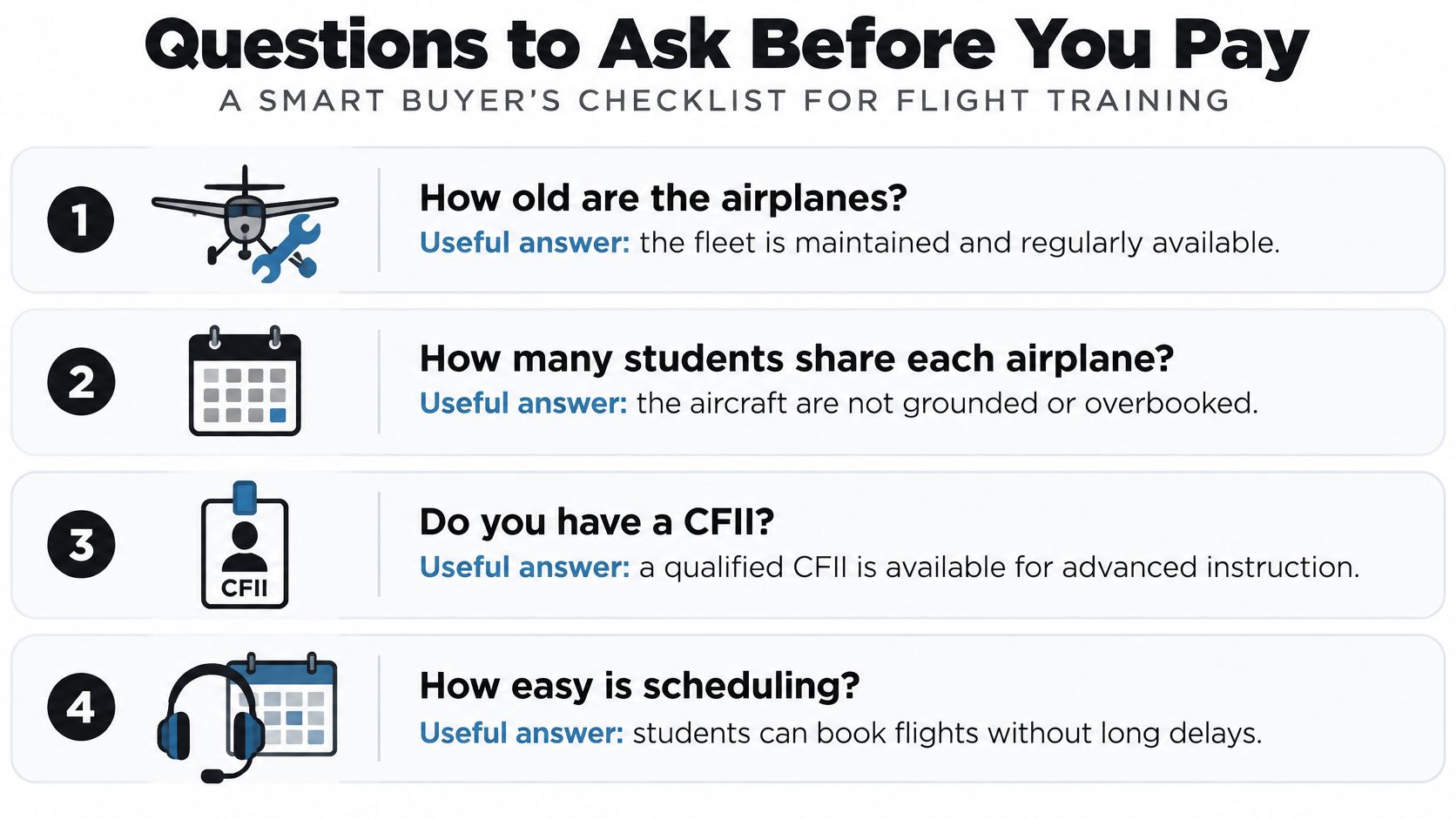
Ask these at every school, including ours. A useful answer is specific. A brochure answer is not.
Fleet, people, and the written total
How old are the airplanes, and how many students share each one? A grounded or overbooked aircraft costs weeks, not just a missed Tuesday. A useful answer names the fleet and how booking works on a busy week.
How often do instructors turn over? A new instructor often repeats lessons you already paid for, because they will not sign off maneuvers they have not seen. Ask how students are reassigned, not only how many instructors are on the roster.
What is the total price in writing, and what is excluded? Headset, tablet, knowledge test, checkride fees, the medical exam, retests, and review flights belong on that list. Before you compare totals, price each line yourself: aircraft rental per hour, instructor time per hour, ground school and study materials, and the medical and test fees. A low hourly rate with no total is not a budget.
Reading recent flight school reviews is useful only after you have those exclusions on paper. Praise without a price sheet does not tell you what you will still owe.
Rules, and whether you can fly first
Is training Part 61 or Part 141? That choice changes some hour floors and the shape of the syllabus. It does not change the privileges on the certificate.
Can I fly before I commit? A discovery flight answers more than a brochure. We treat that first flight as a chance to walk the hangar, sit in a cockpit, and meet the instructors with no syllabus attached.
Pay-as-you-go keeps the downside smaller and the calendar longer. A fixed full-time program does the reverse. The written total, the examiner plan, and the exit terms matter more than the headline month count. If the written terms hold up, choose either one flight to test the fit or the full program. Do not choose from a banner price alone.
Book a Discovery Flight or Career Track
Match the next step to what you know.
If you have never flown, do not sign a nine-month contract to find out whether you like it. A discovery flight is lesson one with an instructor, and no experience is required. The discovery flight price is a separate, smaller decision from any career syllabus. You preflight together and take the controls. Then you decide.
If you already know you want a career and you can train full time in Southern California, the Career Track is a fixed path from zero time to CFII and multi-engine. Tuition is a fixed $89,000. The course runs about nine months. It includes 282 total hours and six certificates and ratings: private pilot, instrument rating, commercial pilot in single- and multi-engine, certified flight instructor, and certified flight instructor–instrument. Training is based in Riverside, Long Beach, and Corona.
Those 282 hours finish that set of certificates and ratings. They do not finish the 1,500-hour airline transport pilot total. Instructing still sits between graduation and an airline seat. Bring the written-price questions and the examiner questions with you. Ask who schedules the checkride, what the price excludes, and what happens if a test slips.
Book the discovery flight if the goal is to find out whether flying fits. Start the Career Track application if the goal is those six ratings on one full-time timetable.
CFII trains aspiring career pilots from a first supervised flight through the certificates and ratings that sit between zero time and an instructor job. If the hour floors, the checkride paperwork, and the Southern California full-time path in this guide match what you want, visit CFII to book a discovery flight or ask about Career Track before you commit to a calendar.
Planning to fly for a living?
See what the path from zero to a pilot career looks like, what it costs and how long it takes.
Learn to fly in Riverside
We train at Riverside Municipal Airport in modern airplanes with a parachute built in. Start with a one hour discovery flight, no experience needed.