

On this page
- Why Part 61 Flight Schools Matter to a New Pilot
- What Part 61 Actually Is
- The legal idea behind the training
- Why that matters on day one
- Part 61 vs Part 141 in Practical Terms
- Where each model fits
- Part 61 vs Part 141 at a glance
- Realistic Costs and Timelines Under Part 61
- What the floor really means
- The role of fixed-price accelerated training
- What to Look For in a Part 61 School
- The six questions that matter
- How an Accelerated CFII Pathway Fits the Part 61 Model
- How the milestones line up with the rules
- Why the operations side matters
- Risks and Tradeoffs of Any Part 61 Track
- The risks that deserve real planning
- Choosing the Right Part 61 Path for You
You're standing at a common starting line, a logbook that's still blank, a career goal that feels clear in your head, and a search results page full of acronyms that blur together after about five minutes. The question isn't whether you can become a pilot. It's which training structure will carry you from zero time to a certificate, then to the next rating, without wasting money or forcing you into a schedule that doesn't fit your life.
Why Part 61 Flight Schools Matter to a New Pilot
If you're new to flying, Part 61 usually shows up after you've already decided you want a career path, but before you understand how the FAA measures progress. That's where many pilots feel stuck. They know they want the cockpit, they've heard about CFI and airline time, and they want a school that can turn that ambition into a real plan.
Part 61 flight schools matter because they operate inside a federal rule set built around certification outcomes, not a single rigid classroom sequence. That gives schools room to schedule one-on-one training, move at a student's pace, and build a path around the experience categories the FAA requires under 14 CFR Part 61. For a new pilot, that flexibility can be a feature, not a loophole.
The catch is simple. Flexibility doesn't remove the FAA's minimums, and it doesn't let a school skip the paperwork. It just changes how the school organizes the training around those requirements. If you understand that early, you'll ask better questions and avoid the biggest beginner mistake, confusing a polished sales page with a complete regulatory plan.
Practical rule: a strong Part 61 school sells structure inside flexibility, not flexibility instead of structure.
By the end of this guide, you should know what Part 61 really requires, how it differs from a more standardized model, what a realistic timeline can look like, what to ask before you enroll, and how a fixed-price accelerated program can stay inside the same rules while moving faster. If you haven't flown yet, a discovery flight is the cleanest first step, and if you're already comparing paths, you'll want to see how a career-track program fits into the bigger picture.
What Part 61 Actually Is
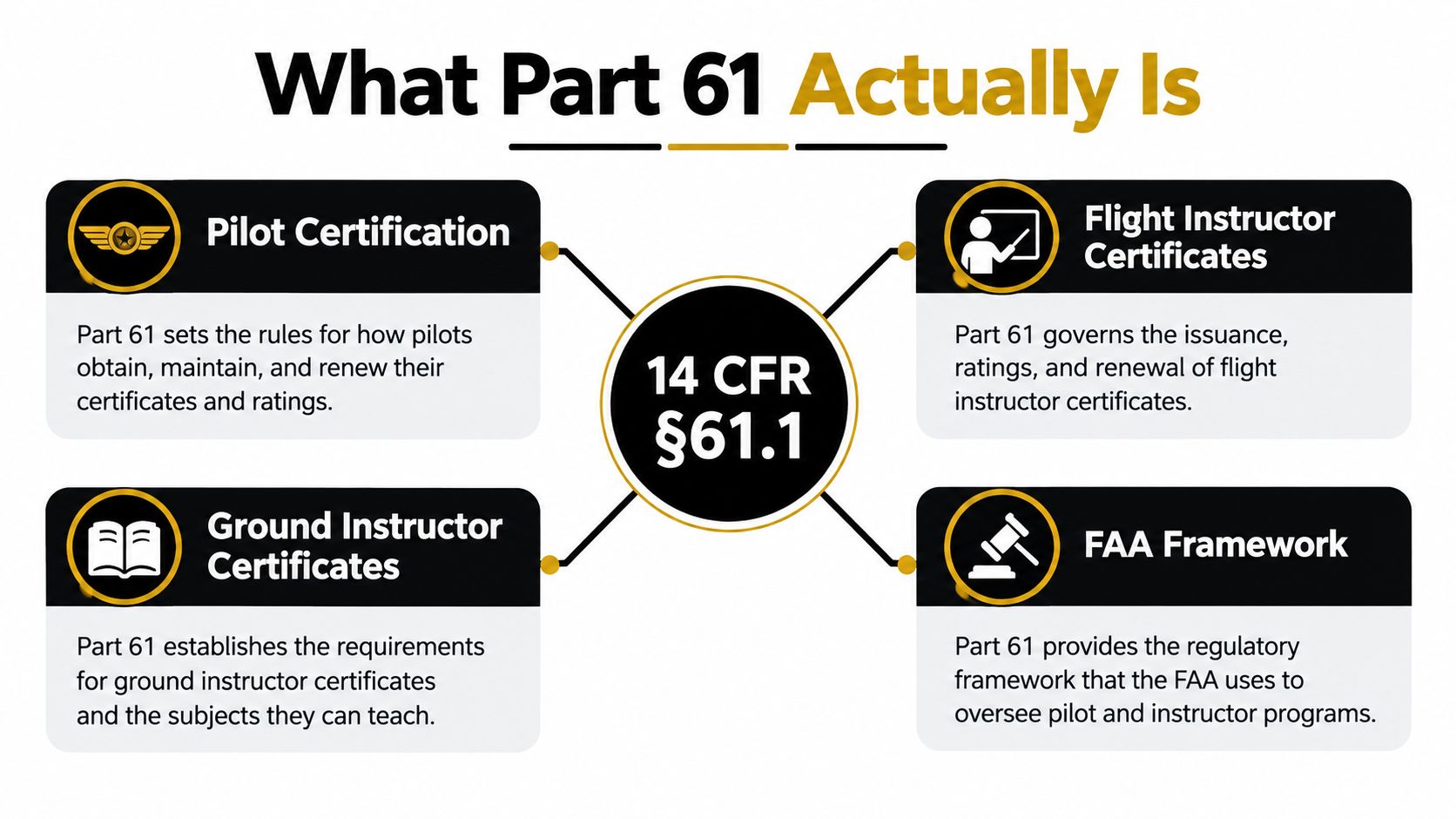
Part 61 is the FAA's certification framework for pilots, flight instructors, and ground instructors under 14 CFR §61.1. That matters because it tells you what the rule is doing. It isn't teaching in the classroom for you. It's defining how certificates and ratings are earned, what experience has to be documented, and what privileges and limits come with each credential.
The legal idea behind the training
Under Part 61, the school doesn't hand you a completed path and tell you to just “finish the hours.” It has to help you meet the required knowledge, skill, and experience standards. That's why two Part 61 schools can look very different on the surface while still working toward the same FAA certificates. One may be more relaxed in scheduling, another more aggressive about daily flying, but both still have to land on the same regulatory finish line.
The logbook is the proof. 14 CFR §61.51 requires training and aeronautical experience to be logged when used to satisfy a certificate, rating, or flight review requirement, and each entry has to identify the date, total time, locations, aircraft or simulator, and role. In plain English, the FAA wants more than “I flew today.” It wants a record that shows what happened, where it happened, and why it counts.
Why that matters on day one
This is why logbook discipline is a serious part of training from the first lesson. A student who tracks every qualifying flight correctly is building a legal record, not just a personal diary. An instructor who signs the training and keeps endorsement records is part of that same chain of proof.
If you're reading about a training path and no one is talking about documentation, that's a red flag. Flexibility is useful. Loose recordkeeping isn't.
For a closer look at how a certifying path is built, see the practical overview at CFII's pilot certification training guide. The details may differ from school to school, but the regulatory spine stays the same.
Part 61 vs Part 141 in Practical Terms
Part 61 and Part 141 both lead to FAA pilot certificates, but they get there in different ways. Part 61 is more instructor-led and individualized. Part 141 is more syllabus-driven and standardized. A good analogy is this, Part 141 is a structured course with seats assigned, while Part 61 is more like a credentialing path with a flight instructor guiding the work.
Where each model fits
Part 141 usually appeals to students who want a tightly ordered progression, stage checks, and a school environment built around a published syllabus. Part 61 is often better for students who need more scheduling freedom, want one-on-one pacing, or are combining flight training with a more complex life. That said, both models still require the applicant to meet the FAA's standards for knowledge, skill, and experience.
The practical tradeoff is pacing versus predictability. Part 141 is easier to map in advance because the structure is fixed. Part 61 can be easier to adapt when weather, aircraft availability, or student progress changes. For a full-time career student, that flexibility can speed things up if the school is organized well.
Bottom line: Part 61 gives the instructor more room to sequence training around the student, but it never reduces the applicant's responsibility to satisfy the FAA requirements.
Part 61 vs Part 141 at a glance
| Dimension | Part 61 | Part 141 |
|---|---|---|
| Training style | Individualized, instructor-led | FAA-approved syllabus with structured progression |
| Scheduling | Flexible | More fixed and standardized |
| Recordkeeping | Logbook-centered under §61.51 | Program structure and school oversight are more formal |
| Best fit | Students who need adaptability and one-on-one pacing | Students who want a highly defined school track |
| Training outcome | Same FAA certificates and ratings | Same FAA certificates and ratings |
For the aspiring career pilot, the most important takeaway is this, Part 61 is the dominant rule set for independent and non-airline-pipeline training in the United States. That's why so many accelerated programs choose it. They're not avoiding structure. They're building structure inside a more flexible rule set.
Realistic Costs and Timelines Under Part 61
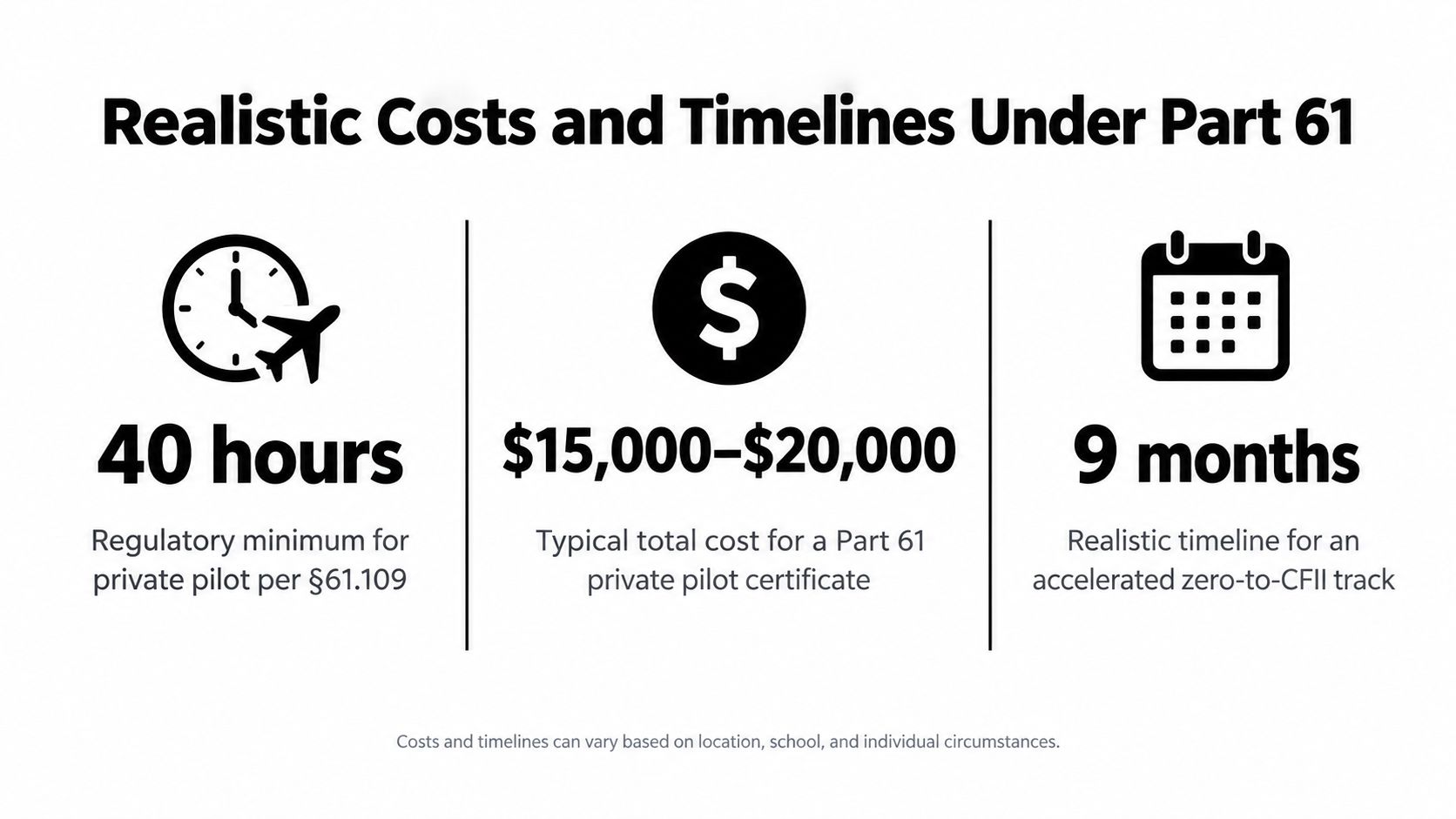
The first number most new pilots need to understand is the private pilot floor. Under §61.109, the FAA requires at least 40 total flight hours for a private pilot airplane single-engine certificate, including training with an authorized instructor, solo time, and the prescribed cross-country, night, and instrument experience. That's the minimum, not a promise that you'll be ready exactly at 40 hours.
What the floor really means
A minimum is not a finish line you automatically cross just because the calendar says you should. In real training, some students need more repetition, more weather days, or more time to make the maneuvers consistent. That's why Part 61 schools usually build around logged experience, not around a fantasy clock that never slips.
The commercial level is a very different climb. Under §61.129, a commercial pilot certificate with an airplane single-engine rating generally requires at least 250 hours of total flight time as a pilot, along with defined categories of pilot-in-command, cross-country, instrument, and instructional experience. That gap explains why the jump from private pilot to career-ready commercial training feels so much bigger than the first certificate.
For a straightforward read on how training expenses build, see this guide to flight training cost. The important idea is simple, under Part 61 the final bill depends on how many hours you log, not just on the advertised minimum.
The role of fixed-price accelerated training
That's also why fixed-price accelerated programs exist. A school can't delete FAA hour requirements, but it can organize the schedule tightly, coordinate checkrides, and use simulators where they're legally creditable to reduce wasted calendar time. That's how a zero-to-CFII path can be compressed without pretending the rules disappeared.
A realistic Part 61 budget often has more moving parts than students expect. Aircraft time, instructor time, simulator use, written test fees, checkride fees, and the medical all belong in the plan. If the school won't explain those categories clearly, ask again before you enroll.
The true takeaway is this. Under Part 61, the published total is the product of the rate and the hours you log. If you want the cost to be predictable, the school has to make the training path predictable too.
What to Look For in a Part 61 School
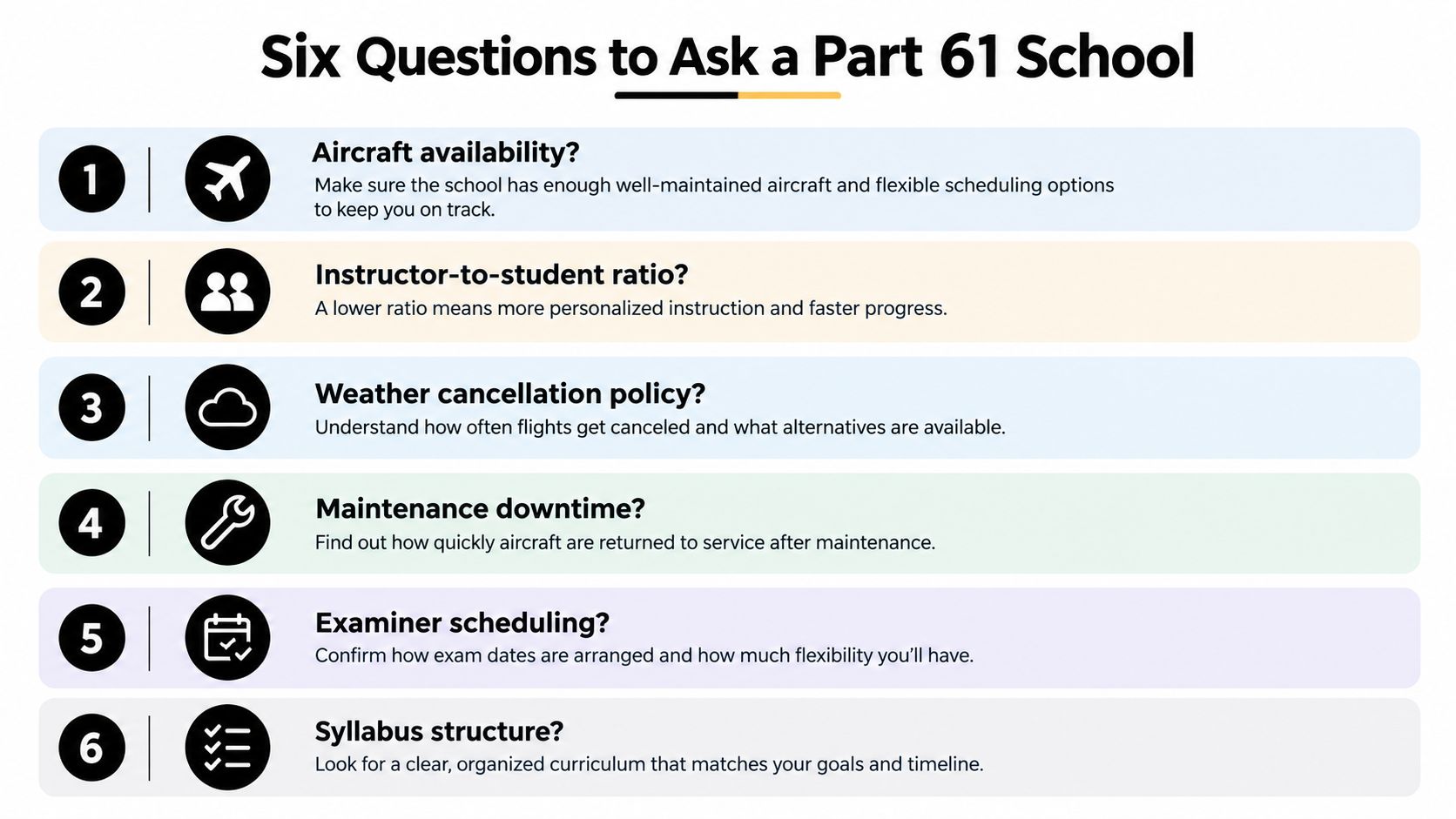
A good Part 61 school should be able to answer the same six questions without dancing around them. If the answers are vague, the program probably shifts too much risk onto the student. If the answers are specific, you're probably looking at a school that understands both instruction and documentation.
The six questions that matter
- Written syllabus? Ask whether the school maps each certificate to the required experience categories, so you can see how night, cross-country, instrument, solo, and aircraft-specific work are sequenced.
- Stage checks and remediation? Find out how the school handles unsatisfactory performance when a student isn't ready on the planned timeline.
- Simulator credit? Confirm whether simulator time is legally creditable for the specific certificate or rating you're pursuing.
- Checkride scheduling? Ask who coordinates examiners and how the school handles wait time.
- Timeline risk? Get a direct answer on weather, maintenance, illness, and failed practical tests.
- Price model? Make sure you know whether the total price is fixed or hourly before you commit.
Under §61.57, currency is separate from certification, and that's where many new pilots get confused. A certificate doesn't automatically mean you're current to carry passengers, and recurring training requirements still apply after the checkride.
A private pilot should not confuse “I earned it” with “I can use it in every situation.” Currency, endorsement, and recent experience are separate questions.
This is also where §61.51 and instructor recordkeeping matter at the program level. You may never handle the school's internal records, but your logbook and the instructor's endorsement records need to match the training reality. That's how the school turns flexibility into something the FAA can verify.
If a school can explain all of that clearly, you're probably talking to a program that respects the rules instead of hiding behind marketing language. For a broader training overview, this flight training courses guide can help you organize what you hear on a school tour.
How an Accelerated CFII Pathway Fits the Part 61 Model

A well-run Part 61 program can move fast without cutting corners, and CFII's Career Track is a clear example of how that works. It runs from zero time to CFII and multi-engine in about nine months at a fixed $89,000 tuition, with 282 total hours by month nine made up of 204 single-engine hours, 25 multi-engine hours, and 53 simulator hours. Those hours support six certificates and ratings, private pilot, instrument rating, single-engine commercial, multi-engine commercial, CFI, and CFII.
How the milestones line up with the rules
Private pilot training fits under §61.109. The instrument rating sits under §61.65. Commercial airplane training aligns with §61.129, multi-engine privilege comes under §61.63, CFI under §61.183 and §61.187, and CFII under §61.185 and §61.191. The point isn't that the school rewrites the rulebook. The point is that it sequences the training so each milestone lands inside the right regulation at the right time.
That sequencing is what makes a short calendar possible. You still have to meet the documented experience requirements, but a school can reduce drag by keeping the flying, study, simulator work, and checkrides tightly coordinated. That's a major difference between a program that merely promises speed and one that organizes for it.
The optional “Work with us” add-on adds $15,000, includes a 25-hour instructor bootcamp, and provides 175 paid instructing hours at $30 per hour, which can move a student toward at least 480 total hours by month 18. That matters because many new instructors stall when they're waiting for a path to building time, and this structure reduces that gap.
Why the operations side matters
The calendar only works if the operations support it. One-on-one instruction, a fleet of factory-new glass-cockpit trainers with whole-aircraft parachutes, certified simulators, and coordinated examiners all help keep the path moving. Southern California bases in Riverside, Long Beach, and Corona also give the program year-round flying conditions.
For readers comparing a structured career path, this accelerated flight training overview is a useful companion. The key lesson here is simple, flexibility works when it's paired with structure, not when it's left to chance.
Risks and Tradeoffs of Any Part 61 Track
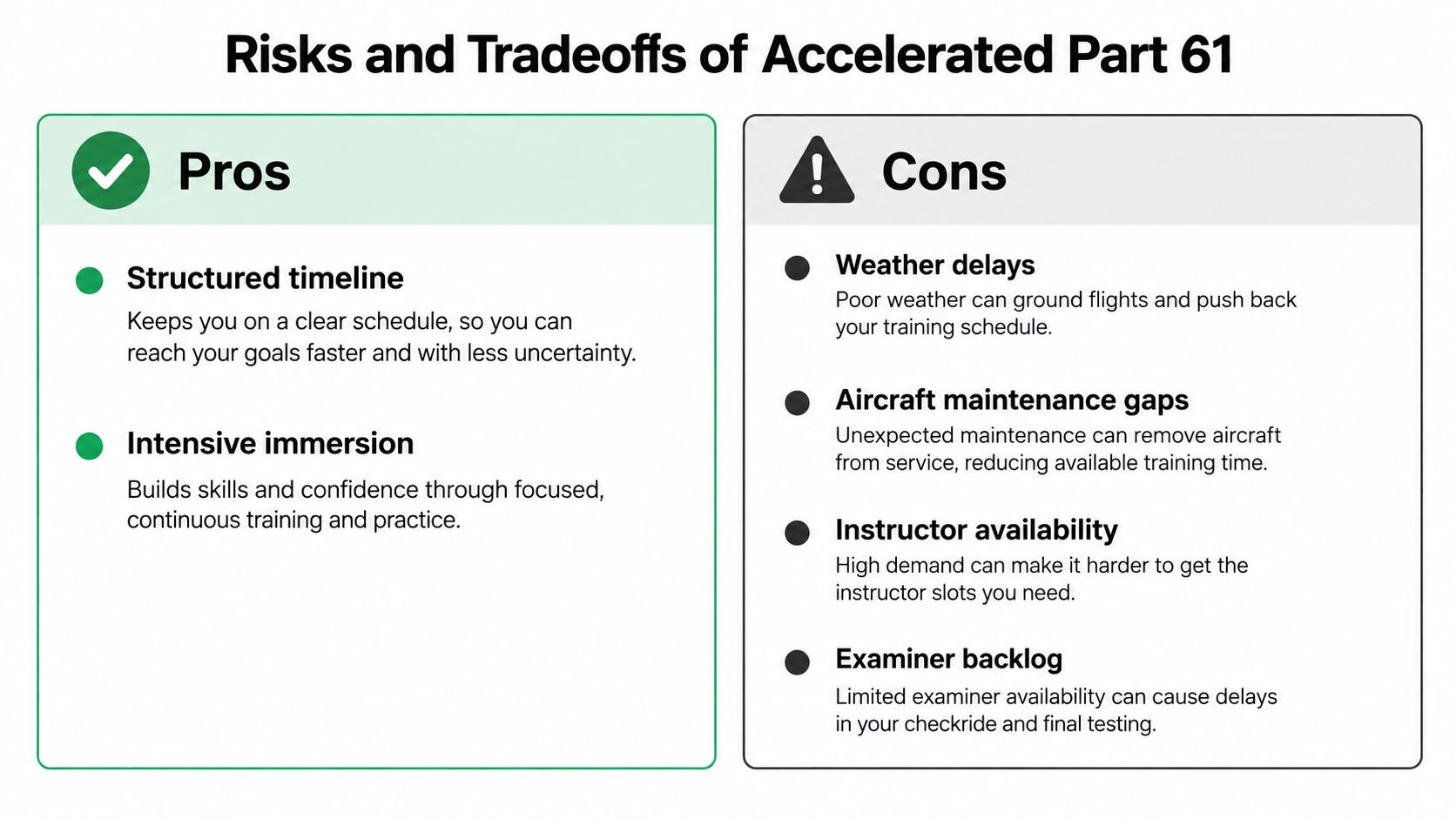
Accelerated training can save calendar time, but it doesn't make ordinary training problems disappear. Weather still cancels flights. Aircraft still go down for maintenance. Examiners still have schedules. Students still get sick. And a practical test can still be failed.
The risks that deserve real planning
- Weather delays can interrupt a tight calendar, so a good school needs reserve days and alternate training plans.
- Aircraft maintenance gaps can push training off course if the fleet isn't managed well.
- Instructor availability can become a bottleneck if the school doesn't protect lesson continuity.
- Examiner backlog can stretch the time between readiness and the actual checkride.
Those are operational realities, not excuses. A strong Part 61 school plans for them instead of pretending they won't happen. That's also where simulator time becomes valuable, because it can keep the training rhythm alive when the airplane is unavailable or the weather isn't cooperating.
Currency risk matters too. Under §61.57, a certificate alone doesn't guarantee current privileges. If too much time passes between lessons or between the checkride and later passenger flying, the school has to manage that transition carefully. Otherwise, the student can finish training but still be unready for normal use of the certificate.
Documentation risk is just as serious. Under §61.51, training and aeronautical experience have to be logged correctly, and instructors must maintain endorsement records under §61.189. A sloppy school can create avoidable problems later, especially when a student needs proof for hiring, recurrent training, or another rating.
Financially, fixed tuition still doesn't mean every cost is included. Medicals, housing, supplies, and some checkride-related costs can sit outside the headline price. If a school offers housing or financing, that can help with cash flow, but it shouldn't distract you from reading the full cost picture.
For example, CFII lists student housing near Riverside at $1,300 per month and financing through Stratus Financial with a 12-month deferral. Those details matter because they show how a program can address real-world friction without changing the FAA requirements.
Choosing the Right Part 61 Path for You
A student choosing between schools is really choosing how training will fit into daily life. Part 61 gives you room to train around work or school, while a structured accelerated path keeps lessons moving in a tighter sequence. Part 141 still offers a more standardized syllabus. The right fit depends on whether you need flexibility, calendar speed, or a clearer day-to-day framework.
A local part-time school can make sense if your schedule changes often. An accelerated fixed-price Part 61 program fits a different student, one who can relocate and wants training organized to reduce gaps between lessons. That is why the regulatory side matters as much as the sales page.
A discovery flight is the easiest first check. If the cockpit feels natural, you can compare the path you want with the rules that govern it. If you are already comparing programs, read how to become a pilot and compare that guide with your own schedule, budget, and timeline.
If your goal is a career, choose the path that keeps training active and removes avoidable confusion. A slower local school may still be the right answer if you need time, distance, or a more flexible pace. A fixed, accelerated Part 61 track fits a student who wants structure without changing regulatory frameworks.
The best choice is the one that gets you from interest to logged experience with the fewest detours.
Planning to fly for a living?
See what the path from zero to a pilot career looks like, what it costs and how long it takes.
Learn to fly in Riverside
We train at Riverside Municipal Airport in factory-new airplanes with a parachute built in. Start with a one hour discovery flight, no experience needed.