On this page
- How Long Private Pilot Training Takes at Each Pace
- How To Read Your Row
- Why 40 Hours Is Only the Starting Point
- What Sits Inside the Minimum
- What Students Actually Log
- Three Milestones Between Your First Lesson and the Certificate
- Milestone One Legal Eligibility
- Milestone Two Checkride Readiness
- Milestone Three Certification
- What Stretches or Shortens Your Timeline, With a Worked Example
- What pushes the date out
- What pulls the date in
- Turn hours into months before you enroll
- What Each Extra Hour Adds to the Cost
- Questions To Ask In Writing
- Choose Your Training Pace and Book a Discovery Flight
- If You Have Not Flown Yet
- If You Want The Full Career Path
A private pilot license follows your weekly schedule, not one poster number. The legal minimum is 40 hours. Most U.S. students need about 60 to 75 hours. Full-time training typically takes 2 to 3 months. One lesson a week turns those same hours into 10 to 16 months.
Two people can need similar hours and still finish a year apart. Divide the hours you still need by the hours you can fly each week. Weather, study, and the checkride add a buffer. More flying days shorten the calendar. They do not always shrink the bill. A pace you cannot sustain adds makeup flights after skills fade, and each of those hours is another charge.
How Long Private Pilot Training Takes at Each Pace
Most U.S. students need roughly 60 to 75 flight hours, and calendar time depends mainly on how often they fly.
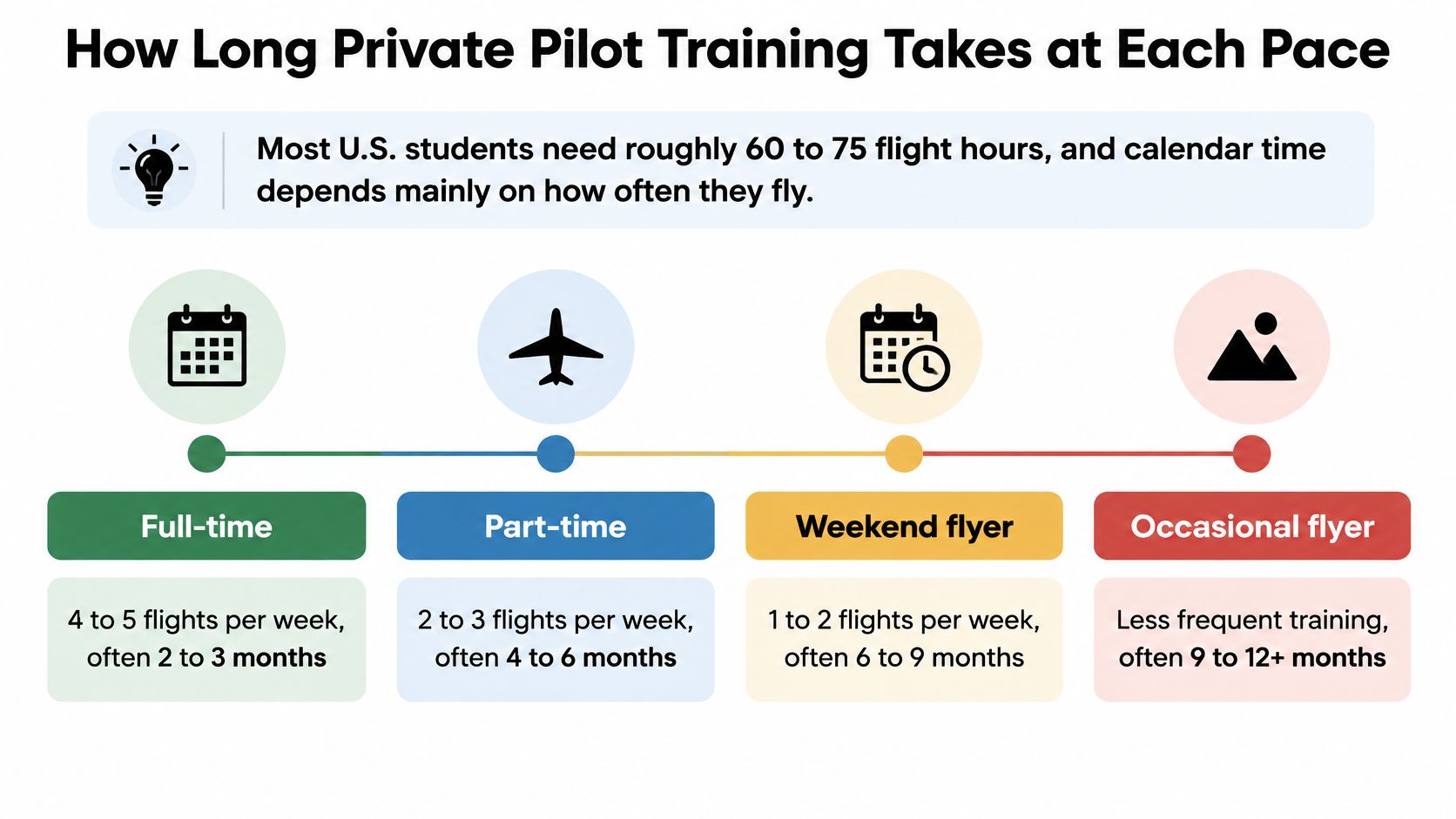
| Training pace | Typical flying per week | Hours to certificate | Calendar time |
|---|---|---|---|
| Full-time, 4 to 5 days a week | 6 to 8 hours | 60 to 75 | 2 to 3 months |
| Two to three lessons a week | 3 to 4 hours | 60 to 75 | 4 to 6 months |
| One lesson a week | 1 to 1.5 hours | 60 to 75 | 10 to 16 months |
| Sporadic, a few times a month | Under 1 hour | 60 to 75 | 2 years or more |
How To Read Your Row
Full-time flying works when you can treat training like a job. You fly four to five days a week, study between flights, and build on yesterday's lesson while it's still fresh. At 6 to 8 hours per week, even a student near the top of the hour range can finish in about a quarter.
Two to three lessons a week is the steady middle path. Hobby students taking two or three lessons per week typically reach the private pilot checkride in four to six months, paying lesson by lesson. That pace fits around a job without leaving long gaps.
One lesson a week still works, but it's slower than the math suggests. A typical lesson puts about 1.5 hours on the clock, and part of each flight goes to rebuilding last week's landing picture. Sporadic flying stretches that problem further, because you spend paid time remembering instead of progressing.
These are planning estimates, not guarantees. They assume 60 to 75 total hours, lessons of about 1.5 hours, and some time lost to weather, aircraft availability, and reschedules. Ground school runs alongside flying, so treat the range as the minimum to plan for, not a promise.
Count the hours you can fly in a normal week, not your best week. That number picks your row.
Why 40 Hours Is Only the Starting Point
A private pilot certificate has a legal flight-time minimum, but the calendar depends on how long it takes you to fly each required skill consistently. The regulation sets the floor; it does not schedule the practice needed to reach checkride standards.
Under 14 CFR §61.109, the Part 61 minimum is 40 hours of logged flight time, including at least 20 hours of flight training with an authorized instructor and 10 hours of solo flight training. The rule also requires 3 hours of cross-country instruction, 3 hours of night training, and 3 hours of instrument-reference training.
What Sits Inside the Minimum
The solo requirement includes 5 hours of solo cross-country flying and one solo cross-country flight of at least 150 nautical miles, with full-stop landings at three points and one leg exceeding 50 nautical miles. You also need instructor-led preparation for the practical test shortly before taking it.
Those requirements define what you must log, not how many attempts it will take to perform each maneuver safely and consistently. Your learning pace, cancelled lessons, and extra practice all affect the total.
Part 141 schools may use a lower minimum within an approved curriculum. The FAA's flight training requirements explain how training requirements fit into the certification process. A lower legal threshold does not lower the skills an examiner expects on checkride day.
What Students Actually Log
| Benchmark | Hours | What it measures |
|---|---|---|
| FAA minimum, Part 61 | 40 | Legal floor under 14 CFR 61.109 |
| FAA minimum, Part 141 approved curriculum | 35 | Minimum within an approved curriculum |
| Jason Blair analysis, 2024, all pilots | 76 | Average to certificate |
| Jason Blair analysis, 2024, Part 61 | 72 | Average under Part 61 |
| Jason Blair analysis, 2024, Part 141 | 78 | Average under Part 141 |
A 2024 analysis by aviation educator Jason Blair reported an average of 76 hours to complete the private pilot certificate: 78 hours under Part 141 and 72 hours under Part 61. The difference shows why a lower minimum does not necessarily mean fewer hours in practice.
A logbook total is only one part of readiness. You need to meet the required experience and perform to standard on the checkride, with the examiner evaluating your flying without your instructor beside you. Plan around the practice needed to build that proficiency, rather than treating the regulatory minimum as a likely finish line.
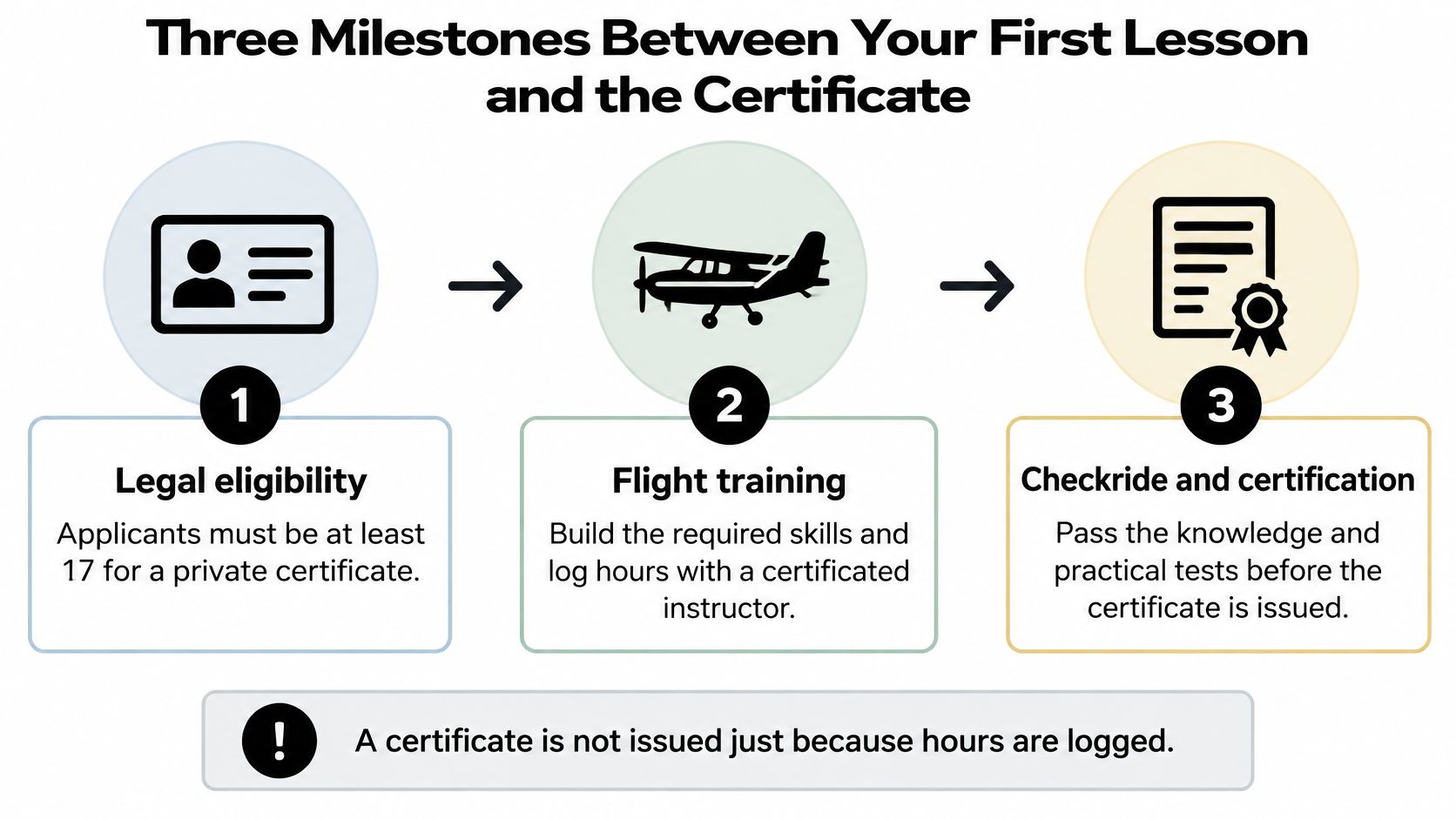
Three Milestones Between Your First Lesson and the Certificate
Logging hours doesn't earn the certificate by itself. Three separate milestones stand between your first lesson and the plastic card, and only one of them is about flying time.
Milestone One Legal Eligibility
Under the general standards in 14 CFR § 61.103, you must be able to read, speak, write, and understand English, complete the applicable aeronautical experience, and hold a U.S. student, sport, or recreational pilot certificate before applying for the practical test. There's no minimum age for lessons, but you can fly solo at 16 and hold a private pilot license at 17.
Medical eligibility belongs here too. A third-class FAA medical certificate from an aviation medical examiner is required before flying solo, but your discovery flight and first lessons can happen before you get one. Book it early anyway, because a surprise medical issue discovered at hour fifteen can pause everything.
Milestone Two Checkride Readiness
Readiness means you've passed the FAA knowledge test, logged the required experience, and earned your instructor's endorsement. That endorsement isn't a formality. Your instructor is stating you're prepared, so they won't sign until your maneuvers, judgment, and oral knowledge hold up together.
Our guide to the student pilot certificate covers the paperwork sequence, but the practical order looks like this.
- Get a student certificate and medical. These allow solo flight, so delays here stall your middle phase.
- Log the required hours and solo flights. Your pace determines the calendar.
- Pass the knowledge test. Study alongside flying rather than cramming at the end.
- Get the instructor endorsement and prepare. Final polish happens close to test day.
- Pass the practical test. An examiner evaluates your knowledge and flying together.
Milestone Three Certification
You become a private pilot when you pass the practical test, not when your logbook crosses a threshold. Ground study, oral preparation, and checkride scheduling all run beside your flying, so a realistic plan adds those weeks to the hour count instead of discovering them later.
What Stretches or Shortens Your Timeline, With a Worked Example
Three students can chase the same private pilot certificate and finish on three different calendars. Weekly frequency does most of the sorting.
Maya flies four days a week while she is between jobs. Each lesson starts on the maneuver the last one left unfinished, and she studies on the off days. She reaches the checkride in about two and a half months with roughly 65 hours. Frequency, not a skipped requirement, is what makes her fast.
Tom flies two lessons a week around work. At CFII, hobby students taking two or three lessons a week typically reach the private pilot checkride in four to six months. Tom fits that pattern: about five months and roughly 70 hours. Most flights open with a short review, then move on. The airplane time runs a bit higher than Maya's, and the schedule still fits a job.
Priya flies once a week and loses extra weeks to travel and weather. In this scenario she takes about 14 months and logs around 80 hours. The certificate and the standard match the other two. The calendar does not.
The shortest calendar path isn't automatically the cheapest. An unrealistic pace creates fatigue and repeated lessons, so consistency often matters more than intensity.
The earlier section on why 40 hours is not the answer already separates the legal minimum from the hours students fly. Your remaining job is to place those hours on a week you can keep.
What pushes the date out
Student flying needs usable weather, and one cancellation on a tight schedule can cost a week. Too many students on too few airplanes turns a training plan into a waiting list. A new instructor spends early flights learning where you are, so those hours go to showing work again instead of adding the next lesson. Ground study left until the end blocks the practical test, which cannot happen before the knowledge test. After you are ready, examiner availability can still insert weeks.
How the school is organized changes how easily you can stack lessons. Part 61 vs Part 141 is the structural choice that affects that flexibility.
What pulls the date in
One instructor who already knows your weak spots skips the reassessment flights. A standing aircraft slot protects the rhythm when the school is busy. Studying for the knowledge test in the first half of training keeps the written exam from owning the last month. Several flights in the weeks you are free beat a single lesson stranded on the calendar.
A faster pace compresses months. It leaves the knowledge test, the checkride standard, and the experience minimums exactly where they were.
Turn hours into months before you enroll
Divide the hours you expect to need by the hours you can fly each week, then add room for weather and reschedules. At 70 hours and 3 hours a week, the flying alone is about 23 weeks before any cancellation. Five to six months is an honest plan. Four months is hopeful.
What Each Extra Hour Adds to the Cost
The certificate's price is mostly a multiplication problem: hours times the rates you pay.
Flight Sim Coach reported in 2024 that private-pilot training generally costs $10,000 to $20,000 and that students average approximately 60 flight hours, compared with the 40-hour FAA minimum.
Spread that band across 60 hours and the implied all-in cost is about $167 to $333 per hour, aircraft and instruction together. Hold those rates steady and 75 hours lands near $12,500 to $25,000. Fifteen extra hours are a quarter more flying, so they move the total by roughly a quarter of whatever you are already paying.
Why gaps add hours is in the pace examples above. A low hourly rate still fails you if the school cannot put you in an airplane on the days you booked. Assessment flights, a new instructor, and empty slots get billed too. Price every school on the same assumption, 60 to 75 hours, not the advertised price of one lesson. Aircraft, instructor, exams, and supplies are broken out in our private pilot license cost guide.
Questions To Ask In Writing
We recommend asking every flight school, including us, the same questions before you commit.
- Airplane age. How old is the fleet you'll train in?
- Students per airplane. Will you get the slots your pace requires?
- Instructor turnover. How likely are you to keep one instructor?
- Total price in writing. What's the full estimate at a realistic hour count?
- Part 61 vs Part 141. Which rules govern your training, and why?
- Fly before committing. Can you take a trial flight first?
Get those answers in writing. Then multiply each school's rates by the same hour count. That is the fair comparison.
Choose Your Training Pace and Book a Discovery Flight
You have three decisions to make, in this order. How many hours can you fly each week, how many months can you commit, and what total budget fits 60 to 75 hours?
Match your weekly hours to the pace table from the opening section. If you can protect three to four hours a week, plan on four to six months. If you have one lesson a week, plan on a year or more and budget for extra review hours, because pretending otherwise just sets you up to quit when reality arrives.
Then price the total using the questions from the cost section, not an hourly rate. Ask for a written estimate at 60, 70, and 75 hours so you can see what each outcome costs before you're emotionally invested.
If You Have Not Flown Yet
Start with a discovery flight before you buy anything bigger. We offer a one-hour discovery flight that requires no experience, so you meet an instructor, preflight the airplane together, and take the controls in the air. You'll learn whether you enjoy flying, how you handle the workload, and whether the school's teaching style suits you.
It also counts as lesson one if you continue, so nothing is wasted. Our guide to discovery flight price explains what that first flight should include and what it should cost you in time.
If You Want The Full Career Path
A private certificate is the first stage of a professional route, not the whole of it. If your goal is to fly for a living, our Career Track runs about nine months from zero time to CFII and multi-engine, with fixed $89,000 tuition, 282 total hours, and six certificates and ratings, based in Riverside, Long Beach, and Corona in Southern California.
That structure takes you from zero experience to flight instructor, with instrument, commercial, and multi-engine ratings along the way. It suits someone who can train full-time and wants the private phase planned as part of a longer sequence rather than a standalone project.
- Pick your pace. Use your real weekly availability, not an ideal week.
- Check your calendar. Protect the same slots every week.
- Compare total cost. Price 60 to 75 hours with the written checklist.
- Book a discovery flight. Fly once before you commit to a program.
If you're ready to find out how long to get a private pilot license on your own schedule, start with a one-hour discovery flight and bring your weekly availability with you. Visit CFII to book that first flight, tour a Southern California base, or ask for a written total price for the pace you can keep.
Planning to fly for a living?
See what the path from zero to a pilot career looks like, what it costs and how long it takes.
Learn to fly in Riverside
We train at Riverside Municipal Airport in modern airplanes with a parachute built in. Start with a one hour discovery flight, no experience needed.