

On this page
- The Six Pilot Certificates Side by Side
- U.S. pilot certificates at a glance
- How the Layers Stack
- Three questions before every flight
- Student and Sport Certificates for Learning and Light Flying
- What sport actually allows
- Recreational and Private Certificates for Flying for Fun
- The money line people misread
- Commercial Pilot Certificate and What It Allows
- Commercial airplane certificate minimums
- A job that fits, and a job that doesn't
- Airline Transport Pilot Certificate and the Hour Climb
- A realistic order of work
- Choose Your Certificate and Plan the Next Step
- Which certificate fits your goal
- Three steps before you spend the training budget
Many students treat a pilot license as one finish line. They ask which card to get, then stop reading. The better question is which privilege, rating, and hour total match the flying you want. A commercial certificate lets you get paid. It does not, by itself, put you in an airline seat.
The FAA organizes the types of pilot licenses as certificates with hard limits. Ratings and medicals sit on top of those certificates and change what you may do on a given day. If you have little or no flight time, match the flying to the rule before you match it to a course.
The Six Pilot Certificates Side by Side
Which license do you need? Start with the flying, not the title. Use the table as a lookup.
U.S. pilot certificates at a glance
| Certificate | Minimum age | Minimum flight time | Medical needed | Core privilege |
|---|---|---|---|---|
| Student | 16 to solo | None for the certificate; solo only when endorsed | Third-class before first solo | Learn under instruction; no passengers |
| Sport | 17 | 20 hours | U.S. driver's license or BasicMed | Light-sport aircraft, one passenger, daytime VFR only |
| Recreational | 17 | 30 hours | Third-class or BasicMed | Limited local flying, one passenger, no night |
| Private | 17 | 40 hours | Third-class | Carry passengers; no compensation for flying |
| Commercial | 18 | 250 hours | Second-class | Compensated flying; paid flight instruction also needs a CFI |
| ATP | 23 | 1,500 hours (fewer on restricted route) | First-class for airline operations | Serve as airline captain |
Read the hours as floors. A private applicant can be eligible at 40 hours, and a commercial applicant can meet a 250-hour floor, but the checkride tests skill. Many applicants who finish log more than the printed minimum.
Two rows surprise new students. Sport can rest on a U.S. driver's license or BasicMed instead of a standard FAA medical, which is why some weekend pilots start there. Paid flying is a different medical problem. Commercial work needs a second-class medical, and airline operations expect first-class. The July 2025 MOSAIC rule widened sport-pilot aircraft and operating possibilities in phases, so confirm today's limits before you choose sport over a higher certificate.
Find the row for the flying you want. Then read that section below. You don't have to climb every row "just in case."
How the Layers Stack
The FAA splits pilot privileges into two layers. The certificate records the level of training and testing you have completed. The ratings attached to it define the aircraft and conditions where you may use it.
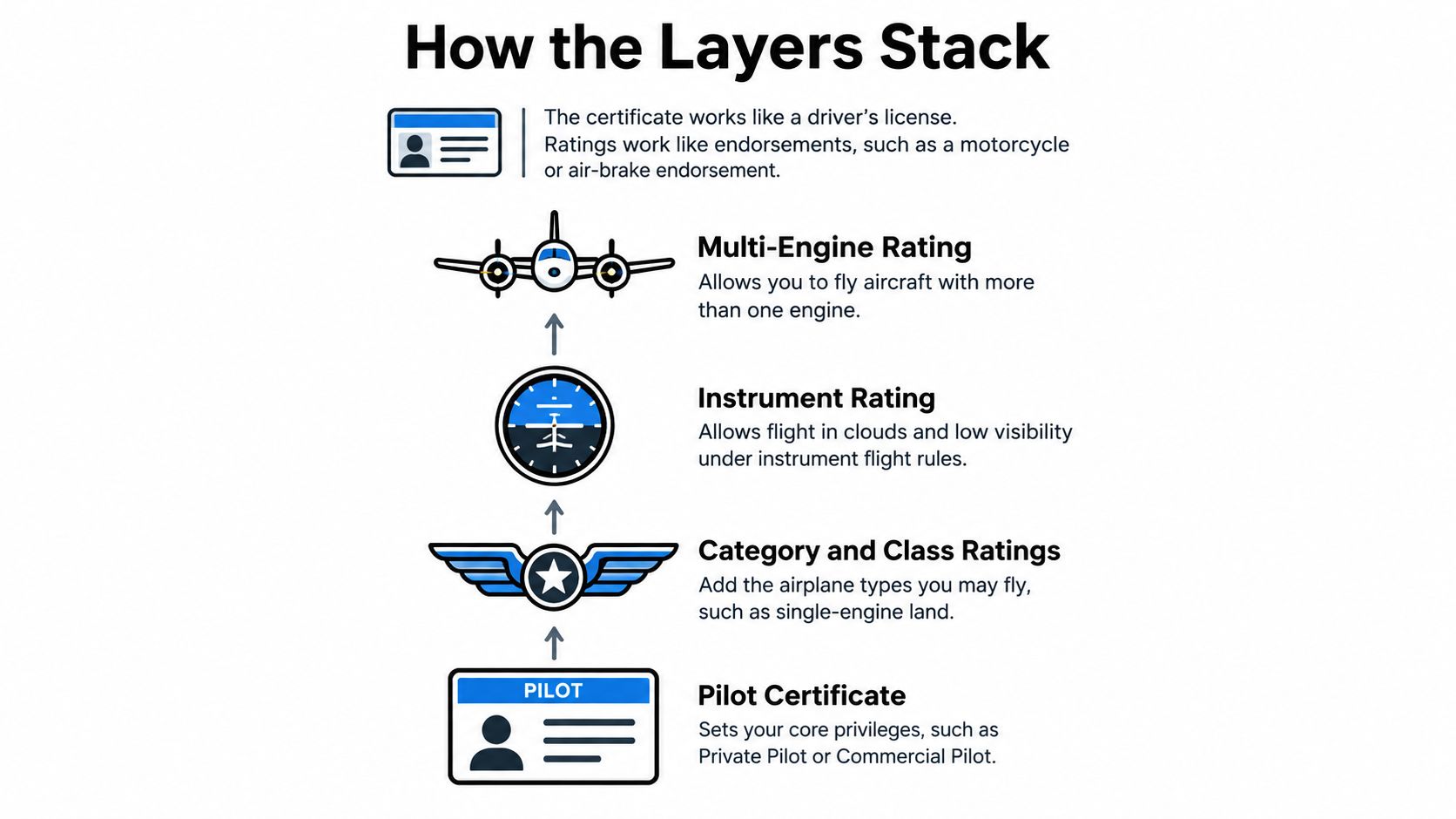
Its overview of pilot certificates separates student, sport, recreational, private, commercial, and airline transport certificates from the ratings that follow them. Category and class name the aircraft family, such as single-engine land or multi-engine land. An instrument rating adds flight under instrument rules. A type rating covers aircraft the FAA classifies as large, plus every turbojet-powered airplane.
Three questions before every flight
- Pilot certificate: How far has the training gone? Private, commercial, or ATP sets the core legal level.
- Category and class: Which aircraft family may you fly? A commercial certificate does not add a second engine on its own.
- Instrument and type: May you enter the clouds, and may you command this large or turbojet airplane?
Take a commercial pilot who holds only a single-engine land class rating. A charter job in a twin stays off the table until a multi-engine class rating goes on that certificate, no matter how many hours sit in the logbook. The certificate grants the level. The rating opens the machine.
Without an instrument rating in the same category and class, a commercial certificate still blocks a common job: carrying passengers for hire on cross-country flights of more than 50 nautical miles, or at night, a limit written into 14 CFR 61.133. Career students usually add the instrument rating alongside or right after private training because it removes that restriction early. A rating and currency are separate checks. You still meet the instrument-currency rules before you carry passengers under IFR.
A flight instructor certificate, including CFI and instrument-instructor privileges, sits on top of the pilot certificate under it rather than replacing it. In 2024 the FAA counted 848,770 active pilot certificates, 342,400 instrument ratings, and 138,127 flight instructors in its civil airmen statistics, which shows how common these added layers are.
A commercial certificate on its own permits paid flying. It does not finish the climb toward an airline seat. List the privileges, ratings, and hours your actual goal needs before you price the next course.
Student and Sport Certificates for Learning and Light Flying
Picture a first solo. You've had the lessons, your instructor watches the pattern, and the endorsement in your logbook is what makes that circuit legal. The student certificate is the learner's permit. It supports training. It never authorizes passengers.
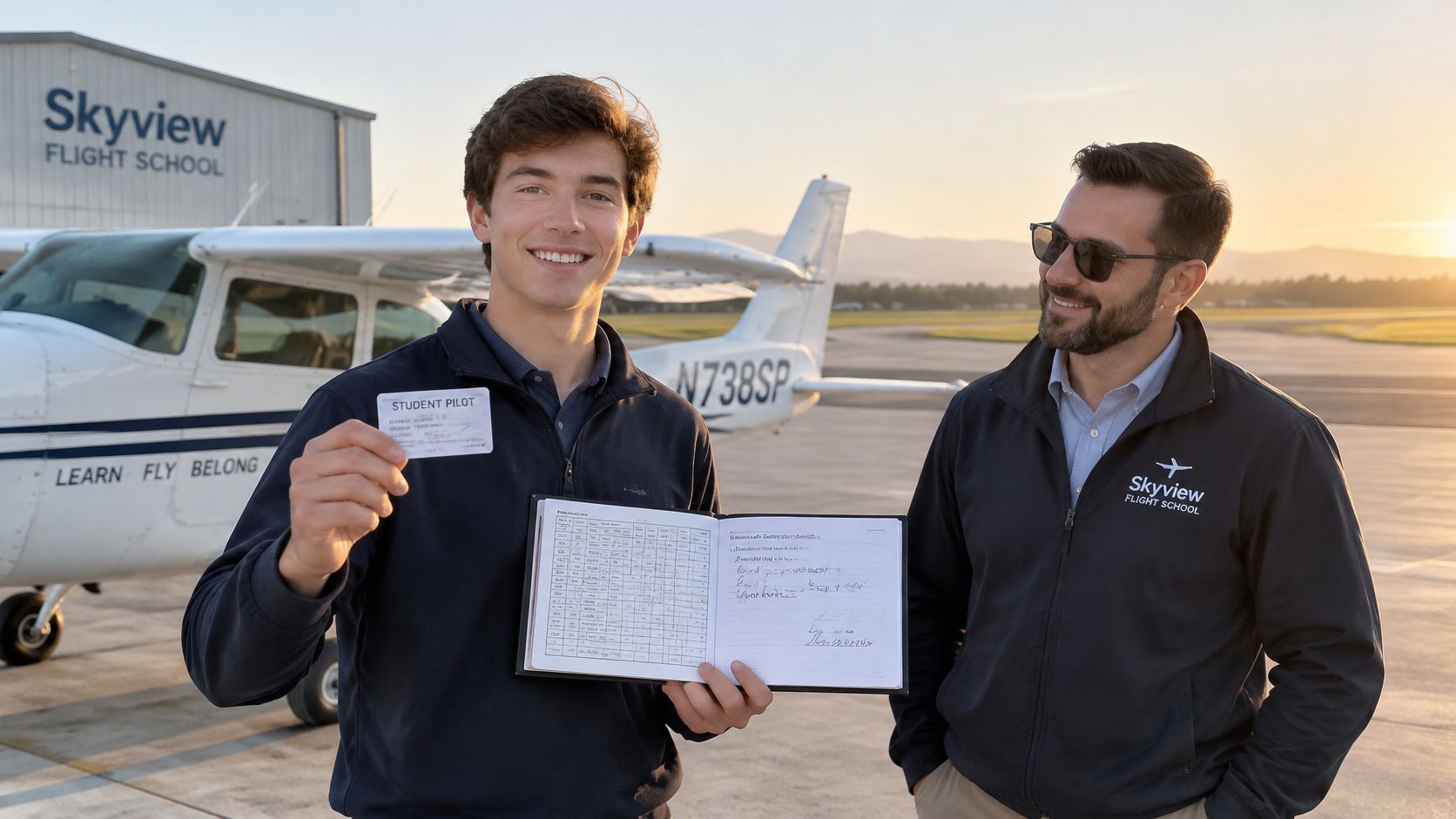
You can start lessons before any minimum age. You can solo at 16, and you need a third-class medical before that first solo. The student certificate has no category or class rating. Solo privileges come only from instructor endorsements, and those endorsements set the aircraft, the airports, and the conditions. There is no passenger seat for a friend on that flight.
What sport actually allows
The sport certificate is a different door. The regulatory floor is 20 hours. For a pilot who wants weekend local flying in a light, inexpensive airplane, that can be the whole plan.
- One passenger: Not a cabin full of friends.
- Light-sport aircraft only: Weight and speed limits live in the rule, and they are not "any small rental."
- Daytime VFR: No night privilege and no instrument privilege on this certificate.
- Driver's license medical: In most cases a U.S. driver's license stands in for an FAA medical.
The July 2025 MOSAIC rule changed sport aircraft and operating limits in phases. Before you train toward sport as an endpoint, read the current text of 14 CFR part 61, subpart J. A hobby pilot who stays local and visual can stop here. A pilot who wants clouds or night flying cannot. That person needs a higher certificate. Our notes on the sport pilot license walk through those limits in more detail.
Entry-level training is where most certificates are issued. In 2025 the FAA issued 58,762 student certificates, 227 sport certificates, and 184,378 pilot certificates across categories, so the early rows dwarf the professional ones in the 2025 airmen issuance data.
Recreational and Private Certificates for Flying for Fun
Both certificates keep you on the unpaid side of flying, but they draw very different circles around what you may do. The recreational certificate works like a permit restricted to your neighborhood in daylight. The private certificate works like a full driver's license: passengers, night flying, and cross-country trips are all inside its boundary.
A recreational certificate, under 14 CFR 61.101, asks for 30 hours. You may carry one passenger, stay within 50 nautical miles of the departure airport, fly only in daylight, and fly an airplane of 180 horsepower or less. That fits a local hobby pilot who wants a small two-seat airplane near home and has no plan to go farther.
A private certificate is the principal noncommercial license. The floor is 40 hours, and you must be 17. After the required night training you may fly at night, and you may carry passengers. You still may not be paid to fly.
The money line people misread
14 CFR 61.113 draws a bright line. A private pilot may share operating costs with passengers. A private pilot may not be hired as the pilot.
You and a friend split fuel on a 200-mile trip. That's cost sharing, and it's allowed. A neighbor offers you money to haul cargo in the same airplane. That is compensation for flying, and a private certificate doesn't cover it.
Private opens the map. Recreational keeps you inside a small circle around one airport.
Pick the layer that matches the flying you want, not the certificate that ranks higher on the ladder. If recreational's distance, passenger, and horsepower limits fit your regular weekends, it covers the whole plan. Pilots who want trips through clouds or poor weather usually add an instrument rating after private, because the private certificate by itself still restricts you to visual weather. For flying friends and family under noncommercial rules, private is the certificate most hobby pilots need, and what you can do with a private pilot license walks through those privileges in detail.
Commercial Pilot Certificate and What It Allows
The commercial certificate is the FAA license for compensated flying. It can cover banner towing, aerial photography, pipeline patrol, and some charter, and each of those jobs still has its own operating rules. It does not make you an airline captain. It also does not, by itself, let you charge for flight instruction. Paid teaching needs a flight instructor certificate on top of the commercial certificate.
Commercial airplane certificate minimums
For an airplane single-engine commercial rating, 14 CFR 61.129 sets aeronautical experience, not school traditions. Approved courses can allow limited credit. The floor still looks like this.
| Requirement | Minimum | What it means in practice |
|---|---|---|
| Total flight time | 250 hours | Floor for the whole logbook, not a target |
| Powered aircraft time | 100 hours | Time in airplanes or other powered aircraft |
| Pilot-in-command time | 100 hours | Time you were the one making decisions |
| Pilot-in-command cross-country | 50 hours, including 10 in airplanes | Trips that leave the local area |
| Commercial training | 20 hours | Structured commercial-level instruction |
| Instrument training | 10 hours, at least 5 in a single-engine airplane | Flying by reference to instruments only |
| Long cross-country | 300 nautical miles, three full-stop landings, one leg of 250 nautical miles | Proves navigation over a long distance |
Compensated flying also requires a second-class medical. A certificate without that medical doesn't put you to work.
A job that fits, and a job that doesn't
Say you hold commercial privileges in a single-engine airplane and a farm co-op pays you for aerial photos over local fields. That work sits inside commercial privileges, assuming the operation itself is legal. The same pilot is then asked to carry a paying passenger on a 120-mile trip. That request runs into the instrument limitation from the layers above. Commercial alone doesn't erase it.
250 hours is a floor. Plenty of applicants log more before the checkride because the maneuvers aren't solid yet. Before you schedule the test, read your logbook against every row. Total time can look fine while pilot-in-command cross-country or the long trip is still short. Training cost is a separate planning problem, and it belongs next to these hours when you look at the cost of a commercial pilot certificate.
Airline Transport Pilot Certificate and the Hour Climb
A commercial certificate lets you get paid to fly. The ATP is the FAA's highest pilot certificate, and airline operations require it for the pilot in command. The distance between the two is measured mostly in logged hours.
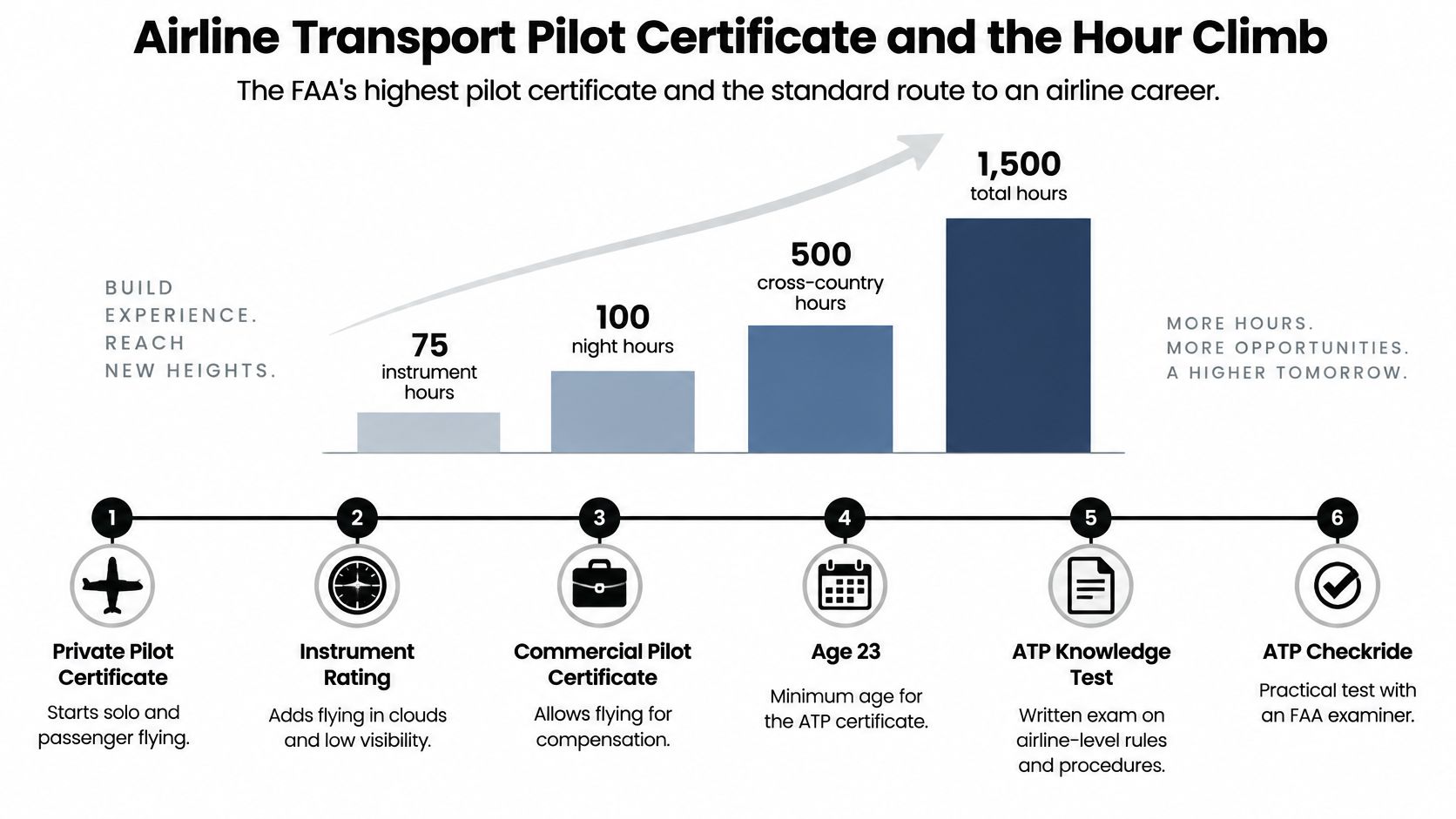
Under FAA Part 61, the standard airplane path expects 1,500 hours of total pilot time, plus specified cross-country, night, and instrument experience. You also need to be 23, and airline operations expect a first-class medical. That total works like a minimum altitude on an approach. You cannot study your way around it, you have to climb to it, and most of the climbing happens after commercial training ends.
A restricted-privileges ATP exists for graduates of an FAA-authorized aviation degree program. It allows fewer than 1,500 hours up front and copilot service until the full total is reached. Eligibility depends on graduating from that authorized program, so it applies to a defined group.
A realistic order of work
- Private pilot, at the 40-hour floor or, more often, above it.
- Commercial certificate at the commercial minimum, with an instrument rating already in the logbook.
- Paid flying or instructing to build hours. Teaching for pay requires a CFI.
- 1,500 total hours of logged flight time.
- The ATP, after the knowledge test and the practical test.
The video below follows that same sequence and shows where the hour-building step stretches longest.
Commercial is an intermediate milestone. Airlines weigh total time, the kind of experience behind it, and whether you have a credible way to build the rest. FAA issuance counts run far higher for new commercial certificates and flight-instructor credentials than for ATPs, a sign of how long the climb takes. Training at this level carries a price to match, and the financing plan matters as much as the syllabus. CFII's Career Track runs $89,000 from zero experience through commercial and flight instructor in nine months full time, with financing available for the full amount. The fastest certificate sequence can still be the slower airline path if it leaves you with no paid flying. The ATP-CTP requirements sit at the top of that climb, and the hours have to be in the book when you get there.
Choose Your Certificate and Plan the Next Step
Match the goal to the first credential, not to the fanciest certificate on the poster.
Which certificate fits your goal
| Your goal | Certificate to start with | Why it fits |
|---|---|---|
| Local flying for fun in a small airplane, no passengers beyond one | Sport or recreational | Lowest hour minimums and medical options, with narrow limits |
| Flying friends and family anywhere within noncommercial rules | Private | Passengers allowed and night flying after training, no compensation |
| Paid flying or banner towing | Commercial, plus instrument rating | Compensated work requires commercial privileges; instrument removes passenger limits |
| Paid flight instruction | Commercial, plus CFI | Instructing for pay requires a flight instructor certificate on top of commercial |
| Airline career | Commercial, instrument, multi-engine, then ATP | Airlines hire on total hours and experience, not the certificate alone |
| Not sure yet | Discovery flight first | Tests whether flying suits you before committing to a certificate |
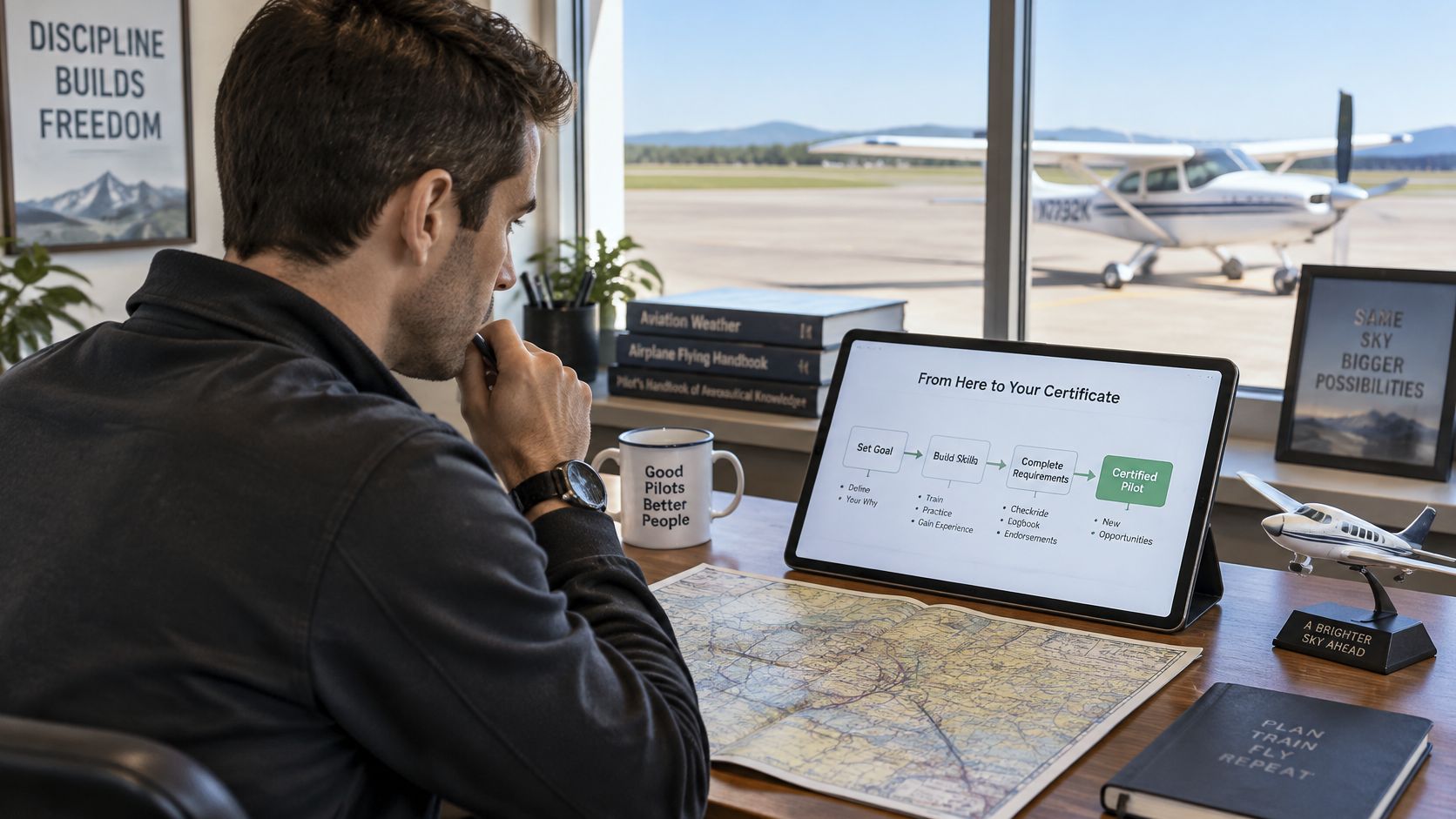
Three steps before you spend the training budget
- Confirm the goal row. If the flying is local and visual, don't buy an ATP plan. If the flying is an airline seat, don't stop at commercial.
- Check the medical that row requires before you pay for a long block of lessons. A third-class medical is required before solo. Lessons and a first flight can happen before you hold one.
- Book a discovery flight if you haven't flown. It is a first flight with an instructor, and it answers a simpler question than any regulation does. You can book a discovery flight before you commit to a certificate.
If the goal row is an airline path, our Career Track runs from zero time to CFII and multi-engine in about nine months. It includes six certificates and ratings, 282 total hours, and fixed tuition of $89,000, with training in Riverside, Long Beach, and Corona. The right certificate still depends on the flying you want. No program guarantees a job. The longer map, from these certificates to an airline application, is in how to become an airline pilot.
CFII trains the certificates on this page as one path, from private through instrument, commercial, multi-engine, and flight instructor, instead of treating each card as a separate finish line. If you're sorting sport, private, commercial, and ATP privileges before you spend a training budget, start with a first flight or a full zero-to-CFII plan. Visit CFII and tell us which kind of flying you want.
Planning to fly for a living?
See what the path from zero to a pilot career looks like, what it costs and how long it takes.
Learn to fly in Riverside
We train at Riverside Municipal Airport in factory-new airplanes with a parachute built in. Start with a one hour discovery flight, no experience needed.