
On this page
- Private and Commercial Certificates Side by Side
- How to read the certificate comparison
- What Each Certificate Lets You Do Legally
- A pilot certificate isn't an operating certificate
- Training Stages, Hours and Ratings in Order
- What changes at each stage
- Fit the schedule to the learning
- Commercial Pilot Versus Airline Transport Pilot
- Build the right experience, not just a larger total
- Restricted ATP isn't an automatic shortcut
- Pay, Hours and Cost Before You Commit
- Put the training investment beside the income plan
- Match Your Goal and Take the First Step
- Match the qualification to the mission
- Stop before an informal arrangement becomes illegal
- Make the next commitment deliberately
The advice to get a commercial pilot certificate and start earning money skips the hardest part: what paid flying are you qualified and authorized to do? A commercial certificate opens a legal door. It doesn't supply an aircraft, an approved passenger-carrying business, an instructor qualification, or an airline job.
For someone who hasn't flown yet, the commercial pilot vs private pilot decision is really about your destination. Start with the flying you want to do, then build a training budget and experience plan that gets you there.
Private and Commercial Certificates Side by Side
The private certificate is the starting point for most pilots. The commercial certificate adds privileges for certain paid flying, while airline work requires further qualifications and experience.
The comparison below covers U.S. airplane certificates. The standard training requirements and medical framework are set out in 14 CFR Part 61, including the 40-hour private minimum under §61.109 and 250-hour commercial minimum under the standard §61.129 airplane pathway.
Private vs commercial airplane requirements
| Requirement | Private Pilot | Commercial Pilot |
|---|---|---|
| Minimum total flight time | 40 hours under §61.109 | 250 hours under the standard §61.129 airplane pathway |
| Average time reported by FAA for airplane applicants | About 75 hours, according to the FAA's airplane applicant data | No comparable commercial average stated in the cited FAA guidance |
| Medical certificate to exercise privileges | Third-class under the standard medical-certificate pathway | Second-class when exercising commercial privileges |
| Pilot in command for compensation or hire | Generally prohibited under §61.113, with narrow exceptions | Permitted, subject to applicable operating rules |
| Instrument limitation on passenger-for-hire flights | Not applicable as a commercial privilege | Cross-country flights over 50 nautical miles or night flights prohibited until the applicable instrument rating is added |
The hour minimums establish eligibility to apply for a practical test. Actual training time varies, and an instructor must prepare you to meet the test standard. Logbook totals alone do not show readiness.
Medical requirements depend on the privileges you plan to exercise. A commercial certificate does not require a commercial medical qualification for every personal flight; eligible pilots may use alternative medical pathways for private flying.
How to read the certificate comparison
For a recreational pilot, the private certificate may meet the need. A commercial certificate is a later qualification for pilots seeking paid flying privileges, with further ratings or operating requirements depending on the work. It does not, by itself, qualify a pilot for every paid flight or for airline service.
What Each Certificate Lets You Do Legally
Compensation is the starting point. Under 14 CFR §61.113, a private pilot generally can't act as pilot in command for compensation or hire, or carry passengers or property for compensation or hire.
Say you and a friend want to visit the same destination. Sharing allowable expenses can be legal when you meet the cost-sharing requirements, including a genuine common purpose and paying at least your proportional share. Charging someone a transportation fee to fly them to a wedding is a different arrangement, even if you call the payment a contribution.
Allowable shared expenses are fuel, oil, airport expenditures, and rental fees. Cost-sharing isn't a way to recover aircraft ownership costs or sell transportation informally.
Which activities each certificate supports
| Activity | Private certificate | Commercial certificate |
|---|---|---|
| Personal travel and recreational flying | Permitted within applicable privileges | Permitted within applicable privileges |
| Sharing pro-rata fuel, oil, airport and rental costs | Permitted under §61.113 conditions | Permitted when structured lawfully |
| Paid passenger or cargo carriage as pilot in command | Generally prohibited | Requires compliance with operating rules, including Parts 91, 119 or 135 as applicable |
| Flight instruction for pay | Private certification alone is insufficient; appropriate instructor qualifications are required | Commercial certification alone is insufficient; appropriate instructor qualifications are required |
| Aerial photography, banner towing or sightseeing for pay | Not authorized by ordinary private privileges | Check activity-specific operating rules, exemptions, waivers and operator authority |
| Charter passenger transportation | Not authorized | Requires applicable pilot qualifications and an appropriately authorized operation |
| Scheduled airline operations | Not authorized | Commercial certification alone is insufficient; airline transport qualifications and operator employment are required |
A pilot certificate isn't an operating certificate
The distinction is between qualifying the pilot and authorizing the operation. Commercial privileges under 14 CFR §61.133 permit compensated command subject to the other applicable requirements; they don't authorize every business model involving an airplane.
For photography, investigate how the flight is conducted and who supplies the aircraft. Banner towing introduces activity-specific requirements. Sightseeing and charter require particular attention to operating authority, rather than an assumption that payment becomes legal once the pilot holds a commercial certificate.
An incidental business flight is another narrow private-pilot exception. Flying yourself to a meeting can fit the rule when flying is incidental to your employment and you aren't carrying passengers or property for compensation.
Practical rule: Name the activity first. Then identify the pilot certificate, aircraft ratings, medical qualification and operating authority it requires.
If your goal is personal transportation, our guide to what you can do with a private pilot license helps separate useful private privileges from paid-flying arrangements that cross the line.
Training Stages, Hours and Ratings in Order
A commercial certificate is a legal gateway to certain paid flying, not a complete career qualification. Training builds the skills and ratings needed for progressively broader work: first aircraft control, then instrument flying, commercial privileges and, if your goals require them, multi-engine and instructor qualifications.
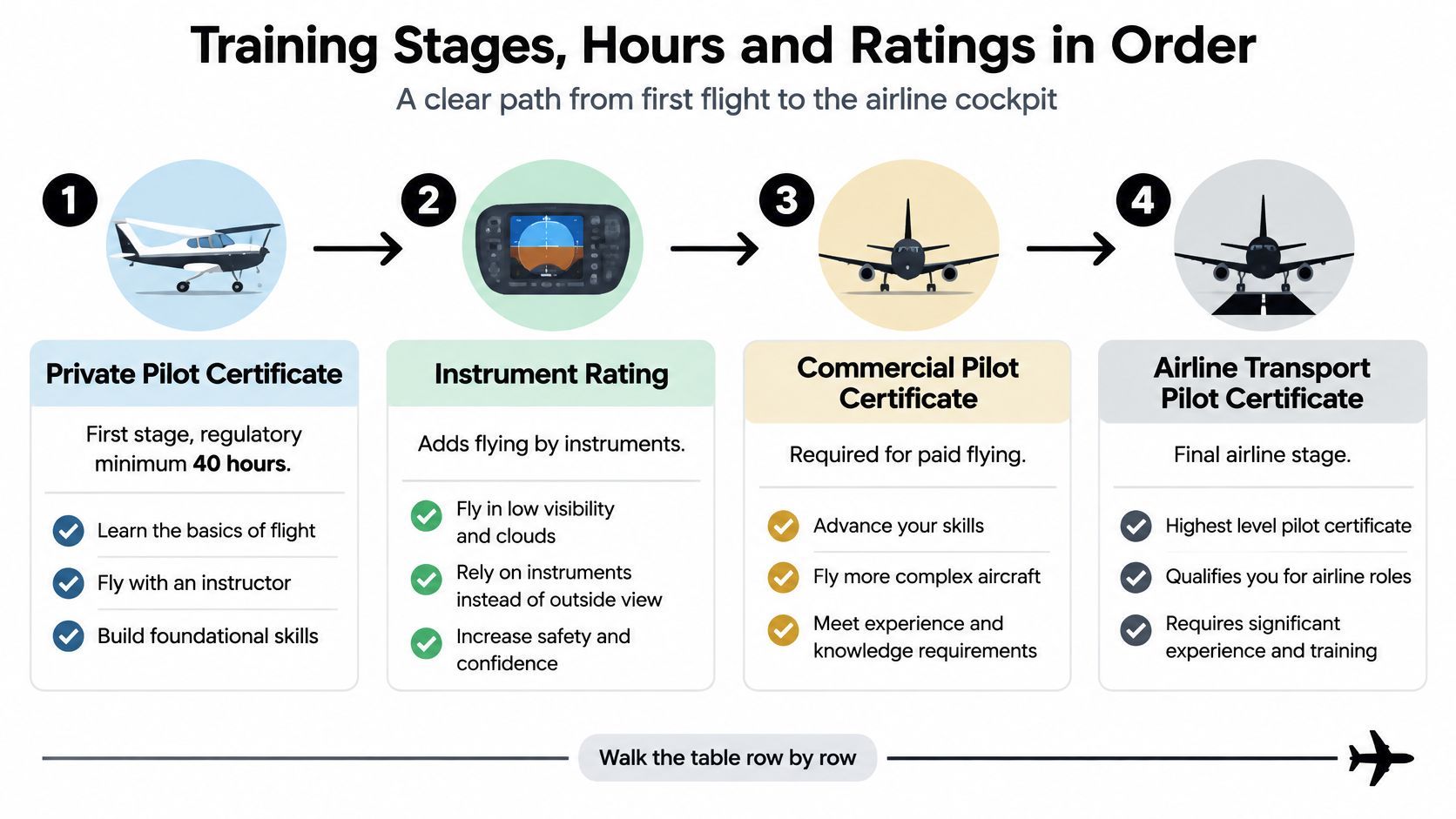
The FAA's pilot-hour guidance sets a private airplane minimum of 40 flight hours, including 20 hours of authorized instruction and 10 hours of solo flight, along with required cross-country, night and instrument experience. The FAA guidance also reports an average of approximately 75 hours for people without a hearing impairment completing the airplane private requirements.
Training stages and what each one adds
| Stage | Privilege it adds | Minimum or key requirement |
|---|---|---|
| Private pilot certificate | Noncommercial pilot in command | Private-hour requirements plus demonstrated practical-test proficiency |
| Instrument rating | Flight under instrument flight rules when qualified | Required instrument experience, training and practical test |
| Commercial pilot certificate | Compensated pilot privileges, subject to applicable requirements | Standard airplane aeronautical-experience requirements, commercial maneuvers and practical test |
| Multi-engine rating | Multi-engine privileges | Additional training and practical test |
| Flight instructor certificate | Flight instruction within instructor privileges | Applicable experience, knowledge and practical-test requirements under Part 61 |
What changes at each stage
Private training develops aircraft control, landings, navigation and sound decisions about whether a flight should begin or continue. Weak fundamentals make later instrument training harder, so build them before adding more procedures.
The instrument rating adds control by reference to instruments, use of clearances and approaches, and weather-related decision-making. It also matters for some compensated passenger flying, which carries instrument-rating requirements.
Commercial training calls for more precise aircraft handling and stronger operational judgment. Single-engine commercial privileges do not include multi-engine operation, which requires its own rating.
Instructor training shifts the focus to teaching. You must explain and demonstrate procedures, recognize errors and intervene when needed to keep a student safe.
Fit the schedule to the learning
Hobby students taking two or three lessons per week typically reach the private pilot checkride in four to six months, paying lesson by lesson. Treat that as a planning range, not a guaranteed finish date.
For career training, the sequence commonly runs from private pilot to instrument, commercial single- and multi-engine, then flight instructor and instrument instructor. The flight training requirements guide can help you organize prerequisites around your schedule and budget.
Commercial Pilot Versus Airline Transport Pilot
A commercial certificate does not make a new pilot airline-qualified. It establishes an important professional milestone, but airline eligibility requires substantially more qualifying experience and additional credentials.
Under 14 CFR §61.159, the standard airplane ATP requirement is 1,500 hours of total pilot time, including 500 hours of cross-country time, 100 hours of night flight time, and 50 hours in the airplane class sought.
That regulation permits up to 25 hours in a qualifying full-flight simulator toward the total-time requirement when completed through an approved course under Parts 121, 135, 141 or 142. Flight training devices and aviation training devices can't satisfy that particular total-time allowance.
Build the right experience, not just a larger total
The difference between commercial completion and ATP eligibility is a working phase of your career. A logbook total alone doesn't show whether you have the required cross-country, night, instrument or aircraft-class experience.
For example, a commercial pilot employed in an authorized aerial-work operation can build qualifying flight experience. Charter may also be a later opportunity, but a new commercial graduate must still meet the position's pilot requirements and the operator's hiring standards.
Instructing is another route, provided you earn the appropriate instructor certificates. It develops explanations, cockpit awareness and decision-making while providing experience, but you shouldn't choose it solely because you want the hours. Students need an instructor who takes teaching seriously.
A good hour-building plan names the work, the qualification needed to obtain it, and the categories of experience you'll log.
Restricted ATP isn't an automatic shortcut
Restricted-ATP provisions under §61.160 offer conditional alternatives for certain qualifying graduates and military pilots. Eligibility depends on the specific education, training, age and experience requirements, and restrictions remain until the pilot qualifies for unrestricted privileges.
Don't assume that any aviation degree or accelerated training program qualifies. Verify the precise route before building your financing plan around an earlier airline transition.
Keep separate records of training completion, regulatory eligibility and hiring readiness. Passing a checkride establishes a qualification; an employer also evaluates whether you meet its operational requirements and can perform in its training environment.
Our airline pilot career guide can help you organize that longer progression. The commercial certificate opens access to appropriate paid work; it doesn't eliminate the experience-building stage.
Pay, Hours and Cost Before You Commit
The BLS median describes employed pilots across all experience levels, so it overstates what a newly certificated pilot should expect to earn. The Bureau of Labor Statistics reports May 2025 median annual wages of $123,220 for commercial pilots and $232,140 for airline pilots, and projects 7% combined employment growth from 2025 to 2035, with about 16,400 openings annually.
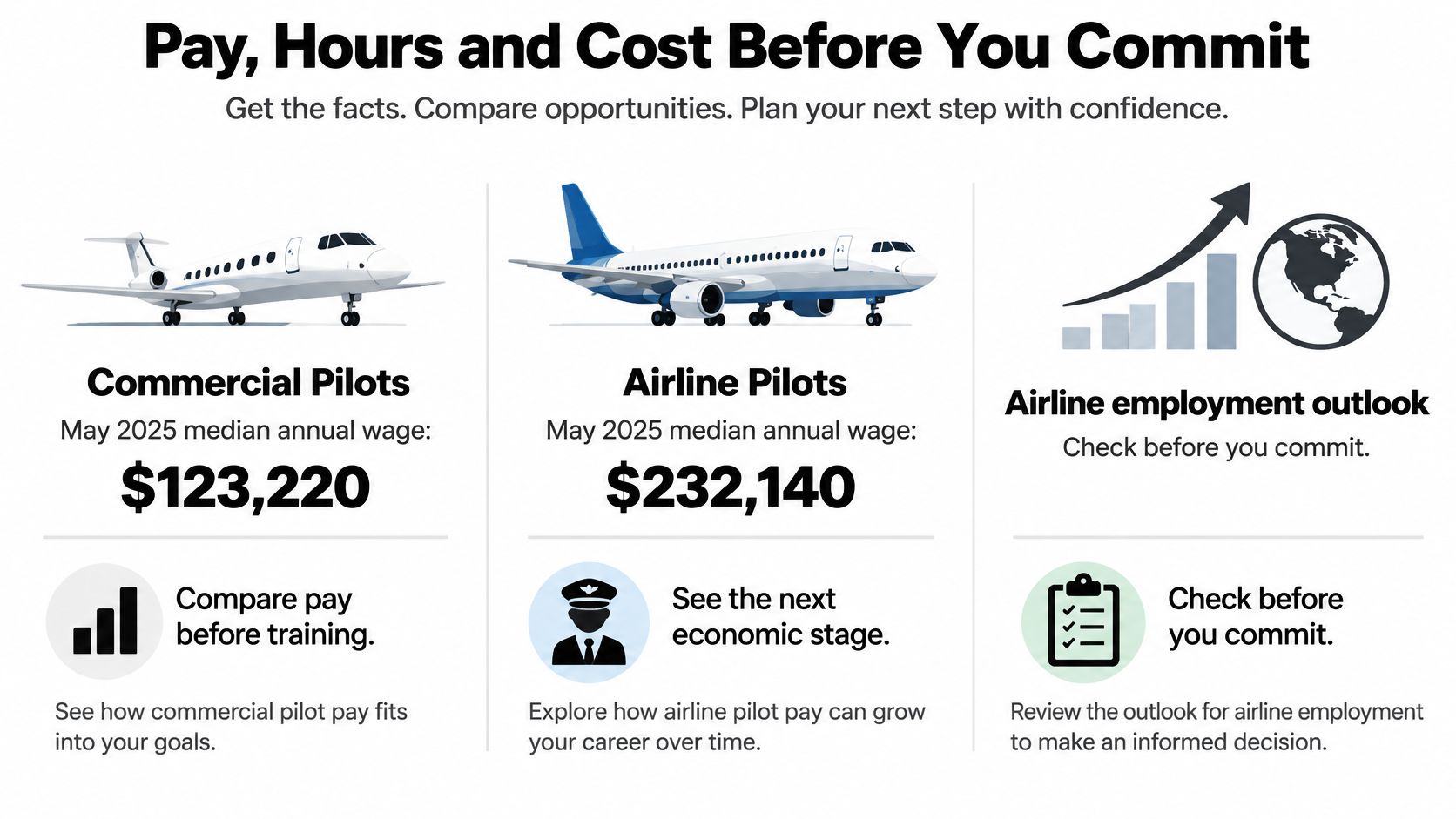
These figures cover employed pilots at different career stages. Annual openings do not guarantee that a new graduate will meet an employer's requirements or receive a particular offer.
The BLS guide to commercial and airline pilots describes commercial work such as charter, air ambulance and air tours, alongside airline flying. It outlines a progression through student, private, instrument, commercial, multi-engine and ATP qualifications, and notes that airline pilots typically need a bachelor's degree and commercial or military flying experience.
Put the training investment beside the income plan
CFII's Career Track costs $89,000 and takes about nine months full time from zero experience to commercial pilot and flight instructor. It includes six ratings and certificates and 282 hours of training.
The breakdown is 204 single-engine hours, 25 multi-engine hours and 53 simulator hours, plus one-on-one instruction. Add the hours by category: simulator time is not airplane flight time. Student-selected gear, including an iPad, headset and flight bag, is not included in the tuition.
| Planning line | What to include |
|---|---|
| Total cost | Tuition, excluded equipment, living expenses and financial contingency |
| Months until first paid flying | Training, testing, obtaining instructor qualifications if needed, and finding suitable work |
| Interim income | Money you can realistically earn while training and during the transition |
| Financing burden | Interest, repayment timing and payments you can support without assuming airline income |
For a closer look at training expenses, read this guide to the cost of getting a commercial pilot license. Include the path from training through the first suitable paid work in your budget; certification alone does not create an income stream.
Early earnings depend on your hours, ratings, available work and local demand. Before enrolling, answer this plainly: How many hours can I fund over the next year, and what will I do with the certificate once I have it?
Match Your Goal and Take the First Step
Choose the certificate that matches the activity you intend to do. The commercial certificate is a legal gateway to certain paid flying, not a guarantee of a job or permission to conduct every kind of commercial operation. The rules for a specific activity may also require particular ratings or an authorized operator.
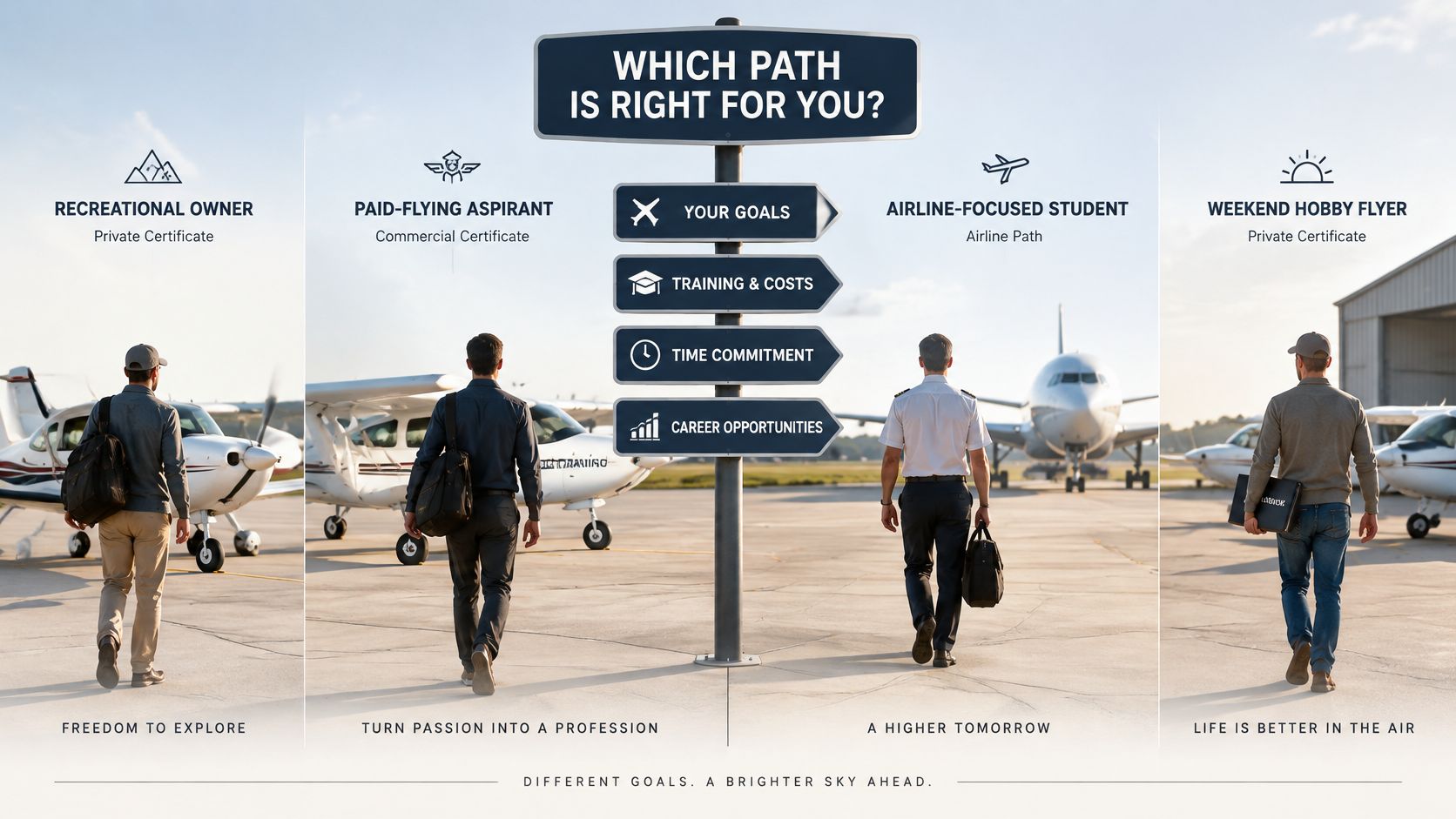
Match the qualification to the mission
Recreational owner. A private certificate can suit weekend flying or personal transportation. CFII offers private pilot lessons from John Wayne Airport for people learning to fly for fun.
Paid-flying applicant. Commercial certification may be part of your path, but the requirements depend on the work. Photography, ferry flying, banner towing, sightseeing and charter can involve different operating rules. The FAA's guidance for pilots, owners and operators explains that commercial operations must follow the rules applicable to the specific operation, including Parts 91, 119 and 135 where relevant. Consider whether you're seeking work within an authorized operation or intend to conduct an operation yourself.
Aspiring instructor. Add instructor qualifications if teaching fits your career plan. Flight instruction involves preparing lessons, diagnosing errors and managing a student's workload. It can also provide a way to build experience, though teaching is a job with responsibilities beyond flying.
Airline aspirant. Plan for the ratings and experience required for your route to airline work, and consider how you'll support yourself while building that experience. The commercial certificate alone does not qualify you for an airline position.
Stop before an informal arrangement becomes illegal
Before accepting payment for a flight, check whether the proposed arrangement is allowed under your certificate and the rules that apply to the operation. A private pilot cannot assume that calling a payment informal makes it lawful cost-sharing.
A commercial pilot without the applicable instrument rating should check the certificate limitation before accepting passenger-for-hire work. Flying on a clear-weather day does not by itself resolve a limitation that applies to the trip.
Compensation and the nature of the operation matter. Carrying a friend is not automatically commercial flying, and a payment described as informal is not automatically lawful.
Make the next commitment deliberately
Use this checklist before paying for a program:
- Confirm the requirements. Refer to Section 2 to check the certificate, ratings, medical qualification and operator authority tied to your intended activity.
- Compare the training operation. Ask every school, including CFII, about airplane age, students per airplane, instructor turnover, total price in writing, Part 61 versus Part 141, and whether you can fly before committing.
- Try the cockpit first. If you haven't flown, book a discovery flight, a first flight with an instructor before making a larger commitment.
- Review the pathway. CFII's Career Track is a fixed-price, zero-experience career program that includes commercial, multi-engine and instructor qualifications.
Then compare the payment schedule with living expenses and realistic income. The guide to how to pay for flight school can help you plan that commitment without counting future earnings as money already available.
Set your budget alongside your career goal. A certificate can qualify you for specific privileges, but your plan also needs to account for training costs, time to employment and the work you intend to pursue.
CFII offers discovery flights and private pilot lessons from John Wayne Airport, as well as its Career Track. Review CFII to choose a first flight or assess the career pathway.
Planning to fly for a living?
See what the path from zero to a pilot career looks like, what it costs and how long it takes.
Learn to fly in Riverside
We train at Riverside Municipal Airport in modern airplanes with a parachute built in. Start with a one hour discovery flight, no experience needed.