
On this page
- How Much a Private Pilot License Really Costs
- FAA Hour Requirements That Drive Your Budget
- Why the minimum misleads first-time students
- What the hour rule means for your wallet
- Line by Line Breakdown of PPL Expenses
- The core buckets to compare
- Why Two Students Pay Different Prices
- What changes the final bill
- A simple way to think about the spread
- PPL Cost Versus a Fixed Price Career Track
- How the math changes for a career-minded student
- Choosing between pay-as-you-go and a full path
- Smart Ways to Save Without Cutting Corners
- The habits that protect your budget
- A simple calculator you can use
- Private Pilot Cost Questions and Next Steps
A private pilot license cost usually lands well above a 40-hour quote, because most students need roughly 60 to 75 hours and the main drivers are aircraft rental and instructor time. If you're starting from zero and trying to budget like a career-minded student, the question isn't "What's the cheapest sticker price?" it's "What will I pay when training takes the normal amount of time?"
You're probably at the stage where the numbers feel slippery. One school says one thing, a friend says another, and the FAA rules look simple until you try to turn them into a real budget. That's where the confusion starts, because flight training isn't one flat tuition bill, it's a stack of costs that move with your hours, your pace, and how ready you are each lesson.
How Much a Private Pilot License Really Costs
A zero-time student usually starts with the wrong question. They ask for a single price, when the better question is what the total budget looks like when training goes the way it usually goes, not the way a minimum-hour ad makes it sound.
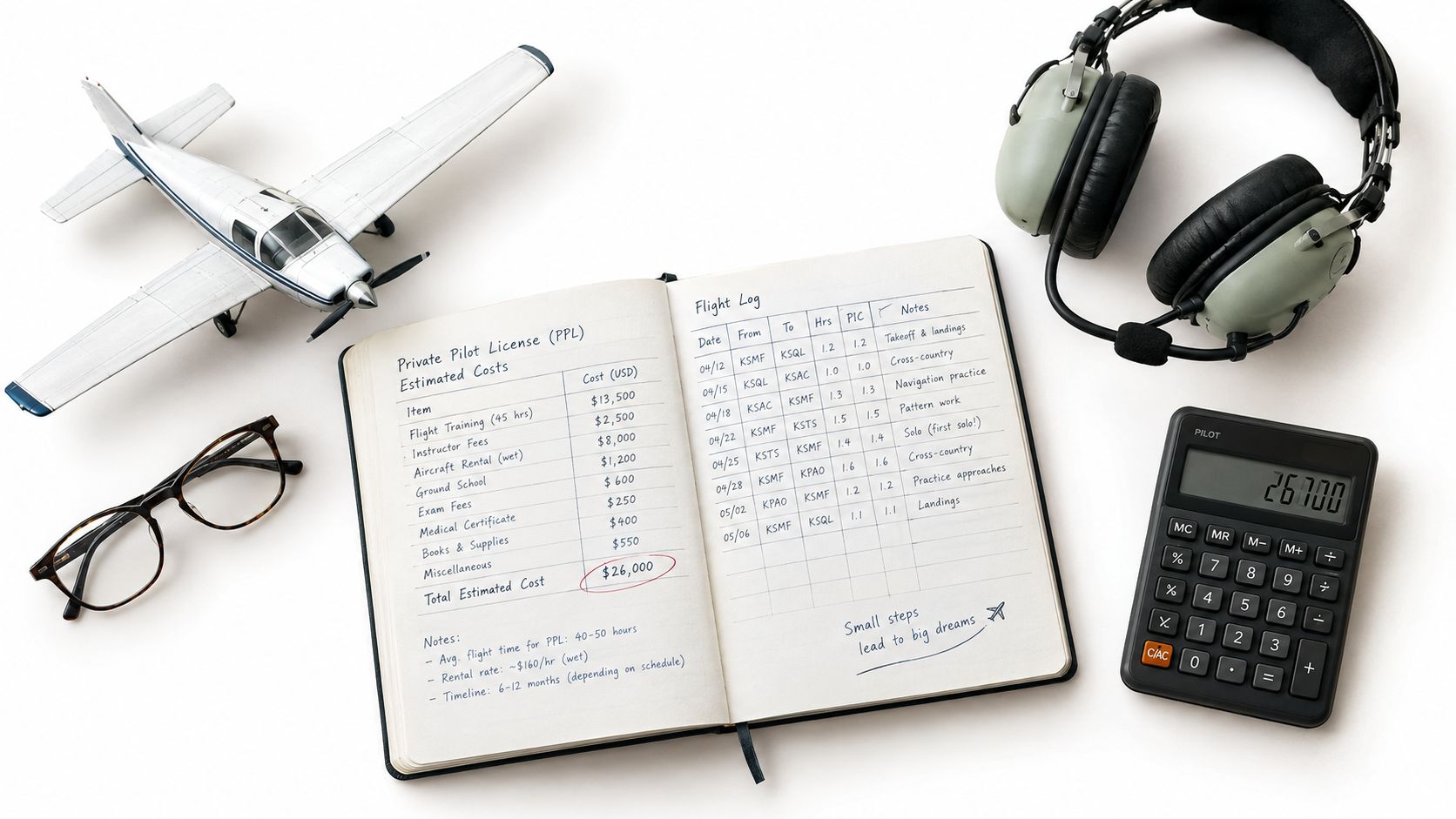
A good first budget treats the private pilot license cost as a variable expense. The aircraft, the instructor, the written test, the checkride, the medical, and the study materials all sit in different buckets. If you only price the airplane, you're not budgeting for flight training, you're budgeting for part of it.
For a career-minded student, that matters right away. You do not want to spend money twice, first on a standalone private certificate and later on a longer professional path, if your real goal is the cockpit as a career. A careful first estimate helps you decide whether a discovery flight, a conventional private pilot path, or a more structured training route fits your timeline.
Practical rule: if a quote only talks about an hourly airplane rate, it's incomplete.
For readers who want to compare a training plan before they commit, this guide will walk through the rulebook, the cost buckets, the reasons two students pay different amounts, and the point where a fixed-price career path can make more sense than paying lesson by lesson. If you want a broader training-cost overview alongside this article, this flight training cost guide is a useful companion.
FAA Hour Requirements That Drive Your Budget
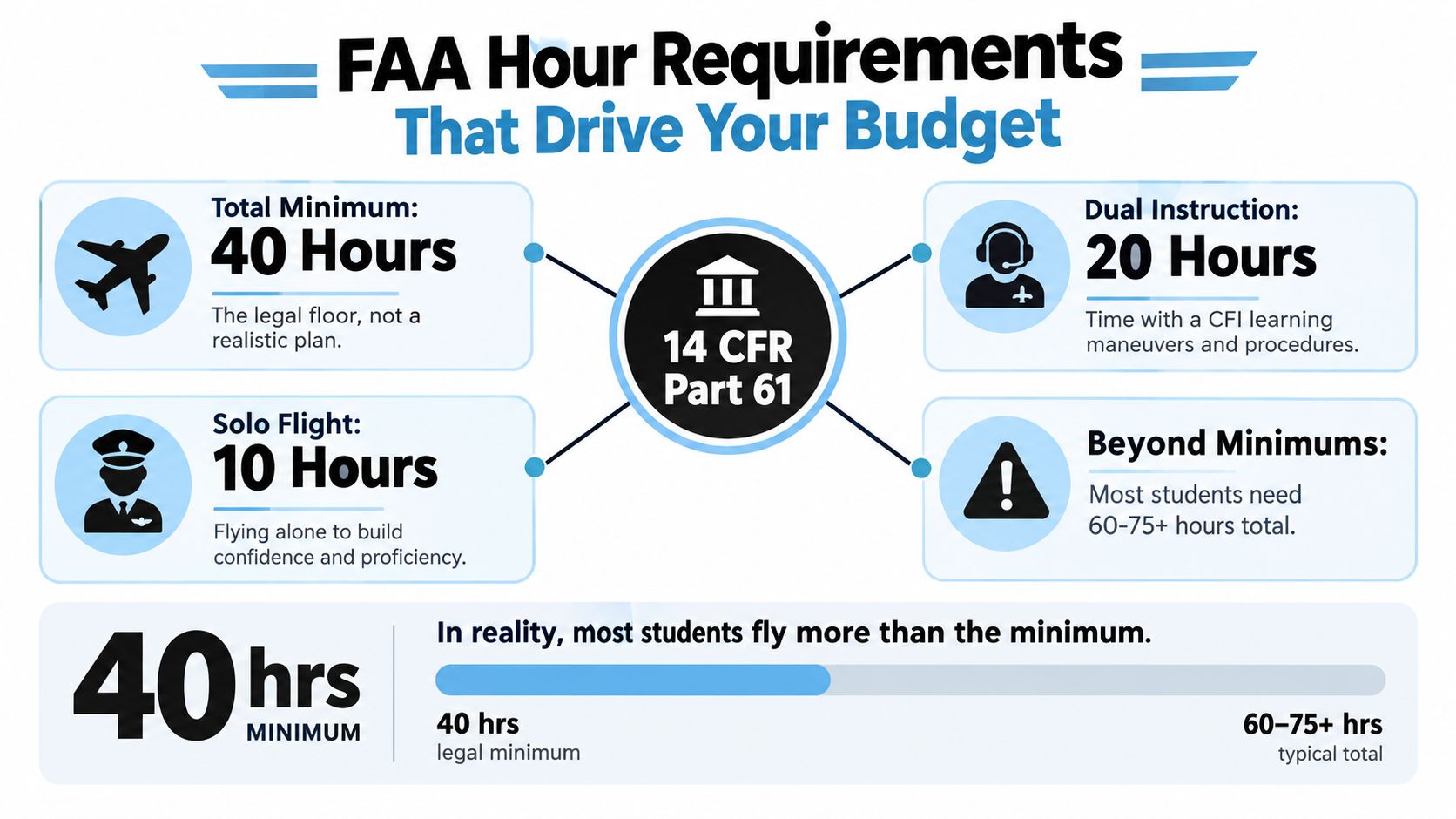
A private pilot certificate starts with a number that looks tidy on paper. Under 14 CFR § 61.109(a), the FAA requires 40 hours of logged flight time for an airplane private pilot certificate, including at least 20 hours with an authorized instructor and 10 hours of solo flight training, plus the required cross-country, night, and instrument experience. That minimum sets the legal floor, and the FAA explains the training requirement in its pilot hour guidance. FAA hour requirements for becoming a pilot 14 CFR § 61.109(a)
Why the minimum misleads first-time students
A new student hears “40 hours” and builds a budget around it. FAA guidance says the average person who completes the private-pilot requirements logs about 75 hours, and most students need roughly 60 to 75 hours. That gap is the reason a 40-hour budget can leave a first-time flyer short. FAA hour requirements for becoming a pilot
The math is straightforward. If a student finishes at 75 hours instead of 40, the training time is 87.5% higher than the legal minimum, so the bill rises with the hours. Aircraft rental, instructor time, simulator practice, and checkride-related expenses are usually tied to activity or time in the airplane, so each extra lesson adds cost. FAA hour requirements for becoming a pilot
Part 141 training can lower the minimum to 35 hours, but that does not guarantee a student will finish there. The FAA cares about proficiency, and proficiency is where budgets stretch. The legal minimum is real, but a realistic budget target sits well above it.
What the hour rule means for your wallet
Each lesson usually includes airplane time, instructor time, and some ground review. If you need extra practice to hold altitude, land more smoothly, or stay ahead of radio calls and checklists, the total bill climbs even when the airplane rate stays the same. That is why a low quote can drift upward by the end.
A student who trains inconsistently often pays twice, first for the original lesson and again for the repeat lesson needed to rebuild proficiency.
For a career-minded student, the planning question changes here. A standalone private certificate can make sense for personal flying, but if your real target is a zero-to-CFII path, the better move is to budget with the next ratings in mind so you do not pay once for a private pilot path and then again for a longer career track. A structured route can also make room for supported practice, including this overview of flight simulation in training, when you need to reinforce procedures without adding another full lesson in the airplane.
Line by Line Breakdown of PPL Expenses
A private pilot budget makes more sense as a variable-cost system than as a single tuition number. The big recurring pieces are aircraft wet rental and instructor time, while testing, gear, and prep sit around them. AOPA identifies airplane rental and instructor time as the main recurring charges, with broad U.S. ranges of $5,000 to $15,000 for airplane rental and $1,000 to $5,000 for instruction, plus about $750 for examinations, $500 for flight gear, and $250 for study materials. AOPA pilot license cost
The core buckets to compare
Break the budget into what you fly, what you study, and what you test. Aircraft time and instructor time usually rise together, because more lessons mean more billed hours in both places. Ground school, written-test prep, checkride prep, medical certification, and the practical test all add their own costs, even if you stay close to the minimum flight time.
A low hourly airplane rate can look attractive until the missing pieces show up later. If a school leaves out instructor billing, extra ground time, or administrative fees, the headline price stops telling the full story. A clean quote should spell out the whole training stack, not just the airplane.
| Sample PPL Cost Buckets to Compare | What to Verify | Typical Range or Note |
|---|---|---|
| Aircraft rental | Wet rate, airplane type, fuel included or not | AOPA reports $5,000 to $15,000 broadly in the U.S. |
| Instructor time | Dual rate, ground instruction, minimum billing increments | AOPA reports $1,000 to $5,000 broadly in the U.S. |
| Examinations | Written test, practical test, examiner fees | AOPA lists about $750 for examinations |
| Flight gear | Headset and other basic equipment | AOPA lists about $500 for flight gear |
| Study materials | Books, digital courses, written prep | AOPA lists about $250 for study materials |
| Medical exam | Startup eligibility check before solo | Treat as a separate startup cost |
| Retest risk | Extra prep or another written test if timing slips | Build a reserve into the budget |
The FAA also requires separate steps like knowledge testing, medical certification, and a practical test, so those are not optional add-ons. Ask one blunt question before comparing quotes, “What exactly is included?” That answer tells you whether the number you see is the training cost or only the starting point.
A good next check is how the school handles the hours between lessons. If you are comparing training pricing and trying to see what schools leave out, this flight school cost guide gives a useful frame for that conversation.
Why Two Students Pay Different Prices
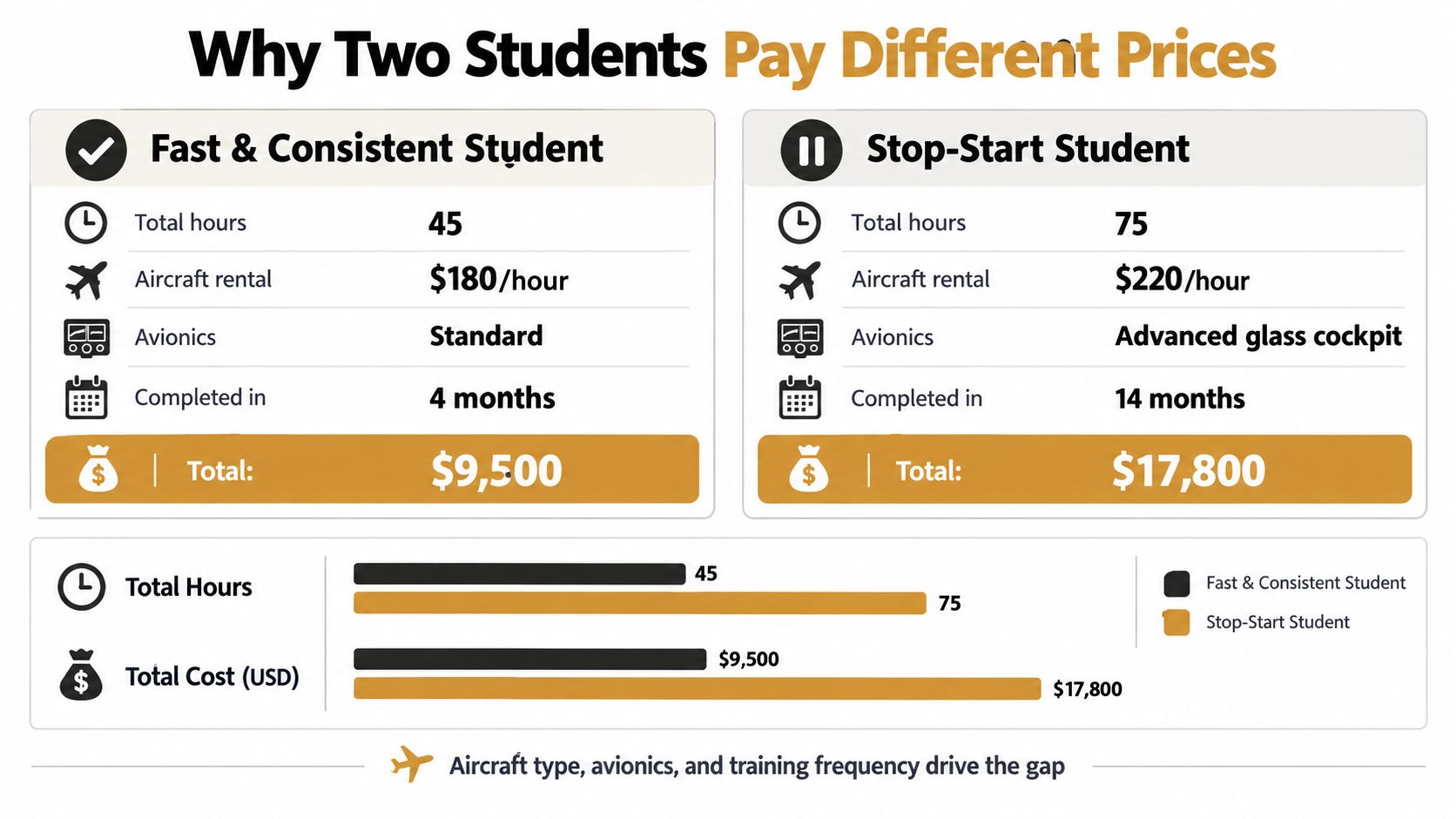
Two people can start with the same certificate goal and end up with very different bills. One trains often, stays current, and needs fewer repeats. The other leaves gaps between lessons, loses sharpness, and spends more on review time just to get back to where they were.
A 2016 Embry-Riddle Aeronautical University analysis looked at more than 1,500 students, 70 aircraft, and 10 flight-training providers, using data collected from August 2014 through April 2016. For the private pilot certificate, it estimated $19,486.96 for flight training, $3,995.50 for oral or ground instruction, and $2,371.40 for flight-training-device use, for a combined total of $25,853.86. The same study reported a mean of 80.3 hours of dual training, with a range from 43.9 to 131.3 hours. Embry-Riddle private pilot cost analysis
What changes the final bill
The biggest variable is still hours. If one student learns quickly and another needs many more lessons to stay proficient, their totals will not match even if they train at the same school. That's not a failure of the program, it's the normal shape of flight training.
Aircraft type matters too, because more advanced avionics or a different trainer can change the hourly rate and the learning curve. Training pace matters just as much. A student who flies consistently keeps skills warm, while a stop-start student often needs extra review before moving ahead.
Practical rule: the cost gap usually comes from training frequency, aircraft choice, and how quickly a student reaches checkride readiness.
You can also control some of the spread. Showing up prepared, asking good questions, and training often helps keep lessons focused on new learning instead of repeat work. If you want a deeper look at why accelerated training can change the math, this accelerated private pilot training article gives a useful contrast.
A simple way to think about the spread
A student who needs more dual instruction pays more for the airplane and more for the instructor. A student who loses time to weather, scheduling gaps, or incomplete study may also add extra ground review and proficiency flights. The certificate is the same, but the path to it isn't.
PPL Cost Versus a Fixed Price Career Track
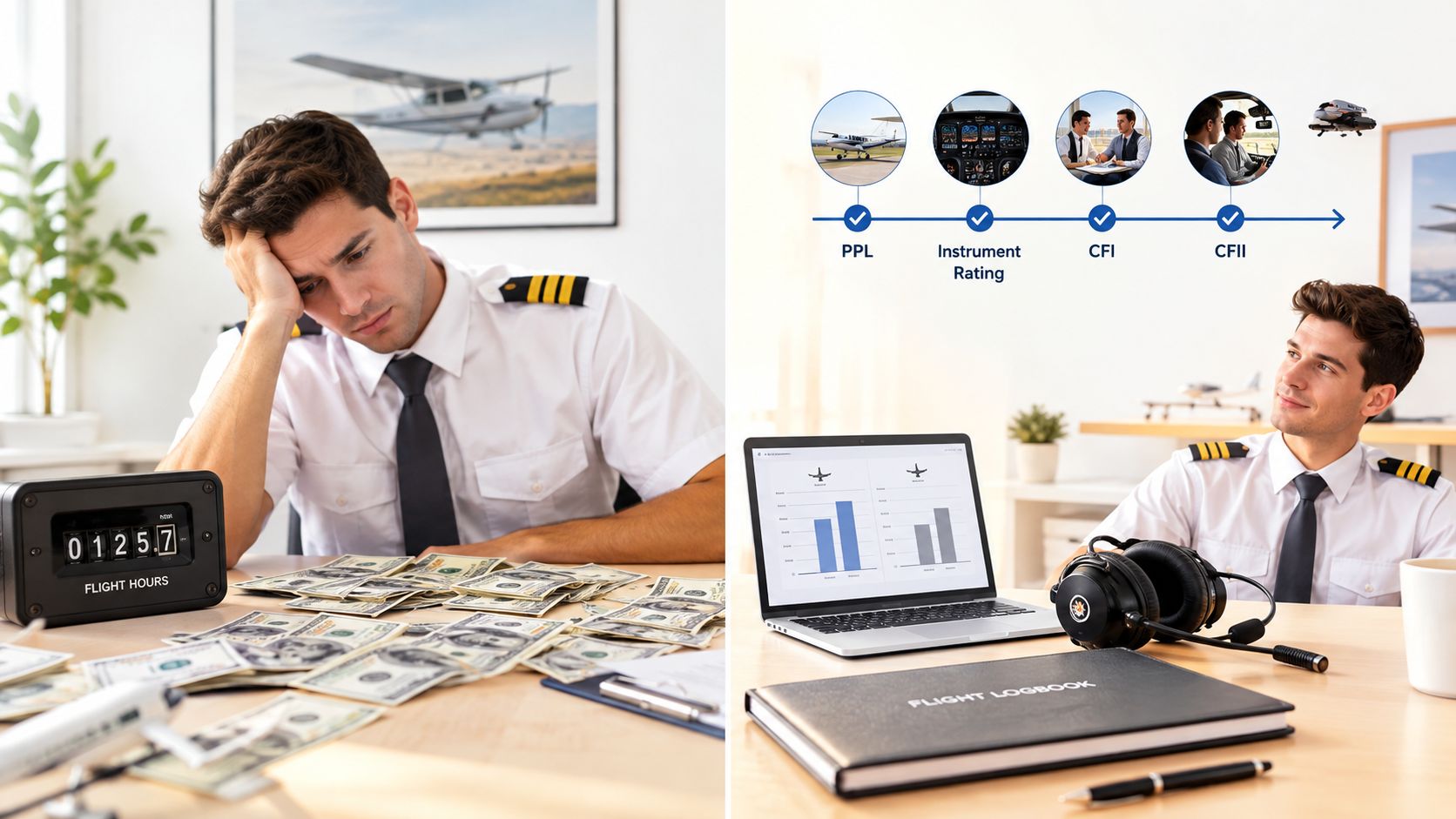
For a future airline or instructor candidate, the private certificate isn't always the end goal. It can be the first purchase in a long chain, and if you know you're headed all the way to advanced ratings, paying one certificate at a time can create duplicate spending on training hours that don't transfer cleanly into a bigger plan.
CFII's Career Track is a fixed $89,000 tuition, runs about nine months from zero time to CFII and multi-engine, includes 282 total hours, and is based in Southern California, including Riverside, Long Beach, and Corona. For a student who wants a zero-to-CFII path, that kind of structure can be easier to plan around than a piecemeal private certificate followed by later retraining. If you're still deciding whether to fly at all, a discovery flight is a reasonable first step, and if you're comparing full training paths, this career-track overview shows the complete route.
How the math changes for a career-minded student
A standalone private pilot path can make sense if you only want the private certificate. It can also make sense if you want flexibility and expect a slower timeline. But if your goal is a professional seat, the question is whether you want to keep budgeting piecemeal after the first certificate or commit to a path built for the full progression.
A fixed-price structure reduces uncertainty. You know the tuition up front, you know the end goal, and you can plan housing, scheduling, and financing around a defined timeline. That's different from trying to piece together a private certificate now and a career path later while hoping the later training won't force a repeat of early hours.
Many students get stuck at this point. They buy the private certificate first because it feels smaller, then discover that the next stage still requires a much bigger financial plan. If you already know you want to fly for work, it's smarter to ask whether the first dollar should go into the first step or into the whole ladder.
Choosing between pay-as-you-go and a full path
Pay-as-you-go gives you flexibility. A fixed career track gives you predictability and a built-in sequence. The right choice depends on whether you're testing the waters or already committed to the profession.
If you're only trying to become a private pilot, hourly training may be enough. If you're already mapping a career, the bigger lesson is to avoid buying the same foundational time twice. One budget should serve your actual destination, not just your first certificate.
For readers who want to understand how a structured course differs from a piecemeal certificate, this training-course overview adds helpful context without the guesswork.
Smart Ways to Save Without Cutting Corners
A private pilot budget gets easier to control when you treat it like two separate piles of money. One pile covers the variable cost per hour, the airplane, the instructor, and the lessons that keep adding up as you train. The other covers fixed items such as testing, medical paperwork, and your checkride reserve. Keep those pieces separate from the start, and it becomes easier to see where the money is going and where it can drift.
The habits that protect your budget
Fly on a steady rhythm. When lessons are spaced too far apart, you spend more time relearning than moving forward, and that extra review lives in the airplane, where it costs more.
Study on the ground before you show up. Ground study is cheaper than repeating basic work in the cockpit, the same way reading the map before a drive saves time on the road. That preparation also makes each lesson count more toward the certificate.
Timing matters too. FAA materials say a passed private-pilot knowledge test must have been passed within the beginning of the 24th month before the month of the practical test, so a long delay can force another written test. FAA knowledge test validity
Get the medical early. The FAA's student-pilot guidance says you need a valid medical certificate before soloing, so it belongs in the budget before the larger training bills start. FAA student pilot medical guidance
Budget in three separate lines, startup costs, recurring training costs, and a checkride reserve.
A simple calculator you can use
Start with the hours you expect to fly. Multiply that by your combined hourly training cost, then add fixed testing and gear costs. After that, set aside a reserve for one extra prep block, because a small cushion is easier to handle than a last-minute scramble.
A monthly savings habit also helps. If you put money aside as you go, each lesson feels like part of a plan instead of a surprise bill that lands all at once.
A quick checklist keeps the math honest:
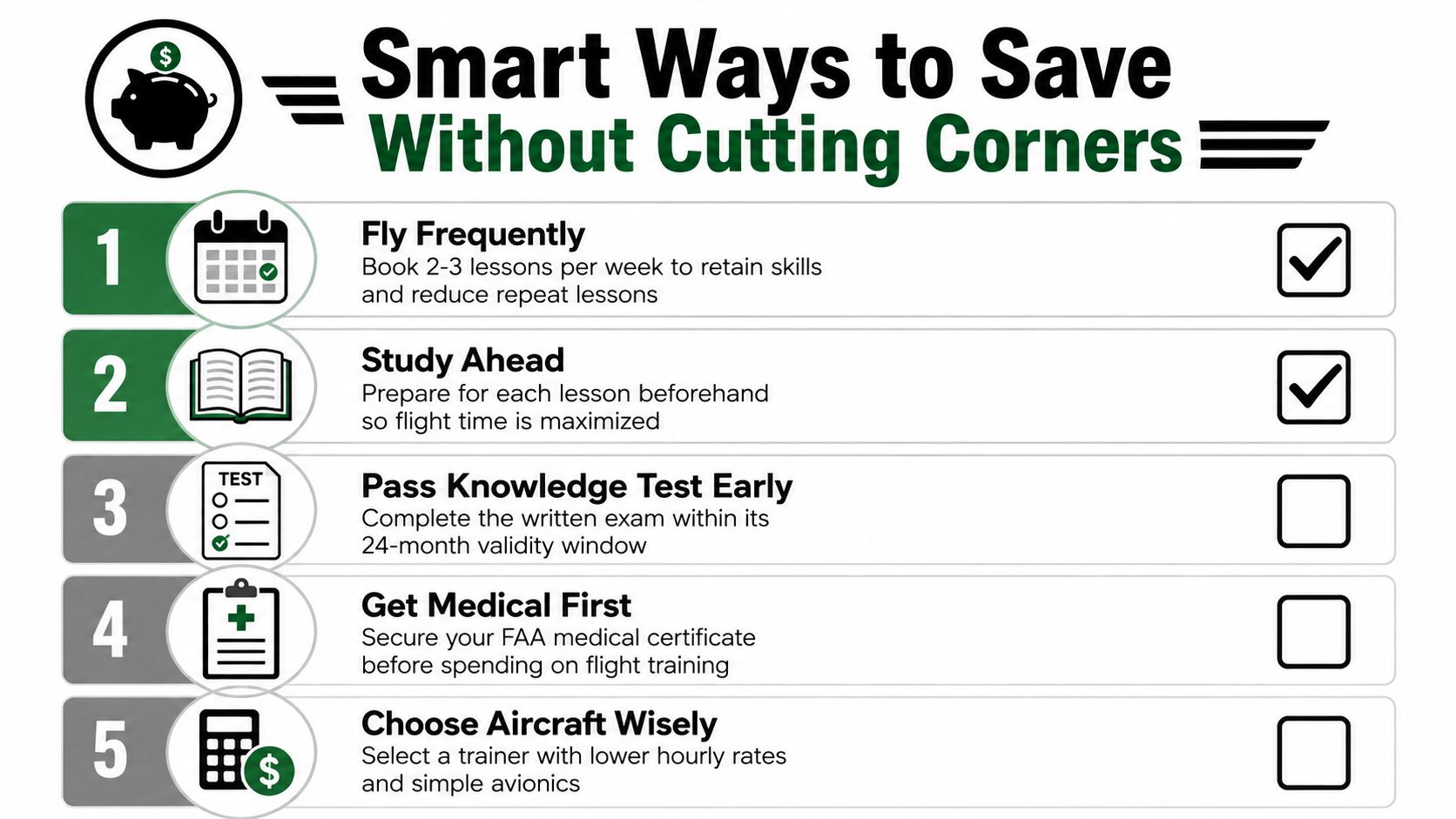
- Fly frequently: keep the skills fresh so you do not pay to rebuild them.
- Study ahead: reduce the time spent on basic review in the airplane.
- Pass the knowledge test early: stay inside the validity window before the practical test.
- Get the medical first: avoid funding lessons before you know you can solo.
- Choose aircraft wisely: simpler trainers can make early lessons easier to manage.
The formula is simple, but discipline does the work. Students who keep a reserve usually feel less pressure when training runs longer than expected, and that calm helps them learn with fewer expensive surprises.
Private Pilot Cost Questions and Next Steps
If you are setting aside money month by month, treat the private pilot license like two buckets. One bucket holds the variable cost per flight hour, and the other covers fixed items such as testing, books, and gear. That split helps you see why two students can land at very different totals even when they start the same training.
Part 61 and Part 141 also change the math. A part-time student training under Part 61 may need more open-ended budgeting, while a structured school path can make the pace easier to forecast. Either way, it helps to reserve a little extra cash for the lesson that runs long, the weather cancellation that pushes training back, or the extra review that smooths out weak spots.
If you are trying to decide between a discovery flight and a full commitment, use the first as a test drive and the second as a budget decision. A short intro lesson answers the “do I like flying?” question. A full program answers the harder question, “am I ready to pay for the whole path?”
Retests deserve their own line in the budget. A failed written or practical step can mean more instruction, another examiner fee, and more time before you are done. That is why a small reserve matters, it keeps one setback from becoming a second round of scrambling.
If you are serious about flying, CFII can help you compare the standalone private pilot path with the longer career track, so you do not pay twice for training you may need again later. Visit CFII to see how the first lessons, the testing costs, and the training structure fit together before you commit.
Planning to fly for a living?
See what the path from zero to a pilot career looks like, what it costs and how long it takes.
Learn to fly in Riverside
We train at Riverside Municipal Airport in factory-new airplanes with a parachute built in. Start with a one hour discovery flight, no experience needed.