
On this page
- Financing Options for Flight Training at a Glance
- Three questions that narrow the field
- Why Federal Aid Rarely Covers the Full Pathway
- The arithmetic in one example
- What Each Certificate Stage Costs and Where Loans Fit
- Map money to each stage
- Airline Hour Requirements and the Post-Training Income Gap
- Find your cash-flow valley
- Lender Terms and Repayment Stress Tests
- Terms to request in writing
- The capitalization trap, in plain terms
- Apply for Financing and Decide Your Path
- One path to test against your numbers
You're looking at flight schools at night, doing math on your phone, and the numbers won't line up. One program wants a large amount up front. Another quotes by the hour, so you can't tell where it ends. A lender advertises deferred payments, but you don't know what you'll earn when those payments start.
That's the right problem to solve before you sign anything. Flight training student loans aren't just about getting approved. They're about whether the payment still fits after training, while you're building hours as an instructor and before airline pay arrives. Work through eligibility first, then stage costs, then hour requirements, then the loan terms in writing.
Financing Options for Flight Training at a Glance
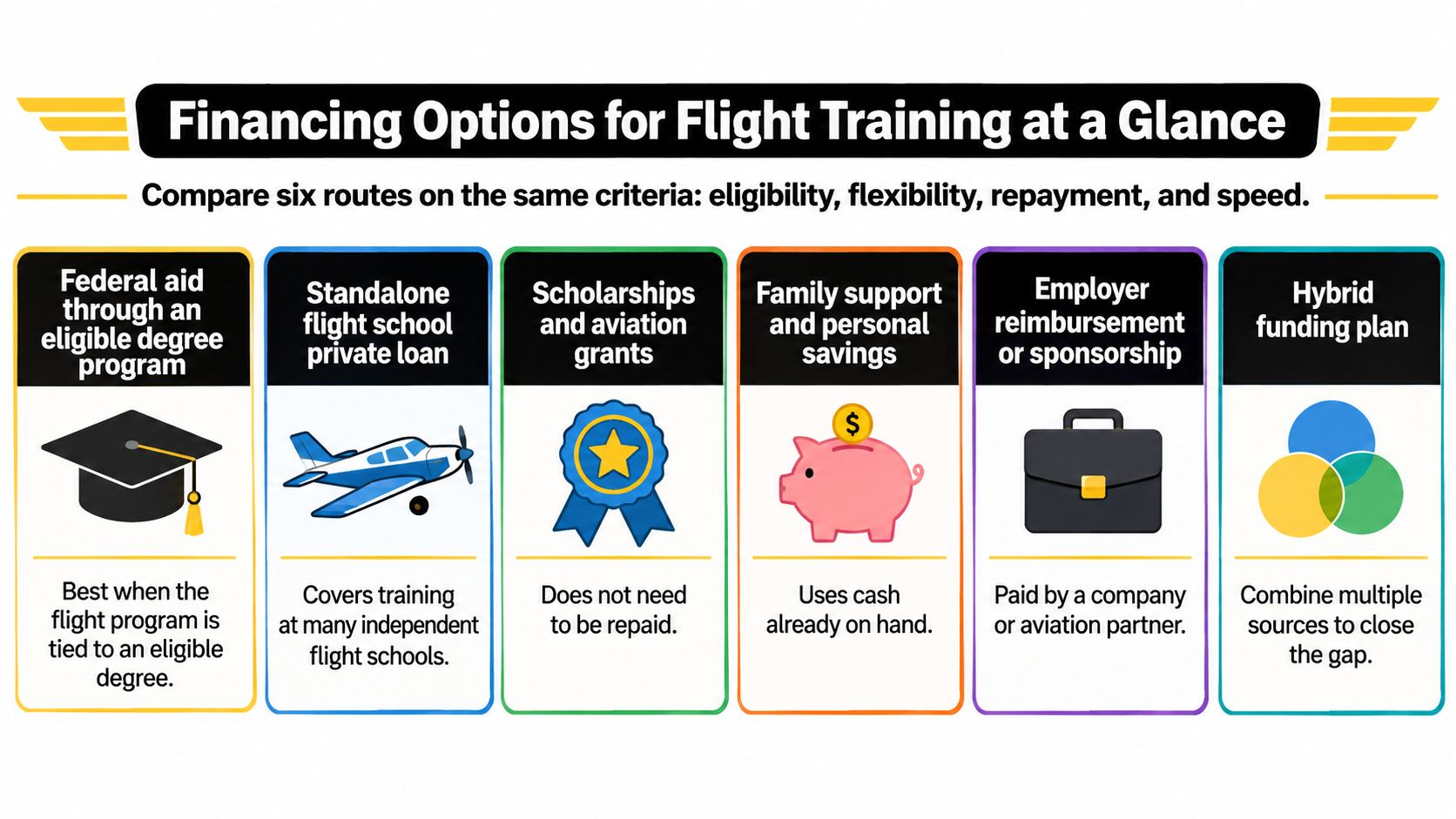
Flight training financing routes compared
| Route | Who qualifies | What it covers | Main risk |
|---|---|---|---|
| Federal aid through a degree program | Students in an eligible college or university program | Tuition and flight fees within federal limits | Degree adds time and living costs |
| Standalone flight school private loan | Borrowers approved by the lender | The program price set in the loan terms | Variable terms, fees and capitalized interest |
| Scholarships and aviation grants | Applicants who meet each award's criteria | Partial tuition or fees | Not guaranteed; each award sets its own amount |
| Family funds or savings | Access to savings or family support | Any approved training cost | Opportunity cost and family obligations |
| Home-equity lines, bank loans or credit cards | Existing credit or collateral | Gaps and living costs | Higher rates; check APR in writing |
| VA education benefits | Eligible veterans in approved programs | Tuition under VA rules | Coverage requires institutional and FAA approval |
The core split is program structure. Standalone flight schools generally fall outside federal Title IV aid. University based programs may qualify, and VA coverage depends on institutional and FAA approval. Don't assume FAFSA, a Pell Grant, or VA benefits travel with you to any school.
Mixed funding is normal. In 2025, flight-training provider Paragon Flight reported that traditional student loans financed 20% of its students, while the remaining 80% used personal funds, home-equity lines, bank loans, or credit cards.
Three questions that narrow the field
- Is training inside a degree program? If it isn't, don't build your plan around federal aid.
- Can savings or family support cover part of the cost? Every dollar paid in cash is a dollar you don't repay with interest. Look at commercial pilot training scholarships before you size a loan.
- Can you qualify for a loan you can repay? Approval tells you a lender will lend. It doesn't tell you the payment fits instructor income.
Practical rule: Test the federal route first, then price private options, and keep eligibility separate from loan approval in your notes.
Why Federal Aid Rarely Covers the Full Pathway
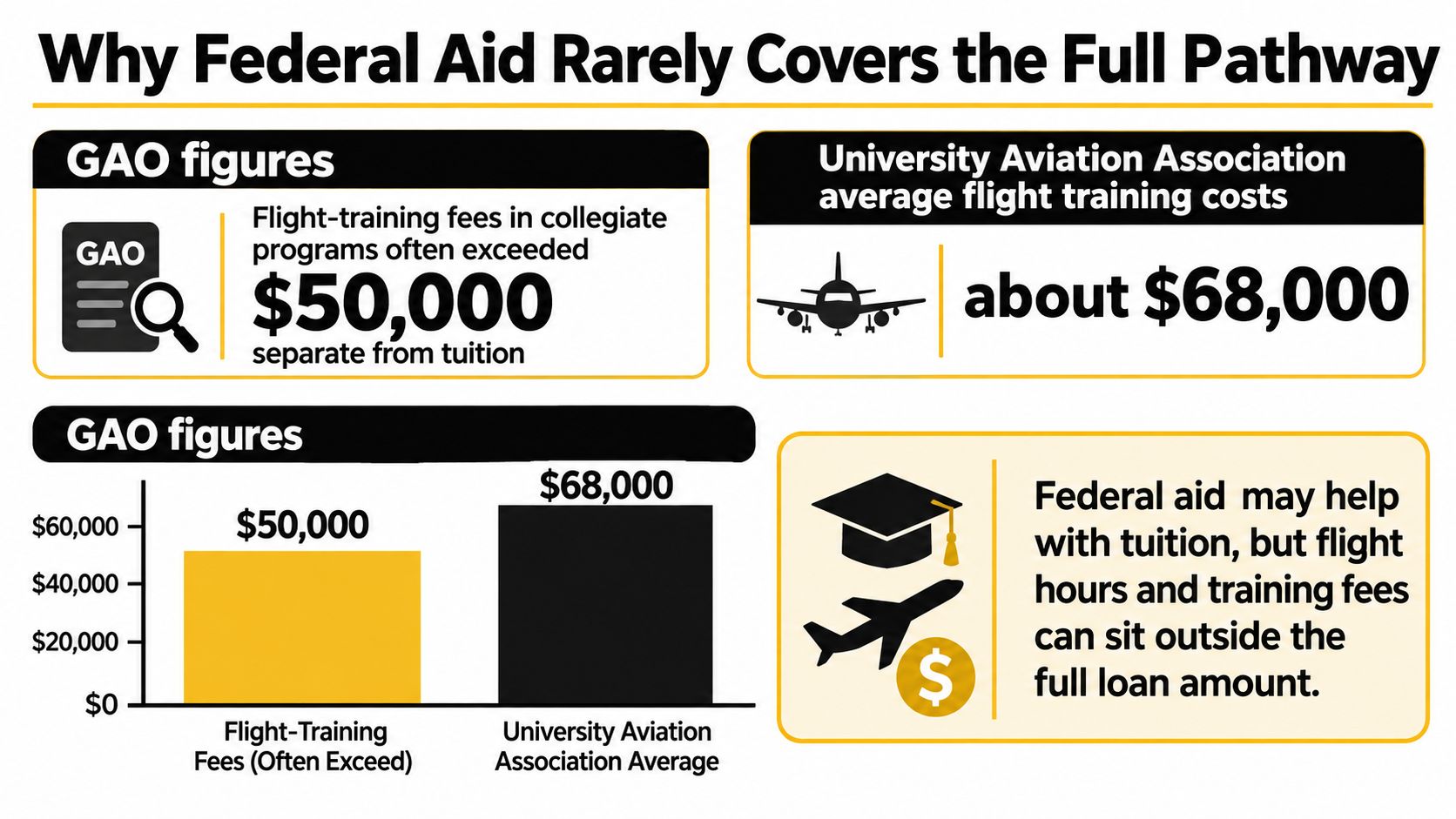
Suppose flight fees alone exceed $50,000, before tuition or rent. The U.S. Government Accountability Office report hosted by FAA Safety found that flight-training fees at collegiate aviation programs often exceeded that amount. Federal aid limits can therefore leave a large share of training costs to cover.
The gap can persist even inside a degree program. Federal aid eligibility depends on the school and program, and annual limits may not match the timing or total cost of flight training. A loan that covers one academic year may not fund every certificate and rating in the pathway.
The arithmetic in one example
Say your flight fees exceed $50,000 and your available federal borrowing for the year is less than that. The difference remains your responsibility, before ordinary tuition and living costs. A Pell Grant may reduce the amount you need to find if you qualify, but it does not guarantee that the full pathway is funded.
That shortfall can push students toward family resources or private credit. A degree route may make federal aid available, but compare the full cost and time commitment, not just the aid package. Veterans can check which flight schools accept the GI Bill and confirm that the specific program is approved.
Before enrolling, list the expenses your funding plan must cover, including housing, transportation, exam fees, equipment, and any additional lessons. Then check whether your available funds cover the complete training sequence or only its first stage.
What Each Certificate Stage Costs and Where Loans Fit
Stage pricing stops you from borrowing for private pilot training and then running dry at commercial. The FAA Safety Team's 2021 flight-training report, summarized in this Embry-Riddle hosted paper, listed median course-completion costs of approximately $10,000 for private pilot training, $4,500 for an instrument rating, $16,000 for commercial single-engine training, $5,000 for commercial multi-engine training, and $5,000 for initial flight-instructor training.
Median cost of each flight training stage
| Stage | Median cost | Loan implication |
|---|---|---|
| Private pilot | About $10,000 | First stage; often the first amount borrowed |
| Instrument rating | About $4,500 | Add-on that needs its own budget line |
| Commercial single-engine | About $16,000 | Largest single stage; required for paid flying |
| Commercial multi-engine | About $5,000 | Needed for many airline-track plans |
| Initial flight-instructor training | About $5,000 | Needed before instructing for pay |
| Total of listed stages | About $40,500 | Size the loan to the full sequence, not one stage |
These are medians, not quotes. Your school, aircraft, lesson frequency, and repeat lessons move the total. Use the table to build a sequence, then replace each median with a written price from the school you're considering. If you're pricing the commercial stage on its own, compare it with the full cost to get a commercial pilot license so you don't miss the stages around it.
Student support is uneven, which is why two classmates can need very different loans. In that same survey of collegiate flight students, 51% had only 0% to 24% of their flight costs covered by aid, loans, or scholarships, while 30% had 75% to 100% of flight costs covered through those sources.
Map money to each stage
- List the stages you'll finish. Don't stop at private if your goal is paid flying.
- Price each stage in writing. Assign a funding source and a start date to every line.
- Add a cash reserve. Put it against the stage where your timeline is least certain, usually where weather, aircraft availability, or a checkride can slip.
A loan that ends before commercial and instructor training leaves you with debt and no way to earn flight hours for pay.
Airline Hour Requirements and the Post-Training Income Gap
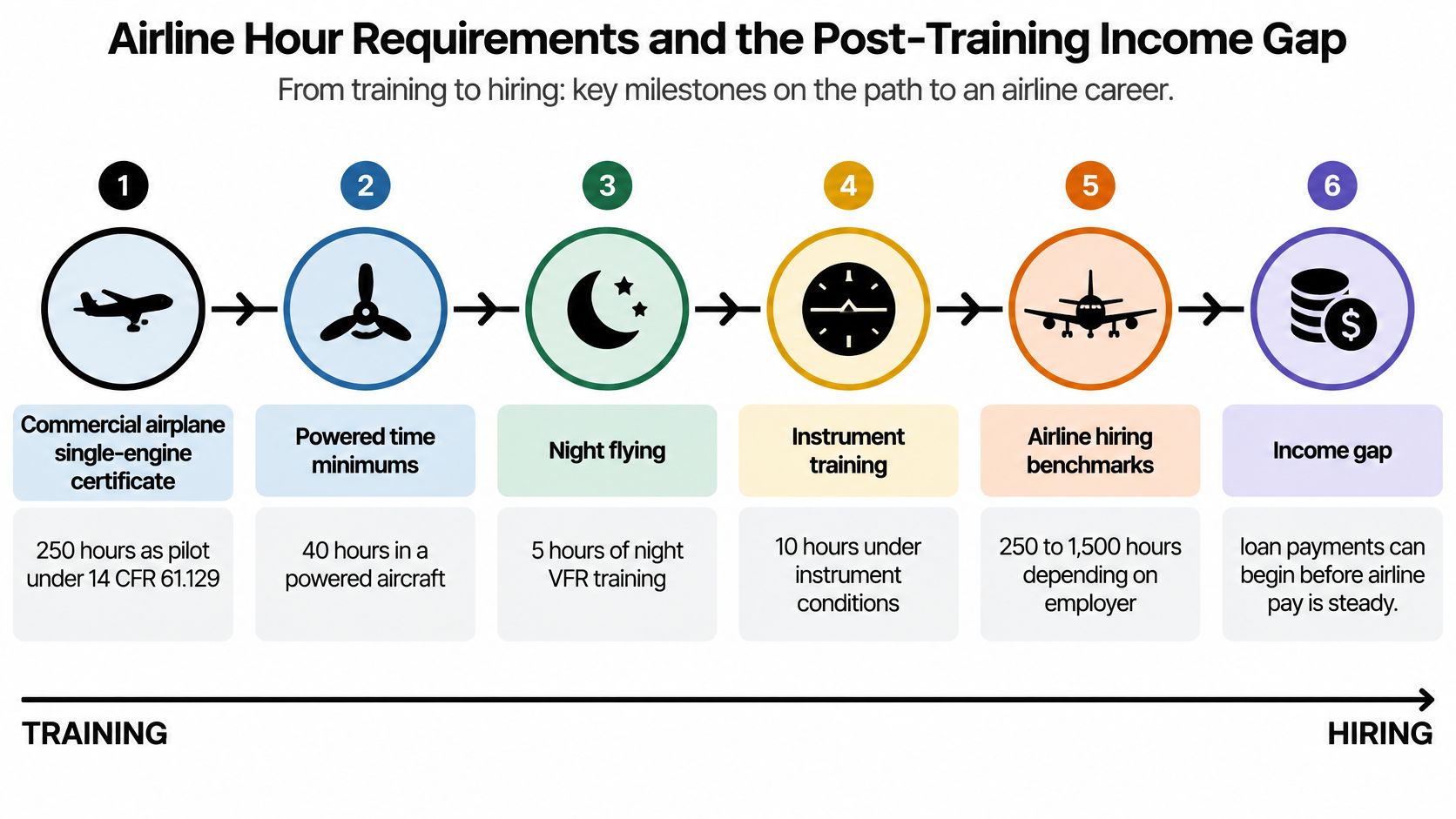
FAA and hiring hour benchmarks
| Milestone | Figure | Source or note |
|---|---|---|
| Commercial pilot, airplane single-engine | 250 hours as pilot | 14 CFR 61.129, with set distribution of hours |
| Restricted airline transport, qualifying military pilots | 750 hours | 14 CFR 61.160 |
| Unrestricted airline transport pilot | Generally 1,500 hours | Standard ATP threshold, separate from restricted privilege |
| Median pay, airline and commercial pilots (2025) | $210,020 | BLS occupational data, not a starting salary |
Under 14 CFR section 61.129, a commercial pilot applicant with an airplane single-engine rating generally needs at least 250 hours of flight time as a pilot. Those hours include at least 100 hours in powered aircraft, including 50 in airplanes, and at least 100 hours as pilot in command, including 50 in airplanes and 50 hours of cross-country flight, with at least 10 of those cross-country hours in airplanes. The rule also requires 20 hours of training, including 10 hours of instrument training and 10 hours in a complex airplane, turbine-powered airplane, technically advanced airplane, or combination.
Commercial certification is one milestone; airline hour requirements come later. Under 14 CFR section 61.160, qualifying military pilots can apply for restricted privileges with 750 hours, while unrestricted airline transport is generally associated with 1,500 total pilot hours. For the broader pilot career path from certificates to instructing and airline hiring, the time between commercial certification and airline eligibility can shape how long a training loan strains your budget.
Find your cash-flow valley
Estimate how many hours you could realistically log each month while instructing, then divide the hours still needed by that monthly rate. For example, at 50 hours a month, the gap from 250 to 1,500 hours is 25 months of hour-building. Your actual path will depend on your starting hours and monthly flying pace.
The U.S. Bureau of Labor Statistics occupational page for airline and commercial pilots lists 2025 median pay of $210,020 for airline and commercial pilots and projects 7% employment growth from 2025 through 2035. The median describes the occupation as a whole, not a new instructor's first year. Set your repayment estimate against the income you expect during hour-building, alongside rent, taxes, and insurance, rather than a future airline paycheck.
Lender Terms and Repayment Stress Tests
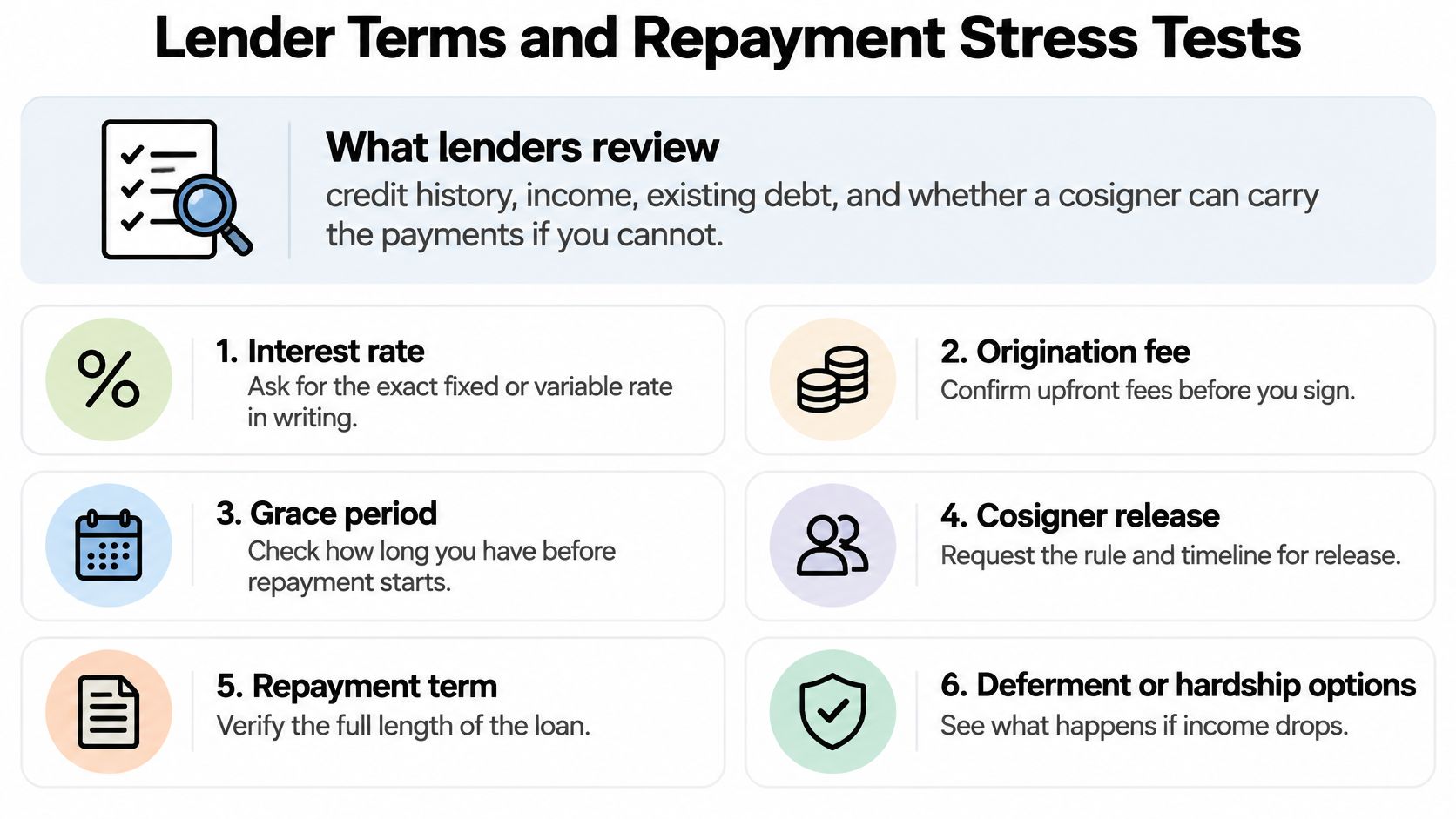
A loan can look manageable on the first day of training and strain your budget months after graduation. Treat it as career-transition debt: you borrow before flight income is likely to cover regular payments. The Consumer Financial Protection Bureau's guidance on private student loans explains that private loans generally lack the flexible repayment terms and borrower protections available under federal student-loan programs.
Lenders consider your credit history, income, existing debt, and whether a cosigner could make payments if you cannot. A cosigner may help with approval or pricing, but is legally responsible for the debt. If your credit history is limited, learn about flight school financing options with bad credit before submitting applications.
Terms to request in writing
- APR and rate type. Ask whether the rate is fixed or variable. A low nominal rate can still cost more after fees, so compare APR and total repayment.
- Origination fees. Find out the fee in dollars and whether it is added to the balance. Include it in the amount you plan to finance.
- Deferment rules. Ask whether interest accrues while payments are paused. Calculate the balance when repayment begins, not just the payment due during training.
- Capitalization triggers. Capitalization adds unpaid interest to principal. Ask when it occurs and whether paying interest during training can prevent it.
- Grace period and first due date. Put the first payment date on your training calendar. Check whether it could arrive before you begin instructing.
- Late-payment consequences. Ask about fees, credit reporting, and hardship options so you know what one difficult month could mean.
- Cosigner release policy. Get the release conditions in writing, including how many on-time payments are required.
- Prepayment and unused funds. Confirm whether you can prepay without a penalty and return unused loan proceeds.
The capitalization trap, in plain terms
Suppose you borrow for a fixed-price program and defer payments for 12 months. If interest accrues and the lender adds it to principal when repayment starts, your starting balance will exceed the amount borrowed. Future interest is then calculated on that larger balance. Deferral protects cash flow during training, but the total cost stays the same or grows.
Repayment stress test by scenario
| Scenario | Added time | Costs to add | Question to answer |
|---|---|---|---|
| On-schedule completion | None | Tuition, housing, exams, equipment | Can my expected instructing income cover the payment? |
| Six-month delay | About six months | Extra living costs and lesson hours | How much interest accrues during deferment? |
| Checkride or weather delay | One to three months in your plan | Extra exam fees and rent | Will the payment still fit if income starts later? |
| Longer delay before paid instructing | Six to twelve months in your plan | Rent, insurance, taxes, and cash reserve | Can I cover the payment before paid instructing starts? |
For each timeline, add tuition, housing, transportation, exam fees, equipment, accruing interest, and a cash reserve. Then compare the payment after deferment with expected instructor income after rent, insurance, taxes, and recurrent training costs. A monthly budget can help you plan debt payments around household expenses and see how much room remains for loan payments.
If the loan only works when everything goes right, it does not work. Your budget should also hold up through a late finish, extra hours, or a checkride delay.
Use the same delayed-start assumptions when reviewing repayment terms. If the payment leaves too little room for ordinary expenses in a slower scenario, consider borrowing less or bringing more cash or scholarship funds to the plan.
Apply for Financing and Decide Your Path
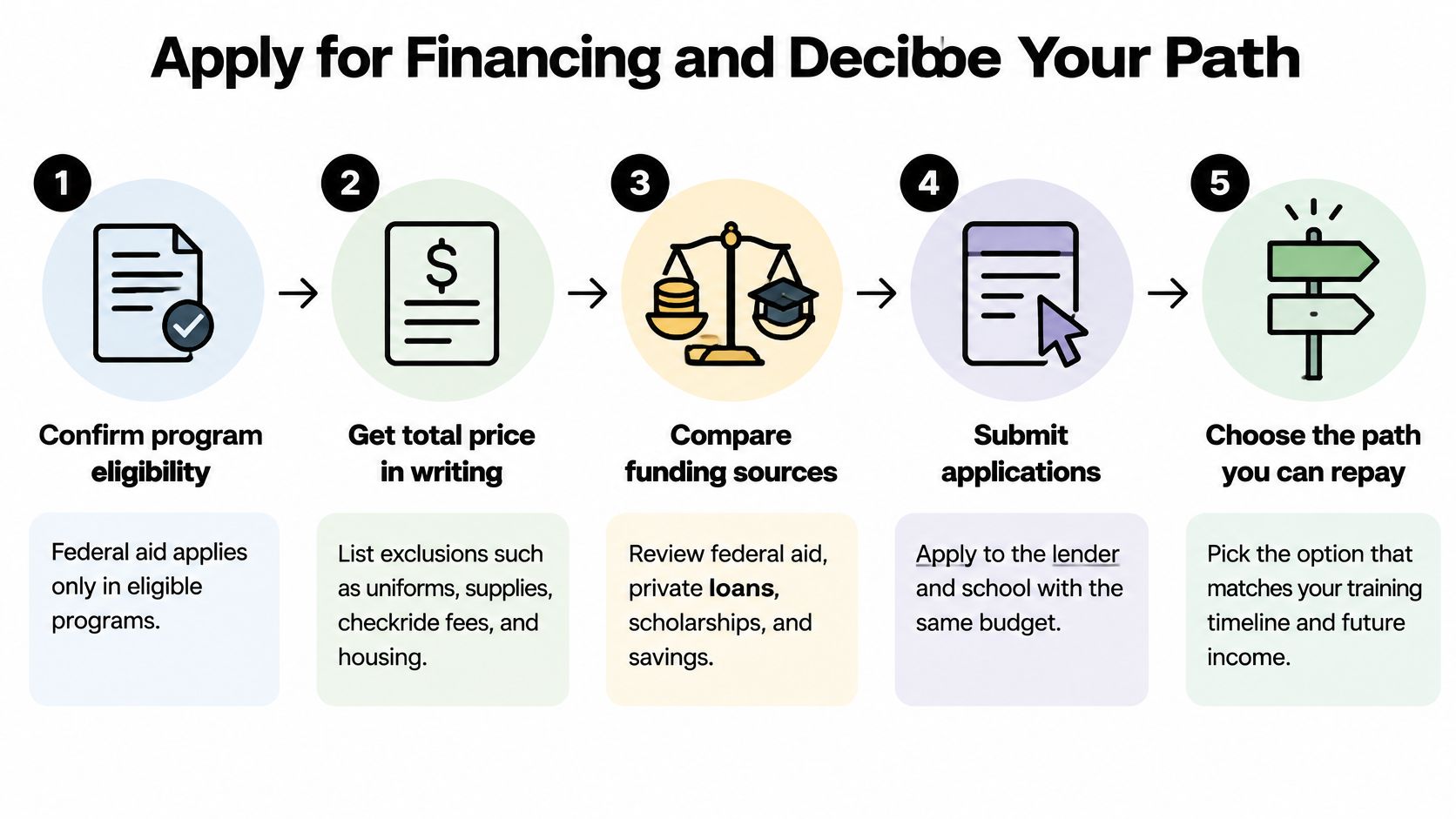
A loan application is easier to manage when you know what you need before submitting it. Work through these steps, then decide how much debt your budget can support.
- Confirm program eligibility. Federal aid applies only to eligible programs. Ask the school whether your chosen training qualifies and get the answer in writing.
- Get the full price and exclusions in writing. List costs not covered by tuition, such as pilot gear, housing, exam fees, and retakes. In CFII's Career Track, pilot gear such as an iPad, headset, and flight bag is selected and purchased by the student.
- Build a stage-by-stage budget. Include costs at each training stage, along with living expenses and a cash reserve.
- Gather your documents. Collect your credit report, proof of income, and any cosigner information. If you're unsure what lenders may request, prepare documents for a personal loan before starting applications.
- Apply only for documented costs. Borrow an amount your budget can support, and ask how unused funds are handled.
One path to test against your numbers
CFII's Career Track costs $89,000 for six certificates and ratings and 282 hours of training, from zero experience to flight instructor in about nine months. Stratus Financial finances the full Career Track, with payments deferred 12 months. The First Milestone Guarantee lets students discontinue before about 20 hours of flight time and pay only for logged flight time at the discounted rate of $200 per hour, with additional payments refunded.
A payment deferral shifts when repayment starts; it does not erase the debt. Before applying, check whether your budget can handle payments after training, including if your path to paid instructing takes longer than expected. If you have not flown before, a discovery flight can help you decide whether you want to pursue flight training.
Ready to review a fixed-price, zero-to-CFII path in Southern California? Visit CFII to see the program details and ask for the total price and exclusions in writing. Before applying, make sure the repayment timeline fits your expected income.
Planning to fly for a living?
See what the path from zero to a pilot career looks like, what it costs and how long it takes.
Learn to fly in Riverside
We train at Riverside Municipal Airport in modern airplanes with a parachute built in. Start with a one hour discovery flight, no experience needed.