On this page
- How the Certificates Stack Under FAA Rules
- How each rating leads to the next
- Hour Minimums That Gate Commercial and Airline Flying
- Time Building After the Ratings
- Timelines for Part-Time, Accelerated, and College Routes
- Medical Certification Before You Spend
- Money, Delays and Plans That Survive a Slow Year
- Choose a Pace and Book the First Flight
A pilot career has two stages: earning certificates and building the paid flight experience needed for airline work. The certificate steps have defined requirements; the hours after instructor training can take longer because progress depends on access to paid flying and available openings.
For someone starting from zero, the first milestones build on one another. The longer stretch often comes after flight instructor training, when pilots seek work that adds logged hours. Industry openings and competition for low-time flying jobs can exist at the same time, so a career timeline needs room for both.
How the Certificates Stack Under FAA Rules
A full-time student may earn a private pilot certificate in about three months. Reaching a regional airline cockpit often takes two to four years from the first lesson, with much of that time spent building experience after the early ratings. Weather, checkride availability, training frequency, and access to paid flying all affect the schedule.
The first milestones are a student pilot certificate and medical eligibility. You train with an instructor, then make your first solo flight after receiving the required authorization. Solo is a major step, but you still have to follow the applicable rules and limitations.
A private pilot certificate allows you to carry passengers and fly under visual flight rules in suitable conditions. It is also the starting point for professional training. Build proficiency for the practical test rather than planning around a fixed date.
How each rating leads to the next
The instrument rating adds training for flight by reference to instruments and for operating under instrument flight rules, including making weather decisions. Under 14 CFR §61.65, applicants must meet specified experience and training requirements, complete the knowledge test before the practical test, and pass that separate test. A private pilot certificate is the usual prerequisite.
The commercial pilot certificate provides privileges for paid flying, subject to the rules governing the specific operation. Its requirements cover more than total flight time. Pilot-in-command time, cross-country experience, and specified training also count. See this guide to flight training requirements.
A flight instructor certificate qualifies you to teach within the privileges of your ratings. Applicants must hold a commercial or ATP certificate with the appropriate aircraft category and class rating, complete documented training, and receive a logbook endorsement confirming readiness for the practical test. The FAA's flight-instructor certification guidance explains the endorsements and certification sequence. A CFII, or instrument instructor, can teach instrument procedures within the privileges of the instructor's ratings.
The stages work like steps on a ladder: each qualification gives you a defined set of privileges, while the next requires its own training and tests. Private flying, instrument flying, commercial operations, and flight instruction each come with distinct rules.
The standard airplane Airline Transport Pilot (ATP) certificate is a later milestone, with a 1,500-hour total-time requirement and other qualifications. The Bureau of Labor Statistics' employment projections and FAA workforce figures project 7% growth for airline and commercial pilots from 2025 through 2035, with approximately 16,400 openings per year over that decade. Those figures include replacement demand and commercial-pilot roles. They do not indicate when an individual instructor will find paid flying work.
| Stage | What it allows | Hour gate | Typical calendar from zero |
|---|---|---|---|
| Student pilot and medical | Dual instruction | 0 | First weeks |
| First solo | Fly alone with instructor authorization | Often about 10–20 | Weeks to a few months |
| Private pilot | Carry passengers and fly day VFR | FAA private-certificate requirements | About 3 months full time; longer part time |
| Instrument rating | Fly under IFR, subject to applicable rules | Additional instrument training after private | Months after private |
| Commercial pilot | Paid flying, subject to operation rules | 250 hours under 14 CFR §61.129 | After instrument, once hours are logged |
| CFI and CFII | Provide flight instruction within certificate privileges | Commercial or ATP plus instructor requirements | Soon after commercial on a full-time syllabus |
| Unrestricted airplane ATP | Standard airplane ATP privileges | 1,500 total flight hours | Often 2–4 years from the first lesson |
Hour Minimums That Gate Commercial and Airline Flying
250 hours is the standard total-time minimum for a single-engine commercial pilot certificate under 14 CFR §61.129. The FAA regulation also specifies what kinds of experience those hours must include.
| Gate | Minimum | What counts | Rule |
|---|---|---|---|
| Commercial total time | 250 hours | Flight time as a pilot, unless an approved-course exception applies | 14 CFR §61.129 |
| Powered-aircraft time | 100 hours | Includes at least 50 hours in airplanes | 14 CFR §61.129 |
| Pilot in command | 100 hours | Includes 50 in airplanes and 50 cross-country, with at least 10 cross-country hours in airplanes | 14 CFR §61.129 |
| Commercial training | 20 hours | Includes 10 hours of instrument training with a view-limiting device, at least 5 in a single-engine airplane, plus 10 hours in a qualifying complex, turbine-powered or technically advanced airplane, or combination | 14 CFR §61.129 |
| Checkride preparation | 3 hours | Instructor training within the previous two calendar months | 14 CFR §61.129 |
| Standard airplane ATP | 1,500 hours | Total time, plus a commercial certificate with instrument rating, tests and applicable class experience | FAA ATP rules |
| Multiengine ATP | ATP CTP | Academic instruction plus flight training before the multiengine airplane ATP | FAA ATP rules |
Log each category separately: pilot-in-command, cross-country, instrument experience, aircraft qualifications and instructor training. A growing total can still leave a required category short.
The airline threshold is another gate. The commercial certificate permits specified paid flying, while an unrestricted airplane ATP requires 1,500 hours of total flight time, along with other qualifications. The FAA's ATP requirements include a commercial certificate with an instrument rating, knowledge and practical tests, and appropriate aircraft-class experience.
Applicants for an airplane multiengine ATP must also complete the FAA's Airline Transport Pilot Certification Training Program (ATP CTP), which combines academic instruction with flight training. That training and the required experience are separate steps, so plan for both when mapping the route from commercial flying to airline eligibility.
Time Building After the Ratings
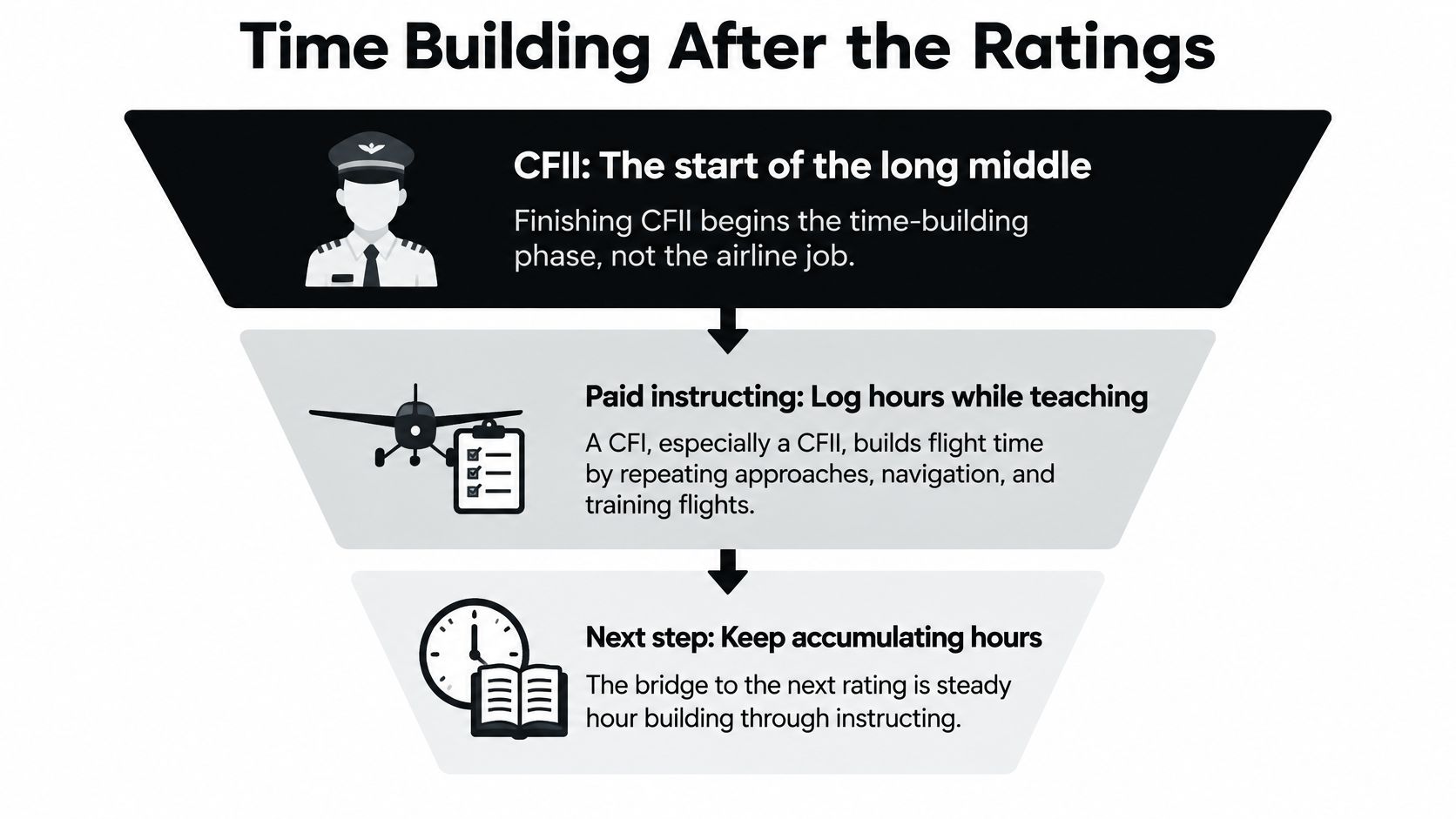
Finishing CFII starts the time-building stage, where many pilots spend years gaining experience before an airline hire. Paid flight instruction is one common route: a CFI teaches while logging flight time, and a CFII can teach instrument procedures within the instructor's privileges. Lessons can cover approaches, navigation, weather decisions, aircraft control, abnormal procedures, and radio calls.
Flight-instructor certificates are rising while airline hiring requires experience a new instructor may not yet have. The Bureau of Labor Statistics' outlook for airline and commercial pilots projects 7% employment growth from 2025 to 2035 and approximately 16,400 openings annually. These figures include replacement demand and different kinds of flying, not just entry-level airline jobs. The FAA issued 12,961 initial flight-instructor certificates in 2025, up from 8,364 in 2022.
Plan around hours you can fly each month. Student demand, aircraft availability, weather cancellations, and maintenance can all reduce expected flight time. Instructor duties have limits, too: under 14 CFR Part 61, Subpart H, a flight instructor may not conduct more than eight hours of flight training in any consecutive 24-hour period and may teach only in aircraft covered by the required ratings.
Three routes may help build experience:
- Steady instructing: Consistent student demand and aircraft access let you build hours while practicing teaching, procedures, and cockpit communication.
- A slow season: Fewer students or more cancellations can cut flying time. A second job, relocation, or another employer may help you keep progressing.
- Other commercial flying: Charter, survey, and other operations may offer another route if you meet their specific requirements and can secure the work.
Track paid hours and logbook categories, including pilot-in-command time. Income can vary while you build experience, so allow for slower months when planning how long it may take to move from CFII to an airline cockpit.
Timelines for Part-Time, Accelerated, and College Routes
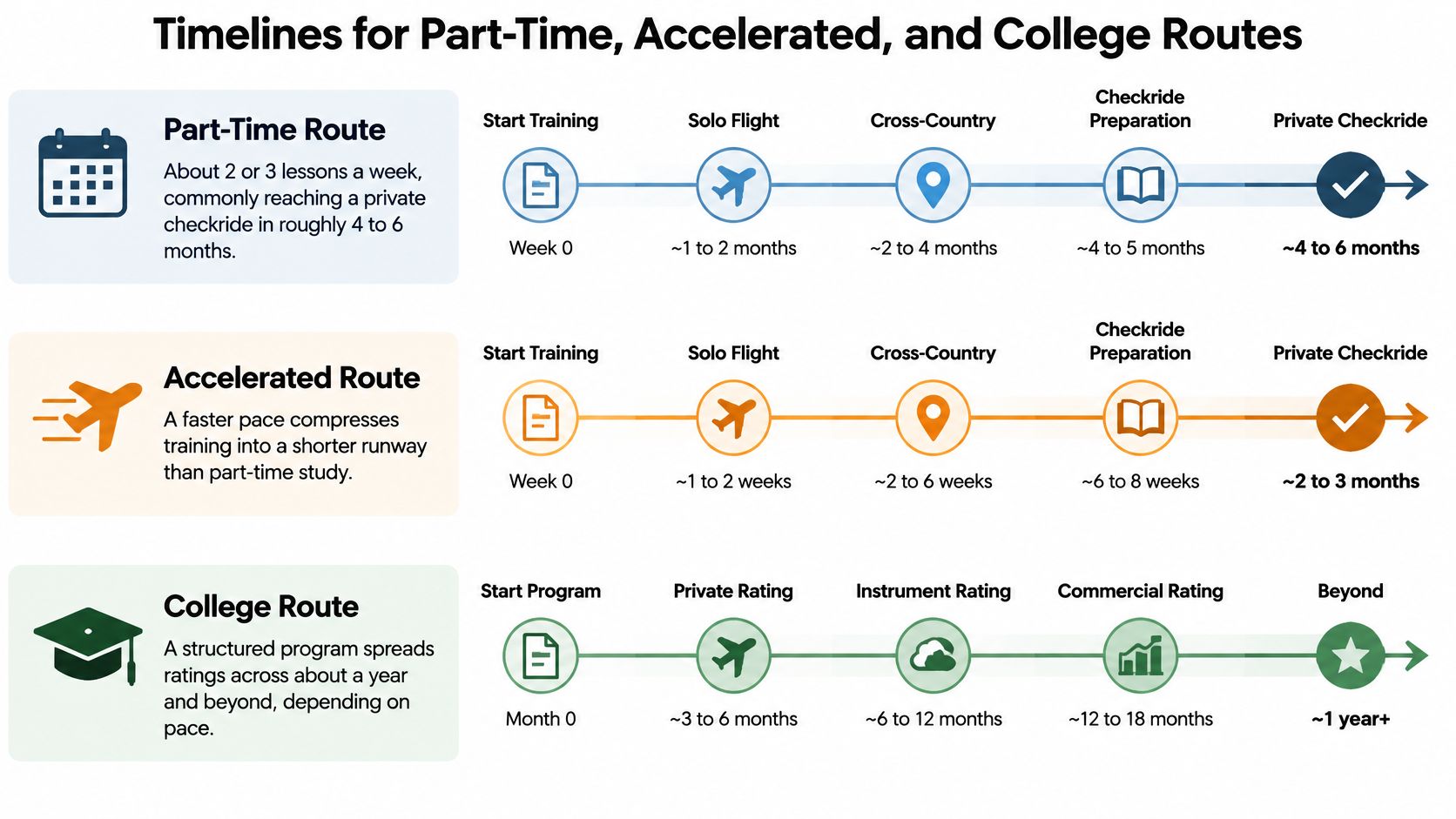
Training pace changes how quickly you reach each certificate. A part-time student taking two or three lessons a week typically reaches the private pilot checkride in four to six months. A full-time schedule can compress the ratings into about nine to twelve months, while a college route spreads training across a longer degree program.
| Route | Private pilot | Ratings through instructor | Main tradeoff |
|---|---|---|---|
| Part-time, 2–3 lessons a week | Commonly 4–6 months | Often well over a year | Keeps a job; weather and gaps between lessons can stretch training |
| Full-time accelerated | About 3 months | Roughly 9–12 months of weekday flying | Requires weekday availability and living near the airport |
| Four-year aviation degree | Spread across the degree | About 4 years | Longer calendar; an approved program may offer a restricted-ATP pathway |
Part-time lessons leave room for work, but breaks between flights can mean extra practice to regain recent skills. A longer schedule may be the workable choice when income needs to continue.
Full-time training keeps lessons and ratings close together. CFII's Career Track, for example, takes students from zero experience to flight instructor in about nine months. The fast-track pilot training guide explains how an intensive schedule differs from training around other commitments.
College training spreads flight lessons across the degree. An approved aviation program may qualify graduates for a restricted-ATP pathway, subject to program and student requirements. That route can change the hour threshold, but it does not remove the need to build flight experience.
Choose a pace by comparing the program's published length with the calendar time students may need to complete lessons, regain skills after breaks, and pass checkrides. Full-time training suits a schedule that can support flying most weekdays. Part-time lessons suit students who need to keep working, while college combines flight training with a degree.
Medical Certification Before You Spend
Medical eligibility is a separate gate from pilot certificates. Check it before making a major financial commitment, because training progress doesn't replace the medical certification needed to exercise flying privileges.
- Book an aviation medical exam early. Speak with an Aviation Medical Examiner before committing to a substantial training schedule.
- Pause if the result needs review. If your application is deferred or a condition requires FAA review, understand the next steps before paying for more lessons.
- Ask how pending status is handled. Know what happens to scheduling and payments if your medical decision takes time.
- Confirm the standard for your intended work. Medical requirements can differ across stages of a flying career. Don't assume that eligibility for one kind of flying automatically covers another.
Put your medical status and renewal dates in the same plan as your training budget. If you need help understanding the medical process, start with CFII's FAA medical information. Resolve questions early, when you still have time to make an informed decision about cost and timing.
Money, Delays and Plans That Survive a Slow Year
A slow start to paid flying can strain a budget even after training is complete. Loan payments, rent and moving costs may arrive before instructing hours become steady. Write down your monthly expenses, how long your savings will cover a lower-income period, and what you will do if a checkride or hiring cycle takes longer than expected.

Certificates are often the shorter part of the path. Building paid hours afterward can take longer, because entry-level openings and competition for available hours may coexist. Keep a reserve for ordinary living costs, and set a date to reassess whether changing employers, relocating or taking other work makes more sense than waiting.
The AOPA coverage of aviation workforce access reports that 5% of U.S. airline-transport-pilot-rated pilots were women, more than half of U.S. airline pilots were over age 50, and roughly 4,300 airline-pilot retirements annually were projected over the next decade. These figures describe workforce composition and projected replacement needs; they do not predict how quickly an individual will find paid flying or build hours.
If scholarships could affect whether you begin or continue training, explore commercial pilot training scholarships. Before borrowing, set a savings floor and decide when you will pause spending. Also choose in advance what alternative work you will take if paid instructing hours have not arrived within six months.
To see the financial and career-planning discussion, watch the video below.
Choose a Pace and Book the First Flight
If you haven't flown, take a discovery flight before paying tuition, relocating or borrowing. It gives you a first flight with an instructor and a chance to learn whether you enjoy the actual work of training, not just the idea of an airline career. You can book a discovery flight as a practical first step.
If you're ready for a structured, full-time route in Southern California, CFII's Career Track has a fixed $89,000 tuition, takes about nine months from zero time to CFII and multi-engine, and includes 282 total hours across six certificates and ratings. The program is based in Riverside, Long Beach and Corona. Its timeline applies to the training route, not the later time-building needed for unrestricted airline eligibility.
Match the route to your real constraints. Choose part-time lessons if your job needs to continue; consider an intensive schedule only if weekday flying and a Southern California base are realistic; choose a degree route only if the degree and possible restricted-hour path justify the longer calendar. Before committing money, check medical eligibility, budget for a lower-income time-building period and identify the experience gate you're working toward: commercial eligibility first, then the total time required for an unrestricted ATP.
CFII offers discovery flights for people who want to experience flying before committing, as well as a structured Career Track for aspiring instructors. Visit CFII to explore the next step that fits your schedule, location and career goals.
Planning to fly for a living?
See what the path from zero to a pilot career looks like, what it costs and how long it takes.
Learn to fly in Riverside
We train at Riverside Municipal Airport in modern airplanes with a parachute built in. Start with a one hour discovery flight, no experience needed.