

On this page
- What Flight Training Really Costs
- Minimum hours aren't a completion promise
- Choose the benchmark that matches your destination
- How to Build a Training Budget You Can Defend
- Build the cost sheet
- Carry a funding requirement, not just tuition
- Compare Funding Sources and Test the Loan
- School eligibility comes before rate shopping
- Use nondebt funds first, then finance the gap
- Read the terms behind the payment
- Make the loan survive a delay
- Cutting the Loan With Paid Hours and Sponsorships
- Paid instructing reduces one cost, not every risk
- Match outside funding to its conditions
- Confirm the Funding Plan Before Your First Lesson
- Get operational and financial answers together
- Release money against demonstrated progress
- Choose a commitment that fits your readiness
The 2024 median rental rate for a training aircraft was $180 per hour, according to Redbird Flight's survey reported by General Aviation News. That's an aircraft-rental benchmark, not a complete lesson price. Paying for pilot training means funding the instruction, testing, living expenses and borrowing costs around those aircraft hours, then staying solvent while you build experience for professional work.
What Flight Training Really Costs
Flight training cost benchmarks
| Cost benchmark | Reported figure | What it depends on |
|---|---|---|
| Private pilot training, typical total | $6,000 to $20,000 or more, according to AOPA's pilot-license cost guide | Aircraft, instruction, training pace, and student progress |
| Median training-aircraft rental, 2024 | $180 per hour, from the Redbird survey cited above | Aircraft type and rental terms |
| Flight-training component, university path, 2021 | $55,887 average, from University Aviation Association figures reported by GAO | Program requirements and aircraft use |
| Collegiate programs with flight costs above $50,000, 2018 | 27 of 45 programs, according to University Aviation Association figures in GAO's review | Certificates and ratings pursued |
These figures cover different kinds of training. The private-pilot range is a starting benchmark; university flight costs cover a broader sequence, and degree totals include tuition beyond flight training. GAO's earlier review reported a highest flight-training estimate of about $81,000 among the collegiate programs it examined.
The rental benchmark is only one part of the bill. Before comparing aircraft rates, check whether fuel is included, how aircraft time is billed, and whether instructor charges are separate. A lower hourly rental rate may still lead to a higher certificate cost if training takes more lessons or scheduling is inconsistent.
Minimum hours aren't a completion promise
For an airplane single-engine private certificate, 14 CFR § 61.109 generally requires 40 hours, including 20 hours of instruction and 10 hours of solo training. Its 35-hour alternative applies to applicants completing an approved private-pilot course at a Part 142 training center. The 40-hour figure sets an experience floor; the instructor decides when you are ready.
You must complete the required operations and demonstrate proficiency. A package priced around minimum hours does not cover extra training unless the contract explicitly includes it.
Choose the benchmark that matches your destination
The 2021 average degree-plus-flight cost was $85,745 for in-state students and $138,511 for out-of-state students, according to GAO's report of University Aviation Association figures. These totals show how college pathways combine degree and flight expenses. A standalone flight-school budget should use flight-only costs.
Aircraft type, student proficiency, school requirements, and certificates pursued all affect the total. Weather, instructor availability, and training frequency also influence how quickly scheduled lessons become completed training.
For recreational flying, use this private pilot license cost breakdown to estimate the certificate's cost. For instrument privileges or a career pathway, price the full sequence. A private certificate is only one stage of that investment.
How to Build a Training Budget You Can Defend
Build a spreadsheet with separate columns for quoted cost, excluded cost, payment date and funding source. A total without payment dates won't tell you whether you'll have cash available when a checkride, housing payment or loan installment comes due.
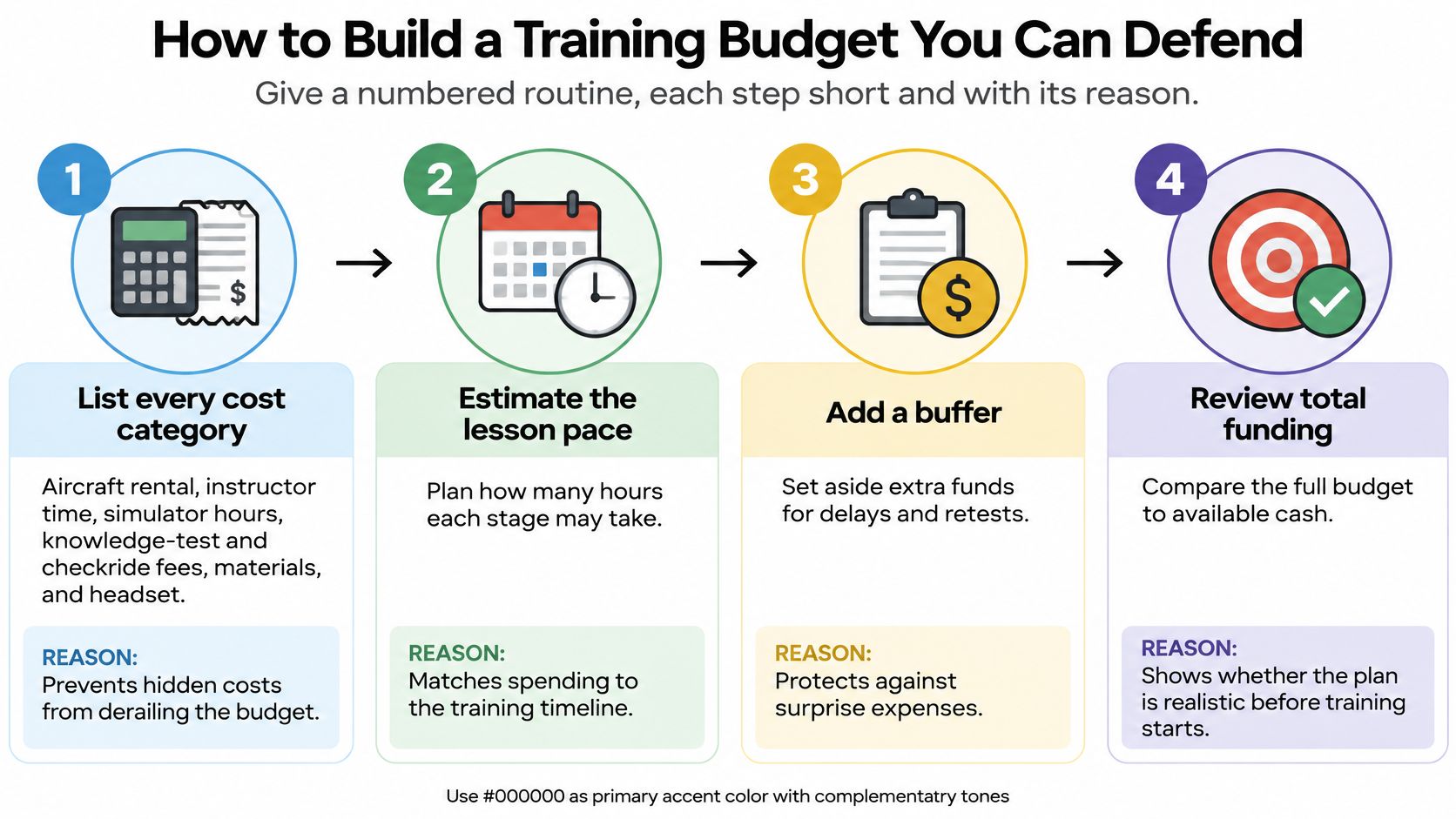
Use this visual routine to organize the calculation.
Build the cost sheet
List every cost category. Separate aircraft rental, instructor time, simulator use, knowledge tests, checkrides, materials, headset, medical certification, housing, financing interest and remedial lessons. Record who charges each item so you don't accidentally omit an examiner's bill or count an included expense twice.
Model the floor, expected case and remediation case. Use the scenarios below rather than a single advertised completion allowance. Ask the instructor to estimate additional training from your actual progress once lessons begin.
Read the fixed-price exclusions. Check aircraft damage deductibles, repeat checkrides, extra ground instruction, examiner fees, written-test fees, housing and financing charges. Mark each item included, excluded or unresolved, and resolve the last category before signing.
Compare effective hourly cost carefully. Divide tuition by the included aircraft, simulator and instructional hours, then account for excluded mandatory expenses. Keep those hour categories visible and don't double-count instruction delivered during a flight; the blended figure is a comparison aid, not a claim that every hour has equal value.
Add the financing overlay. Obtain the lender's estimate of interest during training and deferral, including when unpaid interest becomes principal. Put that amount beside tuition rather than treating it as a distant repayment problem.
Reserve the remediation amount. Price the additional lessons, living costs and retests in your downside case, and keep that reserve accessible. Reforecast when repeated lessons or scheduling gaps show that your original pace no longer fits.
Three budget scenarios and when to reforecast
| Scenario | Hours assumed | What to include | Reforecast trigger |
|---|---|---|---|
| Regulatory floor | 40 hours under the private-pilot rule cited above | Lower bound only, not a budget | Never budget on this alone |
| Expected | 50 to 70 hours, the AOPA benchmark cited above | Full cost list from step 1 | Review after each stage |
| Remediation | Expected hours plus remediation hours set from your own progress | Repeat lessons, weather gaps, repeat checkride fees, extra housing | Repeated lessons on one maneuver or a multi-week gap |
| Financing overlay | Any scenario | Interest during training and deferral | Payments begin before expected income |
Carry a funding requirement, not just tuition
Your working figure is expected training costs + excluded mandatory costs + living costs + borrowing costs + remediation reserve − committed cash and confirmed awards. Keep unawarded scholarships and hoped-for earnings outside the committed-funds column.
When reading flight-school reviews, look for specific descriptions of scheduling, billing and instructor continuity. General praise won't tell you whether the operating conditions support your budget.
Practical rule: Budget for the training you're likely to complete, not merely the hours printed in the syllabus.
Compare Funding Sources and Test the Loan
Pilot training funding sources compared
| Option | Best fit | Main trade-off | Check before signing |
|---|---|---|---|
| Savings and family support | Students with funds or relatives willing to help | Money is tied up; informal support can change | Written repayment expectations |
| Federal student aid | Students at schools that qualify | Flight-instructor-based schools generally do not qualify for federal aid, as described in GAO's review of flight-training financing | School eligibility and aid limits |
| VA education benefits | Veterans | Generally unavailable at flight-instructor-based schools, as described in GAO's review of flight-training financing | Approval for the specific training |
| Private aviation loan | Students whose school is not federally eligible | Interest may accrue during deferral; rates differ | Total repayment and fees |
| Personal loan | Students with strong credit and a small gap | Credit-based pricing; no aviation-specific terms | Rate type and prepayment terms |
| Credit card | Small, short-term costs only | Carrying balances can be expensive | Promotional rate end date |
| Scholarship or grant | Students who can apply early | Competitive; awards may be partial | Renewal rules and deadlines |
| Employer or airline sponsorship | Students committed to one employer | Service obligations and possible repayment if you leave | Clawback terms and timeline |
| School deferred-payment plan | Students who want one provider | Interest and fees may apply during deferral | Refund rules if you stop early |
School eligibility comes before rate shopping
GAO's review of flight-training financing describes limited access to federal financial aid and VA benefits at flight-instructor-based schools, as well as changes in private lending availability. Confirm the school's eligibility and the specific program's approval before counting on an education benefit to cover tuition.
A school's acceptance of private loans does not establish federal aid eligibility. Approval for one course may not cover every certificate you plan to earn. Ask the financial-aid or benefits administrator to identify the approved training and explain how payments reach the school.
For private borrowing, confirm whether the lender finances your selected school, pays by training stage, and allows unused funds to be cancelled. A competitive rate offers little help if the disbursement schedule requires you to borrow earlier than necessary.
Use nondebt funds first, then finance the gap
Rank funding by cost, certainty and flexibility. Start with savings and family support while preserving emergency cash. If relatives expect repayment, put the amount, timing and consequences of stopping training in writing.
Apply for scholarships and grants early, but subtract only confirmed awards from your borrowing requirement. If an award reimburses completed training, you still need enough cash to cover expenses until reimbursement.
Then compare reliable loans for the remaining gap. Include eligible federal aid where available, and compare private aviation loans with personal loans on fees, repayment duration and borrower protections. Avoid borrowing for a longer career path than you can fund without interrupting training.
Treat a school's deferred-payment plan like outside credit. Identify the creditor, interest rate, late fees, withdrawal consequences and collection terms. Deferral postpones principal; interest may still accrue from the first disbursement.
Credit cards are a poor substitute for committed training funding when repayment depends on future employment. Use one only for expenses you can pay from money already available.
Read the terms behind the payment
A published career-training example discussed by RatesChaser uses a 9.38% fixed APR and a 12-month delay before principal-and-interest payments, with total repayment materially above the original balance. Treat it as an illustration, not a current offer or a rate every applicant can obtain.
Ask when interest begins, whether it accrues on each disbursement, whether you can pay it during training and when it capitalizes. Compare fixed and variable rates, origination charges, prepayment terms, cosigner obligations and hardship provisions. A smaller scheduled payment may reflect a longer repayment period, not cheaper borrowing. Request the total scheduled repayment in writing.
If credit is a concern, review financing options for flight school with bad credit before submitting applications. A cosigner remains responsible for the debt if you cannot pay, and approval alone does not show whether the payment fits your income.
Make the loan survive a delay
Run this test against the lender's actual documents:
Write the graduation balance. Include disbursed principal, financed fees and interest expected to accrue during training and deferral. Use the projected balance, not the original tuition amount.
Obtain the monthly payment. Use the lender's amortization schedule and payment-start date. For variable-rate borrowing, request a higher-rate illustration as well.
Calculate the income required. Add loan payments to essential living expenses, taxes, other debt payments and a reserve. Compare that figure with conservative take-home earnings, not an advertised instructor rate multiplied by every available work hour.
Add a hypothetical six-month delay. Include continued housing, transport, additional training and interest under the loan's actual terms. Test a period with no instructing income rather than assuming work starts immediately after certification.
Set an exit point. Choose a date or remaining-cash threshold at which you will pause, work or reduce borrowing. Decide on that boundary before financial pressure makes it harder to act.
A loan fits your cash flow only when you can make payments from income available when repayment starts. Compare the required monthly income with realistic early-career take-home pay, then ask each lender: What is my total repayment if training takes twelve months longer than planned? Treat the answer as a scenario to price, not a prediction to dismiss.
Cutting the Loan With Paid Hours and Sponsorships
Under 14 CFR § 61.159, the standard airplane ATP pathway generally requires 1,500 total hours, including 500 cross-country, 100 night and 50 in the airplane class sought. It also requires 250 hours in an airplane as pilot in command, qualifying supervised pilot-in-command duties as second in command, or a permitted combination; up to 25 qualifying full-flight-simulator hours may count when completed through an approved Part 121, 135, 141 or 142 course.
An accelerated certificate program doesn't by itself make a graduate airline-eligible. Applicants must satisfy the applicable experience requirements or qualify under a restricted-ATP pathway.
For comparison, the airplane single-engine commercial certificate under 14 CFR § 61.129 generally requires 250 total flight hours, along with specified experience and training. Reaching the total doesn't satisfy every commercial-certificate condition.
Paid instructing reduces one cost, not every risk
The Bureau of Labor Statistics' pilot career guide identifies flight instructing as a way to gain experience. Financially, the attraction is earning while building time rather than personally renting an aircraft for all the additional experience.
Before relying on an instructing arrangement, verify:
- Guaranteed hours: Distinguish a contractual commitment from an estimate of student demand.
- Pay schedule: Identify what's paid, when it's paid and whether ground instruction is compensated.
- Aircraft availability: Ask whether maintenance or competing bookings could limit billable work.
- Preparation and cancellations: Establish whether either counts toward an advertised guarantee and whether either is paid.
Build the income forecast from likely paid hours, not total time spent at the airport. Allow for preparation, administration and gaps between students.
Match outside funding to its conditions
Scholarships reduce borrowing without requiring an employment commitment, but application timing and award conditions matter. Use a commercial pilot training scholarship guide to organize opportunities, deadlines and required documents, then plan for a partial award rather than assuming full funding.
Employer and airline sponsorships need a different review. Read the service obligation, repayment owed if you leave early, medical or training contingencies, and exactly what employment the contract guarantees. An interview opportunity isn't a job offer.
A sponsorship is cheap only if its obligations fit your timeline. Compare the debt it removes with the flexibility you surrender.
Confirm the Funding Plan Before Your First Lesson
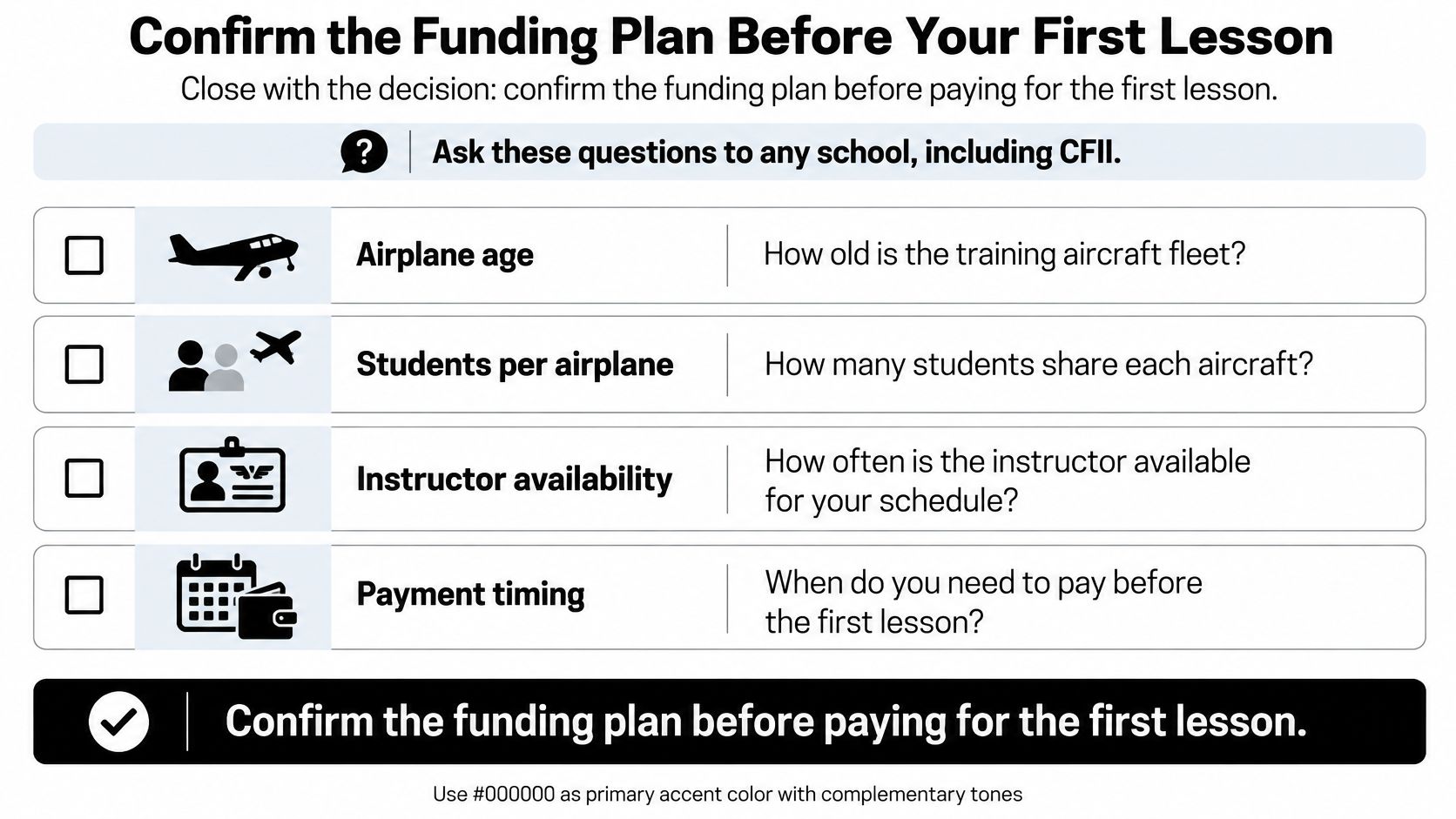
Take a written checklist to the school before paying for training. We recommend asking every flight school, including CFII, about airplane age, students per airplane, instructor turnover, total price in writing, Part 61 versus Part 141, and whether you can fly before committing.
Use these questions during the visit, not just in an admissions email.
Get operational and financial answers together
Ask how many usable aircraft support your training stage and whether instructor availability matches your schedule. Aircraft age is useful context, but availability, maintenance scheduling and consistent access determine whether you can maintain the planned pace.
Have the school explain these contract terms before you authorize payment:
- Total price and scope: Identify the certificates, ratings, hours and instruction included.
- Attendance charges: Read cancellation, tardiness and preparation policies.
- Pause and refund rules: Establish what happens to unused funds if you stop or cannot continue.
- Credit obligations: Confirm whether withdrawing from training changes the debt or merely stops future disbursements.
Veterans should separately confirm benefit eligibility for the actual course. Our guide to flight schools that accept the GI Bill can help organize that review, but the approval and payment details need to match your own enrollment.
Release money against demonstrated progress
Where the contract permits, pay stage by stage. Release the next tranche after the previous stage is complete and you've reviewed first-attempt knowledge-test performance, stage-check results and actual spending.
Keep a simple progress record: scheduled lessons, completed lessons, cancellations, training hours and time waiting for a checkride. If actual performance doesn't support the projected finish date, revise the funding schedule before authorizing more borrowing.
This isn't a reason to interrupt productive training unnecessarily. It's a way to avoid funding later stages against a pace you haven't yet demonstrated.
The following video is available for prospective students considering their next step.
Choose a commitment that fits your readiness
For readers ready for a complete pathway, our Career Track has fixed $89,000 tuition, taking students from zero time to CFII and multi-engine in about nine months, with 282 total hours and six certificates and ratings. We're based in Southern California at Riverside, Long Beach and Corona. Treat the published tuition as the training component of your personal funding plan, then test the surrounding cash-flow requirements.
If you haven't flown, start with a discovery flight, a first flight with an instructor before committing. That's a lower-commitment way to evaluate the activity you're considering financing.
Put your completed budget beside the lender's repayment schedule. Don't sign until the delayed-completion scenario still fits the income you can reasonably support, without relying on an immediate airline job.
CFII offers a fixed-tuition career pathway and discovery flights for people deciding whether professional pilot training fits their goals. Visit CFII to explore the appropriate starting point and bring your budget, funding gap and loan questions before committing.
Planning to fly for a living?
See what the path from zero to a pilot career looks like, what it costs and how long it takes.
Learn to fly in Riverside
We train at Riverside Municipal Airport in modern airplanes with a parachute built in. Start with a one hour discovery flight, no experience needed.