
On this page
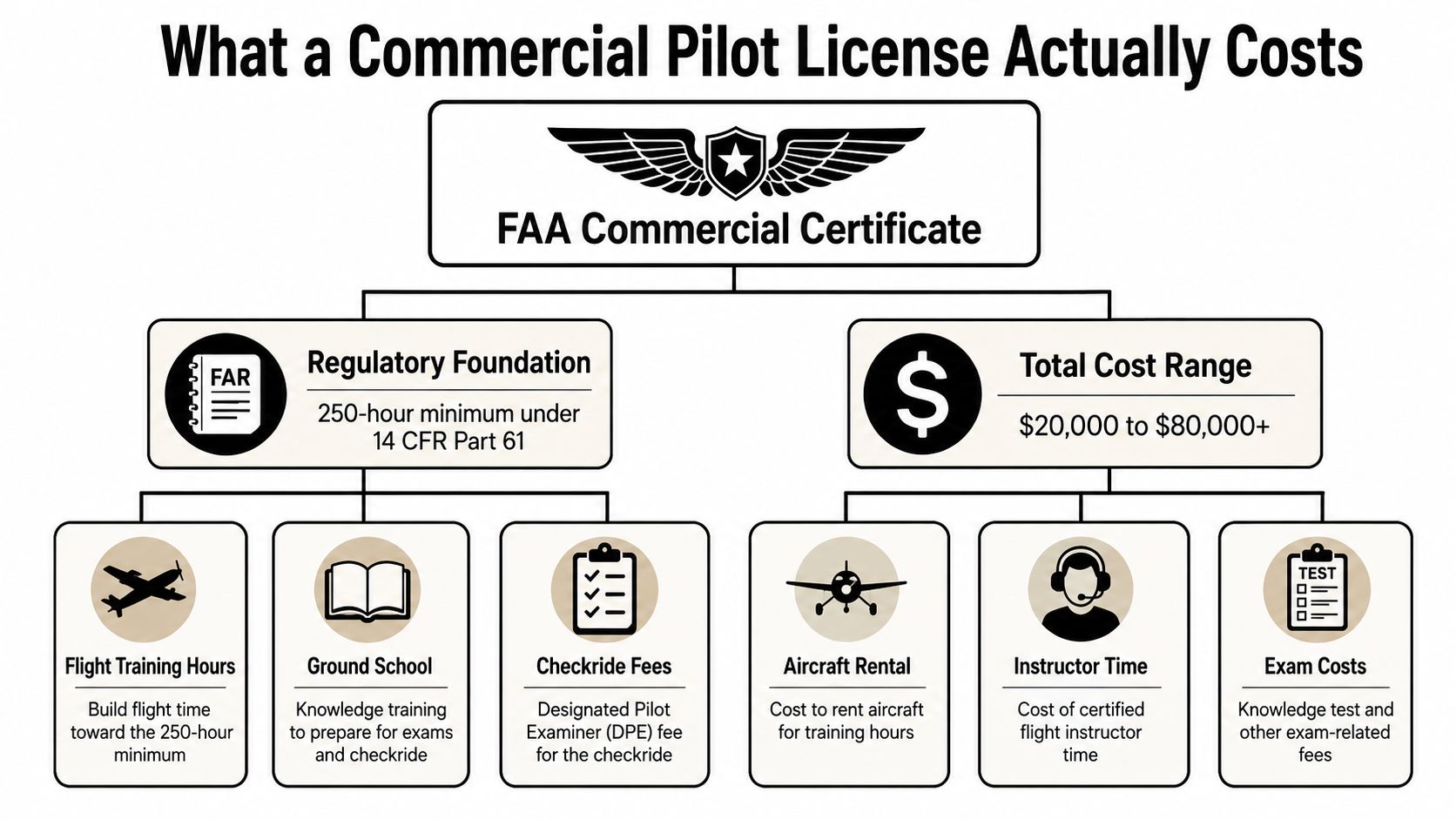
The FAA requires at least 250 total flight hours for an airplane single-engine commercial certificate under 14 CFR 61.129. A published zero-time program such as CFII's $89,000 Career Track includes 282 total hours, already above that minimum, while airline hiring commonly calls for 1,000 to 1,500 hours or more.
That gap is the part many price comparisons miss. The commercial certificate is a milestone, not an airline-ready finish line, and the cost depends on what you're buying, how reliably you can train, and how much time you'll spend getting to the next career step. Judge a program by cost per completed certificate and month of career delay, not tuition alone.
What a Commercial Pilot License Costs
$89,000. That is the tuition CFII's Career Track lists for a zero-time pathway of about nine months, covering 282 total hours and six certificates and ratings through instructor and multi-engine training. Use it as a reference point. The package reaches well past the commercial certificate, so it answers a bigger question than what a CPL alone costs.
The FAA's 250-hour minimum under 14 CFR 61.129 sets what a single-engine applicant must log: total time, pilot-in-command, cross-country, and dual instruction. It says nothing about what an airplane, an instructor, or a checkride costs. Those are market prices, and they move.
The certificate is one milestone on a longer budget line. The FAA's general airplane-category ATP requirement is 1,500 total pilot hours under 14 CFR 61.159, subject to exceptions and restricted pathways. A student starting from zero is funding two related projects: earning the commercial certificate, then logging the experience the hiring market expects. Price the first. Plan for the second.
A fixed-price program and an hourly school are rarely comparable products. The Career Track figure above buys a defined scope that ends past the commercial certificate. A pay-as-you-go quote usually covers a narrower scope, and its final total depends on hours flown and what the hourly rate includes. The same logic applies in reverse: a cheaper program that stretches your timeline can cost more per month of career delay than a pricier one that finishes on schedule.
Practical rule: Compare the same endpoint, the same training scope, and the same included expenses. A certificate-only quote shouldn't be lined up against a zero-to-instructor package as if they're identical products.
Build your estimate around what you need to complete, then allow for the costs a headline often leaves out. For a zero-time student, an honest CPL number accounts for private and instrument training on the way, plus medical costs, knowledge tests, practical-test preparation, and checkride fees. Total each path to the same endpoint and divide by the months it takes to get there. That is the comparison worth paying for.
The Line Items That Make Up a CPL Budget
A training quote becomes useful only when you can see what it pays for. Aircraft rental and instructor time typically make up the core of the bill because flight-hour requirements turn directly into billed time. Ask whether each quoted lesson includes both the airplane and the instructor, and whether the plan spells out how many hours are assumed for each stage.
The aircraft mix matters, too. Training in a glass-cockpit single isn't the same line item as training in a complex airplane. The commercial rules call for specified training in a complex, turbine-powered, or qualifying technically advanced airplane, or an approved combination. Instrument training also takes time and resources, so don't assume a single headline hourly price captures the whole path.
Ask for a complete itemization
| Budget item | What to confirm |
|---|---|
| Aircraft rental | Which aircraft types are included, and how is time billed? |
| Instructor time | Are ground briefings and flight instruction billed separately? |
| Simulator use | Is simulator time included, and which training tasks does it cover? |
| Medical and exams | Are medical, knowledge-test, and practical-test expenses included or separate? |
| Study materials | Are books, online resources, and test preparation part of tuition? |
| Retests and extra lessons | What happens financially if you need additional practice or another test attempt? |
The FAA's requirements also include specific cross-country, daytime, nighttime, and instructor-preparation elements. A quote that lists only aircraft hours can leave out the time needed to meet those requirements and prepare for the practical test. For a broader view of how flight-training expenses accumulate, use this flight training cost breakdown as a checklist, then ask each school to identify what its own price covers.
Don't let a low hourly rate distract you from the total. A lower rate may come with limited aircraft availability, while a higher-priced package may include instruction or materials that another quote bills separately. Build the budget from the regulation up, then add program overhead, not the other way around.
Fixed-Price Programs vs Pay-As-You-Go Training
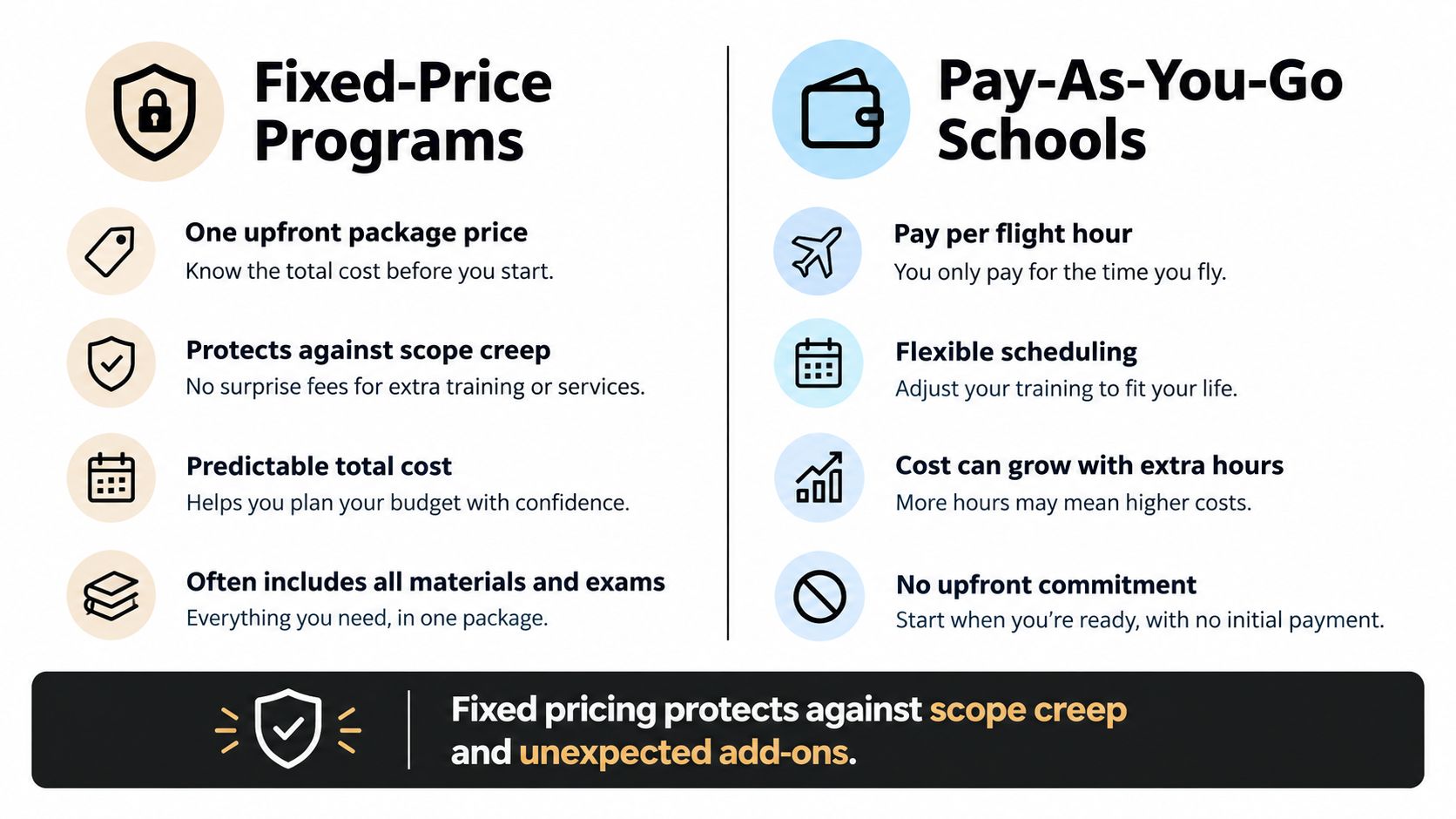
Fixed pricing buys predictability only when the syllabus and exclusions are clear. Pay-as-you-go gives you flexibility, but it transfers more of the schedule and extra-hour risk to you. Neither model is automatically cheaper; your training pace, aircraft access, and tolerance for cost changes decide which one fits.
| Fixed-price training | Pay-as-you-go training |
|---|---|
| Defined package: You know the stated tuition for a specified program scope. | Hourly billing: You pay as lessons and other billable services occur. |
| Scope matters: Confirm the certificates, hours, materials, exams, and exclusions in writing. | Flexibility: You can schedule and pay in stages, but the total depends on the hours and fees you incur. |
| Delay exposure remains: A fixed tuition doesn't necessarily cover housing, missed work, or every retest. | Delays can add cost: Rebooking, proficiency flights, and time away from work can stretch the budget. |
CFII's Career Track is a concrete fixed-price example: $89,000 in tuition, about nine months from zero time to CFII and multi-engine training, 282 total hours consisting of 204 single-engine hours, 25 multi-engine hours, and 53 simulator hours, and six certificates and ratings. The program is based in Southern California, with training in the Riverside, Long Beach, and Corona area. Those figures describe its program scope; they don't mean every personal or testing expense is included. Get the full written list of inclusions and exclusions before comparing it with an hourly plan.
The trade-off is straightforward. A disciplined student with reliable local access to an aircraft and instructor may value paying as training happens. A student who needs a structured schedule may prefer a defined package, provided the program explains what happens when weather, maintenance, or a failed test changes the timeline.
A package price is a useful budget only if you can tell what happens when the plan doesn't go perfectly.
The right question isn't which model is cheaper in theory. Ask which one matches your timeline risk tolerance and access to a consistent aircraft and examiner pipeline. This guide to flight training courses can help you frame questions about program structure before you sign.
Here's a visual comparison of the two payment models:
The Hidden Cost Most CPL Budgets Miss
A schedule delay is a cost, even when it doesn't appear on a tuition invoice. A 2025 study reported an average five-week checkride wait and found that 91% of responding flight schools considered examiner availability a problem (study of checkride access and examiner availability). If a practical test slips, you may need additional proficiency flights, pay to rebook an aircraft or instructor, extend housing, or carry loan costs for longer.
More examiners don't necessarily eliminate the bottleneck. The same study reports that active U.S. designated pilot examiners rose to 1,122 in fiscal year 2024–2025, completing 153,967 practical tests, up from 129,000 the prior year. Testing remained concentrated among high-volume examiners, so the number of examiners nationwide doesn't tell you how quickly a particular training base can get you a test date.
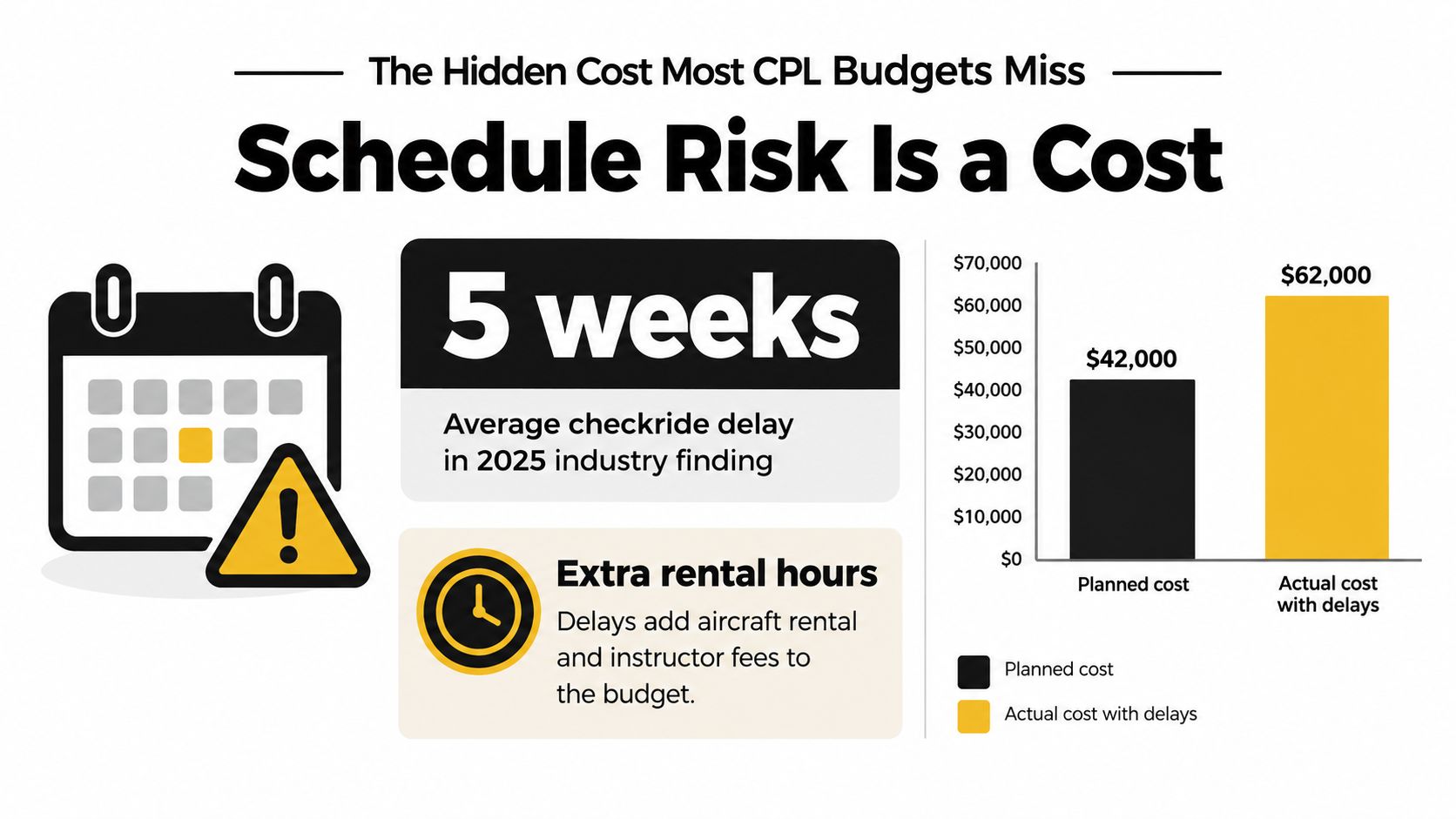
The image's headline makes a specific dollar claim that isn't supported by the available data, so don't use it as a budget estimate. The study gives you a reason to ask about delay exposure, not a universal figure for what waiting will cost you.
Before you enroll, ask the school to state its assumptions for:
- Completion time: What schedule does the quoted price assume?
- Retests: Which rebooking, examiner, or extra-training costs fall to you?
- Examiner access: How are practical tests coordinated, and what happens if availability changes?
- Weather and maintenance: What are the rescheduling policies when flying can't proceed?
- Housing and financing: Which costs continue if your training takes longer than expected?
A fair comparison measures total cost per completed certificate and month of career delay, not tuition alone. If a school can't explain its timeline assumptions and retest policy, you don't have enough information to assess its price.
How Geography Changes the CPL Number
The same license can come with a different bill depending on where you train. In the United States, local aircraft rental rates and instructor availability shape hourly costs, while weather downtime and housing affect how many months you're paying to stay near a training base. The local examiner pipeline matters as well: a school's ability to coordinate a practical test can affect whether you keep moving or need extra flights to stay sharp.
The United Kingdom illustrates why international prices can be misleading. The UK Civil Aviation Authority specifies at least 150 hours of flying training on one commercial pilot licence route, including 80 hours of dual instruction and 70 hours as pilot in command. Applicants must have at least 200 hours of flight time before the skills test. A separate route involving an instrument rating requires at least 195 hours of flying training, plus 750 hours of theoretical knowledge training and at least 25 hours of multi-crew cooperation training. The CAA lists an initial issue fee of £341 (UK CAA commercial pilot licence guidance).
That administrative fee is only one small piece of the overall expense. Aircraft rental, instructor time, examinations, and theoretical training make the true total, and the requirements differ by route. A foreign sticker price may look lower or higher because it includes a different syllabus, a different number of training hours, or a different examiner system. Compare what the student receives and must complete, not just the number printed on a brochure.
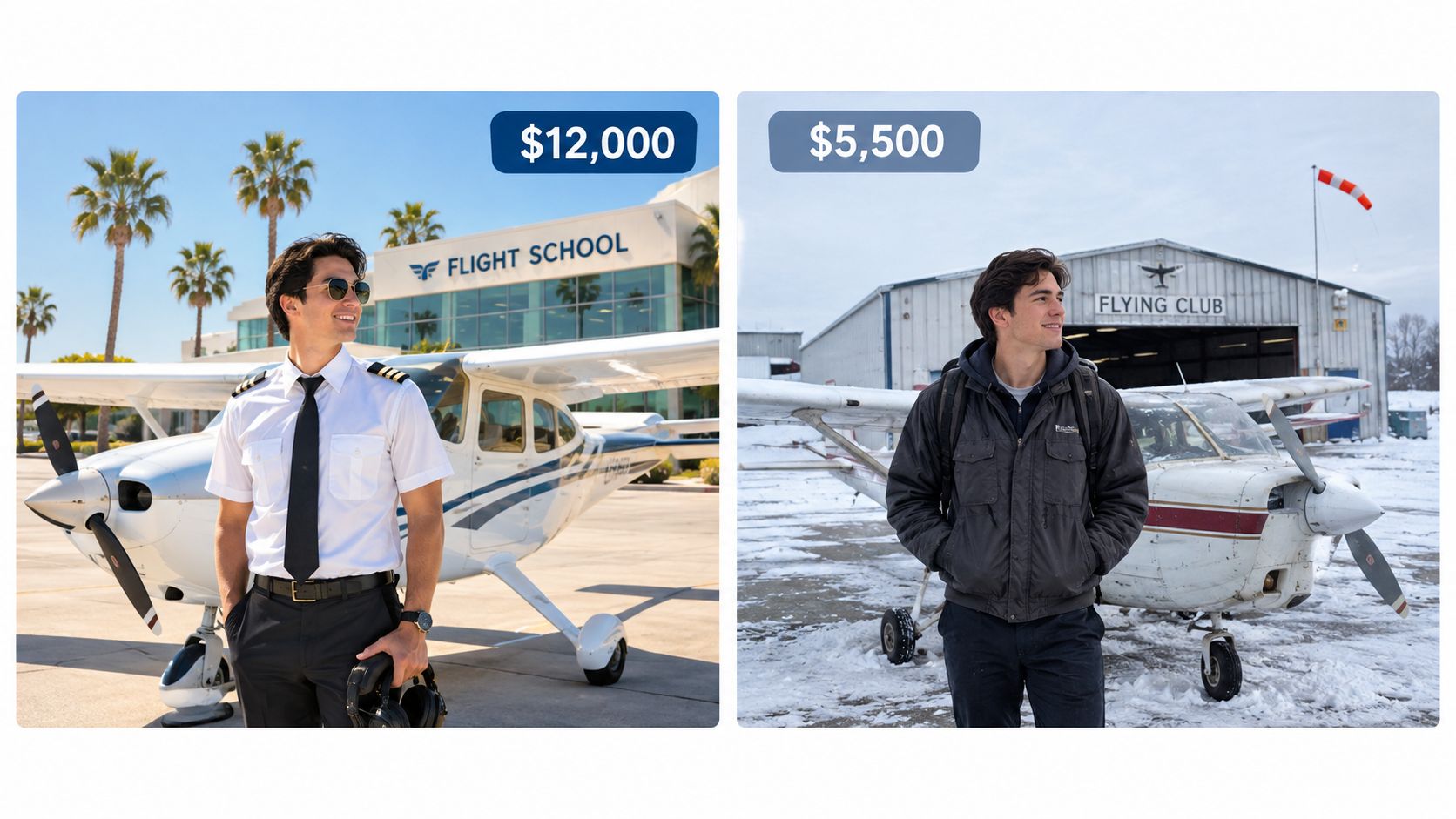
For a U.S. student choosing a region, use a practical checklist:
- Weather reliability: Can you fly regularly through the year?
- Airspace complexity: Will the environment build useful experience for your goals?
- Housing supply: Can you live near the airport without stretching your finances?
- Year-round access: Do aircraft and instructors remain available through seasonal disruptions?
If you're considering Southern California, this overview of flight schools in California offers a starting point for thinking about location. Compare the local schedule and living costs with the training plan, not just the hourly aircraft rate.
From CPL to Airline Eligibility
Treat the commercial certificate as a checkpoint, not a finish line. It lets you fly for compensation or hire, but airline eligibility requires the ATP certificate, which carries the FAA's general 1,500-hour total-time requirement for the airplane category under 14 CFR 61.159, along with 500 hours of cross-country time and 100 hours of night flight. Restricted-ATP pathways and exceptions apply in some cases, so confirm which rules fit your situation before you budget around a number.
Once you hold a CPL, the expense is the gap between your logged hours and airline eligibility. Every month in that gap costs money, whether you are paying for flight time or earning while you build it. Flight instructing is the most common solution because a qualified instructor logs pilot time while teaching. Instructor work depends on student demand, aircraft availability, and local hiring, so verify that a school has instructing positions instead of assuming one appears after your checkride.
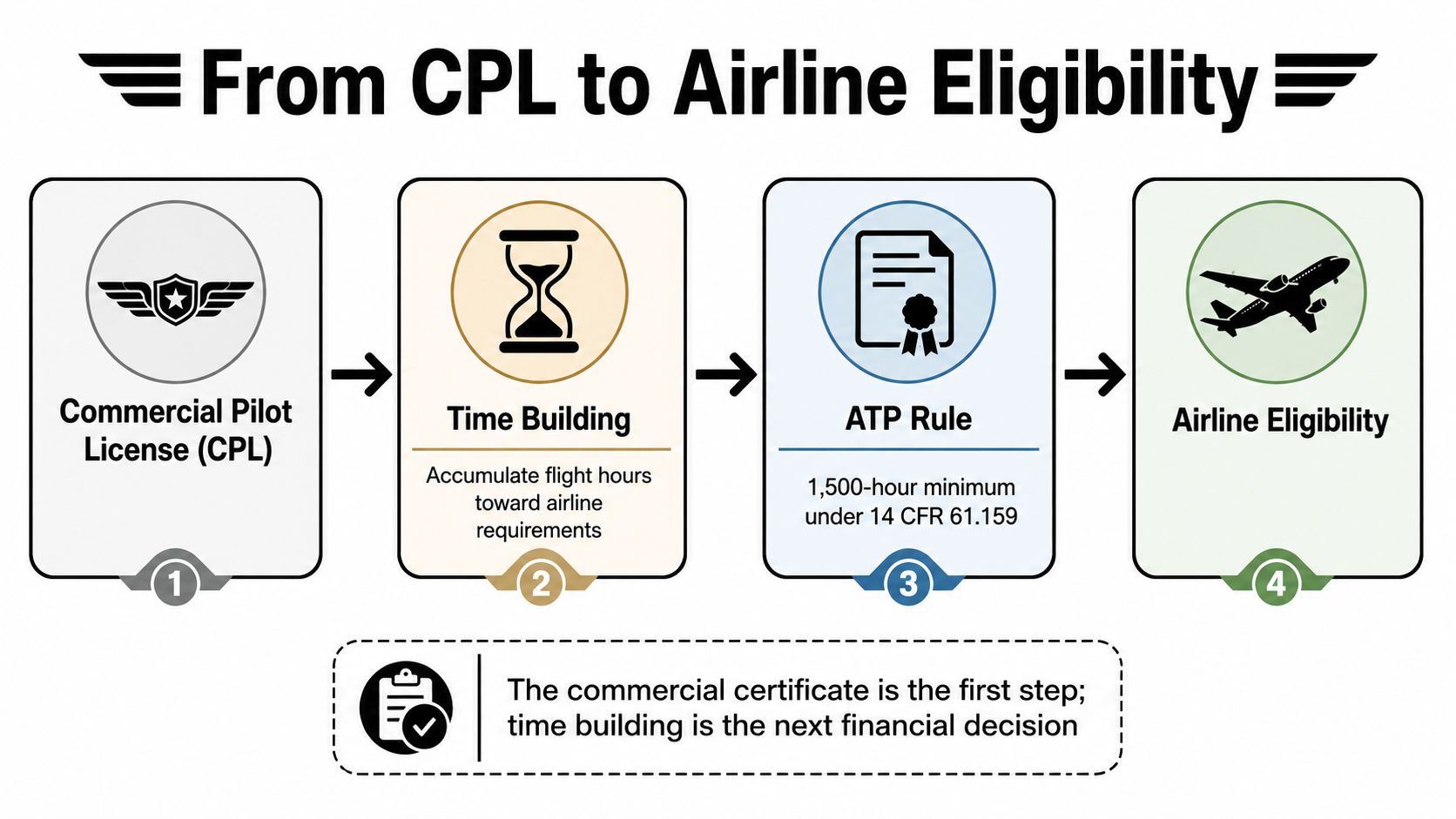
Here is the question I push students to ask any training provider: what will I hold at completion, and what will I still need? A CPL-only course and a program that also prepares you to instruct are different products. The second can cost more at sticker price and less per month of actual progress toward an airline job.
Price the gap. Map the full steps toward becoming a pilot and keep training costs separate from time-building costs, because a cheaper CPL that leaves you with no route to hours costs more in the end than a pricier program with instructing work attached.
Financing the CPL Without Surprises
Borrowed money makes payments manageable. It does not make training cheaper. Judge any financing offer against your months to a completed certificate rather than the sticker price, because a loan sized to the advertised timeline runs short the moment weather, maintenance, or a retest stretches the schedule. Before you accept a loan or sign an enrollment agreement, work out how long you will need to cover living costs and what repayment looks like if training runs long. Aviation-focused lenders may offer deferred-payment arrangements, so read the terms closely and confirm exactly when repayment begins.
Housing deserves the same scrutiny as tuition. Living near the airport makes a demanding schedule easier to keep, and relocating adds rent, food, and travel on top of your training bill. Ask whether housing is available, what it costs, and whether the arrangement holds if training runs late. Never count a housing option as included in tuition unless the agreement says so.
Run this checklist on any program before you commit:
- Included costs: Get a written list of the aircraft, instruction, materials, tests, and fees covered by tuition.
- Retest policy: Confirm what you pay for another practical test or extra preparation.
- Examiner fees: Find out whether they are included or billed separately.
- Aircraft access: Ask how the school handles maintenance, availability, and rescheduling.
- Refund terms: Read the cancellation and refund rules before paying anything.
- Prepayment terms: Check whether early loan repayment carries a fee.
- Timeline assumptions: Ask what the advertised schedule assumes about attendance, weather, and test availability.
For more questions to ask about paying for training, use this flight school financing guide. If you have not flown yet, book a discovery flight before you sign anything.
CFII offers a fixed-price Career Track from zero time to CFII and multi-engine training, with $89,000 tuition, about nine months of training, and 282 total hours in Southern California. Review the CFII Career Track and visit CFII to decide whether its scope and timeline fit your career plan.
Planning to fly for a living?
See what the path from zero to a pilot career looks like, what it costs and how long it takes.
Learn to fly in Riverside
We train at Riverside Municipal Airport in factory-new airplanes with a parachute built in. Start with a one hour discovery flight, no experience needed.