

On this page
- CFI Training Cost at a Glance
- What Each Line Really Buys
- The Metric That Protects Your Budget
- FAA Hour Floors from Private to CFII
- The Private and Commercial Rungs
- The Instructor Rungs
- Why the Same Ratings Cost More in Some Cities
- Local Costs You Can't Negotiate Away
- The Scheduling Ceiling Nobody Can Waive
- All-In Cost When the Timeline Slips
- Three Pictures of the Same Training
- One Fixed-Price Example, With Only Its Stated Facts
- What Instructor Pay Can and Cannot Offset
- The 1,500-Hour Gap Comes First
- What Instructing Changes, and What It Doesn't Promise
- Price the Path Before You Commit
- If You've Never Flown
- If You Want the Full Zero-to-CFII Path
There's no single FAA fee for CFI training cost, because the bill stacks private, instrument, commercial, CFI, and CFII hours, instruction, tests, and extras. The one verified fixed path in this article is the CFII Career Track at $89,000 from zero time to CFII and multi-engine.
That surprises most beginners. They expect a license fee, like paying for a driver's test, and instead find a chain of certificates where each step buys the right to start the next one. You don't pay for a CFI certificate in isolation if you're starting with little or no flight time. You pay to become a private pilot, then an instrument-rated pilot, then a commercial pilot, and only then an instructor who can teach others.
The useful question isn't "what's the hourly airplane rate?" It's "what's the all-in cost per certificate and per completed logged hour?" A cheap hourly rate can still produce an expensive finish if you need repeat lessons, pay separately for ground briefing, or sit out weather for weeks. A higher fixed price can cost less in the end if it covers more hours and the same certificates.
Read every quote that way. Count certificates, count hours that count, and ask what's left outside the number.
CFI Training Cost at a Glance
CFI training cost is a stack of line items, not one license fee and not the advertised airplane hourly rate. The airplane is only the part you can see from the ramp. You also pay the instructor in the right seat, the instructor on the ground before and after the flight, the testing system, and the extra time it takes to get good enough to pass.
Read the table top to bottom and use it as a worksheet. Fill each price from a current written quote, because no national rate card sets these lines for you.
| Cost line | What drives it |
|---|---|
| Airplane rental, dual and solo | Aircraft type, local fleet, fuel |
| Instructor time in flight | Local instructor rate, hours needed |
| Brief and debrief time | Instructor bills ground time |
| Simulator time | Credit and share included in package |
| Knowledge test fees | One per rating |
| Examiner fee per practical test | One per checkride |
| Books and supplies | Materials list |
| Remedial hours above minimum | Aptitude, weather, gaps between lessons |
What Each Line Really Buys
Airplane time covers dual flight with an instructor and solo flight on your own. The clock usually runs on engine time, so taxi, run-up, and waiting in line can cost money before you practice a single maneuver. That's why the same lesson plan costs more in a newer airplane or at a busy airport.
Instructor time doesn't stop when the propeller stops. According to AOPA guidance on pilot license cost, instructors may bill briefing and debriefing time, not just time airborne, and the bill typically combines airplane time, instructor time in flight and on the ground, examiner and checkride fees, written-test fees, materials, and any remedial training. A quote that only shows the airplane rate hides a large part of every lesson.
Simulator time needs a plain question. How much is in the package, and how much counts toward the rating you're earning? Simulator work can be excellent for instrument procedures, checklists, and repeating approaches without burning fuel. It isn't a one-for-one substitute for every required flight hour, so don't value it as if it were.
Tests repeat at every stage. Each rating brings a knowledge test, and each practical test, the checkride, brings an examiner fee. Those fees don't scale with the airplane rate. They arrive on schedule whether your training went smoothly or not, and a failed test can mean paying again after more training.
The Metric That Protects Your Budget
Use this math instead of comparing hourly ads:
Practical rule: Divide total program cost by hours you actually complete and log. That number, not the advertised aircraft rate, tells you what progress cost you.
Why does that matter? Because FAA minimums are floors, not finish lines. You'll see 40 hours for private, 250 hours for commercial, and 15 hours PIC for CFI and CFII eligibility in the next section. Passing is a proficiency standard. If you need more hours to reach it, the school still bills airplane and instructor time, unless a fixed-price contract says otherwise.
The same AOPA guidance names your main cost variables. They're aircraft type, geographic location, training frequency, weather, and individual aptitude. Notice that only one of those is about talent. The rest are about how often you fly, where you fly, and what you fly.
Training frequency is the variable you control most. Fly often and you relearn less. Leave long gaps and your instructor has to rebuild skills you already paid for once. That repetition is real money, even though it never appears as a separate line called "forgetting."
Before you compare two schools, check whether a fixed price explicitly includes:
- Stage checks: Internal progress checks before you move on or test
- Simulator credit: Hours included and how they count
- Checkride coordination: Who schedules the examiner and the airplane
- Examiner charges: Inside tuition or paid separately
- Written-test preparation: Ground school, practice tests, endorsements
- Additional-hours policy: Who pays when you go past the planned hours
Price the full path through CFII, not a private-pilot teaser rate. A low first-stage price can look gentle while the commercial and instructor stages, where the hours and tests pile up, stay unpriced. You're buying a sequence. Budget for the sequence.
FAA Hour Floors from Private to CFII
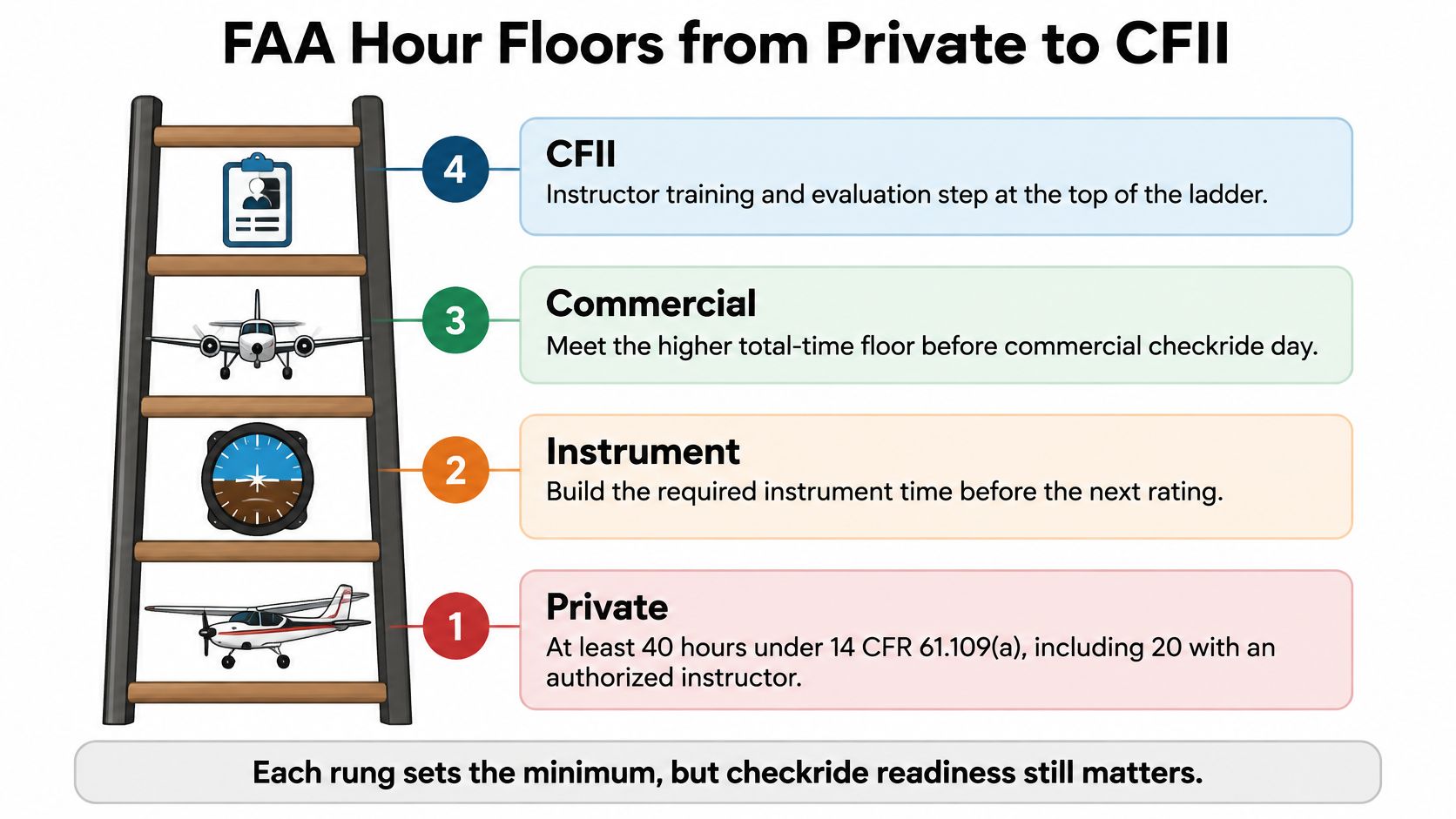
Think of the path as a ladder. Each rung has a minimum height set by regulation, but you still have to climb it cleanly on checkride day. Meeting the hour number makes you eligible to test. It doesn't make you ready to pass.
The Private and Commercial Rungs
The first rung is private pilot, airplane single-engine. Under 14 CFR § 61.109(a), the minimum is 40 total flight hours, including at least 20 hours of flight training with an authorized instructor and 10 hours of solo flight training, plus specified cross-country, night, and instrument-training tasks. The detailed breakdown includes 3 hours of cross-country, 3 hours at night, and 3 hours of instrument training. Those are required tasks, not optional add-ons a school can cut to make a quote cheaper.
You'll sometimes see a 35-hour minimum mentioned. That limited exception applies to graduates of an approved Part 142 private-pilot course. It generally doesn't apply to ordinary Part 61 training, which is how many students train. If a quote leans on 35 hours, ask which approval makes that legal for you.
Most applicants fly past 40 hours. That's not failure, and it isn't necessarily a school padding the bill. The practical test asks you to fly to a standard on one specific day, with an examiner watching. Extra dual and solo time to get consistent is where the private-stage budget usually grows.
The commercial rung is much higher. Under 14 CFR § 61.129(a), an airplane single-engine commercial applicant generally must log at least 250 hours of total flight time, including 100 hours in powered aircraft, 50 hours in airplanes, 100 hours as pilot in command, and 50 hours of cross-country flight, plus at least 10 hours of instrument training using a view-limiting device. That structure matters for cost because 250 hours isn't 250 identical paid lessons. The mix matters.
Ask how any career quote splits that time. How much is single-engine, how much multi-engine, how much simulator, how much solo or pilot-in-command, and how much cross-country? A total that looks complete can still leave a category short, and fixing a short category late is expensive flying.
The Instructor Rungs
CFI and CFII sit on top of commercial privileges. An airplane flight-instructor applicant must hold a commercial or ATP certificate, hold the relevant instrument privileges when the rating requires them, complete required instructor training and endorsements, and log at least 15 hours as pilot in command in the appropriate category and class. For the full eligibility picture before you price a program, read our guide to flight instructor requirements.
That changes what you're buying. Commercial training proves you can fly to a professional standard. Instructor training proves you can teach that standard, explain errors, and manage a lesson from the other seat. It's a different skill, tested separately, with its own knowledge test and practical test.
CFII is commercial privileges plus the skill of teaching them, including instrument teaching. It isn't a longer private course with a new label.
Each rating adds fees while the airplane rate may stay flat. New knowledge test, new practical test, new examiner, new preparation. When you compare programs, count those repeating test events across private, instrument, commercial, CFI, and CFII.
| Milestone | FAA floor | Rule | What it means for cost |
|---|---|---|---|
| Private pilot, airplane single-engine | At least 40 hours total, including 20 with an instructor and 10 solo | 14 CFR 61.109(a) | A floor, not a typical finish; extra dual and solo raise rental and instructor cost |
| Commercial pilot, airplane single-engine | At least 250 total hours | 14 CFR 61.129(a) | Total time, PIC, cross-country and instrument tasks must all be in the quote |
| Airplane CFI | Commercial or ATP, required training, at least 15 hours PIC in category and class | FAA instructor eligibility | A separate instructor course and practical test on top of commercial |
| Airplane CFII | Commercial or ATP with instrument privileges, plus at least 15 hours PIC | FAA instructor eligibility | Another knowledge test, practical test and specialized instructor training |
| Airline first officer | Generally 1,500 hours and an ATP certificate | First-officer qualification rule | Instructor training does not itself buy airline eligibility |
Use the table as a quote checker. If a school's price doesn't clearly account for a rung, a required task inside that rung, or the test at the top of it, you haven't seen the full price yet.
Why the Same Ratings Cost More in Some Cities
Two students can earn identical certificates and pay noticeably different totals. The FAA standard doesn't change by ZIP code. The operating conditions around that standard do.
Local Costs You Can't Negotiate Away
Aircraft rental follows the local fleet and fuel. A school maintaining newer airplanes in a high-cost metro area charges from a different cost base than a small field with older airplanes and cheaper hangar space. Neither fact alone tells you which training is better. It tells you why the hourly ads don't match.
Instructor rates follow local supply. Where experienced instructors are scarce, schools compete for them and students feel that in the rate. Where many new instructors are building time, rates can look lower, though availability and continuity still matter more than a small hourly gap.
Busy airspace burns paid time. Long taxi routes, departure queues, and transits to a practice area all run while you're paying for the airplane, and often the instructor too. A lesson can be well taught and still deliver fewer practice repetitions per paid hour if the airport eats the first and last part of every flight.
Weather works less obviously. A cancelled lesson costs nothing that day, which feels like savings. The bill arrives later.
A long weather gap doesn't pause your budget. It often restarts part of your learning, and you pay instructor and aircraft time to rebuild it.
That's why frequency protects you twice. You finish sooner, and you expose less of your training calendar to cancellations and skill decay. A part-time schedule stretched across bad-weather months can cost more per completed hour than full-time training at a higher posted rate.
The Scheduling Ceiling Nobody Can Waive
There's also a legal limit on how hard a school can push one instructor. Under 14 CFR § 61.195(a) in Part 61, a flight instructor may not conduct more than 8 hours of flight training in any consecutive 24-hour period. The instructor must also hold the appropriate aircraft category and class rating, with additional qualifications required for certain aircraft.
A school can't erase a bottleneck by stacking unlimited lessons on one person's calendar. If instructors are booked out, airplanes are in maintenance, or examiners have no openings, your pace slows regardless of what you prepaid. Those are separate constraints, and each one can stretch rent, interest, and time away from work.
So ask pace questions before price questions get comfortable:
- Attendance assumption: Does the quoted timeline require full-time training?
- Cancellation billing: What happens financially when weather or maintenance cancels you?
- Regulatory basis: Is this Part 61 training or an approved reduced-hour course?
- Real capacity: How do instructor, airplane, and examiner availability support the schedule?
Our breakdown of how to choose a flight school helps you turn those answers into a comparison. Compare pace and inclusions between like programs. Don't set a hometown hourly ad against a packaged career price and call the difference a verdict. They're different products until you normalize hours, certificates, tests, and calendar time.
All-In Cost When the Timeline Slips
Start with the scenarios, because your real risk isn't the brochure number. It's the version of training where something ordinary goes wrong, a stage check needs repeating, weather closes in, or a checkride doesn't pass the first time.
| Scenario | What moves the bill | What to verify in writing |
|---|---|---|
| On-time at the syllabus hours | Planned aircraft, instruction, and simulator only | Stage checks, written tests, examiner fees, and the extra-hour policy |
| About 10 percent more flight time | Repeat lessons, a weak stage check, or a failed checkride | Who pays hours above the package |
| Delayed finish | Extra months of rent and living expenses while other work is limited | Calendar assumptions and cancellation fees |
| Pay-as-you-go by the hour | Separate invoices for rental, brief and debrief, fuel, tests, and repeats | Aircraft rate, instructor rate, and every fee outside the Hobbs time |
| Fixed zero-to-CFII package | One tuition for several certificates and a stated hour total | Certificates, multi-engine, simulator share, and listed exclusions |
Three Pictures of the Same Training
On-time is the clean case. Syllabus hours are enough, stage checks go well, and the contract includes airplane, instructor, simulator, stage checks, written-test preparation, and checkride coordination. Even here, confirm examiner and knowledge-test fees. "Coordinated" and "included" aren't the same word.
About 10 percent more flight time is the honest middle case. One weak area needs extra lessons. A maneuver won't stabilize. A checkride ends early and you retrain before retesting. The airplane invoice grows, but the decisive question is contractual. Who pays for hours above the package, at what rate, and after what approval?
A delayed finish can hurt even when tuition doesn't move. Full-time training crowds out other work. Every extra month adds housing, food, transport, and possibly loan interest while income stays limited. It's important to note that AOPA flight training finance guidance separates private-pilot, instrument, and multiengine borrowing into different loan amounts, which shows how staged the financing can become when you buy the path piece by piece.
Pay-as-you-go training often looks cheapest at the first lesson. You control each payment and can stop anytime. Then the invoices accumulate one at a time. Briefings, fuel surcharges, retests, repeat lessons, and that extra flying after a long break. Control is real. Predictability is weaker.
A fixed package reverses that trade. You commit earlier, and in exchange the price should be steadier. It's cheaper only when the lower or fixed number buys the same certificates and the same hours. If multi-engine, simulator share, or test support sits outside, you're comparing different finish lines.
One Fixed-Price Example, With Only Its Stated Facts
Our CFII Career Track is a zero-experience career program with fixed $89,000 tuition, running about nine months from zero time to CFII and multi-engine, with 282 total hours and six certificates and ratings. It's based in Southern California at Riverside, Long Beach, and Corona, and that $89,000 price includes multi-engine. If you're weighing pace against a slower route, our overview of fast-track pilot training explains what full-time intensity demands from you.
Mark housing, food, and time away from a job as your own runway. Those living costs sit outside that tuition, and every career changer needs cash for them regardless of school. A fixed tuition can stabilize the training bill. It doesn't pay your rent.
Budget check: A lower published price is not cheaper if it excludes the items most likely to overrun.
That's the contrarian point worth keeping. Cheap quotes often exclude exactly the things that go wrong in real training, extra hours, retesting, and delay. Price the overrun before it happens.
What Instructor Pay Can and Cannot Offset
Instructor training looks expensive until you see the gap it helps you cross. It looks unrealistic if you assume it erases that gap by itself. Both mistakes start with skipping the airline experience rule.
The training desk is where tuition ends and time-building begins, so keep those two budgets separate.
The 1,500-Hour Gap Comes First
Following the Airline Safety and Federal Aviation Administration Extension Act of 2010, the FAA adopted the first-officer qualification rule in 2013, as described in the Senate statement on protecting the 1,500-hour rule. The rule generally requires pilots to hold an Airline Transport Pilot certificate supported by 1,500 hours of flight experience before serving as airline first officers.
Put that beside the commercial floor. You can hold a commercial certificate at 250 hours and still be far below airline expectations. The FAA notes airlines may require 1,000, 2,000, or more hours rather than accepting the commercial minimum. Legal to fly commercially is not the same as competitive for an airline seat.
Some restricted-privilege ATP pathways allow eligibility below 1,500 hours for qualifying graduates of authorized aviation degree programs, and that holder may serve as co-pilot until reaching 1,500 hours. That exception helps specific graduates. It doesn't turn a CFI or CFII certificate alone into airline eligibility, a distinction our airline pilot career guide keeps front and center.
What Instructing Changes, and What It Doesn't Promise
The economic reason pilots pay for instructor training is simple. After certification, instructing can turn flight time into paid experience instead of rented time. You're building hours toward that higher threshold while a student pays for the lesson. That's a genuine structural advantage over buying every hour yourself.
Watch this short overview before you model any income, because the day-to-day work and the paycheck don't always move together.
Be precise about the risk. A first instructing job can involve uneven student demand, weather days with no flying, unpaid onboarding, or relocating for the work. Logged hours are not the same as paid hours. You may log flight time while compensation is hourly, per lesson, or tied to student bookings, and ground duties may be treated differently.
Don't let senior airline pay do the math for your first instructor year. Those are different jobs at different experience levels, years apart. Instructor pay can offset part of your investment and fund your time-building. It cannot be quoted responsibly as a guaranteed salary, a guaranteed student load, or a guaranteed start date unless a specific agreement says so in writing.
Judge a program by three things together. Certificates earned, hours logged, and whether any paid instructing access is clearly spelled out. Tuition alone can't tell you how quickly you'll convert credentials into dependable income, and neither can a headline about airline salaries.
Price the Path Before You Commit
You don't need more price ads at this point. You need to know which of two people you are, someone who hasn't flown yet, or someone ready to price the full career path.
If You've Never Flown
Start smaller than a career contract. We offer discovery flights, a first flight with an instructor before committing to career tuition. The flight begins with a walk around the airplane with an instructor and a checklist card, so you see the preflight routine before you ever taxi. Book that first step through our discovery flight page and learn whether you like the airplane, the instruction style, and the workload.
That one flight won't tell you if you'll pass a CFII checkride. It will tell you whether the cockpit feels like a workplace you want. That's worth knowing before five figures move.
If You Want the Full Zero-to-CFII Path
Our Career Track program is fixed $89,000 tuition, about nine months, 282 total hours, and six certificates and ratings including multi-engine, in Riverside, Long Beach, and Corona. Treat those facts as the comparison baseline, then force every other quote onto the same certificates and hours. If financing is part of your decision and your credit history is thin, start with our guide to flight school financing with bad credit before you assume a loan fits.
We recommend asking every flight school, including us, these questions before money moves:
- Airplane age: What will you train in, day after day?
- Students per airplane: How hard is it to get on the schedule?
- Instructor turnover: Will you keep continuity or restart with new instructors?
- Total price in writing: What's included, excluded, and billed extra?
- Part 61 vs Part 141: Which framework governs your course and hour minimums?
- Fly before committing: Can you take a flight before signing a career program?
Then run your personal checklist. Do you have cash for living expenses during full-time training? Who pays for hours above the syllabus? Are examiner fees and written tests inside the number? Does the promised pace fit local weather and real instructor availability?
No school should ask you to skip those questions. Get the answers in writing, for the same certificates and the same hours, and the cheapest quote often identifies itself. Sometimes it isn't the lowest number on the page.
If you're pricing CFI training cost from zero time, CFII offers a Southern California path from your first discovery flight through the fixed-price Career Track to CFII and multi-engine. Visit us to walk the hangar, sit in a cockpit, and meet the instructors before you commit. Bring your questions about hours, inclusions, and total price in writing, and we'll answer them against the same certificates you're comparing everywhere else.
Planning to fly for a living?
See what the path from zero to a pilot career looks like, what it costs and how long it takes.
Learn to fly in Riverside
We train at Riverside Municipal Airport in modern airplanes with a parachute built in. Start with a one hour discovery flight, no experience needed.