

On this page
- Four Ab Initio Routes and What Each Trades Away
- What the Four Routes Are
- FAA Minimum Hours for Each Certificate
- The Certificates in the Order You Earn Them
- Why the Floor Isn't the Plan
- Why Airlines Ask for 1,500 Hours
- How a Restricted ATP Works
- How Long Zero-to-Airline Training Really Takes
- Run the Timeline Stress Test
- Comparing Fixed-Price and Pay-as-You-Go Costs
- How CFII's Career Track Compares Side by Side
- Where This Route Fits and Where It Doesn't
- Choose Your Route and Book Your First Flight
You've had the pilot shortage saved in your bookmarks for a while now, and you've started doing arithmetic on the back of an envelope. Two tabs are open. One is a flight school promising zero to airline in nine months for a price that looks like a mortgage. The other is a university program that mentions a degree and takes three times as long. Somewhere in your search history is an airline cadet scheme that sounded free until you read the small print.
Those three aren't the same product with different branding. They're different ways of splitting risk between you, a school and an airline, and that split matters far more than the headline schedule. Understanding ab initio pilot training means understanding who absorbs the cost when the plan meets reality.
Here's the pathway explained the way a flight instructor explains it across a desk: what the FAA requires, what the numbers mean, where the months go, and which questions expose a program that's selling a schedule it can't keep.
Four Ab Initio Routes and What Each Trades Away
Ab initio is Latin for "from the beginning." In aviation it means training that starts with someone who has never touched the controls and ends with the certificates and flight hours an airline expects. The same idea is often sold as zero to CFII, which names the destination more precisely: certificated flight instructor, then instrument instructor.
One school cannot train everyone who wants that path. A planning forecast from ICAO identified an annual requirement for about 52,506 new pilots against a training-capacity deficit of roughly 8,146 pilots per year. The industry therefore keeps more than one way in.
What the Four Routes Are
- Integrated ATP program. One school runs a single syllabus from the first lesson to airline-ready, with a published price and a planned finish. Because it owns the aircraft, the instructors, and the checkride bookings, it can hold a pace a self-directed student cannot. FAA-approved syllabi of the kind used at Part 141 flight schools add stage checks that surface problems between certificates rather than at the end.
- Degree-linked program. An aviation bachelor's or associate degree runs alongside flight training. It costs more and takes longer. In exchange, the degree can lower the hour threshold for an airline seat, provided the school is authorized for that pathway.
- Modular build-your-own. You buy each certificate separately, from whichever instructor or club has space, and pay by the hour. Nothing is fixed except your own persistence. The finish date moves whenever weather, aircraft, or your schedule slips.
- Airline-sponsored cadet program. The airline funds the training against a service commitment, with repayment owed if you leave early. These schemes are expanding. Airbus reported in 2025 that Sevenair was training 200 cadets and planned to increase its annual training capacity progressively.
Ab initio routes compared
| Route | How it is built | Who carries the risk | Main trade-off |
|---|---|---|---|
| Integrated ATP program | One syllabus from zero to ATP-ready | Mostly the student, but the price is set | Fixed cost, less flexibility in pace |
| Degree-linked program | Aviation degree combined with flight training | Student, with tuition plus flight costs | Longer timeline, but restricted ATP may open earlier |
| Modular build-your-own | Separate certificates bought one by one | Student, with hourly price exposure | Flexible pace, but total cost and finish date are unknown |
| Airline-sponsored cadet program | Airline-funded training under a service agreement | Shared, with the candidate bound by contract | Lower upfront cost, but multi-year commitment and repayment terms |
The useful difference is in the last two columns. All four routes aim at the same certificates. What you give up is control of the calendar, a known end date, or the freedom to leave. An integrated course ties your pace to the school's airplanes and instructors. A degree adds years and can open a restricted ATP sooner. Modular training lets you pause, and the completion date stays unknown. A cadet seat lowers what you pay up front and binds you to the airline's terms.
Ask any provider these three questions before you pay. What exactly does the quoted price include? What happens if I need more hours than the plan assumes? And if I borrow, on what date does repayment begin?
If those answers stay vague, you still do not know which route you are buying.
FAA Minimum Hours for Each Certificate
The FAA publishes minimums. Students read them as averages, and that misreading sits underneath most budget surprises.
Start where every pilot starts. Under 14 CFR 61.109, an airplane private pilot applicant needs at least 40 hours of flight time, including at least 20 hours with an authorized instructor and 10 hours of solo flight. The rule also specifies at least 3 hours of cross-country, 3 hours of night and 3 hours of instrument training. Hitting those numbers isn't the same as being ready, because you also have to complete every required area of operation and demonstrate the knowledge and skill on a practical test.
Book the medical early. A third-class medical certificate from an aviation medical examiner is required before you fly solo, and examiner calendars fill weeks ahead. Your first lessons, including a discovery flight, can happen well before the certificate is issued, so the medical shouldn't hold up the start of training, only the solo.
The Certificates in the Order You Earn Them
The commercial certificate lifts the bar to 250 hours under 14 CFR 61.129, with specified pilot-in-command, cross-country, instrument and night experience built into it. It's worth reading the FAA's guidance on commercial pilot certification alongside the rule, because 250 hours feels like a finish line and isn't one. Airline operations that require an ATP certificate sit under separate requirements, which is why a pilot can hold a commercial certificate and still not be eligible for an airline first officer seat.
FAA minimum hours by certificate
| Certificate | FAA minimum | What the minimum includes | Rule |
|---|---|---|---|
| Private pilot (airplane) | 40 hours | 20 instruction, 10 solo, 3 cross-country, 3 night, 3 instrument | 14 CFR 61.109 |
| Commercial pilot (airplane) | 250 hours | Specified pilot-in-command, cross-country, instrument and night time | 14 CFR 61.129 |
| Airline transport pilot | 1,500 hours | Total pilot time, plus other ATP eligibility requirements | 14 CFR 61.159 |
Why the Floor Isn't the Plan
Build your schedule from realistic hours, not the regulatory number. Ask the school for the hours its recent graduates logged before each checkride, then budget for the upper end of that range rather than the rulebook. If a provider can't produce those figures, that silence tells you something about how the program is priced.
The flight training requirements breakdown walks through how each rating stacks on the one before it, which is the right way to check a syllabus: one step at a time, against the rule that governs it. Completing commercial training is a milestone, not airline qualification. Keep checking each step against its own regulation instead of against the brochure's total.
Why Airlines Ask for 1,500 Hours
You pass the commercial checkride on a Tuesday and can be paid to fly. An airline first officer seat still depends on total time. The FAA's ATP certification rules set the ordinary threshold at 1,500 hours of total pilot flight time under 14 CFR 61.159, plus the other eligibility requirements in that rule. Restricted-privilege pathways under 14 CFR 61.160 lower that floor to 1,000 hours for certain bachelor's-degree graduates and 1,250 hours for qualifying associate-degree and other bachelor's-degree graduates, so those pilots can serve as a copilot while they log the rest.
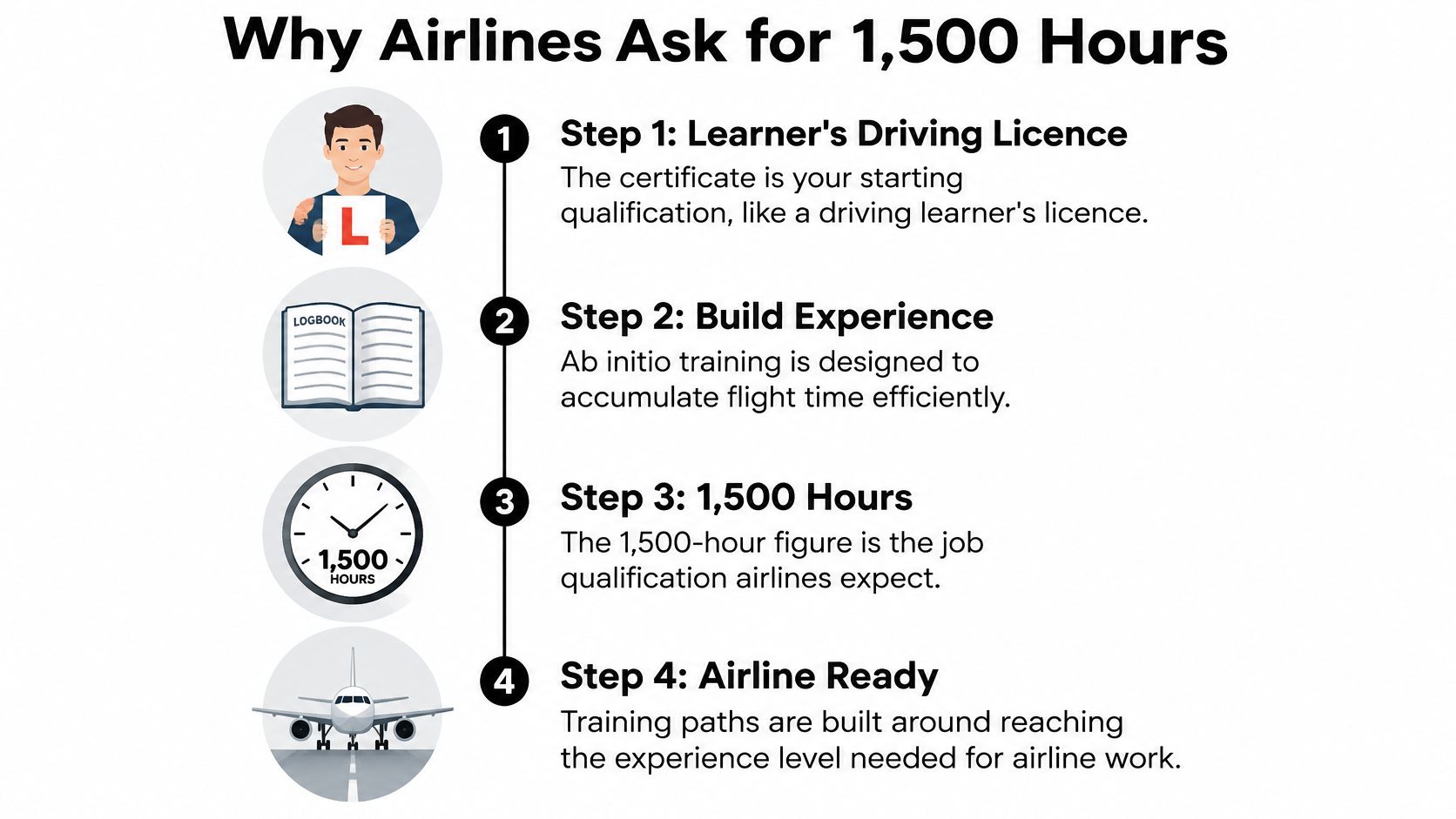
The hour total sits beside other ATP items. Under the FAA's 2013 pilot certification final rule, an applicant for an airplane multiengine ATP also needs at least 50 hours in the multiengine class and must complete the FAA-approved Airline Transport Pilot Certification Training Program, which pairs academic instruction with flight-simulation-device training. That rule made hour building a planned stage of a pilot's career.
How a Restricted ATP Works
The restricted ATP is available to graduates of an authorized higher-education aviation program. Those graduates may use the lower totals above, and the restriction remains until the pilot meets the full experience requirement. If a degree is part of your plan, confirm the school's approval for that pathway before you plan around the lower threshold.
The certificate gets you flying. The hours get you the seat. Two different projects, two different budgets.
The months between those projects decide the calendar. Pilots close the remaining time in a paid flying job such as flight instruction, charter, or cargo. Income starts when that job starts. Each month with little or no flying leaves the 1,500-hour mark where it was, so the airline application waits even after tuition has ended. The airline pilot career path from instructor to regional to major is a sequence, and each move takes as long as the logbook and the hiring market allow.
What counts toward the threshold in practical terms:
- Logged total time. Every hour you fly and record, whether dual, solo, or paid.
- Multiengine time. At least 50 hours in the multiengine class for the airplane multiengine ATP, which is why a multiengine rating early in training avoids a late scramble.
- The required training program. Completion of the ATP Certification Training Program, which a school should schedule before your written exam rather than after it.
How Long Zero-to-Airline Training Really Takes
Say you start a nine-month program in January and plan to be a flight instructor by October, with airline applications a couple of years after that. That plan is only a schedule. Weather, a full instructor roster, a retake, or a checkride wait can move the finish, and each slipped month also delays the day you can start building toward the 1,500-hour airline threshold.
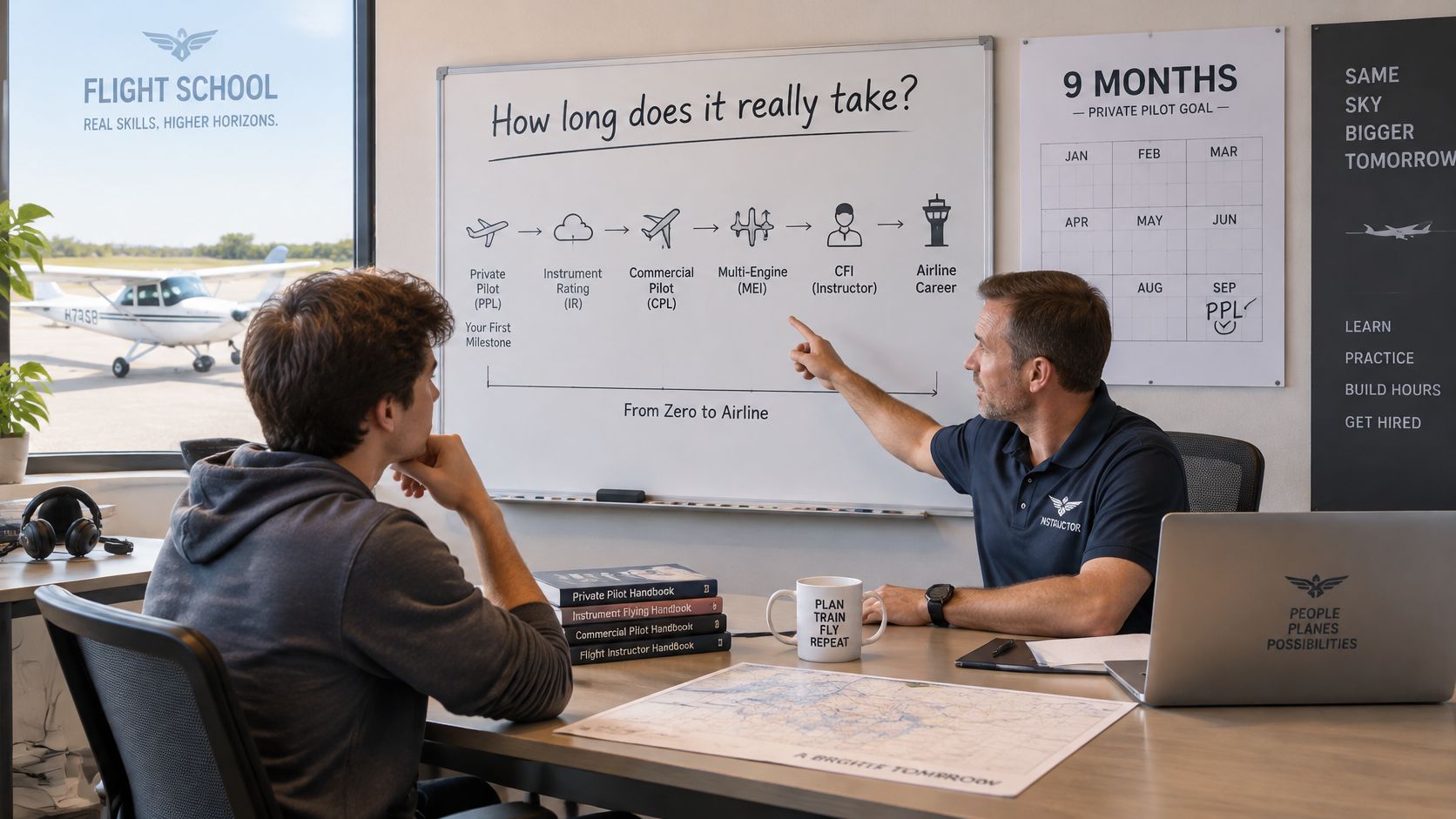
Start from the regulatory floor. A private certificate requires 40 hours under 14 CFR 61.109. Students rarely stop there. Extra practice, lost flying days, and a checkride that is not yet on the calendar push the private phase past that minimum, which is why an honest pilot training cost calculator has to treat the schedule as a range rather than a date. Those extra hours of airplane and instructor time show up before the instrument rating. A first budget built only on the 40-hour floor comes up short for that reason: the hours flown run past the minimum before the checkride.
Weather is the obvious variable. Aircraft availability and instructor scheduling are quieter and just as expensive. A plane in maintenance, or an instructor with a full roster, can cost you a week under a clear sky. Proficiency plateaus stall students who are flying often but not improving. They usually show up first in landings and in the instrument scan. A failed knowledge test means a retake and a new appointment before training moves on. The checkride itself then waits on examiner availability.
A training calendar works like a filed departure time. The published month assumes the airplane is ready, the weather is legal, and an examiner has an open slot. Miss one of those, and the rest of the sequence slides with it.
What stretches the schedule
| Scenario | What adds time | Typical effect |
|---|---|---|
| Regulatory private minimum | None, if every hour flies on schedule | 40 hours, the FAA floor rather than a typical result |
| Typical private completion | Normal training variability | Often well above the 40-hour floor before the checkride |
| Failed knowledge test | Retake and rescheduling | Often several weeks while you retest and get a new date |
| Weather and aircraft availability | Lost flying days | Each lost day pushes the finish a day, so a two-week weather stretch adds two weeks |
| Checkride wait | Examiner availability | Often weeks in busy airspace, which is why early booking matters more than a flexible calendar |
Those delays do not stay inside the flight account. An extra month usually means another month of rent, food, car costs and, if you borrowed, another payment period before a flying paycheck. A nine-month program that takes eleven months costs two months of living on top of any extra flight time. It also pushes back the day you can start logging the hours airlines still require after the certificates are done. The 1,500-hour mark does not move because a school advertised nine months.
The weeks in that stretch are spent on a set sequence, from the first lesson through the ratings that follow.
Run the Timeline Stress Test
Put three questions to any program and write the answers down. Ask what month most students finish, using the month the school has seen. Ask for the best case and the worst case. A single number with no range is marketing. Ask what the program includes if you need extra hours, retake a test, or wait two months for a checkride after month nine. The answer tells you whether the school has priced that risk or left it with you.
Before you commit, write one number on a piece of paper: the cost of each month of delay, including housing, living expenses, and any loan payment. Then decide whether your savings can carry two extra months, not zero.
Comparing Fixed-Price and Pay-as-You-Go Costs
Suppose the certificate lands in month nine and the lender wants the first payment in month ten. Paid flying still has to be scheduled, checked out, and booked. Until that first paycheck, you are paying to wait.
A training loan works like fuel burn on a long cross-country. Cash leaves the tank while you build time toward the 1,500-hour airline mark, and the tank starts refilling only when someone pays you to fly. The useful comparison is that gap: what month paid flying starts, how many of those hours are realistically paid, what an instructor hour pays, and how many loan payments fall before airline eligibility.
Headline tuition blends three different numbers. Separate them on paper: what training costs, when money starts coming in, and what you owe in between. A higher tuition that puts you in a paid cockpit sooner can cost less out of pocket than a lower quote that leaves you hunting for students while payments run.
Cost structure by training model
| Cost factor | Fixed-price program | Hourly modular | Airline-sponsored |
|---|---|---|---|
| Tuition predictability | Set before you start, exclusions listed | Changes with each hour bought | Set by the sponsorship contract |
| Aircraft and instructor time | Confirm whether quoted tuition includes it | Paid as you fly | Set by the sponsorship contract |
| Housing and relocation | Confirm in the quote | Your own cost | Ask what the contract covers during training |
| When repayment starts | Starts on the date your lender sets | Starts when your loan payments begin | After training, per contract |
| Early exit | Check the written refund terms | Pay for hours already flown | Repayment may be owed |
Read the "when repayment starts" row against your own calendar. On a fixed-price quote, overruns stay with the school only if the agreement names what is covered and what is not. Hourly training bills the extra hour to you, which stays manageable while you progress and gets expensive if progress stalls. Airline-sponsored funding lowers the upfront bill and puts a contract in its place, including multi-year service and repayment if you leave early or do not finish, as this breakdown of the pilot career path and hour-building phase sets out.
Practical rule: write the month of your first flying paycheck next to the month of the first loan payment. Price every month those dates do not match before you sign.
Personal flight gear sits outside most quoted totals. You choose and buy the iPad, headset, and flight bag, so add them as their own line. The guide to paying for flight school shows how loans, deferred payments, and payment schedules line up with that same timeline.
How CFII's Career Track Compares Side by Side
Career Track is priced at a fixed $89,000 and runs about nine months from zero time to flight instructor and multi-engine. Line those figures up with any other written quote, and run the stress-test questions you already have. The table is the short list of what should match on paper.
Career Track figures to line up with another quote
| Criterion | Career Track | Match this on the other quote |
|---|---|---|
| Price model | Fixed $89,000 tuition, with all instruction included | One written total, and the items that total leaves out |
| Length | About nine months from zero time to CFII and multi-engine | The month training is expected to finish, and what moves that month |
| Certificates and ratings | Six: private, instrument, commercial in single- and multi-engine, CFI, and CFII | Which of those ratings the price actually includes |
| Total hours | 282 hours, all with one-on-one instruction | Airplane hours and simulator hours stated separately |
| Location | Riverside, Long Beach, and Corona | The weather and the airspace at that base |
A total of 282 hours still hides how the time is built. It splits into 204 hours single-engine, 25 hours multi-engine, and 53 hours in the simulator. The multi-engine block is the slice that has to meet the multi-engine time an ATP requires. Simulator time only trains you if those sessions are tied to the lessons, not parked beside them.
A systematic review published in ICAO's training report found that simulation works when the sessions are built into the teaching method, not because the device looks realistic. The useful check is what each simulator block is for, and whether a stage check looks for a finished maneuver or for workload, an instrument cross-check, and a recovery after the airplane drifts off the plan.
Where This Route Fits and Where It Doesn't
The sticker stays $89,000 if month nine slips to month ten. What moves is the airline clock. Each month before you can instruct leaves the 1,500-hour airline threshold one month further away.
A fixed price and a path that ends in instructor ratings fit a student who wants the total known before lesson one and plans to build time by teaching. That path is a weak first choice if you need a university degree, or if you want an airline to pay for training in return for a service contract. Settle those two questions before you compare tuitions.
The instructor ratings are the hinge either way. The flight instructor course is the step that turns a certificated pilot into someone a school can put in the right seat, and it sets how fast the later hours show up in the logbook.
Choose Your Route and Book Your First Flight
Decide by situation, then act today rather than after another month of reading.
- If you have never flown, book a discovery flight. Ours is one hour with an instructor, requires no experience, and puts you on the controls. Book a discovery flight and find out whether you like flying before you sign anything.
- If you want a fixed price and a fixed finish, review the Career Track details and check precisely what the tuition covers and what it leaves out, including gear and housing.
- If a degree or an airline contract is part of the plan, settle that question before paying anyone, because the restrictions and repayment terms follow you.
You don't need a medical certificate to start. A third-class medical from an aviation medical examiner is required before flying solo, and it can be scheduled in your first weeks while you're already taking lessons. The early exit terms are worth reading too: our First Milestone Guarantee lets a student discontinue for any reason before about 20 hours of flight time and pay only for logged flight time, at a discounted rate of $200 per flight hour, with additional payments refunded.
One action this week. If you haven't flown, book the discovery flight and stop guessing about whether you'll enjoy it. If you have flown, write the cost of one month of delay on paper, multiply it by three, and hold that number next to any program's finish date before you sign.
CFII's Career Track takes you from zero experience to CFII and multi-engine in about nine months at a fixed $89,000 tuition, with 282 hours logged across 204 single-engine, 25 multi-engine and 53 simulator hours, and checkride scheduling handled for you. If you'd rather test the water first, a one-hour discovery flight puts you in the controls with an instructor and no experience required. Visit CFII to see the full pathway, the bases in Riverside, Long Beach and Corona, and to book your first flight.
Planning to fly for a living?
See what the path from zero to a pilot career looks like, what it costs and how long it takes.
Learn to fly in Riverside
We train at Riverside Municipal Airport in modern airplanes with a parachute built in. Start with a one hour discovery flight, no experience needed.