
On this page
- Flight Instructor Eligibility Requirements at a Glance
- Medical certificates and timing
- Hour Requirements From Private Pilot to Flight Instructor
- Why instructing fits between commercial and ATP
- What the Written Tests Measure and What They Miss
- Use a knowledge-to-instruction bridge
- How to Build Lessons Around the Airman Certification Standards
- Instrument Instruction Cycles for CFII Students
- Common CFII instructor errors, causes, and corrections
- Checkride and Oral Exam Prep for Instructor Candidates
- Choose Your Instructor Path Before You Enroll
Can you fly a maneuver well enough to teach it, explain why a student is struggling, and show them how to improve? That's the test behind a flight instructor course. A strong candidate needs more than flight hours and written-test answers. They need to turn aviation knowledge into clear instruction, sound risk decisions, and useful feedback.
For a career pilot starting with little or no flight time, the instructor certificate is a milestone on the way to airline eligibility, not the finish line. Understanding the FAA requirements is essential, but so is choosing training that develops the skill of teaching, not just the ability to perform.
Flight Instructor Eligibility Requirements at a Glance
The CFI certificate is an advanced credential built on a commercial or airline transport pilot certificate, and it adds a teaching test. Before the practical test, the FAA checks age, English, the underlying pilot certificate, knowledge tests, an instructor endorsement, and pilot-in-command time in one regulation. You still have to turn that paperwork into explanations a student can use.
| Requirement | What the rule requires | Rule |
|---|---|---|
| Age | At least 18 years old | 14 CFR 61.183 |
| English | Read, speak, write, and understand English | 14 CFR 61.183 |
| Base certificate | Commercial or airline transport pilot certificate with the right category and class rating | 14 CFR 61.183 |
| Instrument privileges for CFII | Applicable instrument rating or privileges | 14 CFR 61.183 |
| Instructing endorsement | Authorized-instructor endorsement on the fundamentals of instructing | 14 CFR 61.183 |
| Knowledge tests | Required knowledge tests passed for the rating sought | 14 CFR 61.183 |
| Pilot-in-command time | At least 15 hours as pilot in command in the category and class sought | 14 CFR 61.183 |
All of these eligibility items are set out in 14 CFR § 61.183.
Commercial or ATP privileges, with the category and class you intend to teach, are the foundation. A CFII applicant also holds the applicable instrument rating or instrument privileges on that certificate. The fundamentals-of-instructing endorsement is the teaching gate: an authorized instructor signs that you can organize a lesson, explain why a procedure works, and judge whether a student is ready to move on.
Medical certificates and timing
A third-class FAA medical certificate from an aviation medical examiner is required before a student pilot flies solo. A discovery flight and the first lessons can happen before that medical is in hand, so you can sample the airplane and the instructor before you commit to a full plan.
Paid instructing uses a higher medical standard. Under 14 CFR Part 61, a flight instructor who receives compensation exercises commercial privileges and needs at least a second-class medical certificate under § 61.23. Treat the student-solo medical and the paid-instructor medical as two separate items.
Before you apply, line up the records an examiner or training office will ask to see:
- Logbook: Entries that show the required pilot-in-command time in the category and class sought.
- Pilot certificate: Your commercial or ATP certificate, with the ratings that match the instructor certificate you want.
- Instrument qualification: The instrument rating or privileges if the goal is CFII.
- Endorsements: The fundamentals-of-instructing endorsement and any other preparation endorsements the regulation calls for.
Clean records do not teach the lesson for you. They do keep a missing signature from pushing your practical test back a week.
Hour Requirements From Private Pilot to Flight Instructor
The path from a private certificate to airline eligibility is measured in stages. Read the table from top to bottom. These are regulatory minimums, not a guarantee that a pilot will finish each stage at the minimum time.
| Milestone | Minimum flight time | Rule |
|---|---|---|
| Private pilot, airplane | 40 hours total | 14 CFR § 61.109 |
| Commercial pilot, single-engine airplane | 250 hours, including 100 hours powered and 50 hours in airplanes | 14 CFR § 61.129 |
| Commercial pilot via approved Part 142 course | 190 hours, if the course covers the certificate and rating sought | 14 CFR § 61.129 |
| Flight instructor certificate | 15 hours as pilot in command in the category and class sought | 14 CFR § 61.183 |
| Airline transport pilot, airplane | 1,500 hours total time | 14 CFR § 61.159 |
| ATP with qualifying simulator time | Up to 25 hours in a full-flight simulator within an approved course | 14 CFR § 61.159 |
For the single-engine commercial certificate, the general baseline is 250 hours, including at least 100 hours in powered aircraft and 50 hours in airplanes. The 190-hour option applies only to applicants completing an applicable FAA-approved Part 142 course.
The flight instructor certificate has its own experience requirement: 15 hours as pilot in command in the category and class sought. Meeting that minimum does not by itself establish readiness to teach. Candidates also need to turn their flying knowledge into clear explanations and sound instruction.
Why instructing fits between commercial and ATP
The standard airplane ATP threshold is 1,500 hours of total pilot time, with additional requirements for experience such as cross-country, night, and airplane-class time. Up to 25 hours in a qualifying full-flight simulator may count when completed as part of an approved Part 121, 135, 141, or 142 course. A flight-training device or aviation-training device cannot substitute for that simulator time.
Many pilots instruct while building experience toward ATP eligibility. The CFI certificate authorizes instruction within its privileges; reaching the ATP threshold takes further flying, recordkeeping, and continued development of judgment.
What the Written Tests Measure and What They Miss
FAA 2025 test data report a 95.35% average first-attempt pass rate and an 88.89% average score for the Flight Instructor–Airplane knowledge test. For Flight Instructor–Instrument–Airplane, the reported average first-attempt pass rate is 98.88%, with an average score of 92.49%, according to the FAA 2025 Airman Knowledge Test Volume Report.
Those results describe knowledge-test performance. They don't show that a candidate can teach a maneuver, spot a student's misunderstanding, or manage a lesson when the student becomes overloaded. The FAA Airman Certification Standards expect instructor candidates to demonstrate instructional and evaluation skills beyond recalling facts.
A candidate might know the steps of a stall recovery and still struggle to explain them to a nervous learner. Another may know how to brief an instrument approach but fail to make the briefing clear enough for a student to use when workload rises. The gap isn't necessarily a lack of knowledge. It's the difficulty of turning knowledge into useful instruction.
Use a knowledge-to-instruction bridge
For every high-risk topic you study, prepare a short teaching exercise:
- Explain it plainly. Write a two-minute explanation as if your student has never heard the term.
- Name a likely student error. Be specific about what the learner might do or misunderstand.
- Choose a correction. Explain how you'd respond and how you'd check whether the student understood.
- Set an observable standard. Decide what the student must do or explain before you move on.
For example, distinguish a wind-correction angle from a heading change. A student can turn to a new heading for many reasons, but wind correction is an adjustment intended to maintain a desired ground track despite wind drift. Ask the student to predict what will happen to the ground track if the correction is removed, then have them explain what they observe.
Or consider a student who fixates on the airspeed indicator. Repeating a rule about airspeed won't necessarily solve the problem. Teach the student to cross-check attitude, power, and other relevant instruments, then watch whether the scan becomes more balanced during the next maneuver.
Use the same approach while preparing for an instrument knowledge test. This guide to the instrument rating written test can help you organize the knowledge, but your teaching practice should turn each topic into an explanation and a way to evaluate a learner.
A candidate who can teach a topic aloud from memory, respond to follow-up questions, and diagnose a student's error is better prepared for the oral and practical work. A candidate who can only recite the answer still has teaching practice to do.
How to Build Lessons Around the Airman Certification Standards
Slow flight shows whether a lesson follows the standard or only copies a maneuver. On the entry, pitch and power trade off, the stall warning is a cue rather than a surprise, and the candidate has to say what those cues mean before the airplane leaves the pattern. That spoken explanation is the teaching skill the instructor certificate checks.
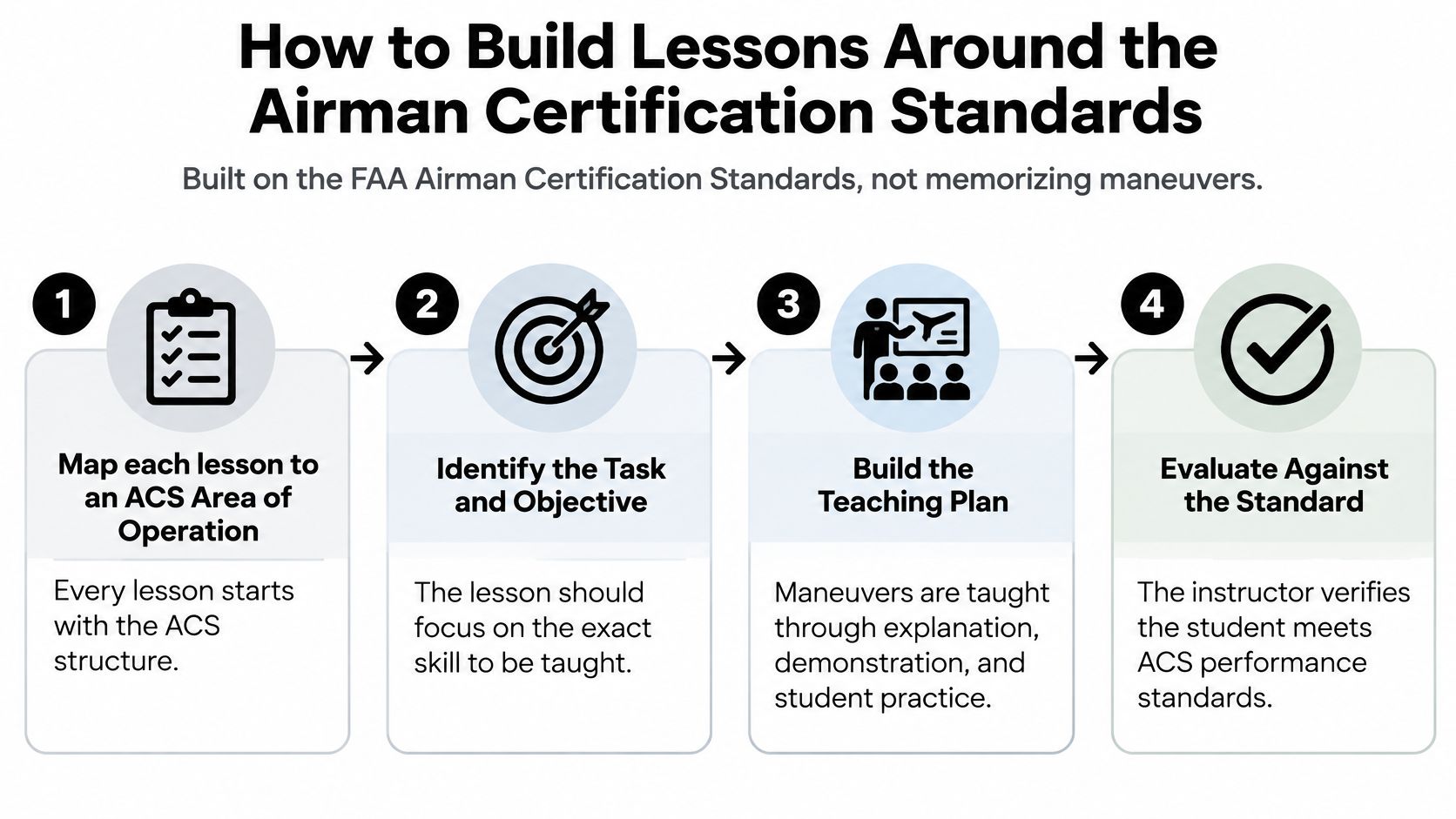
The airplane CFI practical test includes eligibility and preparation, and it scores whether the applicant can recognize, analyze, and correct common errors. Build the lesson from the FAA CFI Airplane ACS, not from a list of maneuvers to memorize.
Map the lesson to the ACS. Name the Area of Operation and the knowledge, risk-management, and skill elements you will cover. Write the objective in those words so the flight stays tied to the element being evaluated.
Turn the knowledge into a spoken demonstration. Fly the maneuver and say the control inputs, the tolerances, and the decision points out loud. In a slow-flight entry, state what pitch and power are doing and which cues you are using to judge the airplane. A written-test answer has to become that sentence or it will not help the student in the other seat.
Seed one error into the plan. Before the flight, choose a single deliberate mistake, such as airspeed falling below the target on the entry. Write what the student will do, what likely caused it, and which teaching response you will accept. You are deciding in advance how a wrong picture differs from a right one.
Set the pass condition in the plan. Call the element done only when the planned explanation, the risk control, and the correction all show up. A smooth maneuver by itself does not meet that bar.
A scenario-driven lesson holds up when it tests the skill and the judgment around it. This guide to scenario-based training shows how to put that pressure into the task without turning the flight into a surprise.
Keep an error log and review it in each debrief. Useful categories include checklist misuse, distraction management, airspeed and altitude deviations, poor coordination, and weak judgment. For each entry, note what the student did, what likely contributed, and which instruction should address the cause rather than only the symptom you saw.
Advancement rule: Don't move a trainee forward just because one maneuver went well. Require consistent explanations, accurate risk controls, and the ability to diagnose another pilot's deviation.
Before the next flight, write one lesson's objective, demonstration script, and one seeded error. If you cannot state what the student should learn, or how you will recognize the mistake, the lesson is not ready to fly.
Instrument Instruction Cycles for CFII Students
Can your trainee talk a student through an approach, or only fly one? The instrument instructor certificate is a teaching-skill test. The FAA instructor-instrument practical-test standard expects candidates to explain, recognize, analyze, and correct common errors, so each lesson has to produce an explanation a student can use when the scan gets busy.
Keep the cycle short and tied to the procedure. Before workload rises, brief the instrument scan, power-pitch relationships, navigation-system logic, weather and alternates, the full approach, missed-approach criteria, and the risk controls. In the lesson, the trainee instructs in real time while you observe: they make the steps understandable, watch the student's performance, and say the decision out loud instead of fixing the airplane in silence. Afterward, rebuild the flight from recorded headings, altitudes, courses, rates, and decision points. A trainee who saw the deviation and still cannot turn it into a teaching point the student could repeat has not finished the cycle.
Common CFII instructor errors, causes, and corrections
| Error | Probable cause | Correction to teach |
|---|---|---|
| Over-reliance on visual cues | Attention drawn outside the cockpit | Return to the instrument scan and cross-check before each input |
| Incomplete approach briefing | Briefing shortened to save time | Brief the full approach, including missed-approach criteria |
| Mode confusion in a glass cockpit | Mode state not called out | Announce the mode before and after each change |
| Correcting symptoms, not causes | Workload or control problem not identified | Ask for the probable cause before the correction |
Use the table in the debrief, not as a second lecture. An altitude deviation might come from a broken scan, a late mode call, or a pitch-power mismatch. The trainee should name which one and give a correction the student can fly on the next approach.
Simulator work belongs in the same record as the airplane. Logging simulator time shows how training-device activity fits the broader training record, including which procedures were taught, not only which hours were logged.
Treat two consecutive stage checks as the readiness benchmark. On each one, the trainee teaches the complete procedure without prompting, holds a disciplined instrument cross-check, and gives an accurate postflight diagnosis.
The FAA material does not set a national CFII pass-rate benchmark. A school that wants to describe its outcomes should publish its own first-attempt pass rate, repeat-event rate, and average remedial hours. Those measures show a candidate what that program tracks and what it treats as ready.
Checkride and Oral Exam Prep for Instructor Candidates
The oral starts as a teaching task. You take a topic the knowledge tests already cover, explain it so a new student can use it on the next flight, and defend the risk call behind that explanation.
On the flight, you demonstrate a maneuver and then respond to a deliberately introduced student error. The examiner is scoring the teaching: what you noticed, why you chose that correction, and what changes if the same error appears again.
I recommend four practice blocks before test day:
Run mock orals. Ask a current instructor to play a confused student. Have them interrupt with follow-up questions so you practice clarifying your explanation instead of relying on a memorized answer.
Record a lesson. Teach one ACS task aloud and listen for unclear ordering, unnecessary jargon, and missing decision points. If you would not understand the explanation as a new student, simplify it.
Practice examiner follow-ups. After each answer, have your mock examiner ask why you chose that correction, which risk you weighed, and how the lesson changes if the student repeats the mistake. Stay with the same lesson logic and answer in plain language.
Prepare the paperwork. Organize logbook entries showing PIC time, your fundamentals-of-instructing endorsement, the practical-test preparation endorsement under 14 CFR § 61.39, knowledge-test results, and your pilot certificate. Confirm that the required documents are available before test day.
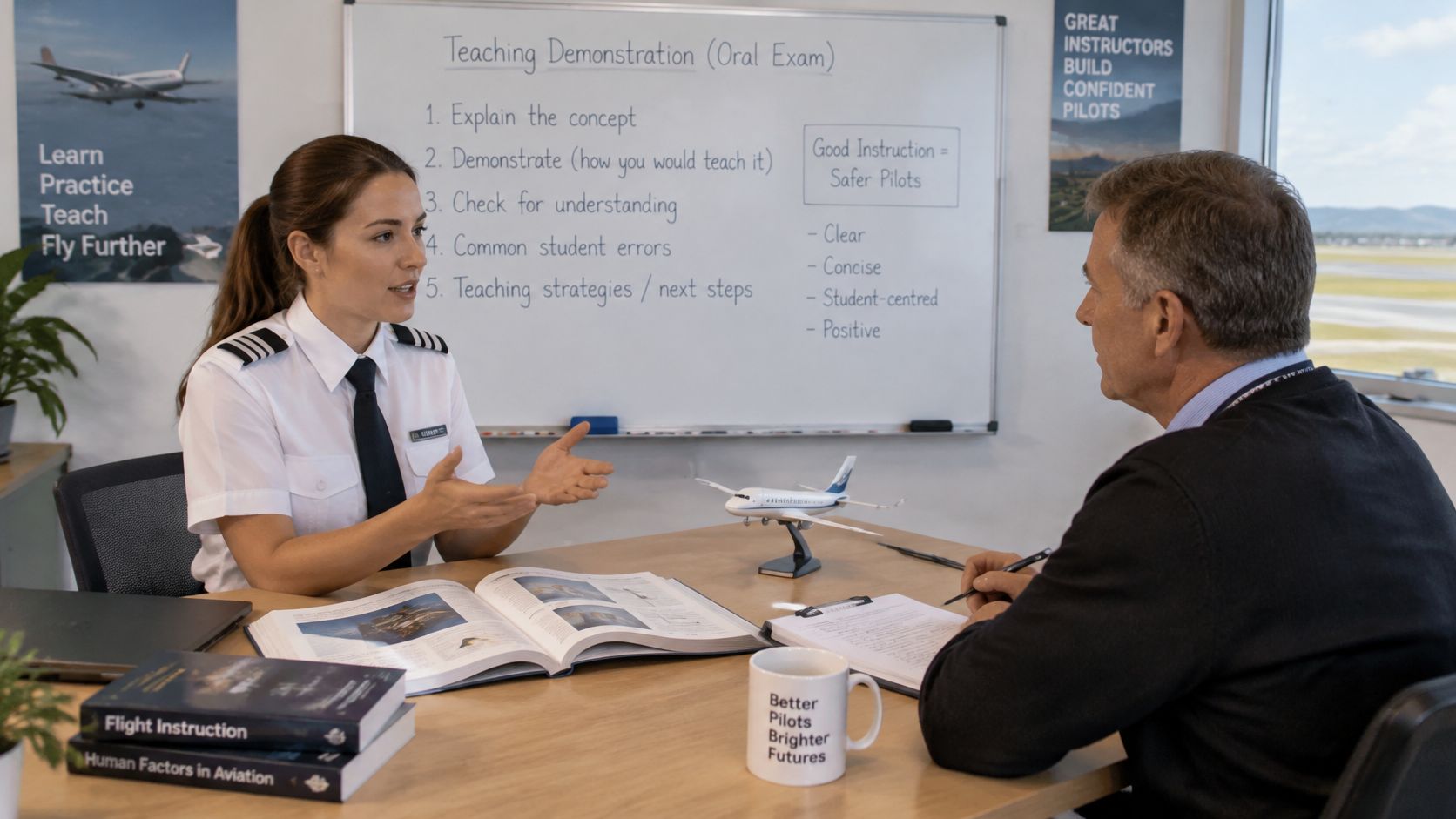
A written outline can keep a lesson in order. You still need enough command of the material to change the explanation when the question changes.
Use a CFI checkride preparation guide to structure your practice, then explain each answer in your own words. Take one knowledge-test item and turn it into a short briefing a student could fly: what to look for, what to do, and when to discontinue the maneuver.
Choose Your Instructor Path Before You Enroll
Before you pay a deposit, get the practical answers in writing: airplane age, how many students share each airplane, how often instructors turn over, the total price, whether the course is Part 61 or Part 141, and whether you can fly before you commit. I recommend asking every flight school those questions, including CFII. An unavailable airplane or a mid-course instructor change breaks lesson continuity and makes a published timeline harder to hold.
Build a planning sheet before you compare programs. Write down how often you can realistically fly, how much instructor work you expect to need before a paid job, and what wage you would accept while you build time. Broader commercial-pilot wage figures mix airline, charter, and instruction jobs, so they are not a guaranteed CFI salary. Treat the job as an operating model: student demand, cancellations, paid preparation, aircraft availability, and your living and financing costs.
The instructor certificate is a teaching-skill test, not a stack of hours. A path worth paying for should make you turn written-test knowledge into an explanation a student can use on the next lesson: why the maneuver failed, what to change, and how you will know the correction stuck. If the syllabus only marches through tasks, you still have to build that skill before the oral.
If you have not flown, start with a discovery flight. It is a first flight with an instructor, and you do not need prior experience. For a wider look at how training paths differ, use this guide to flight training courses.
Choose the path whose schedule, price, and instructor continuity you can verify in writing.
Planning to fly for a living?
See what the path from zero to a pilot career looks like, what it costs and how long it takes.
Learn to fly in Riverside
We train at Riverside Municipal Airport in modern airplanes with a parachute built in. Start with a one hour discovery flight, no experience needed.