

On this page
- The Airline Pilot Career Path at a Glance
- Certificates and what each one allows
- From the first lesson to an airline seat
- Federal ATP Minimums and How Hours Count
- Think in categories, not just totals
- Eligibility and recordkeeping
- Training Routes Compared, From Part 61 to Degree Programs
- Match the route to your circumstances
- Check restricted ATP eligibility carefully
- Building Hours as a Flight Instructor
- Make instruction hours work toward ATP experience
- The Regional-to-Major Progression in Practice
- Pay, Demand and the Lifestyle Trade-Offs
- Read the pay figures as career-wide measures
- Account for the lifestyle
- Confirm Your Route and Book a First Flight
An airline pilot career isn't just a matter of collecting certificates, and “get your pilot's license” is incomplete advice. The long climb is measured in flight hours, and the kinds of hours in your logbook can matter as much as the total. You'll need to know which certificates open each door, how to build the experience the FAA requires, and what the early career stage can involve before airline pay becomes a reality.
The Airline Pilot Career Path at a Glance
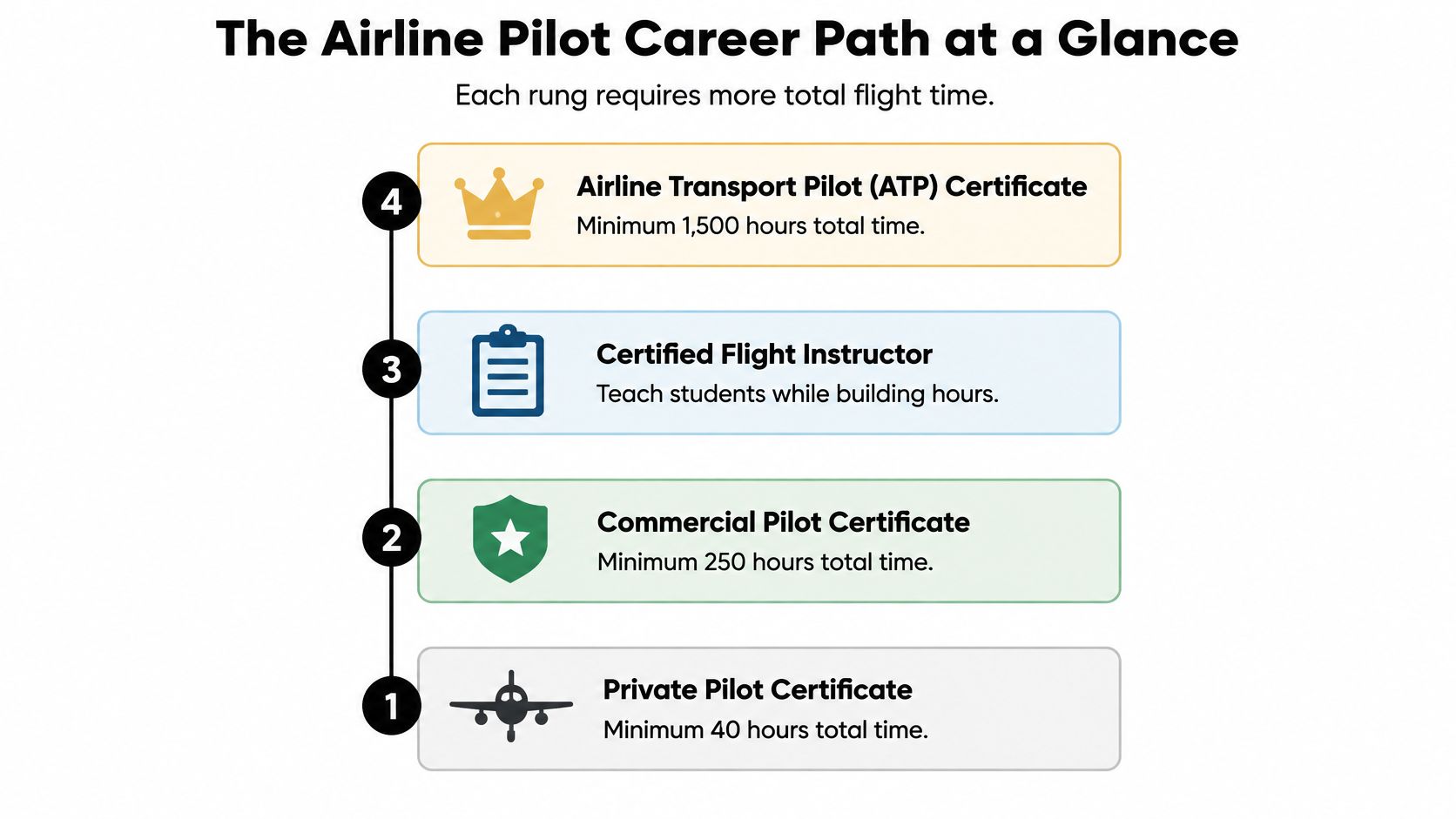
An airline pilot career is a ladder of certificates and ratings, and each rung asks for more logged experience than the one before it. The certificates are the milestones; the flight hours are the currency you spend to reach them. A private certificate starts the climb, and the Airline Transport Pilot (ATP) certificate at the top is the standard federal qualification for serving as a Part 121 airline first officer.
Certificates and what each one allows
| Certificate or rating | Minimum requirement | What it allows |
|---|---|---|
| Private pilot certificate | 40 hours total time under 14 CFR § 61.109; 35 hours under Part 141 | Flying yourself and passengers for fun, not for pay |
| Instrument rating | 40 hours of instrument training and 50 hours of cross-country time as pilot in command under 14 CFR § 61.65 | Flying in clouds and low visibility under instrument rules |
| Commercial pilot certificate | 250 hours under 14 CFR § 61.129; 190 hours under Part 141 | Flying for pay and qualifying for instructor training |
| Flight instructor certificate | 15 hours as pilot in command in the category and class under 14 CFR § 61.183 | Paid instructing and a common way to build hours |
| Airline Transport Pilot (ATP) | 1,500 hours total time under 14 CFR § 61.159 | Unrestricted ATP privileges and eligibility for Part 121 first officer roles |
| Restricted ATP for degree graduates | 1,000 hours with a qualifying bachelor's degree or 1,250 with an associate degree under 14 CFR § 61.160; minimum age 21 | Serving as a copilot while completing the remaining experience |
| Military-trained pilot | 750 hours under the restricted ATP pathway | Copilot roles after qualifying military flight training |
Read the middle column top to bottom and a pattern emerges: the hour requirement climbs from 40 to 1,500, and no certificate skips the logging. The bottom two rows show the only shortcuts that exist, and both are tied to specific training backgrounds rather than a way around building experience.
The certificate names can blur together when you're new to aviation. For a plain-language overview of how the main pilot credentials differ, see this guide to types of pilot licenses.
From the first lesson to an airline seat
The order is straightforward, though each stage takes practice and checkrides:
- Take your first lesson. You can begin flying with an instructor without first holding a pilot certificate.
- Fly solo. Your instructor must determine that you're ready and endorse you before you fly alone.
- Earn a private pilot certificate. You'll learn to plan and conduct flights, handle the aircraft, and carry passengers for noncommercial purposes.
- Add an instrument rating. This trains you to fly using cockpit instruments when visibility is reduced.
- Earn a commercial certificate. You need at least 250 total hours under Part 61, or 190 hours under Part 141, before you can take this checkride.
- Earn instructor qualifications. Teaching can turn your flying skills into a way to build experience.
- Qualify for an ATP certificate. This is the standard experience and certification threshold for the airline path.
- Join an airline as a first officer. You'll work as a copilot and continue developing in airline operations.
There's no minimum age to start lessons. You can solo at 16 and hold a private pilot certificate at 17; you'll need a third-class medical certificate before solo, though you can take a discovery flight and initial lessons before obtaining one.
Start by finding your current rung. Then identify the next certificate, experience requirement, or endorsement you need to reach. That makes a distant career goal into a practical next step.
Federal ATP Minimums and How Hours Count
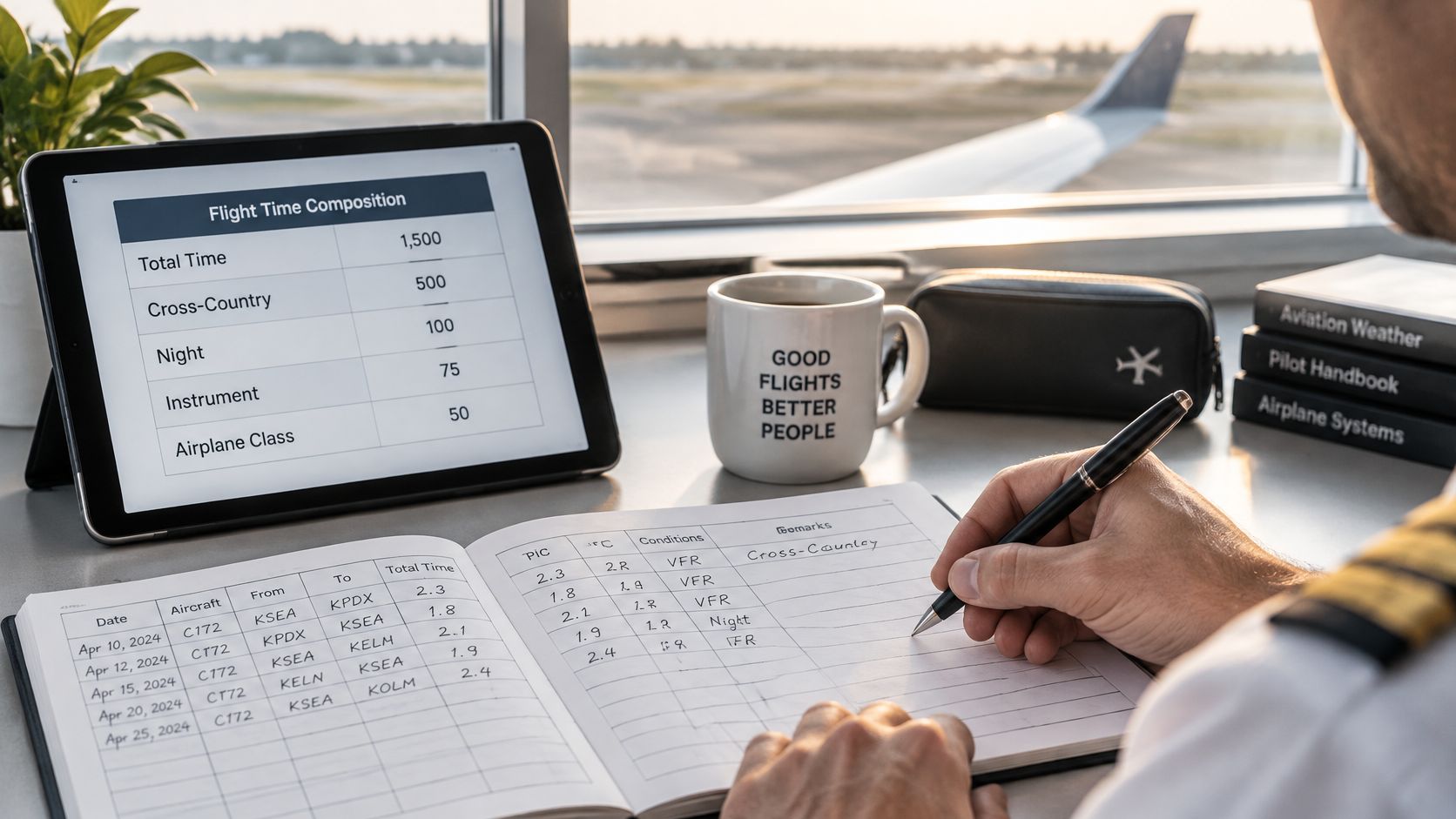
The standard airplane ATP threshold is not just a number on a résumé. Under 14 CFR § 61.159, an applicant generally needs the following experience:
| Requirement | Federal minimum | What your logbook must show |
|---|---|---|
| Total pilot time | 1,500 hours | Each flight, with date, aircraft, and time in each applicable category |
| Cross-country time | 500 hours | Route and distance details |
| Night time | 100 hours | Night flights recorded separately from daytime flights |
| Instrument time | 75 hours | Instrument time and the applicable instructor or device details |
| Airplane class time | 50 hours | Time in the airplane class sought, usually multiengine for airline work |
| Simulator credit | Up to 25 hours | Approved full-flight simulator time, documented and counted only as permitted |
| Minimum age | 23 years | Date of birth for the application |
| Prerequisite certificate | Commercial certificate with an instrument rating | Proof of the certificate and rating |
The 1,500-hour figure is the federal experience threshold for an unrestricted ATP, not a guarantee that an airline will hire you. Airlines can set additional standards. A pilot seeking a Part 121 first officer role generally needs an ATP certificate and the applicable multiengine qualification or type rating. The modern requirement followed congressional action in 2010 after a fatal regional-airline accident in 2009, and the FAA's final certification rule took effect on July 15, 2013, as described in The Air Current's account of the 1,500-hour rule.
Think in categories, not just totals
Treat each hour like a cup of water poured into a bucket. The bucket has a fixed total size, but it also has marked lines for cross-country, night, instrument, and airplane-class time. A training plan that quickly raises your total while leaving those categories short can still delay eligibility.
That's why a large advertised hour total doesn't tell the whole story. Ask what those hours consist of, how they're recorded, and which experience requirements they satisfy. A flight can add total time without adding much to a category where you still have a gap.
Up to 25 hours in an approved full-flight simulator may count toward the applicable ATP flight-time requirement. Simulator practice can help you learn instrument procedures and airline-style operations, but it doesn't automatically replace required airplane experience. The regulation and the documentation matter, so keep simulator records distinct and confirm exactly how any credit applies. For the governing experience details, review 14 CFR § 61.159.
Eligibility and recordkeeping
The standard ATP path also has age and certificate gates: applicants generally must be at least 23, hold a commercial certificate with an instrument rating, and pass the ATP knowledge and practical tests. The FAA's ATP application notice outlines these prerequisites and the experience framework.
Restricted ATP pathways can allow some pilots to serve as copilots before reaching the standard total. Military-trained pilots may qualify at 750 hours; qualifying aviation-program graduates may qualify at 1,000 hours with a bachelor's degree or 1,250 with an associate degree. These alternatives have their own eligibility conditions, so verify which pathway applies to you.
Plan your medical early, too. Airline flying requires a first-class medical certificate under 14 CFR § 61.23. If a medical issue could affect eligibility, it's better to learn about it before investing heavily in training.
Logbook rule: Start on your first lesson. Record the date, aircraft, and each applicable kind of time, then keep the entries consistent and audit-ready. The FAA or a future airline may need to verify that your experience qualifies.
For more on the next qualification stage, see the guide to ATP and CTP requirements.
Training Routes Compared, From Part 61 to Degree Programs
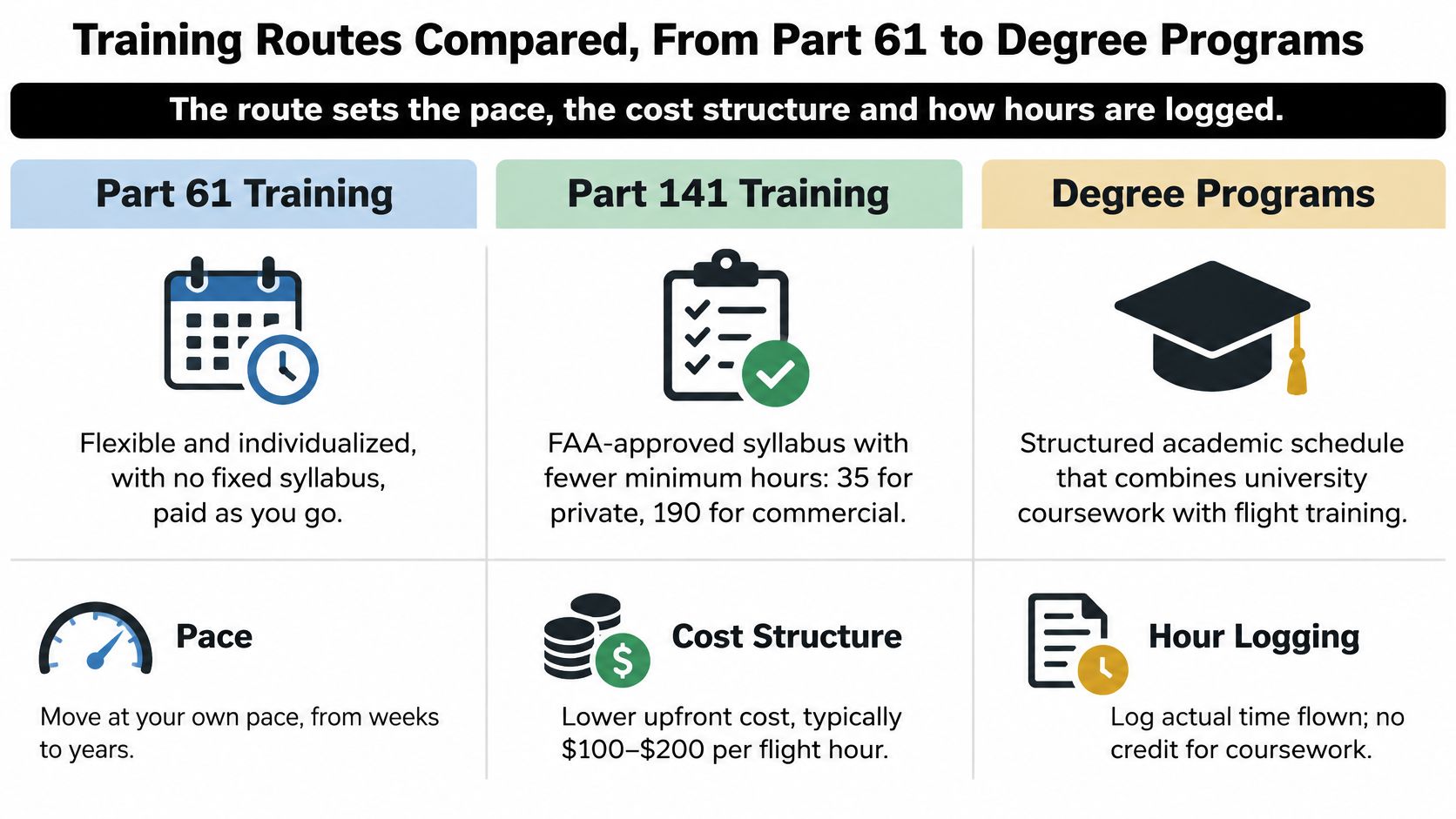
Your training route shapes the pace, the cost structure, and how your hours are logged. It also affects how much flexibility you have to work around a job or other commitments.
| Route | Structure and rules | Typical pace | Best fit |
|---|---|---|---|
| Part 61 flexible training | Individualized lessons without a fixed syllabus; standard Part 61 minimums | Set by the student; a hobby schedule might mean two or three lessons a week | Working adults who need flexibility |
| Part 141 approved school | FAA-approved syllabus, with lower minimums for some certificates | Structured, often full time | Students who want a set curriculum and lower minimums |
| Integrated zero-to-CFII program | One path to commercial, instrument, multiengine, and instructor qualifications; a representative program has 282 total hours | About nine months full time | Students who want a structured route to instructor and multiengine qualifications |
| Aviation degree with restricted ATP | Qualifying degree program; restricted ATP at 1,000 hours with a bachelor's degree or 1,250 with an associate degree | Typically four years | Students who want academic and flight training together |
| Military pilot training | Training through the armed services; restricted ATP pathway at 750 hours | Set by the service | Candidates who qualify for military service |
Match the route to your circumstances
Part 61 lets you arrange individualized lessons without following a fixed school syllabus. That can suit a working adult who needs to train around shifts or family responsibilities. Hobby students taking two or three lessons a week typically reach the private-pilot checkride in four to six months, paying lesson by lesson.
Part 141 training follows an FAA-approved syllabus. Its minimums can be lower for certain certificates, including the private and commercial stages. A structured schedule may help you make steady progress, but ask how the school records each category of flight time and how it plans for experience beyond the certificate minimums.
An integrated zero-to-CFII route groups the professional certificates and ratings into one planned sequence. A full-time program may reach CFI, CFII, and multiengine qualifications in about nine months, with an example pathway totaling 282 hours. The short timeline describes training to those qualifications, not the time needed to reach unrestricted ATP eligibility. Read this guide to fast-track pilot training with that distinction in mind.
Check restricted ATP eligibility carefully
A qualifying aviation degree program can make a graduate eligible for a restricted-privileges ATP pathway. That privilege lets the pilot serve as a copilot while completing the experience needed for unrestricted privileges. The FAA identifies a minimum age of 21 and specific experience pathways, including a cross-country requirement; the exact pathway depends on the applicant's qualifications. A flight-school course by itself doesn't create degree-based eligibility. Review the FAA's ATP and restricted ATP guidance and confirm the applicable 14 CFR § 61.160 requirements before enrolling.
Military flight training is a separate route, with eligibility determined by the service experience and applicable rules. Don't assume that a civilian accelerated program qualifies you for the same reduced-hour pathway.
If you haven't flown yet, start with a discovery flight before choosing a training format. It's a practical way to experience the cockpit and instructor-led flying before making a larger commitment.
Building Hours as a Flight Instructor
If logged hours are the currency of an airline career, instructing is how most new commercial pilots start earning it. Under 14 CFR § 61.183, an airplane flight-instructor applicant needs a commercial pilot certificate or an ATP certificate in the appropriate category and class, at least 15 hours as pilot in command in that category and class, the required ground and flight training, a logbook endorsement, and a passed practical test. The FAA's flight-instructor certification guidance lays out those prerequisites, and teaching instrument flying also requires instrument privileges on your underlying pilot certificate.
Make instruction hours work toward ATP experience
Each lesson pays twice: once in wages, once in logged time, while you practice briefings, weather judgment, and risk decisions in front of a student. The catch is composition. A month of local pattern work can fill pages of your logbook and record zero cross-country time, so track your hours by category rather than watching the running total climb.
An instrument-instructor rating is a separate step from the basic flight-instructor certificate. If teaching instrument flying is part of your plan, confirm that your certificate carries instrument privileges and that you've completed the additional requirements. This guide to flight instructor requirements can help you organize the questions to ask.
The work itself shapes what your logbook becomes. A full day can stack preflight briefings, flights, and debriefs back to back, yet a morning of low clouds or one student cancellation grounds the airplane, and a grounded airplane logs nothing. Before you accept an instructing job, ask what the school's typical lesson really produces: how much cross-country, night, and instrument time it adds, and what your schedule looks like after a stretch of weather delays.
Before you accept: Ask what experience your typical lessons produce. "You'll build hours" is less useful than knowing whether the flying can help you fill the specific gaps in your logbook.
The Regional-to-Major Progression in Practice
Illustration: one hypothetical pilot's path. Maya finishes her commercial certificate, then moves into instructor training. Her career doesn't jump straight from school to a major airline. Each job adds a different kind of experience, responsibility, schedule, and aircraft operation.
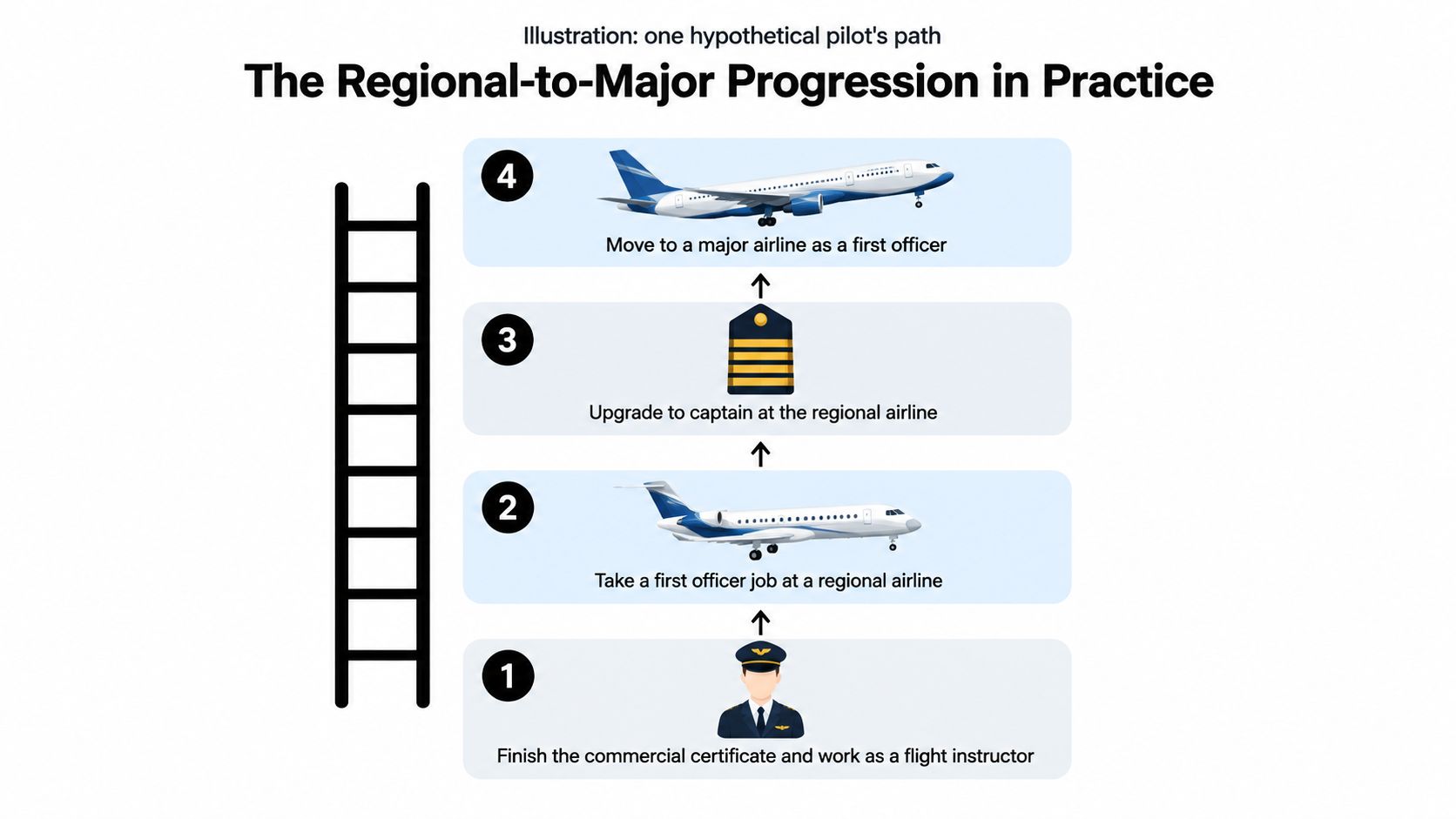
Finish the commercial certificate and work as a flight instructor. Maya teaches in smaller training aircraft and builds experience while helping students learn. Her pay and schedule reflect an early-career instructor role; lesson times can shift with weather and student availability. She may have more control over her home base than she will later, but the income and hours aren't equivalent to airline employment.
Take a charter or other flying job to build experience. After instructing, Maya moves to work that provides more cross-country or night flying. The aircraft, route length, and duty pattern depend on the operation. She may travel farther and spend more time away from home, but the work can help her add experience her logbook still needs.
Earn the ATP certificate. Once she meets the applicable requirements, Maya can apply for the certificate needed for the standard airline first-officer path. That changes which roles she can qualify for, but it doesn't determine her airline, base, schedule, or pay on its own.
Join a regional airline as a first officer. Maya now flies as a copilot on smaller aircraft and shorter routes. The schedule may include reserve duty, commuting, and nights away from home. Her pay and assignment options are shaped by her airline's contract and seniority system.
Build seniority and bid for a major-airline first officer seat. If Maya later moves to a major airline, she may fly larger aircraft and different routes. A move can require relocating or commuting, and the schedule she can hold depends on her position in the airline's bidding system.
Upgrade to captain when seniority allows. As a captain, Maya takes command of the flight, but an upgrade depends on the airline's needs, her qualifications, and her seniority. Her responsibilities change along with the pay and schedule opportunities.
Seniority affects more than a title. Airlines use it to govern bids for schedules and base assignments, so a new pilot may have less choice than a more senior colleague. Reserve assignments and commuting are common considerations early in an airline career.
Some airlines also have cadet or pipeline programs that connect training with a conditional job offer. These programs can create a clearer route to a first airline role, but the terms, training costs, and bonding obligations vary. Read the contract carefully and make sure you understand what you owe, what the airline promises, and what happens if circumstances change.
Pay, Demand and the Lifestyle Trade-Offs
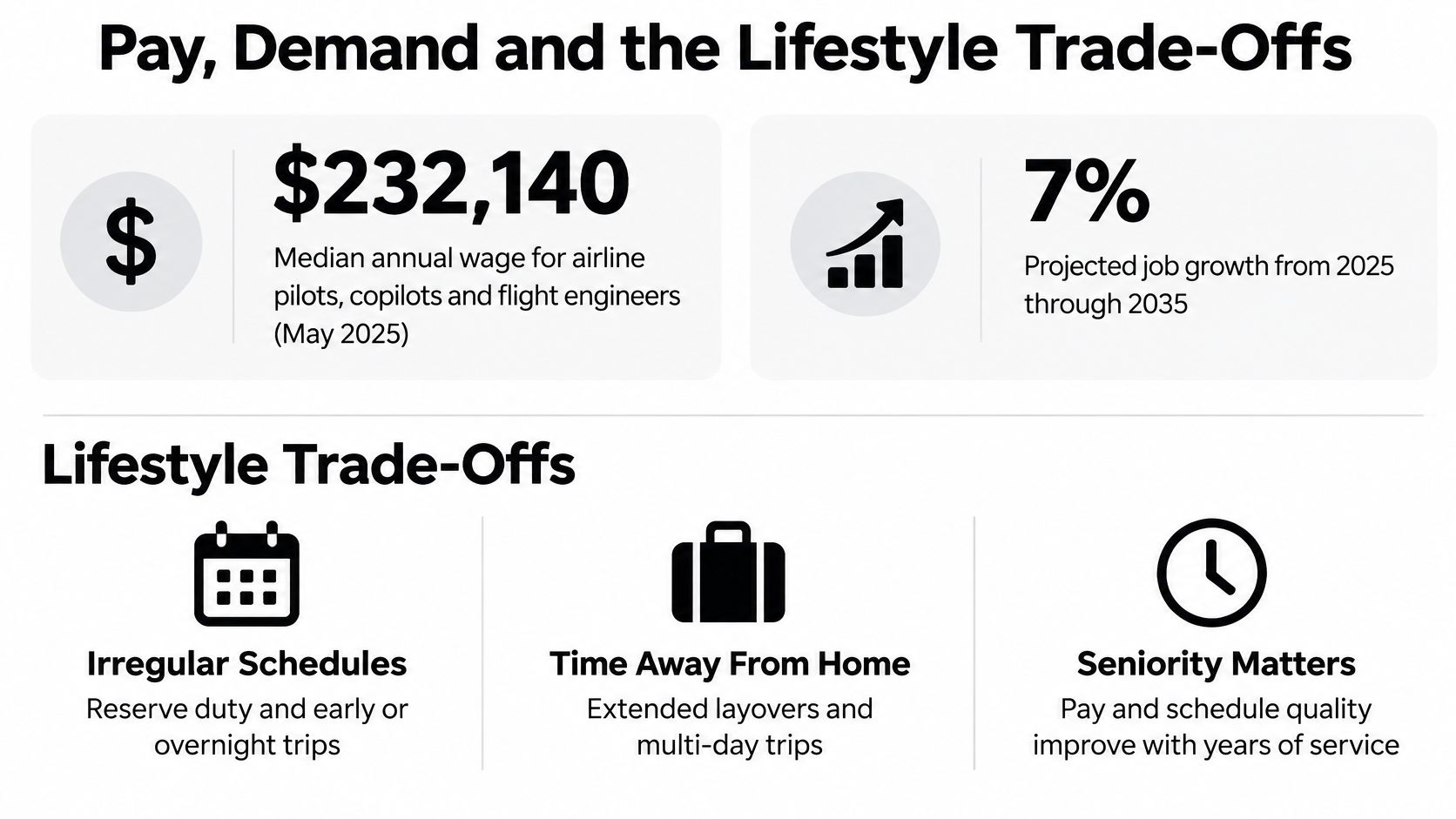
Airline pilot pay can look high on paper, but the figures cover a wide range of jobs and career stages. The U.S. Bureau of Labor Statistics reports a $232,140 median annual wage in May 2025 for airline pilots, copilots, and flight engineers. It projects 7% employment growth from 2025 to 2035 and about 16,400 openings per year, including openings created when workers retire or leave the occupation, according to the BLS occupational outlook.
| Measure | Value | What it means for a beginner |
|---|---|---|
| Median annual wage, May 2025 | $232,140 | A profession-wide midpoint, not a starting salary |
| Lowest 10% annual wage | About $106,710 or less | Pay at the lower end is substantially below the median |
| Highest 10% annual wage | About $463,830 or more | A top-end figure, not a typical first-year expectation |
| Projected employment growth, 2025 to 2035 | 7% | Projected to be faster than the average for all occupations |
| Average annual openings | About 16,400 | Includes growth and replacement of workers who leave |
| Workers in the occupational group, 2025 | About 91,010 | The size of the broader workforce |
BLS figures in the table are from the occupational outlook for airline and commercial pilots.
Read the pay figures as career-wide measures
The BLS wage data show that the lowest 10% earn about $106,710 or less annually, while the highest 10% earn about $463,830 or more. Those figures span a broad occupational range. Your pay will depend on factors such as airline, aircraft, rank, seniority, contract terms, and geographic market.
First officers generally earn less than experienced captains. For a beginner, airline pay is a later-career possibility, not income available immediately after training. This guide to pilot salary by airline explains why pay comparisons need context.
Account for the lifestyle
Airline schedules can include irregular workdays, overnight trips, and time away from home. Seniority affects how much control pilots have over schedules and assignments, so ask pilots at different career stages what their ordinary working weeks look like.
Reaching airline employment takes training and hour-building, and building hours can be slow and expensive. Budget for that stage as well as training, and weigh the time away from home against the earning potential and professional progression.
Confirm Your Route and Book a First Flight
Start with what you can check today: your eligibility, your budget, and what being in a small training airplane really feels like.
- Check the basics. Consider age, medical eligibility, and whether you can fund training and the time it takes to build airline-qualifying experience. Airline flying requires a first-class medical, so plan that exam early.
- Fly before committing. If you have never been in a training aircraft, book a discovery flight at a school near you. It is a first flight with an instructor, and you do not need a medical for it or for your first lessons. A third-class FAA medical from an aviation medical examiner comes due before you fly solo.
- Choose your training format. Compare the schedule and structure you need with the routes available, and ask how each program tracks your logged hours against the experience you still need.
- Ask each school the same questions. Get the total price in writing, and ask what that figure leaves out: pilot gear, written test prep, and checkride scheduling are all worth naming explicitly. Then ask about airplane age, how many students share each airplane, and how often instructors turn over.
- Start your logbook on the first lesson. Record the date, aircraft, and each applicable category of time. Airlines count hours by category, so a logbook that separates cross-country, night, instrument, and instructor time shows at a glance which requirements you are closing on.
For students who want one structured, full-time route, CFII's Career Track takes about nine months from zero experience to flight instructor, with the multi-engine rating included. The program is based in Southern California, at Riverside, Long Beach, and Corona, and the Career Track program includes 282 total hours, six certificates and ratings, and fixed tuition of $89,000. Checkrides are scheduled with FAA examiners, and financing is available for the full amount.
Choose the next action you can take this month. If you have not flown, book a discovery flight. If you have, gather written training plans and compare how each route builds the specific categories of time you still need. A certificate makes you legal to fly for hire; the composition of your hours decides when an airline will hire you.
Planning to fly for a living?
See what the path from zero to a pilot career looks like, what it costs and how long it takes.
Learn to fly in Riverside
We train at Riverside Municipal Airport in factory-new airplanes with a parachute built in. Start with a one hour discovery flight, no experience needed.