

On this page
- What Part 141 Flight Schools Actually Are
- Approval is a starting point, not a ranking
- How Part 141 Differs From Part 61 in Practice
- The syllabus is an operational document
- Instructor oversight has defined qualifications
- The Certificates and Ratings a Part 141 Career Track Covers
- Understand what each milestone accomplishes
- Match each milestone to its actual course
- Benefits and Trade-Offs of Training Under Part 141
- Part 141 Advantages and Trade-Offs at a Glance
- Device credit has firm boundaries
- Initial certification is not airline eligibility
- Four Consumer-Information Gaps Most Articles Skip
- Examining authority is not automatic
- Training-device credit needs an audit trail
- Capacity determines whether lessons happen
- Checkride coordination deserves its own evaluation
- Choosing a Part 141 School and Planning the Cost
- Compare the complete training arrangement
- Separate tuition from total attendance cost
- How an Accelerated Zero-to-CFII Track Uses the Part 141 Framework
- Turn the published pathway into a daily plan
- Keep the next career stage realistic
Part 141 is the FAA's structured, syllabus-based pilot-school framework under 14 CFR Part 141, and eligible courses offer reduced minimum flight hours, including 35 hours for private pilot versus the Part 61 baseline of 40.
You're comparing flight-school websites, trying to work out whether an accelerated program is a credible career move or an expensive promise. You may not have sat in a cockpit yet, but you're already being asked to evaluate aircraft, certificates, training schedules, and financing.
Start with the school's approval, then investigate its execution. The regulatory label matters, but your daily access to instruction, aircraft, progress checks, and testing matters just as much.
What Part 141 Flight Schools Actually Are
If you've never flown, a school's reference to FAA approval can sound like a blanket endorsement of everything it sells. It isn't. Part 141 certification applies to a regulated school and its authorized training courses, not to every marketing claim on its website.
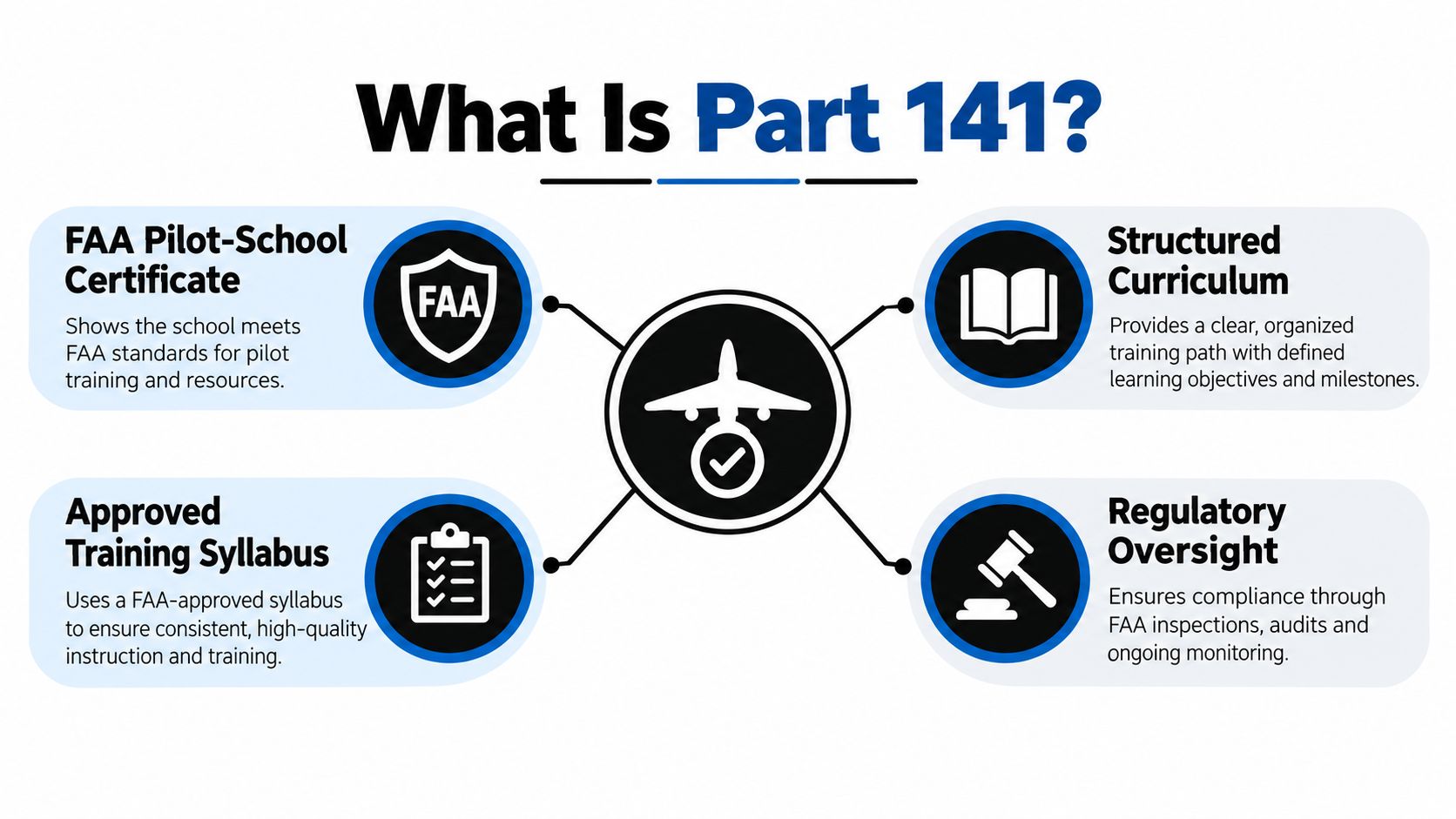
The FAA explains that approved pilot schools operate approved curricula and may qualify students for reduced aeronautical-experience minimums. Its pilot-school guidance supports the private-pilot comparison above, but students must complete the approved course and satisfy the applicable knowledge, stage, and practical-test requirements.
This concept map separates the approval's main components.
Approval is a starting point, not a ranking
Part 141 has deep regulatory roots. The FAA traces flying-school regulations to 1929, following an amendment to the Air Commerce Act of 1926, and identifies foundational connections to Civil Air Regulations Part 50 in its modernization introduction.
That history establishes continuity, not superiority. A longstanding regulatory framework still needs capable people and sufficient equipment to deliver useful training.
Ask admissions to distinguish these separate questions:
- School authorization: What pilot-school certificate does this location operate under?
- Course authorization: Which of the courses you intend to take are approved?
- Student agreement: Which syllabus, attendance rules, and completion conditions will apply to you?
- Operational delivery: Who is responsible for keeping your training moving when an instructor or aircraft becomes unavailable?
My recommendation is straightforward: don't choose a school because its website says Part 141. Choose it because staff can explain exactly how its approval applies to your training.
An admissions representative should be able to identify the relevant course and show you its progression requirements. If the conversation stays focused on speed, financing, or airline aspirations while those details remain vague, keep asking questions before you commit.
How Part 141 Differs From Part 61 in Practice
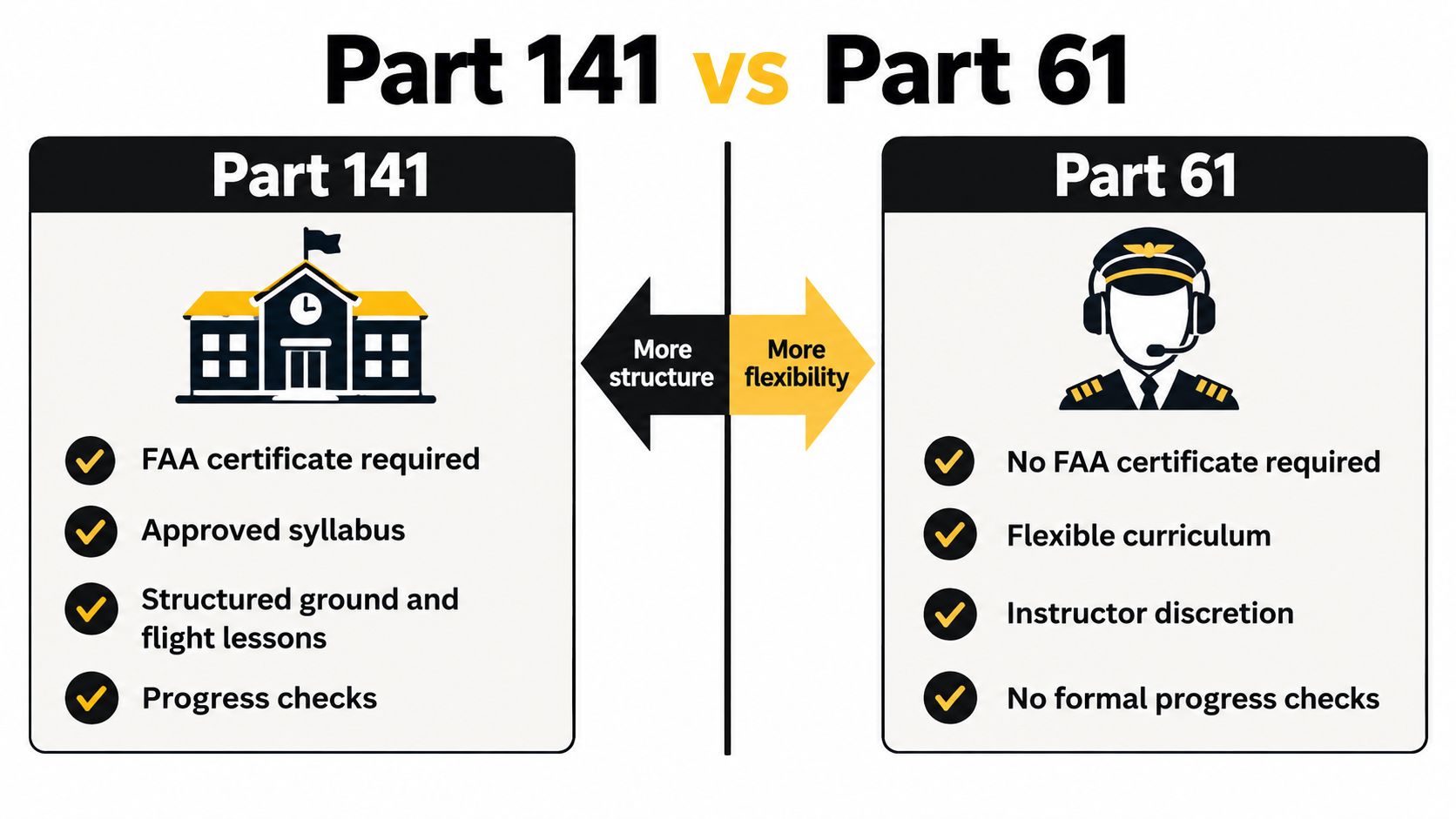
The practical distinction is who controls the training plan and how that plan is documented. Under Part 141, the school works within an approved course. Under Part 61, an instructor has more freedom to arrange lessons around the student's circumstances while still meeting applicable certification requirements.
For someone balancing employment with occasional flying, that flexibility can be valuable. For someone treating flight training as a full-time career transition, a prescribed progression may be easier to organize around. The comparison in Part 61 flight schools is useful when deciding which arrangement fits your actual availability.
The visual comparison captures the broad difference, but flexibility shouldn't be confused with an absence of regulation.
The syllabus is an operational document
Under 14 CFR §§141.3, 141.11, and 141.51, a Part 141 school must hold the appropriate certificate, operate within its approved ratings and authorizations, and use an approved training course. The FAA describes formal application, document review, demonstration of compliance, and issuance of an Air Agency Certificate and training specifications in its pilot-school certification guidance.
That means the school can't treat its syllabus as a suggested reading list. Lessons, training records, facilities, aircraft, and progress evaluations belong to an accountable system.
Consider a student struggling with landing consistency. The important question isn't whether the school will let that student keep buying flight time. It's how the instructor records the deficiency, assigns corrective training, and determines readiness for the next required evaluation.
Practical rule: Ask to see how the school handles an unsatisfactory stage check before you need that procedure yourself.
Instructor oversight has defined qualifications
The framework also sets experience standards for chief instructors. For a private-pilot course, these include 1,000 hours as pilot in command, plus either two years and 500 hours of primary-flight-training experience or 1,000 hours of that training experience; instrument-course requirements include 100 hours in actual or simulated instrument conditions and 1,000 hours as pilot in command, as detailed in the Part 141 regulatory framework.
Those qualifications establish eligibility, not a guarantee of strong teaching. Ask how the chief instructor supervises your assigned instructor and resolves disagreements about your progress.
- Lesson continuity: Who takes over if your instructor leaves?
- Progress visibility: Can you review your training record and outstanding requirements?
- Remediation: Who approves additional training, and how is its cost explained?
I'd favor the school that answers those questions clearly over one that promises more frequent flying.
The Certificates and Ratings a Part 141 Career Track Covers
A career track isn't a single qualification. It's a sequence of certificates and ratings that changes what you can do, the conditions you can operate in, and eventually what you can teach.
For a beginner, the names can blur together. Keep the distinction clear: a pilot certificate establishes a level of qualification, while ratings identify additional operating privileges or capabilities. A commercial certificate and an instructor certificate serve different purposes.
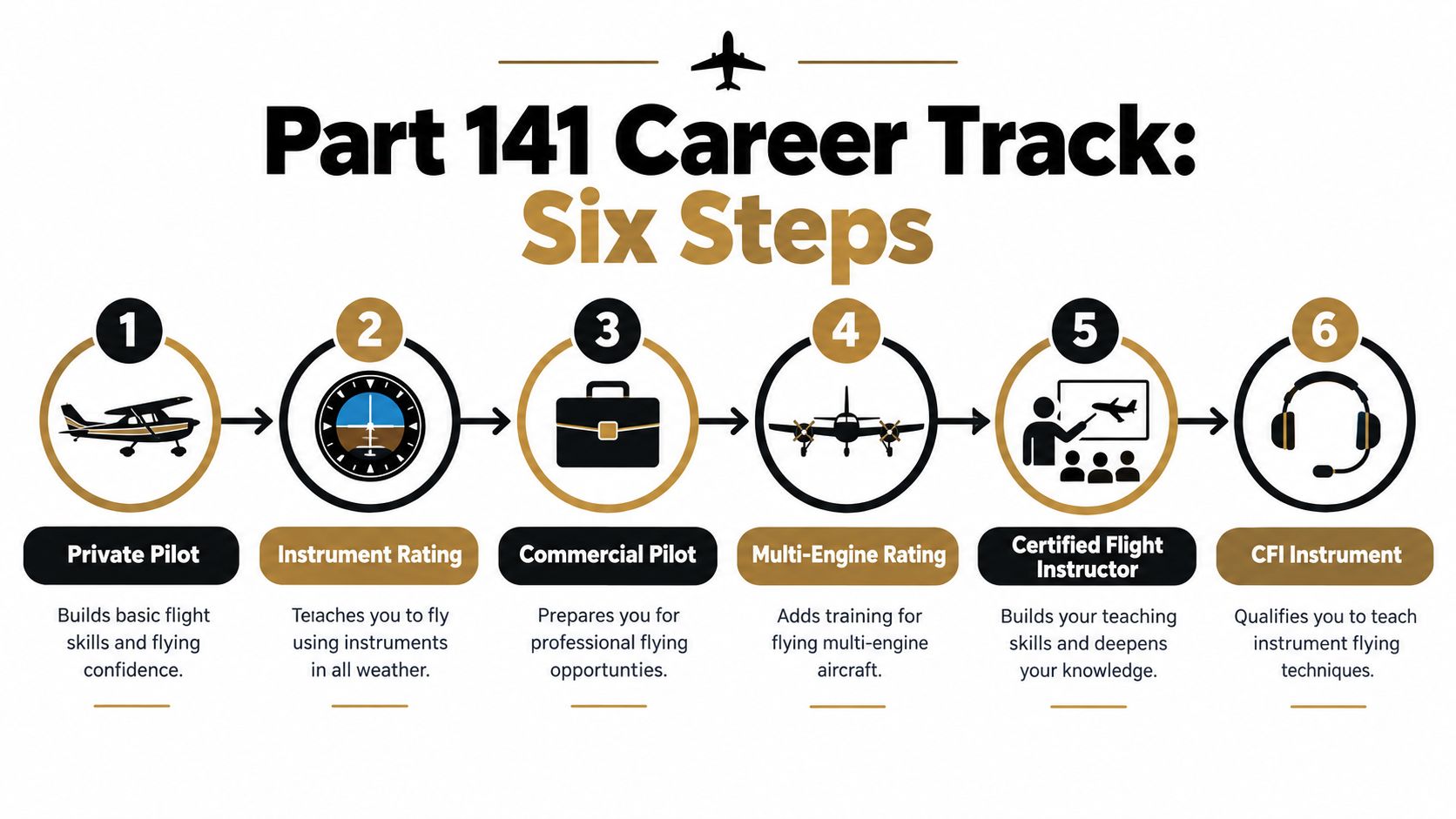
The training sequence below gives you a practical way to organize those milestones.
Understand what each milestone accomplishes
- Private Pilot: Learn to operate the airplane, make sound decisions, and manage normal and abnormal situations. This is your foundation, not your professional endpoint.
- Instrument Rating: Develop the procedures and judgment needed for instrument operations, including navigation, approaches, and disciplined aircraft control.
- Commercial single-engine: Refine aircraft handling and professional decision-making while working toward commercial pilot privileges.
- Commercial multi-engine: Add the relevant multi-engine qualification, with particular attention to performance, systems, and engine-out control.
- Certified Flight Instructor: Learn to teach, diagnose errors, explain procedures, and evaluate another person's performance.
- Certified Flight Instructor–Instrument: Extend that teaching preparation to instrument instruction.
Use the pilot certification training guide to clarify the terminology before comparing enrollment agreements. Don't accept a brochure's milestone list as proof that every component follows an approved Part 141 course.
Match each milestone to its actual course
Ask the school to map your proposed sequence to its course approvals. For each transition, identify the entry prerequisites, completion requirements, evaluation process, and any training conducted outside the approved course.
The FAA's AC 141-1B guidance identifies a 35-hour Part 141 instrument-rating course. It also describes private-course device-credit allowances of up to 15% for an aviation training device and 20% for a flight-training device or full-flight simulator under the applicable provisions.
Those are course-specific allowances, not permission to substitute any simulator session for aircraft training. Have the school show where each credited lesson belongs.
Don't judge the pathway by the last certificate alone. Judge whether each intermediate qualification prepares you for the next responsibility, especially the transition from flying the airplane yourself to teaching someone else to fly it.
Benefits and Trade-Offs of Training Under Part 141
I favor structured training when a student can make it a genuine priority. Clear expectations, documented progress, and planned evaluations give both student and instructor something concrete to work toward.
But structure also creates obligations. If your job regularly interrupts training, a tightly sequenced course may be a poor fit even when its advertised completion time looks attractive.
Part 141 Advantages and Trade-Offs at a Glance
| Documented Part 141 Advantage | Trade-Off or Constraint |
|---|---|
| Reduced experience minimums in eligible approved courses | A minimum is an eligibility threshold, not an individual completion forecast |
| Defined syllabus and progress evaluations | Attendance and progression requirements can restrict flexibility |
| Authorized training-device credit | Credit depends on device type, course approval, and regulatory limits |
| Potential internal testing through examining authority | That authority is separate from ordinary school certification |
| Organized certificate-and-rating progression | Airline eligibility still requires a separate experience plan |
The right comparison is not fewer hours versus more hours. It's whether the training arrangement helps you become proficient without creating avoidable scheduling or financial problems.
Device credit has firm boundaries
The FAA's AC 61-136 aviation-training-device guidance requires specific authorization from the responsible Flight Standards District Office before a Part 141 school uses an aviation training device in its approved curriculum. For instrument training, it identifies a maximum of 10 hours of instrument flight-instruction credit in a basic aviation training device, with combined allowances subject to the 20-hour cap under §61.65 and the 50% cap under Part 141 appendix C, as applicable.
Used intelligently, a device lets an instructor pause a scenario, repeat an approach, or isolate a weak instrument scan. That's a useful teaching function. It doesn't make device time universally interchangeable with airplane time.
Ask for a written explanation of how the proposed device sessions satisfy your course requirements. Keep the educational benefit separate from the amount of regulatory credit.
Initial certification is not airline eligibility
Under 14 CFR §61.159, an airplane-category ATP applicant generally needs 1,500 hours of total pilot time, including 500 hours cross-country, 100 hours night, and 75 hours instrument, according to the FAA's ATP guidance. The FAA also describes restricted-privileges ATP pathways for graduates of qualifying aviation degree programs, but ordinary Part 141 enrollment doesn't establish that eligibility.
A professional training program can prepare you for experience-building work. It cannot turn initial certificates into unrestricted airline eligibility by changing the name of the syllabus.
Treat certificate completion and airline qualification as separate planning problems. Your budget and career expectations need to account for both.
Choose the structured route if you can sustain its pace. Choose a more flexible arrangement if your availability requires it, rather than repeatedly interrupting an accelerated course.
Four Consumer-Information Gaps Most Articles Skip
The questions that matter most rarely appear in the headline tuition or course-duration box. They concern how the school handles authorization, training credit, equipment availability, and practical tests.
Bring these questions to an admissions conversation, and ask for answers you can review afterward.

Examining authority is not automatic
Does my exact course have examining authority? The FAA reports 74 of 509 certificated pilot schools, approximately 15%, held examining authority for at least one course in its examining-authority materials.
The same materials describe eligibility conditions including holding the relevant rating for 24 consecutive months, training and recommending at least 10 students, and achieving at least a 90% first-attempt pass rate among those students. That eligibility threshold isn't a published pass-rate claim for the school you're considering.
The FAA's Notice N 8900.593 further explains the relationship between examining authority and qualifying courses, including §141.55(d) restrictions concerning minimum ground and flight-training times.
Ask which courses have the authority, not whether the school has it somewhere in its operation. Internal evaluation also deserves scrutiny: who reviews an unsuccessful result, and how does the school maintain consistent standards?
Training-device credit needs an audit trail
Which device will I use, and where does its credit appear in my course? Request the device designation, relevant authorization, and lesson allocation rather than accepting a generic simulator-hour total.
Watch for confusion between time offered as useful practice and time credited toward a regulatory requirement. Both can have value, but they aren't the same purchase.
Capacity determines whether lessons happen
What happens when my assigned aircraft or instructor is unavailable? Ask the school to walk through an ordinary disruption, such as an aircraft going into maintenance before a required lesson.
You want practical answers:
- Aircraft substitutions: Which replacement aircraft can serve the lesson?
- Instructor coverage: Who can continue your training without unnecessary repetition?
- Progress-check access: How does the school schedule the evaluator when you're ready?
- Delay recovery: Who reorganizes the plan after cancellations?
Checkride coordination deserves its own evaluation
Who owns the testing schedule, and what happens when it slips? Ask about examiner availability, how appointments are requested, preparation expectations, cancellation policies, and responsibility for rescheduling.
A student can finish training requirements and still face a testing delay. Don't confuse school certification with examiner access.
The distinction discussed in FAA-approved flight schools is useful here: approval should be investigated at the course level. Buy a credible process, not an assumption that FAA approval removes every bottleneck.
Choosing a Part 141 School and Planning the Cost
Start with documents, not a sales presentation. Request the course approvals, enrollment agreement, tuition inclusions, additional-training policy, and completion conditions before making a financial commitment.
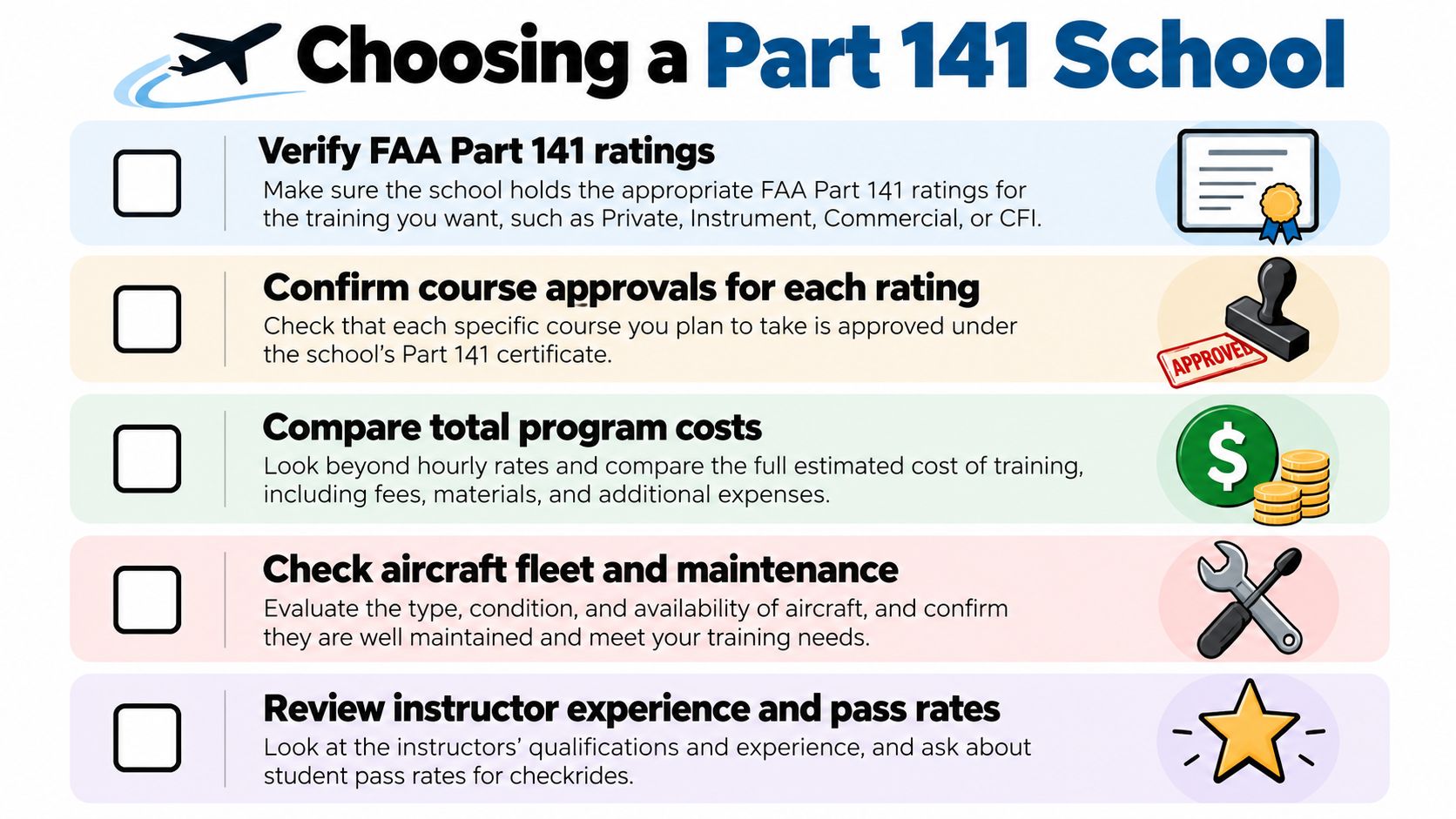
Use this checklist to keep the conversation focused on verifiable details.
Compare the complete training arrangement
Location should work for your daily life, not just your relocation plan. Check the commute, access to study space, and whether optional housing is available near the training base.
- Fleet and avionics: Ask about aircraft availability, maintenance procedures, glass-cockpit standardization, and transition training between aircraft.
- Instructor access: Find out how instructors are assigned and who reviews your progress.
- Training infrastructure: Request a demonstration of the training portal, lesson records, study materials, and progress tracking.
- Financing transparency: If deferred-payment options exist, review interest, repayment timing, fees, and withdrawal consequences.
- Career support: Ask what assistance is offered, such as logbook review or interview preparation, without treating support as a hiring promise.
Standardized equipment can simplify lesson continuity, but a complex cockpit won't compensate for an unavailable aircraft. Likewise, a training portal is useful only if instructors keep records current and students understand what remains outstanding.
Separate tuition from total attendance cost
Published tuition and your total cash requirement are different questions. Request an itemized statement showing whether exam fees, a headset, charts, additional instruction, retests, and lodging are included or excluded.
The flight training cost guide can help organize those categories. Then build your own budget around the actual agreement, including living expenses while you train and a reserve for disruption.
Ask what happens financially if you pause, withdraw, or need more training than the published package includes. A fixed price is only meaningful when its scope and exceptions are clear.
Before committing, use the video below as a prompt for questions about the training experience.
Before you sign: Make sure you understand both the training agreement and the borrowing agreement. Neither should require a verbal explanation to resolve its central terms.
If you haven't flown, book a discovery flight before committing to a multi-month course. Use it to assess your interest in the work itself, ask an instructor about the learning process, and decide whether intensive training fits your expectations.
How an Accelerated Zero-to-CFII Track Uses the Part 141 Framework
An accelerated track succeeds when the school turns course requirements into a workable daily plan. The useful question is whether staff can explain the sequence from lesson preparation through instruction, evaluation, corrective work, and testing.
For a concrete program comparison, CFII's Career Track lists fixed $89,000 tuition, about nine months from zero time to CFII and multi-engine, 282 total hours, and six certificates and ratings, with Southern California bases in Riverside, Long Beach, and Corona.
Those published figures describe the program's scope. They don't, by themselves, establish which components operate under Part 141, how every hour receives regulatory credit, or what happens when a student needs additional training. Verify those details directly rather than inferring them from the program title.
Turn the published pathway into a daily plan
Ask the school to explain a normal training week and a disrupted one. The explanation should identify who assigns lessons, monitors readiness, resolves deficiencies, and adjusts the schedule.
- Preparation: What must you study before arriving for instruction?
- Progression: How does your instructor determine that you're ready to move forward?
- Coordination: Who connects course completion with the appropriate evaluation?
- Accountability: How will you know whether you're on track, and who discusses problems with you?
The practical issues in accelerated flight training should be part of that conversation. Acceleration requires sustained student effort as well as organized school operations.
Keep the next career stage realistic
Once you finish instructor training, consider instructing or other legitimate pilot work as a separate experience-building stage. Ask about any available pathways without assuming that enrollment includes employment or that certification guarantees a position.
My recommendation is to choose the program whose staff can connect approval, training scope, daily delivery, and financial terms in writing. A credible accelerated pathway doesn't need you to ignore the details. It should make them easier to understand.
CFII offers a fixed-tuition Career Track from zero experience through CFII and multi-engine training. Visit CFII to discuss the pathway, confirm which course approvals apply, and review the enrollment terms before committing. If you haven't flown yet, make a discovery flight your first decision rather than a tuition deposit.
Planning to fly for a living?
See what the path from zero to a pilot career looks like, what it costs and how long it takes.
Learn to fly in Riverside
We train at Riverside Municipal Airport in factory-new airplanes with a parachute built in. Start with a one hour discovery flight, no experience needed.