On this page
- The Real Shape of the Airline Pilot Pathway
- Prerequisites You Need Before Any Training Dollars
- Check medical feasibility early
- Check your practical runway
- The Certificate Sequence From Private Through CFII
- Time-Building Routes to the 1,500-Hour Threshold
- Compare the routes by what they give up
- Financing the Training and the Real Cost Beyond Tuition
- Run more than the on-schedule case
- From Eligibility to Employability in a Variable Market
- Protect your options while you build
- A 30-Day Plan and Indicators to Watch Throughout Training
- Your next steps
You may be comparing flight schools, scrolling through advertised timelines, and wondering whether the price on a program page is the price you'll pay. That's a sensible place to start, but the bigger question is whether each stage of your plan leaves you eligible for the next one, even if training takes longer or hiring slows.
How to become an airline pilot is not a single course followed by a job offer. It's a sequence of FAA certificates and experience requirements, then a separate stretch of building the right kinds of flight time, followed by a hiring process that depends on more than your logbook. Plan for each gate, not just the headline hour total.
The Real Shape of the Airline Pilot Pathway
The most common misconception is that becoming an airline pilot means completing one long training program and then moving directly into an airline cockpit. In reality, it's a gated sequence. Each certificate gives you new privileges, but it also comes with requirements you must meet before advancing. Completing flight school gets you started. It doesn't automatically make you eligible for an airline job.
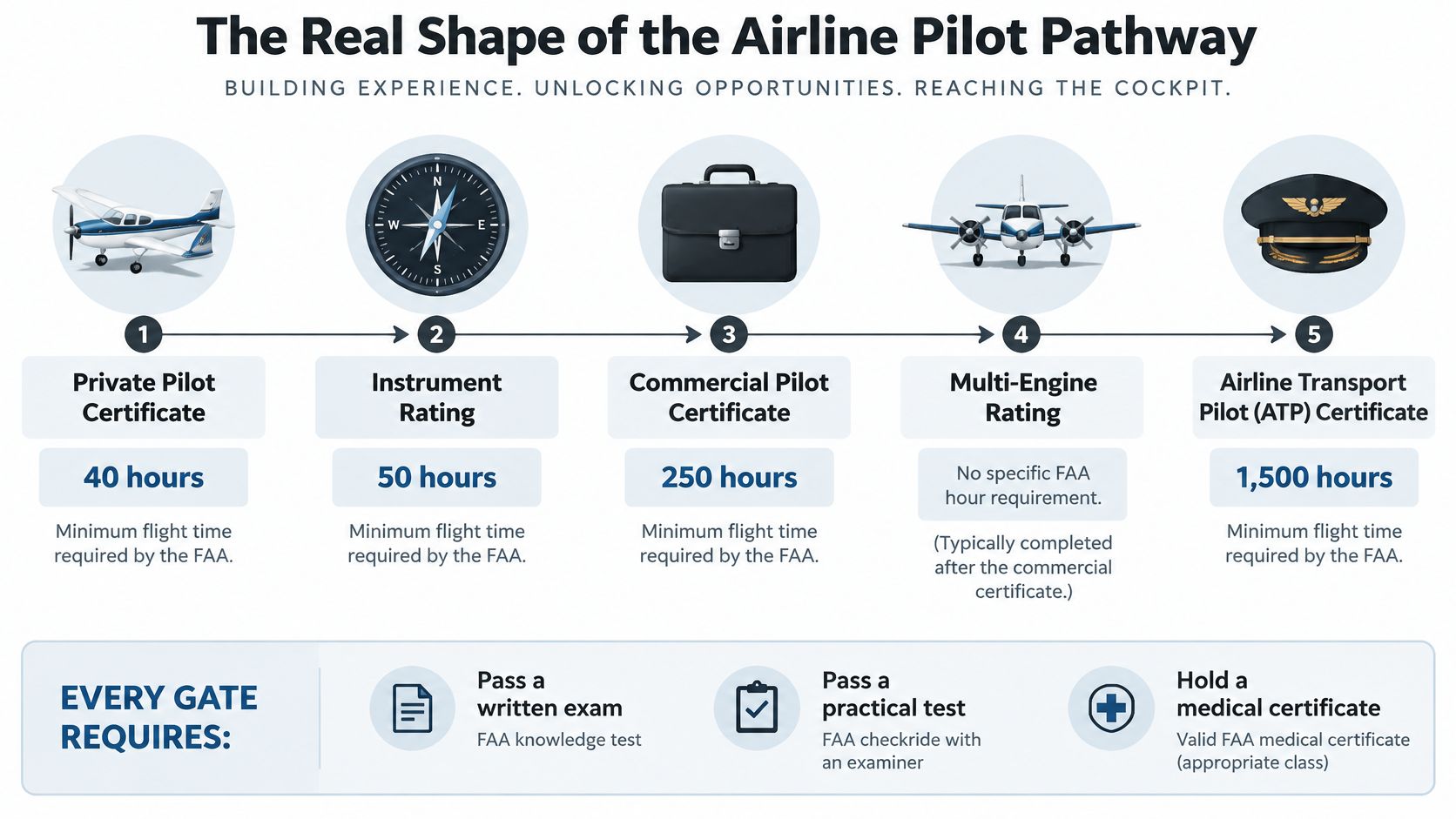
Think of the route as a set of decisions with checkpoints:
- Confirm the medical gate. Before making a major financial commitment, check that you can meet the medical standard for the privileges you intend to exercise.
- Earn your initial certificates and ratings. Train through private, instrument, commercial, and multi-engine qualifications, then consider instructor credentials.
- Build qualifying experience. Your total hours matter, but so do the categories within them, such as pilot-in-command, cross-country, night, instrument, and relevant aircraft-class time.
- Qualify for the ATP. The conventional U.S. route includes specific experience, age, certificate, and testing requirements, not just a total-hour target. FAA ATP aeronautical experience requirements
- Compete for a job. Meeting FAA requirements is regulatory eligibility. Airlines still make hiring decisions based on their own needs and criteria.
The first training decision isn't necessarily which school has the shortest advertised timeline. It's whether the plan tracks every required category and gives you a credible way to build experience after your initial ratings. A legal minimum is not a guarantee that you'll be proficient or ready for a checkride.
If you haven't flown yet, book a discovery flight to experience a first lesson. It's a practical way to test your interest before committing to a professional training plan.
Prerequisites You Need Before Any Training Dollars
Before paying for a substantial training program, confirm that your medical, eligibility, and finances support the plan. The medical check deserves early attention because it can affect which pilot privileges you can exercise. The FAA states that ATP privileges require a first-class medical certificate, while commercial-pilot privileges generally require a second-class certificate. Examinations are conducted by FAA-designated Aviation Medical Examiners under the medical standards in Part 67. FAA medical certificate classes and privileges
Check medical feasibility early
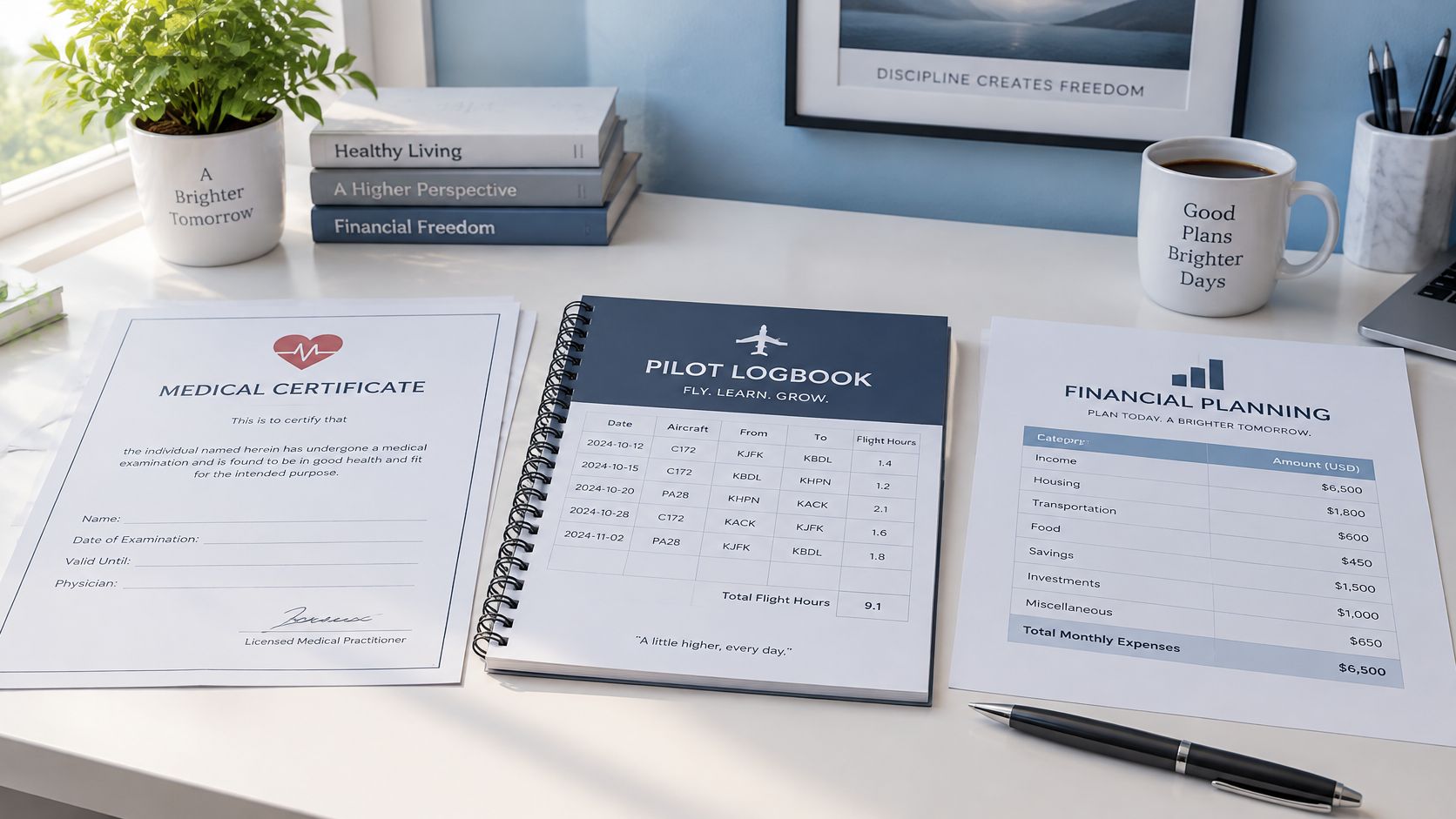
Don't wait until you've paid significant tuition to find out that a medical issue needs further review. If you have a health concern or take medication that may complicate certification, arrange a consultation with an Aviation Medical Examiner before treating flight training as a sure thing. A consultation can help you understand what documentation or evaluation may be needed. It can't guarantee an outcome, so get advice from the appropriate medical professional rather than relying on another student's experience.
Start with the FAA medical certification guidance for pilots and discuss your situation with an examiner. Be candid and bring relevant records. Delaying a difficult medical question doesn't make it less important; it just raises the chance you'll face it after spending more money.
Check your practical runway
The non-regulatory prerequisites matter too. Can you protect regular study and flight time? Can you cover living expenses while training, including if weather, maintenance, or checkride scheduling interrupts your planned pace? Could you relocate or commute if your local options don't provide consistent training access?
Build a budget that separates quoted tuition from other expenses. Include housing, transportation, equipment, medical and test fees, potential retakes, and the income you may give up while training. Then ask how you'll support yourself between graduation and paid flying work. A plan that only works when every event happens on schedule isn't a resilient plan.
The Certificate Sequence From Private Through CFII
Certificates aren't decorative milestones. Each one gives you a new privilege and moves you toward work or experience-building opportunities. The important planning habit is to track the type of time you're logging, not only the total. Your logbook needs to support the specific FAA experience categories required later.
| Rating | FAA minimum | Primary hour category built |
|---|---|---|
| Private Pilot Certificate | At least 40 hours of flight time, with required instructor, solo, cross-country, night, and instrument components. FAA private-pilot requirements | Foundational solo, cross-country, night, and instrument experience |
| Instrument Rating | Requirements depend on the applicable rule and the experience already logged. | Instrument procedures and instrument experience |
| Commercial Pilot Certificate | Generally at least 250 hours for an airplane single-engine applicant, with specific PIC, airplane, cross-country, and training components. 14 CFR § 61.129 | Commercial-level experience, including required PIC and cross-country time |
| Multi-engine Rating | Applicable requirements depend on the certificate and rating sought. | Multi-engine experience |
| CFI and CFII | Requirements depend on the instructor certificate and rating sought. | A route into instructing and continued experience-building |
A private-pilot student must satisfy the FAA's specific experience requirements, not merely reach the minimum total. Many students exceed the legal minimum because weather, aircraft availability, proficiency, and checkride readiness affect progress. The instrument rating matters because professional operations depend on instrument procedures, navigation, weather interpretation, and air-traffic-control clearances.
Under 14 CFR § 61.129, a commercial applicant's experience includes specified powered-aircraft, airplane, PIC, cross-country, and training requirements. Read the rule against your own logbook. Don't assume that an hour counts toward a particular requirement just because it appears in your total.
Logbook rule: Record the category and conditions of each flight while the details are fresh. Trying to reconstruct eligibility after several training stages is an avoidable headache.
CFI and CFII credentials can create a practical way to earn income while building time, but an instructor certificate doesn't erase the need to meet ATP requirements. Keep reviewing your logbook for PIC, cross-country, night, instrument, and aircraft-class experience. The pilot certification training guide can help you compare the sequence and understand what each stage is meant to accomplish.
Time-Building Routes to the 1,500-Hour Threshold
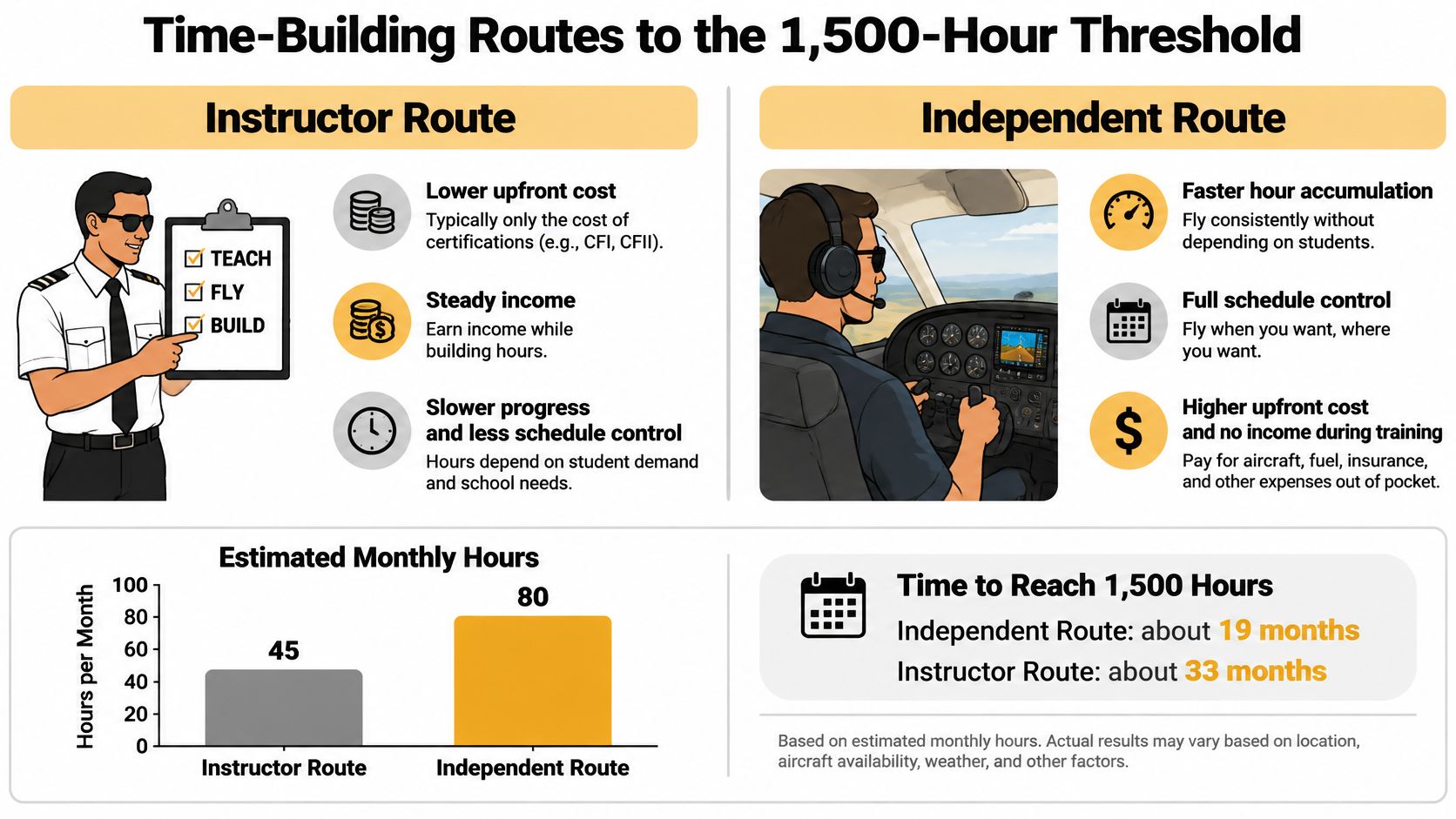
A new instructor can hold the right certificates and still be years from an airline-ready logbook. The conventional ATP route generally requires 1,500 total pilot hours, plus specified experience in areas such as cross-country, night, instrument, airplane class, and PIC time. See the FAA's ATP experience requirements. A large total alone does not satisfy every category.
Compare the routes by what they give up
Instructing lets you earn income while building time, but your hours depend on student demand, weather, aircraft access, and the school's schedule. Teaching can sharpen your explanations and decision-making. Before accepting a job, ask how instructors are assigned students and aircraft, and estimate your likely monthly flight time.
Cadet or pipeline programs can provide a defined sequence and a potential interview opportunity. Read the terms carefully: a structured pathway does not guarantee a job, and its conditions may restrict your options.
Other paid or self-funded flying may include charter or other work for which you qualify. Check the required experience categories before committing. A route that adds hours quickly can still be a poor choice if it leaves gaps in your logbook or costs too much in relocation, schedule, or lost income.
The infographic's time estimates are examples, not a forecast. Your pace depends on the work available, aircraft access, weather, and the experience you still need.
CFII's Career Track program is one initial-training option. The Southern California program lists fixed tuition of $89,000 for a zero-time pathway to CFII and multi-engine, with about nine months of training, 282 total hours, and six certificates and ratings. Those figures describe the program, not a guarantee of ATP eligibility or airline employment. Review what to expect after flight school before choosing a time-building route.
Financing the Training and the Real Cost Beyond Tuition
Tuition is easy to compare. Total cash exposure is harder, because it includes costs that may sit outside the program quote and expenses you incur while waiting for the next stage. Ask for a written estimate that spells out what's included and what you'll pay separately.
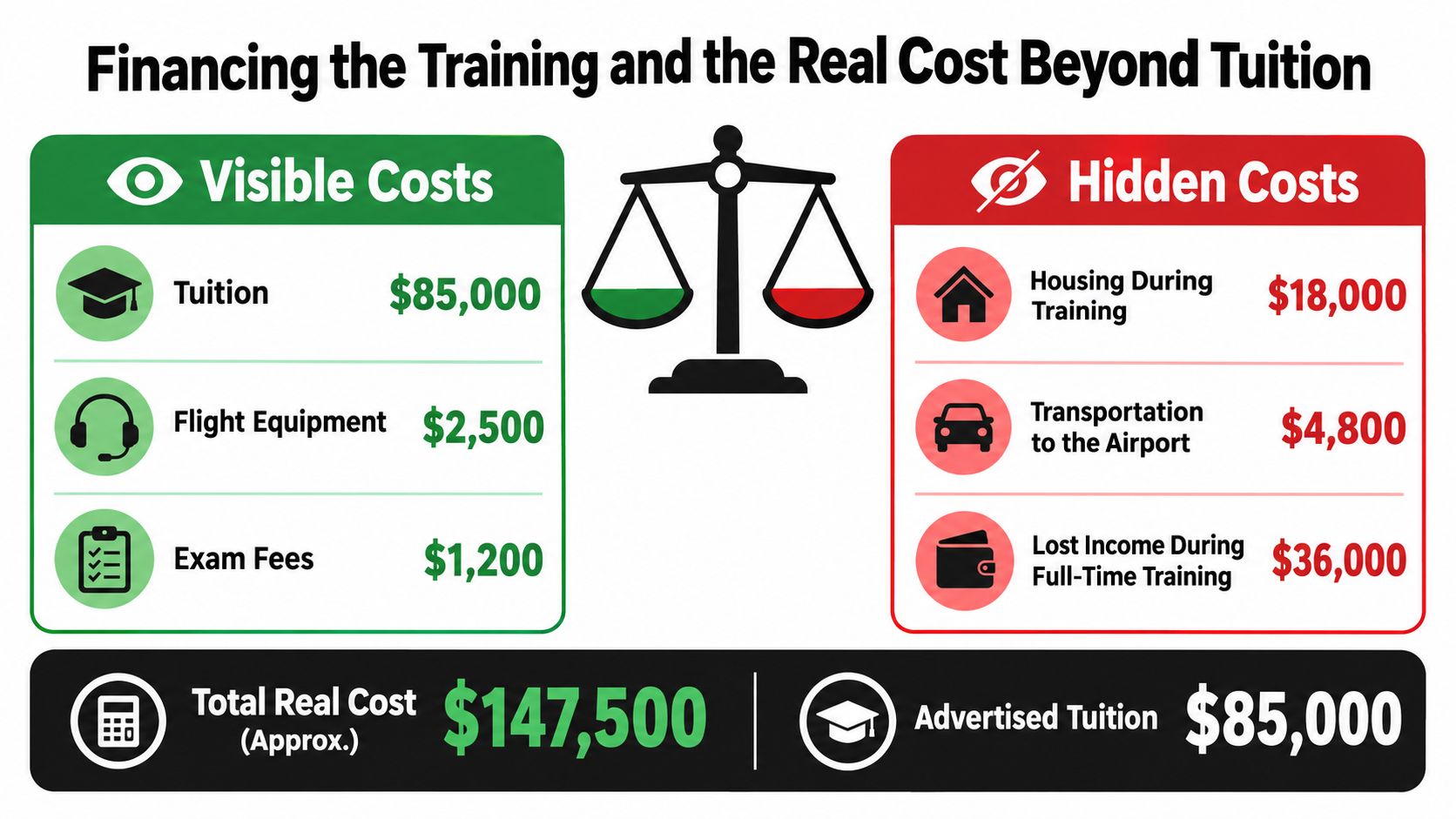
The image's dollar amounts are not a verified cost estimate for your circumstances. Use the categories below to build your own model instead:
- Training charges: Identify the quoted tuition and the certificates, ratings, hours, and instruction it covers.
- Living and travel: Add housing, meals, transportation to the airport, and any relocation expenses.
- Equipment and administration: Account for a headset and other equipment, medical appointments, written tests, examiner fees, and checkride travel.
- Delays and retakes: Allow for targeted retraining, extra aircraft rental, rescheduled tests, and time away from work if a checkride doesn't go as planned.
- Financing and income: Calculate interest and payment obligations under the loan terms, then estimate the income you may give up during training and the time before paid flying begins.
Run more than the on-schedule case
Create an on-schedule budget, then test what happens if weather or aircraft availability delays training, if a checkride needs another attempt, or if a medical issue requires additional review. Also model the period after graduation without assuming that a flying job begins immediately. A plan that stays workable under those conditions is more useful than a single optimistic total.
CFII lists Career Track tuition as $89,000 for its defined training pathway, but that figure alone doesn't tell you your full personal cost. Confirm exclusions and ask how your housing, travel, financing, and time between training and paid work change the total. Use this guide to the cost of commercial-pilot training to organize your questions, then compare written estimates on the same basis.
From Eligibility to Employability in a Variable Market
An ATP certificate makes you regulatorily eligible for the relevant work. It doesn't guarantee an interview, a class date, or a job offer. Airline recruitment depends on hiring cycles and company needs, and those can change while you're building experience.
Boeing's 2025–2044 forecast estimates worldwide demand for 660,000 new pilots. The same forecast says two-thirds of new aviation personnel will replace attrition, while one-third will support fleet growth. It also projects that Eurasia, China, and North America will account for more than half of personnel demand, with South and Southeast Asia expected to grow fastest. Boeing's 2025–2044 aviation personnel outlook That is evidence of long-term global demand, not a promise that every graduate will be hired quickly or in the country where they trained.
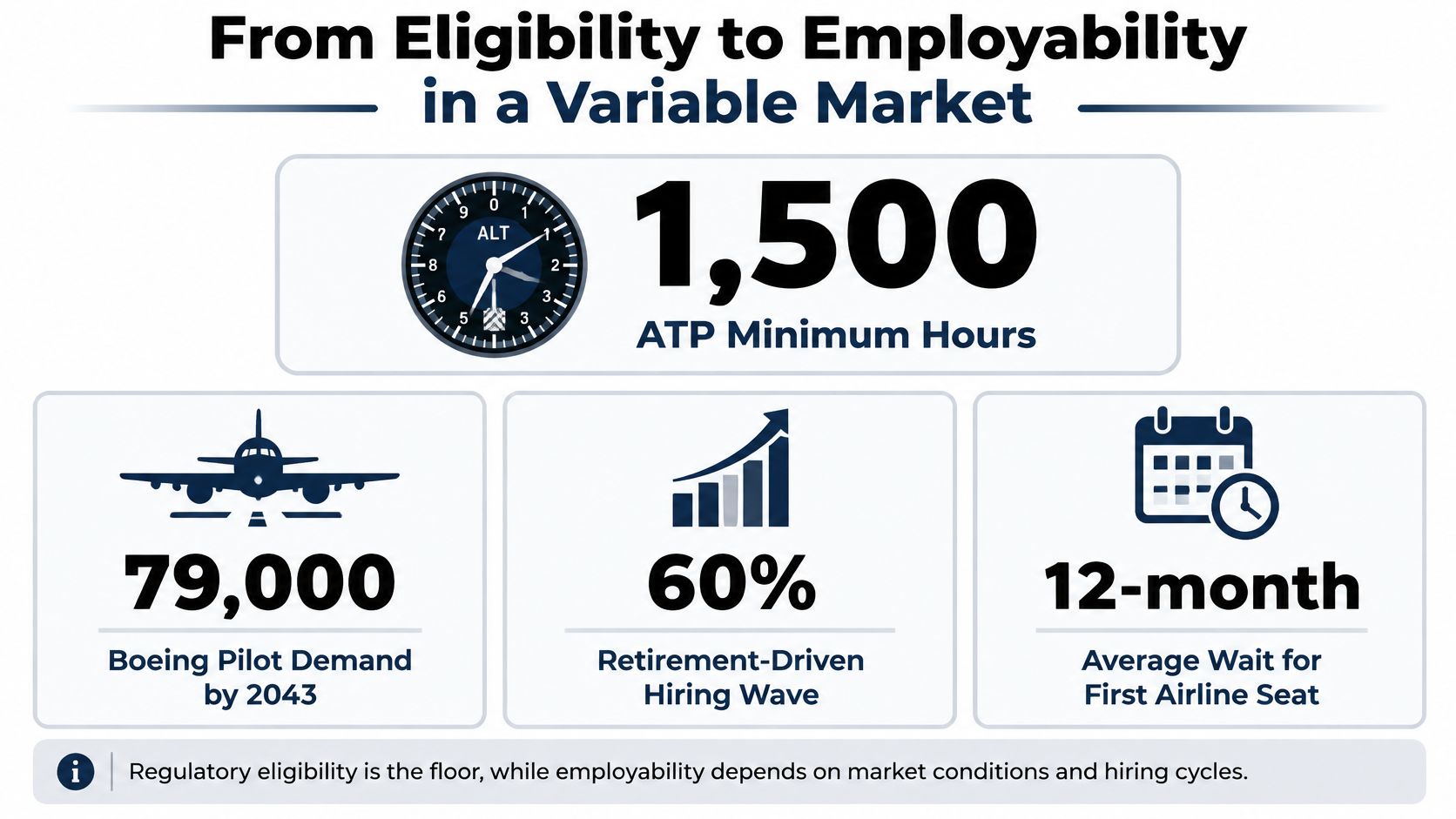
Don't use the infographic's other figures as a personal hiring forecast. The decision you need to make is whether your plan remains viable if recruitment slows, a class date moves, or you need to relocate. Check current hiring requirements directly with the employers you may apply to, and keep your work authorization and geographic flexibility in view.
Protect your options while you build
A strong plan doesn't depend on one airline hiring at the exact moment you reach minimums. It gives you a credible way to keep flying and earning if the airline application takes longer than expected. Instructing or other qualifying work may bridge the gap, but verify that the role fits your experience goals and personal finances.
Long-term demand and individual timing are different questions. Use U.S. airline pilot employment information for additional context, then make decisions using your own eligibility, location, and budget rather than a forecast alone.
A 30-Day Plan and Indicators to Watch Throughout Training
Use the next month to test whether your plan is workable, not to convince yourself that everything will go perfectly. Complete the steps that reduce uncertainty before you make a large commitment.
Your next steps
- If you haven't flown, book a discovery flight. Pay attention to how you feel doing the work, not just to whether the view is memorable.
- Address medical questions early. If you have a health concern, arrange an appropriate first-class medical consultation before committing substantial tuition.
- Request written estimates. Ask training providers to identify what the price includes and what sits outside it, including tests, examiners, equipment, and retakes.
- Build delay scenarios. Model your finances for the expected schedule and for a slower start or a gap before paid flying. Use your actual living costs and financing terms rather than a generic estimate.
- Audit the syllabus and logbook plan. Ask how you'll track PIC, cross-country, night, instrument, and aircraft-class experience, and how simulator time is documented.
Then monitor how the training is going. If a provider can't explain how its syllabus maps to required experience categories, ask for a clear answer before enrolling. If a quotation excludes written exams or examiner costs, add them to your budget instead of treating them as surprises.
Test performance is another useful control, but don't confuse written-test results with practical readiness. FAA 2025 data show a 91.25% first-attempt pass rate for the commercial pilot airplane knowledge test, based on 20,530 examinations. An industry summary of 2021 FAA practical-test data reported a 78% private-pilot pass rate. FAA test statistics and knowledge-test report Those figures describe different tests and shouldn't be treated as a direct comparison of individual schools. They do support a practical lesson: prepare for written exams with targeted study, and schedule checkrides only when your instructor can see consistent, safe performance.
Your aim isn't to predict every delay. It's to keep enough flexibility to respond before a small setback becomes a financial or training crisis. The best plan is the one that preserves options at each gate, not the one built on a single optimistic hiring forecast.
CFII's Career Track offers a fixed-price path from zero time through CFII and multi-engine training in Southern California, with six certificates and ratings and 282 total hours. If you want to review the program against your medical, training, and budget decisions, visit CFII.
Planning to fly for a living?
See what the path from zero to a pilot career looks like, what it costs and how long it takes.
Learn to fly in Riverside
We train at Riverside Municipal Airport in factory-new airplanes with a parachute built in. Start with a one hour discovery flight, no experience needed.