
On this page
- Understanding ATP CTP Eligibility Requirements
- Who actually needs the course
- Where the common confusion starts
- Certificate and Experience Prerequisites
- Start with the certificate you already hold
- Build the hours in the right order
- ATP CTP Course Structure and Hours
- Ground instruction and simulator time work together
- What to expect from an authorized provider
- Why the course feels dense
- Ground School Curriculum Content
- Why each topic matters in airline operations
- The human factors side is not optional
- Simulator Training Requirements Explained
- Full-flight simulator versus flight training device
- Why simulator training matters for the knowledge test
- ATP Knowledge Test Preparation Strategies
- Study for systems thinking, not flashcards alone
- Avoid the common traps
- Career Path After ATP CTP Completion
- What the certificate really signals
- How to think about the road ahead
- Quick Reference Checklist for Students
Are you sure the ATP CTP is only for pilots who already look airline-ready on paper, or is that assumption exactly what keeps people from planning the pathway correctly? The ATP Certification Training Program sits at the transition point between general aviation habits and airline operations, and that's why the ATP CTP requirements confuse so many pilots. The FAA built the program to bridge the knowledge gap between commercial flying and transport-category, multi-crew airline work, and the details matter before you ever sit for the knowledge test.
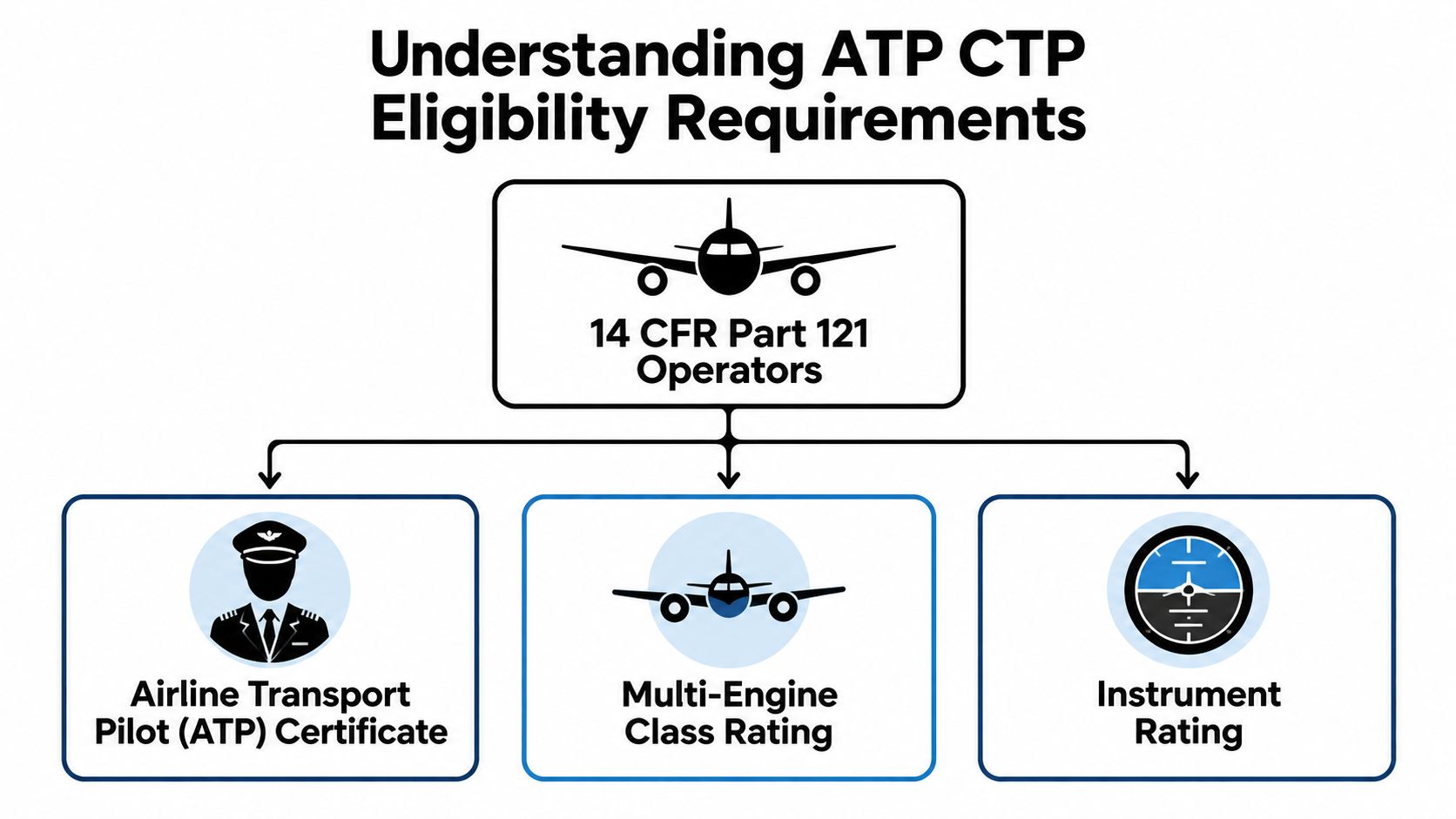
Understanding ATP CTP Eligibility Requirements
The biggest misconception is simple, and it causes avoidable delays. Many pilots think the ATP CTP is only for someone who already has the full airline package, but the FAA's guidance is broader than that. The course is required for most applicants seeking an ATP certificate with an airplane category multiengine class rating, or an ATP issued concurrently with an airplane type rating, and it is specifically designed to prepare pilots for operations that require an ATP by rule (FAA ATP CTP guidance).
Who actually needs the course
If you're aiming for the multi-engine ATP pathway, the ATP CTP is part of the process before the knowledge test. That doesn't mean you need to be at the finish line to begin training. FAA and industry summaries note that enrollment can be open to pilots with a private certificate, qualifying military experience, or a qualifying ICAO foreign license, as long as English proficiency is met (ATP Academy eligibility overview).
The practical question is not, “Am I airline-ready yet?” It's, “Do I qualify for the course that bridges me into airline-level knowledge?”
That distinction matters for career changers and international pilots, because the program is built to close a knowledge gap, not just reward already-high flight time.
Where the common confusion starts
A lot of online descriptions oversimplify the path as “commercial multi-engine plus instrument.” That shortcut is incomplete. The FAA's own framing is broader, and the course can be taken before a pilot has finished every final ATP milestone, as long as the applicant fits the eligibility pathway for the program and later presents the completion certificate before the knowledge test (FAA ATP CTP guidance).
For readers comparing training paths, the FAA's structure is easier to understand when viewed alongside a simple comparison of route options, and this ATP comparison guide helps frame the decision without blurring the regulatory lines.
Certificate and Experience Prerequisites
The ATP CTP sits inside a larger certification sequence, so the first mistake is treating it like a standalone class. It isn't. For most applicants, the traditional ATP benchmark remains 1,500 total flight hours, plus experience minima such as 500 hours cross-country, 100 hours night, 75 hours instrument, and 250 hours as pilot in command (AOPA ATP overview).
Start with the certificate you already hold
Most pilots entering this stage already hold a commercial pilot certificate with an instrument rating, or they qualify through an equivalent pathway. That matters because the ATP CTP is not designed to teach basic airmanship. It assumes you already know how to operate safely as a commercial pilot, then it adds the airline-specific reasoning that general aviation training usually doesn't cover.
A good way to think about it is this, first you qualify to learn airline operations, then you qualify to be tested on them. The ATP CTP completion certificate becomes the gatekeeper to the ATP knowledge test, so missing the prerequisite certificate path can stall you even if your logbook looks healthy.
Build the hours in the right order
The hour minimums are not a suggestion, and they're not interchangeable. Cross-country time, night time, instrument time, and pilot-in-command time each serve a different purpose in proving you've seen enough varied flying to move into the ATP standard. That's why logbook review is so important before you schedule the course.
Practical rule: Don't treat total time as the only metric. A pilot can be close on total hours and still be short on a sub-requirement that blocks the next step.
This is also where the sequence matters. The ATP CTP helps you prepare for the knowledge test, but the full ATP certificate still depends on the broader flight experience threshold. If you're comparing how commercial training fits into that sequence, the commercial pilot requirements guide is a useful reference point for seeing what you should already have in place before ATP-focused training becomes efficient.
ATP CTP Course Structure and Hours
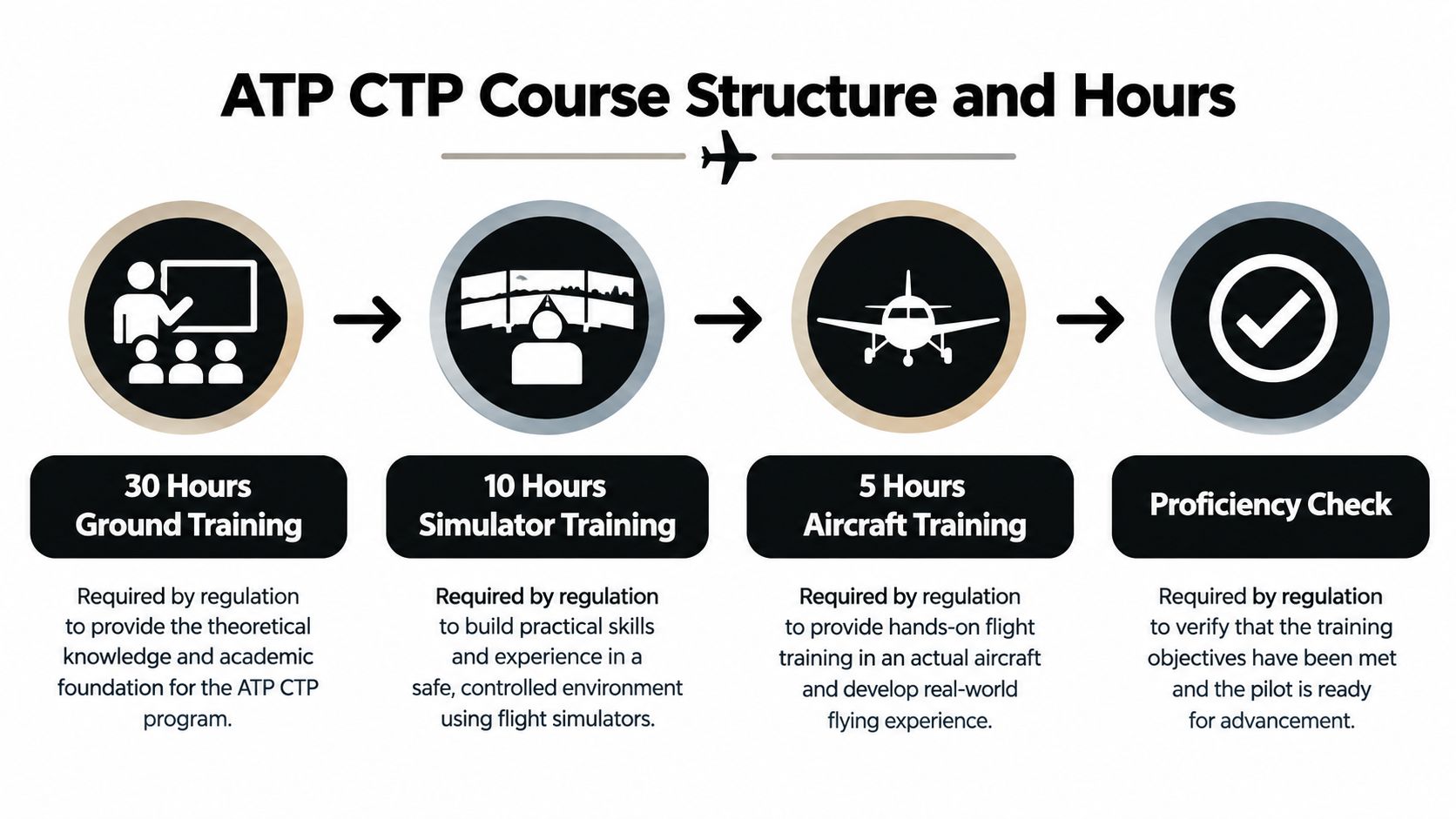
How does the ATP CTP move a commercial pilot toward airline-level operations? Its required hours provide the answer. Under 14 CFR 61.156, the course includes at least 30 hours of classroom instruction and at least 10 hours of training in a flight simulation training device qualified under 14 CFR part 60 (FAA Advisory Circular AC 61-138).
Ground instruction and simulator time work together
The two parts follow a deliberate progression. Classroom instruction establishes the concepts behind transport-category operations. Simulator training then gives you a controlled setting to apply those concepts while managing systems, workload, and crew decisions.
FAA guidance divides the simulator requirement into 6 hours in a Level C or higher full-flight simulator and 4 hours in a Level 4 or higher flight training device (FAA ATP CTP guidance). The device levels matter because they indicate the type and fidelity of training environment you should expect.
Consider the change in perspective. In general aviation, you may focus on aircraft control and completing a flight safely. In airline operations, you must also interpret system indications, assess performance, coordinate with another pilot, and make decisions within an organized operation. The simulator hours give that knowledge a practical setting.
What to expect from an authorized provider
Before enrolling, ask the provider to show the course schedule and identify each training device. Confirm the classroom hours, the simulator categories, and how the required simulator time is allocated. A vague calendar or unclear device description makes it harder to verify that the program matches the regulatory standard.
Why the course feels dense
The ATP CTP places airline concepts into a concentrated training block. That pace reflects the transition from commercial flying to transport-category operations, where pilots must understand how a flight is organized, managed, monitored, and conducted by a crew.
Use each phase to prepare for the knowledge test. During ground lessons, connect regulations and systems to operational examples. During simulator sessions, ask why a decision is made, what information supports it, and how the crew communicates it. This approach helps bridge the gap between knowing a definition and applying it in an airline scenario.
Ground School Curriculum Content
The classroom portion separates the ATP CTP from general aviation training because it asks you to think like an airline pilot before you ever step into the simulator. The FAA frames the curriculum as foundational, and that fits the job. You need a working grasp of transport-category aerodynamics, automation, adverse weather, air carrier operations, performance, professionalism, and leadership.
Why each topic matters in airline operations
A transport jet reacts differently than the aircraft most pilots first learn in. Automation matters because airline crews manage systems and verify outcomes, rather than flying every segment by hand. Adverse weather matters because dispatch, alternates, and route choices are built around keeping the flight on schedule and within limits.
Air carrier operations and performance show how a flight is scheduled, dispatched, and monitored from the ground and from the cockpit. Leadership and professionalism matter because a transport cockpit works as a crew, with clear roles and shared responsibility. The curriculum closes the gap between general commercial flying and the way airline operations are run.
The human factors side is not optional
CRM needs special attention because the ATP CTP is teaching you how to function under airline workload. You are expected to understand communication, delegation, monitoring, and how crew decisions are made in a structured setting. That skill set is different from flying alone or with little crew support.
Instructor note: If a topic sounds “soft,” assume the FAA included it because it shows up in real operational decisions.
The material sticks better when you connect each subject to a cockpit choice. A weather briefing, for example, quickly turns into fuel planning, routing, diversion options, and arrival management. Performance ties the airplane, the runway, and the operating rules together, so the numbers on the page become a decision you can use in practice.
Simulator Training Requirements Explained
Simulator time is where the ATP CTP starts to feel like airline training. The FAA requires at least 10 hours in a qualified training device under part 60, and that time is split between Level C or higher full-flight simulation and Level 4 or higher training device work.
Full-flight simulator versus flight training device
A Level C full-flight simulator gives you the closest match to a transport-category cockpit, especially when the lesson turns to system response, abnormal procedures, and crew coordination. A Level 4 flight training device serves a different purpose. It is still useful, but it is better suited to procedural work and systems practice than to the highest level of realism.
The course uses both tools for a reason. The simulator gives you the “real airplane” feel for checklists, callouts, and timing, while the training device lets instructors repeat scenarios without wasting time on basic orientation. In practice, that mix lets a student rehearse the flow of an airline session before ever stepping into an actual crew environment.
One common session might start with a normal departure, then shift into a reroute, a fuel review, and a late change to the arrival plan. That is where workload management becomes visible. You must keep monitoring the flight path, confirm what the other pilot is doing, and protect the big picture while the details keep changing.
Real airline judgment starts to develop when you are managing workload in a busy scenario, not just locating switches.
This simulator training video helps show the cockpit mindset the course is trying to build.
Why simulator training matters for the knowledge test
The ATP knowledge test is not a simulator check, but simulator sessions make the written material easier to apply. A pilot who has only memorized terms can miss the logic behind a question. A pilot who has practiced the same ideas in a sim usually recognizes how the pieces fit together.
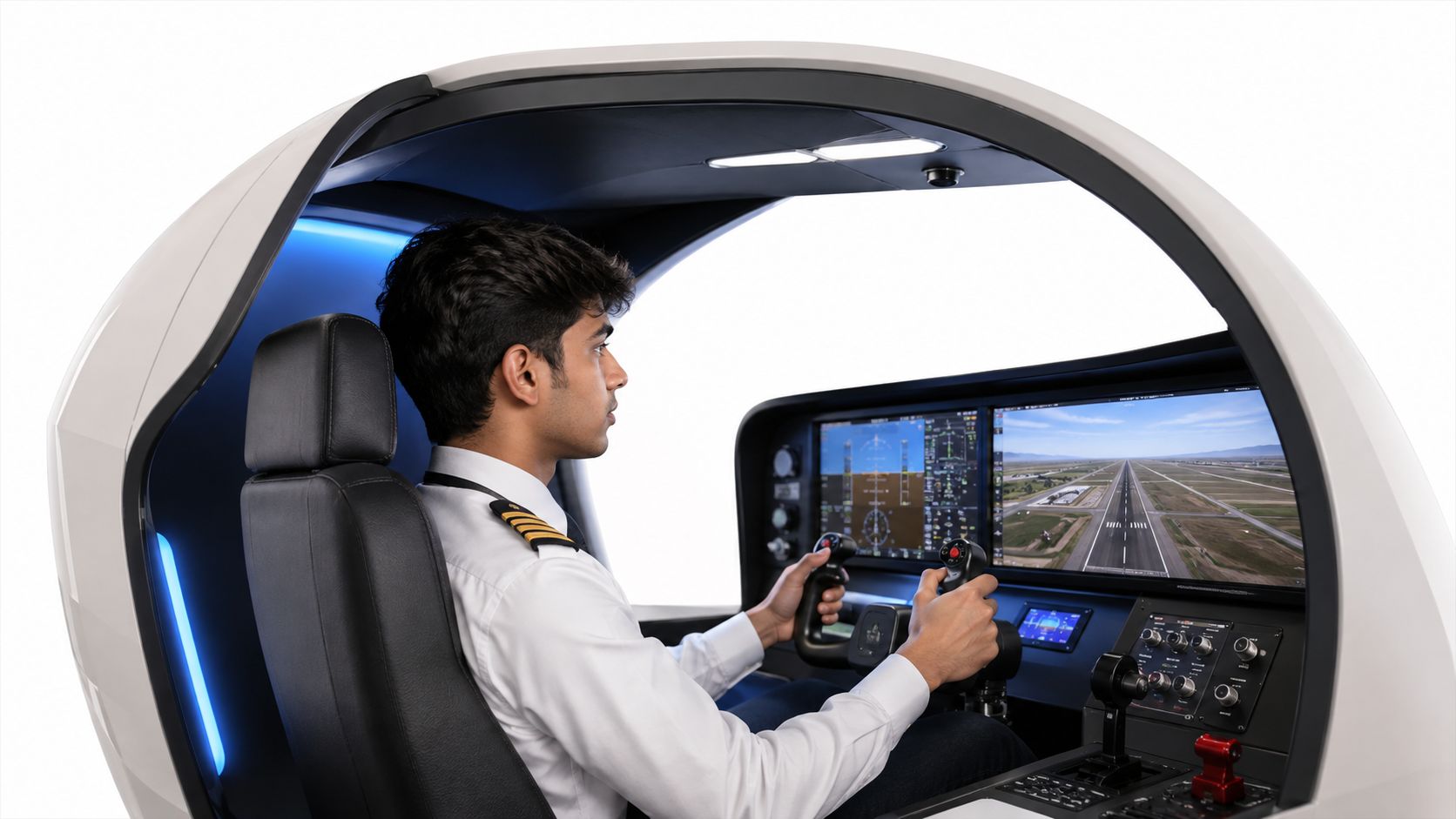
The best providers use the simulator block to reinforce monitoring, checklist discipline, and crew communication. That is why the training feels closer to airline preparation than to conventional flight instruction.
ATP Knowledge Test Preparation Strategies
The ATP CTP completion certificate gets you to the test gate, but it doesn't replace study. That's where many pilots waste time. They assume the course itself will carry them through the written exam, then they discover too late that the ATP knowledge test expects them to connect concepts, not just repeat definitions.
Study for systems thinking, not flashcards alone
A strong study plan starts with the way airline operations fit together. Weather affects dispatch, dispatch affects fuel and alternates, performance affects runway use, and crew coordination affects how all of that gets managed in the cockpit. If you study each subject as an isolated chapter, the test feels harder than it needs to.
Use the ATP CTP classroom material as the framework, then build your review around scenarios. Ask yourself what the captain and first officer need to decide, what information matters most, and which aircraft limitations change the outcome. That kind of practice is much closer to how the written test is built.
Avoid the common traps
Most weak prep plans fail for the same reasons. The student starts too late, reviews passively, or relies on a single memory tool without checking understanding. Another common mistake is ignoring the simulator lessons, even though those sessions often make the written topics easier to recall.
The fix is straightforward, but it takes discipline.
- Review after each lesson: Rework notes the same day so the material stays fresh.
- Use scenario-based questions: Tie each answer to an operational situation, not just a definition.
- Track weak topics early: Don't wait until the end of the course to discover where the gaps are.
- Study the language of airline operations: Terms like crew coordination, performance margins, and adverse weather carry more weight than they do in private training.
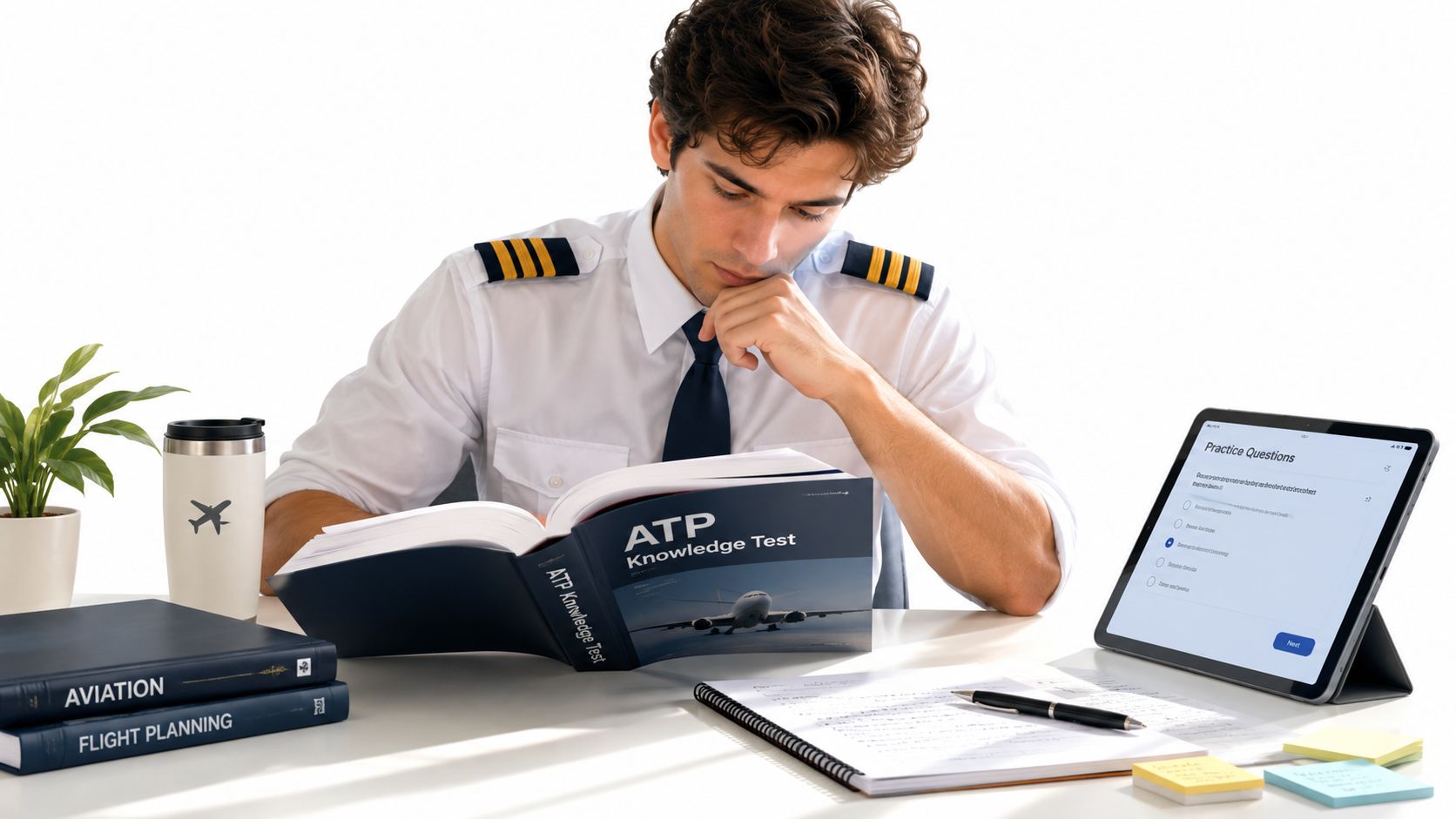
If you like structured prep tools and instructor support, CFII's Career Track program is one training option that pairs study resources with a longer certification path, though it's not a substitute for ATP CTP-specific preparation. The key is still the same, build understanding before you walk into the test room.
Career Path After ATP CTP Completion
What changes after ATP CTP? The course does not finish the airline track, but it does move you across an important boundary in training. You are no longer just building general aviation judgment. You are learning the transport-category mindset that airline operations demand.
In part 121 airline operations, FAA guidance says both pilot in command and second in command crew members are required to hold an ATP certificate. That requirement explains why ATP CTP matters early in the process. It sits between commercial flying and the ATP certificate itself, much like a bridge that connects two different kinds of training.
What the certificate really signals
The ATP CTP completion certificate shows the FAA that you have finished the required bridge training and may sit for the knowledge test. For employers, it signals something slightly different. It shows you understand that airline flying is not just more flying, it is a different operational standard.
The course does not make you airline-ready on its own. It does show that you have started the transition in the right order.
What comes next depends on your place in the sequence. For many pilots, the next steps are test preparation, hour building, and the remaining ATP certificate requirements. Others are following a larger plan that includes type ratings or other airline-related milestones.
How to think about the road ahead
Treat ATP CTP as the point where your training starts to match airline work. The material is meant to carry into the knowledge test, interviews, simulator evaluations, and the decision-making habits airlines expect from new hires.
The quickest way to lose momentum is to separate course completion from career planning. Keep the next milestone in view, whether that is the knowledge test, more flight time, or the job application phase. If you want structured study support, the Career Track program is one option some pilots use alongside ATP CTP preparation.
Once you see how ATP CTP fits into the larger certification path, your choices become clearer and your study plan is easier to organize.
Quick Reference Checklist for Students
What should you check before you enroll or schedule the ATP CTP? Use this as a decision tree, not a memorization drill. Each item tells you whether you are still building the base layer or are ready for the airline-transition phase.
| Milestone | What to confirm | Why it matters |
|---|---|---|
| Eligibility path | You fit the FAA pathway for ATP CTP enrollment | Prevents starting the course before you are eligible |
| Prerequisite certificate | You hold the needed commercial-level certificate and instrument qualification, or another qualifying route | ATP CTP assumes you already have the pilot skills it builds on |
| Experience benchmark | Your logbook supports the ATP experience path you are pursuing | The ATP certificate still depends on your total experience, as outlined in the AOPA ATP overview |
| Classroom training | You can complete the required ground instruction | The course includes the classroom side of the bridge training |
| Simulator training | You can complete the required simulator portion | The simulator work helps connect general aviation habits to airline procedures |
| Knowledge test access | You have the completion certificate before testing | The certificate is the entry ticket to the ATP knowledge test, consistent with FAA AC 61-138 |
A fast self-check keeps the path clear.
- Check your logbook entries. Gaps or mismatched categories can slow everything down.
- Confirm your certificate route. A rating you already hold may help, but it does not replace a required prerequisite.
- Match your study plan to the test. The course is meant to prepare you for ATP-style thinking, not just seat time.
- Keep records together. Completion documents, training notes, and logbook pages should be easy to find when you need them.
- Plan the next step early. If the knowledge test is your next milestone, prepare for it before the course ends.
CFII can help you organize your broader pilot training path with structured instruction, study support, and coordinated certification planning. If you want a clear path through the next stage of your aviation training, visit CFII and see how their programs fit into your goals.
Planning to fly for a living?
See what the path from zero to a pilot career looks like, what it costs and how long it takes.
Learn to fly in Riverside
We train at Riverside Municipal Airport in modern airplanes with a parachute built in. Start with a one hour discovery flight, no experience needed.