
On this page
- What a Sport Pilot License Actually Is
- Separate the credential from the privileges
- Ask three questions before choosing training
- Why the FAA Created the Sport Pilot Certificate
- Less medical administration, not less responsibility
- Match the policy to your purpose
- Who Can Earn a Sport Pilot License
- Check the medical pathway before assuming it works
- Use a realistic applicant self-check
- Training, Flight Hours, and the Checkride
- Build competence alongside flight time
- Student privileges have their own boundaries
- Treat the practical test as a readiness decision
- Aircraft and Operating Limits After MOSAIC
- Check the aircraft against the rule
- Don't turn an aircraft change into an operating assumption
- Sport Pilot vs Private Pilot Compared
- Sport Pilot vs Private Pilot at a Glance
- Audit future credit before buying the stepping stone
- Costs, Timeline, and the Career Path Question
- Compare scope before comparing totals
- Decide whether recreation is a destination or a detour
- Your Next Step as an Aspiring Pilot
- Make your decision this week
A sport pilot license is the FAA's 2004 recreational pilot certificate that lets qualified pilots fly qualifying light-sport aircraft during daytime VFR with no more than one passenger, using either a valid U.S. driver's license or a third-class medical certificate for medical eligibility. That familiar definition needs an important update: today, aircraft eligibility depends on regulatory performance and design requirements, not just the light-sport label.
You're probably comparing training options, wondering whether you need an FAA medical, and trying to avoid spending money on the wrong certificate. Perhaps you'd like to fly recreationally first, but an airline cockpit is already somewhere in your plans.
The confusing part is that older explanations can describe a different regulatory environment. A useful decision starts with your intended flying, your medical eligibility, and the aircraft you'll train in, not whichever certificate sounds quickest.
What a Sport Pilot License Actually Is
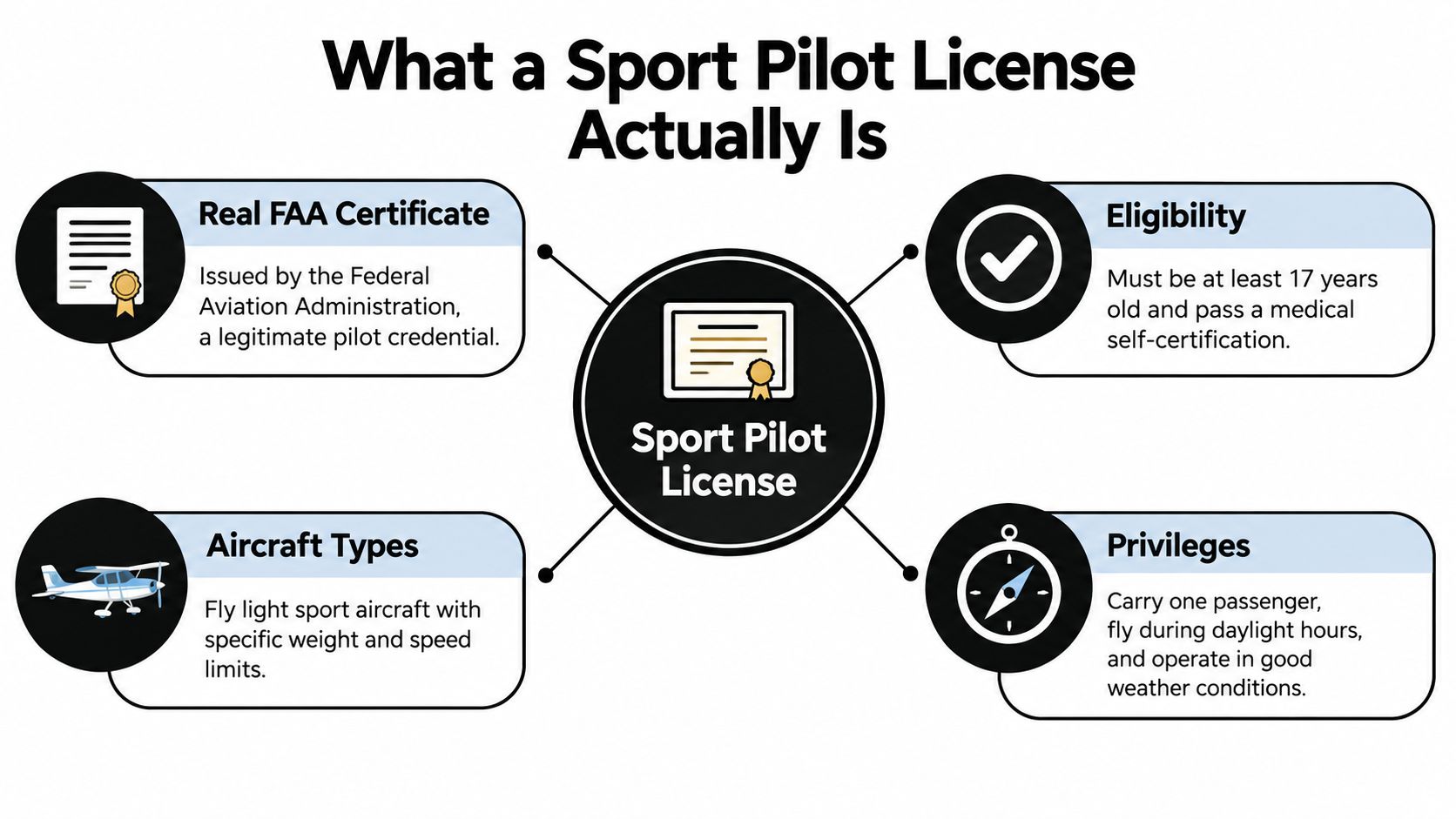
A sport pilot license is a real FAA pilot certificate for limited recreational flying. Pilots commonly say “license,” but the FAA calls the credential a certificate.
It isn't a private pilot certificate with some lessons removed. The FAA describes sport pilot certification as a distinct pathway with its own eligibility requirements, training, testing, and privileges in its sport pilot certification overview.
Think of a pilot certificate as permission to operate within a defined envelope. Training teaches you how to fly safely inside that envelope. Endorsements can authorize particular additional operations, but they don't turn the certificate into an unrestricted qualification.
Separate the credential from the privileges
When a new student asks whether sport pilot is “a real license,” the answer is yes. When that same student asks whether it qualifies them for professional flying, the answer is no.
The practical distinction is between earning a credential and earning the privileges your goal requires. A recreational certificate can be a worthwhile destination without being the right starting plan for someone committed to paid flying.
This concept map introduces the basic framework. Treat its simplified labels as orientation, not as a substitute for the current regulations.
Ask three questions before choosing training
- Medical eligibility: Can you legally use the driver's-license pathway, or do you need a medical certificate?
- Training scope: Will the instruction prepare you for the flying you want to do, rather than help you reach a minimum?
- Aircraft compatibility: Does the specific aircraft qualify under the current rules, and do you have the required privileges and endorsements?
Those questions matter more than the certificate's informal name. They also expose where a seemingly inexpensive first step might leave you needing additional training later.
For a prospective career pilot, my recommendation is to choose the destination before buying the first stage. Recreational flying and professional training can share an interest in aviation without sharing the same best route.
Why the FAA Created the Sport Pilot Certificate
The FAA established the sport pilot certificate in 2004 as part of a national framework for sport pilots and light-sport aircraft. Its foundational purpose was to allow qualified people to fly eligible aircraft without holding an FAA medical certificate, provided they met the alternative medical requirements and operating rules.
That purpose explains the certificate better than calling it an easier private pilot license. The FAA created a bounded recreational pathway, not a workaround for professional certification.
Less medical administration, not less responsibility
A medical alternative changes how a pilot demonstrates eligibility. It doesn't eliminate the pilot's responsibility to recognize when flying would be unsafe.
Consider someone who wants to make local recreational flights and doesn't need the broader privileges associated with private or professional qualifications. A separate certificate can fit that person's intended activity without requiring the same medical-administration pathway.
The governing framework sits in 14 CFR Part 61, Subpart J. Its structure separates eligibility, training, aircraft qualification, and operating privileges rather than treating possession of a certificate as blanket permission.
Instructor's perspective: A narrower certificate can be a sensible choice when the narrower mission is genuinely the mission you want.
Match the policy to your purpose
For a weekend flyer, the appeal is straightforward: train for a defined recreational role and satisfy the applicable medical alternative. For someone planning a flying career, the same boundaries deserve closer attention.
- Recreational destination: You want the activity the certificate is designed to authorize.
- Exploratory stage: You're interested in flying but haven't decided whether to pursue a career.
- Professional destination: You already know you'll need qualifications beyond sport pilot privileges.
My analysis is that the middle group needs the most careful planning. A sport certificate may provide a meaningful recreational milestone while someone evaluates a career, but it shouldn't be sold as automatic progress through every later requirement.
The policy lesson is simple: the FAA reduced certain barriers for a limited flying mission. It didn't erase the distinction between recreational and professional pilot qualifications.
Who Can Earn a Sport Pilot License
Suppose you're an adult applicant with a current driver's license, no flying experience, and a question about a prescription medication. Your age may be straightforward, but the license alone doesn't settle medical eligibility.
Under the FAA eligibility framework introduced earlier, applicants generally must be at least 17, or 16 for glider or balloon privileges, and must be able to read, speak, write, and understand English. Meeting those basic conditions still leaves training, testing, and medical eligibility to address.
Check the medical pathway before assuming it works
The FAA generally permits either a valid pilot medical certificate or a current, valid U.S. driver's license, subject to restrictions. Its medical guidance for sport pilot operations identifies 14 CFR §§ 61.3, 61.23, 61.53, and 61.303 as governing provisions.
The driver's-license option is conditional. Under that guidance:
- License restrictions apply: You must comply with restrictions on the license and judicial or administrative orders affecting motor-vehicle operation.
- Medical denial matters: You can't assume the alternative remains available after a disqualifying FAA medical denial.
- Previous FAA actions matter: A revoked or suspended medical certificate, or a withdrawn special-issuance authorization, can prevent use of the alternative.
- Your present condition matters: You must not know, or have reason to know, that a medical condition would make safe operation impossible.
These aren't boxes to interpret optimistically. They're reasons to get qualified advice before relying on the alternative.
Use a realistic applicant self-check
For the applicant taking medication, the useful question isn't merely whether the driver's license is valid. It's whether the condition, treatment, restrictions, and medical history permit the intended operation.
A recent DUI deserves careful review because license restrictions and court or administrative orders can matter. A progressive vision condition deserves medical advice even if the person still holds a driver's license. Neither example supports an automatic yes or no without the relevant details.
A valid driver's license isn't a declaration that every medical condition is compatible with flying.
If you hope to fly professionally, discuss your longer-term medical requirements with an Aviation Medical Examiner early. Don't assume the sport pathway answers the medical question for a future airline career.
Keep the paperwork separate, too. Understanding the student pilot certificate helps distinguish student authorization from medical eligibility and the eventual sport pilot certificate.
Training, Flight Hours, and the Checkride
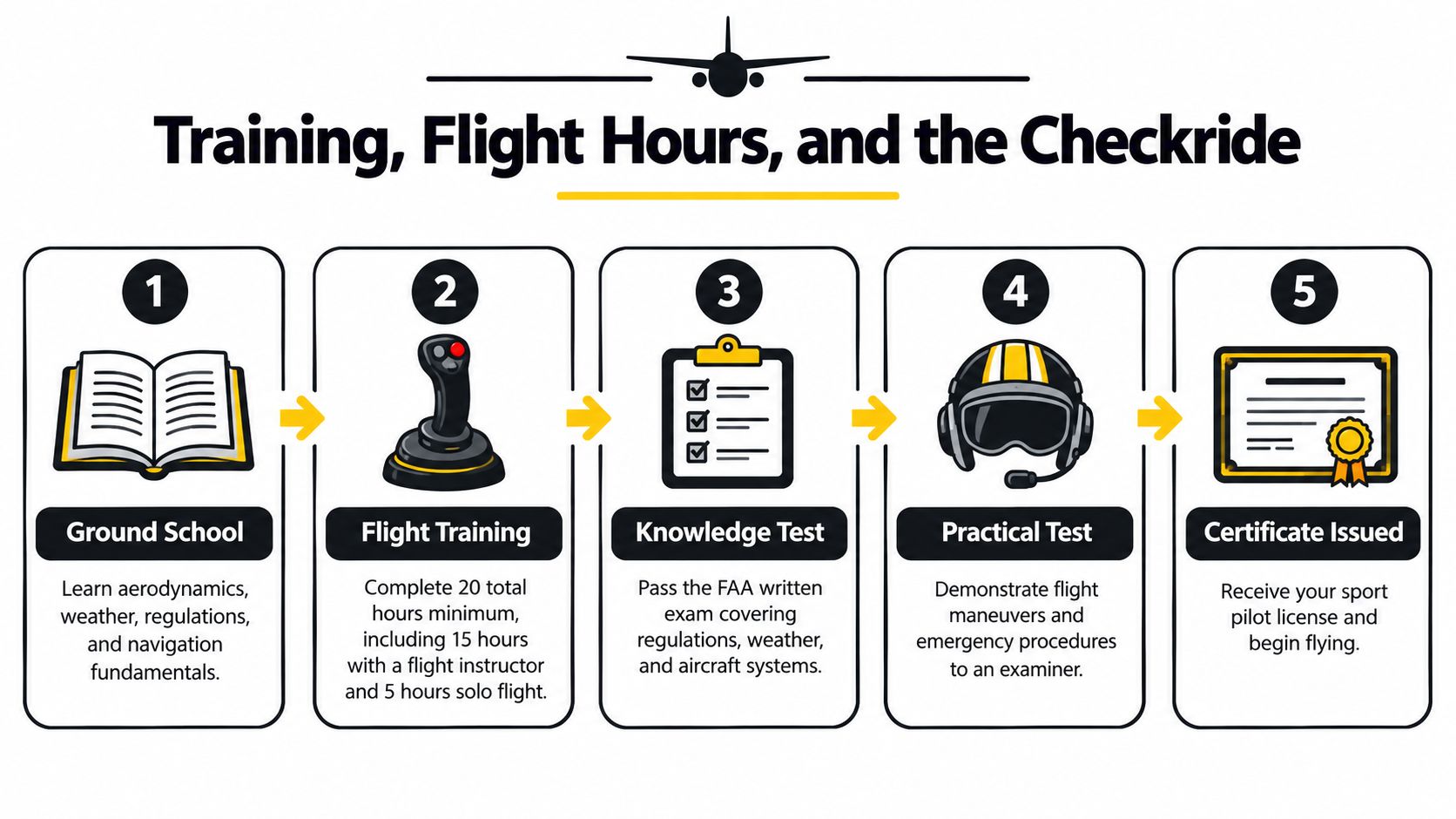
The airplane sport pilot minimum is 20 hours of flight time, including 15 hours of dual instruction and 5 hours of solo flight, followed by knowledge and practical testing, as summarized in the FAA sport pilot training brochure.
Those are minimum requirements, not a guaranteed completion schedule. Your instructor should plan around demonstrated readiness, not promise that the certificate will arrive as soon as your logbook reaches the threshold.
The training sequence is easier to understand when ground learning and cockpit practice are connected.
Build competence alongside flight time
Ground training and flight training serve different purposes. Reading about a maneuver helps you understand the objective; practicing with an instructor develops your ability to perform it while managing the aircraft.
A useful study routine is to prepare before a lesson, identify questions during the briefing, and review the instructor's feedback afterward. Ask what you should be able to explain and demonstrate before the next flight.
- Before the lesson: Review the assigned material and write down uncertainties.
- During the briefing: Connect the lesson to the aircraft and planned operation.
- After the flight: Record what needs improvement, rather than only recording time.
Student privileges have their own boundaries
Under § 61.89(c), a student seeking sport pilot privileges may not act as pilot in command at night or above 10,000 feet mean sea level or 2,000 feet above ground level, whichever is higher; operations in specified controlled airspace and at towered airports require the training and endorsement under § 61.94, with applicable aircraft training and endorsements under § 61.327, as explained in the FAA student sport pilot guidance.
That means an instructor's permission to solo an aircraft doesn't automatically authorize every airport or route. Ask which endorsements your proposed flight requires before planning it.
This video provides another way to approach the training discussion.
Treat the practical test as a readiness decision
The checkride is the practical test, not another hour-building lesson. Use this explanation of what a checkride involves to prepare questions for your instructor about the applicable standards and test format.
Don't budget around an assumed examiner wait or a universal “typical” completion time. Get current scheduling information locally, and leave room for additional preparation when your instructor identifies a weakness.
Aircraft and Operating Limits After MOSAIC
The biggest mistake in an older sport pilot guide is treating the former light-sport-aircraft definition as the complete answer to what you can fly.
The FAA published its MOSAIC final rule on July 24, 2025, with initial provisions effective October 22, 2025, and additional provisions effective July 24, 2026; the FAA MOSAIC fact sheet describes removal of prior weight and airspeed limits, broader aircraft eligibility, powerplants other than turbojets, and provisions for retractable gear, controllable-pitch propellers, and certain four-seat airplanes with a two-person onboard limitation.
Those changes broaden the available aircraft. They don't make every aircraft legal for every sport pilot.
An aircraft's appearance tells you very little about the regulatory checks required before flying it.
Check the aircraft against the rule
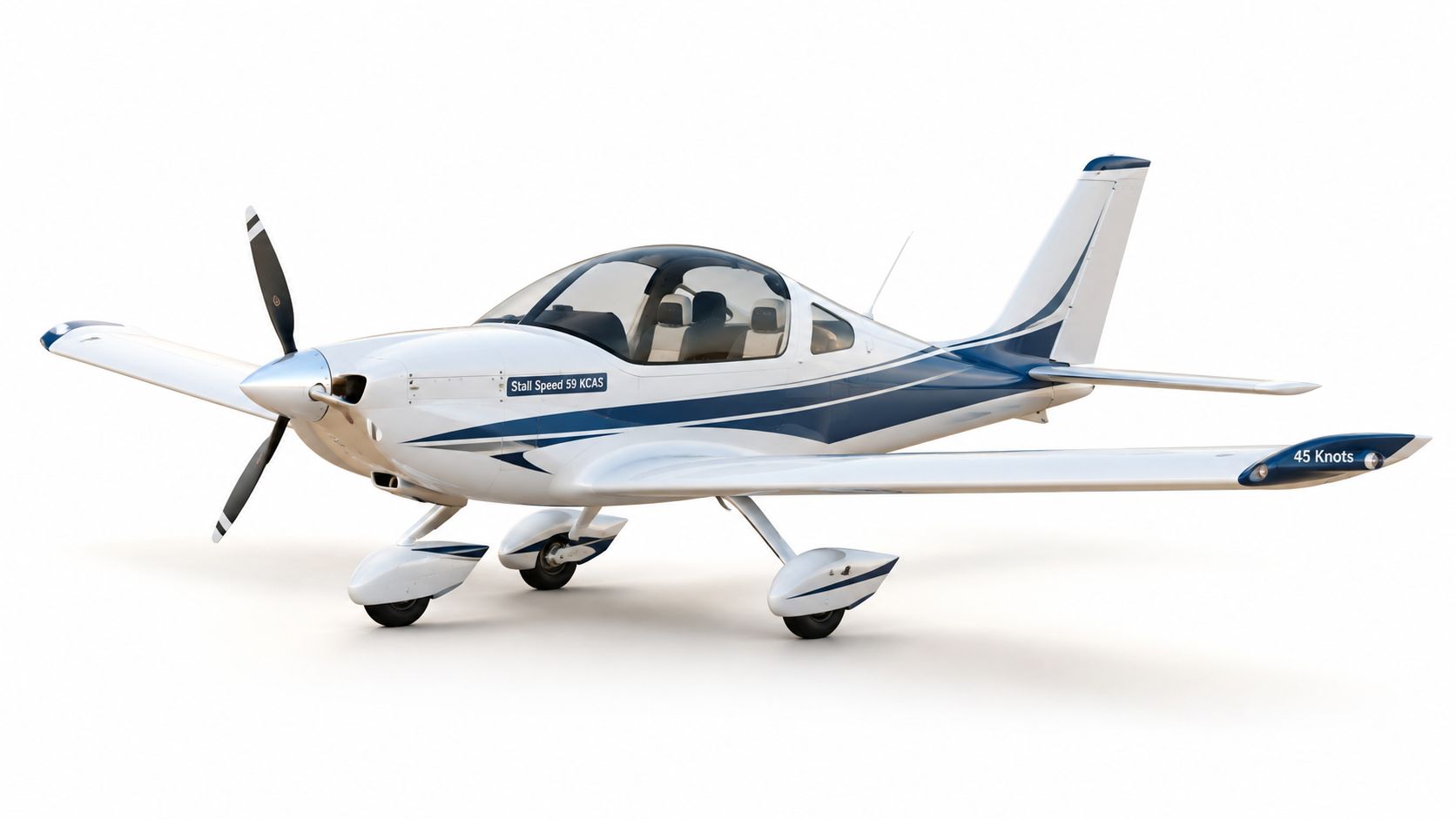
Under 14 CFR § 61.316, the airplane stall-speed ceiling without lift-enhancing devices is 59 knots calibrated airspeed, measured at maximum certificated takeoff weight and the most critical center of gravity; the broader rule specifies 45 knots for other applicable categories, with aircraft qualification and additional endorsement requirements addressed in the current sport pilot regulations.
That's a regulatory measurement condition, not a number to estimate from a familiar approach speed. You need the relevant aircraft documentation and the correct configuration.
A useful mental model is a pair of gates. The aircraft must qualify, and the pilot must separately qualify to operate it.
- Aircraft gate: Verify the applicable performance and design characteristics.
- Pilot gate: Verify your category privileges, training, and endorsements.
- Operation gate: Verify that the flight itself falls within your authorized privileges.
Retractable landing gear and a manually controllable-pitch propeller deserve explicit discussion with your instructor. Their availability under the framework doesn't replace the required additional training and endorsement.
Don't turn an aircraft change into an operating assumption
Consider a rental airplane with more seats than you're authorized to fill. Its seating configuration doesn't increase your passenger privilege. Likewise, permission to operate a particular aircraft doesn't automatically authorize a controlled-airspace operation.
Daytime recreational flying remains a useful baseline for planning, but don't use an older blanket statement about night operations as a complete post-MOSAIC answer. Check the current Subpart J requirements for the intended operation, including any additional medical, training, and endorsement conditions.
For cross-country planning, distinguish aircraft capability from visual flight rules. An airplane's equipment or performance doesn't by itself authorize the pilot to undertake a flight outside their privileges.
Before renting: Ask the instructor to verify the actual aircraft configuration and your proposed mission, not merely confirm that the model is commonly used for training.
Sport Pilot vs Private Pilot Compared
The useful comparison isn't “small certificate versus big certificate.” It's whether each qualification supports the missions you intend to fly.
For a new career-minded student, a private pilot certificate is the more relevant planning reference. That doesn't mean private pilots have unlimited privileges, or that private certification alone authorizes professional employment.
Sport Pilot vs Private Pilot at a Glance
| Criterion | Sport Pilot | Private Pilot |
|---|---|---|
| Passengers | Restricted passenger privilege, even when an eligible aircraft has additional seats | Broader passenger-carrying scope, subject to aircraft and operating requirements |
| Night operations | Don't assume baseline privileges suffice; verify current additional requirements | A broader planning option, subject to applicable qualifications and currency |
| Airspace | Specific additional training and endorsements matter | Broader access doesn't eliminate clearances or other operating requirements |
| Compensation | Not a commercial-employment certificate | Not a general authorization to be paid to fly |
| Aircraft | Must meet sport pilot aircraft requirements | Appropriate aircraft qualifications still matter |
| Career planning | Potential recreational stage before further training | More directly aligned with planning for advanced qualifications |
Use this private pilot privileges guide to frame a discussion with your instructor. Avoid descriptions that say a private pilot can fly “in all airspace” or carry anyone whenever there's an empty seat.
Audit future credit before buying the stepping stone
The career-critical question is how your planned instruction and logged experience will satisfy later requirements. Don't assume that earning the sport certificate automatically completes a fixed portion of a private or commercial training program.
Ask a prospective instructor to review:
- Instructional credit: Which lessons will satisfy the requirements of the next certificate?
- Experience categories: How will the flights be documented for later review?
- Remaining training: Which operations will still need separate preparation?
- Program acceptance: How will a receiving school evaluate existing experience?
My recommendation is to get that review before committing to a sport-first strategy. A useful recreational milestone can still be an inefficient choice for a student who already knows they want professional qualifications.
The opposite can also be true as a personal decision. If you're uncertain about a career and want recreational privileges, the sport certificate may fit your present goal. Choose it for that goal, not for an unverified promise that every hour will remove an hour from a later syllabus.
Costs, Timeline, and the Career Path Question
A legal flight-time minimum isn't a reliable personal budget. It doesn't tell you how much instruction you'll need, what the local aircraft costs, or when you'll be ready for testing.
For sport pilot training, ask for an itemized local estimate rather than relying on a universal hourly rate or a promised part-time completion window. The meaningful comparison is the cost of reaching your intended qualification, not merely the advertised cost of starting.
Compare scope before comparing totals
Request a written explanation of what the estimate includes.
- Aircraft charges: Confirm how rental time is billed and whether fuel is included.
- Instruction: Separate flight instruction from ground instruction.
- Testing and preparation: Ask which expenses are included and which are paid separately.
- Additional lessons: Understand what happens financially if you need more preparation.
- Scheduling: Discuss aircraft availability, instructor availability, and your own ability to attend consistently.
The same discipline applies when reviewing private pilot license costs. A lower starting estimate isn't necessarily a lower cost to your eventual destination.
Decide whether recreation is a destination or a detour
Sport training makes the most sense when you want its recreational privileges or need time to evaluate your interest in a career. If your professional goal is already firm, compare that staged approach with going directly into a career-oriented training program.
One option is CFII's Career Track, a fixed $89,000 tuition program taking students from zero time to CFII and multi-engine in about nine months, with 282 total hours, comprising 204 single-engine, 25 multi-engine, and 53 simulator hours, and six certificates and ratings, based in Southern California at Riverside, Long Beach, and Corona.
Those published figures describe that program, not a sport pilot package or a guaranteed employment outcome. If you already have training, ask how your experience would be evaluated instead of assuming the zero-time price or schedule automatically changes.
For comparison purposes, put both paths on paper. List the qualification you'll hold at the end, the flying it authorizes, and the additional training your career goal still requires. That makes the choice much clearer than comparing minimum hours alone.
Your Next Step as an Aspiring Pilot
Choose a next action that answers a real uncertainty. You don't need to settle your entire career before your first flight, but you should avoid paying for a certificate that doesn't match your purpose.
Aircraft eligibility has changed, medical alternatives remain conditional, and the certificate's operating limits matter more than its informal name. Those are practical questions to resolve with an instructor, not details to leave until after enrollment.
Make your decision this week
- If you haven't flown: Research a discovery flight and explain that you're comparing recreational and professional training.
- If medical eligibility is uncertain: Seek qualified medical advice before relying on the driver's-license alternative or committing substantial tuition.
- If you've already soloed or earned a certificate: Bring your logbook and training records to a planning discussion.
- If a professional cockpit is your goal: Ask for a complete pathway, including how existing experience will be assessed.
A discovery flight can help you evaluate the cockpit experience. A training consultation can help you evaluate the path. Pick whichever answers the question that currently prevents you from making an informed commitment.
Don't choose sport pilot solely because it sounds smaller or faster. Choose it when its privileges fit your intended flying, and choose a professional pathway when that's the destination you're ready to pursue.
CFII offers a Career Track from zero experience to CFII and multi-engine for readers whose goal extends beyond recreational sport flying. Visit CFII to discuss your experience, ask how sport pilot training fits your plans, and identify an appropriate next step.
Planning to fly for a living?
See what the path from zero to a pilot career looks like, what it costs and how long it takes.
Learn to fly in Riverside
We train at Riverside Municipal Airport in factory-new airplanes with a parachute built in. Start with a one hour discovery flight, no experience needed.