
On this page
- Life After the Checkride
- Core Privileges and the Non-Commercial Rule
- What the certificate does not authorize
- Legal Exceptions for Cost Sharing and Community Flights
- Cost sharing must remain cost sharing
- Community and charitable flying
- Special activities need their own qualification
- Travel Scope and Airspace Access
- Local VFR flying
- Cross-country and controlled airspace
- Instrument and international operations
- Transitioning to a Professional Aviation Career
- Why instructing is central to the pathway
- Accelerated Training Pathways and Financial Planning
- Accelerated Career Track Breakdown
- Plan the life around the flying
- Mapping Your Next Steps in the Cockpit
- If you want recreational freedom
- If you want more reliable travel
- If you want an airline career
You've passed the checkride, your certificate is in your wallet, and your friends are already asking when they can go flying. Then the practical questions arrive. Can you take passengers wherever you want? Can they pay for the flight? Are you ready for night trips, international travel, or a professional cockpit?
A private pilot license gives you real freedom, but it isn't a commercial qualification and it isn't a universal permission slip. Used properly, it can become a powerful tool for personal travel, community flying, and advanced training. Used carelessly, it can lead you straight into regulatory trouble. Here's what you can do with a private pilot license, and what I'd recommend as your next move.
Life After the Checkride
The morning after a checkride often feels strangely quiet. During training, every flight had a purpose, a briefing, and an instructor watching your decisions. Once you pass, the aircraft is still the same, but the responsibility changes. You're no longer demonstrating that you can meet a standard for an examiner. You're making the go or no-go decision, planning the route, managing the passengers, and accepting responsibility as pilot in command.

Your first useful flights should be deliberately ordinary. Take a friend on a familiar local route. Visit an airport you know from training. Plan a short cross-country trip with generous weather margins. The certificate lets you carry passengers and operate an aircraft for private purposes, but it doesn't remove the need for judgment, currency, aircraft-specific training, or honest personal minimums.
A new pilot often thinks the license creates instant freedom. In reality, it creates responsibility with more options. You can decide where to go, but you still need to confirm the aircraft is suitable, the weather is acceptable, the runway works for the conditions, and every passenger understands that safety takes priority over the itinerary.
Instructor's advice: Your first year after the checkride should build judgment, not just logbook entries.
The practical transition from student to pilot in command is covered well in what happens after flight school. Keep flying with a purpose. A scenic flight can improve passenger management. A cross-country flight can sharpen navigation and fuel planning. A flight with an instructor can expose weak habits before they become expensive or dangerous.
Your private certificate is also a foundation. It can support further training, including an instrument rating and commercial progression, but it doesn't grant every privilege at once. Treat the checkride as the end of supervised training and the beginning of deliberate self-management.
Core Privileges and the Non-Commercial Rule
A private pilot certificate is built for personal flying, not paid transportation. That distinction answers most questions about what you can do with a private pilot license.
The FAA's baseline for a U.S. private pilot certificate is structured around at least 40 hours of flight time, including at least 20 hours with an authorized instructor and 10 hours of solo flight training. The guidance also includes minimum experience in cross-country, night, and instrument flight. These are legal minimums, not a promise that every student will be ready at that point. The FAA's hourly requirements for becoming a pilot show why the certificate is an entry point into general aviation, not a shortcut through it.
Those requirements prepare you for the core privileges:
- Passenger flying: You may carry friends, family, or other passengers for private flights when you meet the applicable currency and operational requirements.
- Personal travel: You can use an aircraft for private trips, sightseeing, visiting other airports, and cross-country travel.
- Pilot in command authority: You can plan and conduct the flight, provided you're qualified for the aircraft, current for the operation, and operating within the applicable rules.
- Professional progression: You can use the experience as a base for additional ratings and certificates, although a private certificate alone doesn't authorize paid pilot work.
What the certificate does not authorize
Under 14 CFR 61.113, a private pilot generally may not act as pilot in command while carrying passengers or property for compensation or hire. That rules out paid charter, paid sightseeing, and transporting someone as a flying service.
The important point is that compensation isn't limited to an envelope of cash handed to you after landing. If the arrangement makes you the paid provider of transportation, you need to stop and get specific regulatory advice. A private pilot can sometimes share permitted operating expenses, but that isn't the same as charging a fare or making a profit.
There are narrow exceptions. The rules address certain business flights where flying is incidental to the pilot's business, charitable and community flights under defined conditions, aircraft sales demonstrations in specific circumstances, and glider towing when the pilot has the required qualification. Those exceptions are tightly bounded. They don't turn a private certificate into a general commercial authorization.
My recommendation is simple. If someone wants to pay you to fly them, don't improvise from a casual internet explanation. Read the applicable rule, discuss the exact arrangement with a knowledgeable instructor or aviation attorney, and keep private passenger flying separate from commercial operations.
Legal Exceptions for Cost Sharing and Community Flights
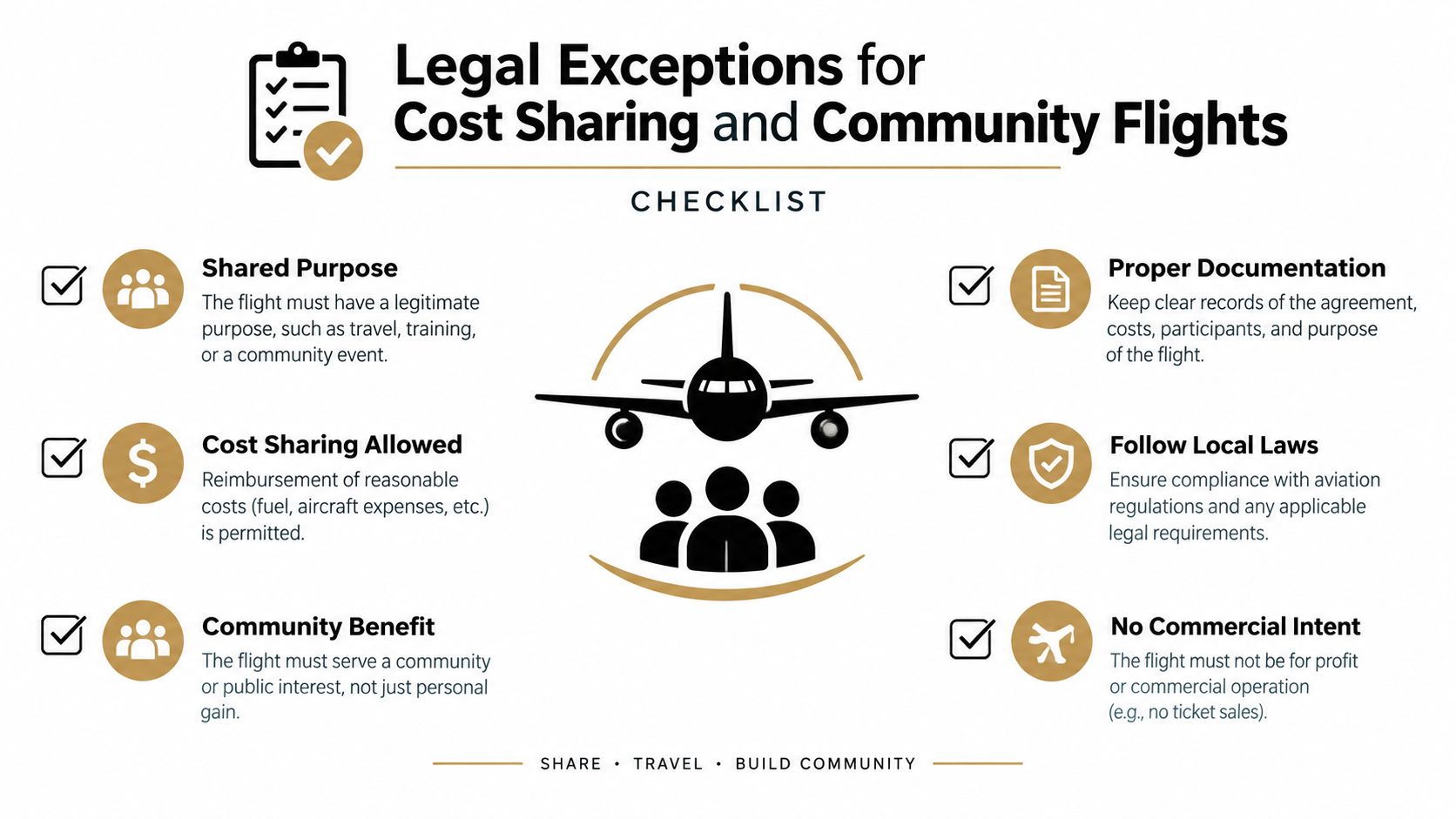
Money changing hands doesn't automatically make a flight illegal, but the details matter. The safest way to think about private pilot cost sharing is that eligible passengers may contribute a pro rata share of certain operating expenses. You can't use the arrangement to create a profit, and you can't present yourself as a transportation provider.
The governing framework includes limited exceptions and conditions described in the current eCFR rules for private pilots. Don't reduce that framework to “split the fuel.” The permitted expenses and the way the flight is arranged both matter.
Cost sharing must remain cost sharing
A compliant arrangement should reflect the passengers' proportionate share of eligible operating costs, rather than a fixed price that guarantees you revenue. You also need to consider the common purpose of the trip. If you were already going somewhere and invited passengers to share the flight, that is a different fact pattern from advertising a destination and offering seats to strangers.
Use a written or clearly documented calculation. Identify the aircraft operating expenses that are eligible under the applicable rule, divide them appropriately, and keep records. Don't add a margin for your time, aircraft access, planning, or inconvenience. If you want to be paid for piloting, you're discussing a commercial pathway, not ordinary private-pilot cost sharing.
Practical rule: If the passenger is buying transportation rather than joining your private flight, stop and seek advice before accepting money.
Community and charitable flying
Private pilots may participate in certain charitable or community flight activities under defined rules. These opportunities can be meaningful, but the organization, event structure, publicity, passenger eligibility, and expense handling can all affect legality.
Ask the organization how it operates before volunteering. Confirm whether it has an established compliance process, what pilot qualifications it expects, and how it handles aircraft expenses. A worthy mission doesn't exempt a pilot from the regulations.
The same discipline applies to volunteer transportation, community events, and public-facing aviation activities. Don't assume that calling a flight a donation makes it permissible. Follow the organization's procedures and verify the legal basis for the operation.
Special activities need their own qualification
Glider towing is a good example of why a private certificate isn't enough by itself. The activity requires separate qualification, and you need to meet the applicable aircraft and operational requirements. Aircraft sales demonstrations also have a narrow exception with specific conditions, including a requirement for the pilot to have at least 200 logged hours in the circumstances described by the regulation. Review the rule before agreeing to conduct such a flight.
The answer to “can I make money with a PPL?” is therefore not a casual yes or no. You can take part in certain cost-sharing, charitable, community, towing, or demonstration activities when the exact legal conditions are satisfied. You can't use those exceptions as a disguise for paid charter or sightseeing.
Travel Scope and Airspace Access
A private pilot certificate can take you much farther than the local practice area, but the useful range of the license depends on weather, aircraft capability, ratings, and airspace knowledge. The certificate supports passenger carrying, cross-country travel, night operations, and broader private flying, but those benefits aren't automatic in every aircraft or country. The EAA's private pilot guidance makes that broader point clearly.
Think of your travel options in layers.
Local VFR flying
Local daytime VFR flights are where most pilots build confidence after the checkride. You can take passengers to nearby airports, fly scenic routes, practice landings at unfamiliar fields, and develop a reliable planning routine. This is also the best environment for learning passenger management, because you can focus on communication and comfort without adding unnecessary operational complexity.
Night flying adds a different workload. You'll need to meet the applicable currency requirements to carry passengers at night, and you should build that experience carefully. A night flight over familiar terrain in good conditions is a sensible progression. A first night trip over challenging terrain or into an unfamiliar airport is poor planning.
Cross-country and controlled airspace
Cross-country travel is one of the strongest practical benefits of a PPL. You can connect smaller airports with destinations that may be inconvenient by ground transportation, provided the route, weather, aircraft, and your experience align.
Busy airspace requires more than a certificate. Review communication procedures, entry requirements, special-use areas, NOTAMs, runway configuration, and expected traffic flows. Use a current airspace classification chart before planning a route through dense terminal areas, and ask an instructor for a checkout if the environment is beyond your experience.
Instrument and international operations
A private pilot certificate doesn't by itself make you an instrument pilot. If you want dependable travel through reduced visibility or cloud, pursue instrument training rather than treating marginal VFR as a substitute. An instrument rating expands your skills and decision-making, but it still doesn't eliminate weather judgment.
International trips are possible in principle, but the destination country's licensing, customs, aircraft, insurance, equipment, and airspace rules also apply. A flight across a national border is an administrative and operational project, not merely a longer domestic cross-country. Plan it with an instructor or experienced international pilot, and verify the current requirements with the relevant authorities before departure.
The same principle applies to larger, faster, or more complex aircraft. Your certificate may be the foundation, but aircraft class, endorsements, ratings, and local rules determine what you can operate.
Transitioning to a Professional Aviation Career
If your goal is an airline cockpit, don't treat the private pilot certificate as the finish line. Treat it as the first serious checkpoint in a longer sequence. The certificate gives you the foundation for instrument training, commercial privileges, instructional qualifications, and eventually advanced professional flying.
The usual progression is logical:
- Private Pilot Certificate: Learn aircraft control, navigation, communication, passenger operations, and pilot decision-making.
- Instrument Rating: Develop the ability to operate under instrument rules and manage weather and navigation with greater precision.
- Commercial Pilot Certificate: Move from private privileges toward the qualifications required for compensated pilot work.
- Flight Instructor Certificate: Teach the skills you've learned while building experience in a structured operating environment.
- Instrument Instructor Qualification: Teach instrument flying and become more useful as an instructor.
- Multi-engine training and later airline qualifications: Add the aircraft experience and credentials required for more advanced professional roles.
The exact sequence can vary, but the strategic advice doesn't. Finish the private certificate with your career plan already in view. Students lose time when they stop flying after the checkride, let skills fade, and then return months later to restart the same learning cycle.
Why instructing is central to the pathway
The private certificate doesn't authorize paid flying, so it can't be your income-producing endpoint. Commercial training changes the legal framework, while instructor qualifications create a practical way to work in aviation and build experience. Teaching also forces you to understand aircraft systems, risk management, regulations, and procedures at a deeper level.
That doesn't mean you should rush through training. An accelerated pathway only works when the student studies consistently, flies frequently, accepts honest feedback, and treats each stage check as a real performance review. Speed without retention creates an expensive pilot who still needs supervision.
Career advice: Choose your next rating based on the cockpit you want, not on the easiest flight you can schedule this weekend.
A professional plan should include a written study schedule, predictable aircraft access, checkride preparation, and a clear method for recording progress. It should also account for the financial gap between earning a certificate and becoming employable. The private pilot license opens the door, but disciplined progression is what moves you through it.
Accelerated Training Pathways and Financial Planning
Full-time flight training is not just more flying. It's a logistics system. You need aircraft availability, instructor continuity, study time, examiner coordination, reliable transportation, housing, and a funding plan that survives delays or additional training.
A fixed-price program can make budgeting easier, but only if you read the inclusions and exclusions carefully. Ask whether the price covers aircraft time, instructor time, simulator sessions, written-test preparation, checkride preparation, examiner fees, supplies, and repeat training. "Fixed price" is useful only when the scope is completely clear.
CFII's published Career Track combines private, instrument, commercial, instructor, and multi-engine training in a structured path. Its stated program data includes six certificates and ratings, 282 total hours by month nine, and an optional paid-instructing add-on that includes 175 paid instructing hours at $30 per hour, with a published tuition of $89,000 for the core track and $15,000 for that add-on. Those figures are program-specific, not universal aviation costs, so compare the syllabus and contractual terms before making a decision.
Accelerated Career Track Breakdown
| Program Phase | Certificates Earned | Flight Hours Logged |
|---|---|---|
| Foundation | Private Pilot | Included in the program total |
| Instrument progression | Instrument Rating | Included in the program total |
| Commercial progression | Commercial Pilot, single-engine and multi-engine | Included in the program total |
| Instructional qualification | CFI and CFII | Included in the program total |
| Published month-nine outcome | Six certificates and ratings | 282 total hours, including single-engine, multi-engine, and simulator time |
The value of an accelerated track isn't the word “accelerated.” The value is reduced friction. Coordinated checkrides prevent a student from finishing training and then waiting without a plan. Standardized glass-cockpit aircraft reduce equipment changes. One-on-one instruction can keep the syllabus focused on the student's actual weaknesses.
Plan the life around the flying
Housing matters because a long commute steals energy from training. A furnished shared apartment near the base may be practical for a relocating student, while a local student might need a different arrangement. Financing also deserves scrutiny. Deferred payments can help with cash flow, but they don't make training free. Read the interest terms, repayment schedule, penalties, and conditions before signing.
For a broader discussion of training expenses and planning, review the cost of pilot training. My recommendation is to compare at least three schools using the same checklist. Ask each one how it handles aircraft maintenance, instructor changes, weather delays, failed checkrides, retesting, and time beyond the planned syllabus.
If you already hold a PPL, don't automatically restart from zero. Ask for a logbook review and a written credit assessment. A good school should tell you what transfers, what needs refreshing, and what schedule gets you efficiently to the next certificate.
Mapping Your Next Steps in the Cockpit
Your best next move depends on why you earned the license. Don't buy advanced training because every pilot at the airport tells you that you should. Choose the path that matches the flying you'll do.
If you want recreational freedom
Fly regularly in familiar aircraft and build your own operating standards. Schedule local passenger flights, cross-country trips, and carefully planned night flights. Use an instructor when you're moving into unfamiliar airspace, a different aircraft type, mountain environments, or more demanding weather.
Your priority is proficiency. Keep passenger comfort, fuel planning, runway performance, weather margins, and personal minimums ahead of ambitious itineraries. The best recreational pilot isn't the one who accepts every trip. It's the one who knows when the trip isn't ready to go.
If you want more reliable travel
Make the instrument rating your next major objective. It develops disciplined weather interpretation, navigation, procedures, and workload management. It won't make every trip safe or practical, but it gives you a stronger foundation for planning beyond basic VFR operations.
Then look at the aircraft you intend to fly. A rating or endorsement is only useful if you also understand the specific aircraft, its systems, performance, and limitations. Get a proper checkout instead of relying on a logbook signature to replace real competence.
If you want an airline career
Move from PPL to instrument training, then commercial and instructor qualifications without allowing long gaps between stages. Compare training schools on total scope, aircraft access, instructor availability, checkride scheduling, simulator use, and time-building support. A program that looks inexpensive at the start can become costly if delays and equipment changes stretch the timeline.
Write down your preferred route now. Decide whether you'll train part time or relocate for full-time instruction. Review your finances, housing needs, and expected study workload before you commit.
The private pilot license gives you choices, but it rewards pilots who plan beyond the next flight. Pick one next step, book the consultation or instructor session, and put a date on the calendar. A vague ambition doesn't move a logbook forward.
If you're ready to turn your PPL into a structured progression, CFII offers a fixed-price Career Track with one-on-one instruction, advanced ratings, coordinated checkrides, and a defined path toward CFII and multi-engine training. Review the program requirements, compare them with your current logbook, and contact CFII to plan the next stage of your aviation career.
Planning to fly for a living?
See what the path from zero to a pilot career looks like, what it costs and how long it takes.
Learn to fly in Riverside
We train at Riverside Municipal Airport in factory-new airplanes with a parachute built in. Start with a one hour discovery flight, no experience needed.