
On this page
- What Happens During a Private Flight Lesson
- The Three Stages of Private Pilot Training
- Stage 1, pre-solo
- Stage 2, solo period
- Stage 3, checkride preparation
- How Many Flight Hours You Will Actually Log
- Why the gap exists
- Solo Authorization and the Regulations Behind It
- Solo cross-country adds another layer
- What Private Flight Lessons Really Cost
- The hidden cost is interruption
- What to ask before you commit
- From Private Certificate to a Flying Career
- The broader market matters, but it doesn't erase the bottleneck
- Choosing a Flight School and Preparing to Start
- Common Questions About Private Flight Lessons
- What medical certificate do I need
- Where does the written exam fit
- What weather minimums apply to a student pilot
- What happens right after the certificate
The first week of flight training usually feels bigger than the airplane. You're learning a new vocabulary, a new rhythm, and a new kind of responsibility, while still trying to remember where to put your hands, what to look at, and who is supposed to say what on the radio. Private flight lessons are where that first fog starts to clear, but the main challenge isn't just learning to fly, it's keeping the training moving when weather interrupts, instructors change, or the calendar doesn't cooperate.
What Happens During a Private Flight Lesson
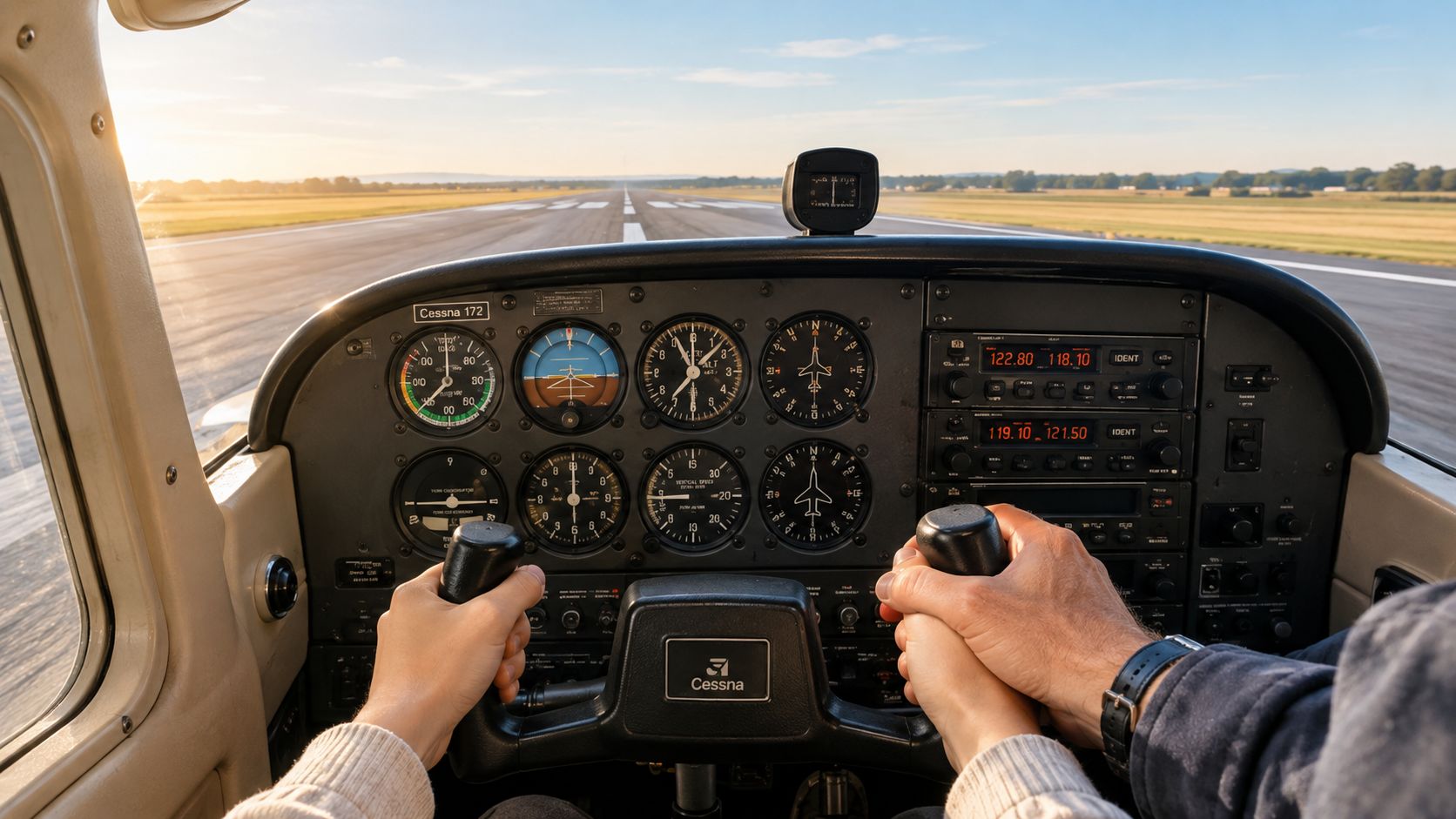
You climb into the right seat, buckle in, and spend a few minutes on the ground before the engine ever starts. A good lesson begins with a short briefing, what the airplane will do today, what you'll practice, and what “good enough” looks like for that flight. That ground time matters because flying isn't only stick-and-rudder work, it's decision-making, checklist discipline, and knowing the plan before you taxi.
In the cockpit, the instructor is there to coach and correct, while you do the work. Before takeoff, you should have the documents and essentials in order, including the student pilot certificate, medical certificate, and logbook, because the lesson doesn't really begin until the airplane is ready and the paperwork is too. If you're brand new, a discovery flight is a lower-pressure introduction, while a formal training lesson is part of a structured syllabus with a clear skill target.
Most lessons are shorter than people expect. A typical block often runs about 1.0 to 1.5 hours of Hobbs time, because the aim is repetition and focus, not marathon flying.
Practical rule: A short, focused lesson with a sharp debrief usually teaches more than a long flight where fatigue starts to blur the lesson.
After you land, the debrief is where the lesson turns into progress. Your instructor should tell you what went well, what needs cleanup, and what to chair-fly before the next lesson. That's also when ground-school topics show up naturally, airspace, weather, radio calls, and aircraft limitations all connect back to what you just felt in the airplane.
If you want a structured starting point after that first taste of flying, the next step is usually a training path that ties lessons, written prep, and checkride planning together, not a series of random flights. For students who haven't flown yet, a discovery flight at CFII's discovery flight page is the cleanest way to find out whether the cockpit feels familiar or foreign before you commit to a full training schedule.
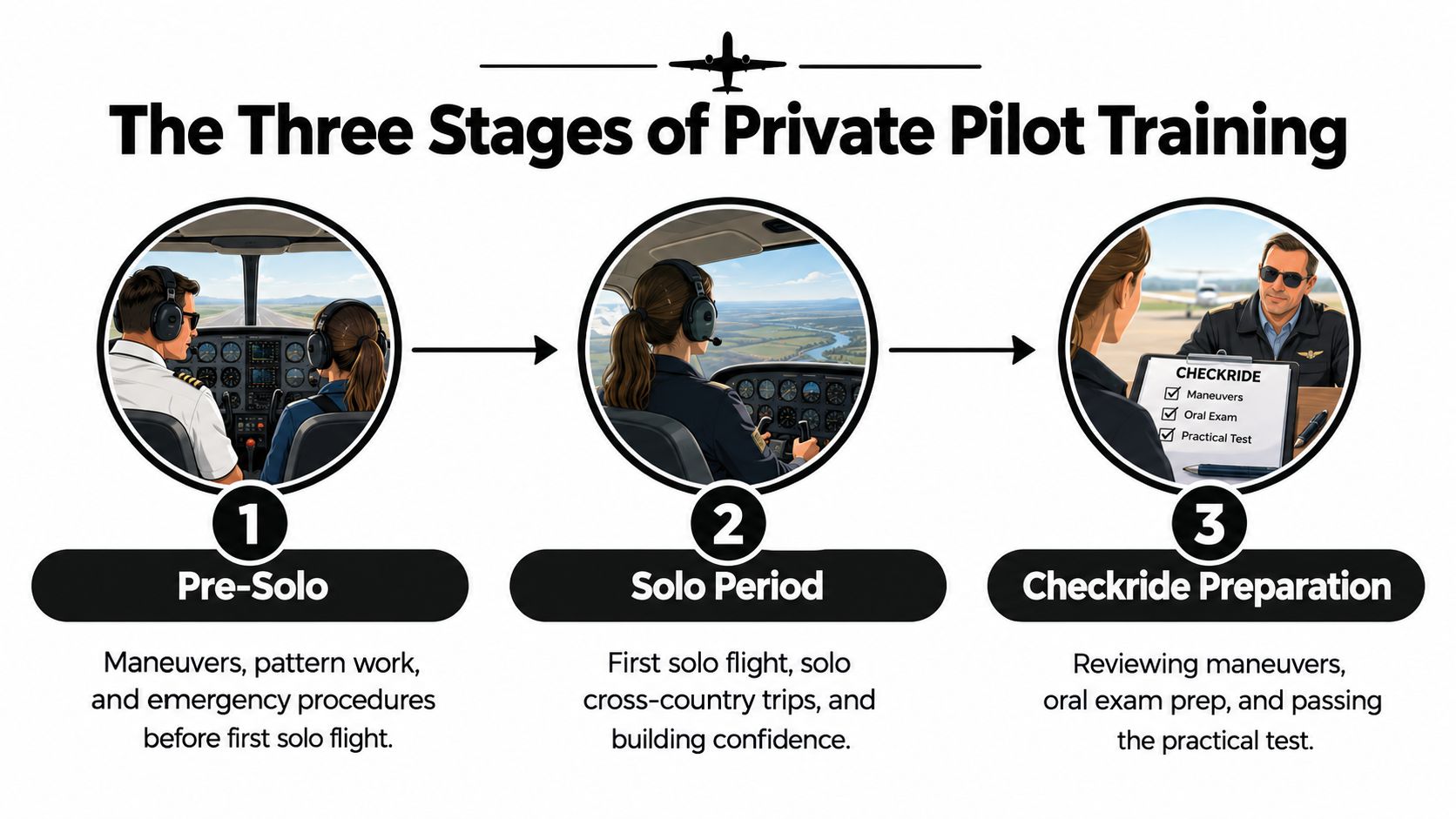
The Three Stages of Private Pilot Training
Stage 1, pre-solo
Here, you learn the airplane from the inside out. Your first landings, pattern work, stalls, steep turns, slow flight, and emergency procedures all live here, and each lesson builds toward the same gate, proving you can handle the airplane consistently and safely. In the beginning, the instructor is making constant judgments about whether your control inputs, scan, and radio work are becoming stable enough for more responsibility.
A lot of students think progression is calendar-based. It isn't. You might fly several good lessons in a row and still not be ready if your scan breaks down under pressure or your pattern work is inconsistent.
Stage 2, solo period
Solo is where the airplane stops feeling like a shared project and starts feeling like your responsibility. The first solo is usually a short, highly supervised event at the home airport, and the solo phase then expands into practice flights, night work, and cross-country training. That's the point where confidence matters, but only because the instructor has already verified the skills underneath it.
Solo cross-country is a different animal from pattern work. The first time you leave the familiar airport environment for a new field, you're managing planning, navigation, communications, and airport procedures without a voice in the other seat.
Stage 3, checkride preparation
By this point, the flying is less about learning brand-new maneuvers and more about cleaning up the edges. You'll review weak spots, tighten decision-making, and build consistency across the FAA practical test areas. The work gets more precise, because the goal is no longer “can you do it at all?” but “can you do it well, reliably, and under scrutiny?”
For a broader view of how these stages fit into a certificate path, this overview of pilot certification training is a helpful companion to the day-to-day lesson structure.
How Many Flight Hours You Will Actually Log
The FAA sets a minimum of 40 logged flight hours for a private pilot certificate under the standard pathway, but that number can fool new students if they treat it like a finish line. The FAA also says applicants without a hearing impairment average about 75 hours when completing private-pilot certification requirements, and training through an approved Part 141 school can reduce the formal minimum to 35 hours while most students still need roughly 60 to 75 hours. Those numbers live in the rules because the certificate is about skill, not just elapsed time in the airplane. FAA hourly requirements for becoming a pilot
Why the gap exists
The extra time usually comes from normal training friction, not from doing anything wrong. A maneuver that looked solid last week may need more work after a weather break, and a lesson that was supposed to be procedural may become a review flight because the student needs a tune-up before moving ahead.
Plain truth: Planning a private certificate around the legal minimum is one of the fastest ways to underbudget both time and money.
Part 61 and Part 141 differ mainly in structure. Part 141 is school-controlled and syllabus-driven, while Part 61 is more flexible and often more student-paced. Either way, the airplane doesn't care what the brochure said, it cares whether you can hold altitude, make good radio calls, manage navigation, and recover calmly when something changes.
For students trying to estimate the actual bill, an accelerated program can make sense only when the cadence is steady enough to reduce relearning. A useful comparison point is accelerated private flight training, but the key consideration is whether the schedule keeps you close to the airplane often enough to preserve momentum.
Solo Authorization and the Regulations Behind It
Solo doesn't happen because a student has “done enough lessons.” Under 14 CFR § 61.87, the instructor has to administer and review the student's aeronautical knowledge, including the applicable Parts 61 and 91 rules, local airspace procedures, and the aircraft's operating limitations. The student must also demonstrate proficiency in the required maneuvers before the instructor can authorize solo flight. 14 CFR § 61.87
There's another detail that surprises new pilots. The solo endorsement is not permanent. Under § 61.87(n), the student needs a current logbook endorsement for the specific make and model, and that endorsement has to come from an authorized instructor who trained the student within the preceding 90 days. That makes solo a supervised privilege, not a one-time achievement you keep forever.
Solo cross-country adds another layer
Cross-country solo needs separate attention under § 61.93. The instructor has to verify readiness for the make and model, and the student must have the proper training and endorsements before flying beyond local solo work. 14 CFR § 61.93
The reason is simple. A first solo in the pattern is one kind of risk. A solo trip to an unfamiliar airport brings planning, weather evaluation, navigation, and airport operations into the picture all at once. The FAA makes you prove those skills separately because each one adds workload, and workload is where beginners can get overloaded.
What Private Flight Lessons Really Cost
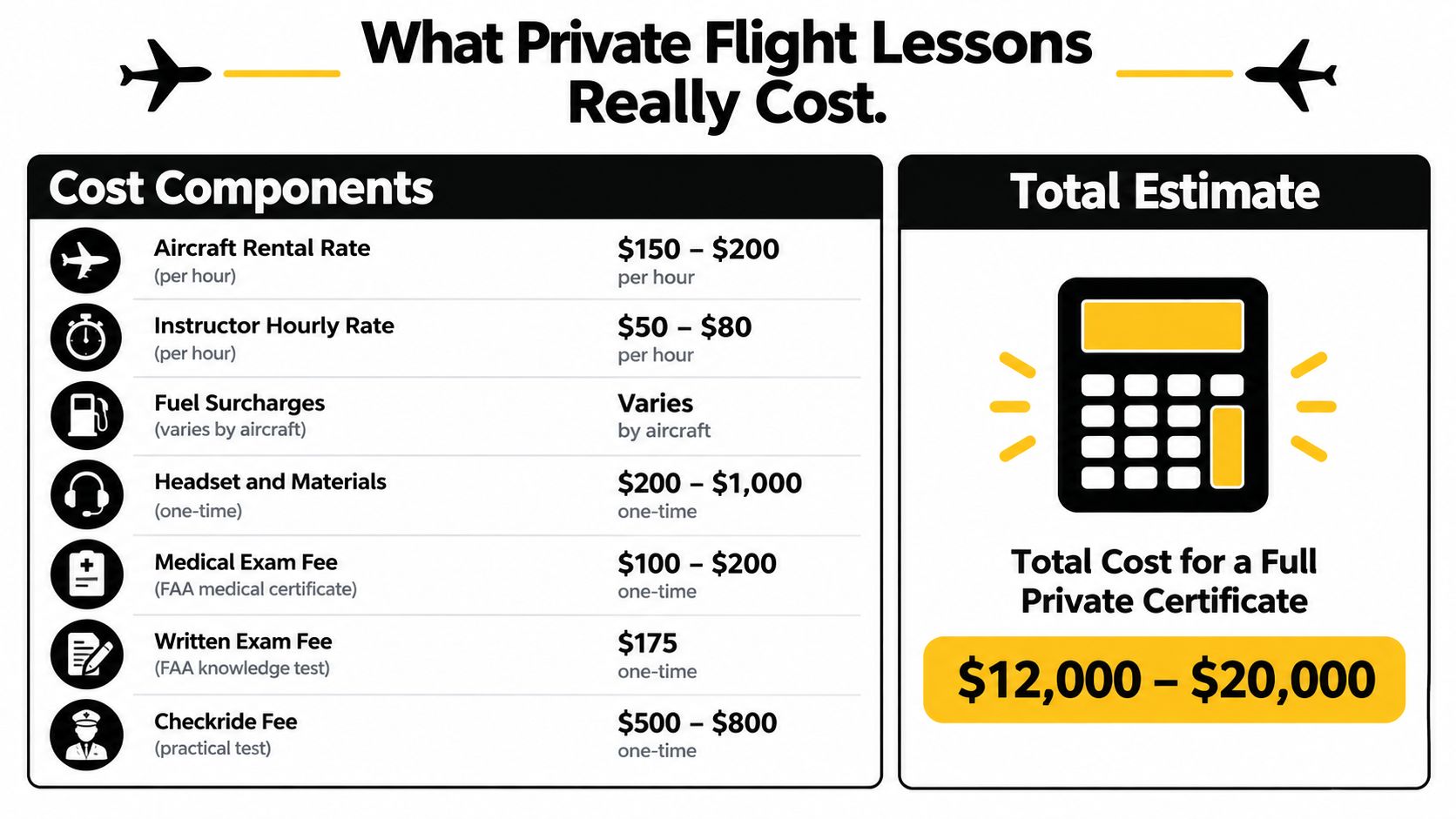
Cost gets easier to understand when you stop looking at the hourly airplane rate by itself and start looking at the entire chain of expenses. The aircraft, instructor, fuel, study materials, medical certificate, written test, and practical test all show up at different points, and none of them are optional once training gets serious. The actual bill is shaped as much by consistency as by price.
The hidden cost is interruption
Available 2025 survey data from 215 respondents found that more than two-thirds had paused flight training, with finances, scheduling, instructor turnover, aircraft availability, and difficulty finding suitable instruction among the leading causes. That matters because every gap in training usually creates more review, more repetition, and more time to regain rhythm. Pilot training survey report 2025
That's why the cheapest advertised rate is not always the lowest total cost. A school that looks inexpensive on paper can end up costing more if you lose momentum and need to repeat lessons, wait for an instructor, or sit out weather windows without a recovery plan.
What to ask before you commit
- What costs are fixed: Ask which parts of the package are locked in and which ones can change with added flight time.
- How cancellations are handled: Find out what happens when weather cancels a lesson and how quickly that time can be recovered.
- Who teaches you consistently: Instructor continuity matters because switching instructors can mean revisiting habits and standards.
- How checkrides are coordinated: Delays before the practical test can stretch the training timeline more than students expect.
The schools that communicate these details early tend to make planning easier, because students can budget for reality instead of hoping for the ideal case. For a deeper breakdown of budgeting questions, private pilot license cost is worth reading before you sign anything.
From Private Certificate to a Flying Career
Private pilot is the foundation, not the finish line. It lets you fly as a certificated pilot under the rules that apply to private operations, but it does not create a professional flying career by itself. To move into commercial flying, the FAA minimum for a single-engine commercial pilot certificate is 250 hours of flight time, with at least 100 hours in powered aircraft, at least 50 hours in airplanes, and at least 100 hours of pilot-in-command time. 14 CFR § 61.129
That gap is why so many aspiring career pilots spend time instructing or building time in other entry-level flying roles after earning the private certificate. The certificate changes what you're allowed to do, but not how much experience you still need before you're employable for most professional jobs.
The broader market matters, but it doesn't erase the bottleneck
Boeing's 2025 to 2044 outlook projects a need for 660,000 new commercial pilots worldwide over 20 years, which shows how strong the long-term demand picture is. Recent government-related reporting also found that U.S. pilot certifications grew about 10% from 2017 to 2024, while student-pilot enrollment rose 67%, and the FAA has been working with industry on checkride wait times. Boeing 2025 to 2044 outlook
Those numbers point in the same direction. More people are entering training, the pipeline is active, and the demand for pilots stays strong, but training speed and hiring speed are still different things. A student can finish a private certificate quickly and still face a long hour-building period before reaching airline or charter thresholds.
Career rule: Don't confuse finishing private training with being ready for a flying job. Those are separate milestones.
If you want a structured route that connects private training to the next certificates and ratings, one option is an accelerated zero-to-CFII path such as how to become a pilot, especially if you want the training, ratings, and time-building plan laid out in one place.
Choosing a Flight School and Preparing to Start
The smartest school choice is the one that keeps you flying, not just the one that sounds polished in a brochure. Ask whether the program is Part 61 or Part 141, how often you'll fly, how instructor continuity works, what happens when weather cancels a lesson, and how the school handles aircraft downtime. Those questions sound basic, but they tell you whether the operation is built for student progress or just for selling an hourly rate.
A discovery flight is the lowest-risk way to test the fit. You get to see whether the pace, communication style, and airplane feel right before you commit to a long training relationship, and that first contact often reveals more than a website ever will.
After you've done that first visit, pay attention to the practical details. If the school can't explain how lessons recover after weather, how often instructors change, or how written-test prep is handled, you'll feel that uncertainty later in the schedule. A school that answers those questions clearly is already helping you train.
The pre-lesson checklist is straightforward. Bring your FAA medical certificate, student pilot certificate, logbook, and study materials, and be ready to start showing up with the kind of preparation that makes each lesson count. If you want a fuller look at how approved schools organize training, the FAA school framework is worth reading alongside your first-school conversations, and FAA-approved flight schools gives that context in plain language.
One more piece matters before you start: consistency. Two or three lessons a week is a very different experience from flying once in a while, because the airplane rewards rhythm and punishes long gaps. If your schedule can support that rhythm, training moves cleaner and cheaper over time.
Common Questions About Private Flight Lessons
What medical certificate do I need
For private pilot training, many students use a third-class medical certificate issued by an FAA-authorized aviation medical examiner. The point isn't to overcomplicate the process, it's to confirm that you're fit to fly safely and that nothing obvious in your medical history needs special attention before training begins. Get the medical sorted early, because it's easier to solve questions before the schedule gets busy.
Where does the written exam fit
The knowledge test sits between early ground study and the later polish stage. You don't need to wait until the end of training to start it, and you shouldn't treat it as separate from flight lessons, because weather, airspace, navigation, and regulations all show up in the airplane later. Good instructors keep written prep tied to what you're flying that week.
What weather minimums apply to a student pilot
A student pilot has to respect the weather rules that apply to the operation, including 14 CFR § 91.155 for visibility and cloud clearance in VFR conditions. In practice, that means you don't decide to “try it and see.” Your instructor and your local procedures have to support the flight, and if the weather doesn't meet the standard, the lesson waits. 14 CFR § 91.155
What happens right after the certificate
Once you earn the private certificate, the next step is usually rental, currency, and the decision about whether you want instrument or commercial training. You can fly for personal transportation and recreation, but if you're aiming for a career, the private certificate is only the first rung on a much taller ladder.
If you want a training path that treats private flight lessons as part of a bigger plan, not just a series of disconnected hours, CFII offers a structured route from zero time through advanced ratings with coordinated instruction and scheduling. If you're ready to see what that looks like in a real training environment, start with a discovery flight or a career-track conversation and compare it against the way you want your first 60 days in aviation to feel.
Planning to fly for a living?
See what the path from zero to a pilot career looks like, what it costs and how long it takes.
Learn to fly in Riverside
We train at Riverside Municipal Airport in factory-new airplanes with a parachute built in. Start with a one hour discovery flight, no experience needed.