

On this page
- Pilot Medical Classes and How Long They Last
- Match the class to the flying
- Understand what expires
- Finding an AME and Booking the Exam
- Book in a deliberate order
- Paperwork to Gather Before You Go
- Build the supporting file
- Pack the night before
- What Happens in the Exam Room
- What the examiner is documenting
- A symptom-free student can still leave without a certificate
- Conditions That Delay or Block a Certificate
- Conditions that block routine FAA medical issuance
- Routine issuance versus special issuance
- What a Deferral Means and Your Next Steps
- Turn the request into an action list
- Use the waiting period deliberately
- Choose the Class and Your Next Step
- Put the medical into your training plan
You're comparing flight schools, working out how to pay for training, and wondering how soon you could leave your current job. Your flight time may still be zero, but your calendar is already filling up.
Before you commit tuition, put an aviation medical examiner on that calendar. A medical-certification issue can stall a career before your first solo, and discovering it early gives you room to gather records, complete evaluations, and make an informed training decision.
Pilot Medical Classes and How Long They Last
If your goal is an airline career, book a first-class medical examination early. It works as a career-screening step you can complete while your training calendar is still open: a discovery flight and your first lessons require no medical at all, and a third-class certificate from an aviation medical examiner becomes necessary before you fly solo. Finding out where you stand against the strictest standard costs one appointment. Finding out after tuition is committed costs far more.
The class follows the privileges you intend to exercise. A student with zero logged hours can hold a first-class certificate, so experience is never a barrier to applying for the class your target job requires.
Match the class to the flying
The FAA's medical-certification guidance associates first class with airline transport pilots, second class with commercial pilots, and third class with private pilots. Distant-vision standards allow correction at every level, so glasses or contacts do not end an airline plan.
Certificate duration comes from 14 C.F.R. § 61.23: first-class airline-transport privileges last 12 months under age 40 or six months at age 40 or older, commercial privileges last 12 months, and third-class privileges last 60 months under age 40 or 24 months at age 40 or older. The FAA's medical-certification guidance sets distant vision at 20/20 or better in each eye for first and second class and 20/40 or better for third class, near vision at 20/40 or better at 16 inches for all three, and an audiometric speech-discrimination option of at least 70% in one ear at no more than 65 decibels. The guidance also requires a first-class electrocardiogram at the first application after age 35, then annually after age 40. The table puts the classes side by side.
FAA medical class, vision, validity, and extra tests
| Class | Privileges | Distant vision | Under age 40 | Age 40 or older | Extra test |
|---|---|---|---|---|---|
| First class | Airline transport pilot | 20/20 or better in each eye, with or without correction | 12 months for ATP privileges | 6 months for ATP privileges | ECG at the first application after age 35, then annually after age 40 |
| Second class | Commercial pilot | 20/20 or better in each eye, with or without correction | 12 months | 12 months | No routine ECG |
| Third class | Private, student, recreational, and qualifying instructor privileges | 20/40 or better in each eye, with or without correction | 60 months | 24 months | No routine ECG |
Book the row that matches the job you are investigating. A career student can sit the first-class exam while still working toward private-pilot privileges, and the vision and hearing measurements happen on the examiner's equipment, so there is nothing to test at home beforehand.
Understand what expires
The regulation calculates each validity period through the last day of the stated month after your examination month, using your age on the examination date. An exam on March 10 under a 12-month privilege expires on the last day of the following March, which gives you a few extra weeks beyond the anniversary.
A first-class certificate also keeps working after its airline-transport window closes. It continues supporting lower-level privileges as long as their applicable duration and other requirements are satisfied, so the same certificate covers commercial privileges for the full commercial period regardless of your age. One appointment produces several expiration clocks, each running at its own speed.
Planning rule: Choose your initial examination around the career you want to investigate, then track validity around the privileges you actually exercise.
If the certificate names still blur together, the guide to types of pilot licenses separates pilot certificates from medical certificates. For the private-pilot written material you will study alongside lessons, the flyCowboys private pilot study guide works as a companion resource. Your AME still makes the final medical call.
Finding an AME and Booking the Exam
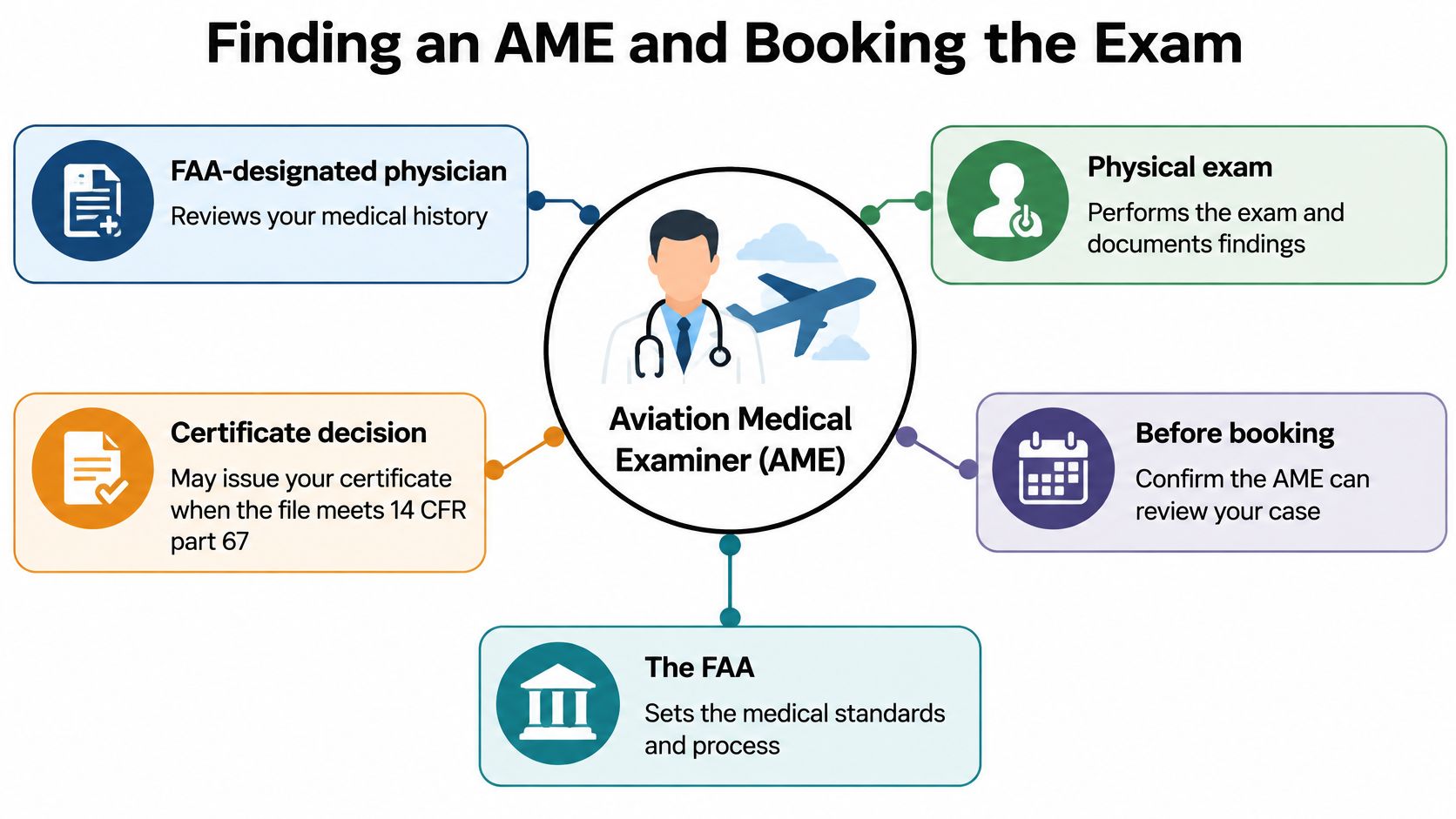
A medical certificate can stall a flying career before the first solo, so plan the exam before paying tuition. An aviation medical examiner, or AME, is an FAA-designated physician who performs aviation certification exams. The FAA's description of the AME's role explains that the examiner reviews your history, conducts the examination, and may issue a certificate when your documentation and findings meet 14 C.F.R. part 67. The FAA sets no age restriction or aviation-experience requirement for obtaining a medical certificate.
For a career-bound student, start by identifying the medical class the career requires. Age restrictions for certain airline operations are separate from eligibility to obtain a medical certificate.
Book in a deliberate order
Find an examiner for your chosen class. Use the FAA's designee search, then contact the office to confirm it performs that examination. If you're planning for an airline career, ask about a first-class examination.
Raise a complicated history before booking the certification exam. If you have a significant diagnosis, ongoing treatment, or an earlier certification problem, ask whether to arrange a consultation first. This gives the office a chance to explain what records or steps may be needed.
Complete MedXPress accurately. The FAA's application instructions require electronic FAA Form 8500-8. Bring the resulting confirmation number and valid photo identification. The AME imports the application and verifies your identity before beginning. Print the summary sheet too.
Schedule within the application window. The FAA's AME process guidance expects the examination within 60 days of application submission. If the window will expire, submit a fresh application and arrange the appointment within its valid period.
Ask what to send ahead. Confirm which records the office wants and how to deliver them. Written documentation can answer questions that a verbal summary cannot.
For the conventional student-pilot route, a third-class FAA medical certificate is required before flying solo. A discovery flight and initial lessons can happen before you obtain one, so you can experience flight training while assessing your next steps. Plan the medical early, especially if you intend to make flying a career.
An examiner may issue a certificate at the appointment when the findings and documentation support it. If FAA review is needed, the visit begins a further review process.
Paperwork to Gather Before You Go
Build a file the examiner can evaluate, not just a form you can submit. A diagnosis that feels settled in everyday life may still need a treatment summary, specialist testing, or supporting records for aviation certification.
The FAA's aeromedical guidance explains that documented history affects the certification pathway and that examiners assess mental fitness through both the application and examination. They may ask follow-up questions, request psychological testing, or defer a case to the Office of Aerospace Medicine when the office assessment isn't enough.
Build the supporting file
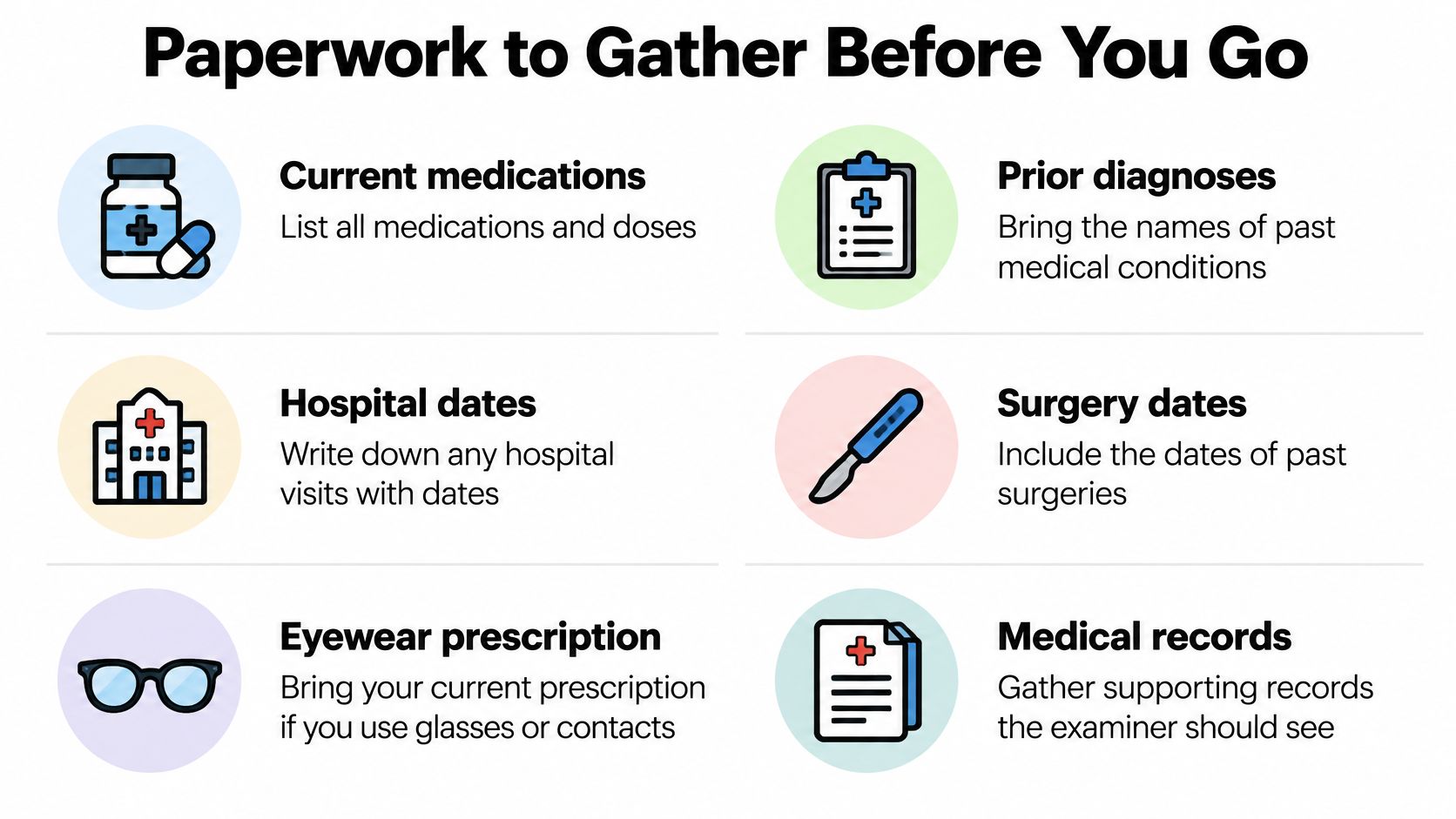
- Medications and doses. List current prescription and nonprescription medications accurately. Include the reason you take each one so the examiner can connect treatment with the underlying diagnosis.
- Diagnoses and treatment history. Use the names shown in your records rather than replacing them with informal descriptions such as nerves or a minor heart issue.
- Hospital and surgery dates. Bring discharge summaries and operative records when relevant. Write dates as the records show them instead of guessing from memory.
- Specialist letters. Ask the AME's office which records it needs before requesting a broad collection of unrelated charts.
- Eyewear and prior FAA correspondence. Bring your current eyewear prescription if you use correction, plus any earlier medical-certification letters or decisions.
Send relevant documents ahead when the office requests them. That gives the examiner a chance to identify missing information before you arrive, rather than discovering during the appointment that a specialist's report is incomplete.
Pack the night before
Night-before checklist: MedXPress confirmation number, valid photo ID, glasses or contacts, medication list with doses, specialist notes, and copies of relevant medical records.
Accuracy matters more than making the application look uncomplicated. Don't omit a hospitalization because you recovered, or a diagnosis because you no longer take medication for it. If you're unsure how an application question applies, seek clarification rather than leaving information out.
Keep the medical packet separate from your other training documents. Your student pilot certificate and your medical certificate serve different purposes, so completing paperwork for one doesn't finish the other.
Bring copies you can leave with the office if needed. Keep your own complete set so you can answer later questions without rebuilding the history.
What Happens in the Exam Room
The examiner checks whether your reported history and physical findings support aviation medical certification. That involves more than taking your blood pressure and asking whether you feel healthy.
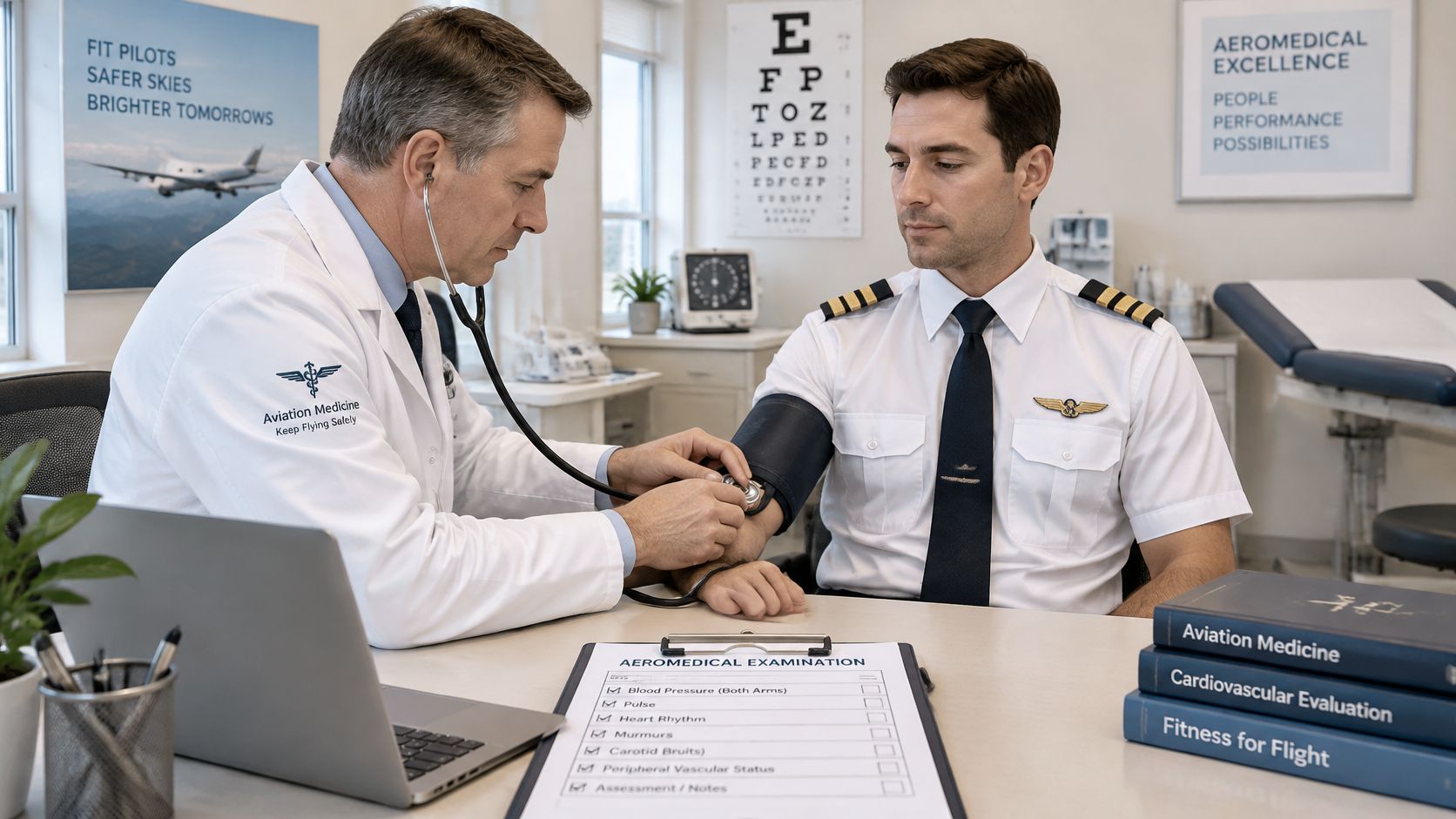
The FAA's examination standards call for representative blood-pressure readings in both arms and documentation of pulse, heart rhythm, murmurs, carotid findings, peripheral vascular status, the back of the eye, and other consequential abnormalities. The current blood-pressure guideline maximum is 155/95, although the formal standards do not establish a single universally disqualifying measurement.
What the examiner is documenting
Vision and hearing are assessed against the applicable medical standards. The examiner also connects individual findings with your history: an unusual pulse has a different significance when there is a known cardiac diagnosis than when it is an isolated observation needing clarification.
For the cardiovascular examination, the FAA's examination standards require reporting of bradycardia below 50 beats per minute, tachycardia during the examination, and rhythm irregularities beyond an occasional ectopic beat or sinus arrhythmia. Those findings can warrant further evaluation or deferral under the examination guidance.
In plain language, the AME records more than whether your heart rate looks high or low. The examiner must decide whether the finding needs explanation before a certificate can be issued.
A single cuff reading is one piece of evidence the examiner weighs alongside your history and the rest of the exam.
The FAA recognizes that temporary stress or fever can affect findings. When clinically appropriate, the examiner may allow recovery and repeat testing. That is a medical judgment made case by case, so you cannot assume every abnormal result will disappear after a few minutes of rest.
A symptom-free student can still leave without a certificate
Say you arrive feeling well and report no limitations during exercise. In the examination chair, however, your pulse is fast and irregular. The examiner may need a cardiac evaluation rather than relying on your lack of symptoms.
You could leave with a deferred application and a request for a cardiology note. A deferral means the evidence gathered so far has not answered the certification question. The examiner is asking for more information before making a decision, and the requested workup determines what happens next.
Do not try to manage the result by stopping prescribed medication or concealing symptoms. Tell the examiner what you take, how you feel, and whether you have been ill, and let your treating clinician direct medical treatment.
Before leaving, establish what happened:
- Certificate issued. Confirm that you received it and understand any listed limitations.
- Application deferred. Ask where the file is going and what question requires review.
- Documentation outstanding. Get the name of the specific report, test result, or specialist statement still needed.
A clear status and a concrete records request are more useful than leaving with only the impression that the examination went well.
Conditions That Delay or Block a Certificate
Some diagnoses take the issuing decision out of the examiner's hands. For these histories, the regulations place the condition on a disqualifying list, and an AME can issue through the ordinary office process only when the FAA has already authorized eligibility.
The FAA's AME decision guidance identifies the following conditions under 14 C.F.R. part 67 as specifically disqualifying without that authorization. The table shows which certification route each history typically follows.
Conditions that block routine FAA medical issuance
| Condition | Usual path |
|---|---|
| Angina pectoris | FAA review or special issuance, not routine issuance |
| Myocardial infarction | FAA review or special issuance, not routine issuance |
| Clinically significant coronary heart disease | FAA review or special issuance, not routine issuance |
| Cardiac valve replacement | FAA review or special issuance, not routine issuance |
| Heart replacement | FAA review or special issuance, not routine issuance |
| Permanent cardiac pacemaker | FAA review or special issuance, not routine issuance |
| Diabetes on insulin or other hypoglycemic medication | FAA review or special issuance, not routine issuance |
| Epilepsy | Disqualifying unless the FAA authorizes eligibility |
| Unexplained disturbance of consciousness | Disqualifying unless the FAA authorizes eligibility |
| Unexplained transient loss of nervous-system control | Disqualifying unless the FAA authorizes eligibility |
| Psychosis | FAA review, not routine issuance |
| Bipolar disorder | FAA review, not routine issuance |
| Severe personality disorder with repeated overt acts | FAA review, not routine issuance |
| Substance abuse or dependence | FAA review, not routine issuance |
Routine issuance versus special issuance
Two pathways exist for these files. In routine issuance, the examiner evaluates the application and can hand you a certificate at the visit. In special issuance, the FAA reviews the medical file itself and grants authorization before any certificate can follow.
Well-controlled diabetes on medication shows the difference. Stable control, normal work, and clean labs all strengthen the file the FAA reviews, and a treating physician's letter helps document that picture. The condition still sits on the disqualifying list, so the applicant needs FAA authorization before an examiner can issue. The earlier exam-room example worked the same principle in reverse: there a routine applicant produced a finding, while here the diagnosis itself assigns the route.
A prior heart attack follows that same route. Recovery and successful treatment matter; the application still needs the appropriate records and review. A history involving a replaced valve or an implanted pacemaker lands in the same certification-review category, no matter how fit the applicant appears.
Mental-health and substance histories deserve the same careful, accurate preparation. Do not minimize them because they are not visible during a physical examination, and do not change treatment without your clinician's guidance.
If you are exploring a sport pilot license, changing training goals does not automatically resolve a medical-eligibility question. Discuss your actual history and proposed privileges with a qualified examiner before choosing an alternative route.
Hold off on full tuition until you know which pathway your file requires. An AME can tell you whether your history supports routine issuance or needs FAA authorization, and a deferred file may still become eligible once the supporting evidence is in.
What a Deferral Means and Your Next Steps
A deferral means the examiner needs more evidence before issuing the certificate. The application stays open while the FAA reviews it, and your job shifts from the exam room to assembling exactly what the reviewer asked for.
Treat it as a defined records project. The faster you identify each required document and its source, the sooner the file moves.
Turn the request into an action list
- Write down every item the reviewer named. Copy the deferral letter's list verbatim. Paraphrasing "current cardiology evaluation" into "heart records" is how applicants end up submitting the wrong document and waiting through a second cycle.
- Send each specialist a complete request. Name the document, its author, and the dates it must cover. For a rhythm finding, that means the treating cardiologist's evaluation, the monitor tracings behind it, the diagnosis, current medications, and a statement of current status. A note saying you feel well answers none of those.
- Keep a submission record. Retain copies of everything you send, with the submission date and recipient.
- Confirm which pathway applies. Some files qualify for routine issuance once the documentation arrives; others need special-issuance authorization, which follows a different track and timeline.
- Hold tuition until the file resolves. Keep deposits and program commitments reversible until you have the certificate or a written plan the examiner accepts.
If the request concerns a rhythm finding, arrive at the cardiology visit prepared. Qaly's questions about managing irregular heart rhythms help you organize that conversation so the specialist's report covers what the FAA asked for.
Use the waiting period deliberately
A review timeline is the one variable you cannot schedule. Everything around it, you can.
Map your pilot career path while the file is with reviewers, and arrange the training components that do not depend on issuance. When the certificate arrives, its limitations and validity period mark the true start of your training calendar, and you can commit to fixed-price tuition knowing the medical gate is behind you.
Choose the Class and Your Next Step
If the destination is an airline cockpit, schedule a first-class examination as an early career-planning decision. You're investigating whether the medical side of the career is workable before arranging your finances and schedule around accelerated training.
If a condition in the table applies to you, make the initial call a discussion about records and consultation. The right preparation may be a specialist summary before an examination appointment, rather than an immediate application with an incomplete history.
Put the medical into your training plan
Use the flight-training requirements guide to organize the rest of your preparation. Keep medical eligibility, student-pilot paperwork, funding, and training availability as separate items so completing one doesn't create false confidence about the others.
For someone who hasn't flown yet, a discovery flight can come before medical issuance. For the full training path, our CFII Career Track has fixed $89,000 tuition, takes about nine months from zero time to CFII and multi-engine, and provides 282 total hours and six certificates and ratings, based in Southern California at Riverside, Long Beach, and Corona.
Examiner fees are separate from tuition everywhere, including at CFII. Budget for them separately rather than treating tuition as the entire cost of medical and testing appointments.
Your next action is concrete: contact an AME this month, identify the correct examination class, and explain any relevant medical history before booking. Give yourself the opportunity to address a deferral before you've committed to a training start date.
CFII offers a zero-time-to-CFII and multi-engine training path in Southern California. Visit CFII to explore the training route and plan your next step alongside your aviation medical examination, before committing to a start date.
Planning to fly for a living?
See what the path from zero to a pilot career looks like, what it costs and how long it takes.
Learn to fly in Riverside
We train at Riverside Municipal Airport in modern airplanes with a parachute built in. Start with a one hour discovery flight, no experience needed.