

On this page
- What a Professional Pilot Program Includes at a Glance
- Why 250 Hours Is a Starting Line, Not a Finish Line
- Certification isn't the same as employability
- How Simulator Hours Count Toward Your Logbook
- Check the credit before counting the hours
- Instructing as the Bridge to Airline Hours
- Calculate the remaining hours, not the headline target
- Career Services and Placement Claims to Verify
- Build alternatives before you need them
- Fixed-Price Tracks Compared with Other Routes
- How to Evaluate a Program Before You Enroll
- Test the fit before committing
- Screen for your intended career
- Confirm the Order Before You Enroll
Commercial operators worldwide are projected to need 660,000 new pilots between 2025 and 2044, according to Boeing's 2025 Pilot and Technician Outlook. That's a reason to investigate a flying career, not a promise that completing flight school leads straight to an airline seat. A professional pilot program should prepare you for distinct stages: earning qualifications, documenting eligible experience, and finding paid flying that helps you progress.
What a Professional Pilot Program Includes at a Glance
The FAA's fiscal-year aviation statistics counted 848,770 active pilot certificates in 2024, up from 806,939 in 2023, while student certificates rose approximately 9.2% to 345,495. A student certificate, however, isn't a professional qualification. Career training follows a sequence in which each certificate or rating prepares you for the next responsibility.
Certificates and ratings in a professional pilot program
| Certificate or rating | FAA minimum (14 CFR) | What it unlocks | Typical order |
|---|---|---|---|
| Private Pilot Certificate | 40 total hours for the standard airplane single-engine Part 61 route, §61.109 | Fly on your own and carry passengers, subject to limitations | 1 |
| Instrument Rating | 40 hours of actual or simulated instrument time, plus other experience requirements, §61.65 | Fly under instrument rules (IFR) | 2 |
| Commercial Pilot, single-engine | 250 total hours, §61.129 | Fly for pay within applicable privileges and operating rules | 3 |
| Commercial Pilot, multi-engine | No fixed additional hour total for the class add-on, §61.63; train to proficiency | Fly multi-engine aircraft for hire within applicable rules | 4 |
| Certified Flight Instructor (CFI) | Requires an appropriate commercial or ATP certificate, §61.183 | Teach students for pay | 5 |
| Certified Flight Instructor-Instrument (CFII) | Appropriate instructor and instrument qualifications, plus required tests | Teach instrument flying | 6 |
| Airline Transport Pilot (ATP) | 1,500 total hours for the standard airplane route, §61.159; restricted pathways under §61.160 | Unrestricted airline first-officer duties when other qualifications are met | 7 |
Read the rows as building blocks, not separate purchases of flight hours. Experience earned during earlier training can contribute toward later requirements when it meets the applicable rule.
Private training develops aircraft control, navigation, and judgment. Instrument training adds the ability to manage the airplane by reference to instruments and follow instrument procedures. Commercial training raises the standard of precision and decision-making, while the multi-engine qualification adds aircraft-specific systems and engine-out skills.
Instructor training changes your role again. You must explain, demonstrate, recognize errors, and intervene safely, not just fly well yourself. The flight-instructor eligibility regulation requires an appropriate commercial or ATP certificate before an applicant can qualify for an instructor certificate.
Program completion and airline qualification are different milestones. Evaluate the program as a map of credentials and experience, with a measurable outcome at each stage.
Why 250 Hours Is a Starting Line, Not a Finish Line
The standard Part 61 commercial airplane single-engine route requires 250 hours of flight time, but that number is a certification floor, not an airline hiring promise. Under 14 CFR §61.129, the experience includes 100 hours in powered aircraft, 100 hours as pilot in command, 50 hours of cross-country time within the pilot-in-command requirement, and 20 hours of specified training, including 10 hours of instrument training.
Those categories overlap. You don't add every line together as though each describes a separate block of flying. A qualifying cross-country flight might contribute to total time, pilot-in-command time, and cross-country experience simultaneously.
The comparison below shows why commercial certification is an early career milestone rather than the end of preparation.
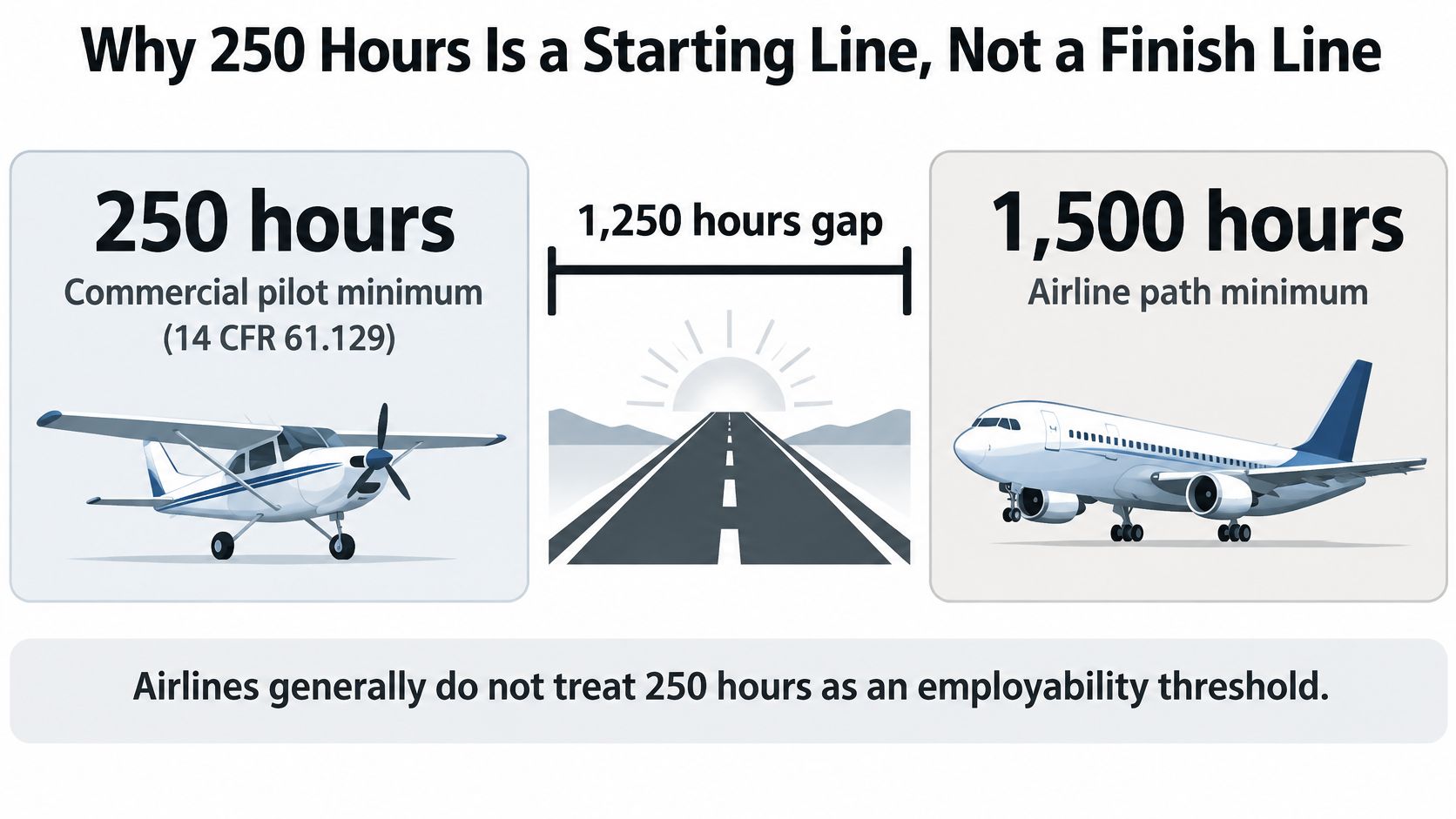
Think of the commercial certificate as a driver's license and your accumulated experience as the driving record an employer examines. The certificate establishes privileges. Employers still evaluate whether your experience fits their operation, aircraft, insurance requirements, and hiring standards.
Certification isn't the same as employability
The FAA's airline-pilot qualification rule describes the standard 1,500-flight-hour ATP threshold, subject to exceptions, including restricted-privileges pathways for graduates of qualifying aviation degree programs at authorized institutions. A restricted ATP isn't an automatic benefit of attending any school that offers aviation courses. Eligibility depends on the qualifying program and the applicant's circumstances.
An airline also evaluates more than a logbook total. Recent flying, relevant aircraft experience, interview performance, and the ability to explain sound operational decisions all matter. Reaching a regulatory threshold doesn't require an employer to offer you a position.
Practical rule: Buy training for the qualification it produces, then evaluate the experience-building plan separately.
Before enrolling, request these measurements:
- Hours by qualification: Ask for the planned logbook position when each certificate or rating is completed.
- Aircraft versus device time: Separate actual aircraft flight from simulator or training-device entries.
- Post-training utilization: Request the expected monthly accumulation rate and the assumptions behind it, including access to aircraft and students.
Use the airline-pilot pathway guide to organize those milestones. A fast training schedule is useful only if you understand what remains after graduation and how you'll support yourself while completing it.
How Simulator Hours Count Toward Your Logbook
A simulator lets you rehearse an approach, pause to discuss an error, and repeat the procedure without operating an aircraft. Training value and regulatory credit aren't the same thing, though. An effective practice session doesn't automatically satisfy a flight-experience requirement.
The FAA's guidance on simulator use and time credits explains that credit requires an approved device and authorized instruction, with applicable approval documentation governing its use. Aviation training device entries generally belong in the permitted categories of total time, instrument time, and instruction received, not indiscriminately in aircraft-flight columns.
Which requirements simulator time can satisfy
| Requirement | Can simulator time count? | What to verify |
|---|---|---|
| Commercial total time, 250 hours | Up to 50 hours in an authorized full-flight simulator or flight training device under §61.129 | Device qualification and matching airplane class and type |
| Instrument training | Yes, within applicable limits, using an approved device and authorized instructor | Device approval, instructor authorization, and rating-specific limits |
| Cross-country and solo requirements | No, these require aircraft flight | Aircraft logbook entries |
| Abnormal and emergency procedures | Strong training value; credit requires applicable approval | Syllabus identifies credited hours and practice-only sessions |
A full-flight simulator, a flight training device, and an aviation training device aren't interchangeable regulatory categories. The commercial credit allowance in the table doesn't mean every desktop trainer qualifies for that allowance.
Simulators are particularly useful for instrument procedures, cockpit flows, navigation workload, and abnormal-event practice. An instructor can introduce a failure at a useful teaching moment without exposing an aircraft and its occupants to the same operational risk.
Check the credit before counting the hours
- Request the documentation. Obtain the applicable qualification documents, Letter of Authorization, and approval guide.
- Match hours to requirements. Have the school identify which sessions satisfy which certificate or rating requirements.
- Inspect the logbook treatment. Confirm how entries appear in the electronic logbook and how aircraft time remains distinguishable.
Say a syllabus includes a substantial simulator component. Ask which sessions provide regulatory credit and which provide additional practice. Practice-only time can still be worthwhile, but it shouldn't be sold as unrestricted flight experience.
The guide to FAA-approved flight simulators can help you ask more precise questions about device categories and approvals.
Instructing as the Bridge to Airline Hours
An instructor certificate creates a possible bridge between paying for training and getting paid to fly. For a new instructor, the pace of completed flying each month matters more than how quickly the instructor checkride was finished, so ask how students get assigned, how many each instructor carries, and what a typical monthly schedule looks like after cancellations.
FAA certificate figures summarized in this pilot hiring outlook show flight-instructor certificates increasing from 11,444 in 2024 to 12,961 in 2025, while initial ATP certificates declined from 11,218 in 2023 to 7,714 in 2025. Those figures don't measure an individual graduate's prospects, but they challenge the assumption that producing more instructors automatically produces an equally fast flow of airline-qualified pilots.
The checkride itself tests a different skill from the ones you trained to earn it. Expect to explain a stall recovery three different ways to a student who keeps making the same error, then sit quietly while they fly far enough into the next mistake to learn from it.

Calculate the remaining hours, not the headline target
Treat this as an accumulation exercise rather than a graduate forecast, and count only productive hours: completed lessons that become logged flight time. Accumulating an entire 1,500-hour block at 40 productive hours monthly takes 37.5 months, roughly three years. At 20 productive hours monthly, the same block takes 75 months, more than six years.
You won't start from zero, so subtract the eligible hours you already hold before dividing by a realistic monthly figure. Build that figure on completed instructional flying rather than scheduled appointments, because weather, maintenance, student cancellations, examiner delays, and instructor turnover all cut into it. Neither calculation includes hiring delays.
A booked lesson isn't a logged hour, and a logged hour doesn't describe everything you learned.
Ground instruction adds teaching experience and income without adding aircraft flight time. When you weigh an instructing offer, evaluate the work itself:
- Relevant experience: Will you teach navigation, instrument procedures, and sound decision-making, rather than merely repeat familiar local flights?
- Consistent access: Are student assignments and aircraft bookings sufficient to support the projected schedule?
- Written employment terms: What compensation, scheduling conditions, and responsibilities apply?
The flight-instructor requirements guide helps separate qualification from employment. An accelerated syllabus can shorten certificate completion without shortening the paid-flying bottleneck.
If a provider advertises an instructing guarantee, read the obligation precisely. It should state paid hours, compensation, scheduling conditions, and what happens when student demand falls short. Confirm in writing whether the offer promises paid instructing time or only scheduling help and introductions to prospective students.
Career Services and Placement Claims to Verify
A school can help you prepare for employment. It can't control an airline's hiring decisions. Resume reviews, logbook checks, interview preparation, employer introductions, and scheduling assistance are useful services, but services aren't placement guarantees.
AOPA's report on normalizing pilot demand states that major U.S. airlines hired 2,190 pilots during the first six months of 2025 and reports the Government Accountability Office's finding that nine airlines hired just over 4,000 pilots in 2024, following about 22,600 across 2022 and 2023. The report also discusses approximately 5,000 annual major-airline hires as a potentially healthier market level, not an individual employment forecast.
At CFII, we facilitate introductions and scheduling between flight instructors and student leads. We don't guarantee that a lead will result in booked or completed training, income, or any particular outcome.
Build alternatives before you need them
Consider regional airlines, charter operations under Part 135, cargo, aerial survey, and other commercial flying. Each has its own qualifications and operational demands.
- Application progress: Track suitable openings and applications submitted.
- Interview readiness: Keep records organized and practice explaining operational decisions.
- Aircraft qualifications: Identify gaps between your credentials and target roles.
- Financial runway: Decide how you'll cover expenses if hiring takes longer than expected.
For any placement percentage, request its source year, definition, measurement window, and whether it counts paid flying, accepted offers, or introductions. Without those details, the figure doesn't tell you what a graduate achieved.
Fixed-Price Tracks Compared with Other Routes
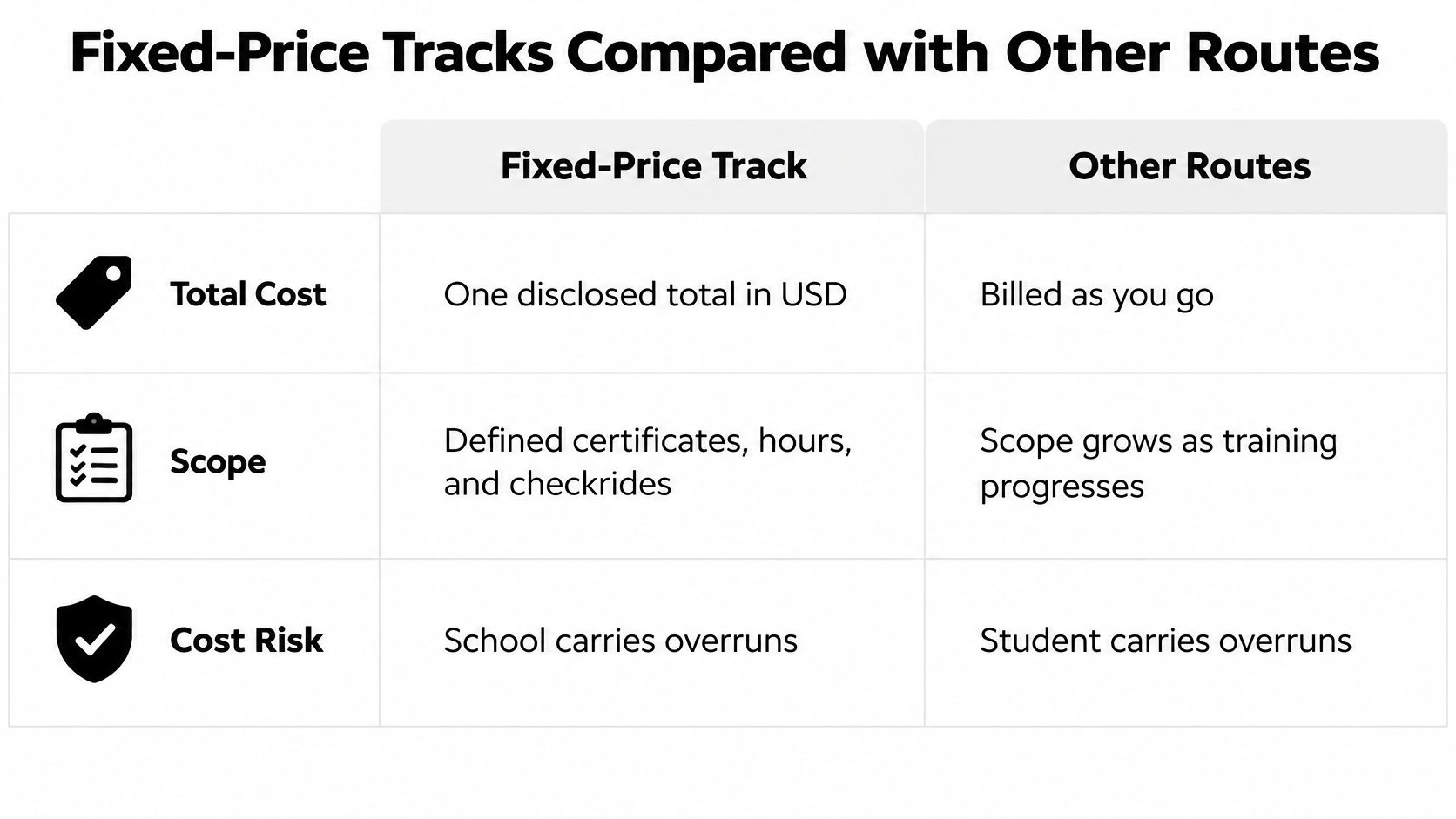
A tuition figure is useful only when the contract identifies the included instruction, aircraft hours, qualifications, tests, and treatment of additional training. Two schools can quote similar totals and deliver very different scope, so read the coverage before comparing the price.
Scope risk shows up in arithmetic. Under pay-per-hour billing, every extra lesson lands on the student: ten additional hours at a $200-per-flight-hour rate add $2,000, and a failed checkride can mean remedial flying plus another exam attempt. Under a fixed tuition, the school absorbs training inside the written coverage, while hours or retests outside it revert to the student. A degree route adds an academic program and a multi-year calendar to the same flight-training question.
The comparison illustrates payment structures, but the written agreement determines who carries overrun risk.
Training routes compared on the same criteria
| Route | How you pay | Pace | Who sets the hours | Main risk |
|---|---|---|---|---|
| Fixed-price accelerated track | One disclosed tuition for defined items | Compressed, full-time schedule | School syllabus, subject to required proficiency | Excluded expenses and hours beyond contractual coverage |
| Pay-as-you-go lesson track | Per lesson or per hour | Your schedule; interruptions can slow progress | You and your instructor within regulatory requirements | Stalled progress raises total cost |
| Aviation degree with flight training | Tuition plus flight costs | Multi-year academic calendar | Academic plan and flight school | Longer commitment and combined academic and flying costs |
| Part 141 approved school | School-specific hourly or package billing | Structured, approved syllabus | Approved syllabus and individual progress | Less freedom to depart from the approved sequence |
These categories overlap. A university can operate an approved flight curriculum, and an accelerated program can run under a particular regulatory framework. Part 141 describes an FAA-approved syllabus, and a school can bill it hourly, by package, or under a single tuition.
Score each route against your available time, financial resources, academic goals, and the qualification it finishes at. A route that ends at the commercial certificate leaves the holder near the 250-hour minimum with hours still to build, while a route that continues into instructing addresses that gap inside the program. If you need to keep working while learning, schedule flexibility may outweigh speed. If you're ready for intensive training, consistent availability may make a structured route more practical.
Contract check: Never assume that fixed tuition means unlimited flying, included living expenses, or automatic coverage of retests.
Use the commercial pilot training cost guide to organize a written comparison. Include living costs, equipment, interruptions, and the period between graduation and dependable flying income alongside the advertised tuition.
How to Evaluate a Program Before You Enroll
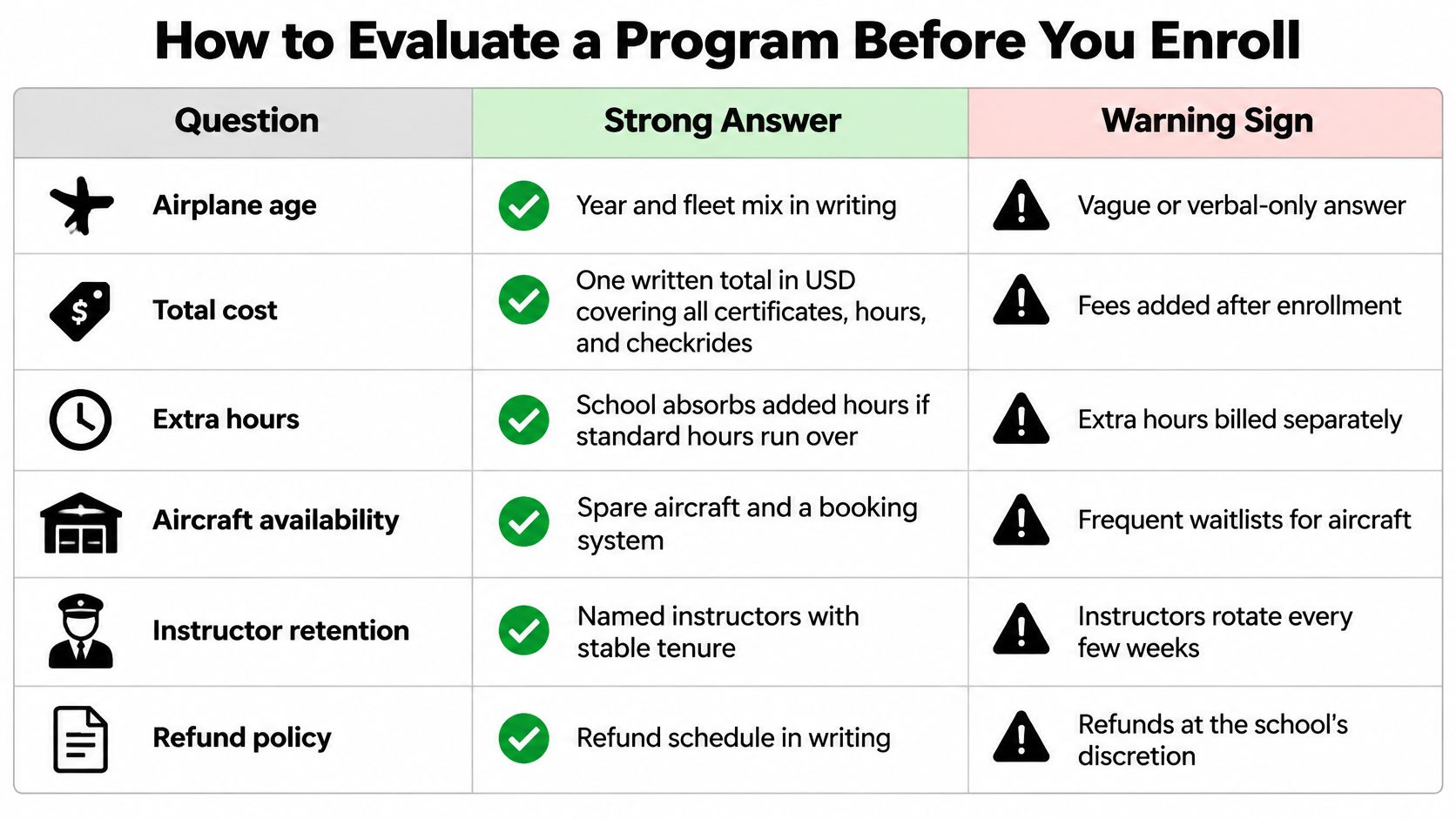
Evaluate a professional pilot program as both a training operation and a substantial financial commitment. At CFII, we recommend asking every school, including us, about airplane age, students per airplane, instructor turnover, written pricing, regulatory structure, and whether you can fly before committing.
Use this checklist to keep the conversation specific.
Questions to ask any professional pilot program
| Question to ask | Strong answer | Warning sign |
|---|---|---|
| Airplane age | Year and fleet mix stated in writing | Vague answer or no year given |
| Students per airplane | Stated ratio and explanation of bookings | No ratio; unexplained waiting |
| Instructor turnover | Departures during the past year, with reasons | Frequent unexplained instructor changes |
| Total price in writing | Itemized inclusions and exclusions | Verbal-only quotation |
| Part 61 or Part 141 | Clear explanation of framework and scheduling | Program type not disclosed |
| Fly before committing | Opportunity to fly before making the full commitment | Pressure to pay before flying |
| Medical timing | Clear advice about certification before solo | No medical discussion before tuition payment |
Aircraft age alone doesn't establish safety or reliability. Ask about maintenance practices, dispatch availability, and substitute aircraft, too. Likewise, a fleet count means little without knowing how many students and instructors compete for those airplanes.
Test the fit before committing
A discovery flight gives you a practical introduction to the cockpit, an instructor's communication style, and your response to flying. Notice whether the instructor explains clearly, invites questions, and discusses workload openly. You don't need to arrive knowing aviation terminology.
This introductory video can accompany your preparation for a conversation with a school.
For the standard student-pilot route, obtain a third-class FAA medical certificate from an aviation medical examiner before solo flight. You can take a discovery flight and initial lessons before obtaining it, but don't postpone medical questions until after making a substantial training commitment.
Screen for your intended career
The FAA's medical-class guidance distinguishes third-class certification for private-pilot operations, second-class certification for commercial operations, and first-class certification for exercising ATP privileges; its first-class standards include 20/20 or better distant vision in each eye, with or without correction, and generally 20/40 or better near vision.
For an airline goal, a first-class medical examination is a sensible early screen. Disclose your health history accurately, and discuss potentially significant conditions or medications with an aviation medical examiner before assuming eligibility.
Use the flight-school selection guide to document your comparisons. Complete the medical screen and an introductory flight before committing to the full program, then obtain the tuition terms, exclusions, additional-hour policy, and refund schedule in writing.
Confirm the Order Before You Enroll
Choose a route by what it produces, in sequence: certificate privileges, logbook credit that counts toward the next step, paid flying that bridges to airline minimums, and employment claims you can verify. The right purchase is the sequence that fits your goal, paced so a 250-hour commercial minimum becomes the first rung of paid experience, with the endpoint set by airline minimums.
- Set the destination. Private flying, professional instruction, and an airline career require different commitments.
- Match the route. Flexible lessons can suit personal flying; a defined career track can suit an instructor goal; a qualifying degree may support a restricted-ATP pathway.
- Check the credit order. Ask which hours are airplane, simulator, dual, solo, and multi-engine, and which certificates each block leads to next.
- Verify the commitment. Complete the operational checklist, introductory flight, and medical screening, then obtain the total price, exclusions, additional-hour policy, refund schedule, and a written list of excluded expenses before the first payment.
For a full zero-to-CFII path, CFII's Career Track has fixed $89,000 tuition, takes about nine months, and includes 282 total hours across six certificates and ratings. It runs in Southern California at Riverside, Long Beach, and Corona, and its First Milestone Guarantee lets a student discontinue before about 20 hours and pay only logged flight time at $200 per flight hour, with additional payments refunded.
If you haven't flown yet, start with a discovery flight. Before any deposit, ask for the same order in writing: credential, credited experience, paid-flying bridge, then placement support.
Visit CFII to discuss your starting point and clarify the written scope before committing.
Planning to fly for a living?
See what the path from zero to a pilot career looks like, what it costs and how long it takes.
Learn to fly in Riverside
We train at Riverside Municipal Airport in factory-new airplanes with a parachute built in. Start with a one hour discovery flight, no experience needed.