
On this page
- Flight Instructor Requirements at a Glance
- Read the columns as prerequisites and additions
- Turn the table into an evidence checklist
- Eligibility Gates You Must Clear First
- Start with age and communication
- Establish the correct pilot qualification
- Bring proof rather than assumptions
- Commercial Certificate and Flight Time Milestones
- Total time doesn't replace specific experience
- Avoid adding every minimum together
- Tests and Endorsements in Order
- Follow the certification sequence
- Prepare to teach rather than narrate
- Audit the endorsement and its supporting records
- CFII Add-On Requirements
- Build the instrument teaching qualification
- Keep the privilege within its scope
- Medical Certificate Rules for Students and Instructors
- Paid instruction isn't automatically a commercial medical operation
- Arrange the medical early in training
- Recurrent Requirements and Staying Legal to Teach
- Respect the rolling flight-training limit
- Confirm the Path Before You Commit
- Choose the next step that matches your starting point
If you pass the flight instructor checkride, are you automatically legal to teach for the rest of your career? No. Earning an instructor certificate and keeping its privileges usable are separate responsibilities, and a good training plan accounts for both.
For someone starting with little or no flight time, FAA flight instructor requirements can look like a collection of unrelated certificates, tests, and hour totals. They make more sense when you separate the prerequisites, the instructor qualification itself, and the rules that govern your work afterward.
Flight Instructor Requirements at a Glance
Which document proves each flight instructor requirement is met? Use the overview below to connect the eligibility rules with the certificates, logbook records, tests, and endorsements that support them.
| Requirement | CFI (airplane) | CFII add-on | Regulation |
|---|---|---|---|
| Minimum age | 18 years old | Same | 14 CFR 61.183 |
| English proficiency | Read, speak, write, and understand English | Same | 14 CFR 61.183 |
| Base certificate | Commercial or ATP certificate with appropriate airplane category and class | Same | 14 CFR 61.183 |
| Instrument rating or privileges | Required for airplane instructor applicants | Required, plus qualification for instrument instructor privileges | 14 CFR 61.183 |
| Pilot-in-command time | 15 hours in the category and class sought | Applicable category and class requirement | 14 CFR 61.183 and FAA guidance |
| Fundamentals of Instructing | Required training and endorsement; knowledge test unless an exception applies | Generally not repeated for an existing flight instructor | 14 CFR 61.183 |
| Flight instructor knowledge test | Appropriate airplane instructor knowledge test within its validity window | Instrument instructor knowledge test, as applicable | 14 CFR 61.183 |
| Practical test endorsement | Authorized instructor endorsement documenting proficiency and timely preparation | Endorsement covering instrument instruction | 14 CFR 61.187 and applicable practical-test prerequisites |
| Medical certificate | Depends on whether you're acting as PIC or a required crewmember | Same activity-based analysis | 14 CFR 61.23 |
| Recent experience | Qualifying pathway completed within the preceding 24 calendar months | Same | 14 CFR 61.197 |
The certificate-eligibility and training entries summarize 14 CFR Part 61, Subpart H. Medical rules depend on the role you perform during a flight. Recent experience concerns whether you can continue using instructor privileges after earning the certificate.
Read the columns as prerequisites and additions
CFI means certificated flight instructor. CFII is the commonly used abbreviation for an instructor with instrument instructor privileges. In the add-on pathway described here, you earn the airplane instructor qualification first, then demonstrate that you can teach instrument flying.
The CFI column shows the airplane instructor baseline. The CFII column lists instrument-specific additions while retaining the underlying pilot credentials, experience, training, and endorsement requirements. The medical row calls for a separate check because the applicable rule depends on your role during the flight. The Fundamentals of Instructing knowledge test also has regulatory exceptions.
The 24-calendar-month window is a recency period, not an expiration date printed on the certificate. For example, the date of a qualifying practical test or other qualifying activity can serve as evidence that the recent-experience requirement was met. Check the applicable records and pathway for your situation.
Turn the table into an evidence checklist
Make a working copy and record the evidence for each item:
- Certificates and ratings: Identify the qualifications shown on your pilot and instructor certificates.
- Experience: Match logbook entries to the required aircraft category and class.
- Training and tests: Keep endorsements and test reports together, and record the planned practical-test date.
- Ongoing compliance: Track recent-experience evidence separately from your original certification records.
Identify the certificate, logbook entry, test report, or endorsement that supports each row. Use the table to organize your records, then check the current regulation for the requirements that apply to your application and instructor privileges.
Eligibility Gates You Must Clear First
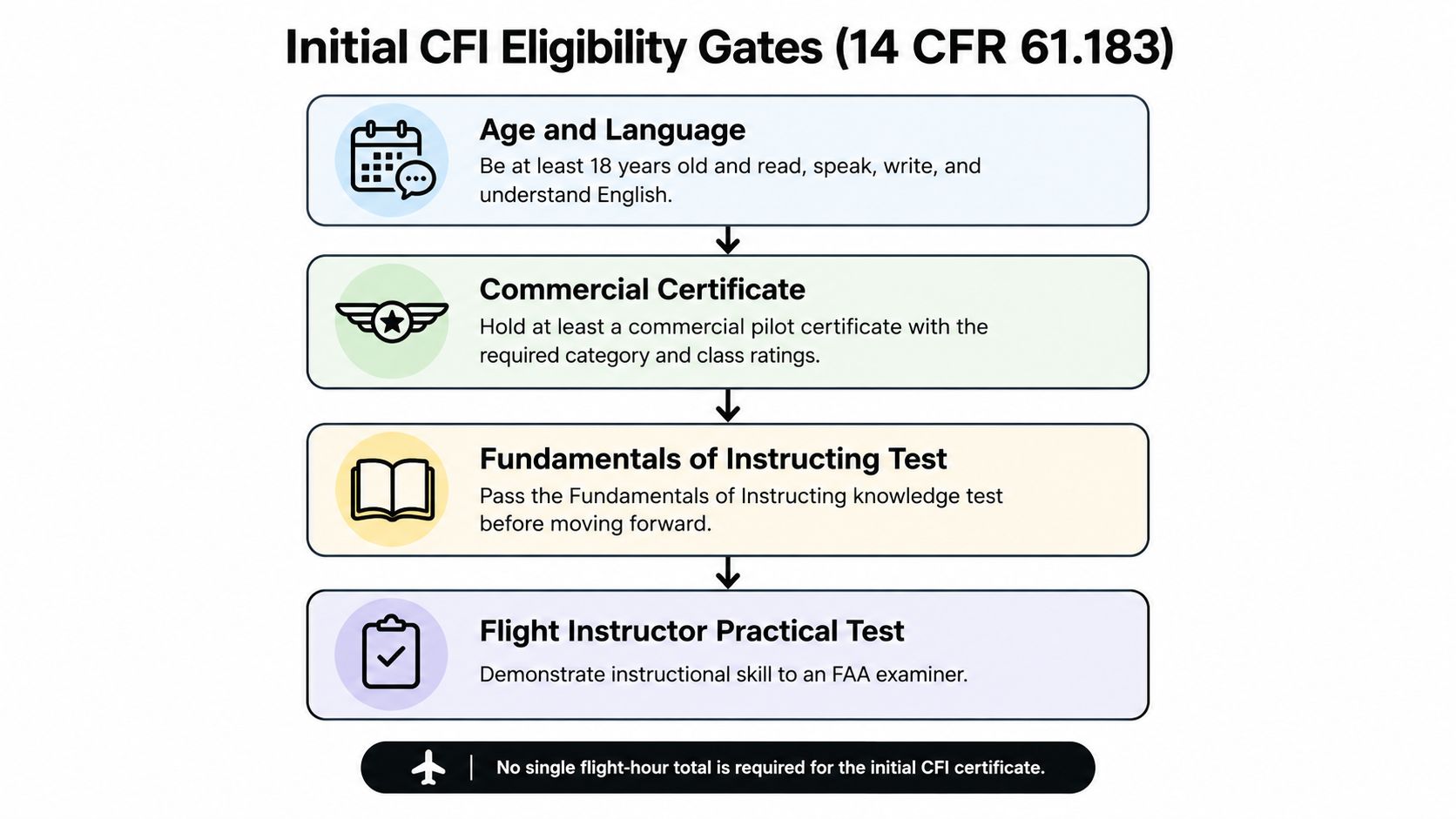
The FAA doesn't prescribe one standalone total-flight-time number that qualifies every initial CFI applicant. Instead, it requires a combination of pilot qualifications, aircraft-specific experience, instructor training, tests, and endorsements.
Think of the usual career-training sequence as a ladder: private pilot, instrument rating, commercial pilot, CFI, then CFII. That's a useful program sequence, not a statement that every credential must always be earned in precisely that order.
Start with age and communication
You must meet the age requirement when applying for the instructor certificate. For example, a younger pilot who has already soloed and earned a private certificate can continue progressing through training, but can't receive the instructor certificate before meeting the eligibility age.
English proficiency means more than memorizing radio calls. An instructor needs to explain an unfamiliar concept, understand a student's question, and communicate a correction clearly. During certification, the evaluator must be satisfied that you meet the language requirement.
Use this diagram as a broad orientation to the eligibility and testing progression.
Establish the correct pilot qualification
A private pilot certificate isn't enough. You need a commercial pilot certificate or airline transport pilot certificate, with the appropriate category and class for the instructor rating sought.
An ATP satisfies the base-certificate alternative. An ATP holder doesn't need to obtain a separate commercial certificate merely to satisfy that particular instructor eligibility requirement.
Category and class deserve careful attention. An airplane qualification isn't interchangeable with a helicopter qualification, and a single-engine airplane rating isn't the same as a multiengine airplane rating. Your existing credentials must match the instructional authority you're seeking.
For airplane instructor applicants, the instrument qualification is also a prerequisite. A commercial pilot who lacks the applicable instrument privileges hasn't completed the eligibility package just because the planned lessons will take place in visual conditions.
Planning principle: Work backward from the instructor rating you want, then verify that your pilot certificate, ratings, and logbook support that exact application.
Bring proof rather than assumptions
Before committing to final instructor preparation, assemble:
- Your airman certificate: Confirm the commercial or ATP qualification and aircraft ratings.
- Instrument qualification records: Check the applicable certificate ratings and supporting records. A collection of instrument lessons alone isn't an instrument rating.
- Your training history: Organize the experience and endorsements that your recommending instructor and evaluator will need.
- Application readiness: Resolve language or certificate discrepancies before scheduling the practical test.
This isn't just paperwork preparation. Reviewing these records early helps you distinguish a missing qualification from a skill you can improve during ordinary instructor training.
Commercial Certificate and Flight Time Milestones
| Requirement | Number | Rule or note |
|---|---|---|
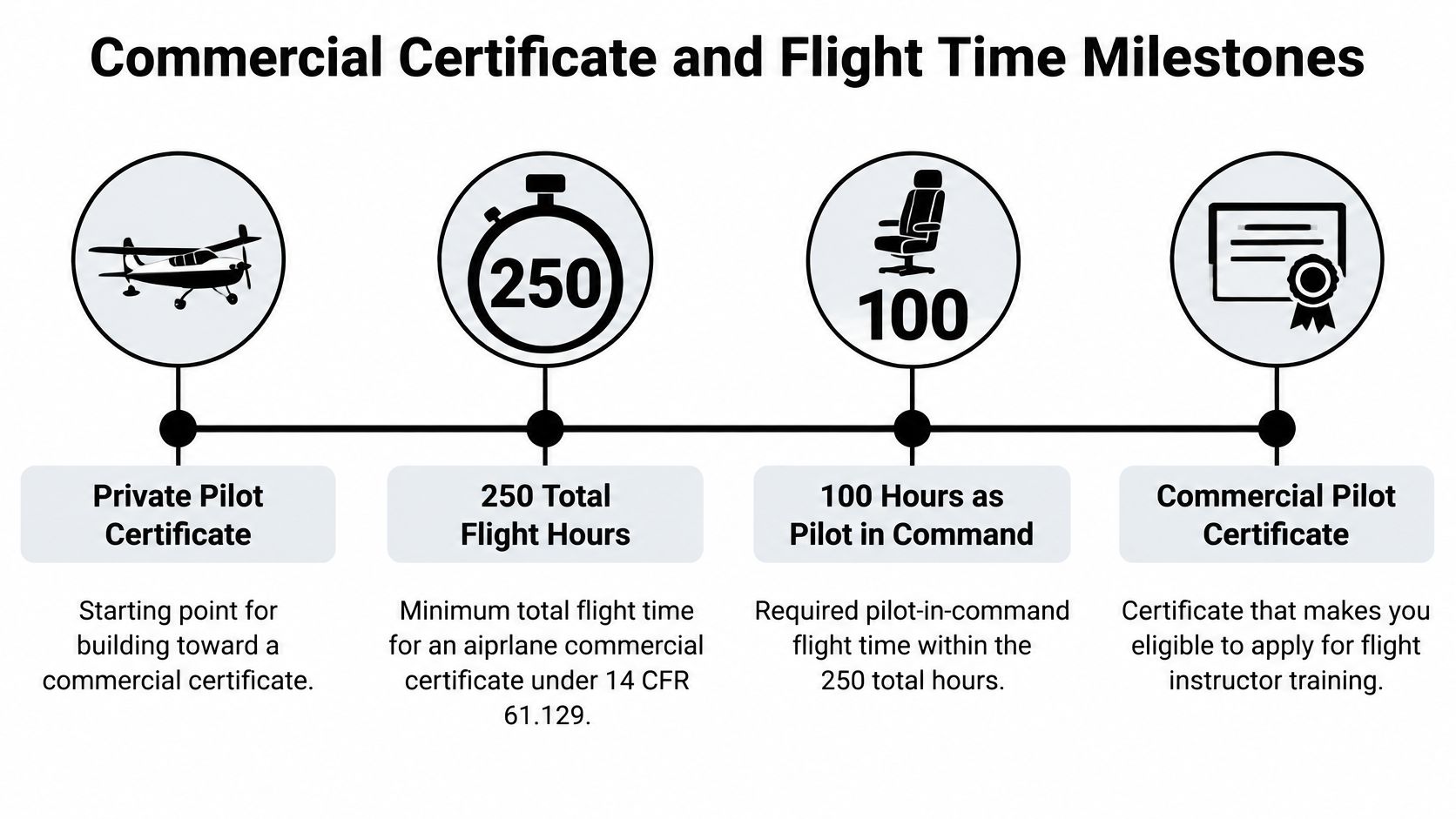
| Commercial airplane single-engine certificate, total time | 250 flight hours under the general Part 61 route | 14 CFR 61.129; certain approved-course pathways differ |
| Commercial PIC time, within that total | 100 hours as PIC, with required experience components | 14 CFR 61.129 |
| Instrument rating experience | 40 hours of actual or simulated instrument time, including required instruction | 14 CFR 61.65; not all of this is necessarily dual instruction |
| PIC time for the instructor rating | 15 hours in the category and class sought | 14 CFR 61.183 and FAA guidance |
The commercial and instrument experience requirements appear in the applicable sections of Part 61. The FAA separately reiterates the 15-hour category-and-class PIC requirement in its pilot certification and endorsement guidance.
Total time doesn't replace specific experience
For the general commercial airplane single-engine pathway, the total-hour requirement includes other prescribed experience. Cross-country flying, night operations, instrument experience, and practical-test preparation aren't interchangeable entries that you can replace with undirected local flying.
Consider a hypothetical applicant whose logbook exceeds the commercial total-time minimum but falls short of the commercial PIC requirement. That applicant still isn't eligible. The correct question is not just how much time they've logged, but what kind of time it is.
The same reasoning applies to instructor eligibility. PIC time in a multiengine airplane doesn't automatically satisfy the single-engine class requirement. Helicopter or glider time doesn't become airplane PIC time because it appears in the same logbook.
This visual highlights the commercial milestones, although the total and PIC requirements must be satisfied together rather than treated as independent training stages.
Avoid adding every minimum together
These aren't necessarily separate blocks of hours to add on top of one another. A properly logged flight can contribute to total time while also satisfying a more specific experience requirement.
Likewise, don't describe the instrument requirement as entirely instructor-provided training. The rule distinguishes actual or simulated instrument time from the instruction that must be included within it.
For a beginner, the practical solution is to maintain an experience audit alongside the training syllabus. Track total time, PIC, aircraft class, instrument experience, and the required flight characteristics separately.
Our explanation of the different types of pilot licenses and ratings can help you place each qualification in context. Regulatory minimums establish eligibility. They don't establish that you're ready for every teaching assignment, and they don't promise airline employment.
Tests and Endorsements in Order
| Test | What it covers | Timing rule |
|---|---|---|
| Fundamentals of Instructing knowledge test | Teaching principles, learning theory, and student evaluation | Confirm applicable requirements and any exemption with your recommending instructor |
| Airplane flight instructor knowledge test | Aeronautical and instructional knowledge for airplane instructors | Must satisfy the applicable knowledge-test validity window |
| Airplane CFI practical test | Required knowledge, flying proficiency, risk management, and instructional ability | Required training and endorsements must be current and complete |
The FAA's cited airplane flight instructor practical-test guidance describes the knowledge-test window as beginning in the 24th month before the practical-test month, and requires an endorsement confirming preparation within the preceding 60 days. Check those prerequisites against the current standards and regulations before scheduling, rather than assuming an older document is the controlling test standard (FAA airplane flight instructor practical-test guidance).
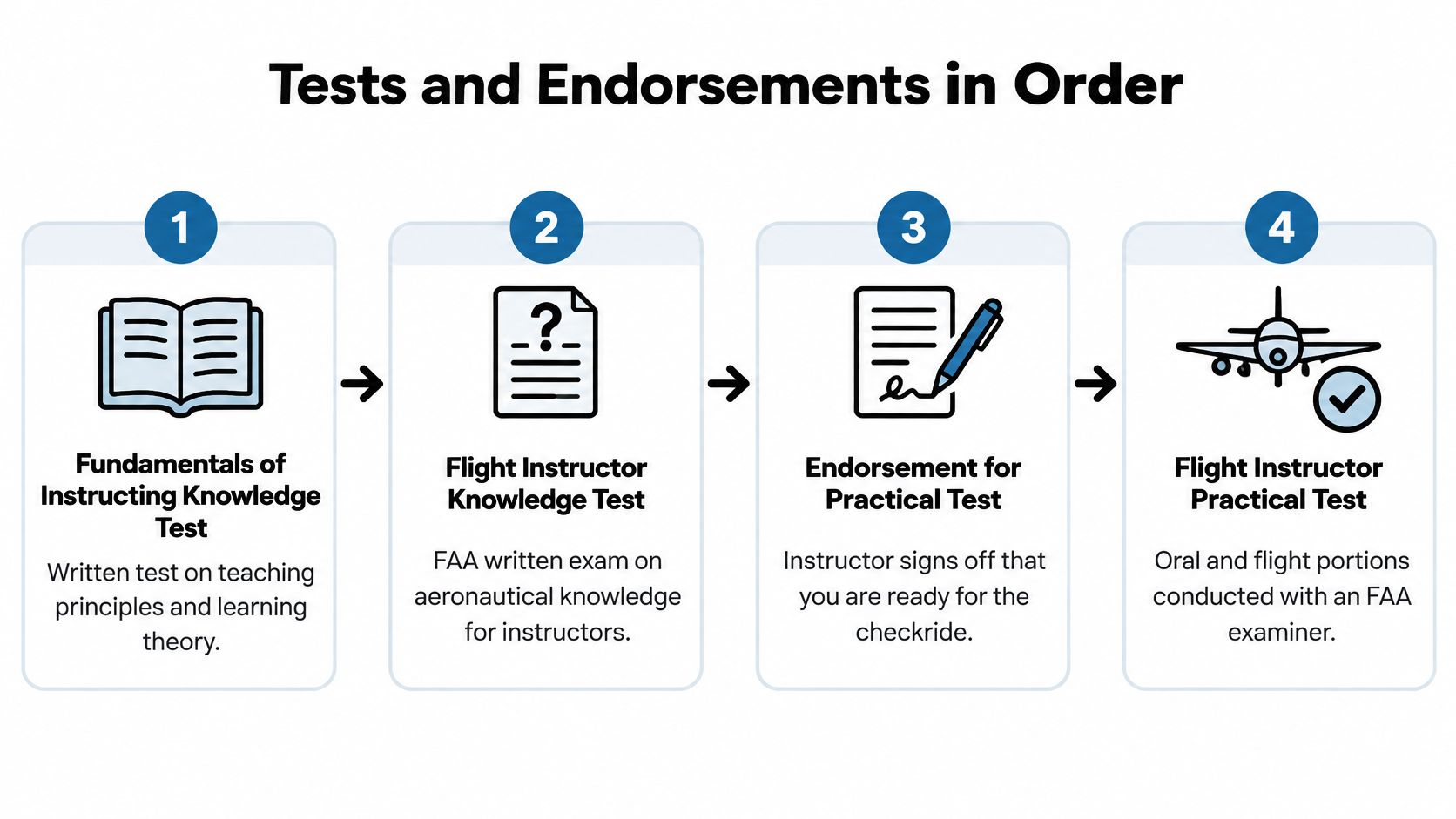
The sequence below separates knowledge testing from the training and signoffs that make you eligible for the practical test.
Follow the certification sequence
Complete the Fundamentals of Instructing requirements. Unless an exception applies, pass the FOI knowledge test. Your instructor must also address the required fundamentals-of-instructing training and endorsement. Passing a test and receiving a training endorsement aren't the same event.
Pass the airplane instructor knowledge test. Prepare to understand and explain the material, not merely recognize an answer. Retain the test report and review its validity against your anticipated practical-test date.
Receive and log instructor-specific ground and flight training. Under 14 CFR 61.187, an authorized instructor must train you in the applicable areas of operation. Personal practice flights and independent study can support preparation, but they don't replace required logged instruction.
Obtain the applicable practical-test endorsements. Your authorized instructor must certify that you've demonstrated the required proficiency. Confirm that the endorsements cover your actual application and remain valid for the scheduled test.
Take the practical test. You'll need to demonstrate instructional competence as well as personal flying skill. For the add-on pathway, instrument instructor preparation adds its own applicable training, knowledge testing, and practical evaluation.
This is the core sequence, not permission to ignore other application-specific endorsements. Review the entire eligibility package with an instructor qualified to prepare initial instructor applicants.
Prepare to teach rather than narrate
A pilot can perform a maneuver correctly without being ready to teach it. An instructor applicant needs to organize the explanation, identify the learning objective, demonstrate appropriately, and recognize what a student is misunderstanding.
For example, talking continuously through a maneuver isn't necessarily useful instruction. A clearer approach is to explain what the learner should notice, demonstrate it, then check whether the learner recognized the intended cues.
Practice ground lessons out loud. Ask your instructor to interrupt with beginner questions, incomplete answers, or a plausible misunderstanding. That gives you a chance to practice adjusting an explanation instead of reciting a memorized presentation.
The accompanying video can serve as supplementary preparation, but it doesn't replace required training or the applicable test standards.
Audit the endorsement and its supporting records
Don't copy a generic statement and assume it makes you eligible. Your instructor should use the applicable endorsement language and confirm that it accurately reflects completed training.
A usable record should identify the applicant, the rating and test involved, the certification being made, and the date. It should also contain the authorized instructor's signature and required instructor-identification information.
Preserve the evidence behind that signature:
- Aircraft category and class: Keep the relevant experience distinguishable.
- PIC and dual received: Don't rely on a single total-time figure.
- Ground training: Record the instruction required for the application.
- Endorsement dates: Check timing against the actual practical-test appointment.
- Knowledge-test reports: Keep the report available and verify its applicability.
A scheduled checkride doesn't make an incomplete application eligible. Check the records before reserving your final preparation flights.
A delayed examiner appointment can change whether your paperwork remains usable. Review the package again if the date moves, particularly when knowledge-test validity or endorsement timing is close.
If you're unfamiliar with the evaluation itself, our guide to what happens during a checkride explains the basic process. The most useful preparation is a coordinated review of your teaching ability, flight proficiency, and application evidence, not a last-minute search for a missing signature.
CFII Add-On Requirements
An instructor needs CFII privileges to teach instrument-rating tasks, such as guiding a student through an instrument approach as part of instrument training. The privilege applies to the instruction being given, so check the scope of the lesson against the instructor ratings held and the limitations in 14 CFR 61.195.
A student's brief use of the flight instruments during other authorized instruction does not, by itself, make the lesson instrument-rating training. The question is whether the lesson involves instruction reserved for an instrument instructor. Our guide to IFR and VFR explains the difference between operating rules and instructor qualifications. A flight in visual conditions can still include instrument training, so weather alone does not determine the instructor authorization needed.
Build the instrument teaching qualification
For the common CFI-to-CFII add-on route, work through these steps:
- Verify your underlying qualifications. Confirm the pilot certificate, instrument qualification, and aircraft ratings required for your application. An instrument-rated private pilot does not meet the base pilot-certificate requirement for instructor certification.
- Complete the applicable knowledge test. Confirm which instrument instructor knowledge test applies to your application and keep the test report.
- Receive instrument instructor training. An authorized instructor must provide the applicable ground and flight training. Practice teaching instrument procedures and recognizing student errors.
- Obtain instrument-specific endorsements. Your endorsements should support the instrument instructor application and certify the required training and readiness for the practical test. An airplane instructor endorsement alone does not establish instrument instructor readiness.
- Pass the CFII practical test. Demonstrate the required instrument knowledge, teaching ability, and flight proficiency.
The practical test evaluates your ability to teach, not merely your own instrument flying. A previous instructor certificate does not replace the instrument-specific training and proficiency demonstration.
Keep the privilege within its scope
An airplane CFI without the appropriate instrument instructor rating cannot provide instruction reserved for that rating. The distinction depends on the lesson's purpose and content, rather than on whether the student references instruments at some point. Apply the instructor limitations in 14 CFR 61.195 to the specific instruction you plan to give.
Medical Certificate Rules for Students and Instructors
| Activity | Medical class or qualification | Under 40 | 40 and older |
|---|---|---|---|
| Discovery flight and dual lessons without acting as PIC or required crew | No medical required for that role | Not applicable | Not applicable |
| Ordinary airplane student solo and private-pilot privileges using a medical certificate | Third class | 60 calendar months | 24 calendar months |
| Paid flight instruction | Payment alone doesn't require a second-class medical; assess PIC and required-crewmember duties | Depends on qualification used | Depends on qualification used |
| Exercising commercial pilot privileges that require a second-class medical | Second class | 12 calendar months | 12 calendar months |
| Operating under BasicMed | Separate eligibility and operating conditions | Check applicable conditions | Check applicable conditions |
These distinctions and medical-certificate durations come from 14 CFR 61.23, available in the current Part 61 regulations. Age for the medical-duration calculation is determined at the examination, and a certificate may remain usable for lower-level privileges after its higher-level duration ends.
Paid instruction isn't automatically a commercial medical operation
A common mistake is assuming that because instructors receive compensation, every paid lesson requires a second-class medical. Compensation for instruction doesn't, by itself, create that requirement.
An instructor acting as PIC or a required pilot crewmember needs the medical qualification applicable to that role. An instructor who is neither acting as PIC nor serving as a required crewmember may instruct without holding a medical certificate, subject to the other applicable rules.
Check the role first: Ask who will act as PIC, whether the instructor is a required crewmember, and which medical qualification supports that operation.
For example, an older instructor doesn't automatically need to renew a second-class medical annually merely because students pay for lessons. If that instructor also conducts operations requiring commercial pilot medical privileges, those separate duties change the analysis.
BasicMed is another possible pathway, but it has its own eligibility and operating limitations. Don't treat it as an unrestricted substitute for every medical certificate or every type of flying.
Arrange the medical early in training
At our school, a third-class FAA medical from an aviation medical examiner is required before solo. You can take your introductory flight and first dual lessons before obtaining it.
That sequence lets a newcomer experience flight training before completing the medical process. Still, if your goal is a career, resolve medical eligibility early rather than committing substantial training funds while leaving a known concern unanswered.
Our FAA medical guidance is a useful starting point for preparation. Confirm your planned activities and current eligibility with the applicable rules and an aviation medical examiner, especially if you have a medical history that may need additional review.
Recurrent Requirements and Staying Legal to Teach
An instructor who misses the recent-experience window must stop exercising instructor privileges until meeting the applicable reinstatement requirements. Under 14 CFR 61.197, instructors must complete a qualifying recent-experience route within the preceding 24 calendar months. The window is measured from qualifying activity, so track the date and evidence for the route you use.
| Recent-experience route | What to verify |
|---|---|
| Practical test or qualifying proficiency evaluation | The test or evaluation qualifies for a rating on your flight instructor certificate |
| Qualifying instructional or evaluation duties | Your duties and the operational setting meet the regulation's conditions |
| FAA-sponsored pilot-proficiency activities | The activity and its documentation meet the regulation's requirements |
If your most recent qualifying practical test falls outside the 24-month window and you have completed no other qualifying activity, check the reinstatement provisions in 14 CFR 61.199 before teaching again. A routine activity that renews recent experience may not satisfy the separate reinstatement requirements after a lapse.
The FAA has updated instructor knowledge-test questions to reflect changes to recent-experience and reinstatement rules. The FAA testing community advisory explains why applicants should check current requirements rather than rely on older descriptions of certificate expiration.

Respect the rolling flight-training limit
Recent experience is one part of staying current. 14 CFR 61.195 also limits a flight instructor to 8 hours of flight training in any consecutive 24-hour period.
For example, lessons taught in the hours before midnight count when checking the limit for a lesson scheduled after midnight, if they fall within the same consecutive 24-hour window. Before accepting another lesson, count all flight training you have provided in that window, including instruction outside your usual school schedule.
Keep records that make compliance straightforward to verify:
- Qualifying method: Record the specific route used to satisfy recent experience.
- Supporting evidence: Retain completion records, test documentation, or other applicable proof.
- Next deadline: Set reminders ahead of the end of the 24-month window.
- Instructional workload: Track flight-training hours across each consecutive 24-hour period.
The CFI renewal and recent-experience guide can help you organize these records. An employer or inspector should be able to follow the evidence without relying on your memory.
Confirm the Path Before You Commit
A sensible enrollment decision starts with your current qualifications, not an advertised completion date. Use this sequence to identify what you need and what a school must explain.
- Check personal eligibility. Confirm that you'll meet the age requirement when applying and that English proficiency won't prevent certification.
- Identify your starting credentials. Separate certificates already held from training merely started. Verify your instrument qualification as well as your base pilot certificate.
- Audit experience by category and class. Count qualifying PIC time rather than relying on the total at the bottom of your logbook.
- Match medical qualification to the activity. Distinguish student solo, acting as PIC while instructing, and other commercial pilot operations.
- Compare schools using consistent questions. We recommend asking every school, including ours, about airplane age, students per airplane, instructor turnover, total price in writing, Part 61 versus Part 141, and whether you can fly before committing.
- Experience a lesson before making the larger commitment. Pay attention to the instructor's explanations and whether you feel comfortable asking basic questions.
Choose the next step that matches your starting point
If you haven't flown, a discovery flight lets you meet an instructor, preflight the airplane together, and take the controls in the air. No prior experience is needed. Treat it as an opportunity to understand the work, not as a test you must already know how to pass.
For readers seeking a complete pathway, our Career Track has fixed $89,000 tuition, takes about nine months from zero time to CFII and multi-engine, and includes 282 total hours and six certificates and ratings. It's based in Southern California, with locations in Riverside, Long Beach, and Corona.
The FAA requirements apply whichever school you choose, subject to the approved training pathway. Choose a program that explains both the evidence needed to earn the qualification and the responsibilities that continue after certification.
CFII offers a Southern California pathway from no flight experience to instrument instructor qualification. Visit CFII to discuss your starting point, review the Career Track, or arrange a first flight before committing to training.
Planning to fly for a living?
See what the path from zero to a pilot career looks like, what it costs and how long it takes.
Learn to fly in Riverside
We train at Riverside Municipal Airport in factory-new airplanes with a parachute built in. Start with a one hour discovery flight, no experience needed.